

Canines
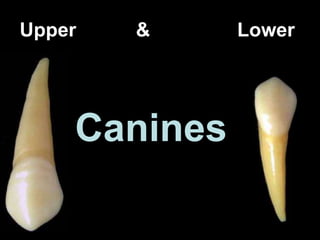
Upper & Lower
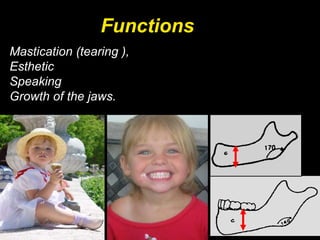
Functions
Mastication (tearing ),
Esthetic
Speaking
Growth of the jaws.
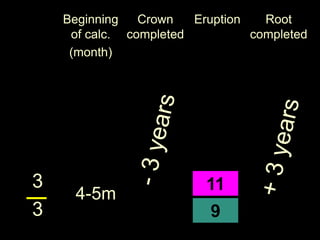
Root
completed
EruptionCrown
completed
Beginning
of calc.
(month)
3
3 9
4-5m
11
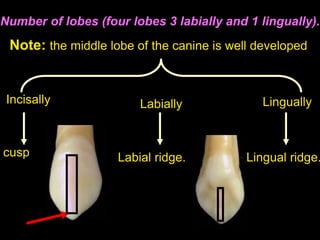
Note: the middle lobe of the canine is well developed
Incisally
cusp
Labially
Labial ridge.
Lingually
Lingual ridge.
Number of lobes (four lobes 3 labially and 1 lingually).
For easy teeth description
We have to speak about :
• Geometric outline of the crown.
• Outlines of the crown and root.
• Surface anatomy of the crown and root
(anatomical landmarks).
Convex Concave
Labial Lingual Mesial Distal
Incisal
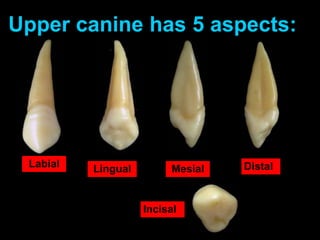
Upper canine has 5 aspects:
Labial Lingual Mesial
Distal
Incisal
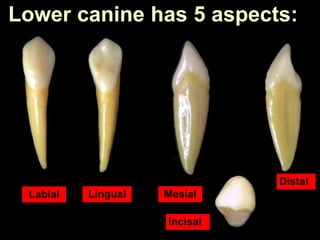
Lower canine has 5 aspects:
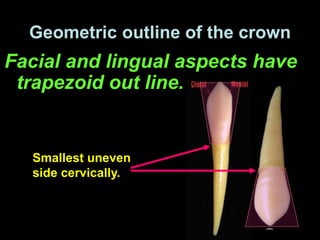
Geometric outline of the crown
Facial and lingual aspects have
trapezoid out line.
Smallest uneven
side cervically.
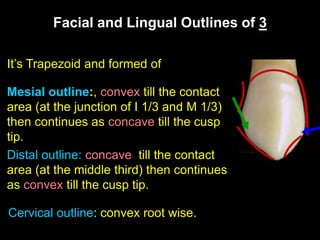
Facial and Lingual Outlines of 3
It’s Trapezoid and formed of
Mesial outline:, convex till the contact
area (at the junction of I 1/3 and M 1/3)
then continues as concave till the cusp
tip.
Distal outline: concave till the contact
area (at the middle third) then continues
as convex till the cusp tip.
Cervical outline: convex root wise.
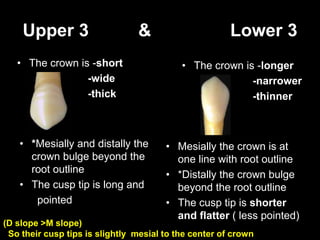
Upper 3 & Lower 3
• The crown is -short
-wide
-thick
• The crown is -longer
-narrower
-thinner
• *Mesially and distally the
crown bulge beyond the
root outline
• The cusp tip is long and
pointed
•
• Mesially the crown is at
one line with root outline
• *Distally the crown bulge
beyond the root outline
• The cusp tip is shorter
and flatter ( less pointed)
(D slope >M slope)
So their cusp tips is slightly mesial to the center of crown
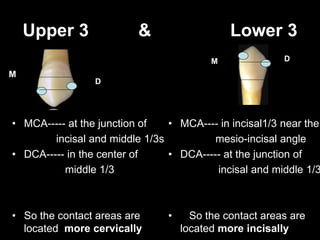
Upper 3 & Lower 3
• MCA----- at the junction of
incisal and middle 1/3s
• DCA----- in the center of
middle 1/3
• So the contact areas are
located more cervically
• MCA---- in incisal1/3 near the
mesio-incisal angle
• DCA----- at the junction of
incisal and middle 1/3
• So the contact areas are
located more incisally
M
M
D
D
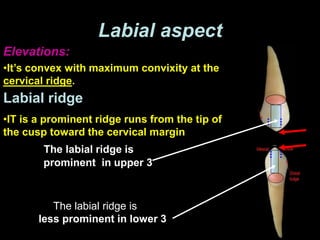
•It’s convex with maximum convixity at the
cervical ridge.
The labial ridge is
prominent in upper 3
Elevations:
Labial ridge
•IT is a prominent ridge runs from the tip of
the cusp toward the cervical margin
Labial aspect
The labial ridge is
less prominent in lower 3
Upper 3 & Lower 3
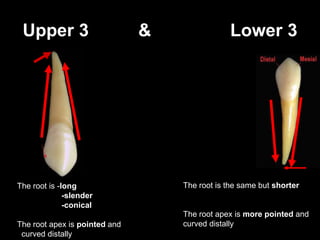
The root is -long
-slender
-conical
The root apex is pointed and
curved distally
The root is the same but shorter
The root apex is more pointed and
curved distally
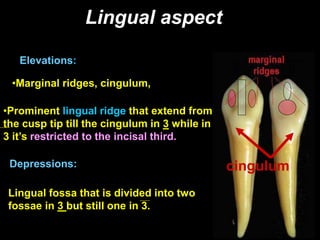
Lingual aspect
Elevations:
•Marginal ridges, cingulum,
cingulum
•Prominent lingual ridge that extend from
the cusp tip till the cingulum in 3 while in
3 it’s restricted to the incisal third.
Depressions:
Lingual fossa that is divided into two
fossae in 3 but still one in 3.
3 3
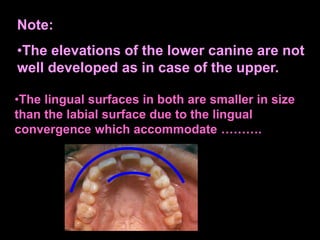
Note:
•The elevations of the lower canine are not
well developed as in case of the upper.
•The lingual surfaces in both are smaller in size
than the labial surface due to the lingual
convergence which accommodate ……….
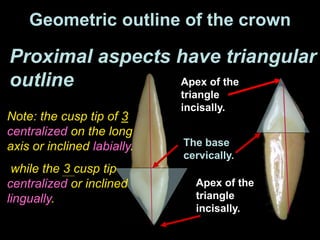
Apex of the
triangle
incisally.
Note: the cusp tip of 3
centralized on the long
axis or inclined labially.
while the 3 cusp tip
centralized or inclined
lingually.
Proximal aspects have triangular
outline
Geometric outline of the crown
The base
cervically.
Apex of the
triangle
incisally.
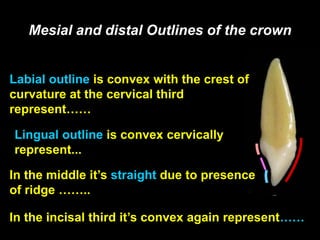
Mesial and distal Outlines of the crown
Labial outline is convex with the crest of
curvature at the cervical third
represent……
Lingual outline is convex cervically
represent...
In the incisal third it’s convex again represent……
In the middle it’s straight due to presence
of ridge ……..
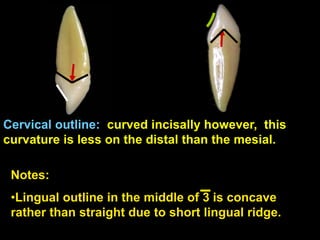
Notes:
•Lingual outline in the middle of 3 is concave
rather than straight due to short lingual ridge.
Cervical outline: curved incisally however, this
curvature is less on the distal than the mesial.
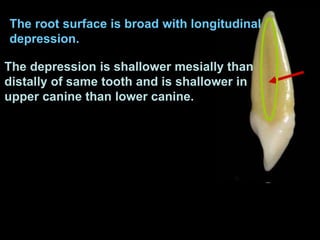
The root surface is broad with longitudinal
depression.
The depression is shallower mesially than
distally of same tooth and is shallower in
upper canine than lower canine.
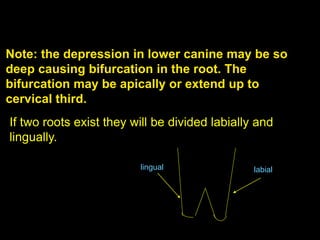
Note: the depression in lower canine may be so
deep causing bifurcation in the root. The
bifurcation may be apically or extend up to
cervical third.
If two roots exist they will be divided labially and
lingually.
labiallingual
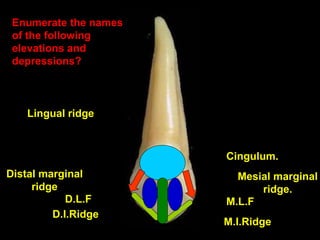
Cingulum.
Mesial marginal
ridge.
Distal marginal
ridge
M.L.FD.L.F
M.I.Ridge
D.I.Ridge
Lingual ridge
Enumerate the names
of the following
elevations and
depressions?
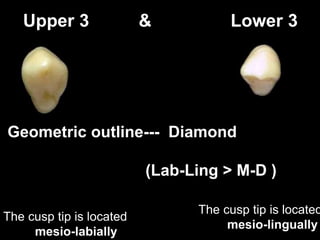
Upper 3 & Lower 3
Geometric outline--- Diamond
(Lab-Ling > M-D )
The cusp tip is located
mesio-labially
The cusp tip is located
mesio-lingually
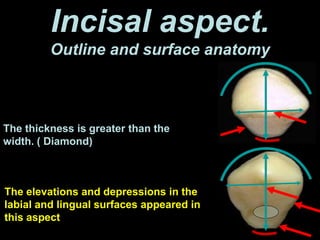
Incisal aspect.
Outline and surface anatomy
The thickness is greater than the
width. ( Diamond)
The elevations and depressions in the
labial and lingual surfaces appeared in
this aspect
3
3
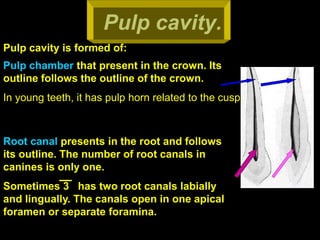
Pulp cavity.
Pulp cavity is formed of:
Pulp chamber that present in the crown. Its
outline follows the outline of the crown.
In young teeth, it has pulp horn related to the cusp
Root canal presents in the root and follows
its outline. The number of root canals in
canines is only one.
Sometimes 3 has two root canals labially
and lingually. The canals open in one apical
foramen or separate foramina.
 canines

canines

  • 2.
  • 3.
  • 4.
  • 5.
    Note: the middlelobe of the canine is well developed Incisally cusp Labially Labial ridge. Lingually Lingual ridge. Number of lobes (four lobes 3 labially and 1 lingually).
  • 6.
    For easy teethdescription We have to speak about : • Geometric outline of the crown. • Outlines of the crown and root. • Surface anatomy of the crown and root (anatomical landmarks). Convex Concave
  • 7.
    Labial Lingual MesialDistal Incisal Upper canine has 5 aspects:
  • 8.
  • 9.
    Geometric outline ofthe crown Facial and lingual aspects have trapezoid out line. Smallest uneven side cervically.
  • 10.
    Facial and LingualOutlines of 3 It’s Trapezoid and formed of Mesial outline:, convex till the contact area (at the junction of I 1/3 and M 1/3) then continues as concave till the cusp tip. Distal outline: concave till the contact area (at the middle third) then continues as convex till the cusp tip. Cervical outline: convex root wise.
  • 11.
    Upper 3 &Lower 3 • The crown is -short -wide -thick • The crown is -longer -narrower -thinner • *Mesially and distally the crown bulge beyond the root outline • The cusp tip is long and pointed • • Mesially the crown is at one line with root outline • *Distally the crown bulge beyond the root outline • The cusp tip is shorter and flatter ( less pointed) (D slope >M slope) So their cusp tips is slightly mesial to the center of crown
  • 12.
    Upper 3 &Lower 3 • MCA----- at the junction of incisal and middle 1/3s • DCA----- in the center of middle 1/3 • So the contact areas are located more cervically • MCA---- in incisal1/3 near the mesio-incisal angle • DCA----- at the junction of incisal and middle 1/3 • So the contact areas are located more incisally M M D D
  • 13.
    •It’s convex withmaximum convixity at the cervical ridge. The labial ridge is prominent in upper 3 Elevations: Labial ridge •IT is a prominent ridge runs from the tip of the cusp toward the cervical margin Labial aspect The labial ridge is less prominent in lower 3
  • 14.
    Upper 3 &Lower 3 The root is -long -slender -conical The root apex is pointed and curved distally The root is the same but shorter The root apex is more pointed and curved distally
  • 15.
    Lingual aspect Elevations: •Marginal ridges,cingulum, cingulum •Prominent lingual ridge that extend from the cusp tip till the cingulum in 3 while in 3 it’s restricted to the incisal third. Depressions: Lingual fossa that is divided into two fossae in 3 but still one in 3. 3 3
  • 16.
    Note: •The elevations ofthe lower canine are not well developed as in case of the upper. •The lingual surfaces in both are smaller in size than the labial surface due to the lingual convergence which accommodate ……….
  • 17.
    Apex of the triangle incisally. Note:the cusp tip of 3 centralized on the long axis or inclined labially. while the 3 cusp tip centralized or inclined lingually. Proximal aspects have triangular outline Geometric outline of the crown The base cervically. Apex of the triangle incisally.
  • 19.
    Mesial and distalOutlines of the crown Labial outline is convex with the crest of curvature at the cervical third represent…… Lingual outline is convex cervically represent... In the incisal third it’s convex again represent…… In the middle it’s straight due to presence of ridge ……..
  • 20.
    Notes: •Lingual outline inthe middle of 3 is concave rather than straight due to short lingual ridge. Cervical outline: curved incisally however, this curvature is less on the distal than the mesial.
  • 21.
    The root surfaceis broad with longitudinal depression. The depression is shallower mesially than distally of same tooth and is shallower in upper canine than lower canine.
  • 22.
    Note: the depressionin lower canine may be so deep causing bifurcation in the root. The bifurcation may be apically or extend up to cervical third. If two roots exist they will be divided labially and lingually. labiallingual
  • 24.
    Cingulum. Mesial marginal ridge. Distal marginal ridge M.L.FD.L.F M.I.Ridge D.I.Ridge Lingualridge Enumerate the names of the following elevations and depressions?
  • 25.
    Upper 3 &Lower 3 Geometric outline--- Diamond (Lab-Ling > M-D ) The cusp tip is located mesio-labially The cusp tip is located mesio-lingually
  • 26.
    Incisal aspect. Outline andsurface anatomy The thickness is greater than the width. ( Diamond) The elevations and depressions in the labial and lingual surfaces appeared in this aspect 3 3
  • 27.
    Pulp cavity. Pulp cavityis formed of: Pulp chamber that present in the crown. Its outline follows the outline of the crown. In young teeth, it has pulp horn related to the cusp Root canal presents in the root and follows its outline. The number of root canals in canines is only one. Sometimes 3 has two root canals labially and lingually. The canals open in one apical foramen or separate foramina.