Dr Ajeet Kumar Khilnani
akk
akk
 Organ of Corti is the sense organ of hearing
 Tunnel of Corti contains cortilymph
Outer hair cells Inner hair cells
Arranged in 3-4 rows Single row
Efferent Afferent in nature
12,000 in number 3500
Cylindrical Flask shaped
Develop late Develop earlier
Modulate inner hair cell
function
Transmit auditory stimuli
Easily damaged by drugs More resistant
akk
akk
akk
 Supporting cells
- Deiters’ cells (situated between outer hair
cells)
- Cells of Hensen lie outside the Deiters’ cells
 Tectorial Membrane
- Gelatinous matrix
- Provides stimulus to hair cells
akk
 Hair cells are innervated by dendrites of
bipolar cells of spiral ganglion situated in
Rosenthal’s canal
 Axons of the bipolar cells form the cochlear
division of 8th nerve and end in the cochlear
nuclei
akk
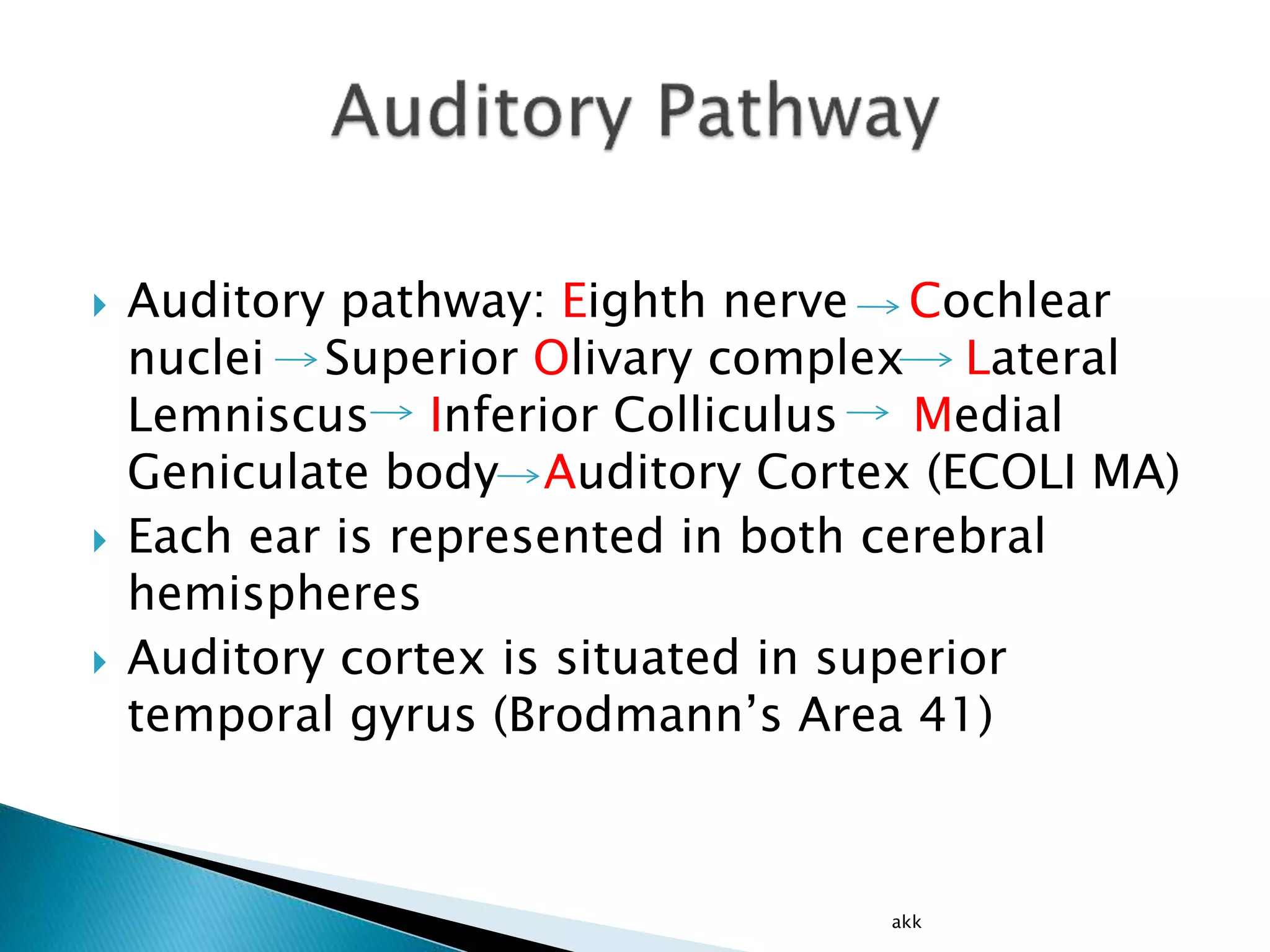
 Auditory pathway: Eighth nerve Cochlear
nuclei Superior Olivary complex Lateral
Lemniscus Inferior Colliculus Medial
Geniculate body Auditory Cortex (ECOLI MA)
 Each ear is represented in both cerebral
hemispheres
 Auditory cortex is situated in superior
temporal gyrus (Brodmann’s Area 41)
akk
akk
 Conductive apparatus (Mechanical conduction
of sound)
 Sensory system of cochlea (Transduction of
mechanical energy to electrical impulses)
 Neural pathways (Conduction of electrical
impulses to the brain)
akk
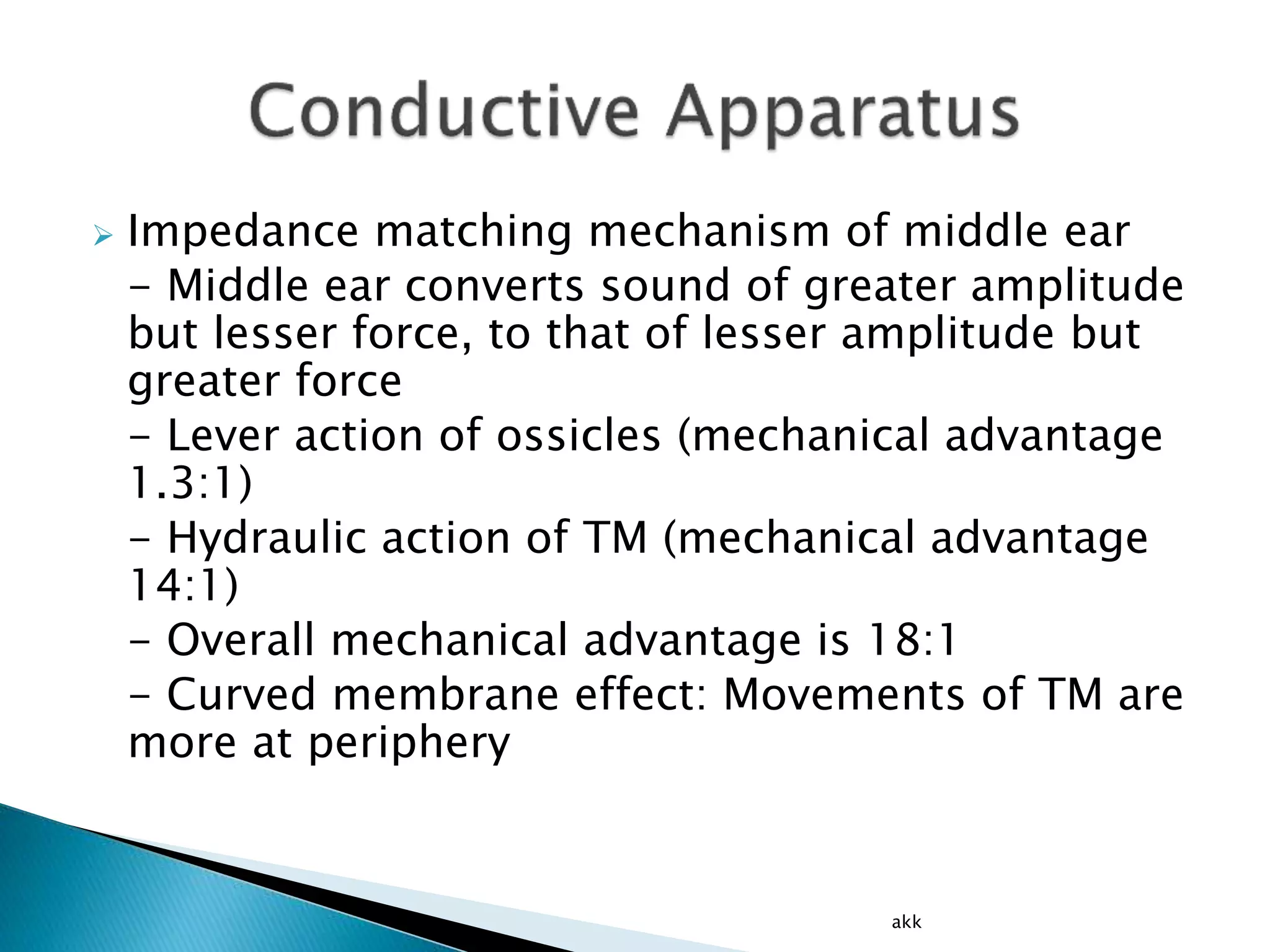
 Impedance matching mechanism of middle ear
- Middle ear converts sound of greater amplitude
but lesser force, to that of lesser amplitude but
greater force
- Lever action of ossicles (mechanical advantage
1.3:1)
- Hydraulic action of TM (mechanical advantage
14:1)
- Overall mechanical advantage is 18:1
- Curved membrane effect: Movements of TM are
more at periphery
akk
akk
 Phase differential between OW and RW
- When OW receives wave of compression,
the RW is at the phase of rarefaction
 Natural resonance of external and middle ear
- Inherent anatomic and physiologic
properties of the external and middle ear
allow certain frequencies of sound to pass
more easily to the inner ear due to their
natural resonances
akk
akk
akk
 ECOLI MA
 Four types of electrical potentials have been recorded
- Endocochlear potential
It is DC recorded from scala media
- Cochlear microphonic
It is AC
- Summating potential
It is DC produced by hair cells
- Compound action potential
It is an all or none response of auditory nerves
akk
 Two types of peripheral receptors
- Cristae
Located at the ampullary end of
semicircular ducts
Respond to angular acceleration
- Maculae
Located in utricle and saccule
Respond to linear acceleration
akk
 Crest like mound of connective tissues on
which lie the sensory epithelial cells
 Cilia of sensory hair cells project into cupula
(gelatinous mass of polysaccharide)
 Two types of sensory hair cells
- Type I: Flask shaped with single large cup
like nerve terminal
- Type II: Cylindrical with multiple nerve
terminals
akk
akk
Macula consists of two parts
 Sensory neuroepithelium
- Made up of type I and II cells
 An otolithic membrane
- Made up of a gelatinous mass
- Crystals of CaCO3 (otoliths or otoconia)
akk
akk
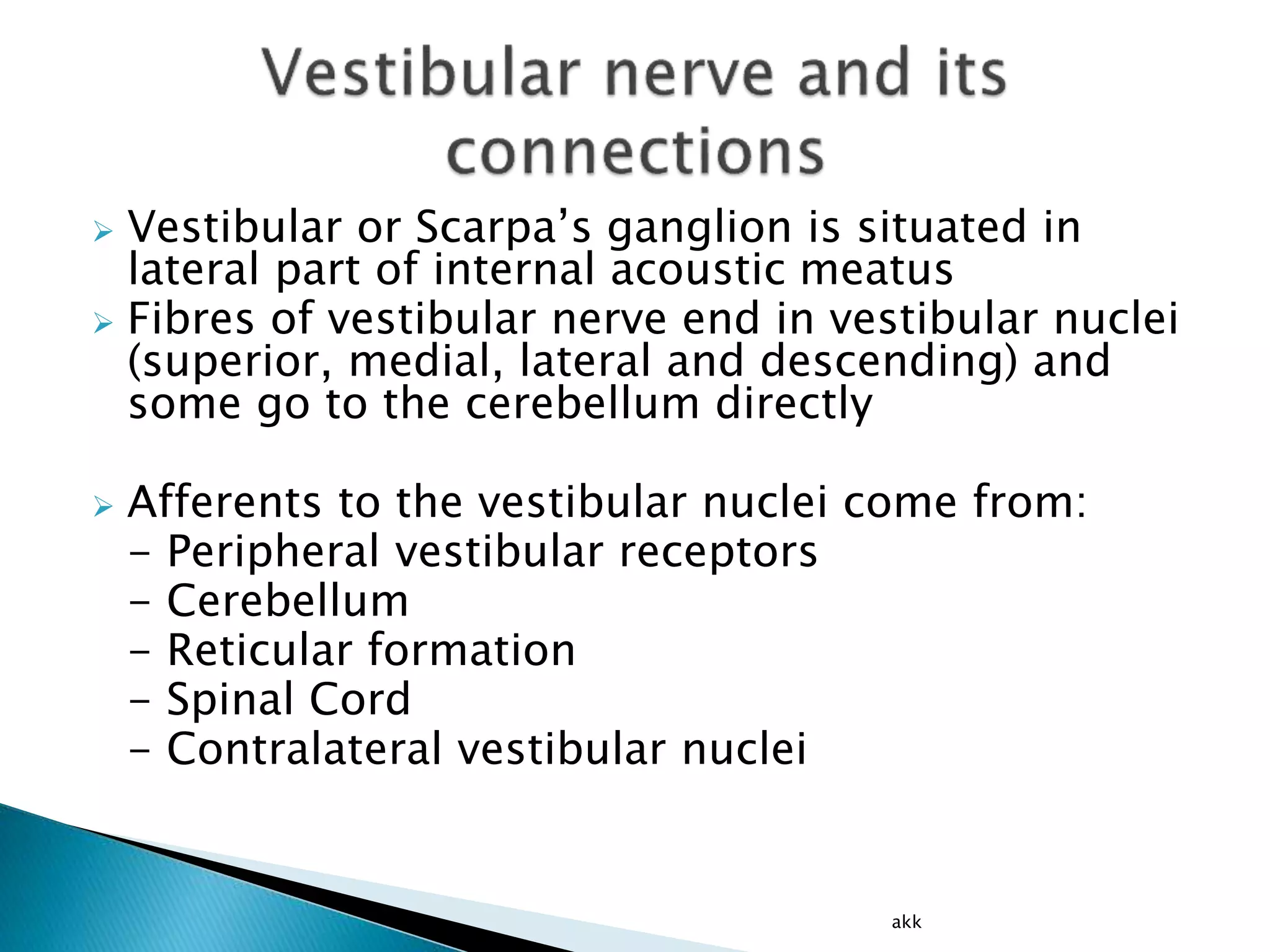
 Vestibular or Scarpa’s ganglion is situated in
lateral part of internal acoustic meatus
 Fibres of vestibular nerve end in vestibular nuclei
(superior, medial, lateral and descending) and
some go to the cerebellum directly
 Afferents to the vestibular nuclei come from:
- Peripheral vestibular receptors
- Cerebellum
- Reticular formation
- Spinal Cord
- Contralateral vestibular nuclei
akk
 Efferents from the vestibular nuclei go to:
- Nuclei of CN III, IV, VI (vestibulo-ocular
reflex, genesis of nystagmus)
- Motor part of spinal cord (vestibulo-spinal)
- Cerebellum (vestibulo-cerebellar)
- ANS (nausea, vomiting)
- Contralateral vestibular nuclei
- Cerebral cortex
akk
Vestibular system is peripheral and central
-Peripheral made up of semicircular ducts,
utricle, saccule and vestibular nerve
-Central made up of nuclei and fibre tracts in
the CNS
 Semicircular canals
- They respond to angular acceleration and
deceleration
- Nystagmus is horizontal from horizontal
canal, rotatory from superior canal and
vertical from posterior canal
akk
 The stimulus of semicircular canal is flow of
endolymph (ampullopetal or ampullofugal)
which displaces the cupula
 Ampullopetal flow is more effective than
ampullofugal for the horizontal canal
 The quick component of nystagmus is always
opposite to the direction of flow of
endolymph
akk
akk
 Utricle and Saccule
- Stimulated by linear acceleration and
deceleration
The vestibular system registers changes in
the head position (acceleration, gravity) and
sends this information to CNS where
information from other systems (visual,
somatosensory) is also received. All this
information is integrated and used in the
regulation of equilibrium and body posture
akk
akk
akk

Physiology of Hearing and Equilibrium

  • 1.
    Dr Ajeet KumarKhilnani akk
  • 2.
  • 3.
     Organ ofCorti is the sense organ of hearing  Tunnel of Corti contains cortilymph Outer hair cells Inner hair cells Arranged in 3-4 rows Single row Efferent Afferent in nature 12,000 in number 3500 Cylindrical Flask shaped Develop late Develop earlier Modulate inner hair cell function Transmit auditory stimuli Easily damaged by drugs More resistant akk
  • 4.
  • 5.
  • 6.
     Supporting cells -Deiters’ cells (situated between outer hair cells) - Cells of Hensen lie outside the Deiters’ cells  Tectorial Membrane - Gelatinous matrix - Provides stimulus to hair cells akk
  • 7.
     Hair cellsare innervated by dendrites of bipolar cells of spiral ganglion situated in Rosenthal’s canal  Axons of the bipolar cells form the cochlear division of 8th nerve and end in the cochlear nuclei akk
  • 8.
     Auditory pathway:Eighth nerve Cochlear nuclei Superior Olivary complex Lateral Lemniscus Inferior Colliculus Medial Geniculate body Auditory Cortex (ECOLI MA)  Each ear is represented in both cerebral hemispheres  Auditory cortex is situated in superior temporal gyrus (Brodmann’s Area 41) akk
  • 9.
  • 10.
     Conductive apparatus(Mechanical conduction of sound)  Sensory system of cochlea (Transduction of mechanical energy to electrical impulses)  Neural pathways (Conduction of electrical impulses to the brain) akk
  • 11.
     Impedance matchingmechanism of middle ear - Middle ear converts sound of greater amplitude but lesser force, to that of lesser amplitude but greater force - Lever action of ossicles (mechanical advantage 1.3:1) - Hydraulic action of TM (mechanical advantage 14:1) - Overall mechanical advantage is 18:1 - Curved membrane effect: Movements of TM are more at periphery akk
  • 12.
  • 13.
     Phase differentialbetween OW and RW - When OW receives wave of compression, the RW is at the phase of rarefaction  Natural resonance of external and middle ear - Inherent anatomic and physiologic properties of the external and middle ear allow certain frequencies of sound to pass more easily to the inner ear due to their natural resonances akk
  • 14.
  • 15.
  • 16.
     ECOLI MA Four types of electrical potentials have been recorded - Endocochlear potential It is DC recorded from scala media - Cochlear microphonic It is AC - Summating potential It is DC produced by hair cells - Compound action potential It is an all or none response of auditory nerves akk
  • 17.
     Two typesof peripheral receptors - Cristae Located at the ampullary end of semicircular ducts Respond to angular acceleration - Maculae Located in utricle and saccule Respond to linear acceleration akk
  • 18.
     Crest likemound of connective tissues on which lie the sensory epithelial cells  Cilia of sensory hair cells project into cupula (gelatinous mass of polysaccharide)  Two types of sensory hair cells - Type I: Flask shaped with single large cup like nerve terminal - Type II: Cylindrical with multiple nerve terminals akk
  • 19.
  • 20.
    Macula consists oftwo parts  Sensory neuroepithelium - Made up of type I and II cells  An otolithic membrane - Made up of a gelatinous mass - Crystals of CaCO3 (otoliths or otoconia) akk
  • 21.
  • 22.
     Vestibular orScarpa’s ganglion is situated in lateral part of internal acoustic meatus  Fibres of vestibular nerve end in vestibular nuclei (superior, medial, lateral and descending) and some go to the cerebellum directly  Afferents to the vestibular nuclei come from: - Peripheral vestibular receptors - Cerebellum - Reticular formation - Spinal Cord - Contralateral vestibular nuclei akk
  • 23.
     Efferents fromthe vestibular nuclei go to: - Nuclei of CN III, IV, VI (vestibulo-ocular reflex, genesis of nystagmus) - Motor part of spinal cord (vestibulo-spinal) - Cerebellum (vestibulo-cerebellar) - ANS (nausea, vomiting) - Contralateral vestibular nuclei - Cerebral cortex akk
  • 24.
    Vestibular system isperipheral and central -Peripheral made up of semicircular ducts, utricle, saccule and vestibular nerve -Central made up of nuclei and fibre tracts in the CNS  Semicircular canals - They respond to angular acceleration and deceleration - Nystagmus is horizontal from horizontal canal, rotatory from superior canal and vertical from posterior canal akk
  • 25.
     The stimulusof semicircular canal is flow of endolymph (ampullopetal or ampullofugal) which displaces the cupula  Ampullopetal flow is more effective than ampullofugal for the horizontal canal  The quick component of nystagmus is always opposite to the direction of flow of endolymph akk
  • 26.
  • 27.
     Utricle andSaccule - Stimulated by linear acceleration and deceleration The vestibular system registers changes in the head position (acceleration, gravity) and sends this information to CNS where information from other systems (visual, somatosensory) is also received. All this information is integrated and used in the regulation of equilibrium and body posture akk
  • 28.
  • 29.