Guided by:
Dr. Lalbabu Kamait
Department of Periodontics
and Implantology
Submitted by
Bibek Jha
BDS 3rd batch
Roll no. 13
 Introduction
 Definition
 Rationale
 Ideal requirements of splint
 Classification
 Indications
 Contraindications
 Principle
 Advantages
 Disadvantages
 Periodontal disease are characterized by sub-
gingival plaque formation, gingival
inflammation, loss of connective tissue
attachment and loss of alveolar bone.
 As a result of progressive loss of attachment ,
the tooth involved in the disease process
eventually exhibit increased tooth mobility.
 Thus the reduction of mobility is an
important objective of periodontal therapy.
 Root planning, curettage, oral hygiene and
surgery may cause teeth to tighten as
inflammation is resolved. However a
transient increase in mobility may occur
immediately after surgery.
 Increasing the support of loose teeth may
also increase their firmness, the device used
for such treatment is the “SPLINT”.
 Splint: Any apparatus, appliance, or device
employed to prevent motion or
displacement of fractured or movable parts.
(Hallmen et al 1996)
 An appliance for immobilization or
stabilization of injured or diseased parts.
(Glickman 1972)
 Dental splint: An appliance designed to
immobilize and stabilize mobile loose
teeth. (AAP1986 Glossary)
1. To provide rest.
2. For redirection of forces― the forces of
occlusion are directed in a more axial
direction over all the teeth included in the
splint.
3. For redistribution of forces ―
redistribution ensures that forces do not
exceed the adaptive capacity of the
periodontium.
4. To preserve the arch integrity ― splinting
restores the proximal contacts, reducing
food impaction and consequent breakdown
of the periodontium.
5. Restoration of the functional stability ―
restores a functional occlusion, stabilizes
mobile abutment teeth and increases
masticatory efficiency.
6. Psychological well-being ― gives the
patient freedom from mobile teeth thereby
giving him a sense of well-being.
7. To stabilize mobile teeth during
surgical, especially regenerative
therapy.
simple and
hygienic
economic
stable and
efficient
Non
irritating
not interfere with
treatment
esthetically
acceptable
not
provoke
iatrogenic
disease
RAMFJORD’S CLASSIFICATION (1979)
I. Temporary:
a) Fixed- Fixed external type (2-6 months)
e.g. Ligature wire, orthodontic bands.
b) Removable-RPD, Night guards,
removable acrylic splints .
II. Provisional:
 8-12 months diagnostic used in borderline cases
where the outcome of treatment cannot be
predicted.
eg.Temporary external splints.
III. Permanent:
a) Fixed- Full crowns, pin ledge type of abutment
retainers.
b) Semi-rigid.
c) Removable-Telescopic crowns, clasp supported
partial denture.
Grant, Stern and Listgarten(1988)
I. TEMPORARY:
Extracoronal (External)-Ligature splint,
Enamel bonding material, welded bond
splints, night guards
Intracoronal (Internal)- Acrylic splints,
Composite splints, acrylic full crowns
II. PROVISIONAL SPILNTS
Serves to stabilize a permanently mobile
dentition from the time of initial tooth
preparation until the time the dentition is
periodontally healthy enough for permanent
restorations.
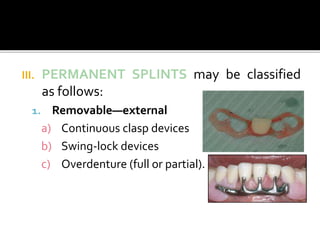
III. PERMANENT SPLINTS may be classified
as follows:
1. Removable—external
a) Continuous clasp devices
b) Swing-lock devices
c) Overdenture (full or partial).
2. Fixed—internal
a) Full coverage, three-fourths coverage crowns
and inlays
b) Posts in root canals
c) Horizontal pin splints .
3. Cast-metal resin-bonded fixed partial
dentures (Maryland splints)
4. Combined
a) Partial dentures and splinted abutments
b) Removable—fixed splints
c) Full or partial dentures on splinted roots
d) Fixed bridges incorporated in partial dentures,
seated on posts or copings
5. Endodontic
According to duration(Ferencz 1991)
1. Short-term splint.
2. Provisional splint.
3. Long-term permanent splint
1. Splints for anterior teeth:
a. Direct bonding system using acid-etch
techniques and alight cured resin.
b. Intracoronal wire and acrylic wire resin splint-it
involves the teeth with stainless steel wire
placed in the slots thus stabilizing the teeth.
Acid etching
Bonding agent
Composite curing
Slot preparation Ss wire adapted into the slot
Sealed with resin
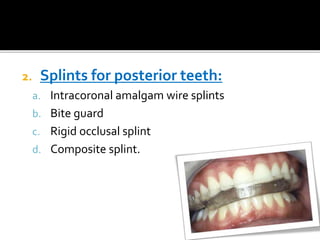
2. Splints for posterior teeth:
a. Intracoronal amalgam wire splints
b. Bite guard
c. Rigid occlusal splint
d. Composite splint.
1. mobility of teeth that is increasing or that
impairs patient comfort.
2. Migration of teeth.
3. prosthetics where multiple abutments are
necessary.
carranza 10th edition
4. Stabilize moderate to advance tooth
mobility that cannot be treated by other
means.
5. Stabilize teeth when increased tooth
mobility interferes with normal masticatory
function and comfort of the patient.
6. Stabilize teeth in secondary occlusal
trauma.
7. Prevent tipping or drifting of the teeth.
8. Prevent extrusion of unopposed teeth.
9. Stabilization of mobile teeth during surgical
especially regenerative therapy. (Serio
1999).
10. Stabilize teeth following acute trauma.
11. Stabilize teeth following orthodontic
movement.
12. Ascertain whether occlusal therapy will be
effective or not.
1. Moderate to severe tooth mobility in
presence of periodontal inflammation
and/or primary occlusal trauma.
2. Insufficient number of firm/sufficiently firm
teeth to stabilize mobile teeth.
3. Prior occlusal adjustment has not been done
on teeth with occlusal trauma or occlusal
interference.
4. Patient not maintaining oral hygiene.
1. Inclusion of sufficient number of healthy
teeth
2. Splint around the arch
3. Coronoplasty may be performed to relieve
traumatic occlusion.
4. The splint should be fabricated in such a way
as to facilitate proper plaque control.
5. Splint should be esthetically acceptable and
should not interfere with occlusion.
 Helpful to decrease mobility and accelerate
healing following acute trauma to the teeth.
 Allows remodeling of alveolar bone and
periodontal ligament for orthodontically,
splinted teeth.
 May establish final stability and comfort for
patient with occlusal trauma.
 Helpful in decreasing mobility thereby
favoring regenerative therapy.
 Distributes the occlusal force over the large
area.
 All the splints hamper the patients self care.
Accumulation of plaque at the splinted
margins can lead to further periodontal
breakdown in a patient with already
compromised periodontal support.
 Number of studies has shown that splinting
does not actually reduce tooth mobility(once
the splint is removed)
 The splint being rigid may acts as lever with
uneven distribution of forces, even if one
tooth of the splint is in traumatic occlusion, it
can injure the peridontium of all the teeth
within the splint.
 Development of caries is an unavoidable risk.
Thus, it obviates the need of excellent oral
hygiene in the patient.
 Clinical periodontology :Shanatipriya Reddy 4th
edition.
 International Journal of Science and Research (IJSR)
ISSN (Online): 2319-7064 Index CopernicusValue
(2013): 6.14 | Impact Factor (2013): 4.438
 Clinical periodontology :Carranza 10th edition
Periodontal splinting

Periodontal splinting

  • 1.
    Guided by: Dr. LalbabuKamait Department of Periodontics and Implantology Submitted by Bibek Jha BDS 3rd batch Roll no. 13
  • 2.
     Introduction  Definition Rationale  Ideal requirements of splint  Classification  Indications  Contraindications  Principle  Advantages  Disadvantages
  • 3.
     Periodontal diseaseare characterized by sub- gingival plaque formation, gingival inflammation, loss of connective tissue attachment and loss of alveolar bone.  As a result of progressive loss of attachment , the tooth involved in the disease process eventually exhibit increased tooth mobility.
  • 4.
     Thus thereduction of mobility is an important objective of periodontal therapy.  Root planning, curettage, oral hygiene and surgery may cause teeth to tighten as inflammation is resolved. However a transient increase in mobility may occur immediately after surgery.
  • 5.
     Increasing thesupport of loose teeth may also increase their firmness, the device used for such treatment is the “SPLINT”.
  • 6.
     Splint: Anyapparatus, appliance, or device employed to prevent motion or displacement of fractured or movable parts. (Hallmen et al 1996)  An appliance for immobilization or stabilization of injured or diseased parts. (Glickman 1972)
  • 7.
     Dental splint:An appliance designed to immobilize and stabilize mobile loose teeth. (AAP1986 Glossary)
  • 8.
    1. To providerest. 2. For redirection of forces― the forces of occlusion are directed in a more axial direction over all the teeth included in the splint.
  • 9.
    3. For redistributionof forces ― redistribution ensures that forces do not exceed the adaptive capacity of the periodontium. 4. To preserve the arch integrity ― splinting restores the proximal contacts, reducing food impaction and consequent breakdown of the periodontium.
  • 10.
    5. Restoration ofthe functional stability ― restores a functional occlusion, stabilizes mobile abutment teeth and increases masticatory efficiency. 6. Psychological well-being ― gives the patient freedom from mobile teeth thereby giving him a sense of well-being.
  • 11.
    7. To stabilizemobile teeth during surgical, especially regenerative therapy.
  • 12.
    simple and hygienic economic stable and efficient Non irritating notinterfere with treatment esthetically acceptable not provoke iatrogenic disease
  • 13.
    RAMFJORD’S CLASSIFICATION (1979) I.Temporary: a) Fixed- Fixed external type (2-6 months) e.g. Ligature wire, orthodontic bands. b) Removable-RPD, Night guards, removable acrylic splints .
  • 15.
    II. Provisional:  8-12months diagnostic used in borderline cases where the outcome of treatment cannot be predicted. eg.Temporary external splints.
  • 16.
    III. Permanent: a) Fixed-Full crowns, pin ledge type of abutment retainers. b) Semi-rigid. c) Removable-Telescopic crowns, clasp supported partial denture.
  • 17.
    Grant, Stern andListgarten(1988) I. TEMPORARY: Extracoronal (External)-Ligature splint, Enamel bonding material, welded bond splints, night guards Intracoronal (Internal)- Acrylic splints, Composite splints, acrylic full crowns
  • 19.
    II. PROVISIONAL SPILNTS Servesto stabilize a permanently mobile dentition from the time of initial tooth preparation until the time the dentition is periodontally healthy enough for permanent restorations.
  • 20.
    III. PERMANENT SPLINTSmay be classified as follows: 1. Removable—external a) Continuous clasp devices b) Swing-lock devices c) Overdenture (full or partial).
  • 21.
    2. Fixed—internal a) Fullcoverage, three-fourths coverage crowns and inlays b) Posts in root canals c) Horizontal pin splints . 3. Cast-metal resin-bonded fixed partial dentures (Maryland splints)
  • 22.
    4. Combined a) Partialdentures and splinted abutments b) Removable—fixed splints c) Full or partial dentures on splinted roots d) Fixed bridges incorporated in partial dentures, seated on posts or copings 5. Endodontic
  • 23.
    According to duration(Ferencz1991) 1. Short-term splint. 2. Provisional splint. 3. Long-term permanent splint
  • 25.
    1. Splints foranterior teeth: a. Direct bonding system using acid-etch techniques and alight cured resin. b. Intracoronal wire and acrylic wire resin splint-it involves the teeth with stainless steel wire placed in the slots thus stabilizing the teeth.
  • 26.
  • 27.
    Slot preparation Sswire adapted into the slot Sealed with resin
  • 28.
    2. Splints forposterior teeth: a. Intracoronal amalgam wire splints b. Bite guard c. Rigid occlusal splint d. Composite splint.
  • 29.
    1. mobility ofteeth that is increasing or that impairs patient comfort. 2. Migration of teeth. 3. prosthetics where multiple abutments are necessary. carranza 10th edition
  • 30.
    4. Stabilize moderateto advance tooth mobility that cannot be treated by other means. 5. Stabilize teeth when increased tooth mobility interferes with normal masticatory function and comfort of the patient. 6. Stabilize teeth in secondary occlusal trauma.
  • 31.
    7. Prevent tippingor drifting of the teeth. 8. Prevent extrusion of unopposed teeth. 9. Stabilization of mobile teeth during surgical especially regenerative therapy. (Serio 1999).
  • 32.
    10. Stabilize teethfollowing acute trauma. 11. Stabilize teeth following orthodontic movement. 12. Ascertain whether occlusal therapy will be effective or not.
  • 33.
    1. Moderate tosevere tooth mobility in presence of periodontal inflammation and/or primary occlusal trauma. 2. Insufficient number of firm/sufficiently firm teeth to stabilize mobile teeth.
  • 34.
    3. Prior occlusaladjustment has not been done on teeth with occlusal trauma or occlusal interference. 4. Patient not maintaining oral hygiene.
  • 35.
    1. Inclusion ofsufficient number of healthy teeth 2. Splint around the arch 3. Coronoplasty may be performed to relieve traumatic occlusion.
  • 36.
    4. The splintshould be fabricated in such a way as to facilitate proper plaque control. 5. Splint should be esthetically acceptable and should not interfere with occlusion.
  • 37.
     Helpful todecrease mobility and accelerate healing following acute trauma to the teeth.  Allows remodeling of alveolar bone and periodontal ligament for orthodontically, splinted teeth.
  • 38.
     May establishfinal stability and comfort for patient with occlusal trauma.  Helpful in decreasing mobility thereby favoring regenerative therapy.  Distributes the occlusal force over the large area.
  • 39.
     All thesplints hamper the patients self care. Accumulation of plaque at the splinted margins can lead to further periodontal breakdown in a patient with already compromised periodontal support.
  • 40.
     Number ofstudies has shown that splinting does not actually reduce tooth mobility(once the splint is removed)
  • 41.
     The splintbeing rigid may acts as lever with uneven distribution of forces, even if one tooth of the splint is in traumatic occlusion, it can injure the peridontium of all the teeth within the splint.
  • 42.
     Development ofcaries is an unavoidable risk. Thus, it obviates the need of excellent oral hygiene in the patient.
  • 44.
     Clinical periodontology:Shanatipriya Reddy 4th edition.  International Journal of Science and Research (IJSR) ISSN (Online): 2319-7064 Index CopernicusValue (2013): 6.14 | Impact Factor (2013): 4.438  Clinical periodontology :Carranza 10th edition

Editor's Notes

  • #32 Regenerative therapy is used in pocket reduction….