ROLE OF PERIODONTAL FLAP
SURGERIES IN CORRECTION
OF PERIODONTAL POCKETS
Dr. Divyasree K A
Senior Lecturer,
Department of Clinical
Periodontology & Oral Implantology,
Royal Dental College
A periodontal flap is a section of gingiva and/or mucosa
surgically separated from the underlying tissues to
provide visibility of and access to the bone and root
surface.
Goals of surgery
• Gain access for root preparation
• Establish favourable gingival contours
• Facilitate oral hygiene
• Lengthen the clinical crown
• Regain lost periodontium using regenerative
approaches
Purpose of Pocket therapy
• Eliminate the pathologic changes in the pocket walls;
• To create a stable, easily maintainable state;
• To promote periodontal regeneration.
Indications
• Areas with irregular bony contours, deep craters and
other defects
• Pockets on teeth for which a complete removal of
root irritant is not possible
• In cases of furcation involvement
• Intrabony pockets on distal to last molars, frequently
associated with mucogingival problems
• Persistent inflammation in areas of moderate to deep
periodontal pockets
Contraindications
 Poor patient
cooperation
 Organ transplants
 Blood disorders
 Hormonal disorders
 Uncontrolled
diabetes
 Adrenal dysfunction
 Multiple sclerosis &
Parkinson’s disease
 Epilepsy
 Smoking
 Unrealistic patient
expectations
 Poor plaque control
 High caries rate
 Cardiovascular disease
 Uncontrolled hypertension
 Angina pectoris
 Myocardial infarction
 Anticoagulant therapy
 Rheumatic endocarditis,
congenital heart lesions, heart
vascular implants
Principles of Periodontal surgery
 Diagnosis & examination
 Medical history
 Assessment of risk factors
 80% plaque free surfaces
 Discussion of risks and
benefits of surgery
 Informed consent
 Premedication
 Surgical instruments
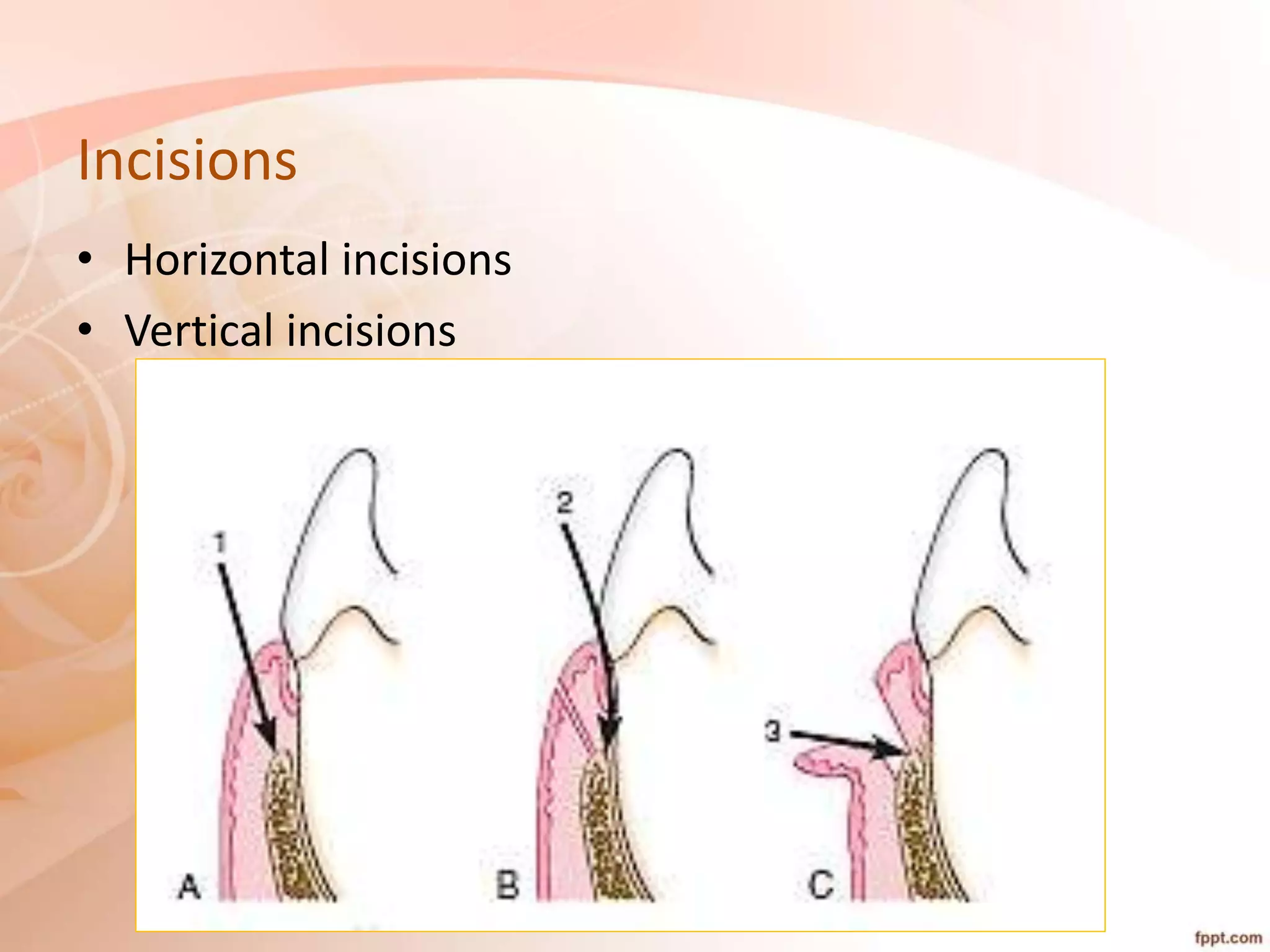
Incisions
• Horizontal incisions
• Vertical incisions
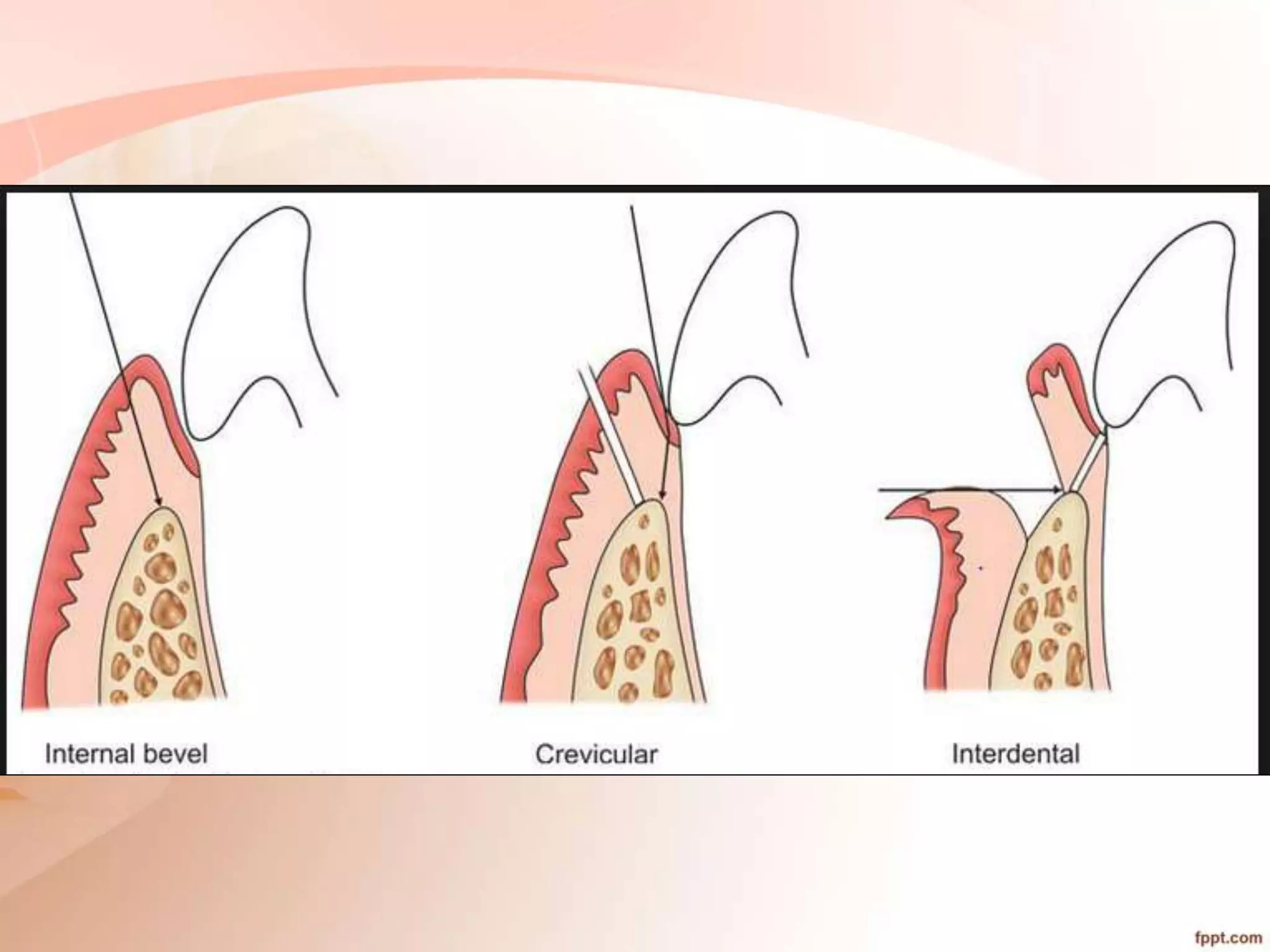
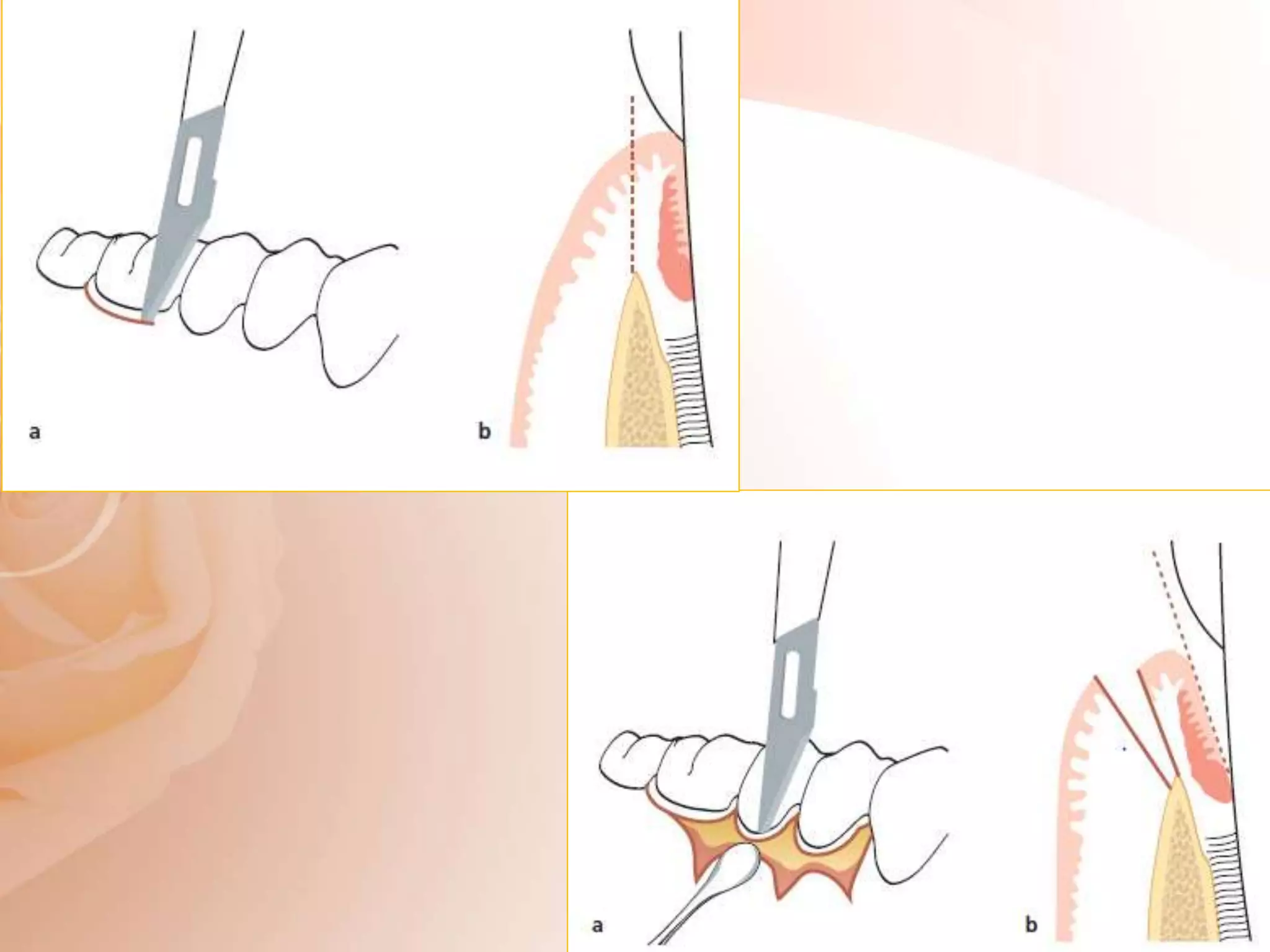
Internal bevel incision
Objectives of Internal bevel incision
 Removal of the pocket lining
 Preservation of keratinized tissue
 Production of sharp, thin flap margin
Crevicular incision
Interdental incision
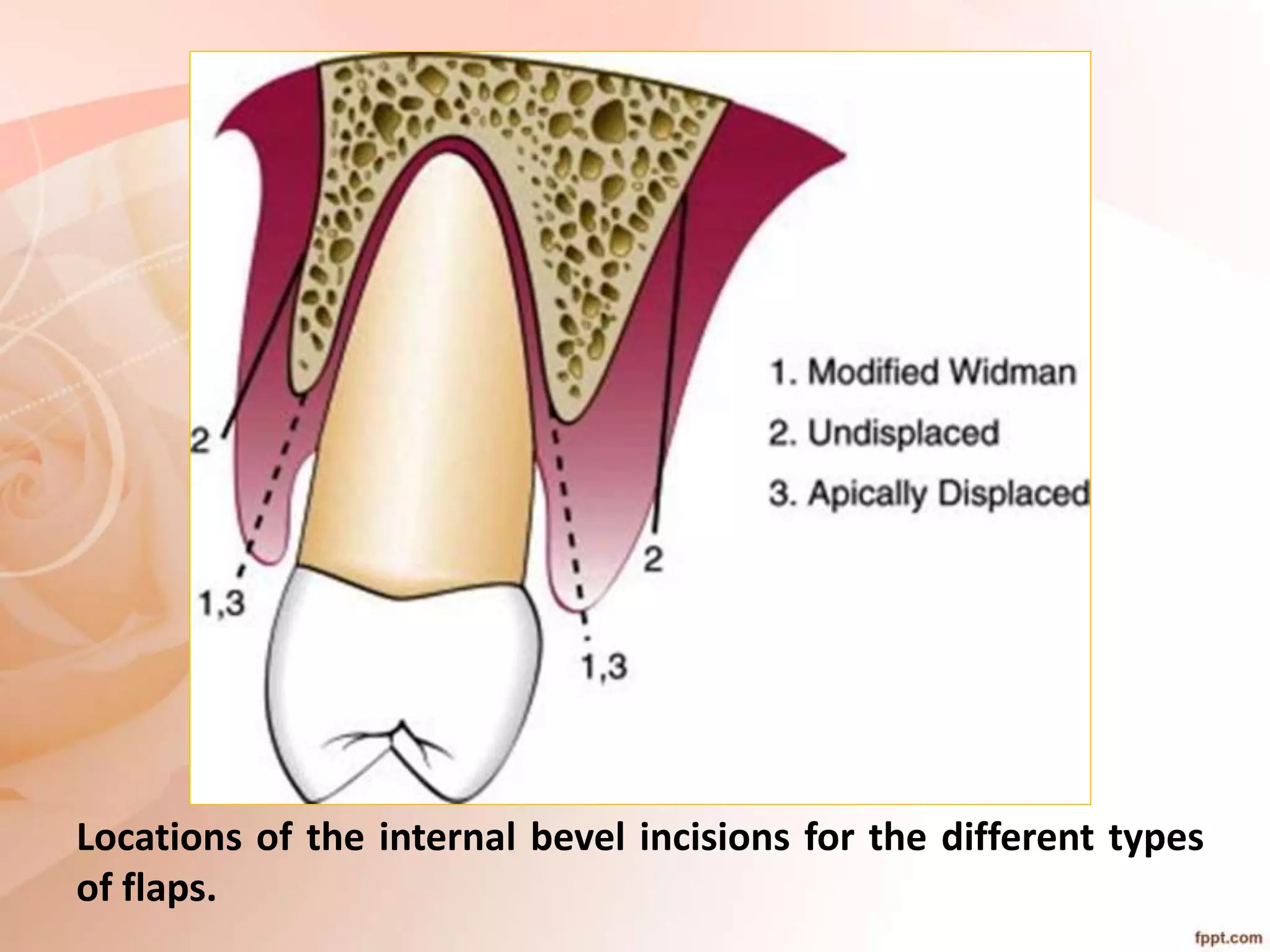
Locations of the internal bevel incisions for the different types
of flaps.
Scalloping required for the different types of flaps
Vertical incisions
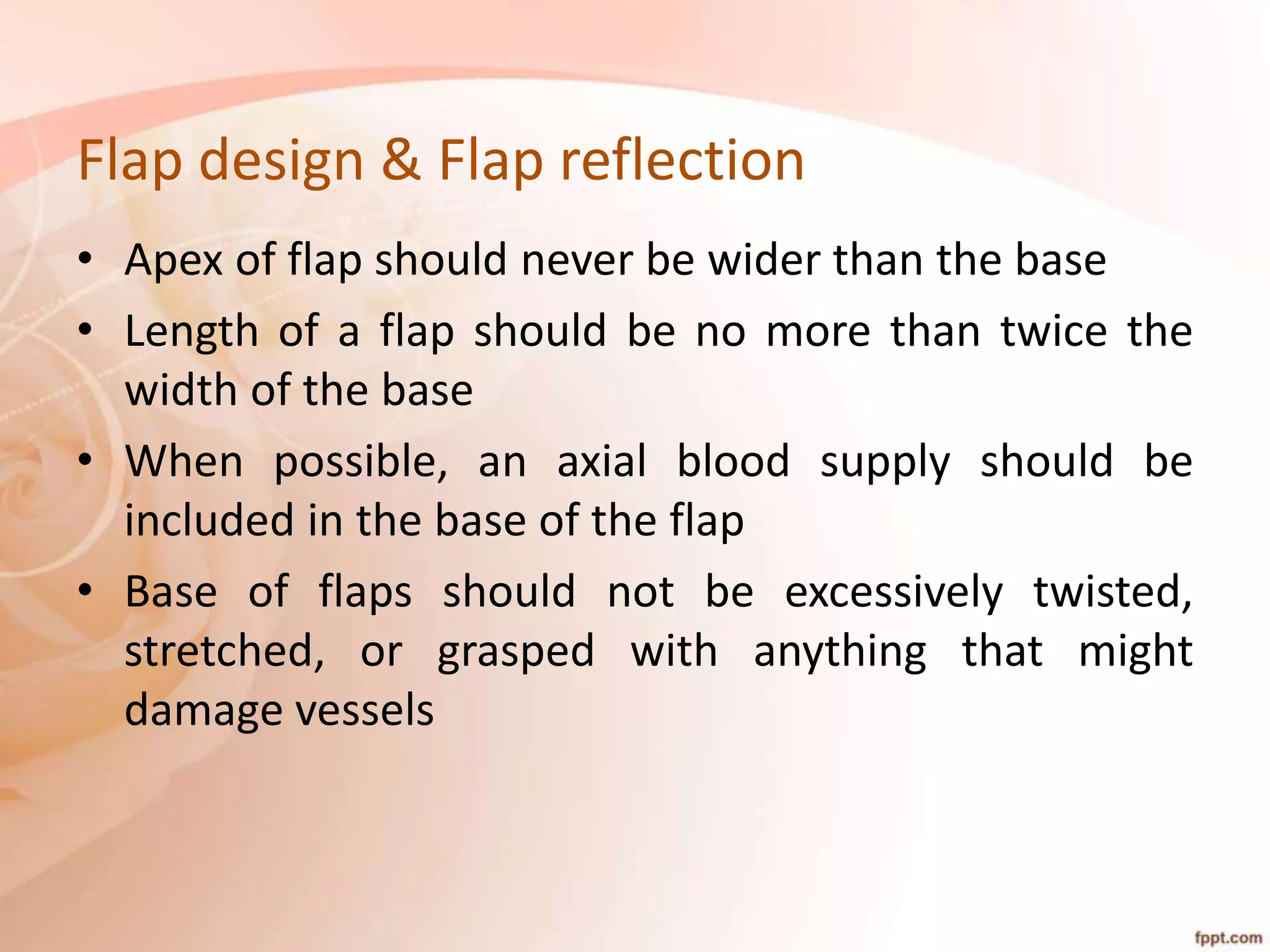
Flap design & Flap reflection
• Apex of flap should never be wider than the base
• Length of a flap should be no more than twice the
width of the base
• When possible, an axial blood supply should be
included in the base of the flap
• Base of flaps should not be excessively twisted,
stretched, or grasped with anything that might
damage vessels
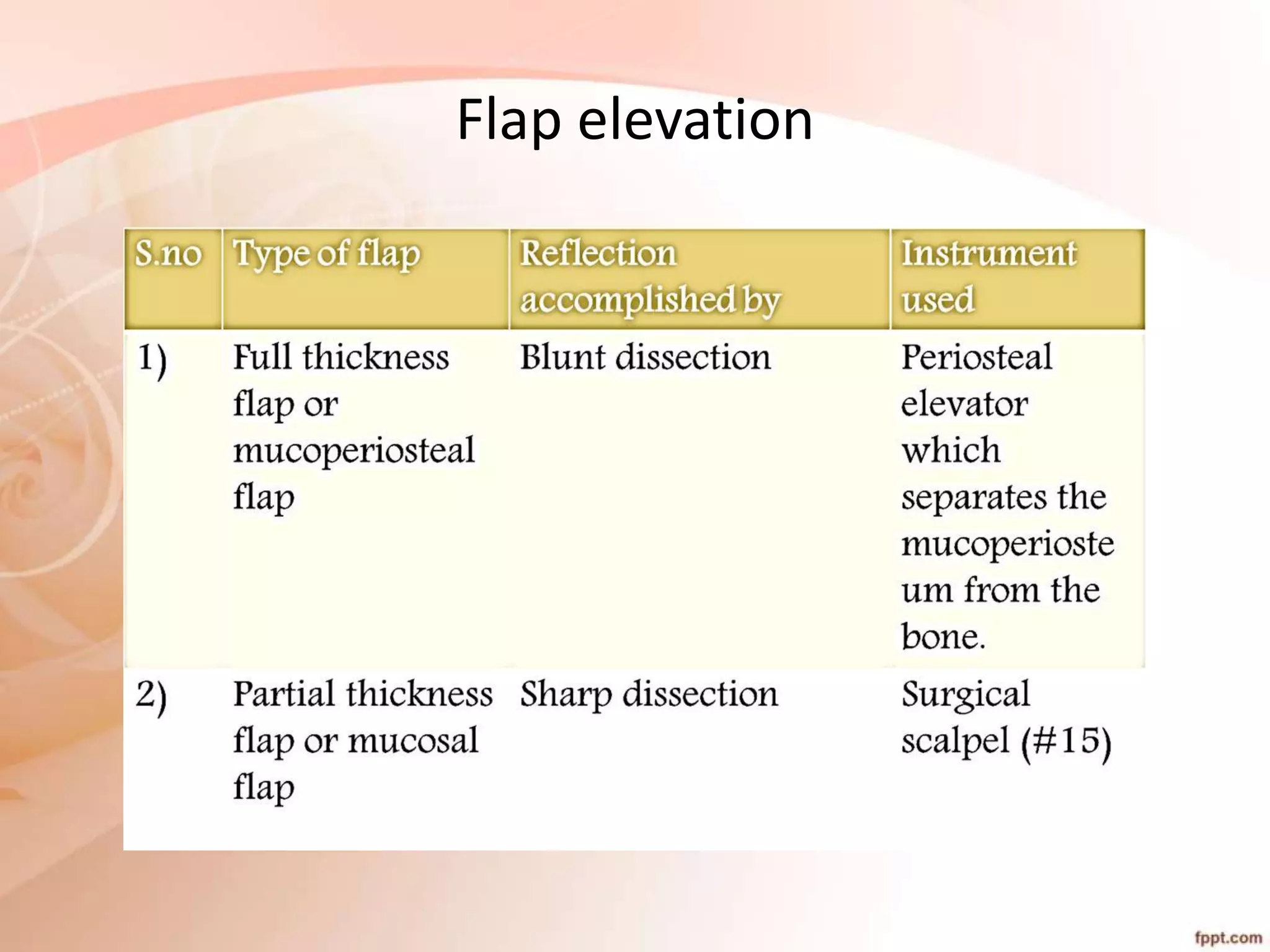
Flap elevation
Modified Widman Flap(1974)
• Ramfjord and Nissle, 1974
Advantages
• Close adaptation of the soft tissues to the root
surface
• Minimum amount of trauma to the alveolar bone
and the soft tissue
• Less exposure of the root surfaces, which is an
advantage from the aesthetic point of view
Disadvantages
• No pocket elimination
• Healing by long junctional epithelium
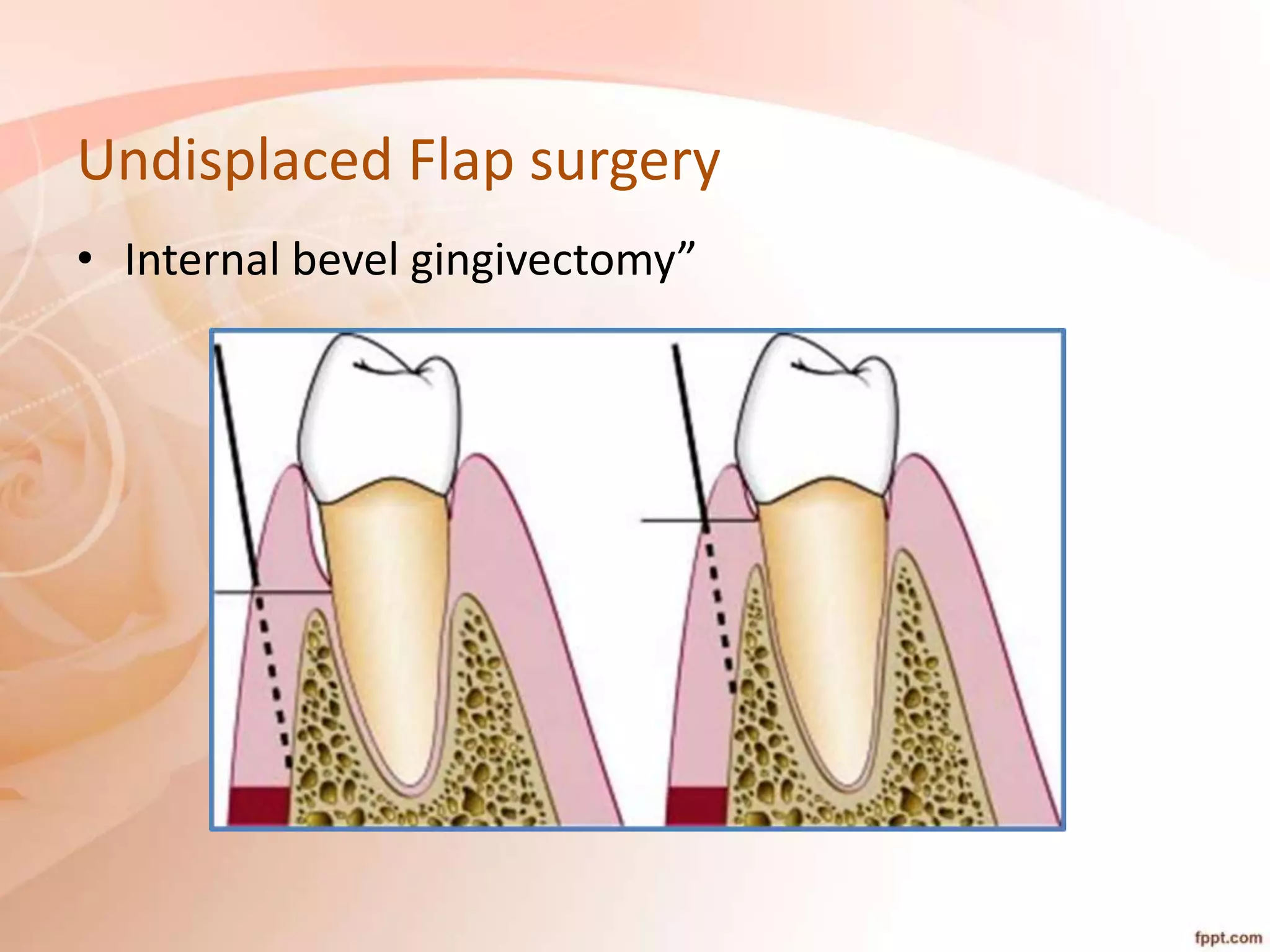
Undisplaced Flap surgery
• Internal bevel gingivectomy”
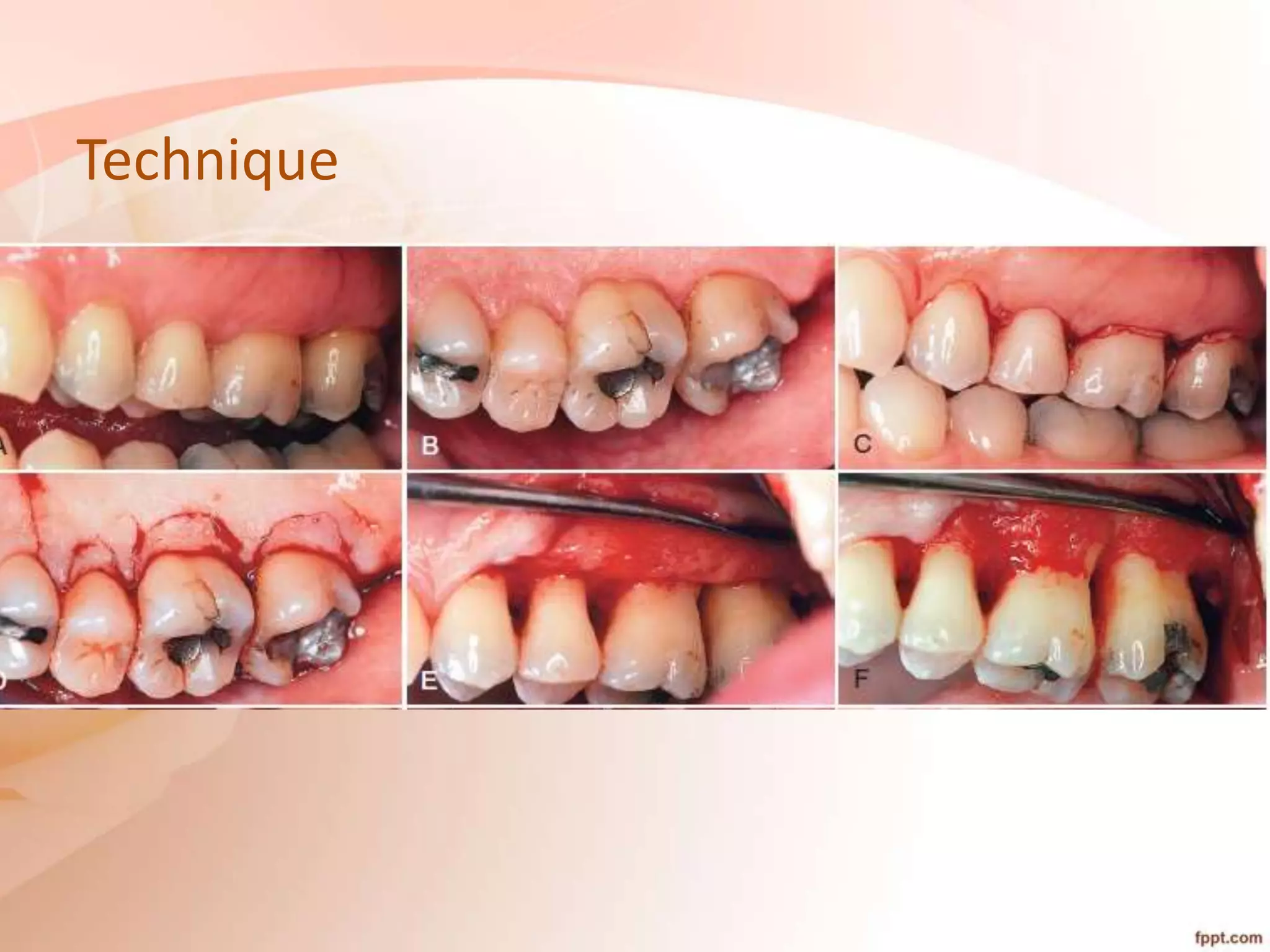
Technique
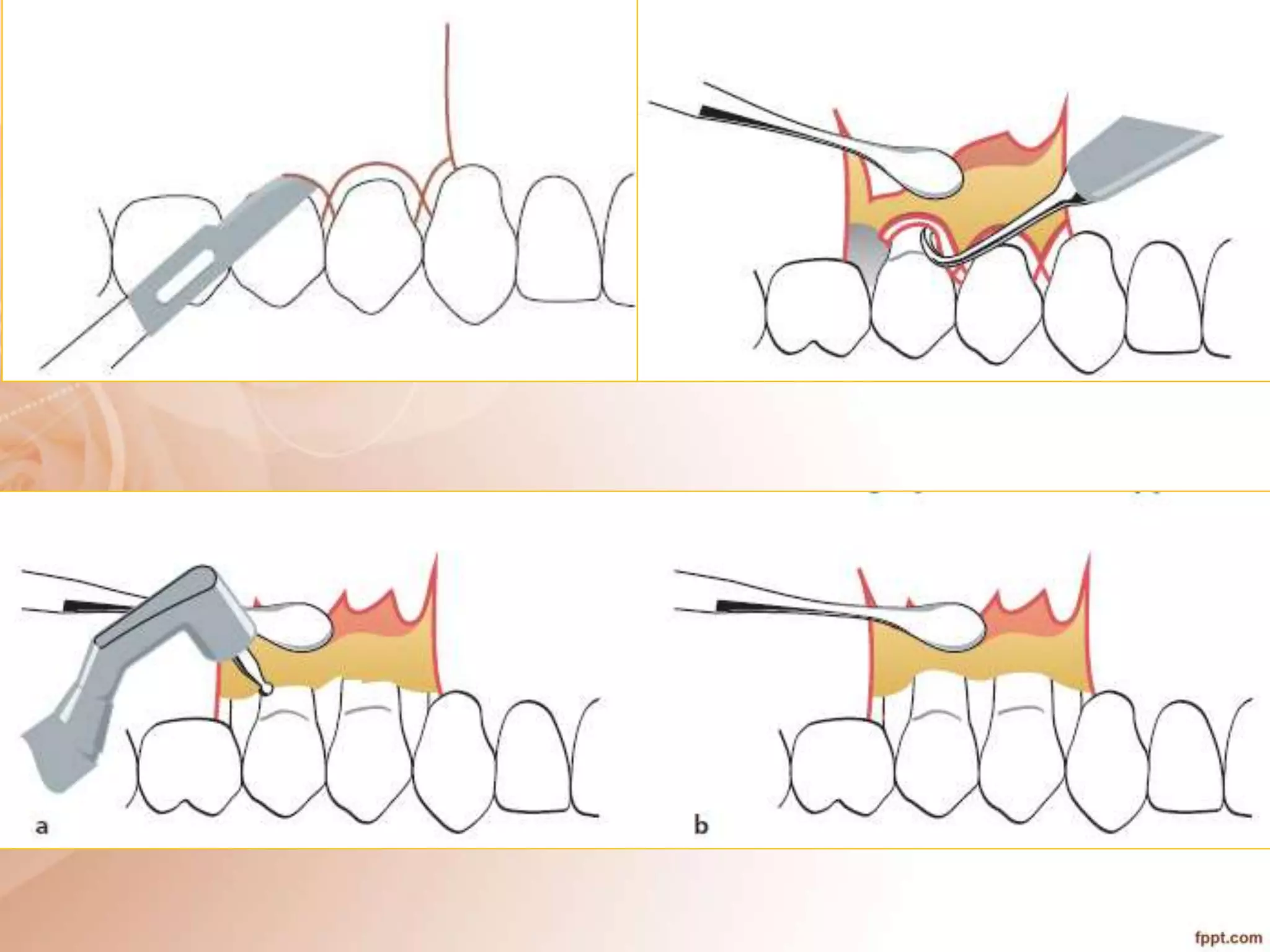
Apically displaced flap surgery
 pocket eradication
 widening the zone of attached gingiva
• Full thickness or split thickness flap
Indications:
• Moderate to deep pockets ,where base is apical to MGJ
• To increase the width of keratinized gingiva
• Crown lengthening
• Grade III furcation
Contraindications:
• Aesthetic reasons
• Risk for root caries
• Dentinal hypersensitivity
Advantages & Disadvantages
Advantages
• Pocket elimination
• Optimum soft tissue coverage of the alveolar bone
• Minimal post surgical bone loss
• Post-operative position of the gingival margin may be
controlled
• Pocket wall is converted to attached gingiva
Disadvantages
• Exposure of the root surface resulting in aesthetic
problems and root sensitivity problems
THANK YOU
Flaps for Reconstructive Surgery
 Papilla preservation flap
 Conventional flap with only crevicular incisions
Papilla Preservation Flap
• To obtain maximum soft tissue coverage during the
treatment of proximal osseous defects
• To be used in combination with regenerative
techniques
• Used in the surgical treatment of anterior tooth
regions because of aesthetic reasons
Technique
Conventional flap surgery
Distal molar surgery
Indications
• For the correction of pockets
• For the correction of bony defects
• Maintain and preserve attached gingiva
• Lengthen the clinical crown
• To create easily cleansable gingiva-alveolar form
Maxillary molars
The following considerations determine the location of
the incision for distal molar surgery:
• Accessibility,
• Amount of attached gingiva,
• Pocket depth, and
• Available distance from the distal aspect of the tooth
to the end of the tuberosity or retromolar pad.
Technique
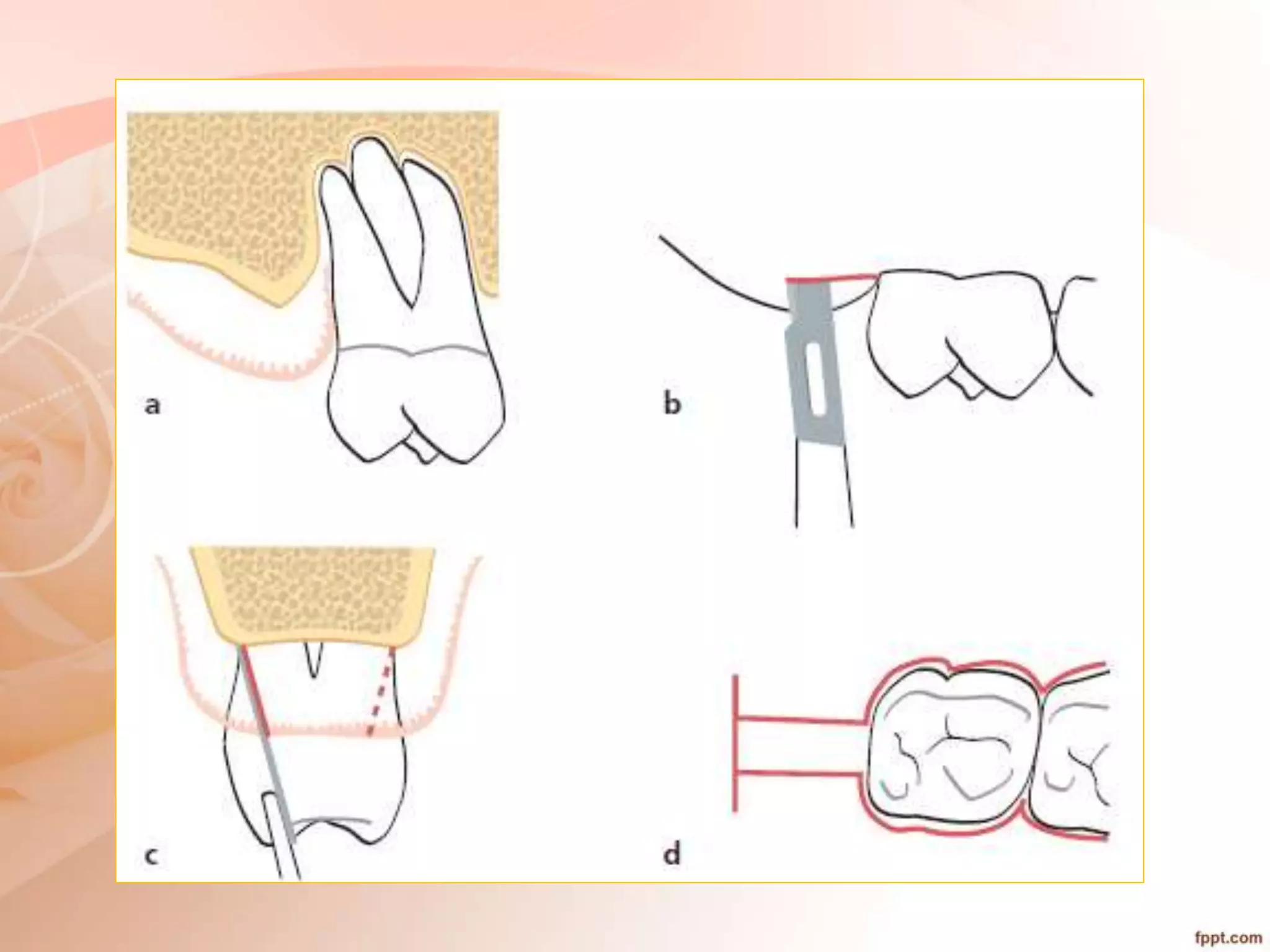
Incision designs for surgical procedures distal to the mandibular
second molar. The incision should follow the areas of greatest
attached gingiva and underlying bone.
Typical incision design for a surgical procedure distal to the
maxillary second molar.
periodontal flap surgery.pptx

periodontal flap surgery.pptx

  • 1.
    ROLE OF PERIODONTALFLAP SURGERIES IN CORRECTION OF PERIODONTAL POCKETS Dr. Divyasree K A Senior Lecturer, Department of Clinical Periodontology & Oral Implantology, Royal Dental College
  • 2.
    A periodontal flapis a section of gingiva and/or mucosa surgically separated from the underlying tissues to provide visibility of and access to the bone and root surface.
  • 3.
    Goals of surgery •Gain access for root preparation • Establish favourable gingival contours • Facilitate oral hygiene • Lengthen the clinical crown • Regain lost periodontium using regenerative approaches
  • 5.
    Purpose of Pockettherapy • Eliminate the pathologic changes in the pocket walls; • To create a stable, easily maintainable state; • To promote periodontal regeneration.
  • 6.
    Indications • Areas withirregular bony contours, deep craters and other defects • Pockets on teeth for which a complete removal of root irritant is not possible • In cases of furcation involvement • Intrabony pockets on distal to last molars, frequently associated with mucogingival problems • Persistent inflammation in areas of moderate to deep periodontal pockets
  • 7.
    Contraindications  Poor patient cooperation Organ transplants  Blood disorders  Hormonal disorders  Uncontrolled diabetes  Adrenal dysfunction  Multiple sclerosis & Parkinson’s disease  Epilepsy  Smoking  Unrealistic patient expectations  Poor plaque control  High caries rate  Cardiovascular disease  Uncontrolled hypertension  Angina pectoris  Myocardial infarction  Anticoagulant therapy  Rheumatic endocarditis, congenital heart lesions, heart vascular implants
  • 8.
    Principles of Periodontalsurgery  Diagnosis & examination  Medical history  Assessment of risk factors  80% plaque free surfaces  Discussion of risks and benefits of surgery  Informed consent  Premedication  Surgical instruments
  • 9.
  • 11.
  • 12.
    Objectives of Internalbevel incision  Removal of the pocket lining  Preservation of keratinized tissue  Production of sharp, thin flap margin
  • 13.
  • 14.
    Locations of theinternal bevel incisions for the different types of flaps.
  • 15.
    Scalloping required forthe different types of flaps
  • 16.
  • 17.
    Flap design &Flap reflection • Apex of flap should never be wider than the base • Length of a flap should be no more than twice the width of the base • When possible, an axial blood supply should be included in the base of the flap • Base of flaps should not be excessively twisted, stretched, or grasped with anything that might damage vessels
  • 18.
  • 20.
    Modified Widman Flap(1974) •Ramfjord and Nissle, 1974
  • 23.
    Advantages • Close adaptationof the soft tissues to the root surface • Minimum amount of trauma to the alveolar bone and the soft tissue • Less exposure of the root surfaces, which is an advantage from the aesthetic point of view Disadvantages • No pocket elimination • Healing by long junctional epithelium
  • 24.
    Undisplaced Flap surgery •Internal bevel gingivectomy”
  • 28.
  • 29.
    Apically displaced flapsurgery  pocket eradication  widening the zone of attached gingiva • Full thickness or split thickness flap
  • 30.
    Indications: • Moderate todeep pockets ,where base is apical to MGJ • To increase the width of keratinized gingiva • Crown lengthening • Grade III furcation Contraindications: • Aesthetic reasons • Risk for root caries • Dentinal hypersensitivity
  • 33.
    Advantages & Disadvantages Advantages •Pocket elimination • Optimum soft tissue coverage of the alveolar bone • Minimal post surgical bone loss • Post-operative position of the gingival margin may be controlled • Pocket wall is converted to attached gingiva Disadvantages • Exposure of the root surface resulting in aesthetic problems and root sensitivity problems
  • 34.
  • 35.
    Flaps for ReconstructiveSurgery  Papilla preservation flap  Conventional flap with only crevicular incisions
  • 36.
    Papilla Preservation Flap •To obtain maximum soft tissue coverage during the treatment of proximal osseous defects • To be used in combination with regenerative techniques • Used in the surgical treatment of anterior tooth regions because of aesthetic reasons
  • 37.
  • 39.
  • 40.
  • 41.
    Indications • For thecorrection of pockets • For the correction of bony defects • Maintain and preserve attached gingiva • Lengthen the clinical crown • To create easily cleansable gingiva-alveolar form
  • 42.
  • 43.
    The following considerationsdetermine the location of the incision for distal molar surgery: • Accessibility, • Amount of attached gingiva, • Pocket depth, and • Available distance from the distal aspect of the tooth to the end of the tuberosity or retromolar pad.
  • 44.
  • 45.
    Incision designs forsurgical procedures distal to the mandibular second molar. The incision should follow the areas of greatest attached gingiva and underlying bone.
  • 46.
    Typical incision designfor a surgical procedure distal to the maxillary second molar.

Editor's Notes

  • #4 Purpose of flap :Visibility, Accessibility for instrumenetation,Facilitate displacement
  • #5 pocket
  • #14 The crevicular incision, also termed the second incision, is made from the base of the pocket to the crest of the bone. This incision, together with the initial reverse bevel incision, forms a V-shaped wedge of tissue ending at or near the crest of bone. 3rd incision: This wedge of tissue contains most of the inflamed and granulomatous areas that constitute the lateral wall of the pocket, the junctional epithelium and ,the connective tissue fibers that still persist between the bottom of the pocket and the crest of the bone The incision is carried around the entire tooth. The beak-shaped #12D blade is usually used for this incision. A periosteal elevator is inserted into the initial internal bevel incision, and the flap is separated from the bone. The most apical end of the internal bevel incision is exposed and visible. With this access, the surgeon is able to make the third incision, or interdental incision, to separate the collar of gingiva that is left around the tooth. The Orban knife is usually used for this incision. The incision is made not only around the facial and lingual radicular area but also interdentally, connecting the facial and lingual segments to free the gingiva completely around the tooth. These three incisions allow the removal of the gingiva around the tooth (i.e., the pocket epithelium and the adjacent granulomatous tissue). A curette or largescaler(U15/30) can be used for this purpose.
  • #22 Technique   Step 1: The initial incision is an internal bevel incision to the alveolar crest starting 1 - 2 mm away from the gingival margin Scalloping follows the gingival margin.Care should be taken to insert the blade in such a way that the papilla is left with a thickness similar to that of the remaining facial flap. Vertical relaxing incisions are usually not needed. Step 2: The gingiva is reflected with a periosteal elevator Step 3: A crevicular incision is made from the bottom of the pocket to the bone, circumscribing the triangular wedge of tissue containing the pocket lining. Step 4: After the flap is reflected, a third incision is made in the interdental spaces coronal to the bone with an interproximal knife and the gingival collar is removed Step 5: Tissue tags and granulation tissue are removed with a curette. The root surfaces are checked, then scaled and planed if needed. Residual periodontal fibers attached to the tooth surface should not be disturbed. Step 6: Bone architecture is not corrected, except if it prevents good tissue adaptation to the necks of the teeth. Every effort is made to adapt the facial and lingual interproximal tissue adjacent to each other in such a way that no interproximal bone remains exposed at the time of suturing .The flaps may be thinned to allow for close adaptation of the gingiva around the entire circumference of the tooth and to each other interproximally.Step 7: Continuous, independent sling sutures are placed in both the facial and palatal and covered with a periodontal surgical pack.
  • #23 Modified Widman flap technique. A, Facial view before surgery. Probing of pockets revealed interproximal depths ranging from 4 to 8 mm and facial and palatal depths of 2 to 5 mm. B, Radiographic survey of area. Note generalized horizontal bone loss. C, Facial internal bevel incision. D, Palatal incision. E, Elevation of the flap, leaving a wedge of tissue still attached to its base. F, Removal of tissue. G, Tissue removed and ready for scaling and root planing. H, Scaling and root planing of exposed root surfaces. I, Continuous, independent sling suture of facial portion of surgery. J, Continuous, independent sling suture of palatal portion of surgery. K, Post surgical result. (Courtesy Dr. Kitetsu Shin, Saitama, Japan).
  • #26 External bevel in ginigivectomy pic
  • #36 In current reconstructive therapy, bone grafts, membranes, or a combination of these, with or without other agents, are used for a successful outcome. The flap design should therefore be set up so that the maximum amount of gingival tissue and papilla are retained to cover the material(s) placed in the pocket. The flap design of choice is the papilla preservation flap, which retains the entire papilla covering the lesion. However, to use this flap, there must be adequate interdental space to allow the intact papilla to be reflected with the facial or lingual/palatal flap When the interdental space is very narrow, making it impossible to perform a papilla preservation flap, a conventional flap with only crevicular incisions is made. This will allow the clinician to retain the maximum amount of gingival tissue, including the papilla, which is essential for graft or membrane coverage.
  • #37 s. Takei et al in 1985 introduced a detailed description of the surgical approach reported earlier by Genon and named the technique as Papilla Preservation Flap, which ensured optimal interproximal coverage and facilitated placement and retention of bone grafts which prevented exfoliation of the graft material [5]
  • #38 The technique for employing a papilla preservation flap is as follows: Step 1: A crevicular incision is made around each tooth with no incisions across the interdental papilla. Step 2: The preserved papilla can be incorporated into the facial or lingual/palatal flap, although it is most often integrated into the facial flap. The lingual or palatal incision consists of a semilunar incision across the interdental papilla in its palatal or lingual aspect This incision dips apically from the line angles of the tooth so that the papillary incision is at least 5 mm from the crest of the papilla. Step 3: An Orban knife is then introduced into this incision to sever half to two-thirds the base of the interdental papilla. The papilla is then dissected from the lingual or palatal aspect and elevated intact with the facial flap.   Step 4: The flap is reflected without thinning the tissue.
  • #40 The technique for employing a conventional flap for reconstructive surgery is as follows:    Step 1: Using a #12 blade, incise the tissue at the base of the pocket and to the crest of the bone, splitting the papilla below the contact point. Every effort should be made to retain as much tissue as possible to protect the area subsequently. Step 2: Reflect the flap, maintaining it as thick as possible, not attempting to thin it as is done for resective surgery. The maintenance of a thick flap is necessary to prevent exposure of the graft or the membrane resulting from necrosis of the flap margins.
  • #41 Treatment of periodontal pockets on the distal surface of terminal molars is often complicated by the presence of bulbous fibrous tissue over the maxillary tuberosity or prominent retromolar pads in the mandible. Deep vertical defects are also often present in conjunction with the redundant fibrous tissue. Inadequate attached gingiva Close ascending ramus Some of these osseous lesions may result from incomplete repair after the extraction of impacted third molars
  • #42 Periodontal surgery A Clinical atlas- Naoshi Sato
  • #43 The tuberosity presents a greater amount of fibrous attached gingiva than does the area of the retromolar pad. The treatment of distal pockets on the maxillary arch is usually simpler than the treatment of a similar lesion on the mandibular arch The anatomy of the tuberosity extending distally is more adaptable to pocket elimination In the mandibular molar arch the tissue extends coronally. However, the lack of a broad area of attached gingiva and the abruptly ascending tuberosity sometimes complicate therapy Refer Atlas of periodontal surgery by sato for flap design of wedge procedues Squar, linear,triangular and pedicle
  • #47 A transversal incision is made at the distal end of the two parallel incisions so that a long, rectangular piece of tissue can be removed. These incisions are usually interconnected with the incisions for the remainder of the surgery in the quadrant involved. Bleeding and flap management become problems when the incision is extended into the alveolar mucosa. The parallel distal incisions should be confined to the attached gingiva If access is difficult, especially if the distance from the distal aspect of the tooth to the mucogingival junction is short, a vertical incision can be made at the end of the parallel incisions. In treating the tuberosity area, the two distal incisions are usually made at the midline of the tuberosity. In most cases, no attempt is made to undermine the underlying tissue at this time. These incisions are made straight down into the underlying bone where access is difficult A #12B blade is generally used. It is easier to dissect out the underlying redundant tissue when the flap is partially reflected. When the distal flaps are placed back on the bone, the two flap margins should closely approximate each other.
  • #48 Two parallel incisions, beginning at the distal portion of the tooth and extending to the mucogingival junction distal to the tuberosity or retromolar pad, are made. The faciolingual distance between these two incisions depends on the depth of the pocket and the amount of fibrous tissue involved. The deeper the pocket, the greater is the distance between the two parallel incisions. The tissue between the two incisions is removed and the flaps are thinned. The two flap edges must approximate each other at a new apical position without overlapping. *When the depth of the pocket cannot be easily estimated, it is better to be on the conservative side, leaving overlapping flaps rather than flaps that are too short and result in exposure of bone. When the two flaps overlap after the surgery is completed, they should be placed one over the other, and the overlapping portion of one of them is grabbed with a hemostat. A sharp knife or scissors is then used to cut the excess.