GROUPS OF
MICROORGANISMS
Microorganisms: The Invisible Architects of Life
By:
M.Umar
A Department of Biotechnology
Introduction
Discovery of Microbes
Zacharias Janssen (Late 16th Century)
Credited with inventing the first compound microscope.
His invention laid the foundation for exploring microscopic life.
Galileo Galilei (Early 17th Century)
Improved the compound microscope by enhancing its lenses.
His contributions advanced the study of small objects, including microorganisms.
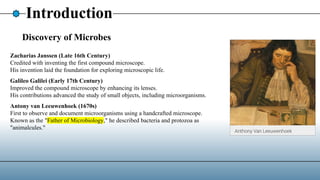
Antony van Leeuwenhoek (1670s)
First to observe and document microorganisms using a handcrafted microscope.
Known as the "Father of Microbiology," he described bacteria and protozoa as
"animalcules."
Microbes
Definition of Microorganisms
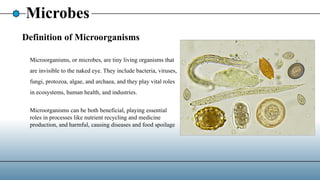
Microorganisms, or microbes, are tiny living organisms that
are invisible to the naked eye. They include bacteria, viruses,
fungi, protozoa, algae, and archaea, and they play vital roles
in ecosystems, human health, and industries.
Microorganisms can be both beneficial, playing essential
roles in processes like nutrient recycling and medicine
production, and harmful, causing diseases and food spoilage
Applications
Importance of Microbes
Microorganisms are crucial for life on Earth. They aid in
nutrient cycling, such as nitrogen fixation in soil,
decompose organic matter, produce oxygen, and form the
basis of many food chains. In human industries, they are
used to make antibiotics, vaccines, and fermented foods,
while also being vital for biotechnology and
environmental cleanup.
Classification
Nomenclature of Microbes
The naming of microorganisms follows a standardized system known as binomial nomenclature, where each
organism is given a two-part scientific name. The first part is the genus (capitalized) and the second part is the
species (lowercase). This system ensures that each microbe has a unique and universally recognized name. For
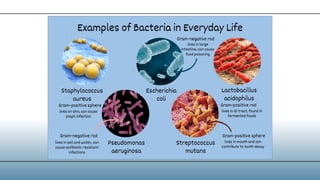
example, Escherichia coli is the scientific name for the bacterium commonly found in the intestines.
The Three Domains of Life
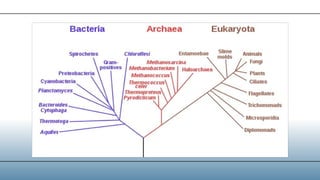
Carl Woese, a prominent microbiologist, revolutionized the classification of life by introducing the Three-Domain
System. This system categorizes all life forms into three primary domains based on genetic differences:
1.Bacteria: Single-celled, prokaryotic organisms, with a simple cell structure. They are found in a wide range of
environments and include both harmful and beneficial species.
2.Archaea: Also prokaryotic but genetically distinct from bacteria, archaea often thrive in extreme environments like
hot springs or deep-sea vents.
3.Eukarya: Organisms with complex cells, including fungi, plants, animals, and protists.
Carl Woese's groundbreaking work in the 1970s, using ribosomal RNA sequences, helped distinguish archaea from
bacteria and led to the establishment of the Three-Domain System, which has become the standard in modern
microbial classification.
Domain Bacteria
Basic Principles
1.Definition
Bacteria are unicellular, prokaryotic microorganisms that lack a defined nucleus and other membrane-bound
organelles. They are found in nearly every environment on Earth, including soil, water, and the human body.
2.Shape and Structure
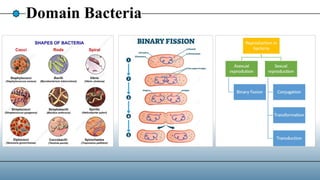
Bacteria come in various shapes, including:
1. Cocci (spherical)
2. Bacilli (rod-shaped)
3. Spirilla (spiral-shaped)
Their cell walls are made of peptidoglycan, and some may have additional structures like flagella or pili for
movement and attachment.
3.Reproduction
Bacteria reproduce primarily through binary fission, a form of asexual reproduction where a single bacterial cell
divides into two identical daughter cells.
Domain Bacteria
Domain Bacteria
Role in Health and Disease
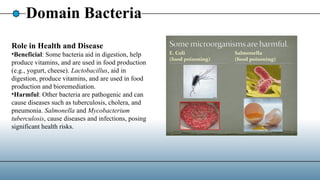
•Beneficial: Some bacteria aid in digestion, help
produce vitamins, and are used in food production
(e.g., yogurt, cheese). Lactobacillus, aid in
digestion, produce vitamins, and are used in food
production and bioremediation.
•Harmful: Other bacteria are pathogenic and can
cause diseases such as tuberculosis, cholera, and
pneumonia. Salmonella and Mycobacterium
tuberculosis, cause diseases and infections, posing
significant health risks.
Domain Archaea
Archaea: Basic Principles
1.Definition
Archaea are single-celled, prokaryotic microorganisms that are genetically distinct from bacteria.
Though they share similarities with bacteria in being unicellular and lacking a nucleus, archaea
have unique biochemical and genetic characteristics that set them apart.
2.Structure
Like bacteria, archaea lack a defined nucleus, but their cell membrane and genetic sequences differ
significantly from those of bacteria. The cell walls of archaea do not contain peptidoglycan, which
is present in bacteria, but instead consist of unique compounds like pseudomurein or S-layer
proteins.
3.Environment
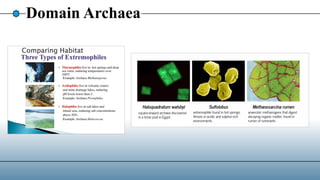
Archaea are often found in extreme environments, such as hot springs, deep-sea hydrothermal
vents, and highly saline or acidic environments, though they can also be found in more moderate
habitats. They are known for their resilience in extreme conditions, earning them the nickname
"extremophiles."
Domain Archaea
Classification of Archaea
Archaea are classified into several groups based on their metabolic activities, environmental niches, and genetic
characteristics. The major groups include:
1.Methanogens
1. Produce methane gas as a byproduct of metabolism.
2. Found in anaerobic environments, such as the intestines of animals, wetlands, and sewage treatment
plants.
2.Halophiles
1. Thrive in highly saline environments like salt lakes and salt mines.
2. Some species can even survive in environments with salt concentrations much higher than that of
seawater.
3.Thermophiles
1. Live in extremely hot environments, such as hot springs, hydrothermal vents, and deep-sea volcanoes.
2. They are capable of surviving temperatures above the boiling point of water.
4.Acidophiles
1. Prefer acidic environments, such as sulfuric hot springs and acidic lakes.
2. These archaea can tolerate low pH levels that would be harmful to most other organisms.
Domain Archaea
Group Fungus
Fungi: Basic Principles
1.Definition
Fungi are eukaryotic organisms that include yeasts, molds, and
mushrooms. Unlike plants, fungi do not perform photosynthesis;
they absorb nutrients from other organic matter. They play crucial
roles in decomposition and nutrient cycling.
2.Structure
Fungi are made up of cells with a cell wall composed of chitin,
rather than cellulose as in plants. They can exist as single cells (like
yeasts) or multicellular organisms (like molds and mushrooms).
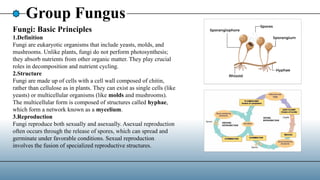
The multicellular form is composed of structures called hyphae,
which form a network known as a mycelium.
3.Reproduction
Fungi reproduce both sexually and asexually. Asexual reproduction
often occurs through the release of spores, which can spread and
germinate under favorable conditions. Sexual reproduction
involves the fusion of specialized reproductive structures.
Group Fungus
•Role in Ecosystems
Fungi are primary decomposers in ecosystems, breaking down dead organic
material and recycling nutrients back into the environment. They also form
symbiotic relationships, such as mycorrhizae with plants, aiding in
nutrient absorption.
•Importance in Industry
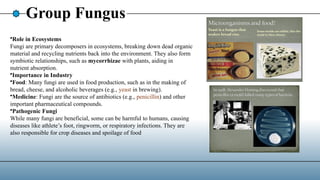
•Food: Many fungi are used in food production, such as in the making of
bread, cheese, and alcoholic beverages (e.g., yeast in brewing).
•Medicine: Fungi are the source of antibiotics (e.g., penicillin) and other
important pharmaceutical compounds.
•Pathogenic Fungi
While many fungi are beneficial, some can be harmful to humans, causing
diseases like athlete’s foot, ringworm, or respiratory infections. They are
also responsible for crop diseases and spoilage of food
Group Algae
1.Definition
Algae are a diverse group of photosynthetic organisms that
live in aquatic or moist environments. They range from
microscopic single-celled forms, like Chlorella, to large
multicellular forms, like seaweed. Unlike plants, algae
lack true roots, stems, and leaves.
2.Structure
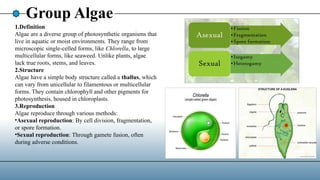
Algae have a simple body structure called a thallus, which
can vary from unicellular to filamentous or multicellular
forms. They contain chlorophyll and other pigments for
photosynthesis, housed in chloroplasts.
3.Reproduction
Algae reproduce through various methods:
•Asexual reproduction: By cell division, fragmentation,
or spore formation.
•Sexual reproduction: Through gamete fusion, often
during adverse conditions.
Group Algae
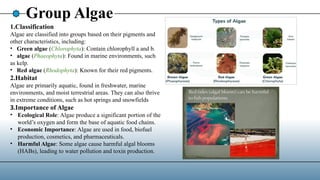
1.Classification
Algae are classified into groups based on their pigments and
other characteristics, including:
• Green algae (Chlorophyta): Contain chlorophyll a and b.
• algae (Phaeophyta): Found in marine environments, such
as kelp.
• Red algae (Rhodophyta): Known for their red pigments.
2.Habitat
Algae are primarily aquatic, found in freshwater, marine
environments, and moist terrestrial areas. They can also thrive
in extreme conditions, such as hot springs and snowfields
3.Importance of Algae
• Ecological Role: Algae produce a significant portion of the
world’s oxygen and form the base of aquatic food chains.
• Economic Importance: Algae are used in food, biofuel
production, cosmetics, and pharmaceuticals.
• Harmful Algae: Some algae cause harmful algal blooms
(HABs), leading to water pollution and toxin production.
Group Protozoa
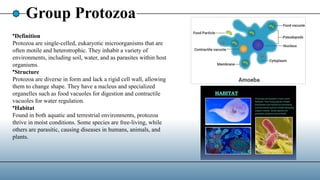
•Definition
Protozoa are single-celled, eukaryotic microorganisms that are
often motile and heterotrophic. They inhabit a variety of
environments, including soil, water, and as parasites within host
organisms.
•Structure
Protozoa are diverse in form and lack a rigid cell wall, allowing
them to change shape. They have a nucleus and specialized
organelles such as food vacuoles for digestion and contractile
vacuoles for water regulation.
•Habitat
Found in both aquatic and terrestrial environments, protozoa
thrive in moist conditions. Some species are free-living, while
others are parasitic, causing diseases in humans, animals, and
plants.
Group Virus
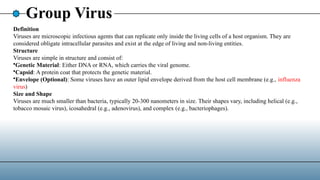
Definition
Viruses are microscopic infectious agents that can replicate only inside the living cells of a host organism. They are
considered obligate intracellular parasites and exist at the edge of living and non-living entities.
Structure
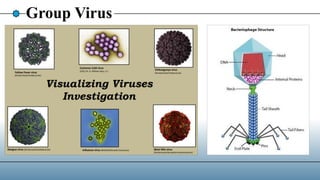
Viruses are simple in structure and consist of:
•Genetic Material: Either DNA or RNA, which carries the viral genome.
•Capsid: A protein coat that protects the genetic material.
•Envelope (Optional): Some viruses have an outer lipid envelope derived from the host cell membrane (e.g., influenza
virus)
Size and Shape
Viruses are much smaller than bacteria, typically 20-300 nanometers in size. Their shapes vary, including helical (e.g.,
tobacco mosaic virus), icosahedral (e.g., adenovirus), and complex (e.g., bacteriophages).
Group Virus
Group Virus
Prions
1.Definition
Prions are infectious protein particles that cause diseases in animals and humans by inducing abnormal folding of
specific proteins in the brain. They lack nucleic acids (DNA or RNA), making them unique among infectious
agents.
2.Characteristics
1. Prions are resistant to heat, radiation, and chemical treatments that typically destroy other pathogens.
2. They cause degenerative neurological disorders called transmissible spongiform encephalopathies
(TSEs), such as Mad Cow desease.
Viroids
3.Definition
Viroids are the smallest known infectious agents, consisting solely of a short strand of circular RNA without a
protein coat. They primarily infect plants.
THANK YOU

Groups of Microorganisms: Exploring Microorganisms and Their Impact

  • 1.
    GROUPS OF MICROORGANISMS Microorganisms: TheInvisible Architects of Life By: M.Umar A Department of Biotechnology
  • 2.
    Introduction Discovery of Microbes ZachariasJanssen (Late 16th Century) Credited with inventing the first compound microscope. His invention laid the foundation for exploring microscopic life. Galileo Galilei (Early 17th Century) Improved the compound microscope by enhancing its lenses. His contributions advanced the study of small objects, including microorganisms. Antony van Leeuwenhoek (1670s) First to observe and document microorganisms using a handcrafted microscope. Known as the "Father of Microbiology," he described bacteria and protozoa as "animalcules."
  • 3.
    Microbes Definition of Microorganisms Microorganisms,or microbes, are tiny living organisms that are invisible to the naked eye. They include bacteria, viruses, fungi, protozoa, algae, and archaea, and they play vital roles in ecosystems, human health, and industries. Microorganisms can be both beneficial, playing essential roles in processes like nutrient recycling and medicine production, and harmful, causing diseases and food spoilage
  • 5.
    Applications Importance of Microbes Microorganismsare crucial for life on Earth. They aid in nutrient cycling, such as nitrogen fixation in soil, decompose organic matter, produce oxygen, and form the basis of many food chains. In human industries, they are used to make antibiotics, vaccines, and fermented foods, while also being vital for biotechnology and environmental cleanup.
  • 6.
    Classification Nomenclature of Microbes Thenaming of microorganisms follows a standardized system known as binomial nomenclature, where each organism is given a two-part scientific name. The first part is the genus (capitalized) and the second part is the species (lowercase). This system ensures that each microbe has a unique and universally recognized name. For example, Escherichia coli is the scientific name for the bacterium commonly found in the intestines. The Three Domains of Life Carl Woese, a prominent microbiologist, revolutionized the classification of life by introducing the Three-Domain System. This system categorizes all life forms into three primary domains based on genetic differences: 1.Bacteria: Single-celled, prokaryotic organisms, with a simple cell structure. They are found in a wide range of environments and include both harmful and beneficial species. 2.Archaea: Also prokaryotic but genetically distinct from bacteria, archaea often thrive in extreme environments like hot springs or deep-sea vents. 3.Eukarya: Organisms with complex cells, including fungi, plants, animals, and protists. Carl Woese's groundbreaking work in the 1970s, using ribosomal RNA sequences, helped distinguish archaea from bacteria and led to the establishment of the Three-Domain System, which has become the standard in modern microbial classification.
  • 9.
    Domain Bacteria Basic Principles 1.Definition Bacteriaare unicellular, prokaryotic microorganisms that lack a defined nucleus and other membrane-bound organelles. They are found in nearly every environment on Earth, including soil, water, and the human body. 2.Shape and Structure Bacteria come in various shapes, including: 1. Cocci (spherical) 2. Bacilli (rod-shaped) 3. Spirilla (spiral-shaped) Their cell walls are made of peptidoglycan, and some may have additional structures like flagella or pili for movement and attachment. 3.Reproduction Bacteria reproduce primarily through binary fission, a form of asexual reproduction where a single bacterial cell divides into two identical daughter cells.
  • 10.
  • 11.
    Domain Bacteria Role inHealth and Disease •Beneficial: Some bacteria aid in digestion, help produce vitamins, and are used in food production (e.g., yogurt, cheese). Lactobacillus, aid in digestion, produce vitamins, and are used in food production and bioremediation. •Harmful: Other bacteria are pathogenic and can cause diseases such as tuberculosis, cholera, and pneumonia. Salmonella and Mycobacterium tuberculosis, cause diseases and infections, posing significant health risks.
  • 12.
    Domain Archaea Archaea: BasicPrinciples 1.Definition Archaea are single-celled, prokaryotic microorganisms that are genetically distinct from bacteria. Though they share similarities with bacteria in being unicellular and lacking a nucleus, archaea have unique biochemical and genetic characteristics that set them apart. 2.Structure Like bacteria, archaea lack a defined nucleus, but their cell membrane and genetic sequences differ significantly from those of bacteria. The cell walls of archaea do not contain peptidoglycan, which is present in bacteria, but instead consist of unique compounds like pseudomurein or S-layer proteins. 3.Environment Archaea are often found in extreme environments, such as hot springs, deep-sea hydrothermal vents, and highly saline or acidic environments, though they can also be found in more moderate habitats. They are known for their resilience in extreme conditions, earning them the nickname "extremophiles."
  • 13.
    Domain Archaea Classification ofArchaea Archaea are classified into several groups based on their metabolic activities, environmental niches, and genetic characteristics. The major groups include: 1.Methanogens 1. Produce methane gas as a byproduct of metabolism. 2. Found in anaerobic environments, such as the intestines of animals, wetlands, and sewage treatment plants. 2.Halophiles 1. Thrive in highly saline environments like salt lakes and salt mines. 2. Some species can even survive in environments with salt concentrations much higher than that of seawater. 3.Thermophiles 1. Live in extremely hot environments, such as hot springs, hydrothermal vents, and deep-sea volcanoes. 2. They are capable of surviving temperatures above the boiling point of water. 4.Acidophiles 1. Prefer acidic environments, such as sulfuric hot springs and acidic lakes. 2. These archaea can tolerate low pH levels that would be harmful to most other organisms.
  • 14.
  • 15.
    Group Fungus Fungi: BasicPrinciples 1.Definition Fungi are eukaryotic organisms that include yeasts, molds, and mushrooms. Unlike plants, fungi do not perform photosynthesis; they absorb nutrients from other organic matter. They play crucial roles in decomposition and nutrient cycling. 2.Structure Fungi are made up of cells with a cell wall composed of chitin, rather than cellulose as in plants. They can exist as single cells (like yeasts) or multicellular organisms (like molds and mushrooms). The multicellular form is composed of structures called hyphae, which form a network known as a mycelium. 3.Reproduction Fungi reproduce both sexually and asexually. Asexual reproduction often occurs through the release of spores, which can spread and germinate under favorable conditions. Sexual reproduction involves the fusion of specialized reproductive structures.
  • 16.
    Group Fungus •Role inEcosystems Fungi are primary decomposers in ecosystems, breaking down dead organic material and recycling nutrients back into the environment. They also form symbiotic relationships, such as mycorrhizae with plants, aiding in nutrient absorption. •Importance in Industry •Food: Many fungi are used in food production, such as in the making of bread, cheese, and alcoholic beverages (e.g., yeast in brewing). •Medicine: Fungi are the source of antibiotics (e.g., penicillin) and other important pharmaceutical compounds. •Pathogenic Fungi While many fungi are beneficial, some can be harmful to humans, causing diseases like athlete’s foot, ringworm, or respiratory infections. They are also responsible for crop diseases and spoilage of food
  • 17.
    Group Algae 1.Definition Algae area diverse group of photosynthetic organisms that live in aquatic or moist environments. They range from microscopic single-celled forms, like Chlorella, to large multicellular forms, like seaweed. Unlike plants, algae lack true roots, stems, and leaves. 2.Structure Algae have a simple body structure called a thallus, which can vary from unicellular to filamentous or multicellular forms. They contain chlorophyll and other pigments for photosynthesis, housed in chloroplasts. 3.Reproduction Algae reproduce through various methods: •Asexual reproduction: By cell division, fragmentation, or spore formation. •Sexual reproduction: Through gamete fusion, often during adverse conditions.
  • 18.
    Group Algae 1.Classification Algae areclassified into groups based on their pigments and other characteristics, including: • Green algae (Chlorophyta): Contain chlorophyll a and b. • algae (Phaeophyta): Found in marine environments, such as kelp. • Red algae (Rhodophyta): Known for their red pigments. 2.Habitat Algae are primarily aquatic, found in freshwater, marine environments, and moist terrestrial areas. They can also thrive in extreme conditions, such as hot springs and snowfields 3.Importance of Algae • Ecological Role: Algae produce a significant portion of the world’s oxygen and form the base of aquatic food chains. • Economic Importance: Algae are used in food, biofuel production, cosmetics, and pharmaceuticals. • Harmful Algae: Some algae cause harmful algal blooms (HABs), leading to water pollution and toxin production.
  • 19.
    Group Protozoa •Definition Protozoa aresingle-celled, eukaryotic microorganisms that are often motile and heterotrophic. They inhabit a variety of environments, including soil, water, and as parasites within host organisms. •Structure Protozoa are diverse in form and lack a rigid cell wall, allowing them to change shape. They have a nucleus and specialized organelles such as food vacuoles for digestion and contractile vacuoles for water regulation. •Habitat Found in both aquatic and terrestrial environments, protozoa thrive in moist conditions. Some species are free-living, while others are parasitic, causing diseases in humans, animals, and plants.
  • 20.
    Group Virus Definition Viruses aremicroscopic infectious agents that can replicate only inside the living cells of a host organism. They are considered obligate intracellular parasites and exist at the edge of living and non-living entities. Structure Viruses are simple in structure and consist of: •Genetic Material: Either DNA or RNA, which carries the viral genome. •Capsid: A protein coat that protects the genetic material. •Envelope (Optional): Some viruses have an outer lipid envelope derived from the host cell membrane (e.g., influenza virus) Size and Shape Viruses are much smaller than bacteria, typically 20-300 nanometers in size. Their shapes vary, including helical (e.g., tobacco mosaic virus), icosahedral (e.g., adenovirus), and complex (e.g., bacteriophages).
  • 21.
  • 22.
    Group Virus Prions 1.Definition Prions areinfectious protein particles that cause diseases in animals and humans by inducing abnormal folding of specific proteins in the brain. They lack nucleic acids (DNA or RNA), making them unique among infectious agents. 2.Characteristics 1. Prions are resistant to heat, radiation, and chemical treatments that typically destroy other pathogens. 2. They cause degenerative neurological disorders called transmissible spongiform encephalopathies (TSEs), such as Mad Cow desease. Viroids 3.Definition Viroids are the smallest known infectious agents, consisting solely of a short strand of circular RNA without a protein coat. They primarily infect plants.
  • 23.