Drugs containing
essential oils
Introduction
• Volatile oils constitute the most important odorous principles found in the
different plant parts. Because they evaporate at ordinary temperatures , on
exposure to air & Volatile in steam, they are called “volatile oils”, “ethereal
oils” or essential oils”.
• Volatile oils differ from fixed oils in both chemical and physical
characters: Volatile oils being capable of volatilization, so they can be distilled
from their natural sources.
• They don’t become rancid as fixed oils, but instead on exposure to light and
air, they will be oxidized and resinified.
They give red color with Sudan III.
• They are described as "volatile" or "etherial" oils to
indicate that they easily evaporate on exposure to air at
room temperature (volatile, from the Latin "volare" i.e. to
fly).
• They are also known as "essential oils" after the Latin word
"essentia", which means a liquid easily changed to a gas
and most probably because they represent the "essences"
or odoriferous principals of the plants.
• They are generally mixtures formed of hydrocarbons
( terpenes) and their oxygenated derivatives. They differ
entirely from "fixed" oils in both chemical and physical
properties.
AROMATHERAPY
• "Aromatherapy" is a branch of complementary
medicine, that uses essential oils for the
purpose of affecting a person's mood or
health.
• Essential oils can be massaged into the skin (the most
effective way of application), inhaled, added to bath water or
as compresses or poultices. They may cause damage to the
sensitive mucous membranes and skin, when used undiluted
externally.
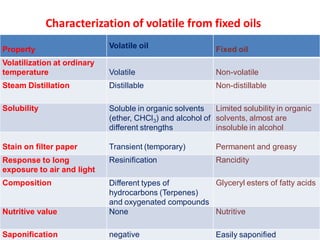
Characterization of volatile from fixed oils
Property Volatile oil Fixed oil
Volatilization at ordinary
temperature Volatile Non-volatile
Steam Distillation Distillable Non-distillable
Solubility Soluble in organic solvents
(ether, CHCl3) and alcohol of
different strengths
Limited solubility in organic
solvents, almost are
insoluble in alcohol
Stain on filter paper Transient (temporary) Permanent and greasy
Response to long
exposure to air and light
Resinification Rancidity
Composition Different types of
hydrocarbons (Terpenes)
and oxygenated compounds
Glyceryl esters of fatty acids
Nutritive value None Nutritive
Saponification negative Easily saponified
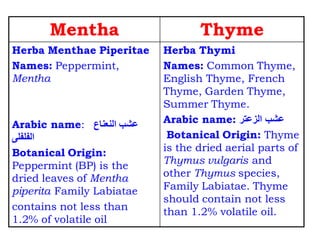
ThymeMentha
Herba Thymi
Names: Common Thyme,
English Thyme, French
Thyme, Garden Thyme,
Summer Thyme.
Arabic name: ‫عشب‬‫الزعتر‬
Botanical Origin: Thyme
is the dried aerial parts of
Thymus vulgaris and
other Thymus species,
Family Labiatae. Thyme
should contain not less
than 1.2% volatile oil.
Herba Menthae Piperitae
Names: Peppermint,
Mentha
Arabic name: ‫النعناع‬ ‫عشب‬
‫الفلفلى‬
Botanical Origin:
Peppermint (BP) is the
dried leaves of Mentha
piperita Family Labiatae
contains not less than
1.2% of volatile oil
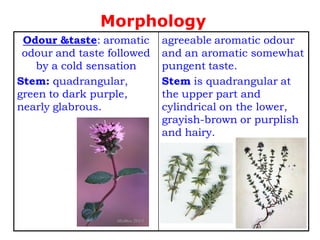
agreeable aromatic odour
and an aromatic somewhat
pungent taste.
Stem is quadrangular at
the upper part and
cylindrical on the lower,
grayish-brown or purplish
and hairy.
Odour &taste: aromatic
odour and taste followed
by a cold sensation
Stem: quadrangular,
green to dark purple,
nearly glabrous.
Morphology
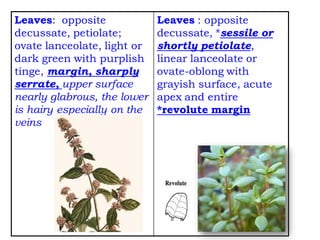
Leaves : opposite
decussate, *sessile or
shortly petiolate,
linear lanceolate or
ovate-oblong with
grayish surface, acute
apex and entire
*revolute margin
Leaves: opposite
decussate, petiolate;
ovate lanceolate, light or
dark green with purplish
tinge, margin, sharply
serrate, upper surface
nearly glabrous, the lower
is hairy especially on the
veins
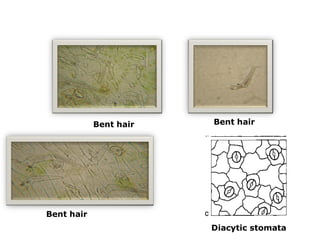
Bent hair
Bent hair
Bent hair
Diacytic stomata
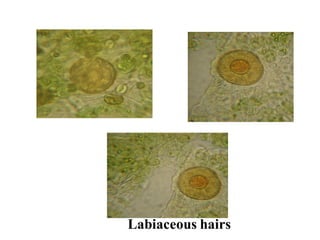
Labiaceous hairs
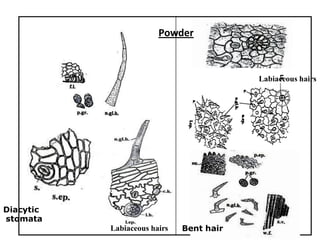
Powder
Diacytic
stomata
Labiaceous hairs
Labiaceous hairs
Bent hair
Active ConstituentsActive Constituents
*Thyme contains volatile
oil (containing phenolic
compounds, mainly
thymol and carvacrol).
- Tannins and
flavonoids.
*The chief constituent
of peppermint is
volatile oil, which
contains up to 78% of
free menthol and up to
20% of menthol
combined as esters.
-The drug also contains
about 6 to 12% of
tannins& flavonoids.
Uses(Thyme)Uses (Mentha)
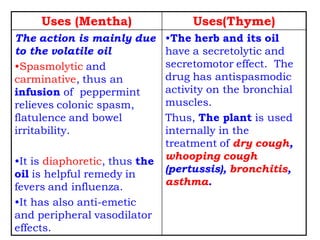
•The herb and its oil
have a secretolytic and
secretomotor effect. The
drug has antispasmodic
activity on the bronchial
muscles.
Thus, The plant is used
internally in the
treatment of dry cough,
whooping cough
(pertussis), bronchitis,
asthma.
The action is mainly due
to the volatile oil
•Spasmolytic and
carminative, thus an
infusion of peppermint
relieves colonic spasm,
flatulence and bowel
irritability.
•It is diaphoretic, thus the
oil is helpful remedy in
fevers and influenza.
•It has also anti-emetic
and peripheral vasodilator
effects.
Uses (Thyme)Uses (Mentha)
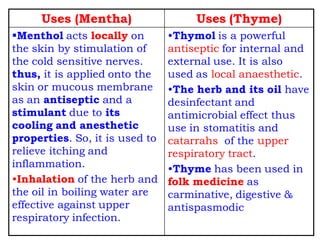
•Thymol is a powerful
antiseptic for internal and
external use. It is also
used as local anaesthetic.
•The herb and its oil have
desinfectant and
antimicrobial effect thus
use in stomatitis and
catarrahs of the upper
respiratory tract.
•Thyme has been used in
folk medicine as
carminative, digestive &
antispasmodic
Menthol acts locally on
the skin by stimulation of
the cold sensitive nerves.
thus, it is applied onto the
skin or mucous membrane
as an antiseptic and a
stimulant due to its
cooling and anesthetic
properties. So, it is used to
relieve itching and
inflammation.
•Inhalation of the herb and
the oil in boiling water are
effective against upper
respiratory infection.
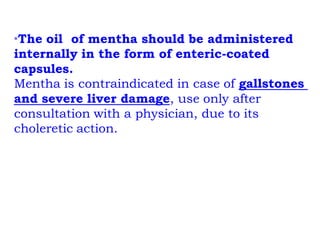
*The oil of mentha should be administered
internally in the form of enteric-coated
capsules.
gallstonesMentha is contraindicated in case of
, use only afterand severe liver damage
consultation with a physician, due to its
choleretic action.
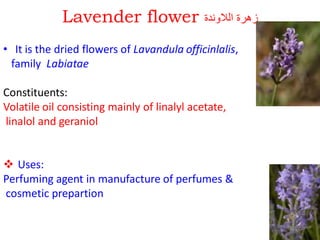
Lavender flower ‫الالوندة‬ ‫زهرة‬
• It is the dried flowers of Lavandula officinlalis,
family Labiatae
Constituents:
Volatile oil consisting mainly of linalyl acetate,
linalol and geraniol
 Uses:
Perfuming agent in manufacture of perfumes &
cosmetic prepartion
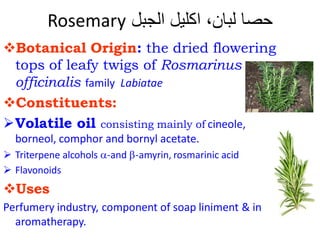
Rosemary ‫الجبل‬ ‫اكليل‬ ،‫لبان‬ ‫حصا‬
Botanical Origin: the dried flowering
tops of leafy twigs of Rosmarinus
officinalis family Labiatae
Constituents:
Volatile oil consisting mainly of cineole,
borneol, comphor and bornyl acetate.
 Triterpene alcohols a-and b-amyrin, rosmarinic acid
 Flavonoids
Uses
Perfumery industry, component of soap liniment & in
aromatherapy.
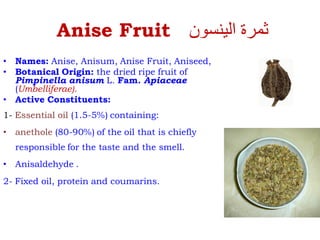
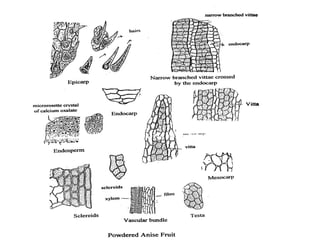
Anise Fruit ‫الينسون‬ ‫ثمرة‬
• Names: Anise, Anisum, Anise Fruit, Aniseed,
• Botanical Origin: the dried ripe fruit of
Pimpinella anisum L. Fam. Apiaceae
(Umbelliferae).
• Active Constituents:
1- Essential oil (1.5-5%) containing:
• anethole (80-90%) of the oil that is chiefly
responsible for the taste and the smell.
• Anisaldehyde .
2- Fixed oil, protein and coumarins.
Uses
• Expectorant and carminative on account of the secretolytic,
spasmolytic and secretomotor effects of its essential oil
(like fennel).
• relieving colic in children.
• in hard dry cough where expectoration is difficult. So, it
may be used in bronchitis in case of persistent irritable
coughing and in whooping cough.
• It has a sedative action.
• In folk medicine, it is used as lactagauge & emmenagauge.
• The oil is also employed in food and drink industry as
flavor enhancer.
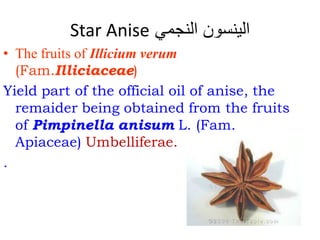
Star Anise ‫النجمي‬ ‫الينسون‬
• The fruits of Illicium verum
(Fam.Illiciaceae)
Yield part of the official oil of anise, the
remaider being obtained from the fruits
of Pimpinella anisum L. (Fam.
Apiaceae) Umbelliferae.
.
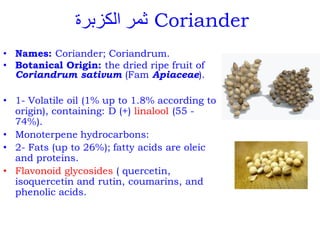
‫الكزبرة‬ ‫ثمر‬ Coriander
• Names: Coriander; Coriandrum.
• Botanical Origin: the dried ripe fruit of
Coriandrum sativum (Fam Apiaceae).
• 1- Volatile oil (1% up to 1.8% according to
origin), containing: D (+) linalool (55 -
74%).
• Monoterpene hydrocarbons:
• 2- Fats (up to 26%); fatty acids are oleic
and proteins.
• Flavonoid glycosides ( quercetin,
isoquercetin and rutin, coumarins, and
phenolic acids.
Uses
• used as a spice than a medicine.
• stomachic, spasmolytic, carminative and flavouring
agent.
• It has bactericidal and fungicidal properties.
• It is useful for sub-acid gastritis, diarrhea and
dyspepsia of various origins.
• It has strong lipolytic activity.
• It is added to purgative preparations of Rhubarb,
Frangula, Cascara and Senna to prevent the
gripping effect that occurs when anthraquinone
drugs are used.
• The high percent of fats and protein make
distillation residues suitable for animal feed.
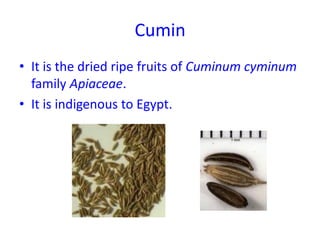
Cumin
• It is the dried ripe fruits of Cuminum cyminum
family Apiaceae.
• It is indigenous to Egypt.
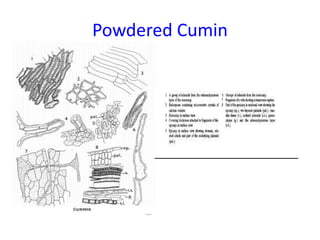
Powdered Cumin
Active Constituents
• The fruits contains about 2.5-4% of Volatile
oil, consisting mainly of cuminic aldehyde (25-
35%), pinine & α-terpeniol.
Uses
• Cumin is one of the commonest spices.
• It is used in folk medicine as an antispasmodic.
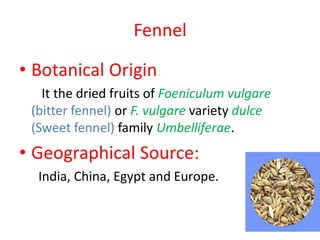
Fennel
• Botanical Origin:
It the dried fruits of Foeniculum vulgare
(bitter fennel) or F. vulgare variety dulce
(Sweet fennel) family Umbelliferae.
• Geographical Source:
India, China, Egypt and Europe.
Powdered Fennel
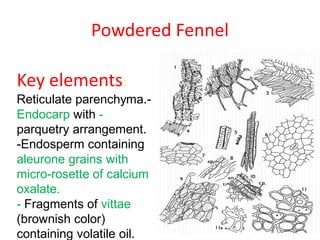
Key elements:
-Reticulate parenchyma.
-Endocarp with
parquetry arrangement.
-Endosperm containing
aleurone grains with
micro-rosette of calcium
oxalate.
- Fragments of vittae
(brownish color)
containing volatile oil.
Active Constituents
• Volatile oil:(1-4% in the bitter fennel & 2% in
sweet fennel), the main constituents of which
is anethole (60%) and fenchone(30%).
Therapeutic Uses
• Carminative
• Aromatic flavoring
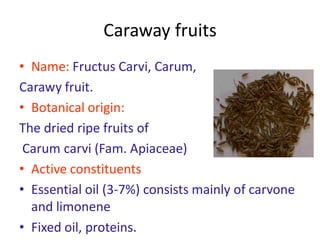
Caraway fruits
• Name: Fructus Carvi, Carum,
Carawy fruit.
• Botanical origin:
The dried ripe fruits of
Carum carvi (Fam. Apiaceae)
• Active constituents
• Essential oil (3-7%) consists mainly of carvone
and limonene
• Fixed oil, proteins.
uses
• Antispasmodic, carminative & stimulant.
• It is used mainly for stomach complains in
both adults and children.
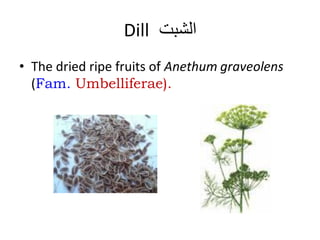
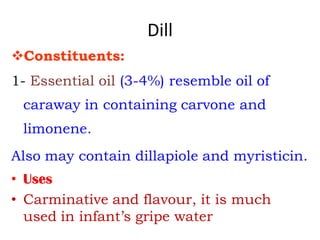
Dill ‫الشبت‬
• The dried ripe fruits of Anethum graveolens
(Fam. Umbelliferae).
Dill
Constituents:
1- Essential oil (3-4%) resemble oil of
caraway in containing carvone and
limonene.
Also may contain dillapiole and myristicin.
• Uses
• Carminative and flavour, it is much
used in infant’s gripe water
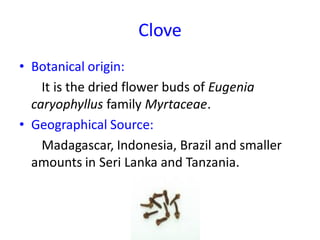
Clove
• Botanical origin:
It is the dried flower buds of Eugenia
caryophyllus family Myrtaceae.
• Geographical Source:
Madagascar, Indonesia, Brazil and smaller
amounts in Seri Lanka and Tanzania.
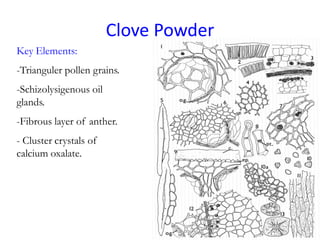
Clove Powder
Key Elements:
-Trianguler pollen grains.
-Schizolysigenous oil
glands.
-Fibrous layer of anther.
- Cluster crystals of
calcium oxalate.
Active Constituents
• Volatile oil (14-20%), the main constituent of
which is the phenolic compounds eugenol,
isoeugenol and acetyl eugenol, in addition to
sesquiterpenes(α- and β-phellandrene).
• Hydrolysable tannin.
Therapeutic Uses
• Stimulant and aromatic flavoring and
antiseptic.
• The oil has local anesthetic effect ( used for
treatment of toothache).
• The sesquiterpenes in oil of clove are cited to
be potential anticarcinogenic compounds.
• Eugenol is used for the preparation of vanillin.
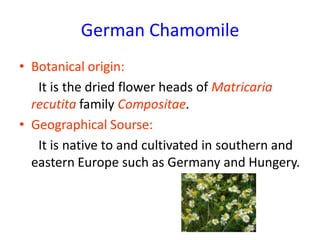
German Chamomile
• Botanical origin:
It is the dried flower heads of Matricaria
recutita family Compositae.
• Geographical Sourse:
It is native to and cultivated in southern and
eastern Europe such as Germany and Hungery.
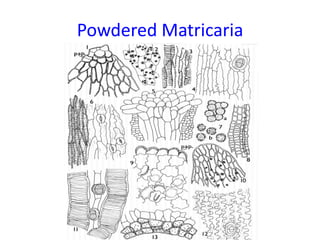
Powdered Matricaria
Active Constituents
• Volatile Oil (0.4%)blue in color due to the
presence of chamazulene {which is formed
from a sesquiterpene lactone (maticin) during
steam distillation} found in the oil together
with other sesquiterpenes (bisabolol and
farnesene.
• Apigenin flavonoid.
• Coumarins.
Therapeutic Uses
• Antispasmodic for digestive disorders.
• Anti-inflammatory in skin preparations.
• It has an ulcer-protective properties (due to
the bisabolol content).
Yarrow
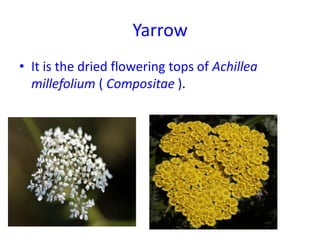
• It is the dried flowering tops of Achillea
millefolium ( Compositae ).
Active Constituents
• Essential oil ( not less than 2% ) containing the
sesquiterpene (chamazulene),caryophylline,
sabinone,α & ß-pinine, borneol, bornyl
acetate, camphor and small quantities of
thujone.
• Sesquiterpene lactones.
• Flavonoids.
• Alkaloids.
Uses
• As chamomile, to treat various skin conditions
and digestive disorders.

Drug containing essencial oils

  • 1.
  • 2.
    Introduction • Volatile oilsconstitute the most important odorous principles found in the different plant parts. Because they evaporate at ordinary temperatures , on exposure to air & Volatile in steam, they are called “volatile oils”, “ethereal oils” or essential oils”. • Volatile oils differ from fixed oils in both chemical and physical characters: Volatile oils being capable of volatilization, so they can be distilled from their natural sources. • They don’t become rancid as fixed oils, but instead on exposure to light and air, they will be oxidized and resinified. They give red color with Sudan III.
  • 3.
    • They aredescribed as "volatile" or "etherial" oils to indicate that they easily evaporate on exposure to air at room temperature (volatile, from the Latin "volare" i.e. to fly). • They are also known as "essential oils" after the Latin word "essentia", which means a liquid easily changed to a gas and most probably because they represent the "essences" or odoriferous principals of the plants. • They are generally mixtures formed of hydrocarbons ( terpenes) and their oxygenated derivatives. They differ entirely from "fixed" oils in both chemical and physical properties.
  • 4.
    AROMATHERAPY • "Aromatherapy" isa branch of complementary medicine, that uses essential oils for the purpose of affecting a person's mood or health. • Essential oils can be massaged into the skin (the most effective way of application), inhaled, added to bath water or as compresses or poultices. They may cause damage to the sensitive mucous membranes and skin, when used undiluted externally.
  • 5.
    Characterization of volatilefrom fixed oils Property Volatile oil Fixed oil Volatilization at ordinary temperature Volatile Non-volatile Steam Distillation Distillable Non-distillable Solubility Soluble in organic solvents (ether, CHCl3) and alcohol of different strengths Limited solubility in organic solvents, almost are insoluble in alcohol Stain on filter paper Transient (temporary) Permanent and greasy Response to long exposure to air and light Resinification Rancidity Composition Different types of hydrocarbons (Terpenes) and oxygenated compounds Glyceryl esters of fatty acids Nutritive value None Nutritive Saponification negative Easily saponified
  • 6.
    ThymeMentha Herba Thymi Names: CommonThyme, English Thyme, French Thyme, Garden Thyme, Summer Thyme. Arabic name: ‫عشب‬‫الزعتر‬ Botanical Origin: Thyme is the dried aerial parts of Thymus vulgaris and other Thymus species, Family Labiatae. Thyme should contain not less than 1.2% volatile oil. Herba Menthae Piperitae Names: Peppermint, Mentha Arabic name: ‫النعناع‬ ‫عشب‬ ‫الفلفلى‬ Botanical Origin: Peppermint (BP) is the dried leaves of Mentha piperita Family Labiatae contains not less than 1.2% of volatile oil
  • 7.
    agreeable aromatic odour andan aromatic somewhat pungent taste. Stem is quadrangular at the upper part and cylindrical on the lower, grayish-brown or purplish and hairy. Odour &taste: aromatic odour and taste followed by a cold sensation Stem: quadrangular, green to dark purple, nearly glabrous. Morphology
  • 8.
    Leaves : opposite decussate,*sessile or shortly petiolate, linear lanceolate or ovate-oblong with grayish surface, acute apex and entire *revolute margin Leaves: opposite decussate, petiolate; ovate lanceolate, light or dark green with purplish tinge, margin, sharply serrate, upper surface nearly glabrous, the lower is hairy especially on the veins
  • 9.
    Bent hair Bent hair Benthair Diacytic stomata
  • 10.
  • 11.
  • 12.
    Active ConstituentsActive Constituents *Thymecontains volatile oil (containing phenolic compounds, mainly thymol and carvacrol). - Tannins and flavonoids. *The chief constituent of peppermint is volatile oil, which contains up to 78% of free menthol and up to 20% of menthol combined as esters. -The drug also contains about 6 to 12% of tannins& flavonoids.
  • 13.
    Uses(Thyme)Uses (Mentha) •The herband its oil have a secretolytic and secretomotor effect. The drug has antispasmodic activity on the bronchial muscles. Thus, The plant is used internally in the treatment of dry cough, whooping cough (pertussis), bronchitis, asthma. The action is mainly due to the volatile oil •Spasmolytic and carminative, thus an infusion of peppermint relieves colonic spasm, flatulence and bowel irritability. •It is diaphoretic, thus the oil is helpful remedy in fevers and influenza. •It has also anti-emetic and peripheral vasodilator effects.
  • 14.
    Uses (Thyme)Uses (Mentha) •Thymolis a powerful antiseptic for internal and external use. It is also used as local anaesthetic. •The herb and its oil have desinfectant and antimicrobial effect thus use in stomatitis and catarrahs of the upper respiratory tract. •Thyme has been used in folk medicine as carminative, digestive & antispasmodic Menthol acts locally on the skin by stimulation of the cold sensitive nerves. thus, it is applied onto the skin or mucous membrane as an antiseptic and a stimulant due to its cooling and anesthetic properties. So, it is used to relieve itching and inflammation. •Inhalation of the herb and the oil in boiling water are effective against upper respiratory infection.
  • 15.
    *The oil ofmentha should be administered internally in the form of enteric-coated capsules. gallstonesMentha is contraindicated in case of , use only afterand severe liver damage consultation with a physician, due to its choleretic action.
  • 16.
    Lavender flower ‫الالوندة‬‫زهرة‬ • It is the dried flowers of Lavandula officinlalis, family Labiatae Constituents: Volatile oil consisting mainly of linalyl acetate, linalol and geraniol  Uses: Perfuming agent in manufacture of perfumes & cosmetic prepartion
  • 17.
    Rosemary ‫الجبل‬ ‫اكليل‬،‫لبان‬ ‫حصا‬ Botanical Origin: the dried flowering tops of leafy twigs of Rosmarinus officinalis family Labiatae Constituents: Volatile oil consisting mainly of cineole, borneol, comphor and bornyl acetate.  Triterpene alcohols a-and b-amyrin, rosmarinic acid  Flavonoids Uses Perfumery industry, component of soap liniment & in aromatherapy.
  • 18.
    Anise Fruit ‫الينسون‬‫ثمرة‬ • Names: Anise, Anisum, Anise Fruit, Aniseed, • Botanical Origin: the dried ripe fruit of Pimpinella anisum L. Fam. Apiaceae (Umbelliferae). • Active Constituents: 1- Essential oil (1.5-5%) containing: • anethole (80-90%) of the oil that is chiefly responsible for the taste and the smell. • Anisaldehyde . 2- Fixed oil, protein and coumarins.
  • 20.
    Uses • Expectorant andcarminative on account of the secretolytic, spasmolytic and secretomotor effects of its essential oil (like fennel). • relieving colic in children. • in hard dry cough where expectoration is difficult. So, it may be used in bronchitis in case of persistent irritable coughing and in whooping cough. • It has a sedative action. • In folk medicine, it is used as lactagauge & emmenagauge. • The oil is also employed in food and drink industry as flavor enhancer.
  • 21.
    Star Anise ‫النجمي‬‫الينسون‬ • The fruits of Illicium verum (Fam.Illiciaceae) Yield part of the official oil of anise, the remaider being obtained from the fruits of Pimpinella anisum L. (Fam. Apiaceae) Umbelliferae. .
  • 22.
    ‫الكزبرة‬ ‫ثمر‬ Coriander •Names: Coriander; Coriandrum. • Botanical Origin: the dried ripe fruit of Coriandrum sativum (Fam Apiaceae). • 1- Volatile oil (1% up to 1.8% according to origin), containing: D (+) linalool (55 - 74%). • Monoterpene hydrocarbons: • 2- Fats (up to 26%); fatty acids are oleic and proteins. • Flavonoid glycosides ( quercetin, isoquercetin and rutin, coumarins, and phenolic acids.
  • 24.
    Uses • used asa spice than a medicine. • stomachic, spasmolytic, carminative and flavouring agent. • It has bactericidal and fungicidal properties. • It is useful for sub-acid gastritis, diarrhea and dyspepsia of various origins. • It has strong lipolytic activity. • It is added to purgative preparations of Rhubarb, Frangula, Cascara and Senna to prevent the gripping effect that occurs when anthraquinone drugs are used. • The high percent of fats and protein make distillation residues suitable for animal feed.
  • 25.
    Cumin • It isthe dried ripe fruits of Cuminum cyminum family Apiaceae. • It is indigenous to Egypt.
  • 26.
  • 27.
    Active Constituents • Thefruits contains about 2.5-4% of Volatile oil, consisting mainly of cuminic aldehyde (25- 35%), pinine & α-terpeniol. Uses • Cumin is one of the commonest spices. • It is used in folk medicine as an antispasmodic.
  • 28.
    Fennel • Botanical Origin: Itthe dried fruits of Foeniculum vulgare (bitter fennel) or F. vulgare variety dulce (Sweet fennel) family Umbelliferae. • Geographical Source: India, China, Egypt and Europe.
  • 29.
    Powdered Fennel Key elements: -Reticulateparenchyma. -Endocarp with parquetry arrangement. -Endosperm containing aleurone grains with micro-rosette of calcium oxalate. - Fragments of vittae (brownish color) containing volatile oil.
  • 30.
    Active Constituents • Volatileoil:(1-4% in the bitter fennel & 2% in sweet fennel), the main constituents of which is anethole (60%) and fenchone(30%). Therapeutic Uses • Carminative • Aromatic flavoring
  • 31.
    Caraway fruits • Name:Fructus Carvi, Carum, Carawy fruit. • Botanical origin: The dried ripe fruits of Carum carvi (Fam. Apiaceae) • Active constituents • Essential oil (3-7%) consists mainly of carvone and limonene • Fixed oil, proteins.
  • 32.
    uses • Antispasmodic, carminative& stimulant. • It is used mainly for stomach complains in both adults and children.
  • 33.
    Dill ‫الشبت‬ • Thedried ripe fruits of Anethum graveolens (Fam. Umbelliferae).
  • 34.
    Dill Constituents: 1- Essential oil(3-4%) resemble oil of caraway in containing carvone and limonene. Also may contain dillapiole and myristicin. • Uses • Carminative and flavour, it is much used in infant’s gripe water
  • 35.
    Clove • Botanical origin: Itis the dried flower buds of Eugenia caryophyllus family Myrtaceae. • Geographical Source: Madagascar, Indonesia, Brazil and smaller amounts in Seri Lanka and Tanzania.
  • 36.
    Clove Powder Key Elements: -Triangulerpollen grains. -Schizolysigenous oil glands. -Fibrous layer of anther. - Cluster crystals of calcium oxalate.
  • 37.
    Active Constituents • Volatileoil (14-20%), the main constituent of which is the phenolic compounds eugenol, isoeugenol and acetyl eugenol, in addition to sesquiterpenes(α- and β-phellandrene). • Hydrolysable tannin.
  • 38.
    Therapeutic Uses • Stimulantand aromatic flavoring and antiseptic. • The oil has local anesthetic effect ( used for treatment of toothache). • The sesquiterpenes in oil of clove are cited to be potential anticarcinogenic compounds. • Eugenol is used for the preparation of vanillin.
  • 39.
    German Chamomile • Botanicalorigin: It is the dried flower heads of Matricaria recutita family Compositae. • Geographical Sourse: It is native to and cultivated in southern and eastern Europe such as Germany and Hungery.
  • 40.
  • 41.
    Active Constituents • VolatileOil (0.4%)blue in color due to the presence of chamazulene {which is formed from a sesquiterpene lactone (maticin) during steam distillation} found in the oil together with other sesquiterpenes (bisabolol and farnesene. • Apigenin flavonoid. • Coumarins.
  • 42.
    Therapeutic Uses • Antispasmodicfor digestive disorders. • Anti-inflammatory in skin preparations. • It has an ulcer-protective properties (due to the bisabolol content).
  • 43.
    Yarrow • It isthe dried flowering tops of Achillea millefolium ( Compositae ).
  • 44.
    Active Constituents • Essentialoil ( not less than 2% ) containing the sesquiterpene (chamazulene),caryophylline, sabinone,α & ß-pinine, borneol, bornyl acetate, camphor and small quantities of thujone. • Sesquiterpene lactones. • Flavonoids. • Alkaloids.
  • 45.
    Uses • As chamomile,to treat various skin conditions and digestive disorders.