Performance of 3 ton/day BFB Gasification
System using Pine Feedstock
Md Waliul Islam1
Prashanth R. Buchireddy1, Ph.D., John L. Guillory1, Ph.D., Mark E. Zappi1, Ph.D.,
Jude Asonganyi1, Robert Bentley1, Derek Richard1
Ben Russo2 and Keith Crump2
1 Energy Institute, University of Louisiana at Lafayette, 2 Cleco Power, LLC.
Objectives
 Optimizing the FBR gasification system to produce clean
energy dense syngas for optimal power generation
 Evaluation of different types of feedstock including Pine,
Willow, and Arundo (Giant Reed).
 Evaluation of tar reforming catalyst
 Improving CO/H2 ratio for gas to liquid production
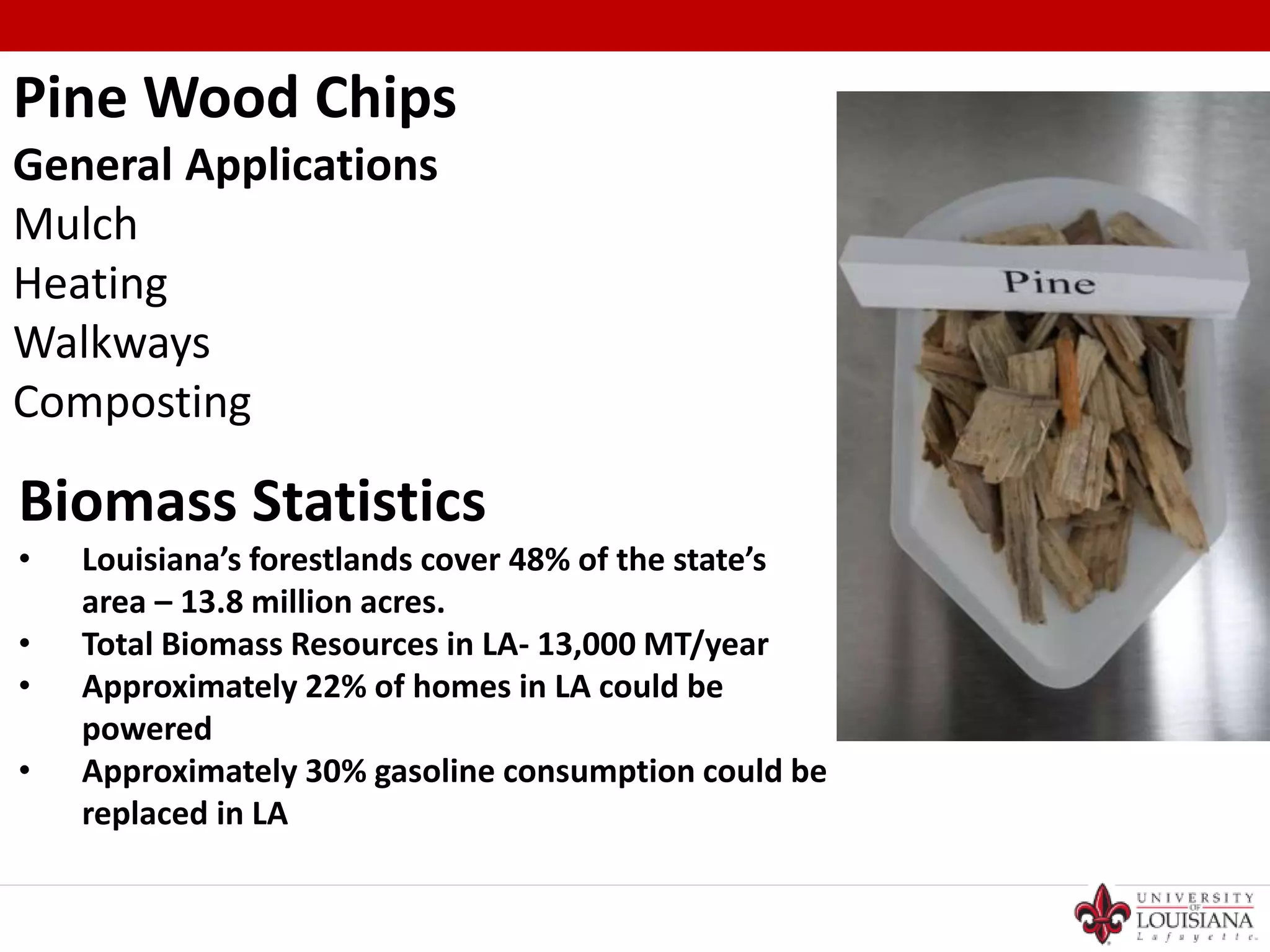
Pine Wood Chips
General Applications
Mulch
Heating
Walkways
Composting
Biomass Statistics
• Louisiana’s forestlands cover 48% of the state’s
area – 13.8 million acres.
• Total Biomass Resources in LA- 13,000 MT/year
• Approximately 22% of homes in LA could be
powered
• Approximately 30% gasoline consumption could be
replaced in LA
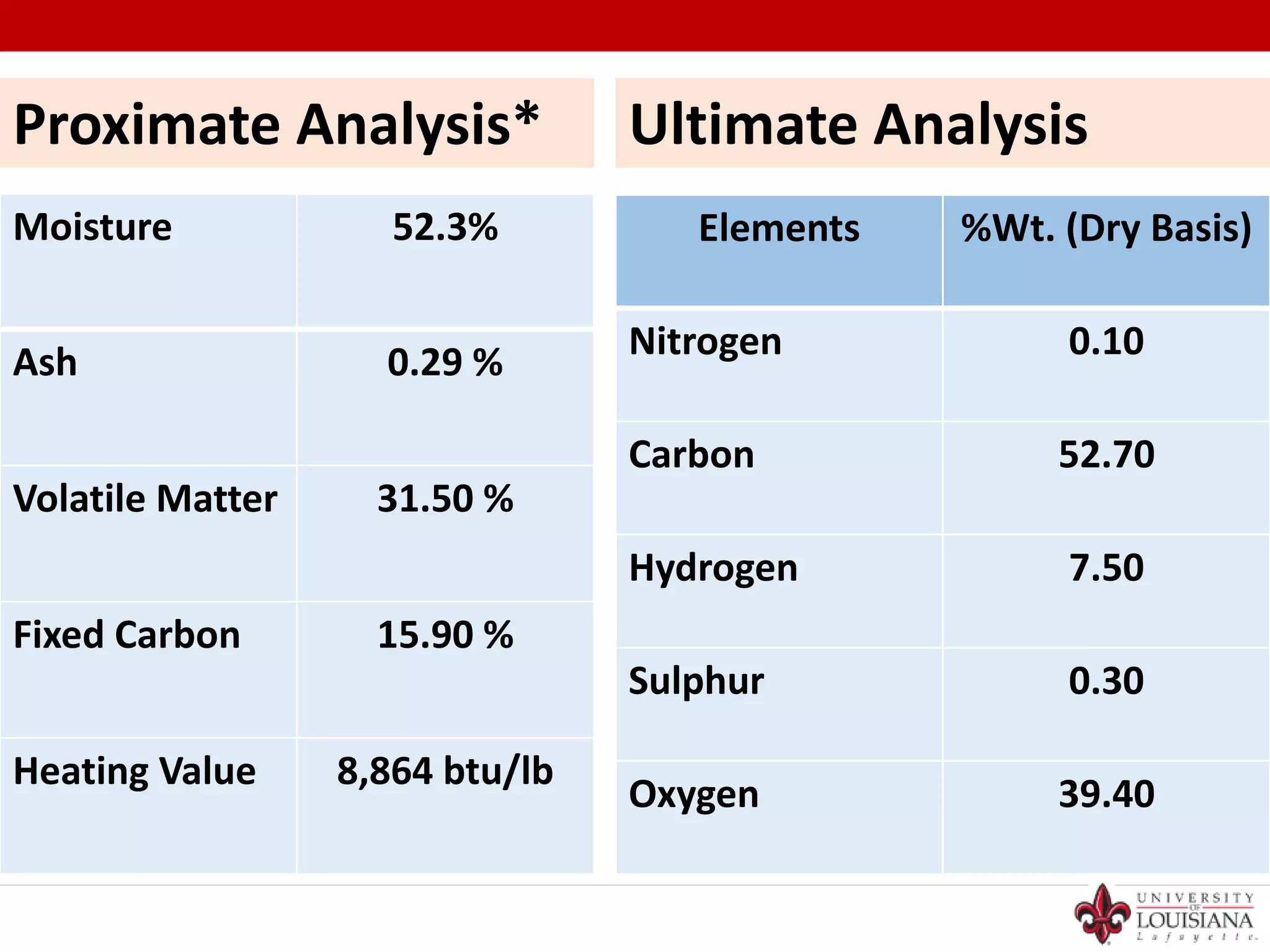
Ultimate Analysis
Elements %Wt. (Dry Basis)
Nitrogen 0.10
Carbon 52.70
Hydrogen 7.50
Sulphur 0.30
Oxygen 39.40
Proximate Analysis*
Moisture 52.3%
Ash 0.29 %
Volatile Matter 31.50 %
Fixed Carbon 15.90 %
Heating Value 8,864 btu/lb
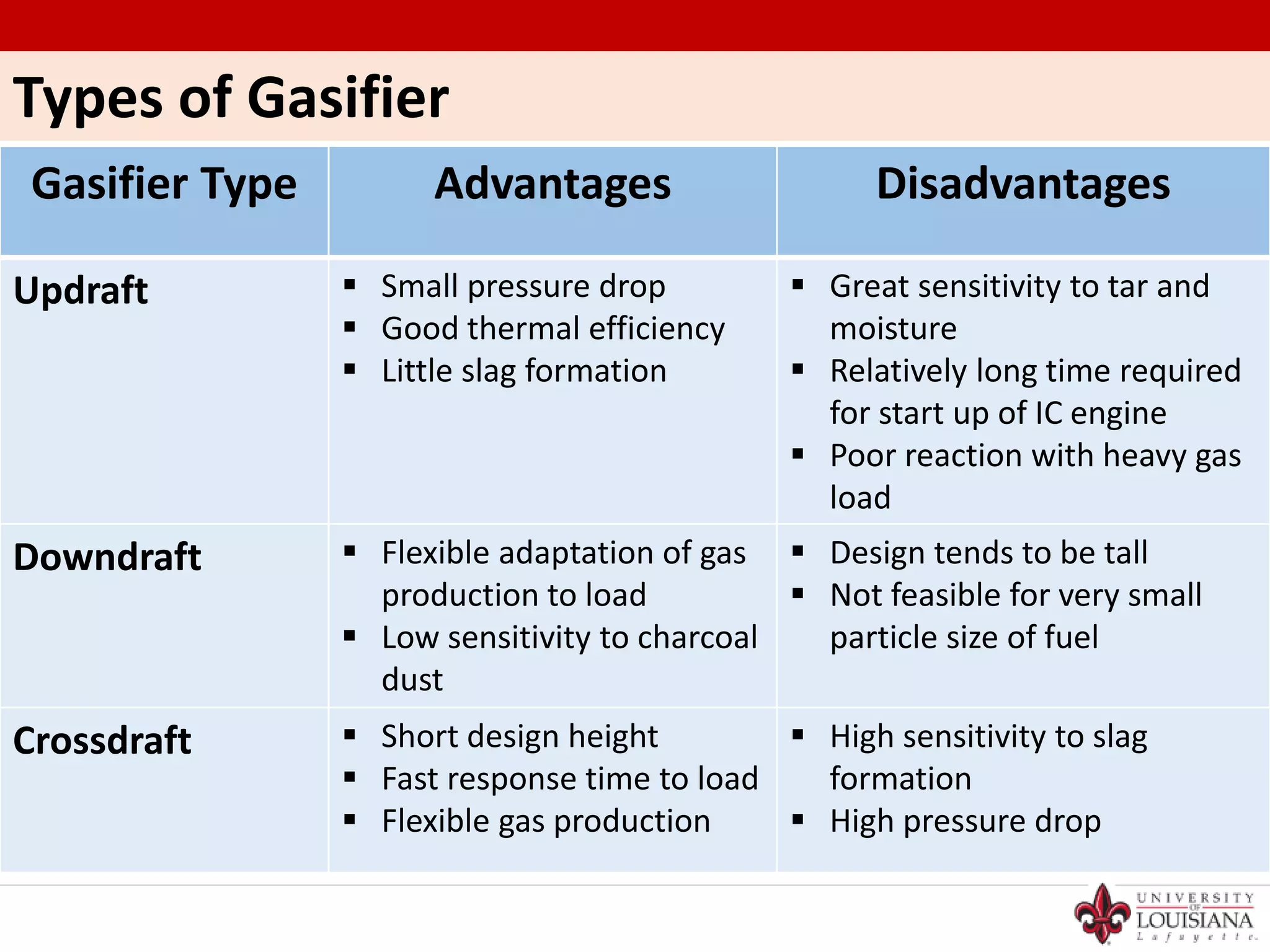
Types of Gasifier
Gasifier Type Advantages Disadvantages
Updraft  Small pressure drop
 Good thermal efficiency
 Little slag formation
 Great sensitivity to tar and
moisture
 Relatively long time required
for start up of IC engine
 Poor reaction with heavy gas
load
Downdraft  Flexible adaptation of gas
production to load
 Low sensitivity to charcoal
dust
 Design tends to be tall
 Not feasible for very small
particle size of fuel
Crossdraft  Short design height
 Fast response time to load
 Flexible gas production
 High sensitivity to slag
formation
 High pressure drop
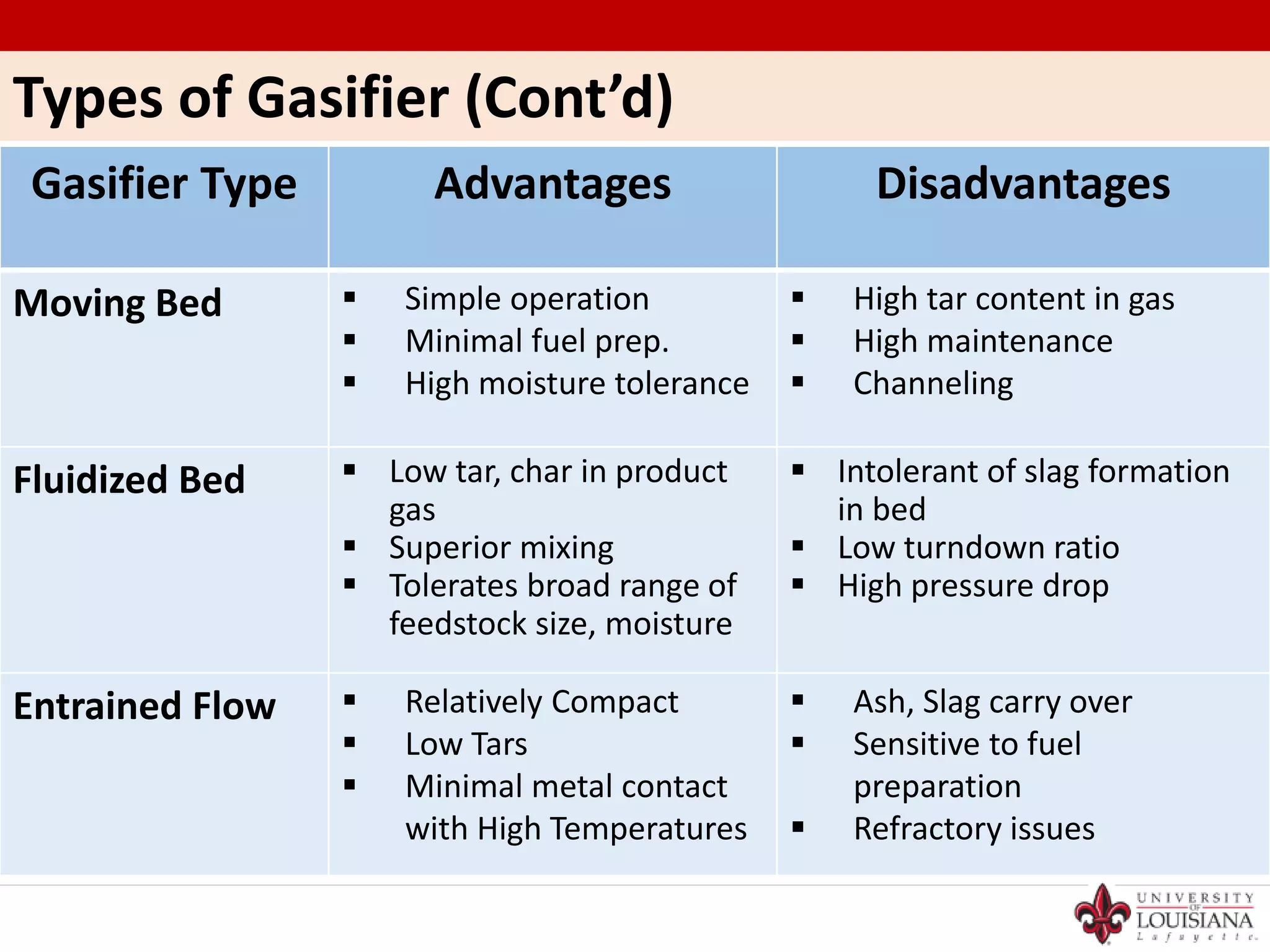
Types of Gasifier (Cont’d)
Gasifier Type Advantages Disadvantages
Moving Bed  Simple operation
 Minimal fuel prep.
 High moisture tolerance
 High tar content in gas
 High maintenance
 Channeling
Fluidized Bed  Low tar, char in product
gas
 Superior mixing
 Tolerates broad range of
feedstock size, moisture
 Intolerant of slag formation
in bed
 Low turndown ratio
 High pressure drop
Entrained Flow  Relatively Compact
 Low Tars
 Minimal metal contact
with High Temperatures
 Ash, Slag carry over
 Sensitive to fuel
preparation
 Refractory issues
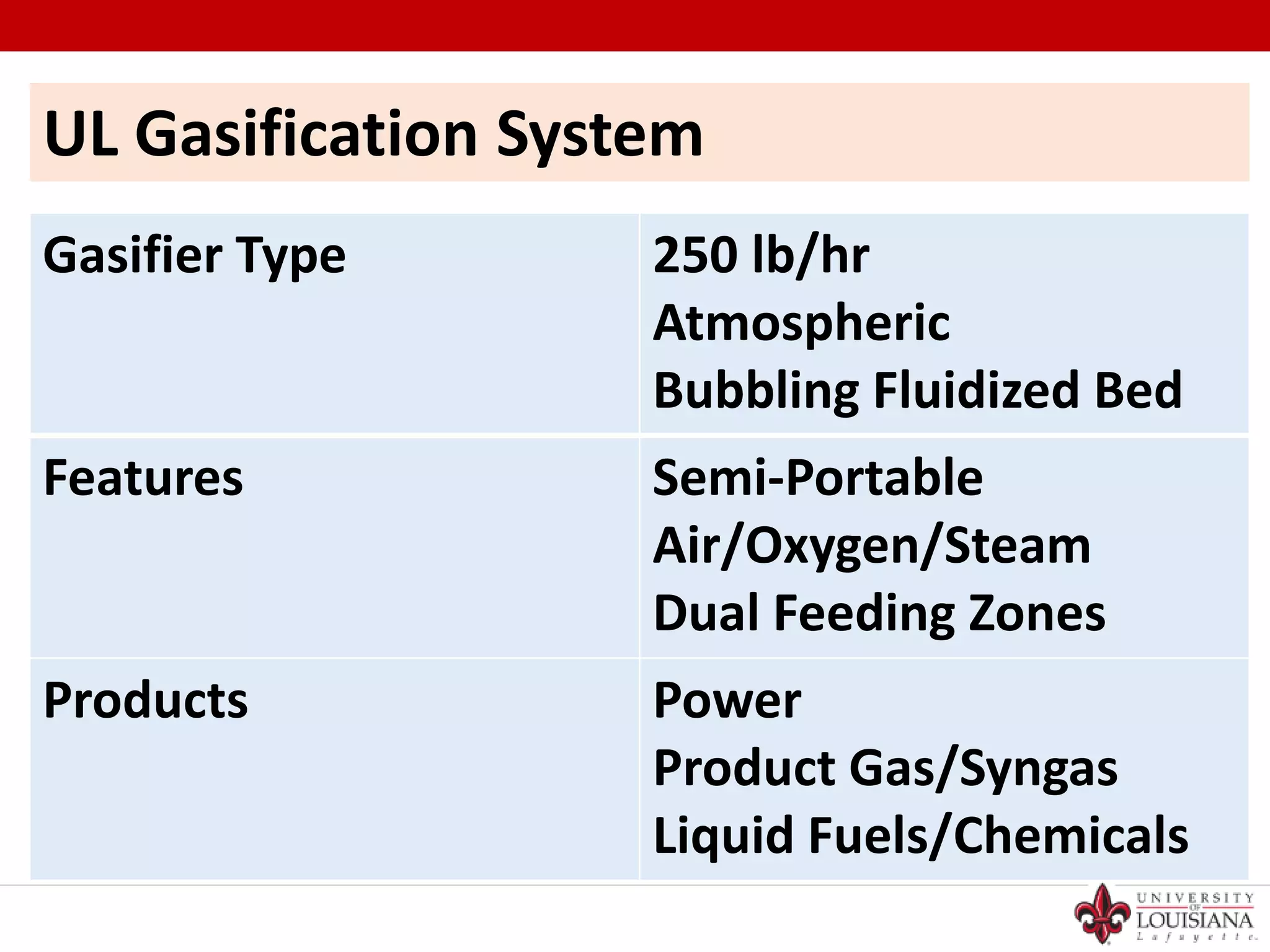
UL Gasification System
Gasifier Type 250 lb/hr
Atmospheric
Bubbling Fluidized Bed
Features Semi-Portable
Air/Oxygen/Steam
Dual Feeding Zones
Products Power
Product Gas/Syngas
Liquid Fuels/Chemicals
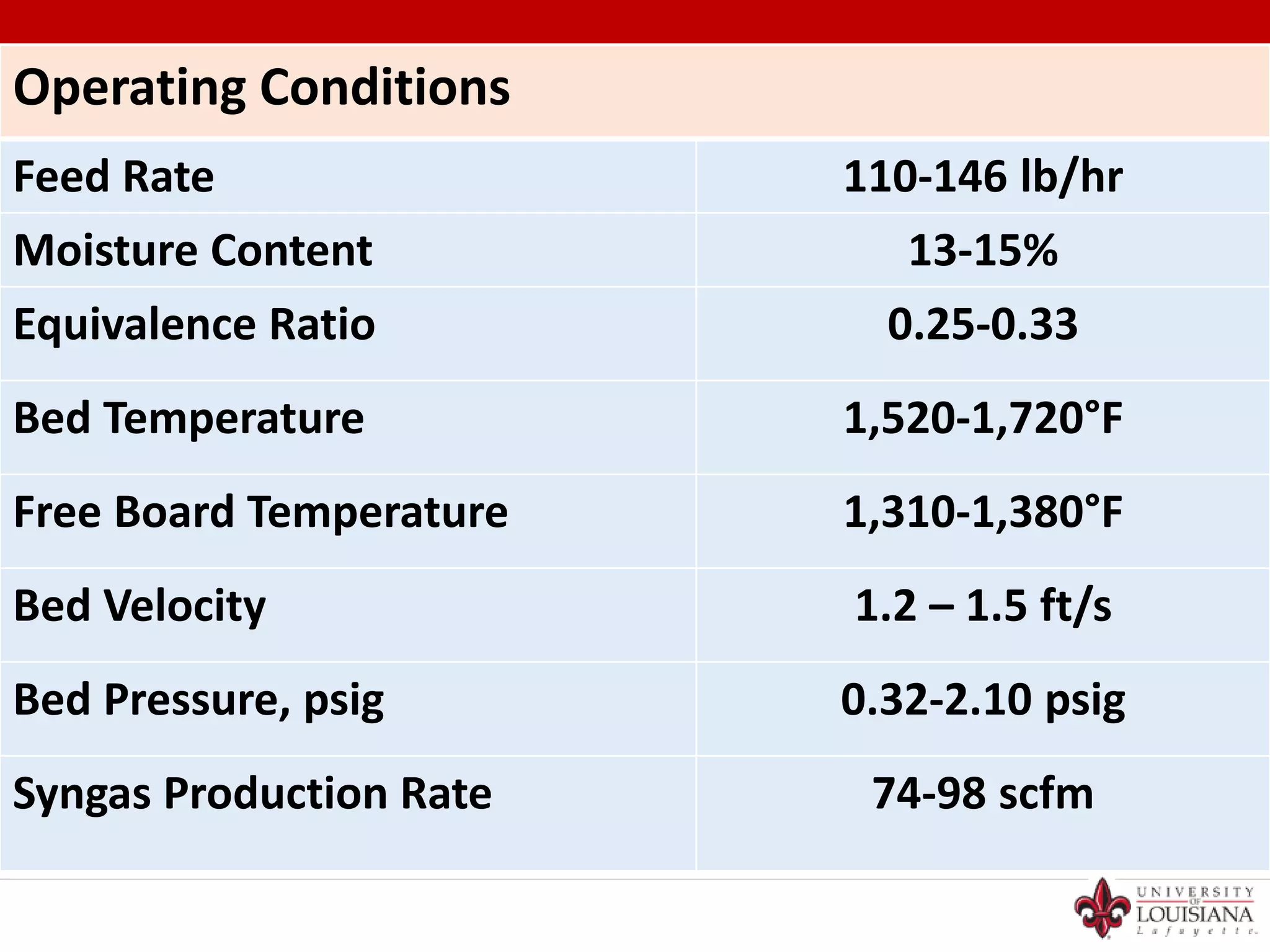
Operating Conditions
Feed Rate 110-146 lb/hr
Moisture Content 13-15%
Equivalence Ratio 0.25-0.33
Bed Temperature 1,520-1,720°F
Free Board Temperature 1,310-1,380°F
Bed Velocity 1.2 – 1.5 ft/s
Bed Pressure, psig 0.32-2.10 psig
Syngas Production Rate 74-98 scfm
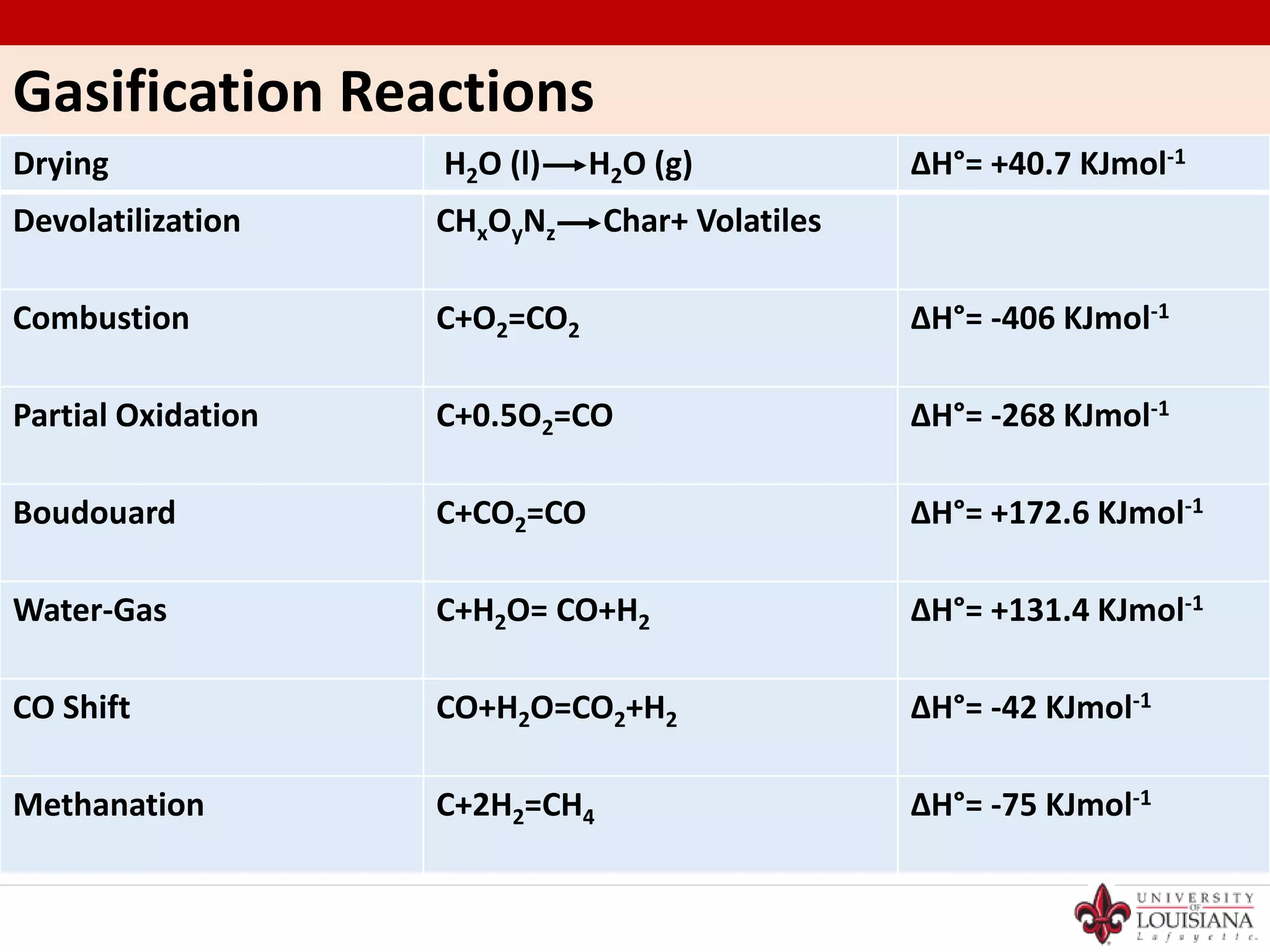
Gasification Reactions
Drying H2O (l) H2O (g) ∆H°= +40.7 KJmol-1
Devolatilization CHxOyNz Char+ Volatiles
Combustion C+O2=CO2 ∆H°= -406 KJmol-1
Partial Oxidation C+0.5O2=CO ∆H°= -268 KJmol-1
Boudouard C+CO2=CO ∆H°= +172.6 KJmol-1
Water-Gas C+H2O= CO+H2 ∆H°= +131.4 KJmol-1
CO Shift CO+H2O=CO2+H2 ∆H°= -42 KJmol-1
Methanation C+2H2=CH4 ∆H°= -75 KJmol-1
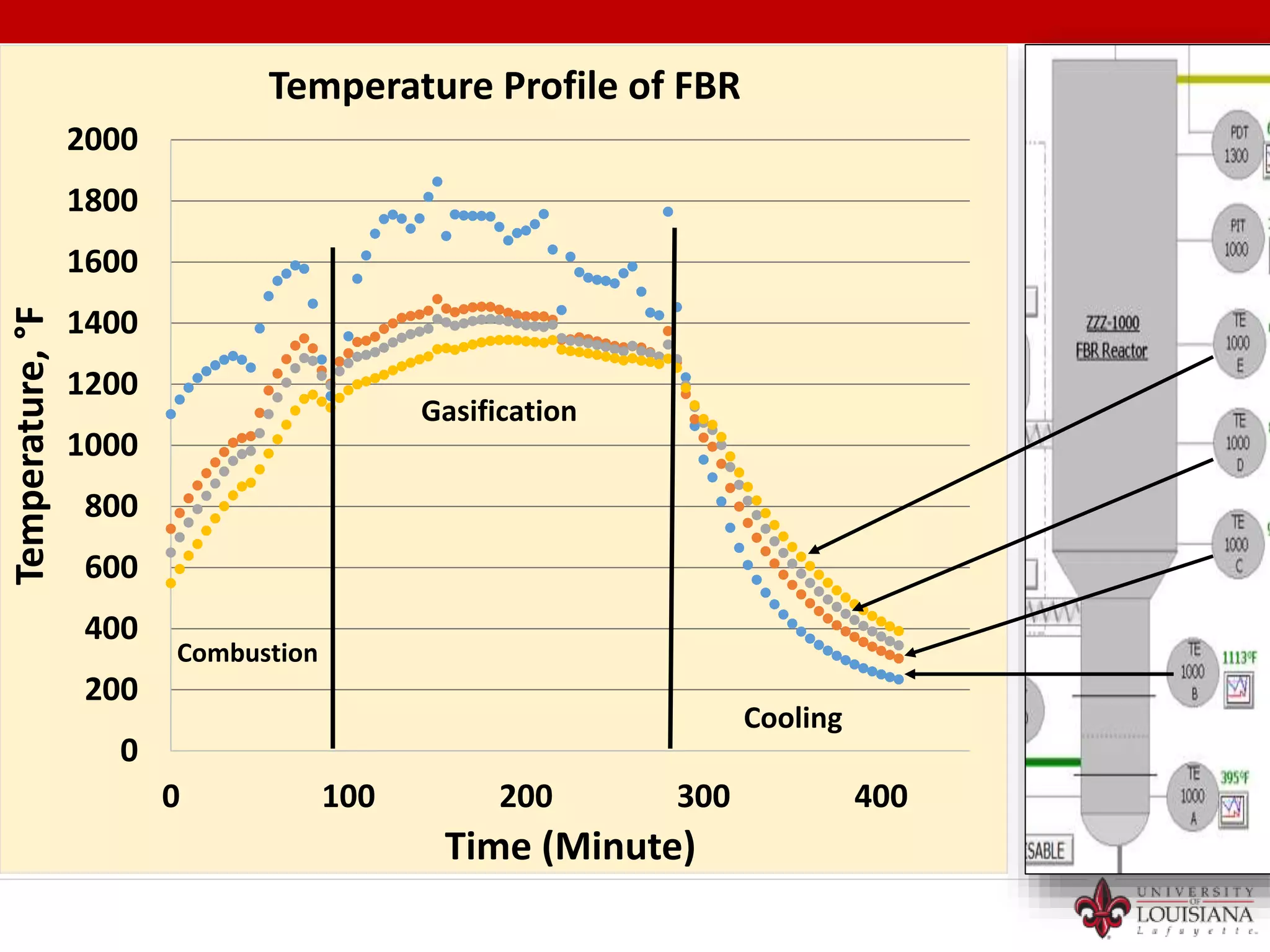
0
200
400
600
800
1000
1200
1400
1600
1800
2000
0 100 200 300 400
Temperature,°F
Time (Minute)
Temperature Profile of FBR
Gasification
Cooling
Combustion
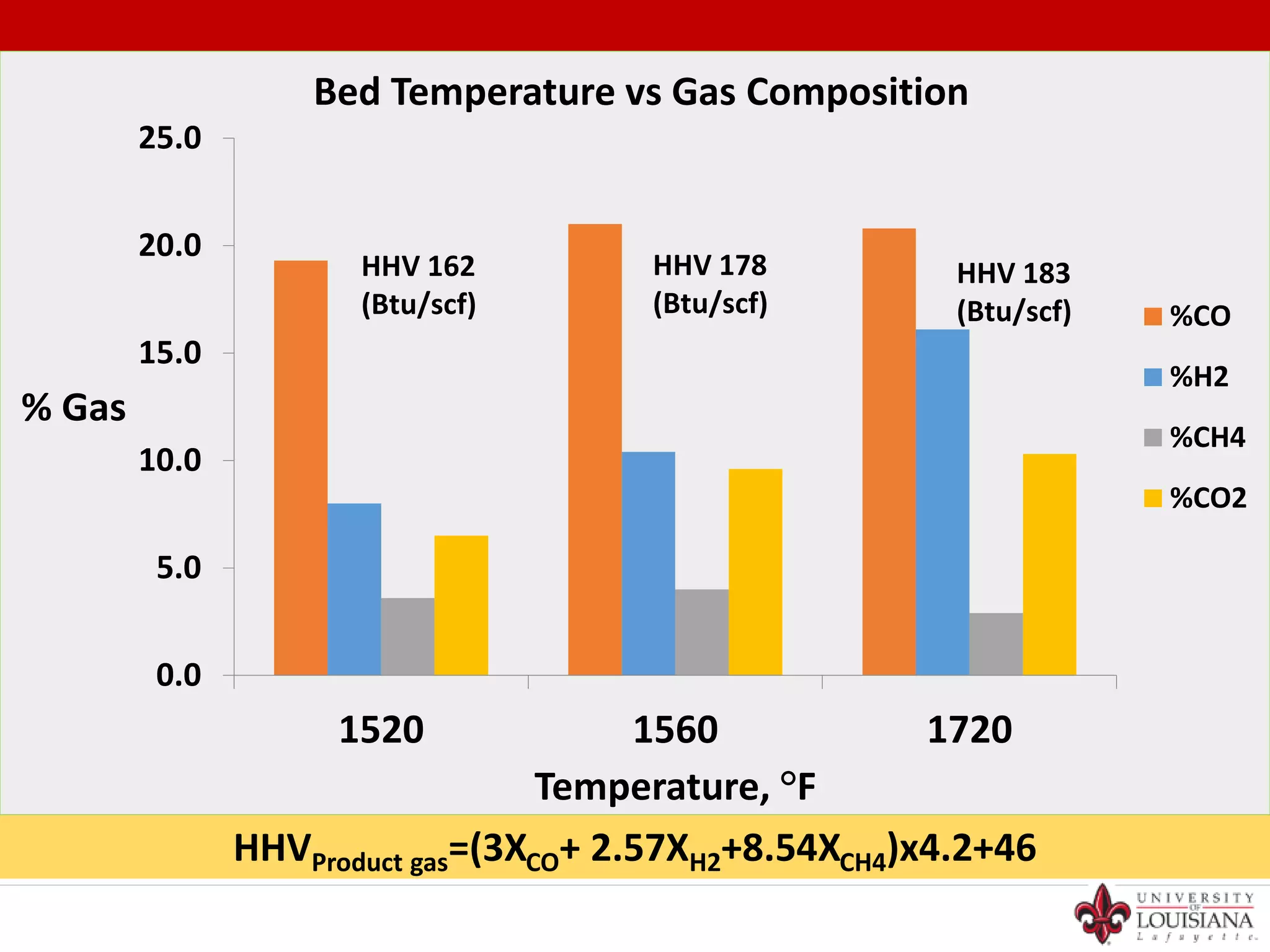
HHVProduct gas=(3XCO+ 2.57XH2+8.54XCH4)x4.2+46
0.0
5.0
10.0
15.0
20.0
25.0
1520 1560 1720
% Gas
Temperature, °F
Bed Temperature vs Gas Composition
%CO
%H2
%CH4
%CO2
HHV 183
(Btu/scf)
HHV 178
(Btu/scf)
HHV 162
(Btu/scf)
0.0
5.0
10.0
15.0
20.0
25.0
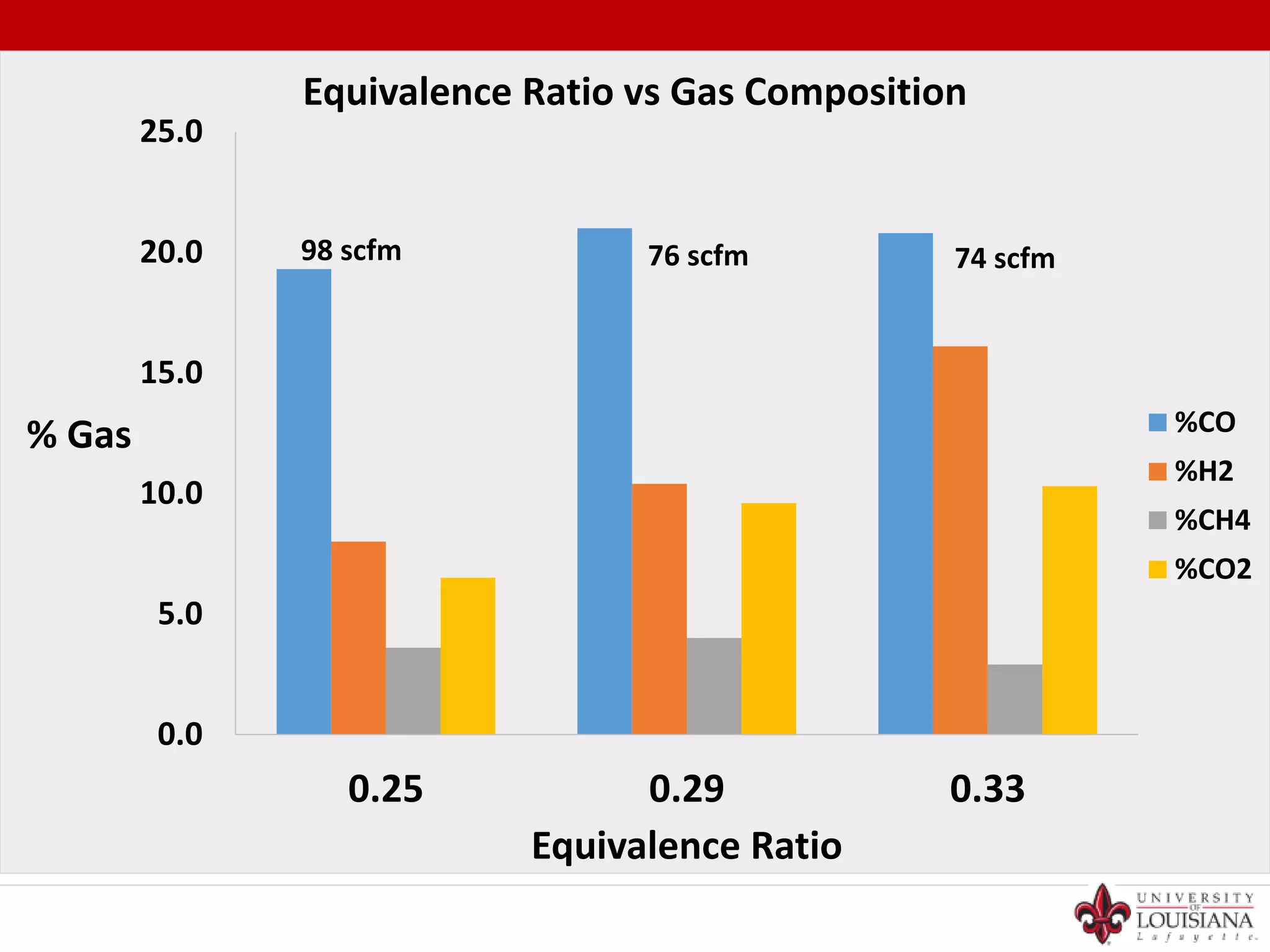
0.25 0.29 0.33
% Gas
Equivalence Ratio
Equivalence Ratio vs Gas Composition
%CO
%H2
%CH4
%CO2
98 scfm 74 scfm76 scfm
0
10
20
30
40
50
60
70
80
90
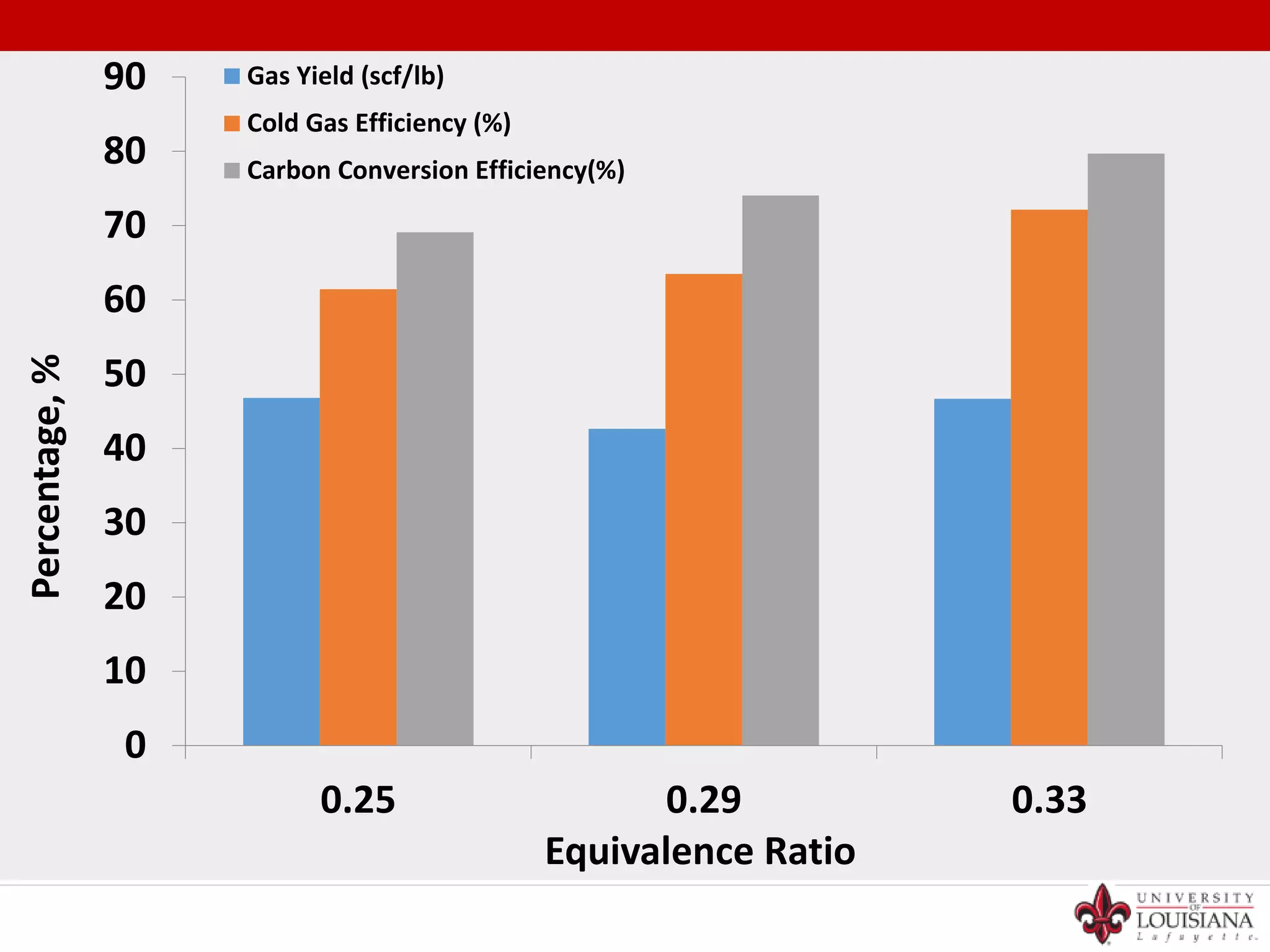
0.25 0.29 0.33
Percentage,%
Equivalence Ratio
Gas Yield (scf/lb)
Cold Gas Efficiency (%)
Carbon Conversion Efficiency(%)
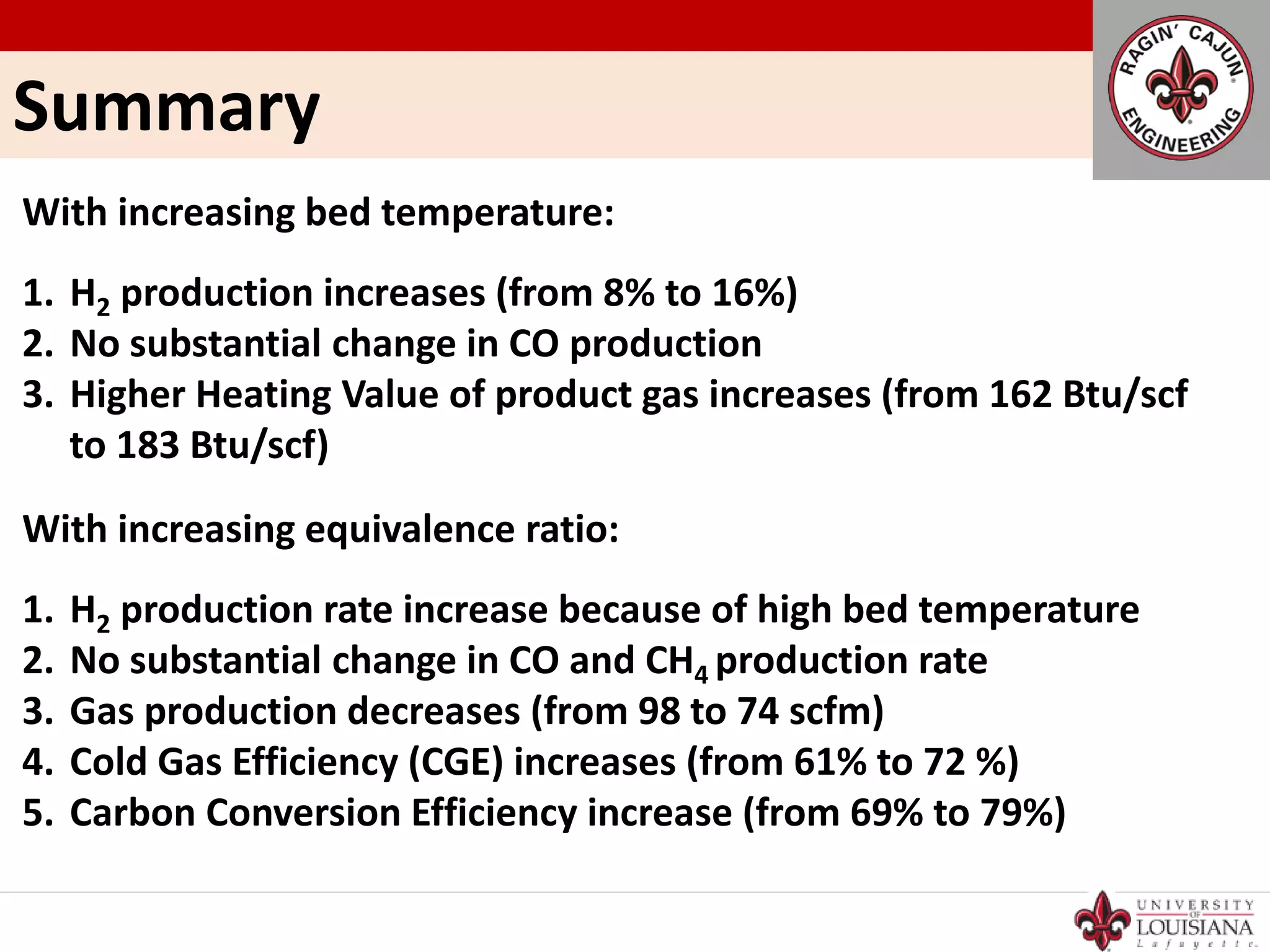
Summary
With increasing bed temperature:
1. H2 production increases (from 8% to 16%)
2. No substantial change in CO production
3. Higher Heating Value of product gas increases (from 162 Btu/scf
to 183 Btu/scf)
With increasing equivalence ratio:
1. H2 production rate increase because of high bed temperature
2. No substantial change in CO and CH4 production rate
3. Gas production decreases (from 98 to 74 scfm)
4. Cold Gas Efficiency (CGE) increases (from 61% to 72 %)
5. Carbon Conversion Efficiency increase (from 69% to 79%)
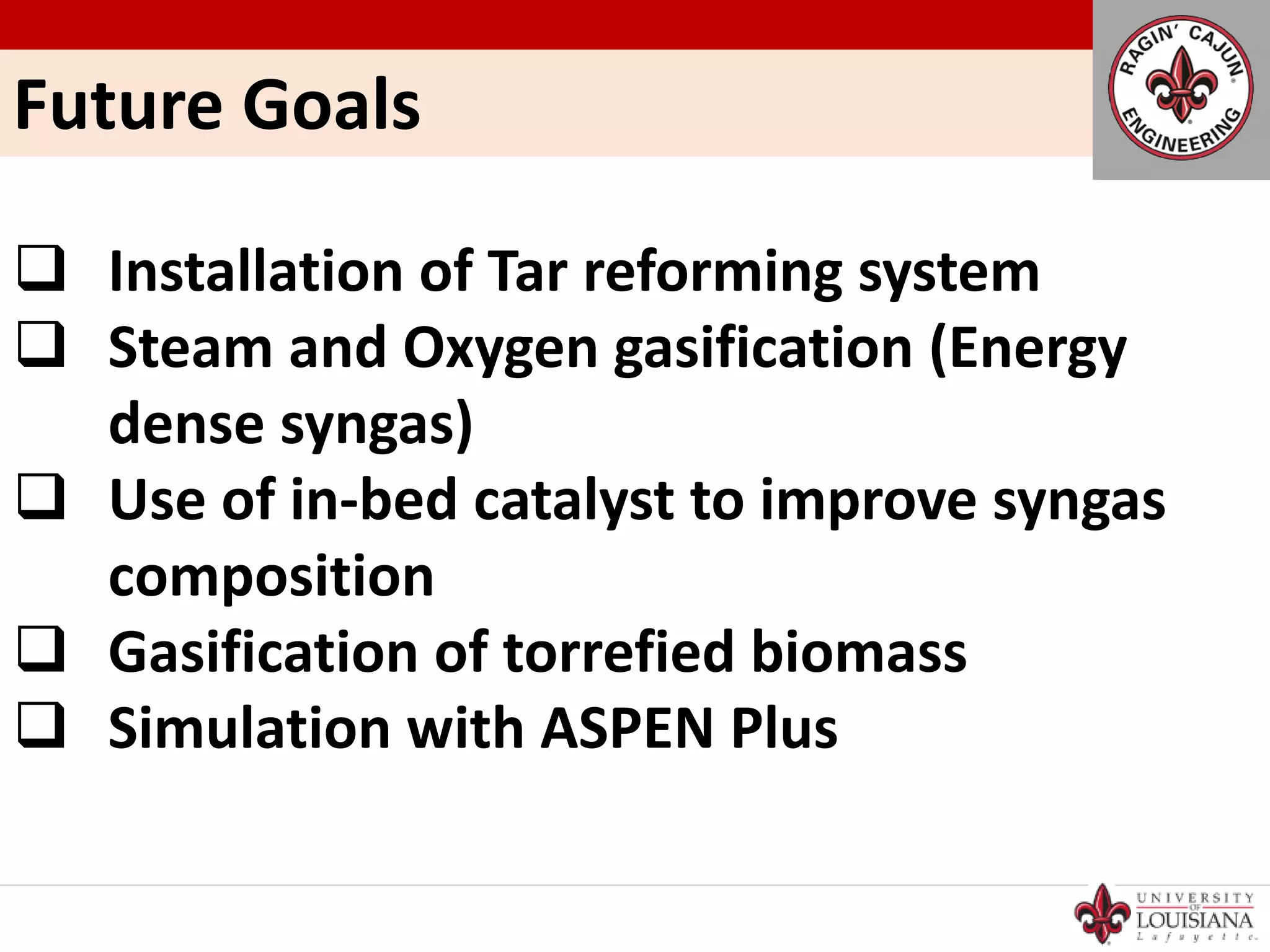
Future Goals
 Installation of Tar reforming system
 Steam and Oxygen gasification (Energy
dense syngas)
 Use of in-bed catalyst to improve syngas
composition
 Gasification of torrefied biomass
 Simulation with ASPEN Plus
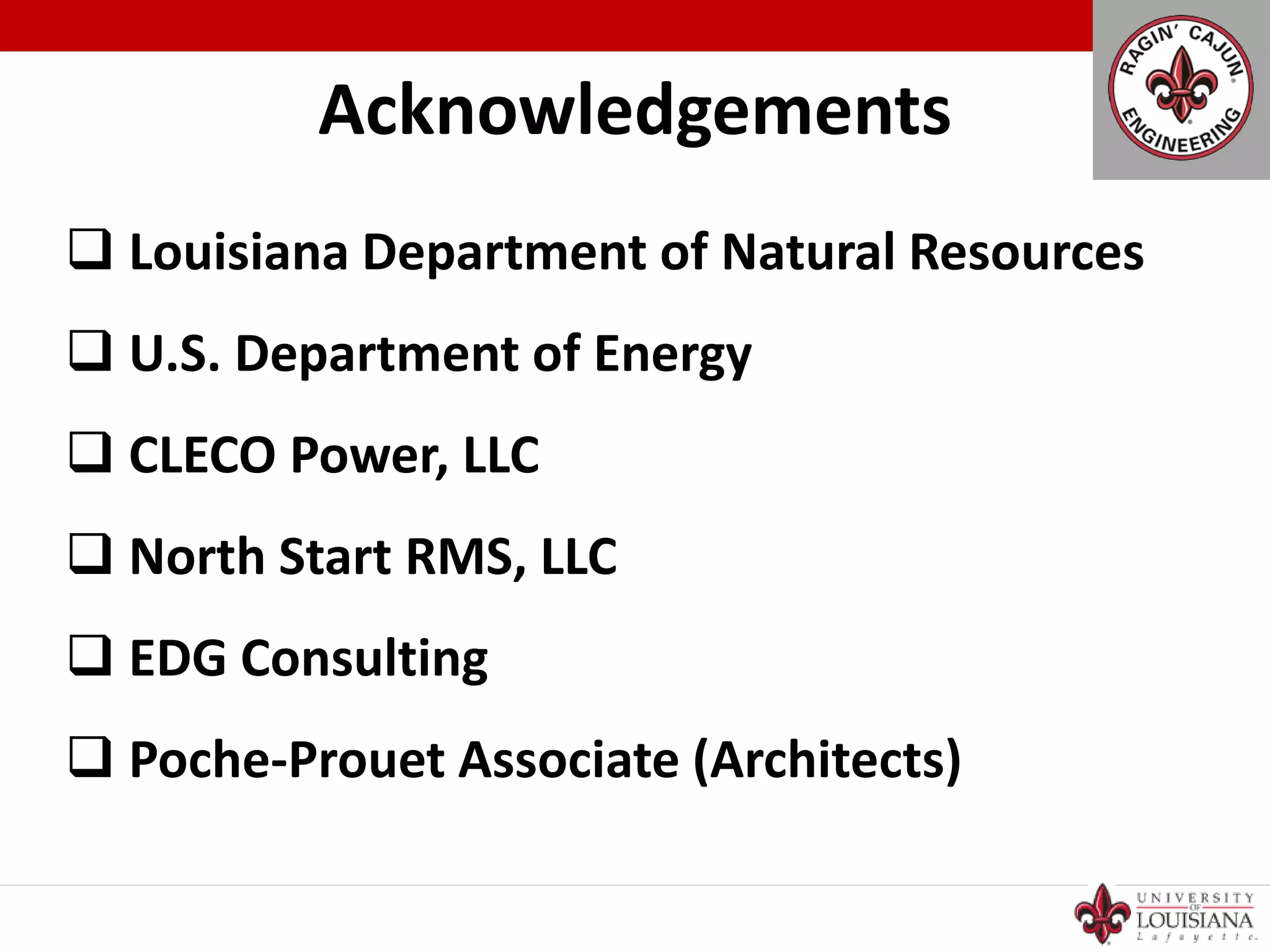
Acknowledgements
 Louisiana Department of Natural Resources
 U.S. Department of Energy
 CLECO Power, LLC
 North Start RMS, LLC
 EDG Consulting
 Poche-Prouet Associate (Architects)
Thank You for Attending
Today’s Presentation
Questions?
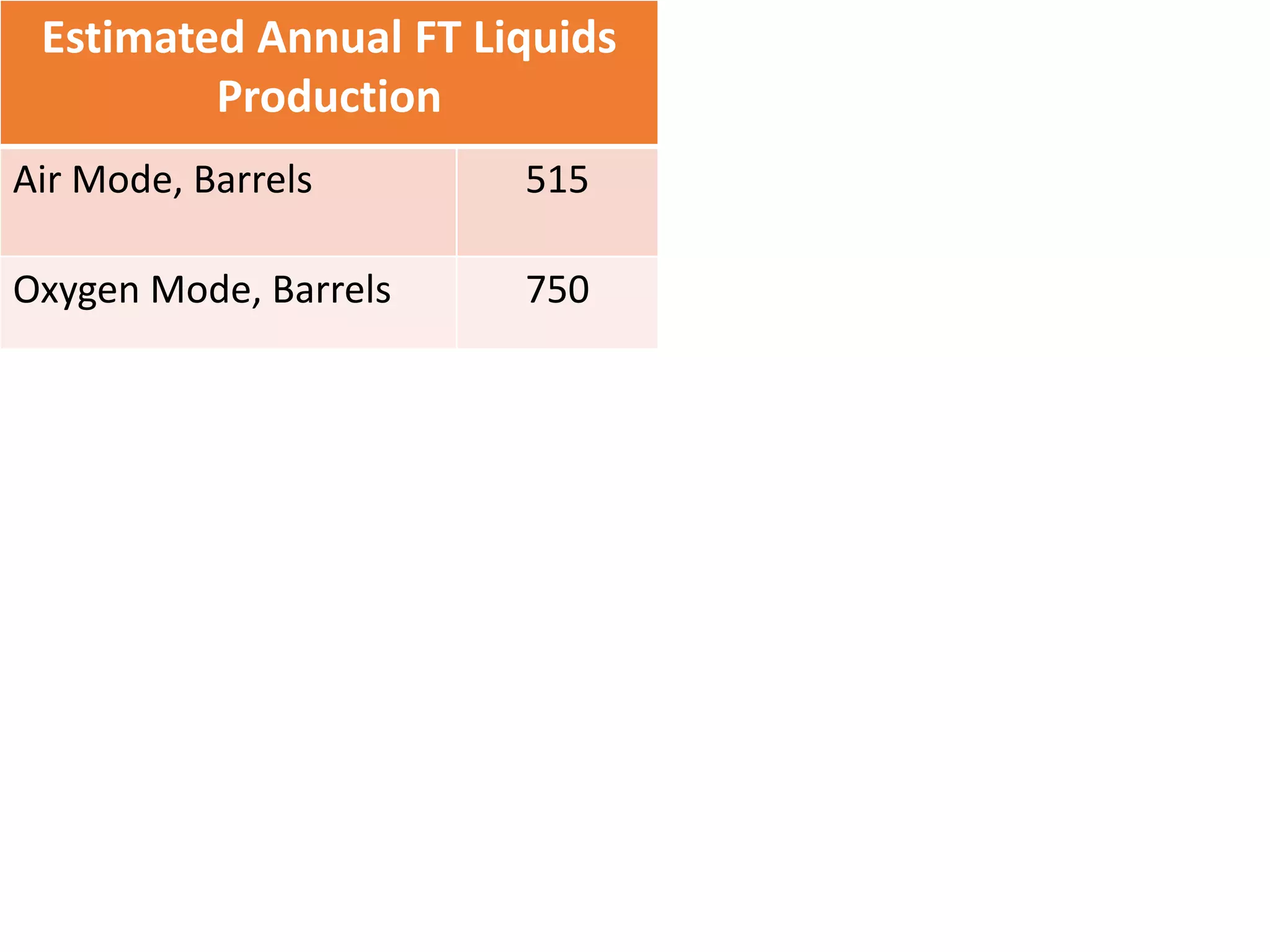
Estimated Annual FT Liquids
Production
Air Mode, Barrels 515
Oxygen Mode, Barrels 750

Performance of 3 ton/day BFB Gasification System using Pine Feedstock

  • 1.
    Performance of 3ton/day BFB Gasification System using Pine Feedstock Md Waliul Islam1 Prashanth R. Buchireddy1, Ph.D., John L. Guillory1, Ph.D., Mark E. Zappi1, Ph.D., Jude Asonganyi1, Robert Bentley1, Derek Richard1 Ben Russo2 and Keith Crump2 1 Energy Institute, University of Louisiana at Lafayette, 2 Cleco Power, LLC.
  • 2.
    Objectives  Optimizing theFBR gasification system to produce clean energy dense syngas for optimal power generation  Evaluation of different types of feedstock including Pine, Willow, and Arundo (Giant Reed).  Evaluation of tar reforming catalyst  Improving CO/H2 ratio for gas to liquid production
  • 3.
    Pine Wood Chips GeneralApplications Mulch Heating Walkways Composting Biomass Statistics • Louisiana’s forestlands cover 48% of the state’s area – 13.8 million acres. • Total Biomass Resources in LA- 13,000 MT/year • Approximately 22% of homes in LA could be powered • Approximately 30% gasoline consumption could be replaced in LA
  • 4.
    Ultimate Analysis Elements %Wt.(Dry Basis) Nitrogen 0.10 Carbon 52.70 Hydrogen 7.50 Sulphur 0.30 Oxygen 39.40 Proximate Analysis* Moisture 52.3% Ash 0.29 % Volatile Matter 31.50 % Fixed Carbon 15.90 % Heating Value 8,864 btu/lb
  • 5.
    Types of Gasifier GasifierType Advantages Disadvantages Updraft  Small pressure drop  Good thermal efficiency  Little slag formation  Great sensitivity to tar and moisture  Relatively long time required for start up of IC engine  Poor reaction with heavy gas load Downdraft  Flexible adaptation of gas production to load  Low sensitivity to charcoal dust  Design tends to be tall  Not feasible for very small particle size of fuel Crossdraft  Short design height  Fast response time to load  Flexible gas production  High sensitivity to slag formation  High pressure drop
  • 6.
    Types of Gasifier(Cont’d) Gasifier Type Advantages Disadvantages Moving Bed  Simple operation  Minimal fuel prep.  High moisture tolerance  High tar content in gas  High maintenance  Channeling Fluidized Bed  Low tar, char in product gas  Superior mixing  Tolerates broad range of feedstock size, moisture  Intolerant of slag formation in bed  Low turndown ratio  High pressure drop Entrained Flow  Relatively Compact  Low Tars  Minimal metal contact with High Temperatures  Ash, Slag carry over  Sensitive to fuel preparation  Refractory issues
  • 7.
    UL Gasification System GasifierType 250 lb/hr Atmospheric Bubbling Fluidized Bed Features Semi-Portable Air/Oxygen/Steam Dual Feeding Zones Products Power Product Gas/Syngas Liquid Fuels/Chemicals
  • 9.
    Operating Conditions Feed Rate110-146 lb/hr Moisture Content 13-15% Equivalence Ratio 0.25-0.33 Bed Temperature 1,520-1,720°F Free Board Temperature 1,310-1,380°F Bed Velocity 1.2 – 1.5 ft/s Bed Pressure, psig 0.32-2.10 psig Syngas Production Rate 74-98 scfm
  • 11.
    Gasification Reactions Drying H2O(l) H2O (g) ∆H°= +40.7 KJmol-1 Devolatilization CHxOyNz Char+ Volatiles Combustion C+O2=CO2 ∆H°= -406 KJmol-1 Partial Oxidation C+0.5O2=CO ∆H°= -268 KJmol-1 Boudouard C+CO2=CO ∆H°= +172.6 KJmol-1 Water-Gas C+H2O= CO+H2 ∆H°= +131.4 KJmol-1 CO Shift CO+H2O=CO2+H2 ∆H°= -42 KJmol-1 Methanation C+2H2=CH4 ∆H°= -75 KJmol-1
  • 12.
    0 200 400 600 800 1000 1200 1400 1600 1800 2000 0 100 200300 400 Temperature,°F Time (Minute) Temperature Profile of FBR Gasification Cooling Combustion
  • 13.
    HHVProduct gas=(3XCO+ 2.57XH2+8.54XCH4)x4.2+46 0.0 5.0 10.0 15.0 20.0 25.0 15201560 1720 % Gas Temperature, °F Bed Temperature vs Gas Composition %CO %H2 %CH4 %CO2 HHV 183 (Btu/scf) HHV 178 (Btu/scf) HHV 162 (Btu/scf)
  • 14.
    0.0 5.0 10.0 15.0 20.0 25.0 0.25 0.29 0.33 %Gas Equivalence Ratio Equivalence Ratio vs Gas Composition %CO %H2 %CH4 %CO2 98 scfm 74 scfm76 scfm
  • 15.
    0 10 20 30 40 50 60 70 80 90 0.25 0.29 0.33 Percentage,% EquivalenceRatio Gas Yield (scf/lb) Cold Gas Efficiency (%) Carbon Conversion Efficiency(%)
  • 16.
    Summary With increasing bedtemperature: 1. H2 production increases (from 8% to 16%) 2. No substantial change in CO production 3. Higher Heating Value of product gas increases (from 162 Btu/scf to 183 Btu/scf) With increasing equivalence ratio: 1. H2 production rate increase because of high bed temperature 2. No substantial change in CO and CH4 production rate 3. Gas production decreases (from 98 to 74 scfm) 4. Cold Gas Efficiency (CGE) increases (from 61% to 72 %) 5. Carbon Conversion Efficiency increase (from 69% to 79%)
  • 17.
    Future Goals  Installationof Tar reforming system  Steam and Oxygen gasification (Energy dense syngas)  Use of in-bed catalyst to improve syngas composition  Gasification of torrefied biomass  Simulation with ASPEN Plus
  • 18.
    Acknowledgements  Louisiana Departmentof Natural Resources  U.S. Department of Energy  CLECO Power, LLC  North Start RMS, LLC  EDG Consulting  Poche-Prouet Associate (Architects)
  • 19.
    Thank You forAttending Today’s Presentation Questions?
  • 20.
    Estimated Annual FTLiquids Production Air Mode, Barrels 515 Oxygen Mode, Barrels 750

Editor's Notes

  • #2 Title need to be changed
  • #5 Proximate Analysis from “ The Industrial Wood Energy Handbook” Prepared by The Technology Applications Laboratory of the Georgia Institute of Technology Engineering Experiment Station, Atlanta, Georgia.
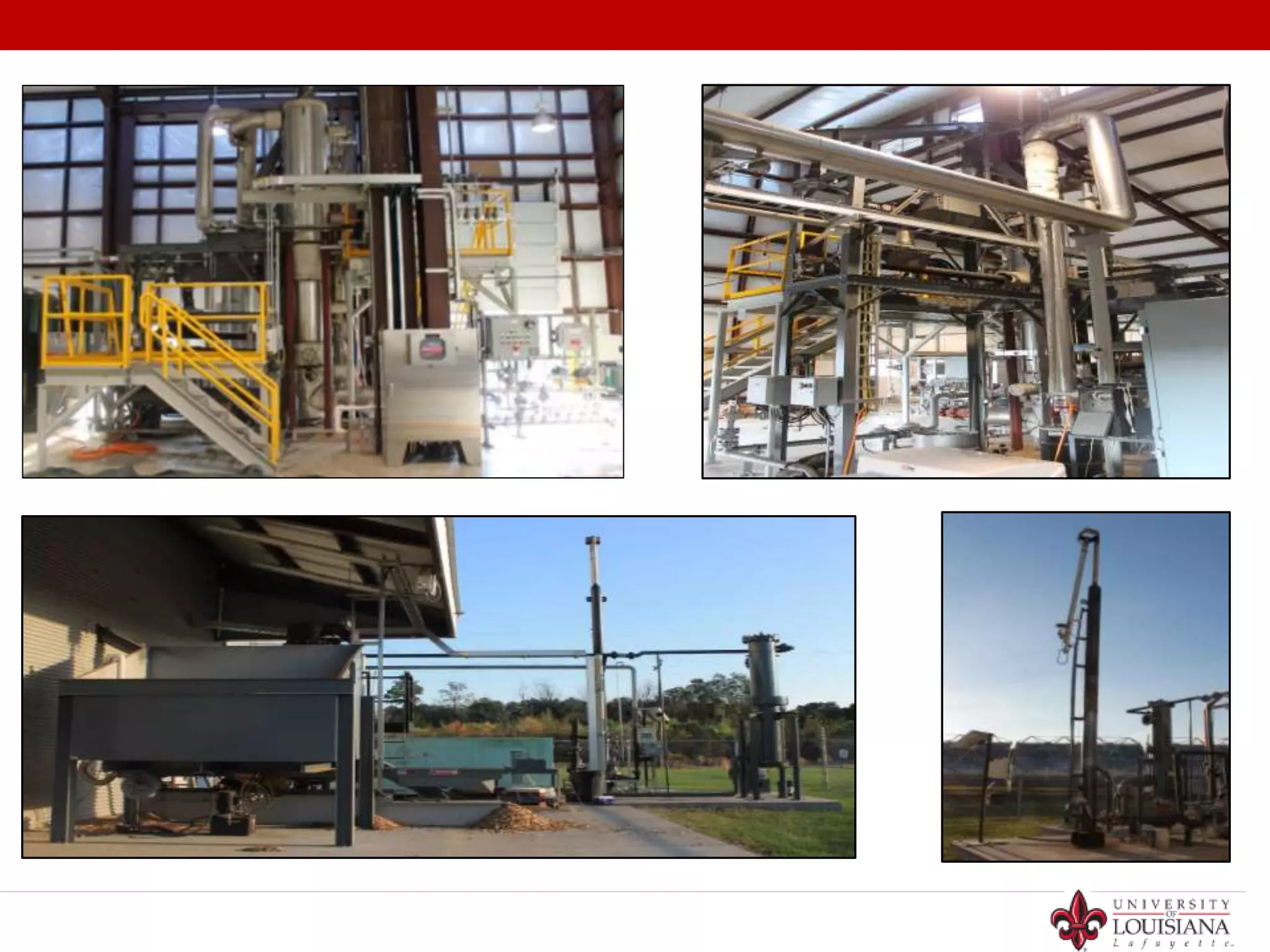
  • #9 We need four photos in one slide