


Biomass-Gasifier
V.V.P ENGINEERING COLLEGE, RAJKOT
Department of Chemical Engineering
Prepared By:
Bhargav Dhameliya (160470105012)
Vivek M. Faldu (160470105013)
Kevin Chothani (160470105009)
Vivek Kansagara (170473105003)
Khunt Nikul (170473105005)
Guide : Jilesh M. Pandya
106-03-2020
• Objective of work
• Introduction to Gasifier
• Literature survey
• Research gap
• Plan of work
• References
OUTLINE
206-03-2020
OBJECTIVE OF WORK
• The main objective which would be in focus is on how
we could bring out the change on an industrial scale by
utilizing our design knowledge to maximize the
efficiency of gasifier when a Bio-mass is used and
simultaneously reduce TAR production.
• Study of thermo-chemical processes during gasification
of biomass.
306-03-2020
Introduction to Gasifier…
• Gasifier is a chemical reactor that convert biomass substance
into a combustible gas that can be burned for heating, Cooking
or for running an internal combustion engine.
• Process of producing energy from natural resources are in
operation from several years.
• Earlier coal and peat were used, but now world is facing a great
problems of energy crisis due to our usage of conventional fuel
in automobiles, power generation and various thermal
application.
• Technology of Bio-mass gasification has existed from more then
seven decade.
• The gases generated from biomass are alternate fuel and also
considered to be a cleaner gas.
406-03-2020
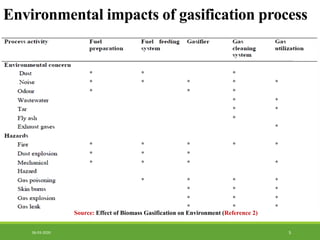
Environmental impacts of gasification process
506-03-2020
Source: Effect of Biomass Gasification on Environment (Reference 2)
Tar yield as an environmental problem
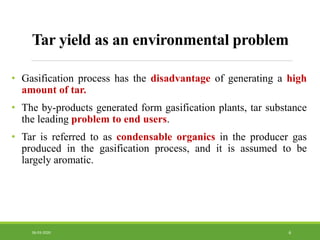
• Gasification process has the disadvantage of generating a high
amount of tar.
• The by-products generated form gasification plants, tar substance
the leading problem to end users.
• Tar is referred to as condensable organics in the producer gas
produced in the gasification process, and it is assumed to be
largely aromatic.
606-03-2020
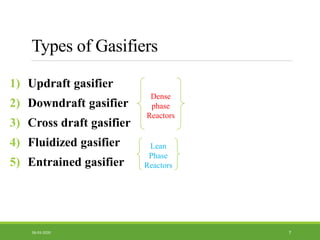
Types of Gasifiers
1) Updraft gasifier
2) Downdraft gasifier
3) Cross draft gasifier
4) Fluidized gasifier
5) Entrained gasifier
Dense
phase
Reactors
Lean
Phase
Reactors
706-03-2020
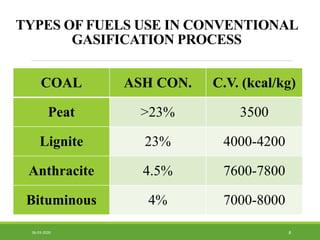
TYPES OF FUELS USE IN CONVENTIONAL
GASIFICATION PROCESS
COAL ASH CON. C.V. (kcal/kg)
Peat >23% 3500
Lignite 23% 4000-4200
Anthracite 4.5% 7600-7800
Bituminous 4% 7000-8000
806-03-2020
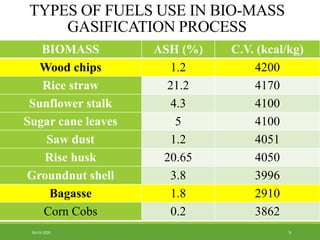
TYPES OF FUELS USE IN BIO-MASS
GASIFICATION PROCESS
BIOMASS ASH (%) C.V. (kcal/kg)
Wood chips 1.2 4200
Rice straw 21.2 4170
Sunflower stalk 4.3 4100
Sugar cane leaves 5 4100
Saw dust 1.2 4051
Rise husk 20.65 4050
Groundnut shell 3.8 3996
Bagasse 1.8 2910
Corn Cobs 0.2 3862
906-03-2020
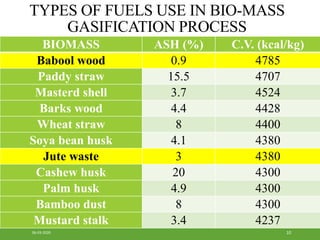
TYPES OF FUELS USE IN BIO-MASS
GASIFICATION PROCESS
BIOMASS ASH (%) C.V. (kcal/kg)
Babool wood 0.9 4785
Paddy straw 15.5 4707
Masterd shell 3.7 4524
Barks wood 4.4 4428
Wheat straw 8 4400
Soya bean husk 4.1 4380
Jute waste 3 4380
Cashew husk 20 4300
Palm husk 4.9 4300
Bamboo dust 8 4300
Mustard stalk 3.4 4237
1006-03-2020
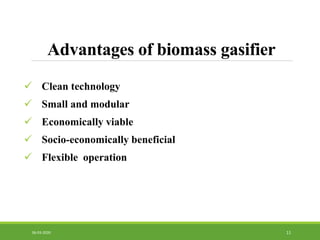
Advantages of biomass gasifier
 Clean technology
 Small and modular
 Economically viable
 Socio-economically beneficial
 Flexible operation
1106-03-2020
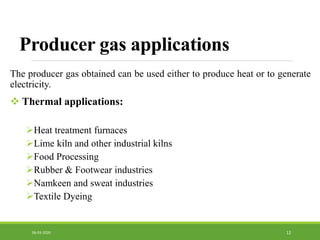
Producer gas applications
The producer gas obtained can be used either to produce heat or to generate
electricity.
 Thermal applications:
Heat treatment furnaces
Lime kiln and other industrial kilns
Food Processing
Rubber & Footwear industries
Namkeen and sweat industries
Textile Dyeing
1206-03-2020
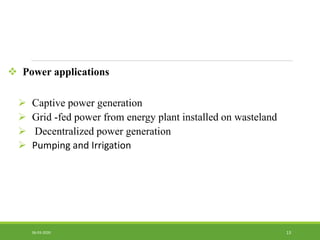
 Power applications
 Captive power generation
 Grid -fed power from energy plant installed on wasteland
 Decentralized power generation
 Pumping and Irrigation
1306-03-2020
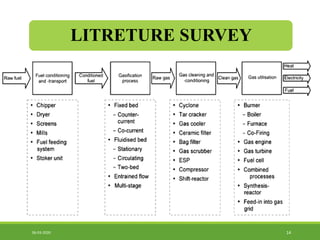
LITRETURE SURVEY
1406-03-2020
Plan of Work
June July August September October November December
Course work
Literature
Review
Analysis of
process
Choose
process
Analysis of
gasifier
Choose
gasifier
Analysis of
feed stock
Used feed
stock in
gasifier
1506-03-2020
June July August September October November December
Characterizat
ion of
Catalysts
Choose
Catalyst
Reaction
Activity in
gasifier
Kinetics
Study
Development
of Model
Report
06-03-2020 16
References
1. Rohit Raj, Vivek k, Parvathy Venugopal, Vishnu Vijayan , Bio gasifier, IJIRT
Volume 2 ,May 2016
2. Amit Kumar Mishra, R N Singh, Pratyush Pingita Mishra, Effect of Biomass
Gasification on Environment, Mesopotamia Environmental Journal volume 1,
2015
3. Elango Balu, J.N. Chung, System characteristics and performance evaluation
of a trailer-sacle downdraft gasifier with different feedstock, Bioresources
technology, may 2015
4. Pratik N. Sheth, B.V. Babu, Experimental studies on producer gas generation
from wood waste in a downdraft biomass gasifier, Bioresources technology,
February 2009
1706-03-2020
5. Maria Puig-Arnavat, Joan Carles Bruno, Alberto Coronas, Review and analysis
of biomass gasification models, Renewable and Sustainable Energy Reviews,
May 2010
6. Pengmei L v , Zhenhong Yuan, Longlong Ma, Chuangzhi W u, Young Chen,
Jingxu Zhu, Hydrogen-rich gas production from biomass air and oxygen/steam
gasification in a downdraft gasifier, Renewable Energy 32(2007)
1806-03-2020
References
1906-03-2020

Biomass Gasifier

  • 1.
    Biomass-Gasifier V.V.P ENGINEERING COLLEGE,RAJKOT Department of Chemical Engineering Prepared By: Bhargav Dhameliya (160470105012) Vivek M. Faldu (160470105013) Kevin Chothani (160470105009) Vivek Kansagara (170473105003) Khunt Nikul (170473105005) Guide : Jilesh M. Pandya 106-03-2020
  • 2.
    • Objective ofwork • Introduction to Gasifier • Literature survey • Research gap • Plan of work • References OUTLINE 206-03-2020
  • 3.
    OBJECTIVE OF WORK •The main objective which would be in focus is on how we could bring out the change on an industrial scale by utilizing our design knowledge to maximize the efficiency of gasifier when a Bio-mass is used and simultaneously reduce TAR production. • Study of thermo-chemical processes during gasification of biomass. 306-03-2020
  • 4.
    Introduction to Gasifier… •Gasifier is a chemical reactor that convert biomass substance into a combustible gas that can be burned for heating, Cooking or for running an internal combustion engine. • Process of producing energy from natural resources are in operation from several years. • Earlier coal and peat were used, but now world is facing a great problems of energy crisis due to our usage of conventional fuel in automobiles, power generation and various thermal application. • Technology of Bio-mass gasification has existed from more then seven decade. • The gases generated from biomass are alternate fuel and also considered to be a cleaner gas. 406-03-2020
  • 5.
    Environmental impacts ofgasification process 506-03-2020 Source: Effect of Biomass Gasification on Environment (Reference 2)
  • 6.
    Tar yield asan environmental problem • Gasification process has the disadvantage of generating a high amount of tar. • The by-products generated form gasification plants, tar substance the leading problem to end users. • Tar is referred to as condensable organics in the producer gas produced in the gasification process, and it is assumed to be largely aromatic. 606-03-2020
  • 7.
    Types of Gasifiers 1)Updraft gasifier 2) Downdraft gasifier 3) Cross draft gasifier 4) Fluidized gasifier 5) Entrained gasifier Dense phase Reactors Lean Phase Reactors 706-03-2020
  • 8.
    TYPES OF FUELSUSE IN CONVENTIONAL GASIFICATION PROCESS COAL ASH CON. C.V. (kcal/kg) Peat >23% 3500 Lignite 23% 4000-4200 Anthracite 4.5% 7600-7800 Bituminous 4% 7000-8000 806-03-2020
  • 9.
    TYPES OF FUELSUSE IN BIO-MASS GASIFICATION PROCESS BIOMASS ASH (%) C.V. (kcal/kg) Wood chips 1.2 4200 Rice straw 21.2 4170 Sunflower stalk 4.3 4100 Sugar cane leaves 5 4100 Saw dust 1.2 4051 Rise husk 20.65 4050 Groundnut shell 3.8 3996 Bagasse 1.8 2910 Corn Cobs 0.2 3862 906-03-2020
  • 10.
    TYPES OF FUELSUSE IN BIO-MASS GASIFICATION PROCESS BIOMASS ASH (%) C.V. (kcal/kg) Babool wood 0.9 4785 Paddy straw 15.5 4707 Masterd shell 3.7 4524 Barks wood 4.4 4428 Wheat straw 8 4400 Soya bean husk 4.1 4380 Jute waste 3 4380 Cashew husk 20 4300 Palm husk 4.9 4300 Bamboo dust 8 4300 Mustard stalk 3.4 4237 1006-03-2020
  • 11.
    Advantages of biomassgasifier  Clean technology  Small and modular  Economically viable  Socio-economically beneficial  Flexible operation 1106-03-2020
  • 12.
    Producer gas applications Theproducer gas obtained can be used either to produce heat or to generate electricity.  Thermal applications: Heat treatment furnaces Lime kiln and other industrial kilns Food Processing Rubber & Footwear industries Namkeen and sweat industries Textile Dyeing 1206-03-2020
  • 13.
     Power applications Captive power generation  Grid -fed power from energy plant installed on wasteland  Decentralized power generation  Pumping and Irrigation 1306-03-2020
  • 14.
  • 15.
    Plan of Work JuneJuly August September October November December Course work Literature Review Analysis of process Choose process Analysis of gasifier Choose gasifier Analysis of feed stock Used feed stock in gasifier 1506-03-2020
  • 16.
    June July AugustSeptember October November December Characterizat ion of Catalysts Choose Catalyst Reaction Activity in gasifier Kinetics Study Development of Model Report 06-03-2020 16
  • 17.
    References 1. Rohit Raj,Vivek k, Parvathy Venugopal, Vishnu Vijayan , Bio gasifier, IJIRT Volume 2 ,May 2016 2. Amit Kumar Mishra, R N Singh, Pratyush Pingita Mishra, Effect of Biomass Gasification on Environment, Mesopotamia Environmental Journal volume 1, 2015 3. Elango Balu, J.N. Chung, System characteristics and performance evaluation of a trailer-sacle downdraft gasifier with different feedstock, Bioresources technology, may 2015 4. Pratik N. Sheth, B.V. Babu, Experimental studies on producer gas generation from wood waste in a downdraft biomass gasifier, Bioresources technology, February 2009 1706-03-2020
  • 18.
    5. Maria Puig-Arnavat,Joan Carles Bruno, Alberto Coronas, Review and analysis of biomass gasification models, Renewable and Sustainable Energy Reviews, May 2010 6. Pengmei L v , Zhenhong Yuan, Longlong Ma, Chuangzhi W u, Young Chen, Jingxu Zhu, Hydrogen-rich gas production from biomass air and oxygen/steam gasification in a downdraft gasifier, Renewable Energy 32(2007) 1806-03-2020 References
  • 19.