CHAPTER 14- PERFORMANCE
MEASUREMENT ALONG THE
SUPPLY CHAIN
Principles of Supply Chain Management:
A Balanced Approach
Principles of Supply Chain Management: A Balanced Approach by Wisner, Leong, and Tan.
© 2005 Thomson Business and Professional Publishing
2
Learning Objectives
You should be able to:
– Describe why firms need to measure & assess performance.
– Discuss the merits of financial & non-financial performance
measures.
– List a number of traditional & world-class performance
measures.
– Describe how the balanced scorecard & the SCOR models
work.
– Describe how to design a supply chain performance
measurement system.
Principles of Supply Chain Management: A Balanced Approach by Wisner, Leong, and Tan.
© 2005 Thomson Business and Professional Publishing
3
Chapter Fourteen Outline
Viewing the Supply Chain (SC) as
a Competitive Weapon
Understanding End Customers
Understanding SC Partner
Requirements
Adjusting SC Member
Capabilities
Traditional Performance Measures
Use of Organization Costs,
Revenue, & Profitability
Measures
Use of Performance Standards &
Variances
Use of Firm-Wide Productivity &
Utilization Measures
World-Class Performance
Measurement Systems
Developing World-Class
Performance Measures
SC Performance Measurement
Systems
Specific Chain Performance
Measures
The Balanced Scorecard
The SC Operations Reference
Model
Principles of Supply Chain Management: A Balanced Approach by Wisner, Leong, and Tan.
© 2005 Thomson Business and Professional Publishing
4
Introduction
“You can’t improve what you can’t measure”
– Companies using performance
measurement- more likely to achieve
leadership positions & twice as likely to
handle a major change successfully.
– Performance measurements vary from
company to company.
– World-class status may initially cost more.
– Adding several tiers of suppliers & customers
complicates performance measurement.
– Performance measures must be visible &
communicated to all members of the SC.
Principles of Supply Chain Management: A Balanced Approach by Wisner, Leong, and Tan.
© 2005 Thomson Business and Professional Publishing
5
Viewing the SC as a Competitive Weapon
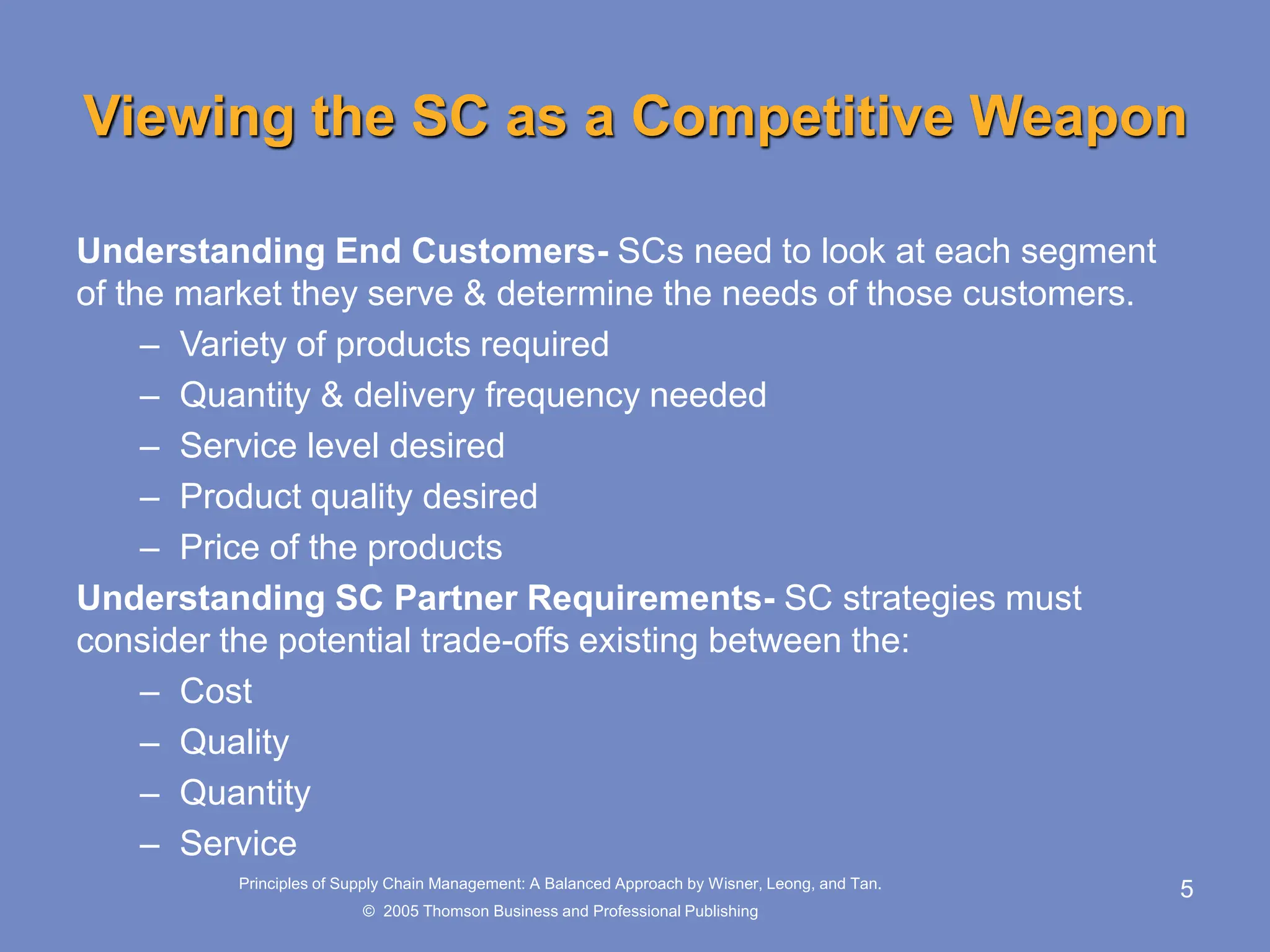
Understanding End Customers- SCs need to look at each segment
of the market they serve & determine the needs of those customers.
– Variety of products required
– Quantity & delivery frequency needed
– Service level desired
– Product quality desired
– Price of the products
Understanding SC Partner Requirements- SC strategies must
consider the potential trade-offs existing between the:
– Cost
– Quality
– Quantity
– Service
Principles of Supply Chain Management: A Balanced Approach by Wisner, Leong, and Tan.
© 2005 Thomson Business and Professional Publishing
6
Viewing the SC as a Competitive
Weapon- Cont.
Adjusting SC Member Capabilities
– SC members audit their capabilities & those of their supply
partners to determine if what they do is consistent with the needs
of the end customers & the SC.
– Matching SC capabilities to end-customer requirements means
that firms & their partners must continually reassess their
performance with respect to requirements.
– The best SC performers are more responsive to customer
needs, quicker to anticipate changes in the markets, & much
better at controlling costs.
Principles of Supply Chain Management: A Balanced Approach by Wisner, Leong, and Tan.
© 2005 Thomson Business and Professional Publishing
7
Traditional Performance Measures
– Financial statements & traditional cost-
based information do not reflect the
underlying performance of the productive
systems of an organization; cost & profit
information can be hidden or
manipulated.
– Decisions made solely to maximize
current stock prices do not necessarily
reflect that the firm is performing well.
– Financial performance measures, while
important, cannot adequately capture a
firm’s ability to excel in these areas.
Principles of Supply Chain Management: A Balanced Approach by Wisner, Leong, and Tan.
© 2005 Thomson Business and Professional Publishing
8
Traditional Performance Measures- Cont.
Use of Organization Costs, Revenue, & Profitability Measures-
Several problems are associated with using these measures to
gauge performance, for example:
– windfall profits that occur when prices suddenly rise due to
supply interruptions, caused for the most part by uncontrollable
environmental conditions.
Another problem is the difficulty, to attribute cost, revenue, or profit
contributions to the various functional units or business units
Allocating costs based on a department’s percentage of direct labor
hours causes managers to waste time trying to reduce direct labor.
Principles of Supply Chain Management: A Balanced Approach by Wisner, Leong, and Tan.
© 2005 Thomson Business and Professional Publishing
9
Traditional Performance Measures- Cont.
Use of Performance Standards & Variances
– Establishing standards for comparison purposes can be
trouble-some.
• Employees & managers do whatever it takes to reach the
goal
• Shoddy work
• “Cooking” the books.
– Performance variance- the difference between the standard
& actual performance.
– Managers can be pressured to find ways to make up these
variances, resulting in decisions that may not be in the long-
term best interests of the firm.
Principles of Supply Chain Management: A Balanced Approach by Wisner, Leong, and Tan.
© 2005 Thomson Business and Professional Publishing
10
Traditional Performance Measures- Cont.
Use of Firm-Wide Productivity & Utilization Measures- useful but
have the same problems as revenues, costs, & profits.
– Decisions made to increase productivity may prove to actually
increase a firm’s costs & reduce quality.
– Tendency to continue producing & adding to inventory to keep
machines & people busy.
– Less time is spent doing preventive maintenance & training for
greater performance & profits in future.
– Traditional performance measures also tend to be short-term
oriented.
Principles of Supply Chain Management: A Balanced Approach by Wisner, Leong, and Tan.
© 2005 Thomson Business and Professional Publishing
11
World-Class Performance Measurement
Systems
Developing World-Class Performance Measures
– Identify the firm’s strategic objectives.
– Develop an understanding of each functional area’s role & the
required capabilities.
– Identify internal & external trends likely to affect the firm & its
performance over time.
– For each functional area, develop performance measures that
describe each area’s capabilities.
– Document current performance measures & identify changes
that must be implemented.
– Assure the compatibility & strategic focus of the performance
measures to be used.
– Implement the new performance system.
– Periodically reevaluate the firm’s performance measurement
system.
Principles of Supply Chain Management: A Balanced Approach by Wisner, Leong, and Tan.
© 2005 Thomson Business and Professional Publishing
12
World-Class Performance Measurement
Systems
Principles of Supply Chain Management: A Balanced Approach by Wisner, Leong, and Tan.
© 2005 Thomson Business and Professional Publishing
13
SC Performance Measurement Systems
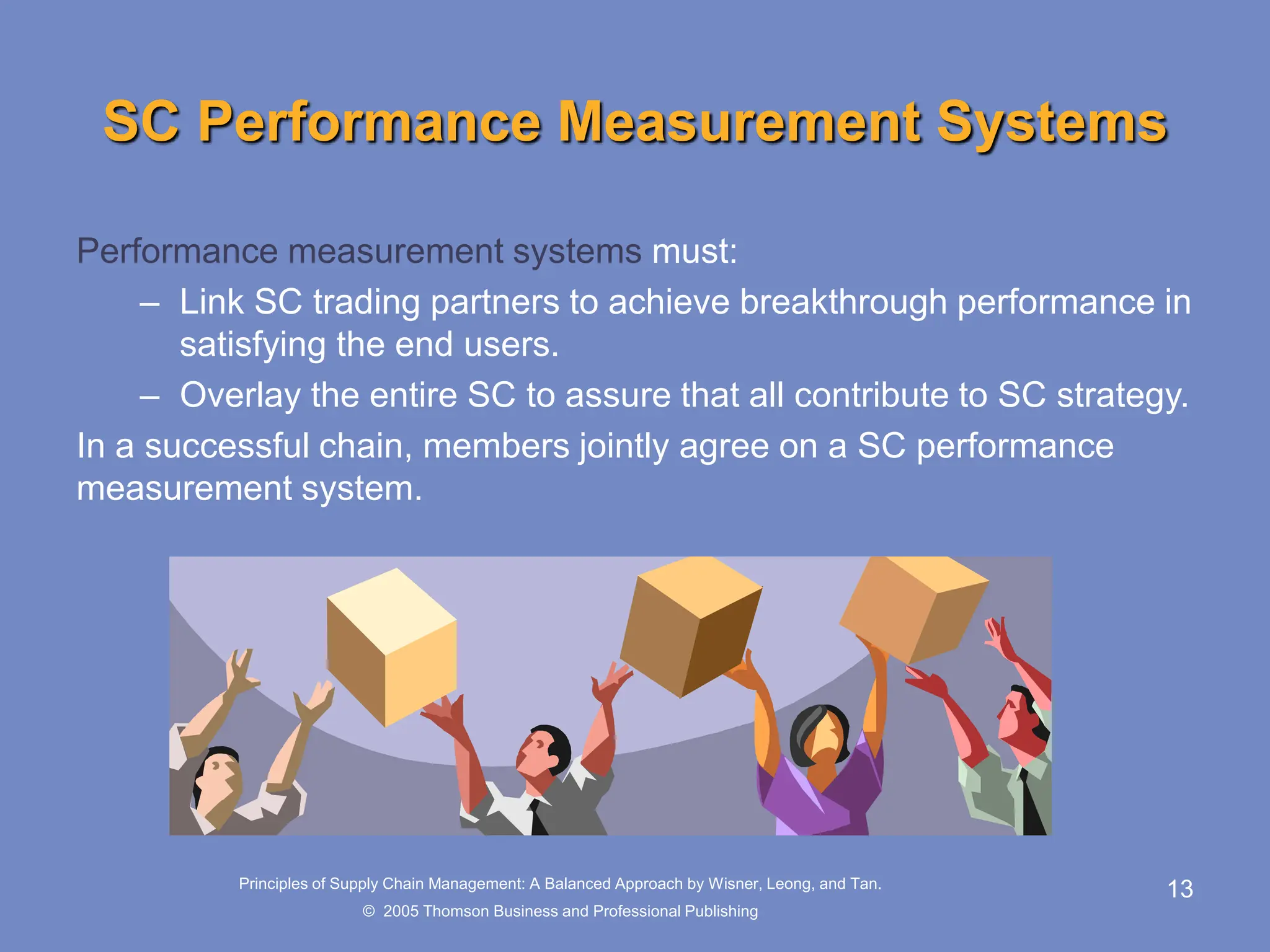
Performance measurement systems must:
– Link SC trading partners to achieve breakthrough performance in
satisfying the end users.
– Overlay the entire SC to assure that all contribute to SC strategy.
In a successful chain, members jointly agree on a SC performance
measurement system.
Principles of Supply Chain Management: A Balanced Approach by Wisner, Leong, and Tan.
© 2005 Thomson Business and Professional Publishing
14
SC Performance Measurement Systems-
Cont.
Specific Supply Chain Performance Measures
– Total SCM costs: cost to process orders; purchase &
manage inventories; & information systems.
– SC cash-to-cash cycle time: Average # of days between
paying for materials and getting paid by SC partners.
– SC production flexibility: average time required to provide an
unplanned 20 % increase in production.
– SC delivery performance: average % of orders filled by
requested delivery date.
– SC perfect order fulfillment performance: average % of
orders that arrive on time, complete, and damage free.
– Supply chain e-business performance: average % of
electronic orders received for all supply chain members.
Principles of Supply Chain Management: A Balanced Approach by Wisner, Leong, and Tan.
© 2005 Thomson Business and Professional Publishing
15
The Balanced Scorecard
Balanced scorecard (BSC) developed
by Kaplan and Norton to align an
organization’s performance measures
with its strategic plan and goals. The
BSC framework consists of four
perspectives:
– Financial perspective
– Internal business process
perspective
– Customer perspective
– Learning and growth perspective
Principles of Supply Chain Management: A Balanced Approach by Wisner, Leong, and Tan.
© 2005 Thomson Business and Professional Publishing
16
The Balanced Scorecard- Cont.
Principles of Supply Chain Management: A Balanced Approach by Wisner, Leong, and Tan.
© 2005 Thomson Business and Professional Publishing
17
The Balanced Scorecard- Cont.
Principles of Supply Chain Management: A Balanced Approach by Wisner, Leong, and Tan.
© 2005 Thomson Business and Professional Publishing
18
Supply Chain Operations Reference
(SCOR) Model
Developed by the Supply-Chain
Council for supply chain management
diagnostic benchmarking, and
process improvement tool. The SCOR
model separates supply chain
operations into 5 process categories:
– Plan
– Source
– Make
– Deliver
– Return

Performance Measurement Supply Chain Management

  • 1.
    CHAPTER 14- PERFORMANCE MEASUREMENTALONG THE SUPPLY CHAIN Principles of Supply Chain Management: A Balanced Approach
  • 2.
    Principles of SupplyChain Management: A Balanced Approach by Wisner, Leong, and Tan. © 2005 Thomson Business and Professional Publishing 2 Learning Objectives You should be able to: – Describe why firms need to measure & assess performance. – Discuss the merits of financial & non-financial performance measures. – List a number of traditional & world-class performance measures. – Describe how the balanced scorecard & the SCOR models work. – Describe how to design a supply chain performance measurement system.
  • 3.
    Principles of SupplyChain Management: A Balanced Approach by Wisner, Leong, and Tan. © 2005 Thomson Business and Professional Publishing 3 Chapter Fourteen Outline Viewing the Supply Chain (SC) as a Competitive Weapon Understanding End Customers Understanding SC Partner Requirements Adjusting SC Member Capabilities Traditional Performance Measures Use of Organization Costs, Revenue, & Profitability Measures Use of Performance Standards & Variances Use of Firm-Wide Productivity & Utilization Measures World-Class Performance Measurement Systems Developing World-Class Performance Measures SC Performance Measurement Systems Specific Chain Performance Measures The Balanced Scorecard The SC Operations Reference Model
  • 4.
    Principles of SupplyChain Management: A Balanced Approach by Wisner, Leong, and Tan. © 2005 Thomson Business and Professional Publishing 4 Introduction “You can’t improve what you can’t measure” – Companies using performance measurement- more likely to achieve leadership positions & twice as likely to handle a major change successfully. – Performance measurements vary from company to company. – World-class status may initially cost more. – Adding several tiers of suppliers & customers complicates performance measurement. – Performance measures must be visible & communicated to all members of the SC.
  • 5.
    Principles of SupplyChain Management: A Balanced Approach by Wisner, Leong, and Tan. © 2005 Thomson Business and Professional Publishing 5 Viewing the SC as a Competitive Weapon Understanding End Customers- SCs need to look at each segment of the market they serve & determine the needs of those customers. – Variety of products required – Quantity & delivery frequency needed – Service level desired – Product quality desired – Price of the products Understanding SC Partner Requirements- SC strategies must consider the potential trade-offs existing between the: – Cost – Quality – Quantity – Service
  • 6.
    Principles of SupplyChain Management: A Balanced Approach by Wisner, Leong, and Tan. © 2005 Thomson Business and Professional Publishing 6 Viewing the SC as a Competitive Weapon- Cont. Adjusting SC Member Capabilities – SC members audit their capabilities & those of their supply partners to determine if what they do is consistent with the needs of the end customers & the SC. – Matching SC capabilities to end-customer requirements means that firms & their partners must continually reassess their performance with respect to requirements. – The best SC performers are more responsive to customer needs, quicker to anticipate changes in the markets, & much better at controlling costs.
  • 7.
    Principles of SupplyChain Management: A Balanced Approach by Wisner, Leong, and Tan. © 2005 Thomson Business and Professional Publishing 7 Traditional Performance Measures Traditional Performance Measures – Financial statements & traditional cost- based information do not reflect the underlying performance of the productive systems of an organization; cost & profit information can be hidden or manipulated. – Decisions made solely to maximize current stock prices do not necessarily reflect that the firm is performing well. – Financial performance measures, while important, cannot adequately capture a firm’s ability to excel in these areas.
  • 8.
    Principles of SupplyChain Management: A Balanced Approach by Wisner, Leong, and Tan. © 2005 Thomson Business and Professional Publishing 8 Traditional Performance Measures- Cont. Use of Organization Costs, Revenue, & Profitability Measures- Several problems are associated with using these measures to gauge performance, for example: – windfall profits that occur when prices suddenly rise due to supply interruptions, caused for the most part by uncontrollable environmental conditions. Another problem is the difficulty, to attribute cost, revenue, or profit contributions to the various functional units or business units Allocating costs based on a department’s percentage of direct labor hours causes managers to waste time trying to reduce direct labor.
  • 9.
    Principles of SupplyChain Management: A Balanced Approach by Wisner, Leong, and Tan. © 2005 Thomson Business and Professional Publishing 9 Traditional Performance Measures- Cont. Use of Performance Standards & Variances – Establishing standards for comparison purposes can be trouble-some. • Employees & managers do whatever it takes to reach the goal • Shoddy work • “Cooking” the books. – Performance variance- the difference between the standard & actual performance. – Managers can be pressured to find ways to make up these variances, resulting in decisions that may not be in the long- term best interests of the firm.
  • 10.
    Principles of SupplyChain Management: A Balanced Approach by Wisner, Leong, and Tan. © 2005 Thomson Business and Professional Publishing 10 Traditional Performance Measures- Cont. Use of Firm-Wide Productivity & Utilization Measures- useful but have the same problems as revenues, costs, & profits. – Decisions made to increase productivity may prove to actually increase a firm’s costs & reduce quality. – Tendency to continue producing & adding to inventory to keep machines & people busy. – Less time is spent doing preventive maintenance & training for greater performance & profits in future. – Traditional performance measures also tend to be short-term oriented.
  • 11.
    Principles of SupplyChain Management: A Balanced Approach by Wisner, Leong, and Tan. © 2005 Thomson Business and Professional Publishing 11 World-Class Performance Measurement Systems Developing World-Class Performance Measures – Identify the firm’s strategic objectives. – Develop an understanding of each functional area’s role & the required capabilities. – Identify internal & external trends likely to affect the firm & its performance over time. – For each functional area, develop performance measures that describe each area’s capabilities. – Document current performance measures & identify changes that must be implemented. – Assure the compatibility & strategic focus of the performance measures to be used. – Implement the new performance system. – Periodically reevaluate the firm’s performance measurement system.
  • 12.
    Principles of SupplyChain Management: A Balanced Approach by Wisner, Leong, and Tan. © 2005 Thomson Business and Professional Publishing 12 World-Class Performance Measurement Systems
  • 13.
    Principles of SupplyChain Management: A Balanced Approach by Wisner, Leong, and Tan. © 2005 Thomson Business and Professional Publishing 13 SC Performance Measurement Systems Performance measurement systems must: – Link SC trading partners to achieve breakthrough performance in satisfying the end users. – Overlay the entire SC to assure that all contribute to SC strategy. In a successful chain, members jointly agree on a SC performance measurement system.
  • 14.
    Principles of SupplyChain Management: A Balanced Approach by Wisner, Leong, and Tan. © 2005 Thomson Business and Professional Publishing 14 SC Performance Measurement Systems- Cont. Specific Supply Chain Performance Measures – Total SCM costs: cost to process orders; purchase & manage inventories; & information systems. – SC cash-to-cash cycle time: Average # of days between paying for materials and getting paid by SC partners. – SC production flexibility: average time required to provide an unplanned 20 % increase in production. – SC delivery performance: average % of orders filled by requested delivery date. – SC perfect order fulfillment performance: average % of orders that arrive on time, complete, and damage free. – Supply chain e-business performance: average % of electronic orders received for all supply chain members.
  • 15.
    Principles of SupplyChain Management: A Balanced Approach by Wisner, Leong, and Tan. © 2005 Thomson Business and Professional Publishing 15 The Balanced Scorecard Balanced scorecard (BSC) developed by Kaplan and Norton to align an organization’s performance measures with its strategic plan and goals. The BSC framework consists of four perspectives: – Financial perspective – Internal business process perspective – Customer perspective – Learning and growth perspective
  • 16.
    Principles of SupplyChain Management: A Balanced Approach by Wisner, Leong, and Tan. © 2005 Thomson Business and Professional Publishing 16 The Balanced Scorecard- Cont.
  • 17.
    Principles of SupplyChain Management: A Balanced Approach by Wisner, Leong, and Tan. © 2005 Thomson Business and Professional Publishing 17 The Balanced Scorecard- Cont.
  • 18.
    Principles of SupplyChain Management: A Balanced Approach by Wisner, Leong, and Tan. © 2005 Thomson Business and Professional Publishing 18 Supply Chain Operations Reference (SCOR) Model Developed by the Supply-Chain Council for supply chain management diagnostic benchmarking, and process improvement tool. The SCOR model separates supply chain operations into 5 process categories: – Plan – Source – Make – Deliver – Return