CHAPTER 2
CORPORATE RISK MANAGEMENT
PREPARED BY : KASHIF ABBASS
CONTENTS
• History of risk management
• Importance of risk management
• Risk Management standard
• Risk management process
• Risk management vs insurance management
• Risk management objectives
INTRODUCTION
•Although the term Risk Mgmt is a recent phenomenon, the actual
practice of risk management is as old as civilization itself
 In the broad sense of the term, risk management is the process of protecting
one’s person and assets.
 In the narrower sense, it is a managerial function of business, which uses a
scientific approach to dealing with risks.
RISK MANAGEMENT
• Risk management is a scientific approach to the problem of
dealing with the pure risks facing by individuals and
organizations.
• It evolved from corporate insurance management, which
focused on the risk of accidental loss to assets and income of
the organization
HISTORY OF MODERN RISK MANAGEMENT
• The general trend in use of the term "risk management"
began in the early 1950's.
One of the early references to risk management in literature
appeared a 1956 article in Harvard Business Review by Russel
Gallagher.
Gallagher proposed that someone within the organization should
be responsible for "managing" the organization's pure risks:
•RM represents the merging of three specialties; decision theory,
risk financing, and risk control.
 Decision theory has its roots in operations research and management
science.
 The risk-financing specialty came from the disciplines of finance and
insurance.
 The risk control specialty represents a merger of traditional safety
management and systems safety from the military and aerospace industry.
RISK MANAGEMENT
• A process that identifies loss exposures faced by an organization and select most
appropriate techniques for treating such exposures.
• Loss exposure – any situation or circumstance in which a loss is possible,
regardless of whether a loss actually occurs.
IMPORTANCE OF RM
• RM program enables a firm to attain its pre-loss and post-loss objectives.
• The cost of risk is reduced, which may increase the company’s profits.
• The adverse financial impact of pure loss exposures is reduced, a firm may be
able to implement an ERM program.
• Society also benefits since both direct and indirect losses are reduced. As a
result, pain and suffering reduced.
RM STANDARD
• A number of standards have been developed worldwide to help organizations
implement risk management systematically and effectively.
• Establish a common view on frameworks, processes and practice, and are
generally set by recognized international standards bodies or by industry groups.
• Risk management is a fast-moving discipline and standards are regularly
supplemented and updated.
• The different standards reflect the different motivations and technical focus of
their developers.
RM STANDARD
Commonly used standards include:
• ISO 31000 2009 – Risk Management Principles and Guidelines
• A Risk Management Standard – IRM/Alarm/AIRMIC 2002 – developed in 2002 by the UK’s
3 main risk organizations.
• ISO/IEC 31010:2009 - Risk Management - Risk Assessment Techniques
• COSO (Committee of Sponsoring Organizations of the Treadway Commission )2004 -
Enterprise Risk Management - Integrated Framework
• OCEG (Open Compliance and Ethics Group ) “Red Book” 2.0: 2009 - a Governance, Risk
and Compliance Capability Model
RM PROCESS
Step 1: Identify loss exposures
Step 2: Measure and analyze the loss exposure
Step 3: Select the appropriate combination of techniques for treating the loss
exposure
Step 4: Implement and monitor the risk management program
RM PROCESS
(IDENTIFY LOSS EXPOSURES)
A. Identify the Loss Exposures
1. Important loss exposures
a. Property loss exposures
b. Liability loss exposures
c. Business income loss exposures
d. Human resources loss exposures
e. Crime loss exposures
f. Employee benefits loss exposures
RM PROCESS
(IDENTIFY LOSS EXPOSURES)
Cont’ed
g. Foreign loss exposures
h. Intangible property loss exposures
i. Failure to comply with government laws and regulations
RM PROCESS
(IDENTIFY LOSS EXPOSURES)
2. Sources of information for identifying loss exposures
a. Risk analysis questionnaires
b. Physical inspection
c. Flow charts
d. Financial statements
e. Historical loss data
RM PROCESS
(MEASURE AND ANALYZE THE LOSS EXPOSURES)
1. Two concepts
a. Loss frequency
b. Loss severity
2. Guidelines for measuring severity
a. Maximum possible loss
b. Probable maximum loss
RM PROCESS
(SELECT THE APPROPRIATE COMBINATION OF TECHNIQUES FOR
TREATING THE LOSS EXPOSURES)
1. Risk control
a. Avoidance
b. Loss prevention
c. Loss reduction
d. Duplication
e. Separation
f. Diversification
RM PROCESS
(SELECT THE APPROPRIATE COMBINATION OF TECHNIQUES FOR TREATING
THE LOSS EXPOSURES)
2. Risk financing
a. Retention
(1) Determining retention levels
(2) Paying losses
(3) Captive insurer
(4) Income tax treatment of captives
(5) Self-insurance
(6) Risk retention groups
(7) Advantages and disadvantages of retention
RM PROCESS
(SELECT THE APPROPRIATE COMBINATION OF TECHNIQUES FOR TREATING
THE LOSS EXPOSURES)
b. Noninsurance transfers
c. Commercial insurance
(1) Advantages of insurance
(2) Disadvantages of insurance
d. Which technique should be used?
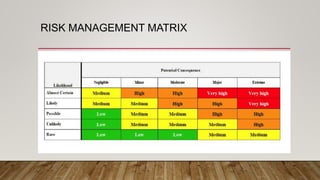
RISK MANAGEMENT MATRIX
RM PROCESS
(IMPLEMENT AND MONITOR THE RISK MANAGEMENT
PROGRAM)
1. Policy statement
2. Cooperation with other departments
3. Periodic review
RISK MANAGEMENT VS INSURANCE
MANAGEMENT
• Risk mgmt
– Broad, includes non insurable risk
– Utilize all techniques, insurance is one of the technique
• Insurance mgmt
– Manage insurable risk only
– Insurance is the main technique
RM OBJECTIVES
A. Pre-loss Objectives
1. Economy goal
2. Reduction of anxiety
3. Meet any legal obligations
RM OBJECTIVES
B. Post-loss Objectives
1. Survival of the firm
2. Continued operation
3. Stability of earnings
4. Continued growth
5. Social responsibility

CHAPTER 2.pptx

  • 1.
    CHAPTER 2 CORPORATE RISKMANAGEMENT PREPARED BY : KASHIF ABBASS
  • 2.
    CONTENTS • History ofrisk management • Importance of risk management • Risk Management standard • Risk management process • Risk management vs insurance management • Risk management objectives
  • 3.
    INTRODUCTION •Although the termRisk Mgmt is a recent phenomenon, the actual practice of risk management is as old as civilization itself  In the broad sense of the term, risk management is the process of protecting one’s person and assets.  In the narrower sense, it is a managerial function of business, which uses a scientific approach to dealing with risks.
  • 4.
    RISK MANAGEMENT • Riskmanagement is a scientific approach to the problem of dealing with the pure risks facing by individuals and organizations. • It evolved from corporate insurance management, which focused on the risk of accidental loss to assets and income of the organization
  • 5.
    HISTORY OF MODERNRISK MANAGEMENT • The general trend in use of the term "risk management" began in the early 1950's. One of the early references to risk management in literature appeared a 1956 article in Harvard Business Review by Russel Gallagher. Gallagher proposed that someone within the organization should be responsible for "managing" the organization's pure risks:
  • 6.
    •RM represents themerging of three specialties; decision theory, risk financing, and risk control.  Decision theory has its roots in operations research and management science.  The risk-financing specialty came from the disciplines of finance and insurance.  The risk control specialty represents a merger of traditional safety management and systems safety from the military and aerospace industry.
  • 7.
    RISK MANAGEMENT • Aprocess that identifies loss exposures faced by an organization and select most appropriate techniques for treating such exposures. • Loss exposure – any situation or circumstance in which a loss is possible, regardless of whether a loss actually occurs.
  • 8.
    IMPORTANCE OF RM •RM program enables a firm to attain its pre-loss and post-loss objectives. • The cost of risk is reduced, which may increase the company’s profits. • The adverse financial impact of pure loss exposures is reduced, a firm may be able to implement an ERM program. • Society also benefits since both direct and indirect losses are reduced. As a result, pain and suffering reduced.
  • 9.
    RM STANDARD • Anumber of standards have been developed worldwide to help organizations implement risk management systematically and effectively. • Establish a common view on frameworks, processes and practice, and are generally set by recognized international standards bodies or by industry groups. • Risk management is a fast-moving discipline and standards are regularly supplemented and updated. • The different standards reflect the different motivations and technical focus of their developers.
  • 10.
    RM STANDARD Commonly usedstandards include: • ISO 31000 2009 – Risk Management Principles and Guidelines • A Risk Management Standard – IRM/Alarm/AIRMIC 2002 – developed in 2002 by the UK’s 3 main risk organizations. • ISO/IEC 31010:2009 - Risk Management - Risk Assessment Techniques • COSO (Committee of Sponsoring Organizations of the Treadway Commission )2004 - Enterprise Risk Management - Integrated Framework • OCEG (Open Compliance and Ethics Group ) “Red Book” 2.0: 2009 - a Governance, Risk and Compliance Capability Model
  • 11.
    RM PROCESS Step 1:Identify loss exposures Step 2: Measure and analyze the loss exposure Step 3: Select the appropriate combination of techniques for treating the loss exposure Step 4: Implement and monitor the risk management program
  • 12.
    RM PROCESS (IDENTIFY LOSSEXPOSURES) A. Identify the Loss Exposures 1. Important loss exposures a. Property loss exposures b. Liability loss exposures c. Business income loss exposures d. Human resources loss exposures e. Crime loss exposures f. Employee benefits loss exposures
  • 13.
    RM PROCESS (IDENTIFY LOSSEXPOSURES) Cont’ed g. Foreign loss exposures h. Intangible property loss exposures i. Failure to comply with government laws and regulations
  • 14.
    RM PROCESS (IDENTIFY LOSSEXPOSURES) 2. Sources of information for identifying loss exposures a. Risk analysis questionnaires b. Physical inspection c. Flow charts d. Financial statements e. Historical loss data
  • 15.
    RM PROCESS (MEASURE ANDANALYZE THE LOSS EXPOSURES) 1. Two concepts a. Loss frequency b. Loss severity 2. Guidelines for measuring severity a. Maximum possible loss b. Probable maximum loss
  • 16.
    RM PROCESS (SELECT THEAPPROPRIATE COMBINATION OF TECHNIQUES FOR TREATING THE LOSS EXPOSURES) 1. Risk control a. Avoidance b. Loss prevention c. Loss reduction d. Duplication e. Separation f. Diversification
  • 17.
    RM PROCESS (SELECT THEAPPROPRIATE COMBINATION OF TECHNIQUES FOR TREATING THE LOSS EXPOSURES) 2. Risk financing a. Retention (1) Determining retention levels (2) Paying losses (3) Captive insurer (4) Income tax treatment of captives (5) Self-insurance (6) Risk retention groups (7) Advantages and disadvantages of retention
  • 18.
    RM PROCESS (SELECT THEAPPROPRIATE COMBINATION OF TECHNIQUES FOR TREATING THE LOSS EXPOSURES) b. Noninsurance transfers c. Commercial insurance (1) Advantages of insurance (2) Disadvantages of insurance d. Which technique should be used?
  • 19.
  • 20.
    RM PROCESS (IMPLEMENT ANDMONITOR THE RISK MANAGEMENT PROGRAM) 1. Policy statement 2. Cooperation with other departments 3. Periodic review
  • 21.
    RISK MANAGEMENT VSINSURANCE MANAGEMENT • Risk mgmt – Broad, includes non insurable risk – Utilize all techniques, insurance is one of the technique • Insurance mgmt – Manage insurable risk only – Insurance is the main technique
  • 22.
    RM OBJECTIVES A. Pre-lossObjectives 1. Economy goal 2. Reduction of anxiety 3. Meet any legal obligations
  • 23.
    RM OBJECTIVES B. Post-lossObjectives 1. Survival of the firm 2. Continued operation 3. Stability of earnings 4. Continued growth 5. Social responsibility