
Supply Chain Risk Management Essentials
Megha Thakkar PMP®
Strategic Supply Chain Management,
Cipla Ltd.
Agenda
• Objective

• Introduction
• Supply Chain Management (SCM)
• SC Risk Management (SCRM)
• Developing A Comprehensive Risk Assessment
• Conclusion
17th Oct 13

Pharma Project

2
Key Interpretation
• Still an art, not a science
• Requirements to drive to SCRM performance are coming from
everywhere
• No industry is immune to the SCRM Imperative
• Key issues include:
– The need for a common framework and language
– Accountability and ownership
– Controls

17th Oct 13

3
Let’s start by DISPELLING
some MYTHS

17th Oct 13

4
FIRST
Supply chain management
is neither
a synonym for logistics
nor
as logistics that includes customers
and suppliers
17th Oct 13

5
SECOND
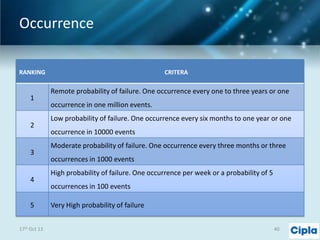
Supply chain management
is not
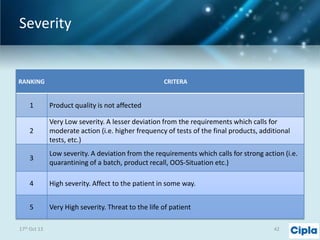
New name
for purchasing &/or operations

17th Oct 13

6
FINALLY
Supply chain management
is not even
Combination of
purchasing, operations and logistics

17th Oct 13

7
Then?
What is supply chain and
Supply chain management?

17th Oct 13

8
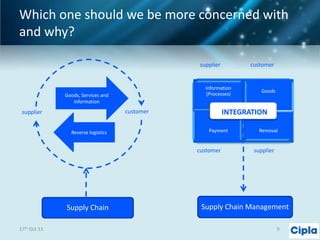
Which one should we be more concerned with
and why?
supplier

Information
(Processes)

Goods, Services and
information

Reverse logistics

Payment

customer

Supply Chain
17th Oct 13

Goods

INTEGRATION

customer

supplier

customer

Removal

supplier

Supply Chain Management
9
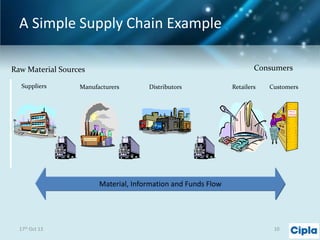
A Simple Supply Chain Example
Consumers

Raw Material Sources
Suppliers

Manufacturers

Distributors

Retailers

Customers

Material, Information and Funds Flow

17th Oct 13

10
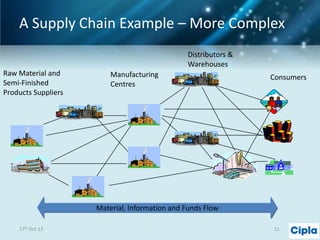
A Supply Chain Example – More Complex
Distributors &
Warehouses
Raw Material and
Semi-Finished
Products Suppliers

Manufacturing
Centres

Consumers

Material, Information and Funds Flow
17th Oct 13

11
Supply Chain
Supply chain is NOT a CHAIN of businesses
BUT A NETWORK of businesses & relationships.
That offers the opportunity to capture the full potential of intra
and inter-company integration and management to organize –
people, activities, information and resources involved in moving
a product from supplier to end-user.

17th Oct 13

12
Supply Chain Management
• Supply chain management is a set of approaches utilized to
efficiently integrate suppliers, manufacturers, warehouses,
and stores, so that product is produced and distributed at the
right quantities, to the right locations, and at the right time, in
order to minimize system wide costs while satisfying service
level requirements.”

17th Oct 13

13
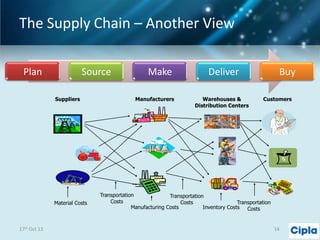
The Supply Chain – Another View
Plan

Source
Suppliers

Material Costs

17th Oct 13

Make
Manufacturers

Deliver
Warehouses &
Distribution Centers

Buy
Customers

Transportation
Transportation
Costs
Transportation
Costs
Manufacturing Costs
Inventory Costs Costs

14
Why Is SCM Difficult?
• Uncertainty is inherent to every supply chain
–
–
–
–

Travel times
Breakdowns of machines and vehicles
Weather, natural catastrophe, war
Local politics, labor conditions, border issues

• The complexity of the problem to globally optimize a supply
chain is significant
– Minimize internal costs
– Minimize uncertainty
– Deal with remaining uncertainty
17th Oct 13

15
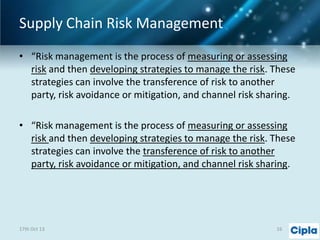
Supply Chain Risk Management
• “Risk management is the process of measuring or assessing
risk and then developing strategies to manage the risk. These
strategies can involve the transference of risk to another
party, risk avoidance or mitigation, and channel risk sharing.
• “Risk management is the process of measuring or assessing
risk and then developing strategies to manage the risk. These
strategies can involve the transference of risk to another
party, risk avoidance or mitigation, and channel risk sharing.

17th Oct 13

16
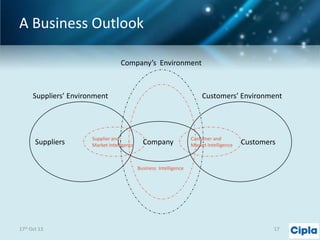
A Business Outlook
Company’s Environment

Suppliers’ Environment

Suppliers

Supplier and
Market Intelligence

Customers’ Environment

Company

Customer and
Market Intelligence

Customers

Business Intelligence

17th Oct 13

17
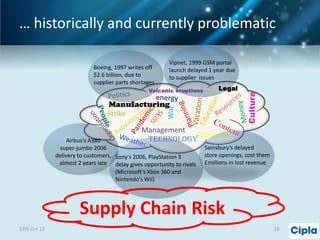
… historically and currently problematic
Vipnet, 1999 GSM portal
launch delayed 1 year due
to supplier issues

Volcanic eruptions

Legal

War

Manufacturing
Strike

Culture

Boeing, 1997 writes off
$2.6 billion, due to
supplier parts shortages

Management
Processes
Technology

Airbus's A380
super-jumbo 2006
delivery to customers, Sony's 2006, PlayStation 3
almost 2 years late delay gives opportunity to rivals
(Microsoft's Xbox 360 and
Nintendo's Wii)

Sainsbury’s delayed
store openings, cost them
£millions in lost revenue

Supply Chain Risk
17th Oct 13

18
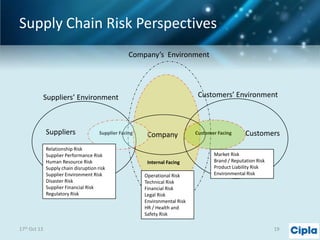
Supply Chain Risk Perspectives
Company’s Environment

Customers’ Environment

Suppliers’ Environment

Suppliers

Supplier Facing

Relationship Risk
Supplier Performance Risk
Human Resource Risk
Supply chain disruption risk
Supplier Environment Risk
Disaster Risk
Supplier Financial Risk
Regulatory Risk

17th Oct 13

Company

Internal Facing
Operational Risk
Technical Risk
Financial Risk
Legal Risk
Environmental Risk
HR / Health and
Safety Risk

Customer Facing

Customers

Market Risk
Brand / Reputation Risk
Product Liability Risk
Environmental Risk

19
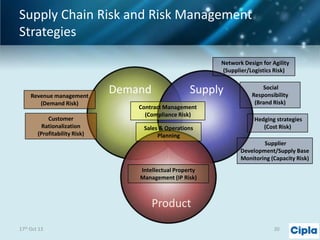
Supply Chain Risk and Risk Management
Strategies
Network Design for Agility
(Supplier/Logistics Risk)

Revenue management
(Demand Risk)
Customer
Rationalization
(Profitability Risk)

Demand

Supply

Contract Management
(Compliance Risk)
Sales & Operations
Planning

Social
Responsibility
(Brand Risk)
Hedging strategies
(Cost Risk)
Supplier
Development/Supply Base
Monitoring (Capacity Risk)

Intellectual Property
Management (IP Risk)

Product
17th Oct 13

20
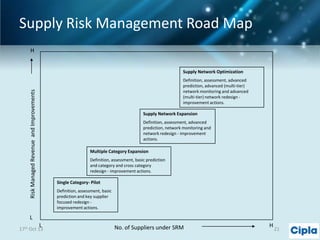
Supply Risk Management Road Map
H

Supply Network Optimization

Risk Managed Revenue and Improvements

Definition, assessment, advanced
prediction, advanced (multi-tier)
network monitoring and advanced
(multi-tier) network redesign improvement actions.

Supply Network Expansion
Definition, assessment, advanced
prediction, network monitoring and
network redesign - improvement
actions.

Multiple Category Expansion
Definition, assessment, basic prediction
and category and cross category
redesign - improvement actions.

Single Category- Pilot
Definition, assessment, basic
prediction and key supplier
focused redesign improvement actions.

L
L

17th Oct 13

No. of Suppliers under SRM

H

21
DEVELOPING A COMPREHENSIVE
RISK ASSESSMENT

17th Oct 13

22
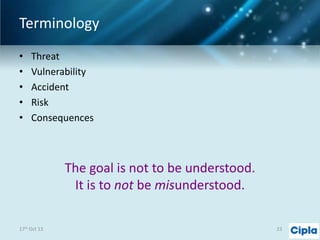
Terminology
•
•
•
•
•

Threat
Vulnerability
Accident
Risk
Consequences

The goal is not to be understood.
It is to not be misunderstood.
17th Oct 13

23
Threat – Hazard - Danger
• A condition that is a prerequisite to a mishap, accident, or
emergency
May be
INTERNAL or EXTERNAL

17th Oct 13

24
Threat Classification
• Natural Hazards
• Anthropogenic (man-caused) Threats
• Technological or Accidental Threats

From Avoiding Disaster, ©2002, John Laye, FBCI
Publisher: John Wiley & Sons, Hoboken, NJ, USA
17th Oct 13

25
Threat – Fear/Terrorism
Perpetrators must have:

INTENT

+

CAPABILITY

Measurable?
Uncertainty  Fear  Risk (Real or Perceived)

17th Oct 13

26
Vulnerability
• A characteristic of a system that allows a threat event to
materialize
Always
INTERNAL
And
Always in RELATION to a threat

17th Oct 13

27
Accident - Emergency
•
•
•
•

A function of vulnerability
Relates to Cause
1st significant deviation from the norm
Reactive Risk Assessment

17th Oct 13

28
Anatomy of an Incident

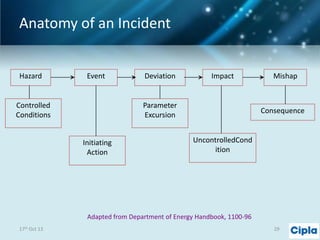
Hazard

Event

Controlled
Conditions

Deviation

Impact

Parameter
Excursion
Initiating
Action

Mishap

Consequence

UncontrolledCond
ition

Adapted from Department of Energy Handbook, 1100-96
17th Oct 13

29
Complex Systems
• Failure in one part (by any threat) may coincide or induce
failure in an entirely different part  unforeseeable
combination resulting in cascading failures.
• Cascading failures can accelerate out of control.
• Potentially limitless combinations in complex systems.
• Accidents are inevitable  “normal”

17th Oct 13

30
Risk
•

Future Effect

•

Combination of Severity and Likelihood

•

Undesirable (Insurance Co. view)

17th Oct 13

31
How do we assess?
• 3 steps to the Assessment process
– Identification
• What might go wrong?
• Must clearly define the risk in question

– Analysis
• What is the likelihood?
• How bad would it be?

– Evaluation
• What are the levels of risk criteria?
• Defined in advance

17th Oct 13

32
Risk Assessment
• A systematic process for organizing information to support a
risk decision that is made within a risk management process.
The process consists of the identification of hazards and the
analysis and evaluation of risks associated with exposure to
those hazards.

17th Oct 13

33
Risk Control
• Risk control includes decision making to reduce and/or accept
risks.
– The purpose of risk control is to reduce the risk to an acceptable
level.
– The amount of effort used for risk control should be
proportional to the significance of the risk.
– The user shall use different processes for understanding the
optimal level of risk control including cost-benefit analysis.

17th Oct 13

34
Risk Reduction
• By the implementation of risk reduction measures,
– new risks may be introduced into the system
– the significance of other existing risks might be increased.
– Hence, it might be appropriate to revisit the risk assessment to
identify and evaluate any possible change in risk.

17th Oct 13

35
Risk Acceptance
• Risk acceptance is a decision to accept risk.
– Risk acceptance can be a formal decision to accept the residual
risk or it can be a passive decision in which residual risks are not
specified.
– This acceptable level will depend on many parameters and
should be decided on a case-by-case basis.

17th Oct 13

36
Risk Review
• The results of the risk management process shall be reviewed
to take into account new knowledge and experience.
• Once a risk management process has been initiated, that
process should continue to be utilized for events that might
impact the original risk management decision whether these
are planned E.g., results of product review, inspections,
audits, change control) or unplanned (e.g., root cause from
failure investigations, recall).
• Risk management shall be an ongoing quality management
process and a mechanism to perform periodic review of
events shall be implemented. The frequency of the review
should be based upon the level of risk. Risk review might
include reconsideration of risk acceptance decisions
17th Oct 13

37
Tools and Techniques for Risk Review
• Ishikawa Model
• SCOR model
• Failure Mode Effects Analysis (FMEA)

17th Oct 13

38
Failure Mode Effects Analysis (FMEA)
• FMEA is a prevention tool used to assess, manage, and reduce
risk associated with failure or potential failure of products,
processes, services, and other systems.
• A quantitative characterization of failures is then undertaken

• This is comprised of the assignment of probabilities to three
factors - the likelihood of occurrence, the likelihood of
detection of failures and the severity of a failure.
• As part of this assessment each characteristic is assigned a
value. These values are then multiplied with the resultant risk
priority number (RPN).
17th Oct 13

39
Occurrence
RANKING

1

2

3

4
5
17th Oct 13

CRITERA

Remote probability of failure. One occurrence every one to three years or one
occurrence in one million events.
Low probability of failure. One occurrence every six months to one year or one
occurrence in 10000 events
Moderate probability of failure. One occurrence every three months or three
occurrences in 1000 events
High probability of failure. One occurrence per week or a probability of 5
occurrences in 100 events
Very High probability of failure
40
Severity
• Severity (S) refers to an assessment of the seriousness of a
failure as it affects the end user.
• A higher severity rating may be assigned to process steps that
involved manual operations or interventions as compared to
done by automatic machine The higher rating is necessary
because of quality failure or introduction of contamination
during these steps will result in a higher risk to the product
safety and the end-user.

17th Oct 13

41
Severity

RANKING

CRITERA

1

Product quality is not affected

2

Very Low severity. A lesser deviation from the requirements which calls for
moderate action (i.e. higher frequency of tests of the final products, additional
tests, etc.)

3

Low severity. A deviation from the requirements which calls for strong action (i.e.
quarantining of a batch, product recall, OOS-Situation etc.)

4

High severity. Affect to the patient in some way.

5

Very High severity. Threat to the life of patient

17th Oct 13

42
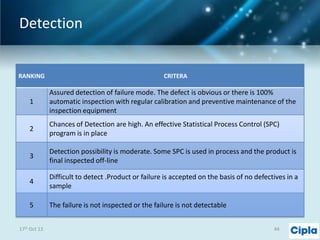
Detection
• Detection (D) refers to the ability to detect the failure mode
for contamination risk prior to the customer receiving the
finished product.
• The rating scale for determining the detection level is shown
in Table

17th Oct 13

43
Detection

RANKING

CRITERA

1

Assured detection of failure mode. The defect is obvious or there is 100%
automatic inspection with regular calibration and preventive maintenance of the
inspection equipment

2

Chances of Detection are high. An effective Statistical Process Control (SPC)
program is in place

3

Detection possibility is moderate. Some SPC is used in process and the product is
final inspected off-line

4

Difficult to detect .Product or failure is accepted on the basis of no defectives in a
sample

5

The failure is not inspected or the failure is not detectable

17th Oct 13

44
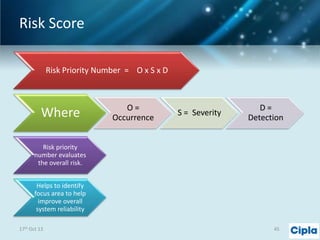
Risk Score
Risk Priority Number = O x S x D

Where

O=
Occurrence

S = Severity

D=
Detection

Risk priority
number evaluates
the overall risk.
Helps to identify
focus area to help
improve overall
system reliability
17th Oct 13

45
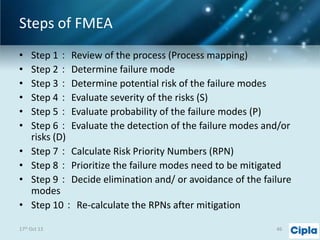
Steps of FMEA
•
•
•
•
•
•
•
•
•
•

Step 1: Review of the process (Process mapping)
Step 2: Determine failure mode
Step 3: Determine potential risk of the failure modes
Step 4: Evaluate severity of the risks (S)
Step 5: Evaluate probability of the failure modes (P)
Step 6: Evaluate the detection of the failure modes and/or
risks (D)
Step 7: Calculate Risk Priority Numbers (RPN)
Step 8: Prioritize the failure modes need to be mitigated
Step 9: Decide elimination and/ or avoidance of the failure
modes
Step 10: Re-calculate the RPNs after mitigation

17th Oct 13

46
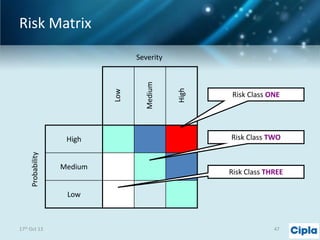
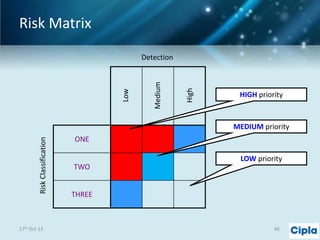
Risk Matrix

Probability

High
Medium

High

Medium

Low

Severity

Risk Class ONE

Risk Class TWO

Risk Class THREE

Low

17th Oct 13

47
Risk Matrix

High

Medium

Low

Detection

HIGH priority

Risk Classification

MEDIUM priority

17th Oct 13

ONE
LOW priority
TWO
THREE

48
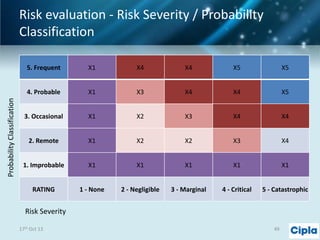
Risk evaluation - Risk Severity / Probability
Classification
X1

X4

X4

X5

X5

4. Probable

Probability Classification

5. Frequent

X1

X3

X4

X4

X5

3. Occasional

X1

X2

X3

X4

X4

2. Remote

X1

X2

X2

X3

X4

1. Improbable

X1

X1

X1

X1

X1

RATING

1 - None

2 - Negligible

3 - Marginal

4 - Critical

5 - Catastrophic

Risk Severity
17th Oct 13

49
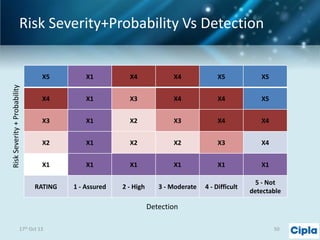
Risk Severity+Probability Vs Detection

X1

X4

X4

X5

X5

X4

X1

X3

X4

X4

X5

X3

X1

X2

X3

X4

X4

X2

X1

X2

X2

X3

X4

X1

X1

X1

X1

X1

X1

RATING

Risk Severity + Probability

X5

1 - Assured

2 - High

3 - Moderate

4 - Difficult

5 - Not
detectable

Detection
17th Oct 13

50
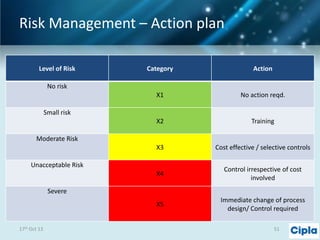
Risk Management – Action plan
Level of Risk

Category

Action

X1

No action reqd.

X2

Training

X3

Cost effective / selective controls

X4

Control irrespective of cost
involved

X5

Immediate change of process
design/ Control required

No risk

Small risk

Moderate Risk

Unacceptable Risk

Severe

17th Oct 13

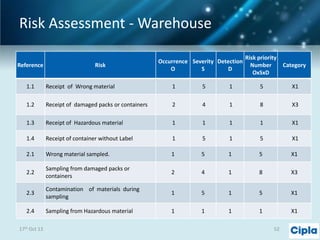
51
Risk Assessment - Warehouse
Reference

Risk

Occurrence Severity Detection
O
S
D

Risk priority
Number
OxSxD

Category

1.1

Receipt of Wrong material

1

5

1

5

X1

1.2

Receipt of damaged packs or containers

2

4

1

8

X3

1.3

Receipt of Hazardous material

1

1

1

1

X1

1.4

Receipt of container without Label

1

5

1

5

X1

2.1

Wrong material sampled.

1

5

1

5

X1

2.2

Sampling from damaged packs or
containers

2

4

1

8

X3

2.3

Contamination of materials during
sampling

1

5

1

5

X1

2.4

Sampling from Hazardous material

1

1

1

1

X1

17th Oct 13

52
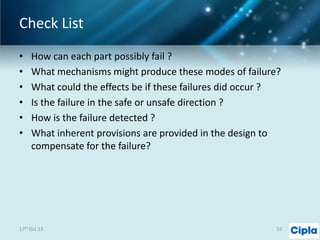
Check List
•
•
•
•
•
•

How can each part possibly fail ?
What mechanisms might produce these modes of failure?
What could the effects be if these failures did occur ?
Is the failure in the safe or unsafe direction ?
How is the failure detected ?
What inherent provisions are provided in the design to
compensate for the failure?

17th Oct 13

53
Any Questions?

17th Oct 13

54
Thank You

Megha Thakkar, PMP ®
Email: kotak.megha@gmail.com
LinkedIn Profile: http://in.linkedin.com/in/mthakkar/

55

Supply chain risk management

  • 1.
    Supply Chain RiskManagement Essentials Megha Thakkar PMP® Strategic Supply Chain Management, Cipla Ltd.
  • 2.
    Agenda • Objective • Introduction •Supply Chain Management (SCM) • SC Risk Management (SCRM) • Developing A Comprehensive Risk Assessment • Conclusion 17th Oct 13 Pharma Project 2
  • 3.
    Key Interpretation • Stillan art, not a science • Requirements to drive to SCRM performance are coming from everywhere • No industry is immune to the SCRM Imperative • Key issues include: – The need for a common framework and language – Accountability and ownership – Controls 17th Oct 13 3
  • 4.
    Let’s start byDISPELLING some MYTHS 17th Oct 13 4
  • 5.
    FIRST Supply chain management isneither a synonym for logistics nor as logistics that includes customers and suppliers 17th Oct 13 5
  • 6.
    SECOND Supply chain management isnot New name for purchasing &/or operations 17th Oct 13 6
  • 7.
    FINALLY Supply chain management isnot even Combination of purchasing, operations and logistics 17th Oct 13 7
  • 8.
    Then? What is supplychain and Supply chain management? 17th Oct 13 8
  • 9.
    Which one shouldwe be more concerned with and why? supplier Information (Processes) Goods, Services and information Reverse logistics Payment customer Supply Chain 17th Oct 13 Goods INTEGRATION customer supplier customer Removal supplier Supply Chain Management 9
  • 10.
    A Simple SupplyChain Example Consumers Raw Material Sources Suppliers Manufacturers Distributors Retailers Customers Material, Information and Funds Flow 17th Oct 13 10
  • 11.
    A Supply ChainExample – More Complex Distributors & Warehouses Raw Material and Semi-Finished Products Suppliers Manufacturing Centres Consumers Material, Information and Funds Flow 17th Oct 13 11
  • 12.
    Supply Chain Supply chainis NOT a CHAIN of businesses BUT A NETWORK of businesses & relationships. That offers the opportunity to capture the full potential of intra and inter-company integration and management to organize – people, activities, information and resources involved in moving a product from supplier to end-user. 17th Oct 13 12
  • 13.
    Supply Chain Management •Supply chain management is a set of approaches utilized to efficiently integrate suppliers, manufacturers, warehouses, and stores, so that product is produced and distributed at the right quantities, to the right locations, and at the right time, in order to minimize system wide costs while satisfying service level requirements.” 17th Oct 13 13
  • 14.
    The Supply Chain– Another View Plan Source Suppliers Material Costs 17th Oct 13 Make Manufacturers Deliver Warehouses & Distribution Centers Buy Customers Transportation Transportation Costs Transportation Costs Manufacturing Costs Inventory Costs Costs 14
  • 15.
    Why Is SCMDifficult? • Uncertainty is inherent to every supply chain – – – – Travel times Breakdowns of machines and vehicles Weather, natural catastrophe, war Local politics, labor conditions, border issues • The complexity of the problem to globally optimize a supply chain is significant – Minimize internal costs – Minimize uncertainty – Deal with remaining uncertainty 17th Oct 13 15
  • 16.
    Supply Chain RiskManagement • “Risk management is the process of measuring or assessing risk and then developing strategies to manage the risk. These strategies can involve the transference of risk to another party, risk avoidance or mitigation, and channel risk sharing. • “Risk management is the process of measuring or assessing risk and then developing strategies to manage the risk. These strategies can involve the transference of risk to another party, risk avoidance or mitigation, and channel risk sharing. 17th Oct 13 16
  • 17.
    A Business Outlook Company’sEnvironment Suppliers’ Environment Suppliers Supplier and Market Intelligence Customers’ Environment Company Customer and Market Intelligence Customers Business Intelligence 17th Oct 13 17
  • 18.
    … historically andcurrently problematic Vipnet, 1999 GSM portal launch delayed 1 year due to supplier issues Volcanic eruptions Legal War Manufacturing Strike Culture Boeing, 1997 writes off $2.6 billion, due to supplier parts shortages Management Processes Technology Airbus's A380 super-jumbo 2006 delivery to customers, Sony's 2006, PlayStation 3 almost 2 years late delay gives opportunity to rivals (Microsoft's Xbox 360 and Nintendo's Wii) Sainsbury’s delayed store openings, cost them £millions in lost revenue Supply Chain Risk 17th Oct 13 18
  • 19.
    Supply Chain RiskPerspectives Company’s Environment Customers’ Environment Suppliers’ Environment Suppliers Supplier Facing Relationship Risk Supplier Performance Risk Human Resource Risk Supply chain disruption risk Supplier Environment Risk Disaster Risk Supplier Financial Risk Regulatory Risk 17th Oct 13 Company Internal Facing Operational Risk Technical Risk Financial Risk Legal Risk Environmental Risk HR / Health and Safety Risk Customer Facing Customers Market Risk Brand / Reputation Risk Product Liability Risk Environmental Risk 19
  • 20.
    Supply Chain Riskand Risk Management Strategies Network Design for Agility (Supplier/Logistics Risk) Revenue management (Demand Risk) Customer Rationalization (Profitability Risk) Demand Supply Contract Management (Compliance Risk) Sales & Operations Planning Social Responsibility (Brand Risk) Hedging strategies (Cost Risk) Supplier Development/Supply Base Monitoring (Capacity Risk) Intellectual Property Management (IP Risk) Product 17th Oct 13 20
  • 21.
    Supply Risk ManagementRoad Map H Supply Network Optimization Risk Managed Revenue and Improvements Definition, assessment, advanced prediction, advanced (multi-tier) network monitoring and advanced (multi-tier) network redesign improvement actions. Supply Network Expansion Definition, assessment, advanced prediction, network monitoring and network redesign - improvement actions. Multiple Category Expansion Definition, assessment, basic prediction and category and cross category redesign - improvement actions. Single Category- Pilot Definition, assessment, basic prediction and key supplier focused redesign improvement actions. L L 17th Oct 13 No. of Suppliers under SRM H 21
  • 22.
    DEVELOPING A COMPREHENSIVE RISKASSESSMENT 17th Oct 13 22
  • 23.
    Terminology • • • • • Threat Vulnerability Accident Risk Consequences The goal isnot to be understood. It is to not be misunderstood. 17th Oct 13 23
  • 24.
    Threat – Hazard- Danger • A condition that is a prerequisite to a mishap, accident, or emergency May be INTERNAL or EXTERNAL 17th Oct 13 24
  • 25.
    Threat Classification • NaturalHazards • Anthropogenic (man-caused) Threats • Technological or Accidental Threats From Avoiding Disaster, ©2002, John Laye, FBCI Publisher: John Wiley & Sons, Hoboken, NJ, USA 17th Oct 13 25
  • 26.
    Threat – Fear/Terrorism Perpetratorsmust have: INTENT + CAPABILITY Measurable? Uncertainty  Fear  Risk (Real or Perceived) 17th Oct 13 26
  • 27.
    Vulnerability • A characteristicof a system that allows a threat event to materialize Always INTERNAL And Always in RELATION to a threat 17th Oct 13 27
  • 28.
    Accident - Emergency • • • • Afunction of vulnerability Relates to Cause 1st significant deviation from the norm Reactive Risk Assessment 17th Oct 13 28
  • 29.
    Anatomy of anIncident Hazard Event Controlled Conditions Deviation Impact Parameter Excursion Initiating Action Mishap Consequence UncontrolledCond ition Adapted from Department of Energy Handbook, 1100-96 17th Oct 13 29
  • 30.
    Complex Systems • Failurein one part (by any threat) may coincide or induce failure in an entirely different part  unforeseeable combination resulting in cascading failures. • Cascading failures can accelerate out of control. • Potentially limitless combinations in complex systems. • Accidents are inevitable  “normal” 17th Oct 13 30
  • 31.
    Risk • Future Effect • Combination ofSeverity and Likelihood • Undesirable (Insurance Co. view) 17th Oct 13 31
  • 32.
    How do weassess? • 3 steps to the Assessment process – Identification • What might go wrong? • Must clearly define the risk in question – Analysis • What is the likelihood? • How bad would it be? – Evaluation • What are the levels of risk criteria? • Defined in advance 17th Oct 13 32
  • 33.
    Risk Assessment • Asystematic process for organizing information to support a risk decision that is made within a risk management process. The process consists of the identification of hazards and the analysis and evaluation of risks associated with exposure to those hazards. 17th Oct 13 33
  • 34.
    Risk Control • Riskcontrol includes decision making to reduce and/or accept risks. – The purpose of risk control is to reduce the risk to an acceptable level. – The amount of effort used for risk control should be proportional to the significance of the risk. – The user shall use different processes for understanding the optimal level of risk control including cost-benefit analysis. 17th Oct 13 34
  • 35.
    Risk Reduction • Bythe implementation of risk reduction measures, – new risks may be introduced into the system – the significance of other existing risks might be increased. – Hence, it might be appropriate to revisit the risk assessment to identify and evaluate any possible change in risk. 17th Oct 13 35
  • 36.
    Risk Acceptance • Riskacceptance is a decision to accept risk. – Risk acceptance can be a formal decision to accept the residual risk or it can be a passive decision in which residual risks are not specified. – This acceptable level will depend on many parameters and should be decided on a case-by-case basis. 17th Oct 13 36
  • 37.
    Risk Review • Theresults of the risk management process shall be reviewed to take into account new knowledge and experience. • Once a risk management process has been initiated, that process should continue to be utilized for events that might impact the original risk management decision whether these are planned E.g., results of product review, inspections, audits, change control) or unplanned (e.g., root cause from failure investigations, recall). • Risk management shall be an ongoing quality management process and a mechanism to perform periodic review of events shall be implemented. The frequency of the review should be based upon the level of risk. Risk review might include reconsideration of risk acceptance decisions 17th Oct 13 37
  • 38.
    Tools and Techniquesfor Risk Review • Ishikawa Model • SCOR model • Failure Mode Effects Analysis (FMEA) 17th Oct 13 38
  • 39.
    Failure Mode EffectsAnalysis (FMEA) • FMEA is a prevention tool used to assess, manage, and reduce risk associated with failure or potential failure of products, processes, services, and other systems. • A quantitative characterization of failures is then undertaken • This is comprised of the assignment of probabilities to three factors - the likelihood of occurrence, the likelihood of detection of failures and the severity of a failure. • As part of this assessment each characteristic is assigned a value. These values are then multiplied with the resultant risk priority number (RPN). 17th Oct 13 39
  • 40.
    Occurrence RANKING 1 2 3 4 5 17th Oct 13 CRITERA Remoteprobability of failure. One occurrence every one to three years or one occurrence in one million events. Low probability of failure. One occurrence every six months to one year or one occurrence in 10000 events Moderate probability of failure. One occurrence every three months or three occurrences in 1000 events High probability of failure. One occurrence per week or a probability of 5 occurrences in 100 events Very High probability of failure 40
  • 41.
    Severity • Severity (S)refers to an assessment of the seriousness of a failure as it affects the end user. • A higher severity rating may be assigned to process steps that involved manual operations or interventions as compared to done by automatic machine The higher rating is necessary because of quality failure or introduction of contamination during these steps will result in a higher risk to the product safety and the end-user. 17th Oct 13 41
  • 42.
    Severity RANKING CRITERA 1 Product quality isnot affected 2 Very Low severity. A lesser deviation from the requirements which calls for moderate action (i.e. higher frequency of tests of the final products, additional tests, etc.) 3 Low severity. A deviation from the requirements which calls for strong action (i.e. quarantining of a batch, product recall, OOS-Situation etc.) 4 High severity. Affect to the patient in some way. 5 Very High severity. Threat to the life of patient 17th Oct 13 42
  • 43.
    Detection • Detection (D)refers to the ability to detect the failure mode for contamination risk prior to the customer receiving the finished product. • The rating scale for determining the detection level is shown in Table 17th Oct 13 43
  • 44.
    Detection RANKING CRITERA 1 Assured detection offailure mode. The defect is obvious or there is 100% automatic inspection with regular calibration and preventive maintenance of the inspection equipment 2 Chances of Detection are high. An effective Statistical Process Control (SPC) program is in place 3 Detection possibility is moderate. Some SPC is used in process and the product is final inspected off-line 4 Difficult to detect .Product or failure is accepted on the basis of no defectives in a sample 5 The failure is not inspected or the failure is not detectable 17th Oct 13 44
  • 45.
    Risk Score Risk PriorityNumber = O x S x D Where O= Occurrence S = Severity D= Detection Risk priority number evaluates the overall risk. Helps to identify focus area to help improve overall system reliability 17th Oct 13 45
  • 46.
    Steps of FMEA • • • • • • • • • • Step1: Review of the process (Process mapping) Step 2: Determine failure mode Step 3: Determine potential risk of the failure modes Step 4: Evaluate severity of the risks (S) Step 5: Evaluate probability of the failure modes (P) Step 6: Evaluate the detection of the failure modes and/or risks (D) Step 7: Calculate Risk Priority Numbers (RPN) Step 8: Prioritize the failure modes need to be mitigated Step 9: Decide elimination and/ or avoidance of the failure modes Step 10: Re-calculate the RPNs after mitigation 17th Oct 13 46
  • 47.
    Risk Matrix Probability High Medium High Medium Low Severity Risk ClassONE Risk Class TWO Risk Class THREE Low 17th Oct 13 47
  • 48.
    Risk Matrix High Medium Low Detection HIGH priority RiskClassification MEDIUM priority 17th Oct 13 ONE LOW priority TWO THREE 48
  • 49.
    Risk evaluation -Risk Severity / Probability Classification X1 X4 X4 X5 X5 4. Probable Probability Classification 5. Frequent X1 X3 X4 X4 X5 3. Occasional X1 X2 X3 X4 X4 2. Remote X1 X2 X2 X3 X4 1. Improbable X1 X1 X1 X1 X1 RATING 1 - None 2 - Negligible 3 - Marginal 4 - Critical 5 - Catastrophic Risk Severity 17th Oct 13 49
  • 50.
    Risk Severity+Probability VsDetection X1 X4 X4 X5 X5 X4 X1 X3 X4 X4 X5 X3 X1 X2 X3 X4 X4 X2 X1 X2 X2 X3 X4 X1 X1 X1 X1 X1 X1 RATING Risk Severity + Probability X5 1 - Assured 2 - High 3 - Moderate 4 - Difficult 5 - Not detectable Detection 17th Oct 13 50
  • 51.
    Risk Management –Action plan Level of Risk Category Action X1 No action reqd. X2 Training X3 Cost effective / selective controls X4 Control irrespective of cost involved X5 Immediate change of process design/ Control required No risk Small risk Moderate Risk Unacceptable Risk Severe 17th Oct 13 51
  • 52.
    Risk Assessment -Warehouse Reference Risk Occurrence Severity Detection O S D Risk priority Number OxSxD Category 1.1 Receipt of Wrong material 1 5 1 5 X1 1.2 Receipt of damaged packs or containers 2 4 1 8 X3 1.3 Receipt of Hazardous material 1 1 1 1 X1 1.4 Receipt of container without Label 1 5 1 5 X1 2.1 Wrong material sampled. 1 5 1 5 X1 2.2 Sampling from damaged packs or containers 2 4 1 8 X3 2.3 Contamination of materials during sampling 1 5 1 5 X1 2.4 Sampling from Hazardous material 1 1 1 1 X1 17th Oct 13 52
  • 53.
    Check List • • • • • • How caneach part possibly fail ? What mechanisms might produce these modes of failure? What could the effects be if these failures did occur ? Is the failure in the safe or unsafe direction ? How is the failure detected ? What inherent provisions are provided in the design to compensate for the failure? 17th Oct 13 53
  • 54.
  • 55.
    Thank You Megha Thakkar,PMP ® Email: kotak.megha@gmail.com LinkedIn Profile: http://in.linkedin.com/in/mthakkar/ 55

Editor's Notes

  • #2 Opportunity to bring my frame of reference of Project management in Supply chain and its value addition.
  • #4 There are some myths around about supplychain
  • #10 Supply Chain is different from Supply Chain Management – why?
  • #20 Supplier Facing looks at the network of suppliers, their markets and their relationship with the “company”. Customer Facing looks at the network of customers and intermediaries, their markets and their relationships with the “company”. Internal facing looks at the company, their network of assets, processes, products, systems and people as well as the company’s markets. In all cases, a global perspective is essential.
  • #24 - People from all over the world  leave translation to youEven American/English has ambiguityThreat assessments, vulnerability assessments, risk assessments, etc.
  • #25 Threats are everywhereLoss prevention – example of internal and external causes/threatsIdentifying threats is typically the second step of RA. Will examine the first shortly.
  • #26 Categorizing threats helps to develop the correct perspective. As well, the correct persepctive helps to identify threats.Correct persepctive and a focus on your system – client, activity, experiment, business, etc.All threats fall into one of three categories
  • #27 Special kind of threat is fear and terrorism. Root word “terror” – is a threat mostly in the sense of the fear – real or perceived. Risk acceptance or risk avoidance determines actions taken in relation to the fear. In fact, risk of death by terrorist acts is very low. But explosions, hostages, etc. – regardless of cause or perpetrator – can be very high in the right circumstances.Opposite: It can’t happen here.
  • #28 With fear is concept of vulnerability. Terrorism works because of randomness that increases perception of vulnerability and knowledge that the targets are civilians.Vulnerability –or lack of protection/mitigation – in a system is directly related to the a threat. So a threat assessment cannot stand on its own – it must relate to something. Perspective and knowledge of a system and its interdependencies is critical. Find the experts and guide them in the methodology.
  • #29 When a threat and a vulnerability collide, we risk an accident. It may or may not happen. The existence of a pickpocket in a crowd, or the presence of a drunk driver on the road does not guarantee an event but the right circumstances are in place. It still needs a catalyst.
  • #30 Precipitating event. Every arrow is an opportunity to prevent or mitigate the effects of an incident.(Talk to slide)
  • #31 It’s well recognized the more complex a system, the more opportunity for error. The original jeep of WWII (Wiley) was much more reliable than a modern day Cadillac if only for the number of systems – the vulnerability to failure. Again, perspective is your guide in helping experts – the system experts – identify the threats and vulnerabilities
  • #32 A risk assessment attempts to discover the entire range of threats and vulnerabilities – their confluence – looking for “what can go wrong.”