SUPPLY CHAIN
MANAGEMENT
UNIT - I
INTRODUCTION
CONTENT
FUNDAMENTALS OF
SCM
SUPPLY CHAIN
STRATEGY
SC PERFORMANCE
MEASURES.
INTRODUCTION
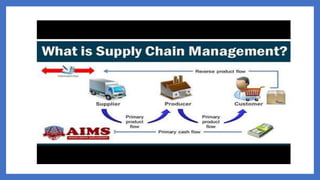
• SUPPLY CHAIN MANAGEMENT (SCM) A supply chain is a network of supplier,
manufacturing, assembly, distribution and logistics facilities that perform the functions
of procurement of materials, transformation of these material into intermediate and
finished products, and the distribution of these products to customers.”
• SUPPLY CHAIN MANAGEMENT WORKS : Planning, Sourcing, Manufacturing,
Delivery and Logistics, Returning.
• SUPPLY CHAIN ACTIVITIES refers procurement, product lifecycle management,
supply chain planning (including inventory planning and the maintenance of enterprise
assets and production lines), logistics (including transportation and fleet management),
and order management.
MEANING AND DEFINITION OF SUPPLY CHAIN
According to Professor Douglas M Lambert. “ Supply Chain Management as
the integration of business process from the end user through original supplier
who provide products, services and information that adds value for the
customers. ”
DEFINITION OF SUPPLY CHAIN According to Ganeshan & Harrison. “A
supply chain is a network of facilities and distribution options that perform the
function of procurement of material transformation of these materials into
intermediate and finished products, and the distribution of these finished products
to customers. ”
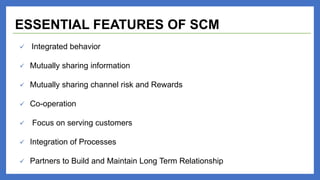
ESSENTIAL FEATURES OF SCM
 Integrated behavior
 Mutually sharing information
 Mutually sharing channel risk and Rewards
 Co-operation
 Focus on serving customers
 Integration of Processes
 Partners to Build and Maintain Long Term Relationship
OBJECTIVES OF SUPPLY CHAIN MANAGEMENT
 Service Orientation
 System Orientation.
 Competitiveness and Efficiency.
 Minimizing the Time.
 Minimizing Work in Progress.
 Improving Pipeline Visibility.
 Improving visibility Demand.
 Improving Quality.
 Reduces Transportation Cost.
 Reduces Warehousing Cost
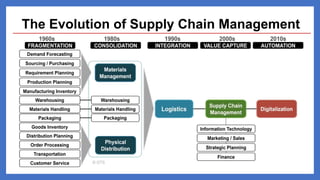
The Evolution of Supply Chain Management
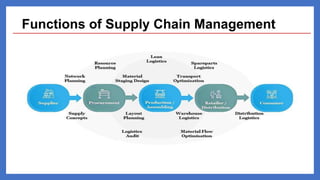
Functions of Supply Chain Management
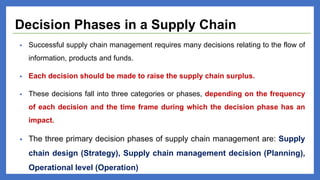
Decision Phases in a Supply Chain
• Successful supply chain management requires many decisions relating to the flow of
information, products and funds.
• Each decision should be made to raise the supply chain surplus.
• These decisions fall into three categories or phases, depending on the frequency
of each decision and the time frame during which the decision phase has an
impact.
• The three primary decision phases of supply chain management are: Supply
chain design (Strategy), Supply chain management decision (Planning),
Operational level (Operation)
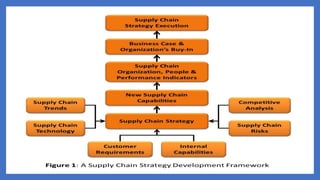
What is Supply Chain Strategy?
Supply Chain Strategy or Strategic Supply Chain Management is defined as:
“A strategy for how the supply chain will function in its environment to meet the
goals of the organization’s business and organization strategies”.
The whole process of Supply chain strategy are summarized in 4 steps:
1. Understand customer needs and the Business strategy
2. Decide the type of supply chain strategy to pursue as a competitive advantage.
3. Map the supply chain's strengths and weaknesses
4. Define an action plan to achieve the desired supply chain performance.
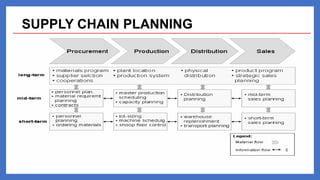
SUPPLY CHAIN PLANNING
Strategic Fit
 Strategic fit expresses the degree to which an organization is matching its
resources and capabilities with the opportunities in the external environment.
 In addition, strategic fit also examines the resource base of the organization and
explores how they can be utilized to achieve maximum benefits.
 Resources relate to the inputs to production owned by the company, whereas
capabilities describe the accumulation of learning the company possesses.
Resources can be classified as tangible and intangible:
 Tangible: Financial (Cash, securities), Physical (Location, plant, machinery).
 Intangible: Technology, Human resources, Reputation (Brands), Culture.
Supply Chain Drivers – Performance Measures
Supply Chain Enablers – Performance Measures
Organizational
Structure
Technology
Internal
Resources
SC Partners
Supply Chain Enablers – Performance Measures
RESEARCH ARTICLE
Supply Chain Management – Performance Measures
Supply chain performance measure can be defined as an approach to judge the
performance of supply chain system.
Supply chain performance measures can broadly be classified into two categories:
 Qualitative measures :
For example, customer satisfaction and product quality.
 Quantitative measures
For example, order-to-delivery lead time, supply chain response time,
flexibility, resource utilization, delivery performance.
Supply Chain Management – Performance Measures
Quantitative measures is the assessments used to measure the performance, and
compare or track the performance or products. We can further divide the quantitative
measures of supply chain performance into two types. They are −
 Non-financial measures - The metrics of non-financial measures comprise cycle
time, customer service level, inventory levels, resource utilization ability to perform,
flexibility, and quality.
 Financial measures - The measures taken for gauging different fixed and operational
costs related to a supply chain are considered the financial measures. Finally, the key
objective to be achieved is to maximize the revenue by maintaining low supply chain
costs.
Supply Chain Management – Performance Measures
Financial Measures : Generally, the financial performance of a supply chain is assessed
by considering the following items −
 Cost of raw materials.
 Activity-based costs like the material handling, manufacturing, assembling rates etc.
 Inventory holding costs.
 Transportation costs.
 Cost of expired perishable goods.
 Penalties for incorrectly filled or late orders delivered to customers.
 Credits for incorrectly filled or late deliveries from suppliers.
 Cost of goods returned by customers and suppliers.
Supply Chain Management – Performance Measures
Non - Financials Measures:
 Cycle Time - Supply chain lead time, Order-to-delivery lead time.
 Customer Service Level - Order fill rate, Stockout rate, Backorder level,
Probability of on-time delivery.
 Inventory Levels - Raw materials, Work-in-process, Finished goods
inventory, Spare parts.
 Resource Utilization - Manufacturing resources, Storage resources,
Logistics resources, Human resources, Financial resources
SUMMARY
 Supply chain Management – Definition & Objectives.
 Evolution of SCM – Material Management & Physical Distribution
 Functions of SCM – Information Flow – Forward & Backward
 Decision Phases Of SCM – SCM Design / Strategy, SCM Planning, Operational
Level.
 Strategic Fit
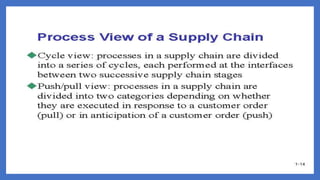
 Cycle and Push & Pull Flow of SCM
 Drivers of SCM - Facility, Inventory, Transportation, Location, Information.
 Enablers of SCM – Performance Measures
SCM - Unit - I.pptx

SCM - Unit - I.pptx

  • 1.
  • 2.
  • 3.
    INTRODUCTION • SUPPLY CHAINMANAGEMENT (SCM) A supply chain is a network of supplier, manufacturing, assembly, distribution and logistics facilities that perform the functions of procurement of materials, transformation of these material into intermediate and finished products, and the distribution of these products to customers.” • SUPPLY CHAIN MANAGEMENT WORKS : Planning, Sourcing, Manufacturing, Delivery and Logistics, Returning. • SUPPLY CHAIN ACTIVITIES refers procurement, product lifecycle management, supply chain planning (including inventory planning and the maintenance of enterprise assets and production lines), logistics (including transportation and fleet management), and order management.
  • 4.
    MEANING AND DEFINITIONOF SUPPLY CHAIN According to Professor Douglas M Lambert. “ Supply Chain Management as the integration of business process from the end user through original supplier who provide products, services and information that adds value for the customers. ” DEFINITION OF SUPPLY CHAIN According to Ganeshan & Harrison. “A supply chain is a network of facilities and distribution options that perform the function of procurement of material transformation of these materials into intermediate and finished products, and the distribution of these finished products to customers. ”
  • 5.
    ESSENTIAL FEATURES OFSCM  Integrated behavior  Mutually sharing information  Mutually sharing channel risk and Rewards  Co-operation  Focus on serving customers  Integration of Processes  Partners to Build and Maintain Long Term Relationship
  • 6.
    OBJECTIVES OF SUPPLYCHAIN MANAGEMENT  Service Orientation  System Orientation.  Competitiveness and Efficiency.  Minimizing the Time.  Minimizing Work in Progress.  Improving Pipeline Visibility.  Improving visibility Demand.  Improving Quality.  Reduces Transportation Cost.  Reduces Warehousing Cost
  • 7.
    The Evolution ofSupply Chain Management
  • 9.
    Functions of SupplyChain Management
  • 10.
    Decision Phases ina Supply Chain • Successful supply chain management requires many decisions relating to the flow of information, products and funds. • Each decision should be made to raise the supply chain surplus. • These decisions fall into three categories or phases, depending on the frequency of each decision and the time frame during which the decision phase has an impact. • The three primary decision phases of supply chain management are: Supply chain design (Strategy), Supply chain management decision (Planning), Operational level (Operation)
  • 12.
    What is SupplyChain Strategy? Supply Chain Strategy or Strategic Supply Chain Management is defined as: “A strategy for how the supply chain will function in its environment to meet the goals of the organization’s business and organization strategies”. The whole process of Supply chain strategy are summarized in 4 steps: 1. Understand customer needs and the Business strategy 2. Decide the type of supply chain strategy to pursue as a competitive advantage. 3. Map the supply chain's strengths and weaknesses 4. Define an action plan to achieve the desired supply chain performance.
  • 16.
  • 25.
    Strategic Fit  Strategicfit expresses the degree to which an organization is matching its resources and capabilities with the opportunities in the external environment.  In addition, strategic fit also examines the resource base of the organization and explores how they can be utilized to achieve maximum benefits.  Resources relate to the inputs to production owned by the company, whereas capabilities describe the accumulation of learning the company possesses. Resources can be classified as tangible and intangible:  Tangible: Financial (Cash, securities), Physical (Location, plant, machinery).  Intangible: Technology, Human resources, Reputation (Brands), Culture.
  • 26.
    Supply Chain Drivers– Performance Measures
  • 27.
    Supply Chain Drivers– Performance Measures
  • 29.
    Supply Chain Enablers– Performance Measures Organizational Structure Technology Internal Resources SC Partners
  • 31.
    Supply Chain Enablers– Performance Measures RESEARCH ARTICLE
  • 32.
    Supply Chain Management– Performance Measures Supply chain performance measure can be defined as an approach to judge the performance of supply chain system. Supply chain performance measures can broadly be classified into two categories:  Qualitative measures : For example, customer satisfaction and product quality.  Quantitative measures For example, order-to-delivery lead time, supply chain response time, flexibility, resource utilization, delivery performance.
  • 33.
    Supply Chain Management– Performance Measures Quantitative measures is the assessments used to measure the performance, and compare or track the performance or products. We can further divide the quantitative measures of supply chain performance into two types. They are −  Non-financial measures - The metrics of non-financial measures comprise cycle time, customer service level, inventory levels, resource utilization ability to perform, flexibility, and quality.  Financial measures - The measures taken for gauging different fixed and operational costs related to a supply chain are considered the financial measures. Finally, the key objective to be achieved is to maximize the revenue by maintaining low supply chain costs.
  • 34.
    Supply Chain Management– Performance Measures Financial Measures : Generally, the financial performance of a supply chain is assessed by considering the following items −  Cost of raw materials.  Activity-based costs like the material handling, manufacturing, assembling rates etc.  Inventory holding costs.  Transportation costs.  Cost of expired perishable goods.  Penalties for incorrectly filled or late orders delivered to customers.  Credits for incorrectly filled or late deliveries from suppliers.  Cost of goods returned by customers and suppliers.
  • 35.
    Supply Chain Management– Performance Measures Non - Financials Measures:  Cycle Time - Supply chain lead time, Order-to-delivery lead time.  Customer Service Level - Order fill rate, Stockout rate, Backorder level, Probability of on-time delivery.  Inventory Levels - Raw materials, Work-in-process, Finished goods inventory, Spare parts.  Resource Utilization - Manufacturing resources, Storage resources, Logistics resources, Human resources, Financial resources
  • 36.
    SUMMARY  Supply chainManagement – Definition & Objectives.  Evolution of SCM – Material Management & Physical Distribution  Functions of SCM – Information Flow – Forward & Backward  Decision Phases Of SCM – SCM Design / Strategy, SCM Planning, Operational Level.  Strategic Fit  Cycle and Push & Pull Flow of SCM  Drivers of SCM - Facility, Inventory, Transportation, Location, Information.  Enablers of SCM – Performance Measures