Logistics Development Award 2005- Wyndham Cramer
The Development of Closed-The Development of Closed-
Loop Supply Chains-Loop Supply Chains-
The most significant supply chain trend
affecting business in Australia
Logistics Development Award 2005- Wyndham Cramer
BackgroundBackground
Unconstrained production and
consumption is no longer feasible
Businesses are faced with the following
issues
– Public scrutiny of environmental credentials
– Government Regulation.
– Focus on Life Cycle and Total Costs. Microsoft Excel
Worksheet
Logistics Development Award 2005- Wyndham Cramer
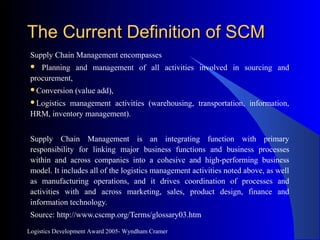
The Current Definition of SCMThe Current Definition of SCM
Supply Chain Management encompasses
 Planning and management of all activities involved in sourcing and
procurement,
Conversion (value add),
Logistics management activities (warehousing, transportation, information,
HRM, inventory management).
Supply Chain Management is an integrating function with primary
responsibility for linking major business functions and business processes
within and across companies into a cohesive and high-performing business
model. It includes all of the logistics management activities noted above, as well
as manufacturing operations, and it drives coordination of processes and
activities with and across marketing, sales, product design, finance and
information technology.
Source: http://www.cscmp.org/Terms/glossary03.htm
Logistics Development Award 2005- Wyndham Cramer
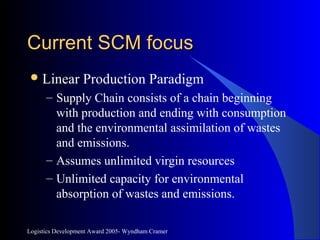
Current SCM focusCurrent SCM focus
Linear Production Paradigm
– Supply Chain consists of a chain beginning
with production and ending with consumption
and the environmental assimilation of wastes
and emissions.
– Assumes unlimited virgin resources
– Unlimited capacity for environmental
absorption of wastes and emissions.
Logistics Development Award 2005- Wyndham Cramer
Closed Loop Supply ChainClosed Loop Supply Chain
Consists of a forward movement at the
beginning of its life cycle
Retrieval and reprocessing at the end of its
life (Reverse Supply Chain).
Creating a secondary life cycle and
repeating step 1 and 2; n number of times.
Logistics Development Award 2005- Wyndham Cramer
Closed Loop Supply ChainClosed Loop Supply Chain
Addresses the issues that businesses face
due to
– Public scrutiny
– Government regulation
– Life cycle and total costs due to internalization
of disposal costs.
Reduces costs due to substitution of
secondary resources in forward supply
chains.
Logistics Development Award 2005- Wyndham Cramer
The Reverse Supply ChainThe Reverse Supply Chain
 In the context of the Closed Loop Supply Chain this is
the component that involves the retrieval and
reprocessing at the end of the product life cycle.
 Reverse Supply Chain is made up of the following
components
– Product Acquisition
– Reverse Logistics
– Inspection and disposition
– Reconditioning
– Distribution and Sales
Logistics Development Award 2005- Wyndham Cramer
Change from a linear to a closedChange from a linear to a closed
loop mindset.loop mindset.
 The most significant supply chain trend affecting
business in Australia due to the following
reasons.
– Environmental Concerns- (Primary Factor)
– Geographical Location of Australia and the costs due
to the tyranny of distance- (Secondary Factor)
 Freight Costs
 Population centres far dispersed from each other and
relatively small by world standards.
 Reconditioning or remanufacturing using secondary
resources would result in material costs that are approx 80%
lower than primary resources.
Logistics Development Award 2005- Wyndham Cramer
Change from a linear to a closedChange from a linear to a closed
loop mindset.loop mindset.
Challenges
– Pool of Supply Chain Managers in Australia
 Conditioned towards a linear approach
 Change needs to be driven by senior management;
dearth of supply chain personnel representation at
this level.
Logistics Development Award 2005- Wyndham Cramer
ConclusionConclusion
Australia – a natural candidate for closed loop
supply chains due to environmental concerns and
its geographical location. The country will be
forced to adopt closed loop supply chains.
Australia will develop sophisticated reverse
logistics supply chains in the future.
The rest of the world will use Australia as a
benchmark for closed loop supply chains.

The Development Of Closed Loop Supply Chains

  • 1.
    Logistics Development Award2005- Wyndham Cramer The Development of Closed-The Development of Closed- Loop Supply Chains-Loop Supply Chains- The most significant supply chain trend affecting business in Australia
  • 2.
    Logistics Development Award2005- Wyndham Cramer BackgroundBackground Unconstrained production and consumption is no longer feasible Businesses are faced with the following issues – Public scrutiny of environmental credentials – Government Regulation. – Focus on Life Cycle and Total Costs. Microsoft Excel Worksheet
  • 3.
    Logistics Development Award2005- Wyndham Cramer The Current Definition of SCMThe Current Definition of SCM Supply Chain Management encompasses  Planning and management of all activities involved in sourcing and procurement, Conversion (value add), Logistics management activities (warehousing, transportation, information, HRM, inventory management). Supply Chain Management is an integrating function with primary responsibility for linking major business functions and business processes within and across companies into a cohesive and high-performing business model. It includes all of the logistics management activities noted above, as well as manufacturing operations, and it drives coordination of processes and activities with and across marketing, sales, product design, finance and information technology. Source: http://www.cscmp.org/Terms/glossary03.htm
  • 4.
    Logistics Development Award2005- Wyndham Cramer Current SCM focusCurrent SCM focus Linear Production Paradigm – Supply Chain consists of a chain beginning with production and ending with consumption and the environmental assimilation of wastes and emissions. – Assumes unlimited virgin resources – Unlimited capacity for environmental absorption of wastes and emissions.
  • 5.
    Logistics Development Award2005- Wyndham Cramer Closed Loop Supply ChainClosed Loop Supply Chain Consists of a forward movement at the beginning of its life cycle Retrieval and reprocessing at the end of its life (Reverse Supply Chain). Creating a secondary life cycle and repeating step 1 and 2; n number of times.
  • 6.
    Logistics Development Award2005- Wyndham Cramer Closed Loop Supply ChainClosed Loop Supply Chain Addresses the issues that businesses face due to – Public scrutiny – Government regulation – Life cycle and total costs due to internalization of disposal costs. Reduces costs due to substitution of secondary resources in forward supply chains.
  • 7.
    Logistics Development Award2005- Wyndham Cramer The Reverse Supply ChainThe Reverse Supply Chain  In the context of the Closed Loop Supply Chain this is the component that involves the retrieval and reprocessing at the end of the product life cycle.  Reverse Supply Chain is made up of the following components – Product Acquisition – Reverse Logistics – Inspection and disposition – Reconditioning – Distribution and Sales
  • 8.
    Logistics Development Award2005- Wyndham Cramer Change from a linear to a closedChange from a linear to a closed loop mindset.loop mindset.  The most significant supply chain trend affecting business in Australia due to the following reasons. – Environmental Concerns- (Primary Factor) – Geographical Location of Australia and the costs due to the tyranny of distance- (Secondary Factor)  Freight Costs  Population centres far dispersed from each other and relatively small by world standards.  Reconditioning or remanufacturing using secondary resources would result in material costs that are approx 80% lower than primary resources.
  • 9.
    Logistics Development Award2005- Wyndham Cramer Change from a linear to a closedChange from a linear to a closed loop mindset.loop mindset. Challenges – Pool of Supply Chain Managers in Australia  Conditioned towards a linear approach  Change needs to be driven by senior management; dearth of supply chain personnel representation at this level.
  • 10.
    Logistics Development Award2005- Wyndham Cramer ConclusionConclusion Australia – a natural candidate for closed loop supply chains due to environmental concerns and its geographical location. The country will be forced to adopt closed loop supply chains. Australia will develop sophisticated reverse logistics supply chains in the future. The rest of the world will use Australia as a benchmark for closed loop supply chains.