Manish Sonkar
IMS Unison University
Methods of Performance Appraisal
Introduction
• Each method of performance appraisal has its strengths
and weaknesses may be suitable for one organisation
and non-suitable for another one.
• As such, there is no single appraisal method accepted
and used by all organisations to measure their
employees’ performance.
• All the methods of appraisal devised so far have been
classified differently by different authors.
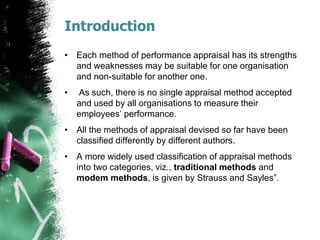
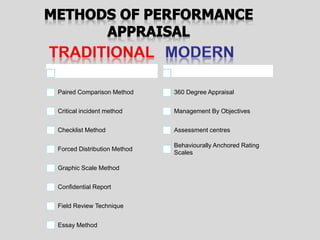
• A more widely used classification of appraisal methods
into two categories, viz., traditional methods and
modem methods, is given by Strauss and Sayles”.
Paired Comparison Method
Critical incident method
Checklist Method
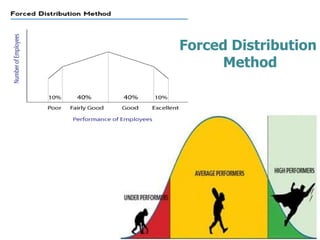
Forced Distribution Method
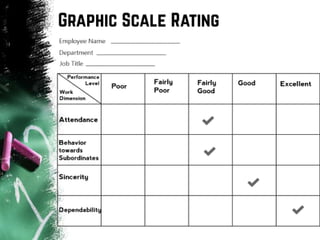
Graphic Scale Method
Confidential Report
Field Review Technique
Essay Method
360 Degree Appraisal
Management By Objectives
Assessment centres
Behaviourally Anchored Rating
Scales
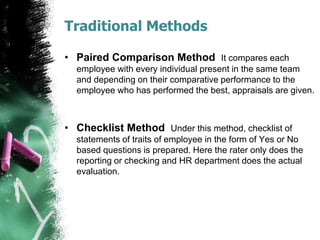
Traditional Methods
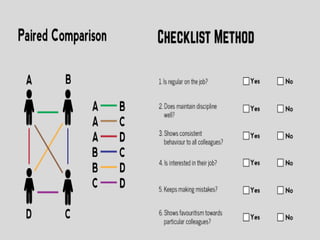
• Paired Comparison Method It compares each
employee with every individual present in the same team
and depending on their comparative performance to the
employee who has performed the best, appraisals are given.
• Checklist Method Under this method, checklist of
statements of traits of employee in the form of Yes or No
based questions is prepared. Here the rater only does the
reporting or checking and HR department does the actual
evaluation.
Critical Incident Method
• Critical incident method or critical incident technique in which
analyses the behaviour of employee in certain events in
which either he performed very well and the ones in which
he could have done better.
• In Critical incident method, the manager of the employee
gives all the details of the incident. This method is quite
subjective in nature as compared to other methods which
may be very objective and would require just ratings out of
5/10 etc.
• Critical Incident Technique Example:
• On a particular day one Salesperson stayed 60 minutes
beyond his break during the busiest part of the day. Whereas
another salesperson fails to answer store manager’s call
thrice.
Forced Distribution
Method
Assessment Centre
• Assessment Centre or Management Assessment Centre is one of
the selection techniques used in organizations to measure the
knowledge, skills & abilities (KSA) of a person.
• A traditional assessment centre involves six participants and lasts
from one to three days. The participants are evaluated by trained
assessors by various techniques like simulations and also
sometimes using interviews & tests
• In the simulation technique, the participants are asked to perform
realistic tasks in hypothetical situations. Some of the commonly
used simulation exercises include:
• •In-basket exercise
• •Leaderless group discussion
• •Management games
• •Fact-finding exercises
• •Individual presentation exercises
Assessment Centre Process
• When the participants work through these exercises, the
assessors evaluate their behaviour & knowledge level.
• After that, they share their observations and prepare the
evaluation report. It is especially done for management level
candidates like plant managers, general managers etc.
• It is a very good technique to predict future job performance.
• In some of the companies the assessment is done through
external agency also.
• Many manufacturing companies use this method where large
number of applicants must be processed.
• Toyota for example assessed 22,000 applicants by this
method to staff their 3000 person plant in Kentucky.
360 Degree Appraisal
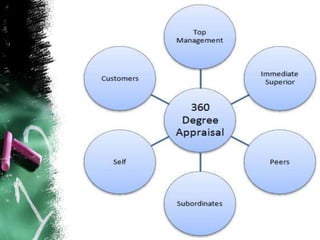
• This method involves getting a feedback about the employee
from every individual who interacts with him during his
working hours. They can be his peers, his subordinates, his
superiors, customers who have interacted with him and even
he himself would be interviewed about his perception of
himself and his duties at the workplace
• In India, companies like Reliance Industries, Wipro
Corporation, Infosys Technologies, Thermax, Thomas Cook
etc., have been using this method for appraising the
performance of their employees.
• This feedback based method is generally used for
ascertaining training and development requirements, rather
than for pay increases.
Management By Objective
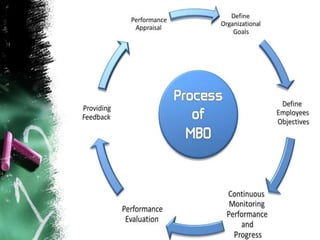
• MBO is employer-employee driven approach of performance
appraisal which involves superior and subordinates in setting
goals.
• The technique involves setting up of objectives and goals for
the employee either by the employer, or his manager, or both
employee and employer.
• The employees work upon achieving their set goals and
employers keep a record of how close they are to
accomplishment of the goals.
• This way, employees become clear about which path to walk
on to get the goals, subsequently increasing and improving
his performance level.
• This is a fair method of evaluating because the employee
knows the odds that he is measured against.
Behaviorally anchored rating scales
(BARS)
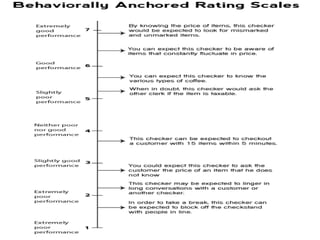
• Behaviorally anchored rating scales (BARS) is
the combination of critical incident and rating
scale methods of performance appraisal. Under
this method, the scale points are defined by
critical (effective or ineffective) behaviors of the
employee.
• BARS usually consists of scale ranging from 5
to 9 points, each representing continuum of
statements that describes behavior of
employees ranging from unacceptable to most
effective.
Procedure of BARS Development
 A BARS can be developed in following steps:
1. Collecting samples of effective and ineffective job behavior
from the experts by analyzing the critical incident method
2. Converting these samples into performance dimension
3. Relocating the performance dimension (from unacceptable
to outstanding)
4. Rating the performance dimension accordingly, starting
from 1
5. Finally, using the scale anchor to evaluate employee’s
performance
THANK YOU…

Methods of performance appraisal

  • 1.
    Manish Sonkar IMS UnisonUniversity Methods of Performance Appraisal
  • 2.
    Introduction • Each methodof performance appraisal has its strengths and weaknesses may be suitable for one organisation and non-suitable for another one. • As such, there is no single appraisal method accepted and used by all organisations to measure their employees’ performance. • All the methods of appraisal devised so far have been classified differently by different authors. • A more widely used classification of appraisal methods into two categories, viz., traditional methods and modem methods, is given by Strauss and Sayles”.
  • 3.
    Paired Comparison Method Criticalincident method Checklist Method Forced Distribution Method Graphic Scale Method Confidential Report Field Review Technique Essay Method 360 Degree Appraisal Management By Objectives Assessment centres Behaviourally Anchored Rating Scales
  • 4.
    Traditional Methods • PairedComparison Method It compares each employee with every individual present in the same team and depending on their comparative performance to the employee who has performed the best, appraisals are given. • Checklist Method Under this method, checklist of statements of traits of employee in the form of Yes or No based questions is prepared. Here the rater only does the reporting or checking and HR department does the actual evaluation.
  • 6.
    Critical Incident Method •Critical incident method or critical incident technique in which analyses the behaviour of employee in certain events in which either he performed very well and the ones in which he could have done better. • In Critical incident method, the manager of the employee gives all the details of the incident. This method is quite subjective in nature as compared to other methods which may be very objective and would require just ratings out of 5/10 etc. • Critical Incident Technique Example: • On a particular day one Salesperson stayed 60 minutes beyond his break during the busiest part of the day. Whereas another salesperson fails to answer store manager’s call thrice.
  • 7.
  • 10.
    Assessment Centre • AssessmentCentre or Management Assessment Centre is one of the selection techniques used in organizations to measure the knowledge, skills & abilities (KSA) of a person. • A traditional assessment centre involves six participants and lasts from one to three days. The participants are evaluated by trained assessors by various techniques like simulations and also sometimes using interviews & tests • In the simulation technique, the participants are asked to perform realistic tasks in hypothetical situations. Some of the commonly used simulation exercises include: • •In-basket exercise • •Leaderless group discussion • •Management games • •Fact-finding exercises • •Individual presentation exercises
  • 11.
    Assessment Centre Process •When the participants work through these exercises, the assessors evaluate their behaviour & knowledge level. • After that, they share their observations and prepare the evaluation report. It is especially done for management level candidates like plant managers, general managers etc. • It is a very good technique to predict future job performance. • In some of the companies the assessment is done through external agency also. • Many manufacturing companies use this method where large number of applicants must be processed. • Toyota for example assessed 22,000 applicants by this method to staff their 3000 person plant in Kentucky.
  • 12.
    360 Degree Appraisal •This method involves getting a feedback about the employee from every individual who interacts with him during his working hours. They can be his peers, his subordinates, his superiors, customers who have interacted with him and even he himself would be interviewed about his perception of himself and his duties at the workplace • In India, companies like Reliance Industries, Wipro Corporation, Infosys Technologies, Thermax, Thomas Cook etc., have been using this method for appraising the performance of their employees. • This feedback based method is generally used for ascertaining training and development requirements, rather than for pay increases.
  • 14.
    Management By Objective •MBO is employer-employee driven approach of performance appraisal which involves superior and subordinates in setting goals. • The technique involves setting up of objectives and goals for the employee either by the employer, or his manager, or both employee and employer. • The employees work upon achieving their set goals and employers keep a record of how close they are to accomplishment of the goals. • This way, employees become clear about which path to walk on to get the goals, subsequently increasing and improving his performance level. • This is a fair method of evaluating because the employee knows the odds that he is measured against.
  • 16.
    Behaviorally anchored ratingscales (BARS) • Behaviorally anchored rating scales (BARS) is the combination of critical incident and rating scale methods of performance appraisal. Under this method, the scale points are defined by critical (effective or ineffective) behaviors of the employee. • BARS usually consists of scale ranging from 5 to 9 points, each representing continuum of statements that describes behavior of employees ranging from unacceptable to most effective.
  • 17.
    Procedure of BARSDevelopment  A BARS can be developed in following steps: 1. Collecting samples of effective and ineffective job behavior from the experts by analyzing the critical incident method 2. Converting these samples into performance dimension 3. Relocating the performance dimension (from unacceptable to outstanding) 4. Rating the performance dimension accordingly, starting from 1 5. Finally, using the scale anchor to evaluate employee’s performance
  • 19.