Module-1
   Performance Appraisal (PA) refers to all those
    procedures that are used to evaluate the
    personality performance, potential of its
    group members


                                                     2
 Performance    appraisal is a method of evaluating
 the behaviour of employees in the workspot,
 normally including both the quantitative &
 qualitative aspects of job performance.

 PA is   the systematic evaluation of the individual
 with respect to his/her performance on the job &
 his/her potential for development.

                                                        3
   It Provide a basis for promotion/ transfer/
    termination: Identify those employees who
    deserve promotion Or those who Enhance
    employees’ effectiveness require lateral shift
    (transfer) or termination, PA is used for career
    planning .
   by helping to identify their strengths and
    weaknesses and Inform them about expected
    levels of performance If employees
    understand their roles well, they are likely to
    be more effective on the job .


                                                       4
   Identifying training and development needs
    of employees is necessary to prepare them
    for meeting challenges in their current and
    future employment.
    Aid in designing training and development
    programs: Identifying skills required to be
    developed would help in tailor- making
    training and development programs.


                                                  5
   Remove work alienation: Counseling Employees
    to correct misconceptions which might result in
    work alienation.
    Remove discontent: Identifying and removing
    factors responsible for workers’ discontent would
    motivate them for better work performance.
    Develop inter-personal relationships: Relations
    between superior - subordinate can be improved
    through realization that each is dependent on the
    other for better performance and success


                                                        6
   Aid   wage    administration:    Performance
    appraisal can help in development of
    scientific basis for reward allocation, wage
    fixation, incentives.
    Improve           communication:Performance
    appraisal serves as a mechanism for
    communication       between  superiors   and
    subordinates


                                                   7
   Provide information about the performance ranks basing
    on which decision regarding salary fixation, confirmation,
    transfer , promotion & demotion are taken.
   Provide information to diagnose deficiency in employee
    regarding skill, knowledge, determine training &
    development needs & to set new standards of work, if
    necessary.
   Provide information for correcting placement.

                                                                 8
 Provide    feedback information about the level
    of achievement & behaviour of subordinate.
   Provide information which helps to counsel
    the subordinate.
   To prevent grievances & indisciplinary
    activities.

                                                    9
1.   Validity
2.   Reliability
3.   Freedom from bias
       a. Legal issues of fairness
       b. Freedom from rating errors
4.   Practicality


                                       10
   Establish Performance Standards:
    Performance standards serve as benchmarks
    against which performance is measured
    Standards should relate to the desired results
    of each job.
    Communicate the Standards : Performance
    appraisal involves at least two parties, the
    appraiser who does the appraisal and the
    appraisee whose performance is being
    evaluated.


                                                     11
    The appraiser should prepare job
    descriptions clearly; help appraisee set his
    goals and targets; analyse results objectively;
    offer coaching and guidance to appraisee
    whenever required and reward good results.
    The appraisee should be very clear about
    what he is doing and why.


                                                      12
     Performance measures may be objective or
    subjective .
   Objective performance measures are
    indications of job performance that can be
    verified by others and are usually
    quantitative.
    Subjective performance measures are ratings
    that are based on the personal standards or
    opinions of those doing the evaluation and
    are not verifiable by others.


                                                   13
Compare Actual performance with Standards
and Discuss the Appraisal,Actual performance
may be better than expected and sometimes
it may go off the track Whatever be the
consequences, there is a way to communicate
and discuss the final outcome


                                               14
    Corrective action is of two types One puts
    out the fires immediately, Other strikes at the
    root of the problem permanently


                                                      15
     In order to be effective, the criteria for
    performance appraisal should be genuinely
    related to success / failure in the job and should
    be amenable to objective judgement MBO is an
    example of performance-based appraisal
    approach that involves setting objectives and
    comparing performance against those objectives.
     Performance Criteria Objectives give greater
    freedom to both management and the employees
    in deciding how performance is to be measured.


                                                         16
   Benefits of Performance Appraisal For the
    appraisee Better understanding of his role in
    the organization—what is expected and what
    needs to be done to meet those expectations
    Clear understanding of his strengths and
    weaknesses to develop himself into a better
    performer in future.


                                                    17
    Increased motivation, job satisfaction, and
    self-esteem Opportunity to discuss work
    problems and how they can be overcome
    Opportunity to discuss aspirations and any
    guidance, support or training needed to fulfil
    those aspirations Improved working
    relationships with supervisors .


                                                     18
   Identification of performers and non-
    performers and their development towards
    better performance Opportunity to prepare
    employees for assuming higher
    responsibilities.
    Opportunity to improve communication
    between the employees and management
    Identification of training and development
    needs Generation of ideas for improvements
    Better identification of potential and
    formulation of career plans


                                                 19
   Improved performance through out the
    organization Creation of a culture of
    continuous improvement and success
    Conveying the message that people are
    valued.


                                            20
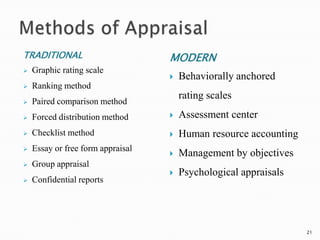
TRADITIONAL                        MODERN
   Graphic rating scale
                                      Behaviorally anchored
   Ranking method
                                       rating scales
   Paired comparison method
   Forced distribution method        Assessment center
   Checklist method                  Human resource accounting
   Essay or free form appraisal
                                      Management by objectives
   Group appraisal
                                      Psychological appraisals
   Confidential reports


                                                                   21
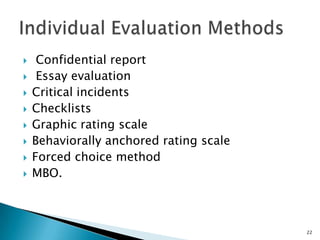
    Confidential report
    Essay evaluation
   Critical incidents
   Checklists
   Graphic rating scale
   Behaviorally anchored rating scale
   Forced choice method
   MBO.


                                         22
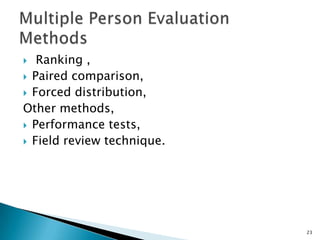
  Ranking ,
 Paired comparison,
 Forced distribution,
Other methods,
 Performance tests,
 Field review technique.


                            23
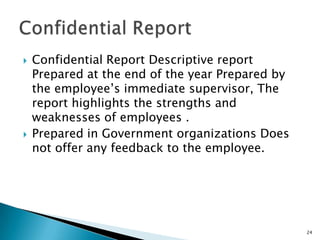
   Confidential Report Descriptive report
    Prepared at the end of the year Prepared by
    the employee’s immediate supervisor, The
    report highlights the strengths and
    weaknesses of employees .
   Prepared in Government organizations Does
    not offer any feedback to the employee.


                                                  24
   Essay Evaluation The rater is asked to express
    the strong as well as weak points of
    employee’s behavior The rater considers the
    employee’s : Job knowledge and potential
    Understanding of company’s programs,
    policies, objectives etc Relation with co-
    workers and supervisors Planning, organizing
    and controlling ability Attitude and
    perception


                                                     25
This method has the following limitations:
 Highly subjective.
 Supervisor may write biased essay.
 Difficult to find effective writers.
 A busy appraiser may write the essay hurriedly
  without assessing properly the actual performance of
  the worker.
 If the appraiser takes a long time it becomes
  uneconomical from the view point of the firm
     Used in the companies like BPL, Bata, Wheels India, Birla &
     others.
.


                                                                    26
    Manager prepares lists of statements of very
    effective and ineffective behavior of an
    employee.
    These critical incidents represent the
    outstanding or poor behavior of the
    employees.
    The manager periodically records critical
    incidents of employee’s behavior .


                                                    27
   Critical Incident Technique Example: July 20 -
    Sales clerk patiently attended to the
    customers complaint. He is polite, prompt,
    enthusiastic in solving the customers’
    problem July 20 - The sales assistant stayed
    45 minutes beyond his break during the
    busiest part of the day. He failed to answer
    store manager’s call thrice. He is lazy,
    negligent, stubborn and uninterested in work.


                                                     28
   Negative incidents may be more noticeable
    than positive incidents.
    Supervisors have a tendency to unload a
    series of complaints about incidents.
    Results in very close supervision which may
    not be liked by the employee.
   The recording of incidents may be a chore for
    the manager concerned who may be too busy
    or forget to do it


                                                    29
    A checklist is a set of objectives or
    descriptive statements about the employee
    and his behavior.
    If the rater believes that the employee
      possesses a listed trait, the item is
      checked
    A rating score equals the number of
      checks


                                                30
 Simple   checklist method
 Weighted    checklist method
 Forced   choice method

Simple checklist method:

   Is employee regular                    Y/N
   Is employee respected by subordinate         Y/N
   Is employee helpful                          Y/N
   Does he follow instruction             Y/N
   Does he keep the equipment in order    Y/N


                                                       31
weights       performance rating
                         (scale 1 to 5 )
   Regularity         0.5
   Loyalty        1.5
   Willing to help    1.5
   Quality of work    1.5
   Relationship 2.0


                                           32
Was developed because graphic rating scales allowed
 supervisors to rate everyone high
 The rater must choose from a set of descriptive
 statements about employee
 Supervisors check the statements that describe the
 employee, or they rank the statements from most to
 least descriptive
 Forced choice can be used by superiors, peers,
 subordinates, or a combination of these


                                                       33
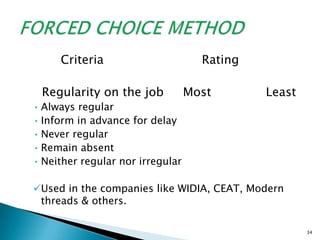
Criteria                       Rating

 Regularity on the job            Most       Least
• Always regular
• Inform in advance for delay
• Never regular
• Remain absent
• Neither regular nor irregular

Used in the companies like WIDIA, CEAT, Modern
 threads & others.

                                                     34
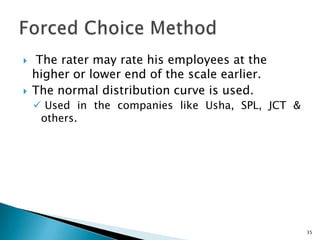
    The rater may rate his employees at the
    higher or lower end of the scale earlier.
   The normal distribution curve is used.
     Used in the companies like Usha, SPL, JCT &
     others.


                                                    35
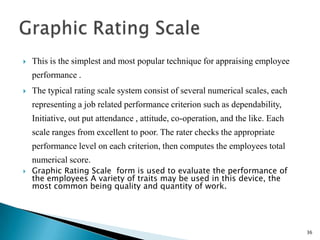
   This is the simplest and most popular technique for appraising employee
    performance .
   The typical rating scale system consist of several numerical scales, each
    representing a job related performance criterion such as dependability,
    Initiative, out put attendance , attitude, co-operation, and the like. Each
    scale ranges from excellent to poor. The rater checks the appropriate
    performance level on each criterion, then computes the employees total
    numerical score.
   Graphic Rating Scale form is used to evaluate the performance of
    the employees A variety of traits may be used in this device, the
    most common being quality and quantity of work.


                                                                                  36
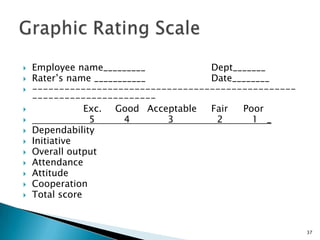
   Employee name_________           Dept_______
   Rater’s name ___________         Date________
   -------------------------------------------------
    -----------------------
               Exc. Good Acceptable Fair  Poor
                5     4      3       2      1 _
   Dependability
   Initiative
   Overall output
   Attendance
   Attitude
   Cooperation
   Total score


                                                        37
   Behaviorally Anchored Rating Scale
    Combination of rating scale and critical
    incidence Steps
    Collect critical incidents Identify performance
    dimensions.
    Reclassification of incidents.
    Assigning scale values to incidents Producing
    the final instrument
    MBO emphasizes collectively set goals that
    are tangible, verifiable, and measurable
    Focuses attention on goals rather than on
    methods Concentrates on Key Result Areas
    (KRA) Systematic and rational technique that
    allows management to attain maximum
    results from available resources by focusing
    on achievable goals


                                                   39
    Arranging organizational goals in a means-
    ends chain Engaging in joint goal setting This
    process has the following steps:
    Identify KRAs
    Define expected results
    Assign specific responsibilities to employees.
   Define authority and responsibility
    relationship
   Conducting periodic progress review
   Conducting annual performance review
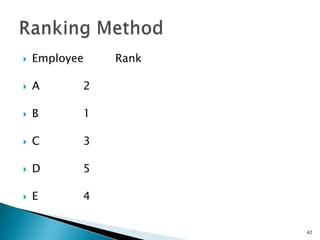
       Ranking method: The evaluator rates the employee from
     highest to lowest on some overall criteria.
    Ex :if there are 30 workers in a work group the most efficient employee
     may be ranked as number one and the least efficient employee as
     number thirty.
Advantages:
    Easy and inexpensive


    Disadvantages:
    Not well defined
    Raters bias


                                                                               41
   Employee   Rank

   A      2

   B      1

   C      3

   D      5

   E      4


                      42
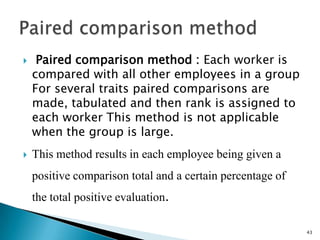
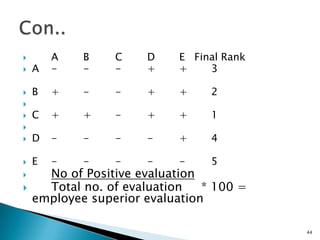
    Paired comparison method : Each worker is
    compared with all other employees in a group
    For several traits paired comparisons are
    made, tabulated and then rank is assigned to
    each worker This method is not applicable
    when the group is large.
   This method results in each employee being given a
    positive comparison total and a certain percentage of
    the total positive evaluation.

                                                            43
       A   B    C    D    E Final Rank
   A   -   -    -    +    +    3

   B   +   -    -    +    +     2

   C   +   +    -    +    +     1

   D   -   -    -    -    +     4

   E   -   -    -    -    -     5
     No of Positive evaluation
     Total no. of evaluation   * 100 =
    employee superior evaluation

                                          44
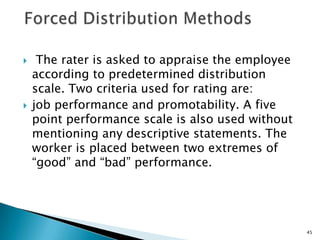
    The rater is asked to appraise the employee
    according to predetermined distribution
    scale. Two criteria used for rating are:
   job performance and promotability. A five
    point performance scale is also used without
    mentioning any descriptive statements. The
    worker is placed between two extremes of
    ―good‖ and ―bad‖ performance.


                                                   45
    Group Appraisal Employee is appraised by a
    group of appraisers. The group consists of
    Immediate supervisor of the employee Other
    supervisors who have close contact with the
    employee’s work. Manager or head of the
    departments. Consultants or Clients.
   Used in the companies like Kinetic Honda, Blue
    star, Birla VXL & others.


                                                     46
    Field Review Technique The appraiser goes
    to the field and obtains the information about
    work performance of the employee by way of
    questioning the said individual, his peer
    group, and his superiors


                                                     47
   Conducted to assess employees’ potential.

   Psychological Appraisals consists of:
    ◦   In-depth interviews
    ◦   Psychological tests
    ◦   Consultations and discussions with the employees
    ◦   Discussions with superiors, subordinates and peers,
        etc.


                                                              48
   Evaluation is conducted in the areas of:
    ◦   Employees intellectual abilities
    ◦   Emotional stability
    ◦   Motivational responses
    ◦   Reasoning and analytical abilities
    ◦   Interpretation and judgement skills
    ◦   Sociability
    ◦   Ability to foresee the future, etc.


                                               49
   Let the Employee Know Where He Stands
     To help employees do a better job by
    clarifying what is expected of them.
   To plan opportunities for development and
    growth To strengthen the superior-
    subordinate working relationship by
    developing mutual agreement of goals.
    To provide an opportunity for employees to
    express themselves on performance related
    issues.

                                                  50
   360 Degree Appraisal
    360 degree feedback, also known as 'multi-rater
    feedback', is the most comprehensive appraisal
    where the feedback about the employees’
    performance comes from all the sources that
    come in contact with the employee on his job.
    Organisations are increasingly using feedback
    from various sources such as peer input,
    customer feedback, and input from superiors.
    Different forms with different formats are being
    used to obtain the information regarding the
    employee performance.


                                                       51
   360o Appraisal System It is a systematic
    collection and feedback of performance data
    on an individual or group, derived from a
    number of stakeholders Data is gathered and
    feed back to the individual participant in a
    clear way designed to promote
    understanding, acceptance and ultimately
    behavior .


                                                   52
   According to a wall street journal headline, ―Teams have
    become commonplace in U.S. Companies‖.
   Most of the performance appraisal techniques are
    formulated with individuals in mind i.e. to measure and
    rate the performance of the individual employee.
    Therefore, with the number of teams increasing in the
    organisations, it becomes difficult to measure and
    appraise the performance of the team.
   The question is how to separate the performance of the
    team from the performance of the employees.
    A solution to this problem that is being adopted by the
    companies is to measure both the individual and the team
    performance. Sometimes, team based objectives are also
    included in the individual performance plans.


                                                               53
 Also known as the ―Up or out policy‖, the rank
  and yank strategy refers to the performance
  appraisal model in which best-to-worst ranking
  methods are used to identify and separate the
  poor performers from the good performers.
    Then the action plans and the improvement
  opportunities of the poor performers are
  discussed and they are given to improve their
  performance in a given time period, after which
  the appropriate HR decisions are taken. Some of
  the organisations following this strategy are
  Ford, Microsoft and Sun Microsystems.


                                                    54
   BPO sector offers handsome initial salary,
    good growth and many other benefits to its
    employees.
   Keeping in relatively a new sector in the
    Indian industry, but has established itself
    well and is growing at a rapid rate.
   mind the attrition rates in the sector, the
    performance measurement and appraisal
    processes are of extreme importance in
    BPO’s. It is often used as one of the tools to
    retain the employees.
                                                     55
   BPO employees have the advantage of
    getting performance based incentives.
   In most of the BPO organisations, there are
    well designed schemes for awarding the
    performance based incentives to the
    individuals and/or the teams as a whole.
    An incentive on the completion of the
    defined targets is a common practice in
    BPO’s.


                                                  56
The general parameters for the measurement
 of employees’ performance are:

    Speed i.e. process performance,

   Accuracy and


   Productivity of each process,


                                             57
HRA :
 Deals with cost of and contribution of human
  resources to the organization.

   Positive employee performance:
    contribution ↑ cost ↓
   Negative employee performance:
    contribution ↓ cost ↑


                                                 58
Getting PA from the computers based upon the
  data stored in the computer about the
  employee.
Assessment Centre:
 Individuals from various departments are
  brought together to spend 2 or 3 days.
 Observers rank the performance of each and
  every participant in order of merit.


                                               59
   Since assessment centers are basically meant
    for evaluating the potential of candidates to
    be considered for promotion.


                                                    60
I.   Judgment errors:
      1. First impressions(primacy effect)
      2. Halo errors
      3. Horn effect
         (down grades other aspects of employee’s
     performance because of a single performance
     dimension )
      4. Leniency
      5. Central tendency
      6. Contrast error
        (Compare people against one another instead of
     against an objective )
      7. Recency effect


                                                         61
II.    Poor appraisal forms:
       1. Vague & unclear rating scale
       2. Ignore important aspects of job
       performance
        3. Additional & irrelevant performance
        4. Too long and complex

III.   Lack of rater preparedness
IV.    Ineffective organizational policies &
       practices


                                                 62
   Trait based system
   Behaviour based system
   Result based system


                             63
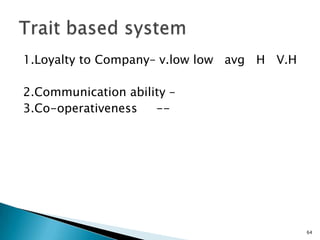
1.Loyalty to Company– v.low low avg H V.H

2.Communication ability –
3.Co-operativeness   --


                                            64
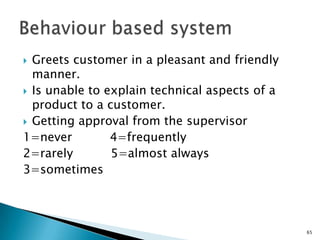
 Greets customer in a pleasant and friendly
  manner.
 Is unable to explain technical aspects of a
  product to a customer.
 Getting approval from the supervisor
1=never         4=frequently
2=rarely        5=almost always
3=sometimes


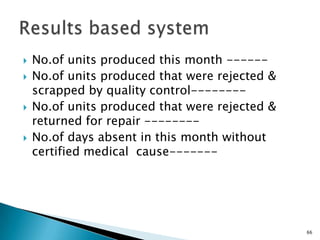
                                                65
   No.of units produced this month ------
   No.of units produced that were rejected &
    scrapped by quality control--------
   No.of units produced that were rejected &
    returned for repair --------
   No.of days absent in this month without
    certified medical cause-------


                                                66
   Frank Henderson is the manager of General Electric’s
    Appliance Division. Each April, he must evaluate all his
    subordinates to decide who is to receive a merit increase for
    the upcoming fiscal year. But each year these employees
    complain about how they are evaluated, how merit money is
    dispersed and what criteria are used for the evaluations.


                                                                    67
   However, during the past two years there has been a
    tremendous emphasis on quality of production. A review of
    the merit recipients reveals that these people were the ones
    who had the best quality records. But many of the employees
    felt that quality should not be the determining factor. At an
    employee forum, one of the senior members remarked: “How
    can Frank now reward quality? What happened to production
    numbers?”


                                                                    68
Another employee agreed and stated: “This quality game is okay
 for some, but what about overall production? It seems to me
 that if I will only be rewarded for quality, then I should
 produce a few items but make them perfect.”

       After hearing such criticism, Frank was quite upset. He
  wasn’t trying to cause chaos in his evaluations, nor was he
  attempting to hurt anyone. Unfortunately, what was originally
  intended to be an appraisal system had just become a nuisance.


                                                                   69
1.   What is the major problem with Frank’s appraisal
     system?

2.   Describe a performance appraisal system that you
     could recommend to Frank for evaluating a worker
     on the production line.
3.   If no changes are made in the current system that
     Frank is using, what do you expect will occur
     regarding future production performance of the
     employees?

4.   What does this case tell us about the impact of
     performance appraisals on employee motivation?


                                                         70
THANK YOU


            71

Performance Appraisal class 1

  • 1.
  • 2.
    Performance Appraisal (PA) refers to all those procedures that are used to evaluate the personality performance, potential of its group members 2
  • 3.
     Performance appraisal is a method of evaluating the behaviour of employees in the workspot, normally including both the quantitative & qualitative aspects of job performance.  PA is the systematic evaluation of the individual with respect to his/her performance on the job & his/her potential for development. 3
  • 4.
    It Provide a basis for promotion/ transfer/ termination: Identify those employees who deserve promotion Or those who Enhance employees’ effectiveness require lateral shift (transfer) or termination, PA is used for career planning .  by helping to identify their strengths and weaknesses and Inform them about expected levels of performance If employees understand their roles well, they are likely to be more effective on the job . 4
  • 5.
    Identifying training and development needs of employees is necessary to prepare them for meeting challenges in their current and future employment.  Aid in designing training and development programs: Identifying skills required to be developed would help in tailor- making training and development programs. 5
  • 6.
    Remove work alienation: Counseling Employees to correct misconceptions which might result in work alienation.  Remove discontent: Identifying and removing factors responsible for workers’ discontent would motivate them for better work performance.  Develop inter-personal relationships: Relations between superior - subordinate can be improved through realization that each is dependent on the other for better performance and success 6
  • 7.
    Aid wage administration: Performance appraisal can help in development of scientific basis for reward allocation, wage fixation, incentives.  Improve communication:Performance appraisal serves as a mechanism for communication between superiors and subordinates 7
  • 8.
    Provide information about the performance ranks basing on which decision regarding salary fixation, confirmation, transfer , promotion & demotion are taken.  Provide information to diagnose deficiency in employee regarding skill, knowledge, determine training & development needs & to set new standards of work, if necessary.  Provide information for correcting placement. 8
  • 9.
     Provide feedback information about the level of achievement & behaviour of subordinate.  Provide information which helps to counsel the subordinate.  To prevent grievances & indisciplinary activities. 9
  • 10.
    1. Validity 2. Reliability 3. Freedom from bias a. Legal issues of fairness b. Freedom from rating errors 4. Practicality 10
  • 11.
    Establish Performance Standards: Performance standards serve as benchmarks against which performance is measured Standards should relate to the desired results of each job.  Communicate the Standards : Performance appraisal involves at least two parties, the appraiser who does the appraisal and the appraisee whose performance is being evaluated. 11
  • 12.
    The appraiser should prepare job descriptions clearly; help appraisee set his goals and targets; analyse results objectively; offer coaching and guidance to appraisee whenever required and reward good results. The appraisee should be very clear about what he is doing and why. 12
  • 13.
    Performance measures may be objective or subjective .  Objective performance measures are indications of job performance that can be verified by others and are usually quantitative.  Subjective performance measures are ratings that are based on the personal standards or opinions of those doing the evaluation and are not verifiable by others. 13
  • 14.
    Compare Actual performancewith Standards and Discuss the Appraisal,Actual performance may be better than expected and sometimes it may go off the track Whatever be the consequences, there is a way to communicate and discuss the final outcome 14
  • 15.
    Corrective action is of two types One puts out the fires immediately, Other strikes at the root of the problem permanently 15
  • 16.
    In order to be effective, the criteria for performance appraisal should be genuinely related to success / failure in the job and should be amenable to objective judgement MBO is an example of performance-based appraisal approach that involves setting objectives and comparing performance against those objectives.  Performance Criteria Objectives give greater freedom to both management and the employees in deciding how performance is to be measured. 16
  • 17.
    Benefits of Performance Appraisal For the appraisee Better understanding of his role in the organization—what is expected and what needs to be done to meet those expectations Clear understanding of his strengths and weaknesses to develop himself into a better performer in future. 17
  • 18.
    Increased motivation, job satisfaction, and self-esteem Opportunity to discuss work problems and how they can be overcome Opportunity to discuss aspirations and any guidance, support or training needed to fulfil those aspirations Improved working relationships with supervisors . 18
  • 19.
    Identification of performers and non- performers and their development towards better performance Opportunity to prepare employees for assuming higher responsibilities.  Opportunity to improve communication between the employees and management Identification of training and development needs Generation of ideas for improvements Better identification of potential and formulation of career plans 19
  • 20.
    Improved performance through out the organization Creation of a culture of continuous improvement and success Conveying the message that people are valued. 20
  • 21.
    TRADITIONAL MODERN  Graphic rating scale  Behaviorally anchored  Ranking method rating scales  Paired comparison method  Forced distribution method  Assessment center  Checklist method  Human resource accounting  Essay or free form appraisal  Management by objectives  Group appraisal  Psychological appraisals  Confidential reports 21
  • 22.
    Confidential report  Essay evaluation  Critical incidents  Checklists  Graphic rating scale  Behaviorally anchored rating scale  Forced choice method  MBO. 22
  • 23.
     Ranking,  Paired comparison,  Forced distribution, Other methods,  Performance tests,  Field review technique. 23
  • 24.
    Confidential Report Descriptive report Prepared at the end of the year Prepared by the employee’s immediate supervisor, The report highlights the strengths and weaknesses of employees .  Prepared in Government organizations Does not offer any feedback to the employee. 24
  • 25.
    Essay Evaluation The rater is asked to express the strong as well as weak points of employee’s behavior The rater considers the employee’s : Job knowledge and potential Understanding of company’s programs, policies, objectives etc Relation with co- workers and supervisors Planning, organizing and controlling ability Attitude and perception 25
  • 26.
    This method hasthe following limitations:  Highly subjective.  Supervisor may write biased essay.  Difficult to find effective writers.  A busy appraiser may write the essay hurriedly without assessing properly the actual performance of the worker.  If the appraiser takes a long time it becomes uneconomical from the view point of the firm  Used in the companies like BPL, Bata, Wheels India, Birla & others. . 26
  • 27.
    Manager prepares lists of statements of very effective and ineffective behavior of an employee.  These critical incidents represent the outstanding or poor behavior of the employees.  The manager periodically records critical incidents of employee’s behavior . 27
  • 28.
    Critical Incident Technique Example: July 20 - Sales clerk patiently attended to the customers complaint. He is polite, prompt, enthusiastic in solving the customers’ problem July 20 - The sales assistant stayed 45 minutes beyond his break during the busiest part of the day. He failed to answer store manager’s call thrice. He is lazy, negligent, stubborn and uninterested in work. 28
  • 29.
    Negative incidents may be more noticeable than positive incidents.  Supervisors have a tendency to unload a series of complaints about incidents.  Results in very close supervision which may not be liked by the employee.  The recording of incidents may be a chore for the manager concerned who may be too busy or forget to do it 29
  • 30.
    A checklist is a set of objectives or descriptive statements about the employee and his behavior. If the rater believes that the employee possesses a listed trait, the item is checked A rating score equals the number of checks 30
  • 31.
     Simple checklist method  Weighted checklist method  Forced choice method Simple checklist method:  Is employee regular Y/N  Is employee respected by subordinate Y/N  Is employee helpful Y/N  Does he follow instruction Y/N  Does he keep the equipment in order Y/N 31
  • 32.
    weights performance rating (scale 1 to 5 )  Regularity 0.5  Loyalty 1.5  Willing to help 1.5  Quality of work 1.5  Relationship 2.0 32
  • 33.
    Was developed becausegraphic rating scales allowed supervisors to rate everyone high  The rater must choose from a set of descriptive statements about employee  Supervisors check the statements that describe the employee, or they rank the statements from most to least descriptive  Forced choice can be used by superiors, peers, subordinates, or a combination of these 33
  • 34.
    Criteria Rating Regularity on the job Most Least • Always regular • Inform in advance for delay • Never regular • Remain absent • Neither regular nor irregular Used in the companies like WIDIA, CEAT, Modern threads & others. 34
  • 35.
    The rater may rate his employees at the higher or lower end of the scale earlier.  The normal distribution curve is used.  Used in the companies like Usha, SPL, JCT & others. 35
  • 36.
    This is the simplest and most popular technique for appraising employee performance .  The typical rating scale system consist of several numerical scales, each representing a job related performance criterion such as dependability, Initiative, out put attendance , attitude, co-operation, and the like. Each scale ranges from excellent to poor. The rater checks the appropriate performance level on each criterion, then computes the employees total numerical score.  Graphic Rating Scale form is used to evaluate the performance of the employees A variety of traits may be used in this device, the most common being quality and quantity of work. 36
  • 37.
    Employee name_________ Dept_______  Rater’s name ___________ Date________  ------------------------------------------------- -----------------------  Exc. Good Acceptable Fair Poor  5 4 3 2 1 _  Dependability  Initiative  Overall output  Attendance  Attitude  Cooperation  Total score 37
  • 38.
    Behaviorally Anchored Rating Scale Combination of rating scale and critical incidence Steps  Collect critical incidents Identify performance dimensions.  Reclassification of incidents.  Assigning scale values to incidents Producing the final instrument
  • 39.
    MBO emphasizes collectively set goals that are tangible, verifiable, and measurable Focuses attention on goals rather than on methods Concentrates on Key Result Areas (KRA) Systematic and rational technique that allows management to attain maximum results from available resources by focusing on achievable goals 39
  • 40.
    Arranging organizational goals in a means- ends chain Engaging in joint goal setting This process has the following steps:  Identify KRAs  Define expected results  Assign specific responsibilities to employees.  Define authority and responsibility relationship  Conducting periodic progress review  Conducting annual performance review
  • 41.
    Ranking method: The evaluator rates the employee from highest to lowest on some overall criteria.  Ex :if there are 30 workers in a work group the most efficient employee may be ranked as number one and the least efficient employee as number thirty. Advantages:  Easy and inexpensive Disadvantages:  Not well defined  Raters bias 41
  • 42.
    Employee Rank  A 2  B 1  C 3  D 5  E 4 42
  • 43.
    Paired comparison method : Each worker is compared with all other employees in a group For several traits paired comparisons are made, tabulated and then rank is assigned to each worker This method is not applicable when the group is large.  This method results in each employee being given a positive comparison total and a certain percentage of the total positive evaluation. 43
  • 44.
    A B C D E Final Rank  A - - - + + 3  B + - - + + 2   C + + - + + 1   D - - - - + 4  E - - - - - 5  No of Positive evaluation  Total no. of evaluation * 100 = employee superior evaluation 44
  • 45.
    The rater is asked to appraise the employee according to predetermined distribution scale. Two criteria used for rating are:  job performance and promotability. A five point performance scale is also used without mentioning any descriptive statements. The worker is placed between two extremes of ―good‖ and ―bad‖ performance. 45
  • 46.
    Group Appraisal Employee is appraised by a group of appraisers. The group consists of Immediate supervisor of the employee Other supervisors who have close contact with the employee’s work. Manager or head of the departments. Consultants or Clients.  Used in the companies like Kinetic Honda, Blue star, Birla VXL & others. 46
  • 47.
    Field Review Technique The appraiser goes to the field and obtains the information about work performance of the employee by way of questioning the said individual, his peer group, and his superiors 47
  • 48.
    Conducted to assess employees’ potential.  Psychological Appraisals consists of: ◦ In-depth interviews ◦ Psychological tests ◦ Consultations and discussions with the employees ◦ Discussions with superiors, subordinates and peers, etc. 48
  • 49.
    Evaluation is conducted in the areas of: ◦ Employees intellectual abilities ◦ Emotional stability ◦ Motivational responses ◦ Reasoning and analytical abilities ◦ Interpretation and judgement skills ◦ Sociability ◦ Ability to foresee the future, etc. 49
  • 50.
    Let the Employee Know Where He Stands To help employees do a better job by clarifying what is expected of them.  To plan opportunities for development and growth To strengthen the superior- subordinate working relationship by developing mutual agreement of goals.  To provide an opportunity for employees to express themselves on performance related issues. 50
  • 51.
    360 Degree Appraisal 360 degree feedback, also known as 'multi-rater feedback', is the most comprehensive appraisal where the feedback about the employees’ performance comes from all the sources that come in contact with the employee on his job. Organisations are increasingly using feedback from various sources such as peer input, customer feedback, and input from superiors. Different forms with different formats are being used to obtain the information regarding the employee performance. 51
  • 52.
    360o Appraisal System It is a systematic collection and feedback of performance data on an individual or group, derived from a number of stakeholders Data is gathered and feed back to the individual participant in a clear way designed to promote understanding, acceptance and ultimately behavior . 52
  • 53.
    According to a wall street journal headline, ―Teams have become commonplace in U.S. Companies‖.  Most of the performance appraisal techniques are formulated with individuals in mind i.e. to measure and rate the performance of the individual employee. Therefore, with the number of teams increasing in the organisations, it becomes difficult to measure and appraise the performance of the team.  The question is how to separate the performance of the team from the performance of the employees.  A solution to this problem that is being adopted by the companies is to measure both the individual and the team performance. Sometimes, team based objectives are also included in the individual performance plans. 53
  • 54.
     Also knownas the ―Up or out policy‖, the rank and yank strategy refers to the performance appraisal model in which best-to-worst ranking methods are used to identify and separate the poor performers from the good performers.  Then the action plans and the improvement opportunities of the poor performers are discussed and they are given to improve their performance in a given time period, after which the appropriate HR decisions are taken. Some of the organisations following this strategy are Ford, Microsoft and Sun Microsystems. 54
  • 55.
    BPO sector offers handsome initial salary, good growth and many other benefits to its employees.  Keeping in relatively a new sector in the Indian industry, but has established itself well and is growing at a rapid rate.  mind the attrition rates in the sector, the performance measurement and appraisal processes are of extreme importance in BPO’s. It is often used as one of the tools to retain the employees. 55
  • 56.
    BPO employees have the advantage of getting performance based incentives.  In most of the BPO organisations, there are well designed schemes for awarding the performance based incentives to the individuals and/or the teams as a whole.  An incentive on the completion of the defined targets is a common practice in BPO’s. 56
  • 57.
    The general parametersfor the measurement of employees’ performance are: Speed i.e. process performance,  Accuracy and  Productivity of each process, 57
  • 58.
    HRA :  Dealswith cost of and contribution of human resources to the organization.  Positive employee performance: contribution ↑ cost ↓  Negative employee performance: contribution ↓ cost ↑ 58
  • 59.
    Getting PA fromthe computers based upon the data stored in the computer about the employee. Assessment Centre:  Individuals from various departments are brought together to spend 2 or 3 days.  Observers rank the performance of each and every participant in order of merit. 59
  • 60.
    Since assessment centers are basically meant for evaluating the potential of candidates to be considered for promotion. 60
  • 61.
    I. Judgment errors: 1. First impressions(primacy effect) 2. Halo errors 3. Horn effect (down grades other aspects of employee’s performance because of a single performance dimension ) 4. Leniency 5. Central tendency 6. Contrast error (Compare people against one another instead of against an objective ) 7. Recency effect 61
  • 62.
    II. Poor appraisal forms: 1. Vague & unclear rating scale 2. Ignore important aspects of job performance 3. Additional & irrelevant performance 4. Too long and complex III. Lack of rater preparedness IV. Ineffective organizational policies & practices 62
  • 63.
    Trait based system  Behaviour based system  Result based system 63
  • 64.
    1.Loyalty to Company–v.low low avg H V.H 2.Communication ability – 3.Co-operativeness -- 64
  • 65.
     Greets customerin a pleasant and friendly manner.  Is unable to explain technical aspects of a product to a customer.  Getting approval from the supervisor 1=never 4=frequently 2=rarely 5=almost always 3=sometimes 65
  • 66.
    No.of units produced this month ------  No.of units produced that were rejected & scrapped by quality control--------  No.of units produced that were rejected & returned for repair --------  No.of days absent in this month without certified medical cause------- 66
  • 67.
    Frank Henderson is the manager of General Electric’s Appliance Division. Each April, he must evaluate all his subordinates to decide who is to receive a merit increase for the upcoming fiscal year. But each year these employees complain about how they are evaluated, how merit money is dispersed and what criteria are used for the evaluations. 67
  • 68.
    However, during the past two years there has been a tremendous emphasis on quality of production. A review of the merit recipients reveals that these people were the ones who had the best quality records. But many of the employees felt that quality should not be the determining factor. At an employee forum, one of the senior members remarked: “How can Frank now reward quality? What happened to production numbers?” 68
  • 69.
    Another employee agreedand stated: “This quality game is okay for some, but what about overall production? It seems to me that if I will only be rewarded for quality, then I should produce a few items but make them perfect.” After hearing such criticism, Frank was quite upset. He wasn’t trying to cause chaos in his evaluations, nor was he attempting to hurt anyone. Unfortunately, what was originally intended to be an appraisal system had just become a nuisance. 69
  • 70.
    1. What is the major problem with Frank’s appraisal system? 2. Describe a performance appraisal system that you could recommend to Frank for evaluating a worker on the production line. 3. If no changes are made in the current system that Frank is using, what do you expect will occur regarding future production performance of the employees? 4. What does this case tell us about the impact of performance appraisals on employee motivation? 70
  • 71.