Performance
Appraisal interview
and feedback
MS. PREETI BHASKAR
What is an Appraisal Interview?
Talks between employee and manager happen on an almost daily
basis. The annual Appraisal Interview however offers the opportunity
to systematically discuss the following content:
• Discuss work and performance of the past year – tasks, work
conditions and cooperation
• Resolve problems and misunderstandings • Mutually voice
acknowledgement and critique in a factual matter
• Agree on measures to boost development and further education
• Mutually agree on long term goals and focus points
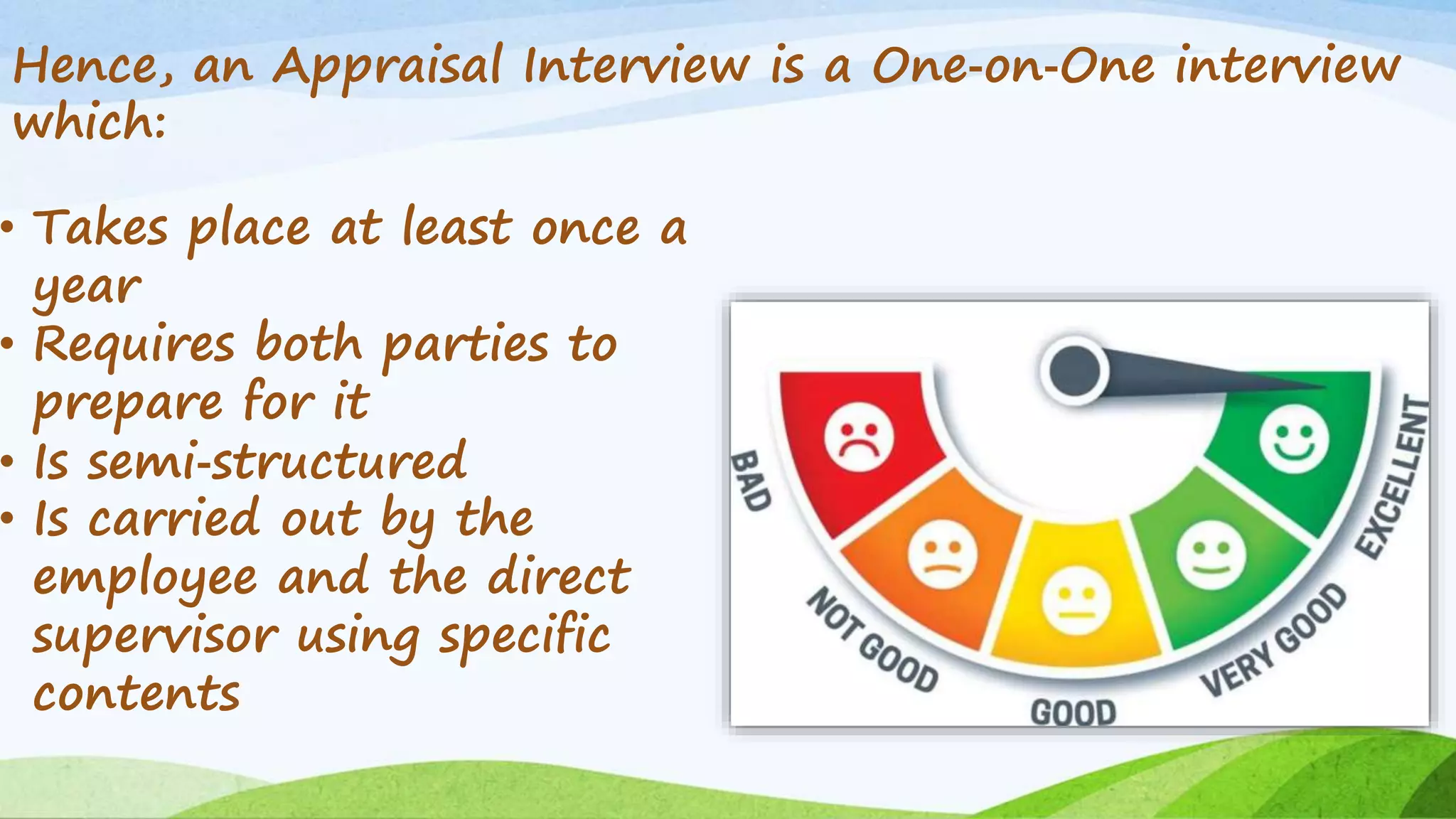
Hence, an Appraisal Interview is a One‐on‐One interview
which:
• Takes place at least once a
year
• Requires both parties to
prepare for it
• Is semi‐structured
• Is carried out by the
employee and the direct
supervisor using specific
contents
Why carry out an Appraisal Interview?
From the manager’s perspective
A manager’s success depends on how well an employee can carry out
his or her tasks. The Appraisal Interview enables the manager to fulfill
his/her leadership role. The manager
• Agrees on goals with the employee therefore providing the employee
with a direction to go to
• Facilitates important information regarding the University and/or
the organizational unit
• Evaluates goals together with the employee and conducts causal
research • Receives information regarding himself, his employees and
organizational unit (mutual exchange of expectations and desires)
• Assists and promotes his/her employees
Why carry out an Appraisal Interview?
From the employee’s perspective
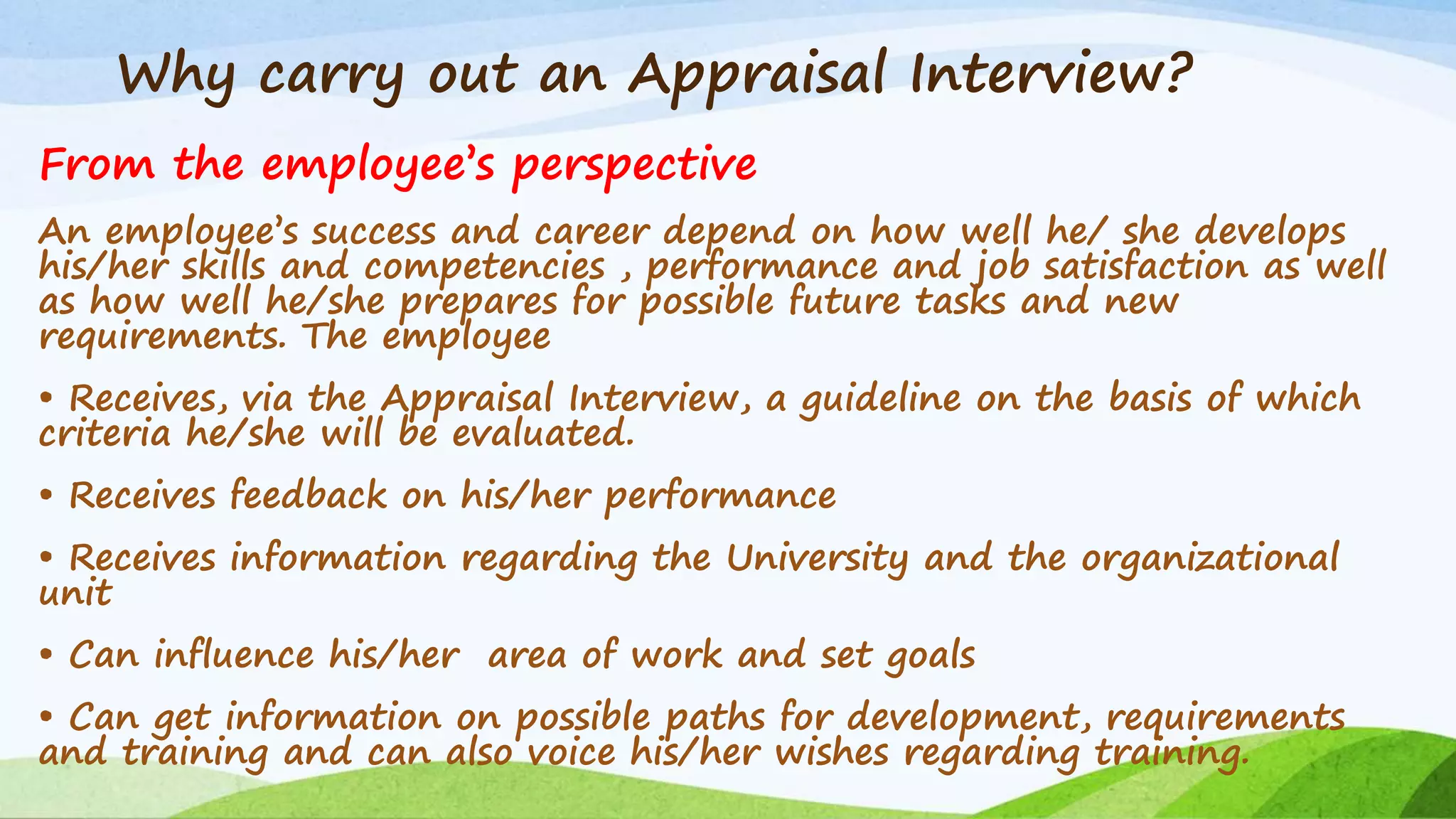
An employee’s success and career depend on how well he/ she develops
his/her skills and competencies , performance and job satisfaction as well
as how well he/she prepares for possible future tasks and new
requirements. The employee
• Receives, via the Appraisal Interview, a guideline on the basis of which
criteria he/she will be evaluated.
• Receives feedback on his/her performance
• Receives information regarding the University and the organizational
unit
• Can influence his/her area of work and set goals
• Can get information on possible paths for development, requirements
and training and can also voice his/her wishes regarding training.
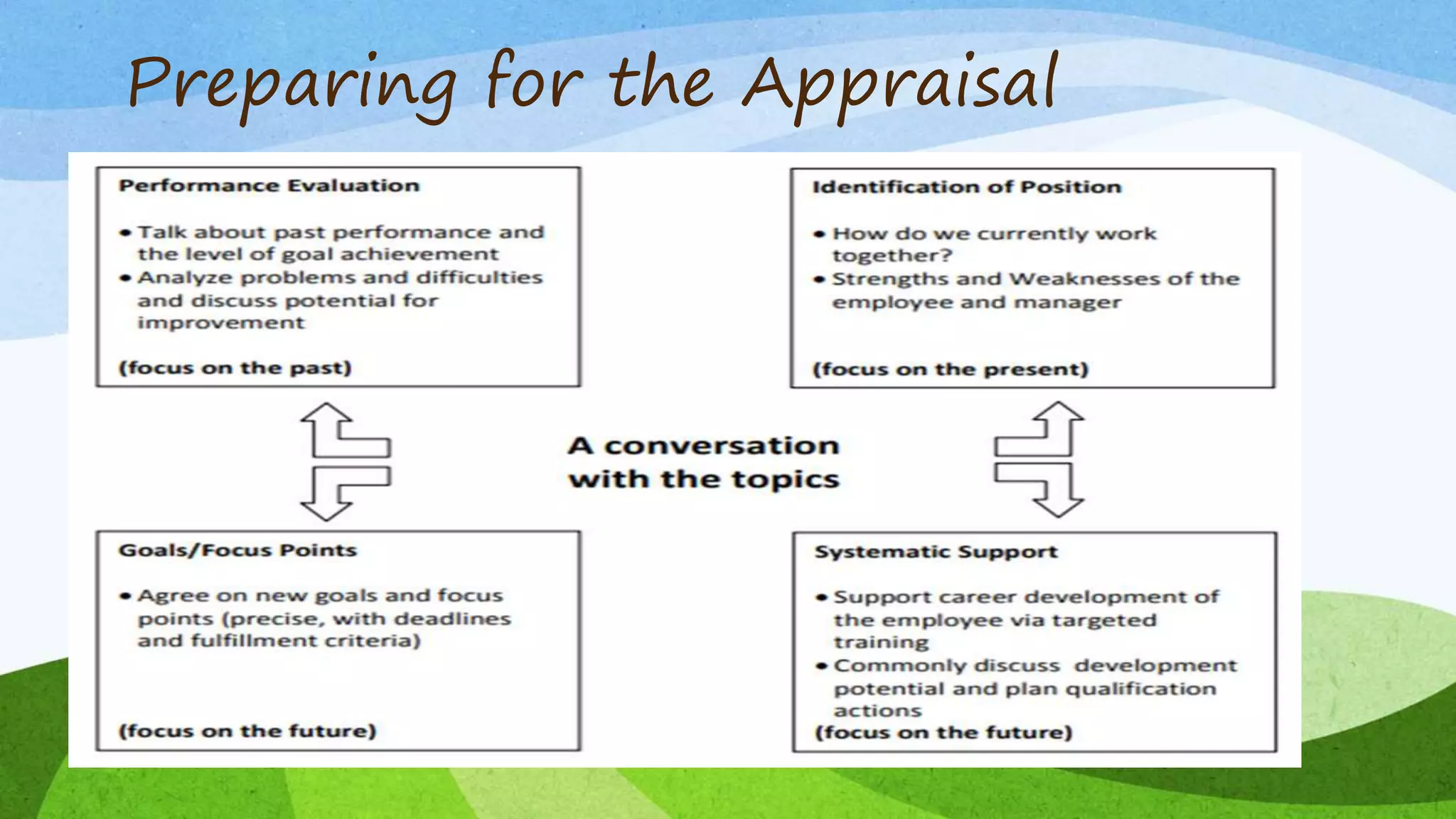
Preparing for the Appraisal
Performance Appraisal Interviewing
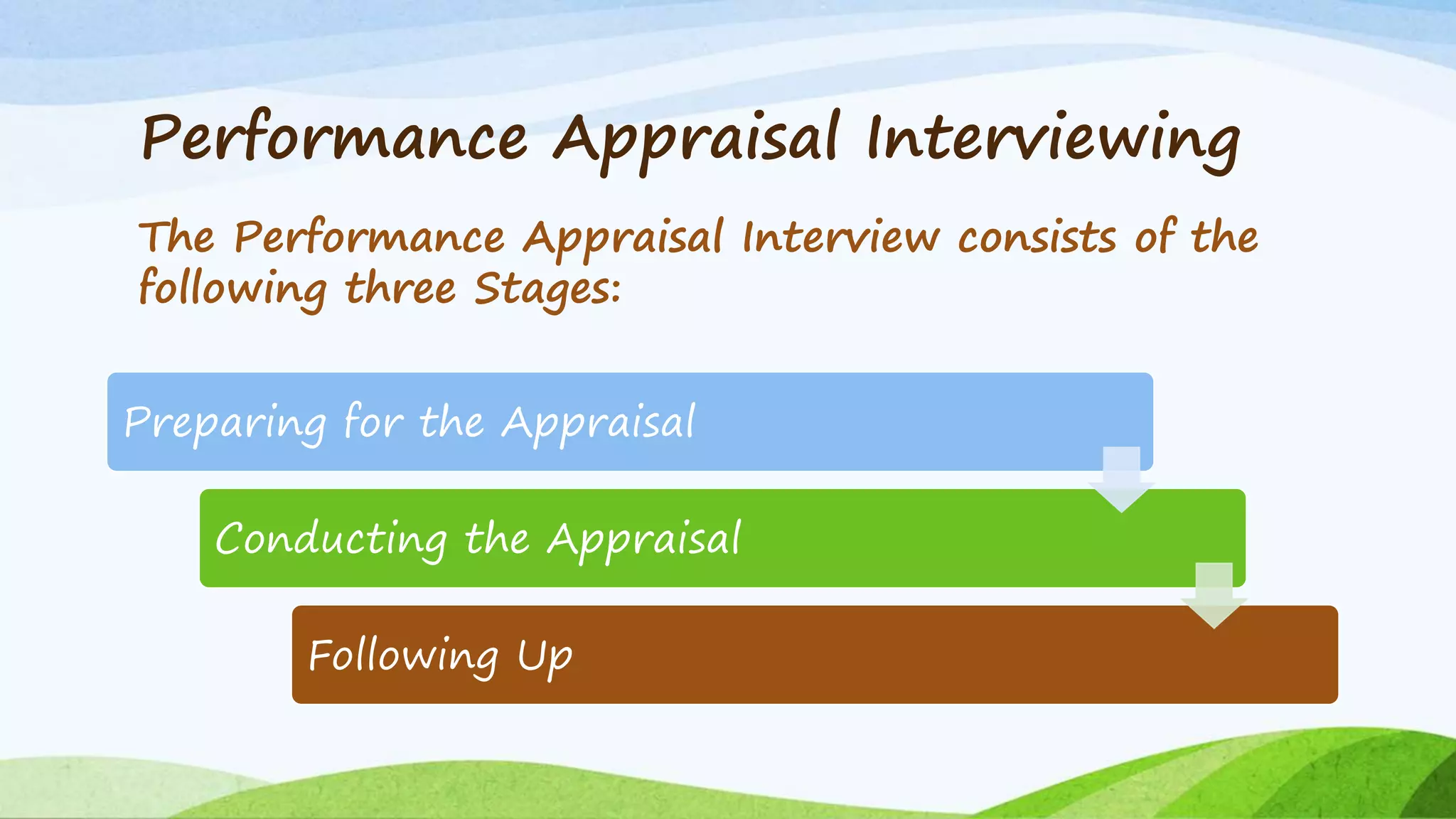
The Performance Appraisal Interview consists of the
following three Stages:
Preparing for the Appraisal
Conducting the Appraisal
Following Up
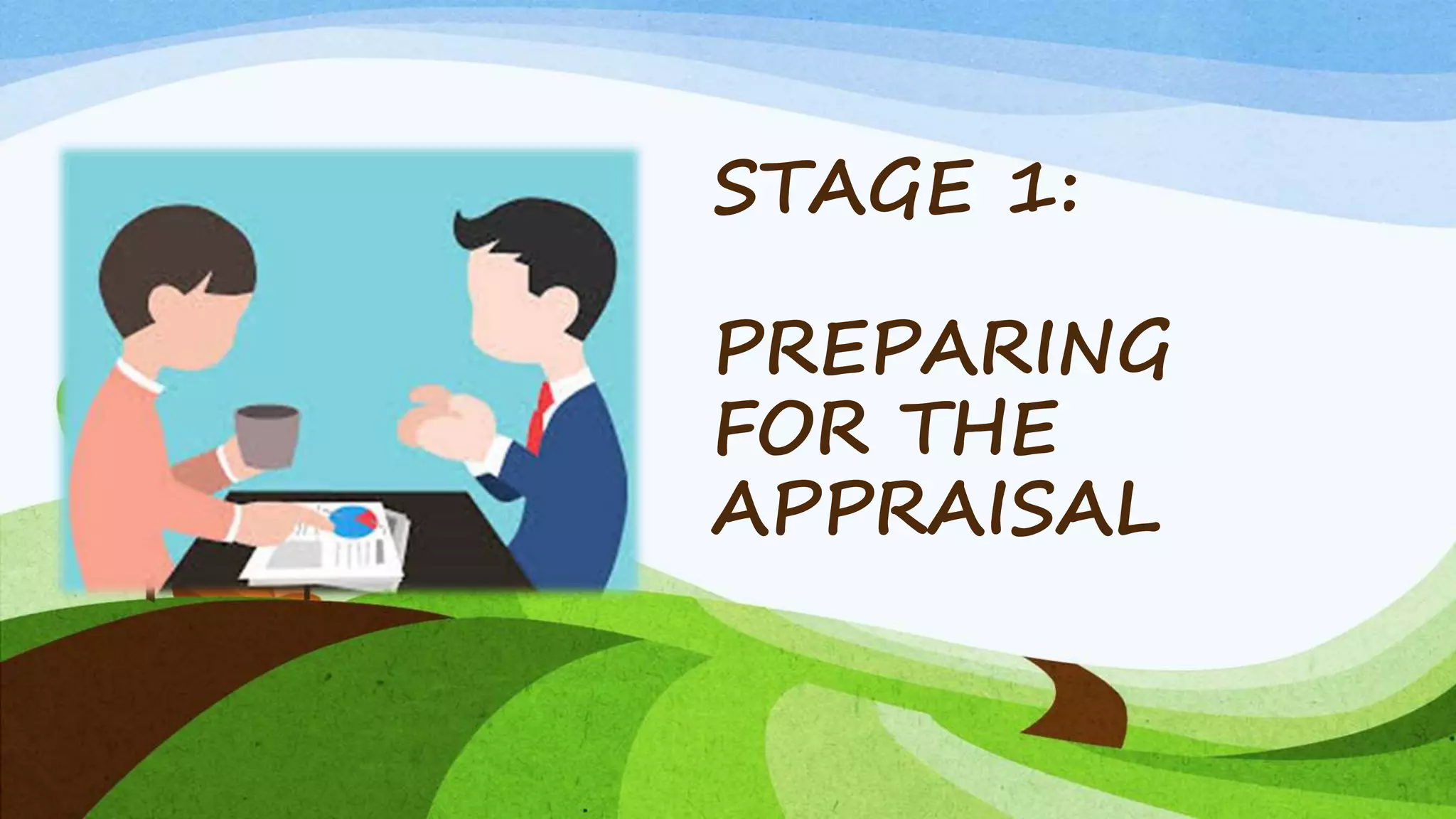
STAGE 1:
PREPARING
FOR THE
APPRAISAL
It is important that arrangements for the Performance Appraisal be
made well in advance so that both Appraisor and Appraisee have
adequate time to prepare properly.
A number of things need to be done in preparation to ensure a fruitful
discussion:
• Review Appraisees' Performance Appraisal Forms to refresh your
memory regarding the Performance Measures
(Goals/Objectives/KPIs/Competencies) that were agreed with them.
• Review their previous Appraisal Summary & Performance
Optimization Plans (POPs) to see what was agreed that they should
work on improving. Did you do what you have undertaken?
• Study their Performance Record Notes as accumulated throughout the
performance period. Consult all other relevant records on their
performance.
• Inform them to prepare for the Appraisal by completing and printing out
their Appraisal Prep Forms, and studying/printing out their Performance
Record Notes. The system allows you to request that they release their Prep
Form to you prior to the appraisal (check your company policy on this).
• Agree a mutually suitable date and time for the interview. A minimum of
one week's notice should be given. For more senior and specialist positions,
allow even more preparation time.
• Select a private, comfortable venue where you can meet in a relaxed,
unhurried, informal atmosphere, without disturbances or interruptions.
Avoid sitting behind a desk during the interview. Rather sit together with
the Appraisee in front of your desk or, alternatively, at a conference table.
Sitting behind a desk transmits a nonverbal message of formality, reinforcing
the "superior-subordinate" relationship.
• Set aside adequate time for the Appraisal Interview, which may vary in
length from 45 to 90 minutes, depending on the complexity and seniority of
the position under consideration.
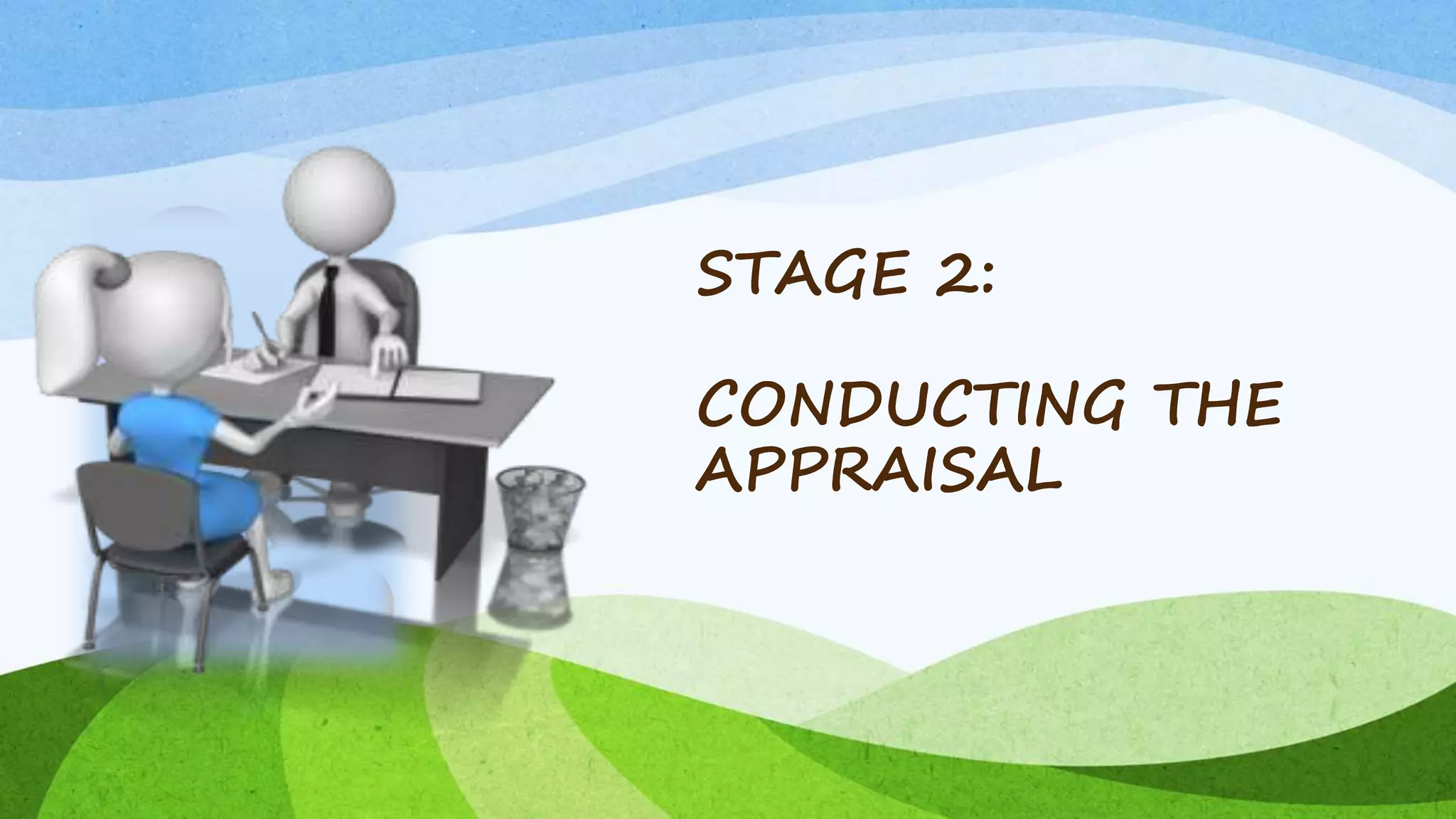
STAGE 2:
CONDUCTING THE
APPRAISAL
The Performance Appraisal consists of two distinct parts:
(1) REVIEWING PERFORMANCE: A "backward" look at how well previously set
Performance Measures and Standards were achieved, and the factors that affected
their achievement.
(2) PLANNING PERFORMANCE: A "forward" look at new or adapted Performance
Measures and Standards to be achieved during the next performance period.
The following FIVE STEPS need to be followed to ensure a constructive session:
1. Start with an icebreaker
2. Explain the purpose of the interview
3. Work through the Performance Measures (agree Actual Performance, Ratings and
POPs)
4. Agree Performance Measures and Standards for the next performance period
5. Close on a positive note
The online Official Performance Appraisal Form need to be completed by the Appraisor
during (or immediately after) the Appraisal Interview to record the actual performance
information, including the ratings and POP notes, as was mutually agreed on by both
Appraisor and Appraisee.
STAGE 3:
FOLLOWING UP
• The Performance Agreement for the next performance period can be viewed
as a negotiated contract. Appraisees are committing themselves to achieve
certain objectives/targets in return for specified support from their line
managers. It is crucial that you deliver on this promised support.
• Provide all possible psychological support (praise, recognition,
encouragement, etc.) and physical support (work tools, equipment, finances,
staff, etc.).
• Show interest by MBWA ("managing by walking around"), i.e. be there
where the action is, observing their performance, enquiring about progress,
and offering assistance.
• Arrange the necessary training and coaching as identified.
• Provide regular feedback on performance (both positive and
negative/constructive) as soon as possible after the event.
• Create a pleasant working environment and climate where people can fulfill
their social and other motivational needs, while maintaining a business focus
and urgency.
GENERAL CONSIDERATIONS IN RESPECT OF
APPRAISAL INTERVIEWS
• A Firm Manner
Do not accept any ideas or suggestions from Appraisees that you are not fully satisfied with or that
are not congruent with corporate and your own goals and standards. Tell them what these
nonnegotiable parameters are that you cannot compromise on.
• You do need a certain firmness of manner, which should be used as required during the Appraisal.
It is your job to keep the interview on track and not allow serious digressions.
• Firmness of manner means assertiveness, not aggression. It means ensuring you keep control of the
interview -- always politely, but with authority.
• Confidentiality
It is essential that you are discreet. The Appraisee must be able to trust you to keep whatever is
discussed confidential.
• Fair Assessment: External factors affecting performance
In assessing an Appraisee's performance, the extent to which circumstances beyond their control
have influenced the achievement of their objectives, must be taken into consideration. This means
that, if these circumstances have contributed greatly to good results, they should not get the
benefit of it. Likewise, they should not be punished if adverse, uncontrollable causes have prevented
them from achieving their objectives optimally.
Appraisal Pitfalls
The following needs to be avoided during the performance rating process:
• Tendency to give all employees more or less the same ratings, or giving an employee
the same rating on all his/her Performance Measures (to avoid potential conflict)
• Consistently being too strict or too lenient
• "Job Halo", by giving higher ratings to certain employees based upon your personal
preferences, or one-off incidents instead of actual performance over the entire period
Managers should differentiate very clearly between those employees who achieve their
objectives and those who do not, and give clear messages to both. "Compromising" and
giving all employees the same bonus or increase will give the wrong message to
everybody. Top performers will feel punished (even cheated) and poor performers will
be rewarded.
• Managers must have the courage of their conviction to give credit where credit is due
and not be manipulated by those poor performers who rather bet on the manager's
fear for confrontation. Such managers invariable end up losing the respect and loyalty
of both types of performer.
appraisal interview
appraisal interview
appraisal interview

appraisal interview

  • 1.
  • 2.
    What is anAppraisal Interview? Talks between employee and manager happen on an almost daily basis. The annual Appraisal Interview however offers the opportunity to systematically discuss the following content: • Discuss work and performance of the past year – tasks, work conditions and cooperation • Resolve problems and misunderstandings • Mutually voice acknowledgement and critique in a factual matter • Agree on measures to boost development and further education • Mutually agree on long term goals and focus points
  • 3.
    Hence, an AppraisalInterview is a One‐on‐One interview which: • Takes place at least once a year • Requires both parties to prepare for it • Is semi‐structured • Is carried out by the employee and the direct supervisor using specific contents
  • 4.
    Why carry outan Appraisal Interview? From the manager’s perspective A manager’s success depends on how well an employee can carry out his or her tasks. The Appraisal Interview enables the manager to fulfill his/her leadership role. The manager • Agrees on goals with the employee therefore providing the employee with a direction to go to • Facilitates important information regarding the University and/or the organizational unit • Evaluates goals together with the employee and conducts causal research • Receives information regarding himself, his employees and organizational unit (mutual exchange of expectations and desires) • Assists and promotes his/her employees
  • 5.
    Why carry outan Appraisal Interview? From the employee’s perspective An employee’s success and career depend on how well he/ she develops his/her skills and competencies , performance and job satisfaction as well as how well he/she prepares for possible future tasks and new requirements. The employee • Receives, via the Appraisal Interview, a guideline on the basis of which criteria he/she will be evaluated. • Receives feedback on his/her performance • Receives information regarding the University and the organizational unit • Can influence his/her area of work and set goals • Can get information on possible paths for development, requirements and training and can also voice his/her wishes regarding training.
  • 6.
  • 7.
    Performance Appraisal Interviewing ThePerformance Appraisal Interview consists of the following three Stages: Preparing for the Appraisal Conducting the Appraisal Following Up
  • 8.
  • 9.
    It is importantthat arrangements for the Performance Appraisal be made well in advance so that both Appraisor and Appraisee have adequate time to prepare properly. A number of things need to be done in preparation to ensure a fruitful discussion: • Review Appraisees' Performance Appraisal Forms to refresh your memory regarding the Performance Measures (Goals/Objectives/KPIs/Competencies) that were agreed with them. • Review their previous Appraisal Summary & Performance Optimization Plans (POPs) to see what was agreed that they should work on improving. Did you do what you have undertaken? • Study their Performance Record Notes as accumulated throughout the performance period. Consult all other relevant records on their performance.
  • 10.
    • Inform themto prepare for the Appraisal by completing and printing out their Appraisal Prep Forms, and studying/printing out their Performance Record Notes. The system allows you to request that they release their Prep Form to you prior to the appraisal (check your company policy on this). • Agree a mutually suitable date and time for the interview. A minimum of one week's notice should be given. For more senior and specialist positions, allow even more preparation time. • Select a private, comfortable venue where you can meet in a relaxed, unhurried, informal atmosphere, without disturbances or interruptions. Avoid sitting behind a desk during the interview. Rather sit together with the Appraisee in front of your desk or, alternatively, at a conference table. Sitting behind a desk transmits a nonverbal message of formality, reinforcing the "superior-subordinate" relationship. • Set aside adequate time for the Appraisal Interview, which may vary in length from 45 to 90 minutes, depending on the complexity and seniority of the position under consideration.
  • 11.
  • 12.
    The Performance Appraisalconsists of two distinct parts: (1) REVIEWING PERFORMANCE: A "backward" look at how well previously set Performance Measures and Standards were achieved, and the factors that affected their achievement. (2) PLANNING PERFORMANCE: A "forward" look at new or adapted Performance Measures and Standards to be achieved during the next performance period. The following FIVE STEPS need to be followed to ensure a constructive session: 1. Start with an icebreaker 2. Explain the purpose of the interview 3. Work through the Performance Measures (agree Actual Performance, Ratings and POPs) 4. Agree Performance Measures and Standards for the next performance period 5. Close on a positive note The online Official Performance Appraisal Form need to be completed by the Appraisor during (or immediately after) the Appraisal Interview to record the actual performance information, including the ratings and POP notes, as was mutually agreed on by both Appraisor and Appraisee.
  • 13.
  • 14.
    • The PerformanceAgreement for the next performance period can be viewed as a negotiated contract. Appraisees are committing themselves to achieve certain objectives/targets in return for specified support from their line managers. It is crucial that you deliver on this promised support. • Provide all possible psychological support (praise, recognition, encouragement, etc.) and physical support (work tools, equipment, finances, staff, etc.). • Show interest by MBWA ("managing by walking around"), i.e. be there where the action is, observing their performance, enquiring about progress, and offering assistance. • Arrange the necessary training and coaching as identified. • Provide regular feedback on performance (both positive and negative/constructive) as soon as possible after the event. • Create a pleasant working environment and climate where people can fulfill their social and other motivational needs, while maintaining a business focus and urgency.
  • 15.
    GENERAL CONSIDERATIONS INRESPECT OF APPRAISAL INTERVIEWS • A Firm Manner Do not accept any ideas or suggestions from Appraisees that you are not fully satisfied with or that are not congruent with corporate and your own goals and standards. Tell them what these nonnegotiable parameters are that you cannot compromise on. • You do need a certain firmness of manner, which should be used as required during the Appraisal. It is your job to keep the interview on track and not allow serious digressions. • Firmness of manner means assertiveness, not aggression. It means ensuring you keep control of the interview -- always politely, but with authority. • Confidentiality It is essential that you are discreet. The Appraisee must be able to trust you to keep whatever is discussed confidential. • Fair Assessment: External factors affecting performance In assessing an Appraisee's performance, the extent to which circumstances beyond their control have influenced the achievement of their objectives, must be taken into consideration. This means that, if these circumstances have contributed greatly to good results, they should not get the benefit of it. Likewise, they should not be punished if adverse, uncontrollable causes have prevented them from achieving their objectives optimally.
  • 16.
    Appraisal Pitfalls The followingneeds to be avoided during the performance rating process: • Tendency to give all employees more or less the same ratings, or giving an employee the same rating on all his/her Performance Measures (to avoid potential conflict) • Consistently being too strict or too lenient • "Job Halo", by giving higher ratings to certain employees based upon your personal preferences, or one-off incidents instead of actual performance over the entire period Managers should differentiate very clearly between those employees who achieve their objectives and those who do not, and give clear messages to both. "Compromising" and giving all employees the same bonus or increase will give the wrong message to everybody. Top performers will feel punished (even cheated) and poor performers will be rewarded. • Managers must have the courage of their conviction to give credit where credit is due and not be manipulated by those poor performers who rather bet on the manager's fear for confrontation. Such managers invariable end up losing the respect and loyalty of both types of performer.