PERCEPTRONS
Umair Ali
Perceptron - introduction
• ANN based on unit is called
perceptron
• Perceptrons takes the vector of
inputs
• can deal linear separable
functions only like AND or but
not XOR
Perceptron - Representations
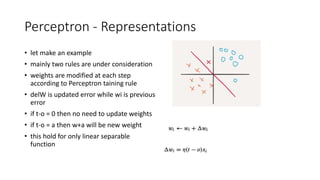
• let make an example
• mainly two rules are under consideration
• weights are modified at each step
according to Perceptron taining rule
• delW is updated error while wi is previous
error
• if t-o = 0 then no need to update weights
• if t-o = a then w+a will be new weight
• this hold for only linear separable
function
coding for perceptron training rule
• import numpy as np
• inputs = np.array([[0,0,-1],[0,1,-
1],[1,0,-1],[1,1,-1]])
• targets = np.array([[1],[0],[0],[0]])
• weights = np.array([[0.2],[0.1],[0.2]])
• for n in range(4):
•
• out = np.dot(inputs,weights)
• out=np.where(out>0,1,0)
•
• weights -=
0.25*np.dot(np.transpose(inputs
),(out-targets))
•
• print ("Iteration: ", n)
• print (weights)
• print (out)
Perceptron - Gradient Descent or delta rule
• perceptron rule is not for linearly
separable
• due to this deficiency delta rule
is introduced for best fitting
• main purpose is to find weights
for best fitting targets
• WITHOUT any threshold
• (t-o)^2 summed over all training
examples.
• D is training example(d) set and
Perceptron - GD - Visualizing hypothesis space
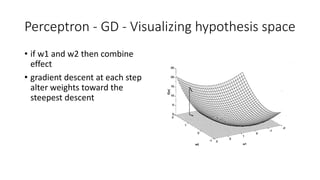
• if w1 and w2 then combine
effect
• gradient descent at each step
alter weights toward the
steepest descent
Perceptron - GD - Derivation of GD rule
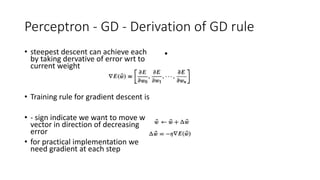
• steepest descent can achieve each
by taking dervative of error wrt to
current weight
• Training rule for gradient descent is
• - sign indicate we want to move w
vector in direction of decreasing
error
• for practical implementation we
need gradient at each step
•
perceptron -GD - derivation
• xid is single input for training
example d
• training example (x,t) input,
target
• Notice
• the delta rule in Equation (4.10) is similar to
the perceptron training rule in
• Equation (4.4.2). In fact, the two expressions
appear to be identical. However,
• the rules are different because in the delta
rule o refers to the linear unit output
• o(2) = i;) .?, whereas for the perceptron rule o
refers to the thresholded output
• o(2) = sgn($ .2)

Perceptrons

  • 1.
  • 2.
    Perceptron - introduction •ANN based on unit is called perceptron • Perceptrons takes the vector of inputs • can deal linear separable functions only like AND or but not XOR
  • 3.
    Perceptron - Representations •let make an example • mainly two rules are under consideration • weights are modified at each step according to Perceptron taining rule • delW is updated error while wi is previous error • if t-o = 0 then no need to update weights • if t-o = a then w+a will be new weight • this hold for only linear separable function
  • 4.
    coding for perceptrontraining rule • import numpy as np • inputs = np.array([[0,0,-1],[0,1,- 1],[1,0,-1],[1,1,-1]]) • targets = np.array([[1],[0],[0],[0]]) • weights = np.array([[0.2],[0.1],[0.2]]) • for n in range(4): • • out = np.dot(inputs,weights) • out=np.where(out>0,1,0) • • weights -= 0.25*np.dot(np.transpose(inputs ),(out-targets)) • • print ("Iteration: ", n) • print (weights) • print (out)
  • 5.
    Perceptron - GradientDescent or delta rule • perceptron rule is not for linearly separable • due to this deficiency delta rule is introduced for best fitting • main purpose is to find weights for best fitting targets • WITHOUT any threshold • (t-o)^2 summed over all training examples. • D is training example(d) set and
  • 6.
    Perceptron - GD- Visualizing hypothesis space • if w1 and w2 then combine effect • gradient descent at each step alter weights toward the steepest descent
  • 7.
    Perceptron - GD- Derivation of GD rule • steepest descent can achieve each by taking dervative of error wrt to current weight • Training rule for gradient descent is • - sign indicate we want to move w vector in direction of decreasing error • for practical implementation we need gradient at each step •
  • 8.
    perceptron -GD -derivation • xid is single input for training example d • training example (x,t) input, target • Notice • the delta rule in Equation (4.10) is similar to the perceptron training rule in • Equation (4.4.2). In fact, the two expressions appear to be identical. However, • the rules are different because in the delta rule o refers to the linear unit output • o(2) = i;) .?, whereas for the perceptron rule o refers to the thresholded output • o(2) = sgn($ .2)