Perceptron &
Sigmoid Neurons
Dr.S.SHAJUN NISHA, MCA.,M.Phil.,M.Tech.,MBA.,Ph.D
Assistant Professor & Head
PG & Research Dept. of Computer Science
Sadakathullah Appa College
shajunnisha_s@yahoo.com
+91 99420 96220
Perceptron
 Frank Rosenblatt, an American psychologist,
proposed the classical perceptron model(1958)
 A more general computational model than
McCulloch–Pitts neurons
 Main differences: Introduction of numerical
weights for inputs and a mechanism for learning
these weights
 Input-Real Value
 Output- Binary (0,1)
Perceptron
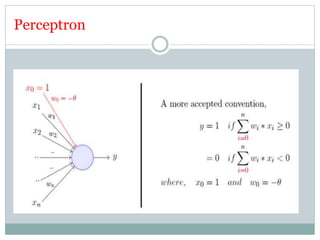
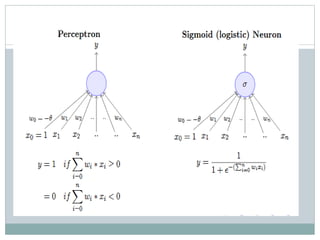
 It takes an input, aggregates it (weighted sum) and
returns 1 only if the aggregated sum is more than
some threshold else returns 0
 Perceptron is usually used to classify the data into
two parts. Therefore, it is also known as a Linear
Binary Classifier.
Perceptron
Bias
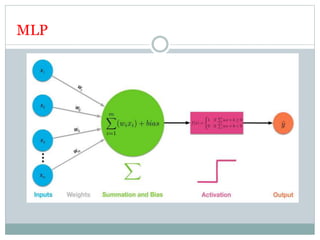
 In the above diagram, x0 is bias input.
 Bias is an additional parameter in the Neural
Network which is used to adjust the output along
with the weighted sum of the inputs to the neuron.
 Therefore Bias is a constant which helps the model in
a way that it can fit best for the given data.
 bias helps in controlling the value at which activation
function will trigger
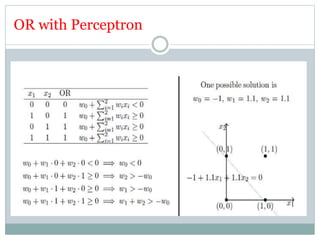
OR with Perceptron
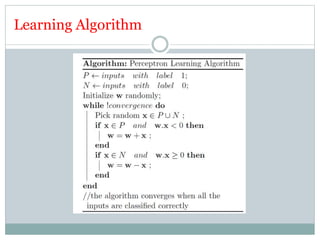
Learning Algorithm
Multi Layer Perceptron (MLP)
 Multi-layer Perceptron model (MLP) is an artificial
neural network with three or more hidden layers.
 It is a feed-forward neural network that uses back
propagation technique for training the network.
 Multi-layer perceptron model is sometimes
referred to as the deep neural network because it
has many hidden layers.
MLP
 It is a deep learning method used for supervised
learning and its capable of modeling complex
problems.
 Multi-layer perceptron is capable of handling both
linearly and non-linearly separable tasks.
MLP
MLP
 There are 2 stages in learning process
 Feedforward
 Backpropagation
Feed Forward
 The input layer receives the features from the data
set each node representing a feature
 bias is added to the sum of input and weight
 The information from the input layer is sent to each
neuron in the hidden layer for further processing
 The neurons in the hidden layer accepts the
information from input layer together with their
weights and biases.
 The neuron has an activation function which
regulates the processing of information in the
neuron
 The activation function ensures that the information
is within the required range such as 0 to 1 or -1 to 1
 The output from one layer is the input in the next
layer.
 When the information moves from one layer to the
next layer it is multiplied by the weights and bias
added.
 The final hidden layer is the output layer and is
responsible for predicting the results of the model
Back Propagation
 We can improve the accuracy of the prediction
by adjusting weights and biases in a backward
direction.
 The objective of back propagation is to reduce the
error
 Error(loss function)=Expected Output-Actual
Output
 There are many types of loss functions such as
Root Mean Squared Error (RMES)
Cross Entropy (CE)
 The error is reduced through what is called the
gradient descent process which uses the
derivatives to find the gradient/slope of the error
function
 The objective of gradient descent is to move the
error to the zero level
Sigmoid Neurons
 Why Sigmoid Neuron?
 MP-Neuron
Input and Output= Binary
 Perceptron
Input=Real value, Output=Binary
Can’t handle linearly non-separable problems
 MLP(Network of Perceptron)
Input=Real value, Output=Binary
Can handle linearly non-separable problems
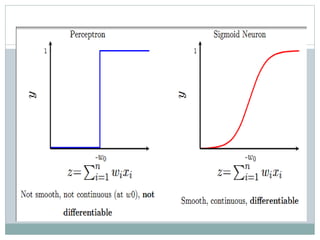
Sigmoid Neuron
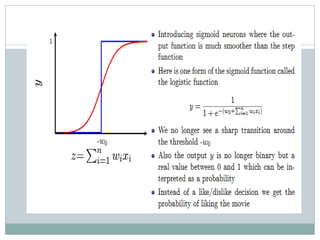
 Both input and Output are real values
 Output of sigmoid neuron is a real value between 0
and 1, which is smoother than binary input
 There are many functions with the characteristic of
an “S” shaped curve known as sigmoid functions
 The most commonly used function is the logistic
function
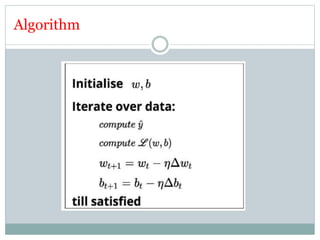
Learning Algorithm
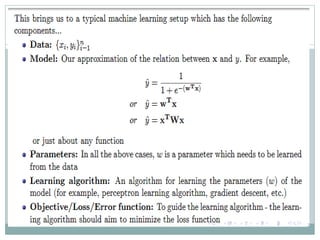
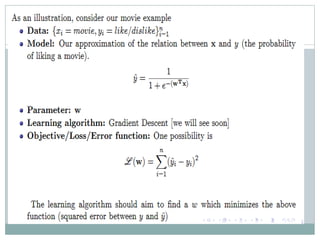
 The objective of the learning algorithm is to
determine the best possible values for the
parameters (w and b), such that the overall loss
(squared error loss) of the model is minimized as
much as possible.
Algorithm
Perceptron and Sigmoid Neurons

Perceptron and Sigmoid Neurons

  • 1.
    Perceptron & Sigmoid Neurons Dr.S.SHAJUNNISHA, MCA.,M.Phil.,M.Tech.,MBA.,Ph.D Assistant Professor & Head PG & Research Dept. of Computer Science Sadakathullah Appa College shajunnisha_s@yahoo.com +91 99420 96220
  • 2.
    Perceptron  Frank Rosenblatt,an American psychologist, proposed the classical perceptron model(1958)  A more general computational model than McCulloch–Pitts neurons  Main differences: Introduction of numerical weights for inputs and a mechanism for learning these weights  Input-Real Value  Output- Binary (0,1)
  • 3.
    Perceptron  It takesan input, aggregates it (weighted sum) and returns 1 only if the aggregated sum is more than some threshold else returns 0  Perceptron is usually used to classify the data into two parts. Therefore, it is also known as a Linear Binary Classifier.
  • 4.
  • 5.
    Bias  In theabove diagram, x0 is bias input.  Bias is an additional parameter in the Neural Network which is used to adjust the output along with the weighted sum of the inputs to the neuron.  Therefore Bias is a constant which helps the model in a way that it can fit best for the given data.  bias helps in controlling the value at which activation function will trigger
  • 6.
  • 7.
  • 8.
    Multi Layer Perceptron(MLP)  Multi-layer Perceptron model (MLP) is an artificial neural network with three or more hidden layers.  It is a feed-forward neural network that uses back propagation technique for training the network.  Multi-layer perceptron model is sometimes referred to as the deep neural network because it has many hidden layers.
  • 9.
    MLP  It isa deep learning method used for supervised learning and its capable of modeling complex problems.  Multi-layer perceptron is capable of handling both linearly and non-linearly separable tasks.
  • 10.
  • 11.
    MLP  There are2 stages in learning process  Feedforward  Backpropagation
  • 12.
    Feed Forward  Theinput layer receives the features from the data set each node representing a feature  bias is added to the sum of input and weight  The information from the input layer is sent to each neuron in the hidden layer for further processing
  • 13.
     The neuronsin the hidden layer accepts the information from input layer together with their weights and biases.  The neuron has an activation function which regulates the processing of information in the neuron  The activation function ensures that the information is within the required range such as 0 to 1 or -1 to 1
  • 14.
     The outputfrom one layer is the input in the next layer.  When the information moves from one layer to the next layer it is multiplied by the weights and bias added.  The final hidden layer is the output layer and is responsible for predicting the results of the model
  • 15.
    Back Propagation  Wecan improve the accuracy of the prediction by adjusting weights and biases in a backward direction.  The objective of back propagation is to reduce the error  Error(loss function)=Expected Output-Actual Output  There are many types of loss functions such as Root Mean Squared Error (RMES) Cross Entropy (CE)
  • 16.
     The erroris reduced through what is called the gradient descent process which uses the derivatives to find the gradient/slope of the error function  The objective of gradient descent is to move the error to the zero level
  • 17.
    Sigmoid Neurons  WhySigmoid Neuron?  MP-Neuron Input and Output= Binary  Perceptron Input=Real value, Output=Binary Can’t handle linearly non-separable problems  MLP(Network of Perceptron) Input=Real value, Output=Binary Can handle linearly non-separable problems
  • 18.
    Sigmoid Neuron  Bothinput and Output are real values  Output of sigmoid neuron is a real value between 0 and 1, which is smoother than binary input  There are many functions with the characteristic of an “S” shaped curve known as sigmoid functions  The most commonly used function is the logistic function
  • 25.
    Learning Algorithm  Theobjective of the learning algorithm is to determine the best possible values for the parameters (w and b), such that the overall loss (squared error loss) of the model is minimized as much as possible.
  • 26.