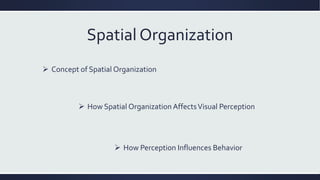
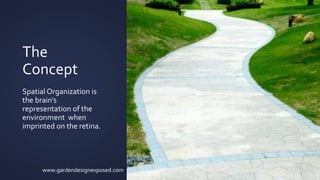
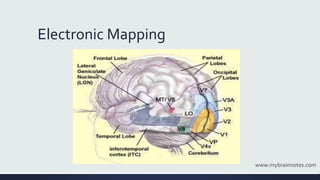
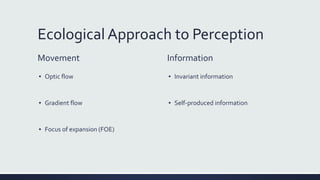
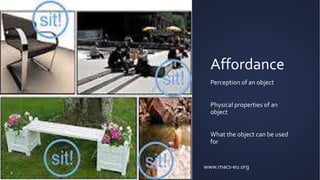
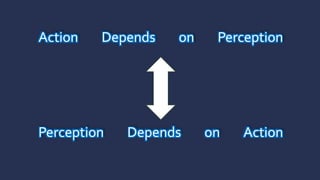
Spatial organization represents how the brain maps the external environment based on visual input to the retina. It affects visual perception and influences behavior. Gibson's ecological approach viewed perception as an active process where movement through the environment provides optical and other sensory information, rather than a passive experience. Affordances are the actionable properties of objects perceived in relation to an individual. Perception and action have an interdependent relationship, as each can drive the other.