Perception The Perceptual process can be defined as a complicated interaction of selection, organization,and interpretation. The perceptual process adds to, and subtracts from the real sensory world. It is the process through which people make sense of the vast array of sensory inputs and involves the active processing of information.
Sub-processes of Perception I.External Environment: a).Sensual stimulation b).Physical Environment Office. Factory floor. Research Labs. Store. Climate. c).Sociocultural environment Management Styles. Values Discrimination.
Sub-processes of Perception… II.Confrontation of Specific stimulus. (supervisor,new procedure,new machinery). III.Registration of Stimulus (sensory and neural mechanisms). IV.Interpretation of the stimulus (motivation, learning,and personality).
Sub-processes of Perception… V.Feedback for clarification. VI.Behaviour (overt or covert). VII.Consequence (reinforcement/punishment or some organizational outcome).
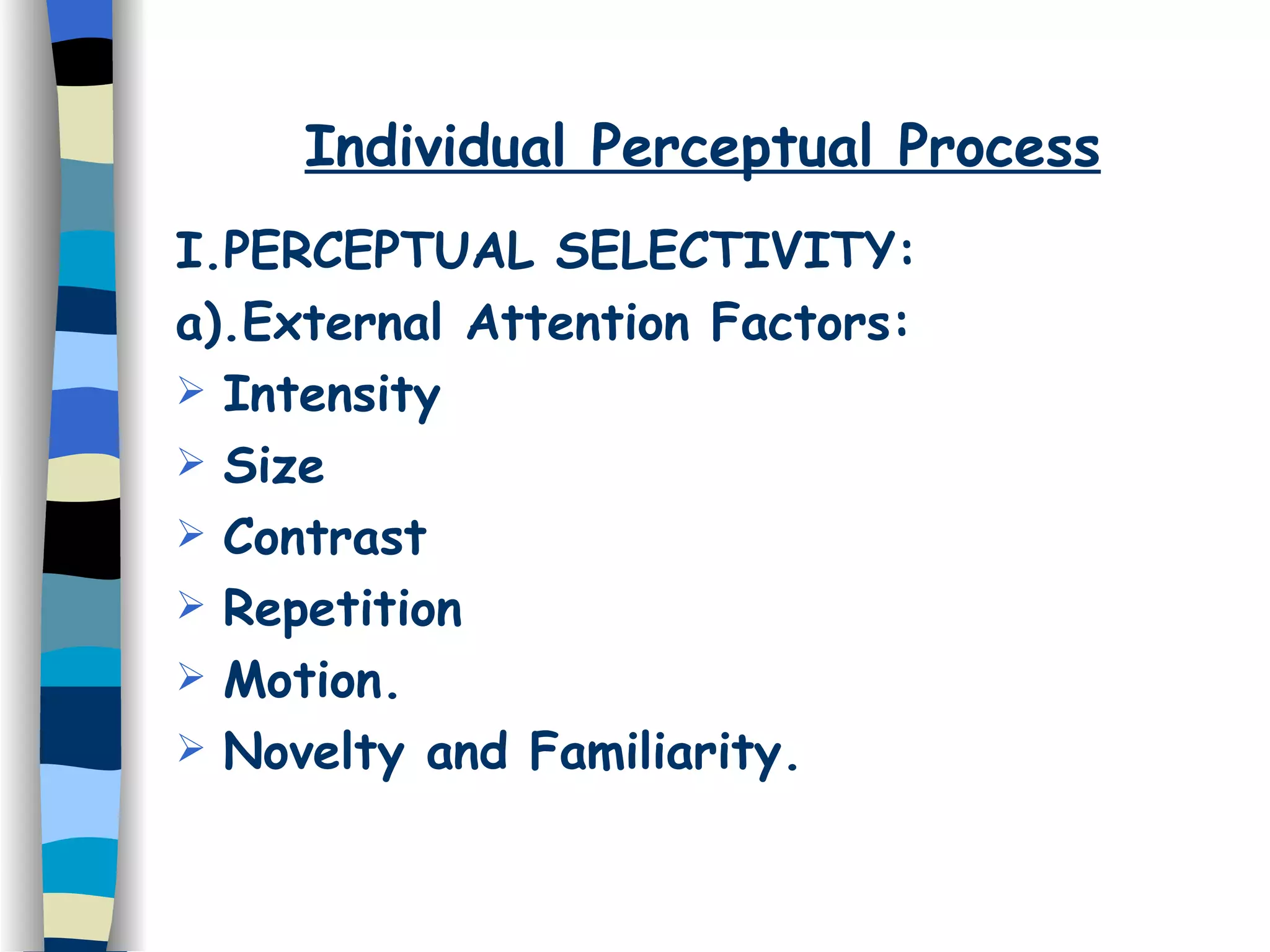
Individual Perceptual Process I.PERCEPTUAL SELECTIVITY: a).External Attention Factors: Intensity Size Contrast Repetition Motion. Novelty and Familiarity.
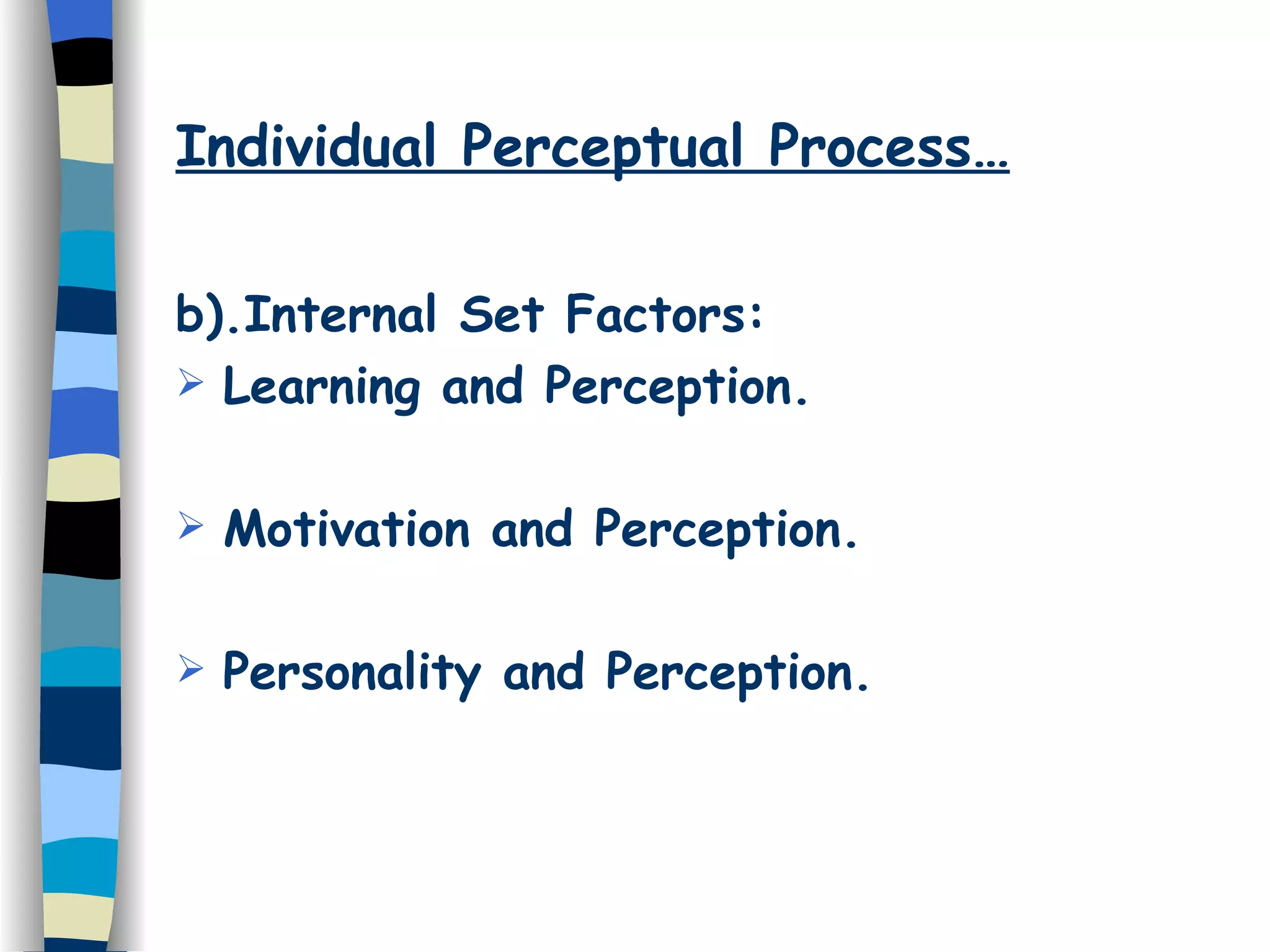
Individual Perceptual Process… b).Internal Set Factors: Learning and Perception. Motivation and Perception. Personality and Perception.
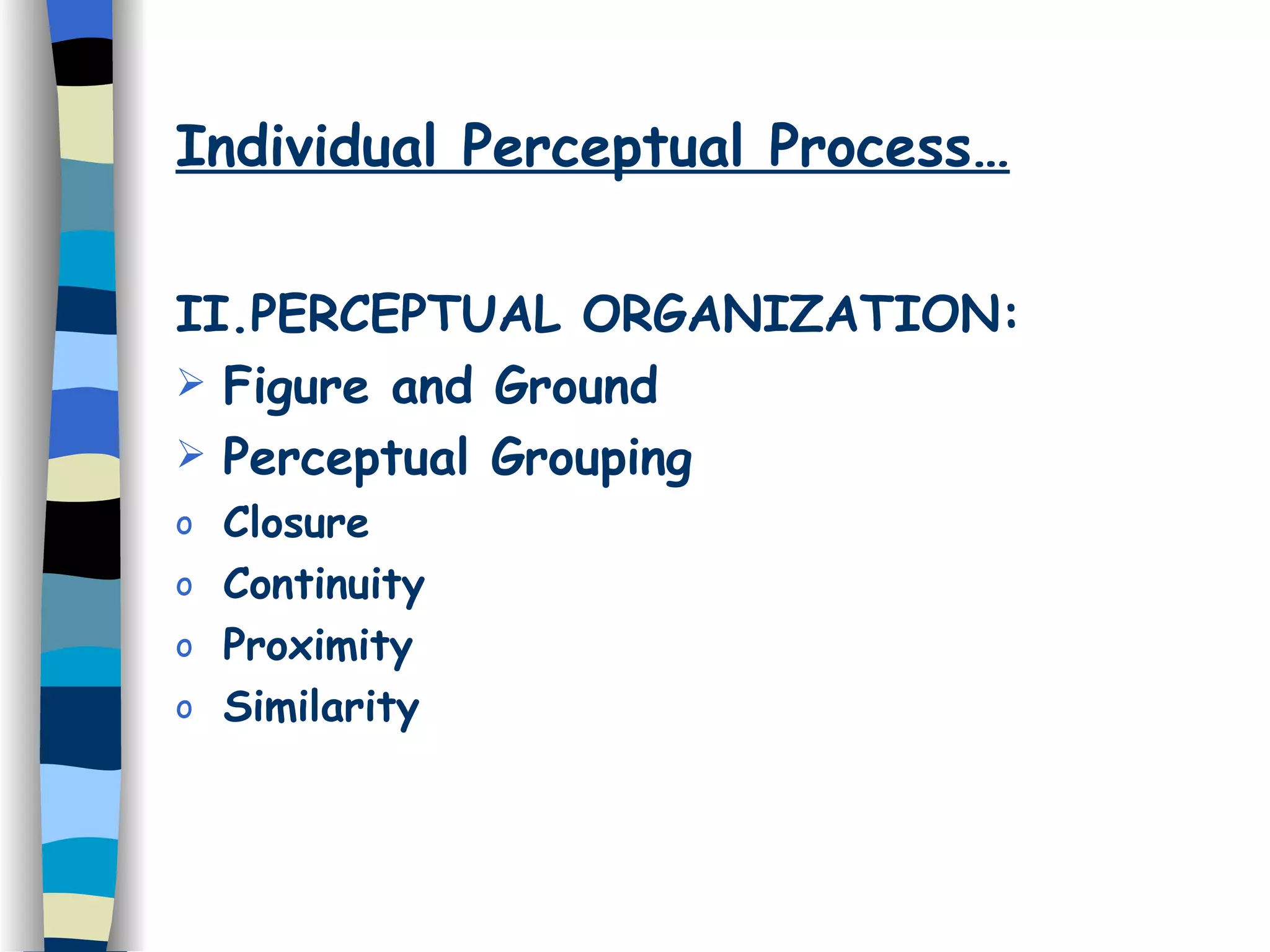
Individual Perceptual Process… II.PERCEPTUAL ORGANIZATION: Figure and Ground Perceptual Grouping Closure Continuity Proximity Similarity
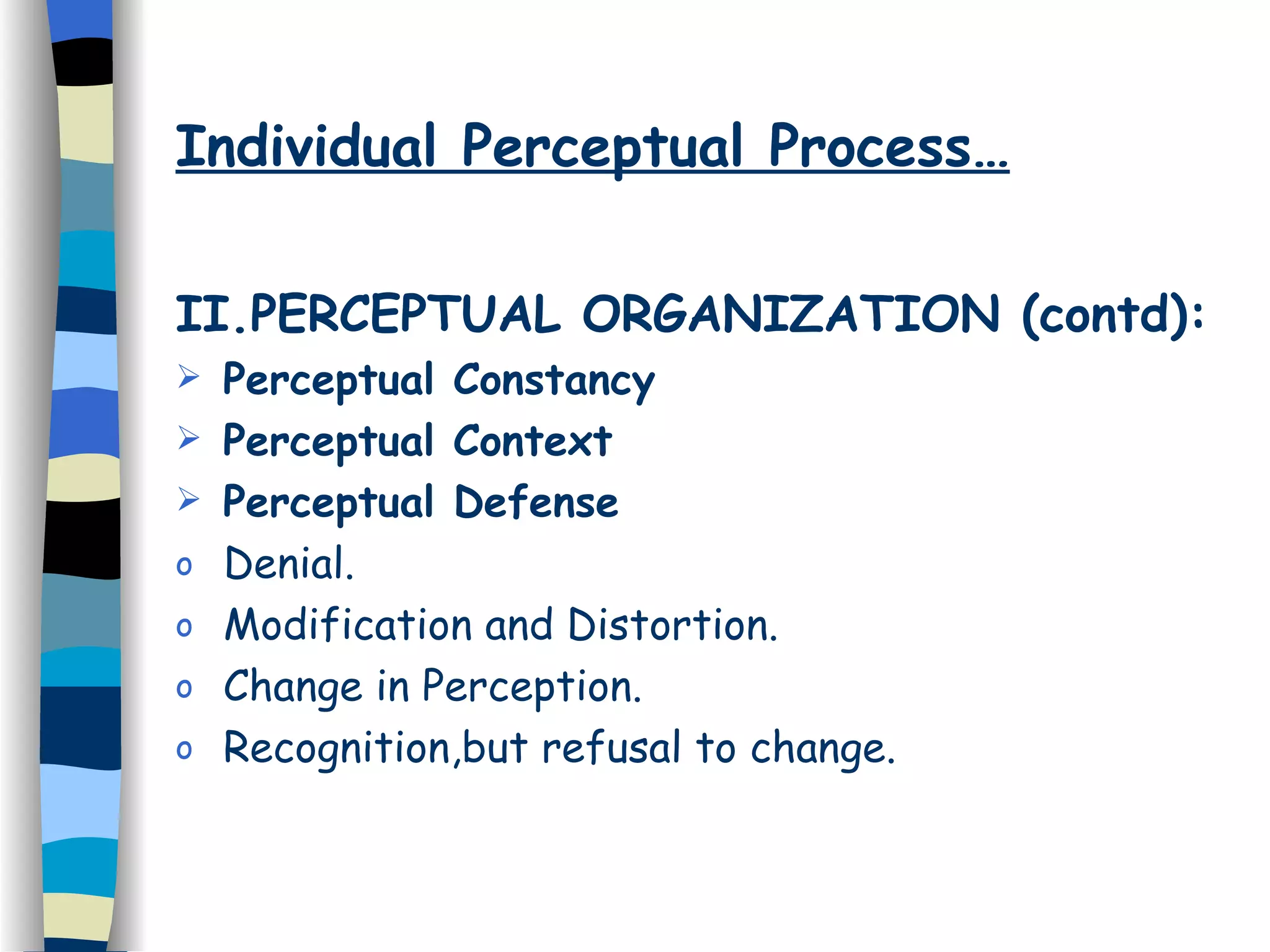
Individual Perceptual Process… II.PERCEPTUAL ORGANIZATION (contd): Perceptual Constancy Perceptual Context Perceptual Defense Denial. Modification and Distortion. Change in Perception. Recognition,but refusal to change.
II.PERCEPTUAL ORGANIZATION (contd): Perceptual Defense  (continued) : Emotionally disturbing information has a higher threshold for recognition. Disturbing information and stimuli are likely to bring about substitute perceptions that are distorted to prevent recognition of disturbing elements. Emotionally arousing information actually does arouse emotion,which might be directed elsewhere.
Individual Perceptual Process… III.SOCIAL PERCEPTION: Characteristics of Perceiver and Perceived. The Similar-to-me Effect. Attribution. First Impression Error-confirming one’s expectation. The Halo Effect. Selective Perception. Stereotyping.
IMPRESSION MANAGEMENT I. Demotion-Preventive Strategy: a ).Accounts. b).Apologies. c).Disassociation. II.Promotion-Enhancing Strategy: a).Entitlements. b).Enhancements. c).Obstacle Disclosures. d).Association.

Perception

  • 1.
    Perception The Perceptualprocess can be defined as a complicated interaction of selection, organization,and interpretation. The perceptual process adds to, and subtracts from the real sensory world. It is the process through which people make sense of the vast array of sensory inputs and involves the active processing of information.
  • 2.
    Sub-processes of PerceptionI.External Environment: a).Sensual stimulation b).Physical Environment Office. Factory floor. Research Labs. Store. Climate. c).Sociocultural environment Management Styles. Values Discrimination.
  • 3.
    Sub-processes of Perception…II.Confrontation of Specific stimulus. (supervisor,new procedure,new machinery). III.Registration of Stimulus (sensory and neural mechanisms). IV.Interpretation of the stimulus (motivation, learning,and personality).
  • 4.
    Sub-processes of Perception…V.Feedback for clarification. VI.Behaviour (overt or covert). VII.Consequence (reinforcement/punishment or some organizational outcome).
  • 5.
    Individual Perceptual ProcessI.PERCEPTUAL SELECTIVITY: a).External Attention Factors: Intensity Size Contrast Repetition Motion. Novelty and Familiarity.
  • 6.
    Individual Perceptual Process…b).Internal Set Factors: Learning and Perception. Motivation and Perception. Personality and Perception.
  • 7.
    Individual Perceptual Process…II.PERCEPTUAL ORGANIZATION: Figure and Ground Perceptual Grouping Closure Continuity Proximity Similarity
  • 8.
    Individual Perceptual Process…II.PERCEPTUAL ORGANIZATION (contd): Perceptual Constancy Perceptual Context Perceptual Defense Denial. Modification and Distortion. Change in Perception. Recognition,but refusal to change.
  • 9.
    II.PERCEPTUAL ORGANIZATION (contd):Perceptual Defense (continued) : Emotionally disturbing information has a higher threshold for recognition. Disturbing information and stimuli are likely to bring about substitute perceptions that are distorted to prevent recognition of disturbing elements. Emotionally arousing information actually does arouse emotion,which might be directed elsewhere.
  • 10.
    Individual Perceptual Process…III.SOCIAL PERCEPTION: Characteristics of Perceiver and Perceived. The Similar-to-me Effect. Attribution. First Impression Error-confirming one’s expectation. The Halo Effect. Selective Perception. Stereotyping.
  • 11.
    IMPRESSION MANAGEMENT I.Demotion-Preventive Strategy: a ).Accounts. b).Apologies. c).Disassociation. II.Promotion-Enhancing Strategy: a).Entitlements. b).Enhancements. c).Obstacle Disclosures. d).Association.