1
PERCEPTION
•Perception can be defined as a process by which
individuals organise and interpret their sensory
impression in order to give meaning to their
environment. One of the important cognitive factors of
human behaviour is perception. It is essentially a
psychological process.
•Perception is the process whereby people select,
organise and interpret sensory stimulations into
meaningful information about their work environment.
There can be no behaviour without perception and
perception lies at the base of every individual behaviour.
Neeraj Chitkara
2
•What is perception?
•Perception is the intellectual process by which a person
acquires the information from the environment, organise it
and obtain the meaning from it.
•Perception basically refers to the manner in which a person
experiences the World. Perception is “the process by which
people organise, interpret, experience process and use
stimulus materials in the environment so that they satisfy
their needs”.
•Perceptual Process
•Perceptual inputs are first received, then processed by the
perceiver and the resultant output becomes the base of the
behaviour.
Neeraj Chitkara
3
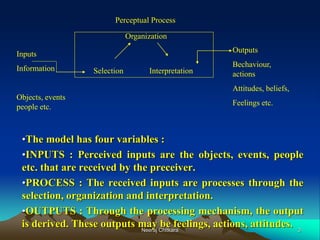
•The model has four variables :
•INPUTS : Perceived inputs are the objects, events, people
etc. that are received by the preceiver.
•PROCESS : The received inputs are processes through the
selection, organization and interpretation.
•OUTPUTS : Through the processing mechanism, the output
is derived. These outputs may be feelings, actions, attitudes.
Selection Interpretation
Organization
Perceptual Process
Inputs
Information
Objects, events
people etc.
Outputs
Bechaviour,
actions
Attitudes, beliefs,
Feelings etc.
Neeraj Chitkara
4
• BEHAVIOURS : Behaviour is dependent on these
perceived outputs. The perception behaviour, inturn,
generates responses from the perceived and these
responses rise to a new set of inputs.
• MECHANISMS OF PERCEPTION
• The mechanisms of perception are selection, organisation
and interpretation. Perceptual selection takes account of
only those stimuli that are relevant and appropriate for an
individual. Perceptual organisation is concerned with
shaping perceived inputs and converting them into a
meaningful shape or form. The final mechanism-
perceptual interpretation, deals with inference from
observed means from the perceived events or object. From
it emerges the resultant behaviour of individual.
Neeraj Chitkara
5
1. SELECTION : Individuals will not be able to assimilate
all they observe so they engage in selectivity.
• Selection is the fundamental step in perceptual process.
Individual collect bits and pieces of information, not
randomly, but selectively depending the interests,
background experience, attitudes of the perceiver.
a) FIGURE GROUND PRINCIPLE : In the field of
perception certain factors are considered significant and
give a meaning to the person, and certain others which
are whether unimportant for a person or cannot be
studies are left : as insignificant. The meaningful and
significant portion is called the “figure” and the
insignificant or meaningless portion is labelled as
“ground”
Neeraj Chitkara
6
b) RELEVANCY : Relevancy is one important criterion for
selective perception. People selectively perceived things
that are relevant to their needs and desires.
2) ORGANISATION : The perceived inputs (incoming
stimuli) are organised into meaningful pictures to the
perceiver. Organising the information that is incoming
into a meaningful whole is called “organisation”. This
process is also labelled as “gestalt process.
• Gestalt is a German word meaning “to organise”. There
are different ways by which people organise the
perceived inputs, objects, events for e.g. grouping,
closure and simplification.
a) GROUPING : Grouping is possible depending on the
similarity or proximity. The tendency to group people or
things that appear to be similar in certain ways, but not
in al, is a common means of organising the perceptions.
Neeraj Chitkara
7
b) CLOSURE : People when faced with incomplete
information have a tendency to fill the gaps themselves
to make it more meaningful. The tendency to form a
complete message is known as “Closure”.
c) SIMPLIFICATION : Whenever people are overloaded
with information they try to simplify it to make it more
meaningful and understandable. Simplification occurs
when the perceiver subtracts less salient information and
concentrates an important one.
3. INTERPRETATION : The third and most important
mechanism of perception is interpretation. Without the
interpretation it does not make any sense. Interpretation
is subjective and judgmental process. In organisation,
interpretation is influenced by many factors such as the
halo effect, stereotyping, attribution, impression and
inference.
Neeraj Chitkara
8
(a) HALO EFFECT : It is the process of using a single trait
of individual and drawing a general impression about
him. It has an important implication for evaluating
employees in an organisation. Those employees with
certain features are rated highly on other characteristics
also. But halo effect leads to nagative effects also. They
are more often right than wrong.
(b) STEREOTYPING : Judging people on the basis of the
characteristics of the group to which they belong is
called “stereotyping”
• The word stereotype was first applied by Walter
Lippmann to perception. It was basically applied for
ethnic prejudice.
Neeraj Chitkara
9
• Secord and Backman observe that “stereotyping” is not
simply the assignment of favourable or unfavourable
traits to a class of persons as a function of whether the
observer has a positive or negative attitude toward the
person’s category.
• Most stereotypes have both Favourable and
Unfavourable traits and more prejudiced individuals
assign both in greater degree. Stereotyping greatly
influences perception in organisations.
• The basic problem with stereotyping is that it does not
give indepth truth and gives rise to distortion because
sometimes perception may be inaccurate and based on a
false impression about a particular group. It is also a
major source of social and racial bias.
Neeraj Chitkara
10
(c) ATTRIBUTION : When people give cause and effect
explanation to their behaviour it is known as attribution.
• Perception is distorted sometimes by the efforts of the
perceiver to attribute a causal explanation to an
outcome.
• There is a tendency for the individuals to attribute their
own behaviour to situational requirements but explain
the behaviour of others by their personal dispositions.
(D) IMPRESSION : People often form impression of others
on the first sight. Even before knowing any of their
personality traits they start having impressions and
assess. This sometimes leads to perceptual distortion.
Neeraj Chitkara
11
(e) INFERENCE : There is a growing tendency on the part
of people to judge others on limited information. For
example an employee might be sitting at is desk
throughout the working hours without doing anything
but it is inferred that he is hardworking.
ATTRIBUTION THEORY
• Attribution relates to the way people try to understand
the behaviour of others. The main issue revolves around
whether one attributes the cause of a behaviour to
internal or external causes.
• Research by Kelley ha suggested that people focus on
three major factors in making their attributions : (1)
Consensus (2) Consistency (3) Distinctiveness.
Neeraj Chitkara
12
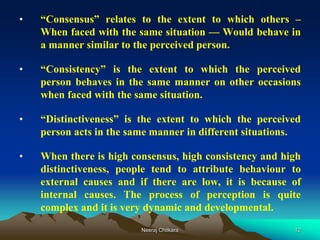
• “Consensus” relates to the extent to which others –
When faced with the same situation — Would behave in
a manner similar to the perceived person.
• “Consistency” is the extent to which the perceived
person behaves in the same manner on other occasions
when faced with the same situation.
• “Distinctiveness” is the extent to which the perceived
person acts in the same manner in different situations.
• When there is high consensus, high consistency and high
distinctiveness, people tend to attribute behaviour to
external causes and if there are low, it is because of
internal causes. The process of perception is quite
complex and it is very dynamic and developmental.
Neeraj Chitkara
13
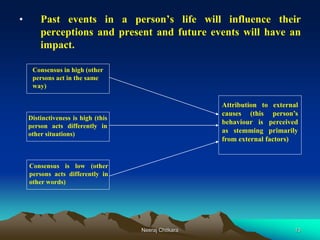
• Past events in a person’s life will influence their
perceptions and present and future events will have an
impact.
Distinctiveness is high (this
person acts differently in
other situations)
Consensus in high (other
persons act in the same
way)
Consensus is low (other
persons acts differently in
other words)
Attribution to external
causes (this person’s
behaviour is perceived
as stemming primarily
from external factors)
Neeraj Chitkara
14
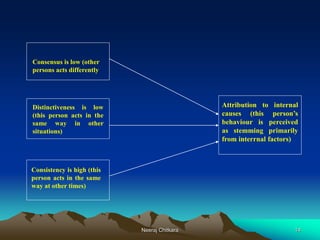
Distinctiveness is low
(this person acts in the
same way in other
situations)
Consensus is low (other
persons acts differently
Consistency is high (this
person acts in the same
way at other times)
Attribution to internal
causes (this person’s
behaviour is perceived
as stemming primarily
from interrnal factors)
Neeraj Chitkara
15
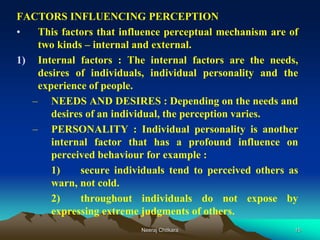
FACTORS INFLUENCING PERCEPTION
• This factors that influence perceptual mechanism are of
two kinds – internal and external.
1) Internal factors : The internal factors are the needs,
desires of individuals, individual personality and the
experience of people.
– NEEDS AND DESIRES : Depending on the needs and
desires of an individual, the perception varies.
– PERSONALITY : Individual personality is another
internal factor that has a profound influence on
perceived behaviour for example :
1) secure individuals tend to perceived others as
warn, not cold.
2) throughout individuals do not expose by
expressing extreme judgments of others.
Neeraj Chitkara
16
3. persons who accept themselves and have faith
in their individuality perceive things favourably
4. self-accepting individuals perceive themselves
as liked, wanted and accepted by others.
c) EXPERIENCE : Experience and knowledge has basis
on perception. Successful experiences enhance and boost
the perceptive ability and lead to accuracy in perception
of a person whereas failure erodes self-confidence.
2) External (exogenous) factors : The external factors
which influence the perception are size, intensity,
frequency, status ect.
Neeraj Chitkara
17
a) SIZE : The bigger the size of the perceived stimulus,
the higher is the probability that it is perceived. Size
attracts the attention of an individual. It establishes
dominance and enhances perceptual selection.
b) INTENSITY : Intensity attracts to increase the
selective perception.
c) FREQUENCY : Repeated external stimulus is more
attention – attracting than a single time.
d) STATUS : Perception is also influenced by the status
of the perceiver. High status people can exert
influence on perception of an employee than low
status people.
e) CONTRAST : Stimuli that contrasts with the
surrounding environment are more likely to be
attention catching than the stimuli that blends in.Neeraj Chitkara
18
PERCEPTION AND ITS APPLICATION IN
ORGANISATIONS
• People in organisations are always assessing others.
Managers must appraise their subordinate’s
performance, evaluate how co-working. When a new
person joins a department he or she is immediately
assessed by the other persons. These have important
effect on the organisation.
• EMPLOYMENT INTERVIEW
• PERFORMANCE APPRAISALS
• ASSISSING LEVEL OF EFFORT
• ASSESSING LOYALTY
Neeraj Chitkara
19
 In short, it can be said that perceptual skills can be
enhanced by :
1) Knowing and perceiving oneself accurately
2) Being empathic i.e. to see a situation as it is experienced by
others.
3) Having positive attitudes, which helps in reduction of
perceptual distortions.
4) Enhancing one’s self-concept, which helps in perceiving
more accurately.
5) Making a conscious effort to avoid the possible common
biases in perception
6) Communicating with employees to erase incorrect
perceptions
7) Avoiding attributions.
 Perception is an important process in an organisation. It
plays a vital role in forming the basis of one’s behaviour by
which one formulates a view of the world.
Neeraj Chitkara

perception

  • 1.
    1 PERCEPTION •Perception can bedefined as a process by which individuals organise and interpret their sensory impression in order to give meaning to their environment. One of the important cognitive factors of human behaviour is perception. It is essentially a psychological process. •Perception is the process whereby people select, organise and interpret sensory stimulations into meaningful information about their work environment. There can be no behaviour without perception and perception lies at the base of every individual behaviour. Neeraj Chitkara
  • 2.
    2 •What is perception? •Perceptionis the intellectual process by which a person acquires the information from the environment, organise it and obtain the meaning from it. •Perception basically refers to the manner in which a person experiences the World. Perception is “the process by which people organise, interpret, experience process and use stimulus materials in the environment so that they satisfy their needs”. •Perceptual Process •Perceptual inputs are first received, then processed by the perceiver and the resultant output becomes the base of the behaviour. Neeraj Chitkara
  • 3.
    3 •The model hasfour variables : •INPUTS : Perceived inputs are the objects, events, people etc. that are received by the preceiver. •PROCESS : The received inputs are processes through the selection, organization and interpretation. •OUTPUTS : Through the processing mechanism, the output is derived. These outputs may be feelings, actions, attitudes. Selection Interpretation Organization Perceptual Process Inputs Information Objects, events people etc. Outputs Bechaviour, actions Attitudes, beliefs, Feelings etc. Neeraj Chitkara
  • 4.
    4 • BEHAVIOURS :Behaviour is dependent on these perceived outputs. The perception behaviour, inturn, generates responses from the perceived and these responses rise to a new set of inputs. • MECHANISMS OF PERCEPTION • The mechanisms of perception are selection, organisation and interpretation. Perceptual selection takes account of only those stimuli that are relevant and appropriate for an individual. Perceptual organisation is concerned with shaping perceived inputs and converting them into a meaningful shape or form. The final mechanism- perceptual interpretation, deals with inference from observed means from the perceived events or object. From it emerges the resultant behaviour of individual. Neeraj Chitkara
  • 5.
    5 1. SELECTION :Individuals will not be able to assimilate all they observe so they engage in selectivity. • Selection is the fundamental step in perceptual process. Individual collect bits and pieces of information, not randomly, but selectively depending the interests, background experience, attitudes of the perceiver. a) FIGURE GROUND PRINCIPLE : In the field of perception certain factors are considered significant and give a meaning to the person, and certain others which are whether unimportant for a person or cannot be studies are left : as insignificant. The meaningful and significant portion is called the “figure” and the insignificant or meaningless portion is labelled as “ground” Neeraj Chitkara
  • 6.
    6 b) RELEVANCY :Relevancy is one important criterion for selective perception. People selectively perceived things that are relevant to their needs and desires. 2) ORGANISATION : The perceived inputs (incoming stimuli) are organised into meaningful pictures to the perceiver. Organising the information that is incoming into a meaningful whole is called “organisation”. This process is also labelled as “gestalt process. • Gestalt is a German word meaning “to organise”. There are different ways by which people organise the perceived inputs, objects, events for e.g. grouping, closure and simplification. a) GROUPING : Grouping is possible depending on the similarity or proximity. The tendency to group people or things that appear to be similar in certain ways, but not in al, is a common means of organising the perceptions. Neeraj Chitkara
  • 7.
    7 b) CLOSURE :People when faced with incomplete information have a tendency to fill the gaps themselves to make it more meaningful. The tendency to form a complete message is known as “Closure”. c) SIMPLIFICATION : Whenever people are overloaded with information they try to simplify it to make it more meaningful and understandable. Simplification occurs when the perceiver subtracts less salient information and concentrates an important one. 3. INTERPRETATION : The third and most important mechanism of perception is interpretation. Without the interpretation it does not make any sense. Interpretation is subjective and judgmental process. In organisation, interpretation is influenced by many factors such as the halo effect, stereotyping, attribution, impression and inference. Neeraj Chitkara
  • 8.
    8 (a) HALO EFFECT: It is the process of using a single trait of individual and drawing a general impression about him. It has an important implication for evaluating employees in an organisation. Those employees with certain features are rated highly on other characteristics also. But halo effect leads to nagative effects also. They are more often right than wrong. (b) STEREOTYPING : Judging people on the basis of the characteristics of the group to which they belong is called “stereotyping” • The word stereotype was first applied by Walter Lippmann to perception. It was basically applied for ethnic prejudice. Neeraj Chitkara
  • 9.
    9 • Secord andBackman observe that “stereotyping” is not simply the assignment of favourable or unfavourable traits to a class of persons as a function of whether the observer has a positive or negative attitude toward the person’s category. • Most stereotypes have both Favourable and Unfavourable traits and more prejudiced individuals assign both in greater degree. Stereotyping greatly influences perception in organisations. • The basic problem with stereotyping is that it does not give indepth truth and gives rise to distortion because sometimes perception may be inaccurate and based on a false impression about a particular group. It is also a major source of social and racial bias. Neeraj Chitkara
  • 10.
    10 (c) ATTRIBUTION :When people give cause and effect explanation to their behaviour it is known as attribution. • Perception is distorted sometimes by the efforts of the perceiver to attribute a causal explanation to an outcome. • There is a tendency for the individuals to attribute their own behaviour to situational requirements but explain the behaviour of others by their personal dispositions. (D) IMPRESSION : People often form impression of others on the first sight. Even before knowing any of their personality traits they start having impressions and assess. This sometimes leads to perceptual distortion. Neeraj Chitkara
  • 11.
    11 (e) INFERENCE :There is a growing tendency on the part of people to judge others on limited information. For example an employee might be sitting at is desk throughout the working hours without doing anything but it is inferred that he is hardworking. ATTRIBUTION THEORY • Attribution relates to the way people try to understand the behaviour of others. The main issue revolves around whether one attributes the cause of a behaviour to internal or external causes. • Research by Kelley ha suggested that people focus on three major factors in making their attributions : (1) Consensus (2) Consistency (3) Distinctiveness. Neeraj Chitkara
  • 12.
    12 • “Consensus” relatesto the extent to which others – When faced with the same situation — Would behave in a manner similar to the perceived person. • “Consistency” is the extent to which the perceived person behaves in the same manner on other occasions when faced with the same situation. • “Distinctiveness” is the extent to which the perceived person acts in the same manner in different situations. • When there is high consensus, high consistency and high distinctiveness, people tend to attribute behaviour to external causes and if there are low, it is because of internal causes. The process of perception is quite complex and it is very dynamic and developmental. Neeraj Chitkara
  • 13.
    13 • Past eventsin a person’s life will influence their perceptions and present and future events will have an impact. Distinctiveness is high (this person acts differently in other situations) Consensus in high (other persons act in the same way) Consensus is low (other persons acts differently in other words) Attribution to external causes (this person’s behaviour is perceived as stemming primarily from external factors) Neeraj Chitkara
  • 14.
    14 Distinctiveness is low (thisperson acts in the same way in other situations) Consensus is low (other persons acts differently Consistency is high (this person acts in the same way at other times) Attribution to internal causes (this person’s behaviour is perceived as stemming primarily from interrnal factors) Neeraj Chitkara
  • 15.
    15 FACTORS INFLUENCING PERCEPTION •This factors that influence perceptual mechanism are of two kinds – internal and external. 1) Internal factors : The internal factors are the needs, desires of individuals, individual personality and the experience of people. – NEEDS AND DESIRES : Depending on the needs and desires of an individual, the perception varies. – PERSONALITY : Individual personality is another internal factor that has a profound influence on perceived behaviour for example : 1) secure individuals tend to perceived others as warn, not cold. 2) throughout individuals do not expose by expressing extreme judgments of others. Neeraj Chitkara
  • 16.
    16 3. persons whoaccept themselves and have faith in their individuality perceive things favourably 4. self-accepting individuals perceive themselves as liked, wanted and accepted by others. c) EXPERIENCE : Experience and knowledge has basis on perception. Successful experiences enhance and boost the perceptive ability and lead to accuracy in perception of a person whereas failure erodes self-confidence. 2) External (exogenous) factors : The external factors which influence the perception are size, intensity, frequency, status ect. Neeraj Chitkara
  • 17.
    17 a) SIZE :The bigger the size of the perceived stimulus, the higher is the probability that it is perceived. Size attracts the attention of an individual. It establishes dominance and enhances perceptual selection. b) INTENSITY : Intensity attracts to increase the selective perception. c) FREQUENCY : Repeated external stimulus is more attention – attracting than a single time. d) STATUS : Perception is also influenced by the status of the perceiver. High status people can exert influence on perception of an employee than low status people. e) CONTRAST : Stimuli that contrasts with the surrounding environment are more likely to be attention catching than the stimuli that blends in.Neeraj Chitkara
  • 18.
    18 PERCEPTION AND ITSAPPLICATION IN ORGANISATIONS • People in organisations are always assessing others. Managers must appraise their subordinate’s performance, evaluate how co-working. When a new person joins a department he or she is immediately assessed by the other persons. These have important effect on the organisation. • EMPLOYMENT INTERVIEW • PERFORMANCE APPRAISALS • ASSISSING LEVEL OF EFFORT • ASSESSING LOYALTY Neeraj Chitkara
  • 19.
    19  In short,it can be said that perceptual skills can be enhanced by : 1) Knowing and perceiving oneself accurately 2) Being empathic i.e. to see a situation as it is experienced by others. 3) Having positive attitudes, which helps in reduction of perceptual distortions. 4) Enhancing one’s self-concept, which helps in perceiving more accurately. 5) Making a conscious effort to avoid the possible common biases in perception 6) Communicating with employees to erase incorrect perceptions 7) Avoiding attributions.  Perception is an important process in an organisation. It plays a vital role in forming the basis of one’s behaviour by which one formulates a view of the world. Neeraj Chitkara