ACTION RESEARCH AND COLLABORATIVE COMMUNITIES FOR LEARNING AS A MEANS OF PROFESSIONAL DEVELOPMENT AND IMPROVED PRACTICE Dr Donald Gray Dr Dean Robson Dr Laura Collucci-Gray School of Education,  University of Aberdeen
Scottish Teachers for a New Era Scottish Executive Education Department Hunter Foundation University of Aberdeen Opportunity for Change Research Informed Development Developing teachers : increasing learner gains
What is STNE ? Development  and  research Build an evidence base – inform developments,  add to knowledge  New collaborative model of teacher development  Design Principles Decisions driven by evidence Engagement with Arts & Sciences Teaching as an academically taught clinical practice Key Aims To develop a : Teacher for a New Era New Learning Environment New Framework for Continuous Learning New Professional Culture
Review of ITE Stage 2  ‘ I want universities, local authorities and others to work together … in a way which allows them to  develop theory and practice simultaneously  …’ (Peter Peacock, Minister for Education and Young People, Ministerial Response, 2005,  p6)
Research Aspects :  Evidence-informed development Building an evidence base Six year plan for data collection, analysis and reporting Reviews of Literature  Adding to knowledge and understanding Building research capacity
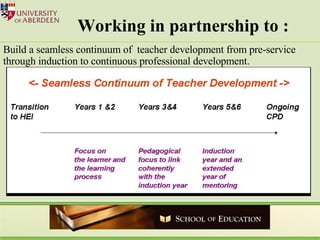
Working in partnership to : Build a seamless continuum of  teacher development from pre-service through induction to continuous professional development.
TTA: Teaching 2020 What sort of teachers will be needed then, and so what kind of teacher education and training?   Whatever happens in 2020 schools and teachers will be very different.  The teachers we are training now, and those currently teaching and engaging in CPD, need to be prepared to be flexible, to manage change, and more than that, to be agents of change.
Globalisation (Mortimore, 2001) International comparisons show effects of – motivating staff, focusing on T&L, enhancing the physical environment, changing the culture of the school.  However, while many similar strategies used, the  different context meant similar actions did not always produce similar results . Improvements must fit the grain of society; indiscriminate borrowing from other cultures may not achieve the desired results;  there is no ‘quick fix’ for school improvement; change has to be carried out by the school itself.
Teaching and Research “ What constitutes the relevance of research, for instance, depends to a large extent on what questions are being asked, in what context, and for what practical ends.”  Davies (1999) “ Teachers engaging in research is a third seed of professional knowledge creation.”  Hargreaves (1999) “… the uniqueness of each classroom setting implies that any proposal needs to be tested and verified and adapted by each teacher in her or his own classroom.”  McIntyre (2005) “ The evidence indicates how teachers’ involvement and confidence can be built in expansive learning environments characterised by specialist support, collaborative working, and the development of mutual trust.”  Brown (2005)
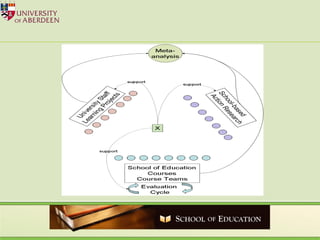
STNE Research Impetus 2007  Programme Evaluation and  Development Learning Projects Action Research Initiatives
 
What is Action Research ? ‘ Applied to classroom, action research is an approach to improving education through change, by encouraging teachers to become aware of their own practice, to be critical of that practice, and to be prepared to change it.  It is participatory, in that it involves the teacher in his own enquiry, and collaborative, in that it involves other people as part of a shared enquiry.  It is research WITH, rather than research ON’. [McNiff, J (1988) Action Research Principles and Practice. Basingstoke:MacMillan Education]
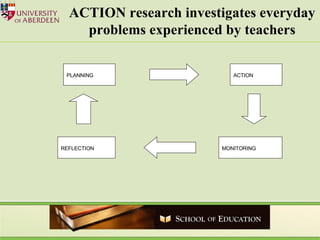
ACTION research investigates everyday problems experienced by teachers PLANNING ACTION MONITORING REFLECTION
Why Action Research ? GTCS recognition of importance of teacher research. Standards and Professional Recognition Frameworks (SITE, SFR etc). Models of CPD. Defined aims of STNE R&D project link to the continuous development of a research engaged teacher within the envelope of integrated whole career professional learning. Classroom-based investigation of pupil (learner) gains.
S tandard for  I nitial  T eacher  E ducation Benchmarks : Professional Knowledge and Understanding – 1.3.2 Professional Skills and Abilities – 2.4.1, 2.4.2, 2.4.3 SITE details http://www.gtcs.org.uk/Becoming_a_Teacher/Trainingtobeateacher/TheStandardforInitialTeacherEducation.asp
Teachers for Excellence :  A Model for CPD 4 Stages of CPD Becoming Aware Becoming Interested Integrating into Practice Innovating and Creating [National CPD Team, 2006]   Link  http://www.ltscotland.org.uk/cpdscotland/images/Occasional%20Paper%208%20%20Teachers%20for%20Excellence_tcm4-410558.pdf
Defining the Action Research  Learning Community BEd (P) Year 3 students BEd (P) Year 4 students Probationer Teachers in 6 STNE local authority partners Action Research Scholars in 6 STNE local authority partners Role of SBTN (Supporting Beginning Teachers’ Network)
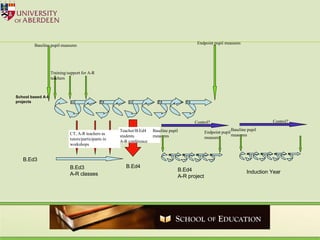
School based A-R projects B.Ed3 A-R classes CT, A-R teachers as tutors/participants in workshops B.Ed4 A-R project B.Ed4 B.Ed3 Teacher/B.Ed4 students  A-R conference Training/support for A-R teachers Baseline pupil measures Baseline pupil  measures Endpoint pupil measures Endpoint pupil  measures Control? Baseline pupil  measures Control? Induction Year
A R Scholarships Research seminars University mentors Links with APS Focus on classroom practice Focus on pupil (learner) gains 2007 : Funded 15 teachers
What are Pupil Gains ? Links to a Curriculum for Excellence Link http://www.curriculumforexcellencescotland.gov.uk/about/essentialinformation/purposes.asp
STNE AR Scholarships 2007 Examples (P&S) : The impact of using drama in media studies in a CfE. New approaches to introducing P1 children to ICT. Video-based approaches to problem solving (maths recovery).  Writing through role-play structured activities. Personal Learning Planning Enterprise in mathematics
Partnership with Local Authorities 3 target groupings Virtual and physical network New teachers, Mentors/Supporters, LA personnel CPD Communities of Learning Collaborative Research S upporting  B eginning  T eachers’  N etwork

pepe341

  • 1.
    ACTION RESEARCH ANDCOLLABORATIVE COMMUNITIES FOR LEARNING AS A MEANS OF PROFESSIONAL DEVELOPMENT AND IMPROVED PRACTICE Dr Donald Gray Dr Dean Robson Dr Laura Collucci-Gray School of Education, University of Aberdeen
  • 2.
    Scottish Teachers fora New Era Scottish Executive Education Department Hunter Foundation University of Aberdeen Opportunity for Change Research Informed Development Developing teachers : increasing learner gains
  • 3.
    What is STNE? Development and research Build an evidence base – inform developments, add to knowledge New collaborative model of teacher development Design Principles Decisions driven by evidence Engagement with Arts & Sciences Teaching as an academically taught clinical practice Key Aims To develop a : Teacher for a New Era New Learning Environment New Framework for Continuous Learning New Professional Culture
  • 4.
    Review of ITEStage 2 ‘ I want universities, local authorities and others to work together … in a way which allows them to develop theory and practice simultaneously …’ (Peter Peacock, Minister for Education and Young People, Ministerial Response, 2005, p6)
  • 5.
    Research Aspects : Evidence-informed development Building an evidence base Six year plan for data collection, analysis and reporting Reviews of Literature Adding to knowledge and understanding Building research capacity
  • 6.
    Working in partnershipto : Build a seamless continuum of teacher development from pre-service through induction to continuous professional development.
  • 7.
    TTA: Teaching 2020What sort of teachers will be needed then, and so what kind of teacher education and training? Whatever happens in 2020 schools and teachers will be very different. The teachers we are training now, and those currently teaching and engaging in CPD, need to be prepared to be flexible, to manage change, and more than that, to be agents of change.
  • 8.
    Globalisation (Mortimore, 2001)International comparisons show effects of – motivating staff, focusing on T&L, enhancing the physical environment, changing the culture of the school. However, while many similar strategies used, the different context meant similar actions did not always produce similar results . Improvements must fit the grain of society; indiscriminate borrowing from other cultures may not achieve the desired results; there is no ‘quick fix’ for school improvement; change has to be carried out by the school itself.
  • 9.
    Teaching and Research“ What constitutes the relevance of research, for instance, depends to a large extent on what questions are being asked, in what context, and for what practical ends.” Davies (1999) “ Teachers engaging in research is a third seed of professional knowledge creation.” Hargreaves (1999) “… the uniqueness of each classroom setting implies that any proposal needs to be tested and verified and adapted by each teacher in her or his own classroom.” McIntyre (2005) “ The evidence indicates how teachers’ involvement and confidence can be built in expansive learning environments characterised by specialist support, collaborative working, and the development of mutual trust.” Brown (2005)
  • 10.
    STNE Research Impetus2007  Programme Evaluation and Development Learning Projects Action Research Initiatives
  • 11.
  • 12.
    What is ActionResearch ? ‘ Applied to classroom, action research is an approach to improving education through change, by encouraging teachers to become aware of their own practice, to be critical of that practice, and to be prepared to change it. It is participatory, in that it involves the teacher in his own enquiry, and collaborative, in that it involves other people as part of a shared enquiry. It is research WITH, rather than research ON’. [McNiff, J (1988) Action Research Principles and Practice. Basingstoke:MacMillan Education]
  • 13.
    ACTION research investigateseveryday problems experienced by teachers PLANNING ACTION MONITORING REFLECTION
  • 14.
    Why Action Research? GTCS recognition of importance of teacher research. Standards and Professional Recognition Frameworks (SITE, SFR etc). Models of CPD. Defined aims of STNE R&D project link to the continuous development of a research engaged teacher within the envelope of integrated whole career professional learning. Classroom-based investigation of pupil (learner) gains.
  • 15.
    S tandard for I nitial T eacher E ducation Benchmarks : Professional Knowledge and Understanding – 1.3.2 Professional Skills and Abilities – 2.4.1, 2.4.2, 2.4.3 SITE details http://www.gtcs.org.uk/Becoming_a_Teacher/Trainingtobeateacher/TheStandardforInitialTeacherEducation.asp
  • 16.
    Teachers for Excellence: A Model for CPD 4 Stages of CPD Becoming Aware Becoming Interested Integrating into Practice Innovating and Creating [National CPD Team, 2006] Link http://www.ltscotland.org.uk/cpdscotland/images/Occasional%20Paper%208%20%20Teachers%20for%20Excellence_tcm4-410558.pdf
  • 17.
    Defining the ActionResearch Learning Community BEd (P) Year 3 students BEd (P) Year 4 students Probationer Teachers in 6 STNE local authority partners Action Research Scholars in 6 STNE local authority partners Role of SBTN (Supporting Beginning Teachers’ Network)
  • 18.
    School based A-Rprojects B.Ed3 A-R classes CT, A-R teachers as tutors/participants in workshops B.Ed4 A-R project B.Ed4 B.Ed3 Teacher/B.Ed4 students A-R conference Training/support for A-R teachers Baseline pupil measures Baseline pupil measures Endpoint pupil measures Endpoint pupil measures Control? Baseline pupil measures Control? Induction Year
  • 19.
    A R ScholarshipsResearch seminars University mentors Links with APS Focus on classroom practice Focus on pupil (learner) gains 2007 : Funded 15 teachers
  • 20.
    What are PupilGains ? Links to a Curriculum for Excellence Link http://www.curriculumforexcellencescotland.gov.uk/about/essentialinformation/purposes.asp
  • 21.
    STNE AR Scholarships2007 Examples (P&S) : The impact of using drama in media studies in a CfE. New approaches to introducing P1 children to ICT. Video-based approaches to problem solving (maths recovery). Writing through role-play structured activities. Personal Learning Planning Enterprise in mathematics
  • 22.
    Partnership with LocalAuthorities 3 target groupings Virtual and physical network New teachers, Mentors/Supporters, LA personnel CPD Communities of Learning Collaborative Research S upporting B eginning T eachers’ N etwork