A study of social presence in blended social work education Professor Walter LaMendola, PhD University of Denver
Council On Social Work Education (USA) focus on e-learning & practice a special national project a subject of significance  to the US social work profession
Components of Our Project Comparing different forms of social work practice class delivery Faculty development process Organizational requirements for social work e-learning programming Measures of student information literacy Measures of student learning outcomes
Presentation Today Introduce conceptual model Examine our study of social work e-learning in terms of the development of social presence community of inquiry and communities of practice related to the student's field experience. Present preliminary data
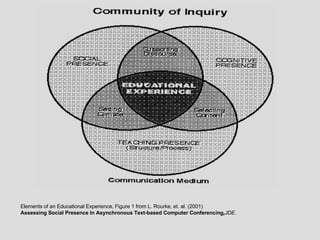
Elements of an Educational Experience, Figure 1 from L. Rourke, et. al. (2001) Assessing Social Presence In Asynchronous Text-based Computer Conferencing , JDE.
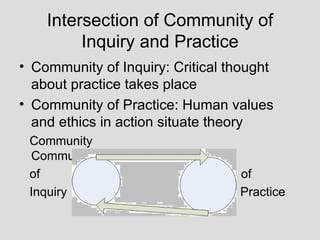
Intersection of Community of Inquiry and Practice Community of Inquiry: Critical thought about practice takes place Community of Practice: Human values and ethics in action situate theory Community  Community of  of Inquiry  Practice
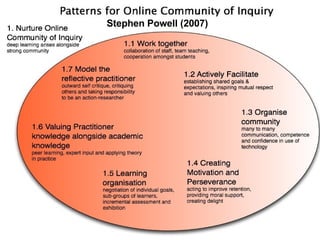
Stephen Powell (2007)
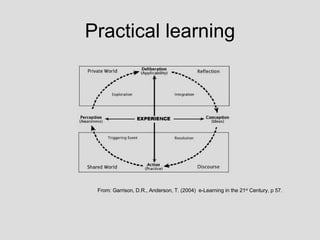
Practical learning From: Garrison, D.R., Anderson, T. (2004)  e-Learning in the 21 st  Century, p 57.
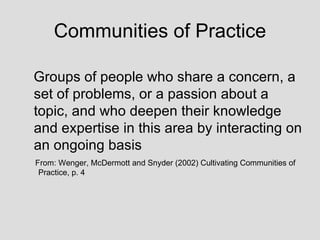
Communities of Practice Groups of people who share a concern, a set of problems, or a passion about a topic, and who deepen their knowledge and expertise in this area by interacting on an ongoing basis  From: Wenger, McDermott and Snyder (2002) Cultivating Communities of  Practice, p. 4
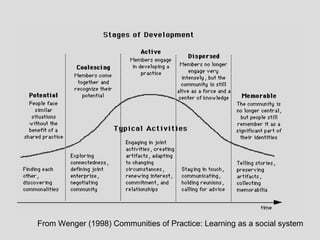
From Wenger (1998) Communities of Practice: Learning as a social system
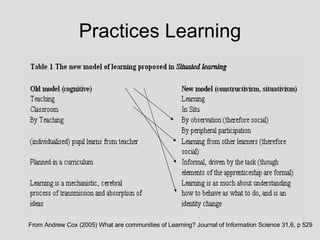
Practices Learning From Andrew Cox (2005) What are communities of Learning? Journal of Information Science 31,6, p 529
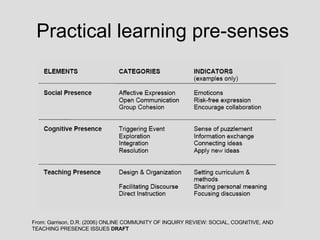
Practical learning pre-senses From: Garrison, D.R. (2006) ONLINE COMMUNITY OF INQUIRY REVIEW: SOCIAL, COGNITIVE, AND TEACHING PRESENCE ISSUES  DRAFT
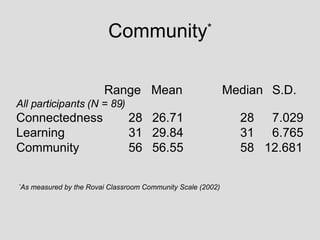
Community * Range  Mean   Median S.D. All participants (N = 89) Connectedness   28 26.71 28 7.029 Learning   31 29.84 31 6.765 Community   56 56.55 58  12.681 * As measured by the Rovai Classroom Community Scale (2002)
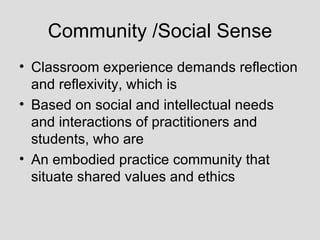
Community /Social Sense Classroom experience demands reflection and reflexivity, which is Based on social and intellectual needs and interactions of practitioners and students, who are An embodied practice community that situate shared values and ethics
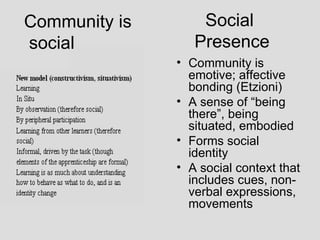
Social  Presence Community is emotive; affective bonding (Etzioni) A sense of “being there”, being situated, embodied  Forms social identity A social context that includes cues, non-verbal expressions, movements Community is social
Creating Social Presence How do we vary social presence in social work education to support practitioner development? Opportunities of self disclosure Spontaneity and humor Creating awe Expressing emotions Forms of discussion Who are our community members becoming; how are their practice identities formed? Field Integration Seminar included
Measuring Social Presence Analysis of classroom discussions Coding for social presence (Garrison et al) Richardson & Swan (2003) measure Short, Christie, & Williams (1976) measure Student and faculty interviews
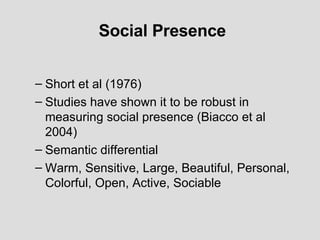
Social Presence Short et al (1976) Studies have shown it to be robust in measuring social presence (Biacco et al 2004) Semantic differential Warm, Sensitive, Large, Beautiful, Personal, Colorful, Open, Active, Sociable
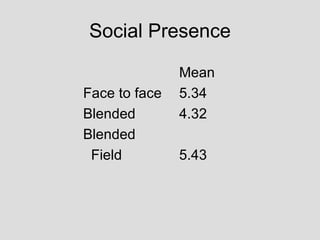
Social Presence Mean Face to face 5.34 Blended 4.32 Blended Field 5.43
Preliminary discussion analysis Blended field more comments by students Blended field lengthier comments by students Students comments affective
Sample of Qualitative Results What is their perception of their learning? “ The field experience was the most beneficial to me ...having other students share their experience...The field instructor had a lot of experience that she was able to share with us. It is hard to pass up discussions... I do not think a student can get much out of reading without experience and discussion with others... Forming a sense of community, I learn better through experiential learning.”   Which aspects were most effective for facilitating social presence? “ The field experience was the most beneficial, because it forced me to get out and experience issues that I hadn't before...  I haven't taken the time to interact as much as I would like to but I know that people would've been available for more interaction if I'd taken the effort.
Possible future considerations More time in field based learning centers More student use of technology, multimedia to communicate experience and practical learning More co-teaching with field supervisors, using video conferencing Courses offered from the field site

pepe382

  • 1.
    A study ofsocial presence in blended social work education Professor Walter LaMendola, PhD University of Denver
  • 2.
    Council On SocialWork Education (USA) focus on e-learning & practice a special national project a subject of significance to the US social work profession
  • 3.
    Components of OurProject Comparing different forms of social work practice class delivery Faculty development process Organizational requirements for social work e-learning programming Measures of student information literacy Measures of student learning outcomes
  • 4.
    Presentation Today Introduceconceptual model Examine our study of social work e-learning in terms of the development of social presence community of inquiry and communities of practice related to the student's field experience. Present preliminary data
  • 5.
    Elements of anEducational Experience, Figure 1 from L. Rourke, et. al. (2001) Assessing Social Presence In Asynchronous Text-based Computer Conferencing , JDE.
  • 6.
    Intersection of Communityof Inquiry and Practice Community of Inquiry: Critical thought about practice takes place Community of Practice: Human values and ethics in action situate theory Community Community of of Inquiry Practice
  • 7.
  • 8.
    Practical learning From:Garrison, D.R., Anderson, T. (2004) e-Learning in the 21 st Century, p 57.
  • 9.
    Communities of PracticeGroups of people who share a concern, a set of problems, or a passion about a topic, and who deepen their knowledge and expertise in this area by interacting on an ongoing basis From: Wenger, McDermott and Snyder (2002) Cultivating Communities of Practice, p. 4
  • 10.
    From Wenger (1998)Communities of Practice: Learning as a social system
  • 11.
    Practices Learning FromAndrew Cox (2005) What are communities of Learning? Journal of Information Science 31,6, p 529
  • 12.
    Practical learning pre-sensesFrom: Garrison, D.R. (2006) ONLINE COMMUNITY OF INQUIRY REVIEW: SOCIAL, COGNITIVE, AND TEACHING PRESENCE ISSUES DRAFT
  • 13.
    Community * Range Mean Median S.D. All participants (N = 89) Connectedness 28 26.71 28 7.029 Learning 31 29.84 31 6.765 Community 56 56.55 58 12.681 * As measured by the Rovai Classroom Community Scale (2002)
  • 14.
    Community /Social SenseClassroom experience demands reflection and reflexivity, which is Based on social and intellectual needs and interactions of practitioners and students, who are An embodied practice community that situate shared values and ethics
  • 15.
    Social PresenceCommunity is emotive; affective bonding (Etzioni) A sense of “being there”, being situated, embodied Forms social identity A social context that includes cues, non-verbal expressions, movements Community is social
  • 16.
    Creating Social PresenceHow do we vary social presence in social work education to support practitioner development? Opportunities of self disclosure Spontaneity and humor Creating awe Expressing emotions Forms of discussion Who are our community members becoming; how are their practice identities formed? Field Integration Seminar included
  • 17.
    Measuring Social PresenceAnalysis of classroom discussions Coding for social presence (Garrison et al) Richardson & Swan (2003) measure Short, Christie, & Williams (1976) measure Student and faculty interviews
  • 18.
    Social Presence Shortet al (1976) Studies have shown it to be robust in measuring social presence (Biacco et al 2004) Semantic differential Warm, Sensitive, Large, Beautiful, Personal, Colorful, Open, Active, Sociable
  • 19.
    Social Presence MeanFace to face 5.34 Blended 4.32 Blended Field 5.43
  • 20.
    Preliminary discussion analysisBlended field more comments by students Blended field lengthier comments by students Students comments affective
  • 21.
    Sample of QualitativeResults What is their perception of their learning? “ The field experience was the most beneficial to me ...having other students share their experience...The field instructor had a lot of experience that she was able to share with us. It is hard to pass up discussions... I do not think a student can get much out of reading without experience and discussion with others... Forming a sense of community, I learn better through experiential learning.” Which aspects were most effective for facilitating social presence? “ The field experience was the most beneficial, because it forced me to get out and experience issues that I hadn't before... I haven't taken the time to interact as much as I would like to but I know that people would've been available for more interaction if I'd taken the effort.
  • 22.
    Possible future considerationsMore time in field based learning centers More student use of technology, multimedia to communicate experience and practical learning More co-teaching with field supervisors, using video conferencing Courses offered from the field site