Learning to Learn: the Collaborative Challenge.  Louise O’Connor London South Bank University January 2008
“ It’s all good in the end.  This Unit drags you out of your comfort zone by the throat and batters you with learning.”  Student quote
Focus of Study  & Presentation Plan First stage of two-part study Undergraduate BA Social Work & BSc  Nursing and Social Work (learning  disabilities)  Focus on teaching & learning of ‘ Partnership & Participation’   Background to innovations in collaborative learning / teaching and assessment Structure of course Research project Initial findings Questions / Themes
Spirit of Partnership? Reform of social work education in UK Emphasis on multi-disciplinary approaches to education & practice Social Work located within diverse faculties (health, education, psychology, law, social policy or social sciences…) ‘ Partnership working’   a prescribed curriculum area in England  (DoH 2002)
Partnership - a dangerous liaison?  (Preston-Shoot 2007:670) Original Module & assignment SCIE Knowledge Review (2006) Missed opportunities for challenges / experiential learning? 06/07 Piloted group learning activity Students + lecturer reflection & feedback on pilot and assignment  What does it mean?  How can we teach  this?
Revised Module aims: Maximise collaborative inter / intra-professional learning Explicit emphasis on: - group work theory and skills - personal and experiential learning Effective collaboration necessary to achieve outcome Group & individual elements ‘ Intrinsic motivation ’  (Mc Dowell, 2001)
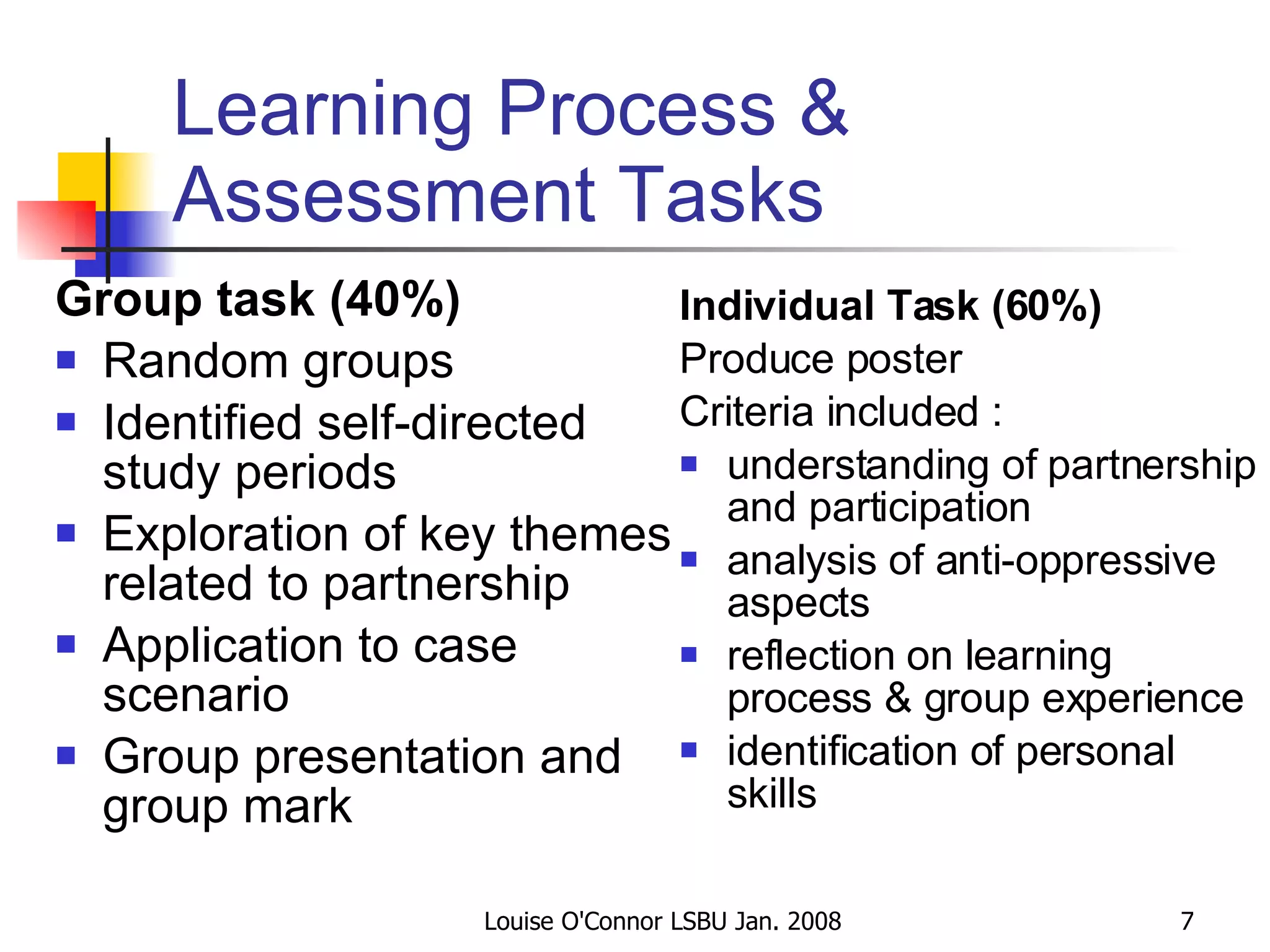
Learning Process & Assessment Tasks Group task (40%) Random groups Identified self-directed study periods Exploration of key themes related to partnership Application to case scenario Group presentation and group mark Individual Task (60%) Produce poster Criteria included :  understanding of partnership and participation analysis of anti-oppressive aspects reflection on learning process & group experience identification of personal skills
Study – Stage 1:  Key Questions Impact of an innovative learning and assessment process? Contribution to students’ collaborative and individual learning? Skill and knowledge development (within and across professional boundaries).
Study – Stage 1: Data Two cohorts of employment based (EBR) undergraduate social work students  (social care posts, attend part-time) Mature, experienced & ethnically diverse: EBR 06 – 17 students EBR 05 – 20 students Taught jointly – 12 week module Stage 2  – 50 Social Work & 25 Nursing / Social Work students (May 08) 37
Study – Stage 1 Questionnaires using Likert scales Focus on: - views on personal learning - skill development - understanding of theory / literature - motivation Focus Group
Respondents: 14 White / White British 10 Minority Ethnic 4 Ethnicity not indicated Age 25-57. (Mean 42) 18 female 8 male 1 disabled 14 indicated student group  (6 – EBR 05 & 8 – EBR 06) 28 questionnaires completed 1 focus group
Preliminary Findings The following slides provide examples of some of the preliminary findings.  The themes & correlations identified are tentative and will be the subject of further analysis.  Stage 2 of the project will be evaluated following delivery of the current module to  both nursing and social work students. (post June 2008)
Views on Personal Learning ‘I learn more when…’ I experience challenge or tension I am involved in small group discussions
Skill development: Time management Team work Communication Negotiation Personal awareness Reflection Presentation Assertiveness Use of IT Researching literature Group task improved skills in all areas Range – 70-92%
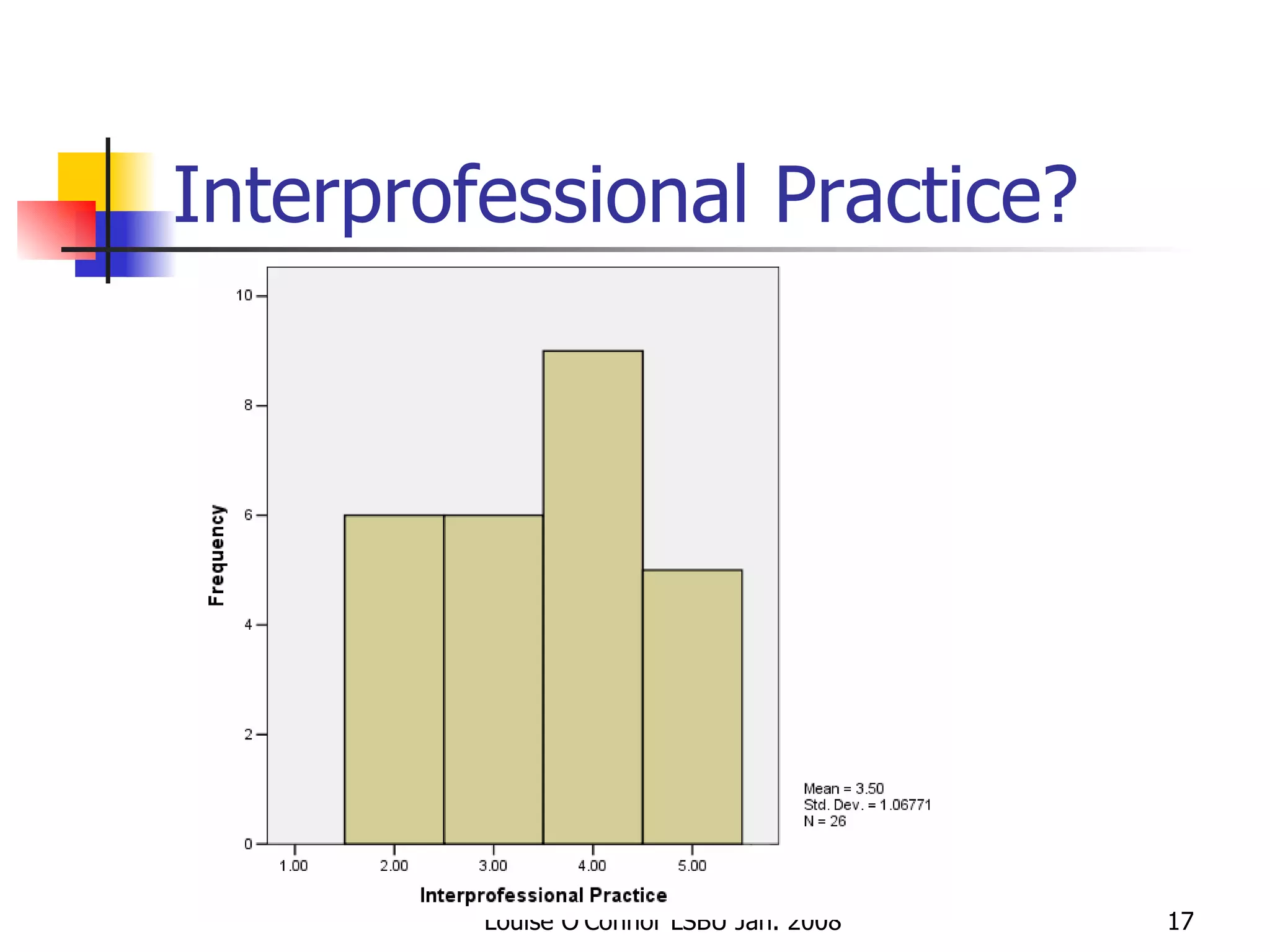
Skill development ? Resolving conflict 31% disagreed / didn’t know Interprofessional practice 23% disagreed; 23% didn’t know; Working with difference 18% didn’t know
Interprofessional Practice?
Understanding of Theory / Literature: Group dynamics * Groupwork models Partnership Participation Anti-oppressive  practice * Applying theory  to practice * Group task improved skills in all areas Range – 64 –77% *  Increase in ‘Disagree’ / ‘Don’t know’
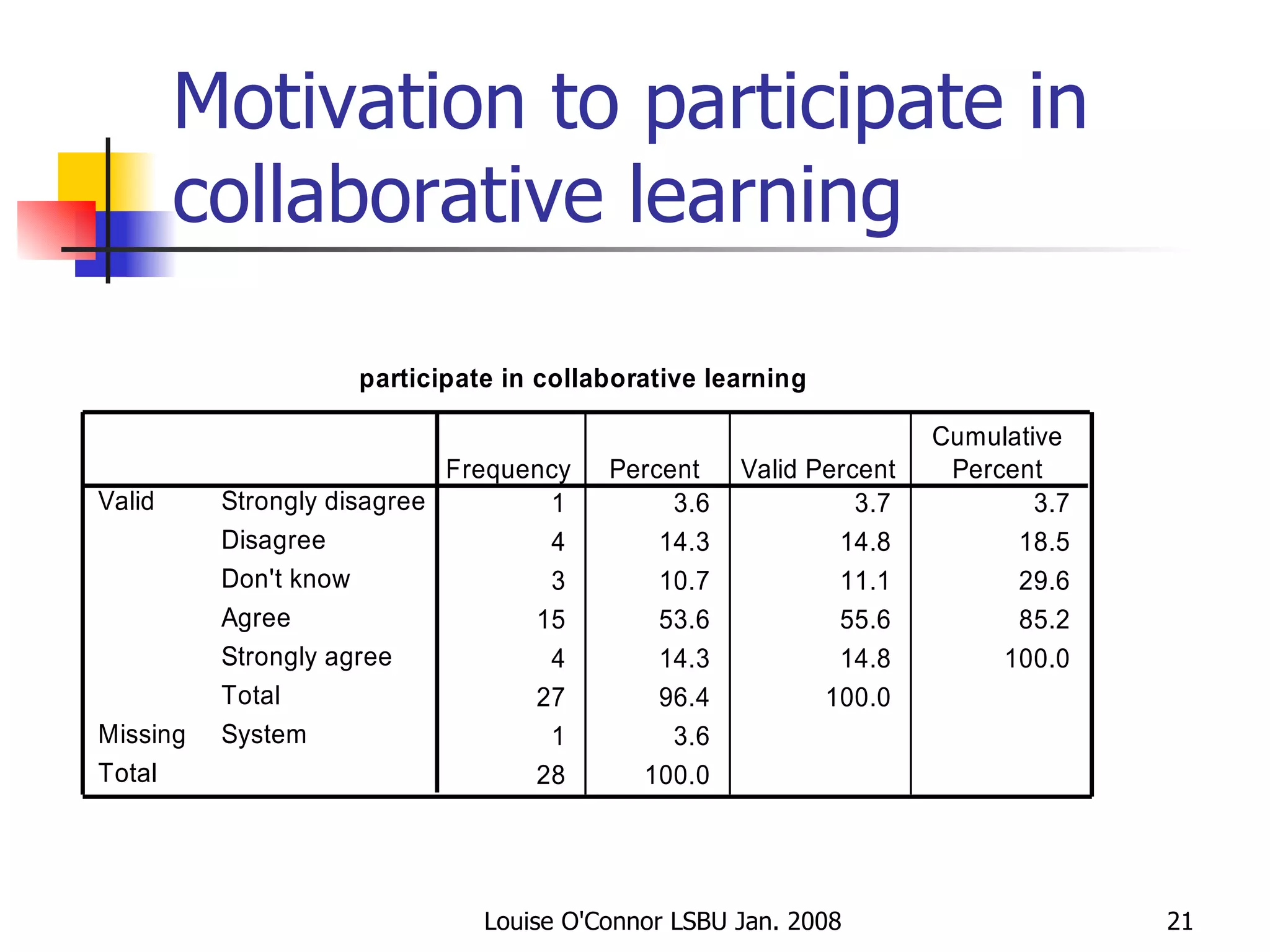
Increased motivation & involvement & learning process? Motivation to: Learn more about topics * Participate in collaborative learning * Undertake individual study / tasks Explore different perspectives Improved motivation 70-78% Disagreed / don’t know 14-21%
Motivation to participate in collaborative learning:
Motivation to participate in collaborative learning
Significant correlations Age is significantly correlated to score for anti-oppressive practice (5%) Score for ‘Participate in collaborative learning’ is highly significantly correlated to score for anti-oppressive practice (0.5%) Ethnic group is significantly correlated to assertiveness (5%)
Qualitative Data  Main benefits? Student quotes: : ‘ putting partnership skills into practice – clarifying roles, challenging each other, developing shared responsibility..’   ‘ working with difference i.e. colleagues’ perspectives, attitudes & ways of working .. helped me to accept these and share my ideas..’ ‘ Learning to manage group dynamics and the complexities involved’.. ‘ good practice to work as a team with people you don’t know well..’
Qualitative data  Main drawbacks? Student quotes: ‘ personalities & levels of participation … although this exists in the workplace managers and supervisors are there to support the group’..’  ‘ not being able to complete tasks to my own agenda, timeframe..’ ‘ it does not always show the difficulties that occurred and the learning that took place’ Group conflict …. it got nasty and personal..
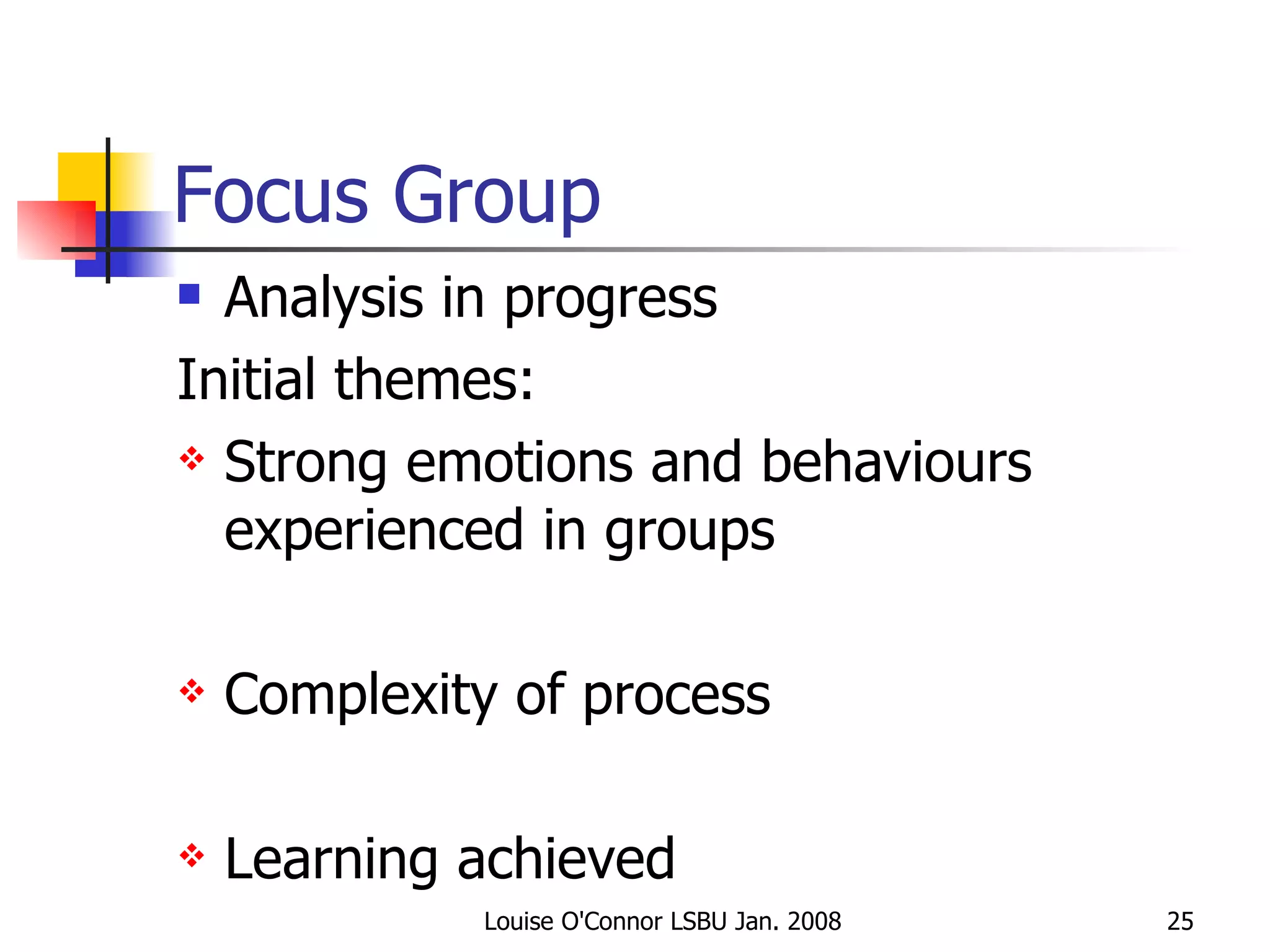
Focus Group  Analysis in progress Initial themes: Strong emotions and behaviours experienced in groups Complexity of process Learning achieved
Focus Group Themes: Tension, safety, control … ‘ It was very difficult .. Lots of tensions, lots of ‘storming’ all the way through.. ‘ Two cohorts .. power dynamics going on..’ ‘ There was a feeling … “them and us”…’ Maybe they felt it was a safe environment .. the university .. a lot of stuff came out.. they would not have been said in workplace ..’
  Focus Group Themes:  professional boundaries / identities   'they would be disciplined for some of the things that were said… ‘ work is safe because you know there is some sort of redress…’ ‘ in work … always difficult professionals .. [but] always someone higher managing that…’
Possible themes to explore, subject to further analysis: Facilitation of groups to enhance learning and conflict resolution? – or will this prevent learning? Greater linking of taught topics with collaborative  experience of partnership in action Relevance of identities within and across professional boundaries? Impact of physical location on behaviour / identities? Similarities or differences with Stage 2  data cohort  ?
‘ It’s all good in the end.  This unit drags you out of your comfort zone by the throat  and batters you with learning.’  student quote ************** Correspondence to Louise O’Connor  [email_address] Senior Lecturer in Social Work Faculty of Health & Social Care, London South Bank University Learning to learn – the collaborative challenge
References Barr, H.  Interprofessional education, Today, yesterday and tomorrow. A Review . Learning & Teaching Support Network for Health Sciences & Practice,  CAIPE. Jackson, c. (2007)  Motivating learning through innovative assessment   http://www.bournemouth.ac.uk/eds/presentations/conference_2007/caroline_jackson.ppt Accessed online 20 Jan 2008 McDowell, L. (2001)  Students and innovative assessment.  York: LTSN Generic Centre [available online]  www.heacademy.ac.uk Preston-Shoot, M. (2004) Responding by Degrees: Surveying the Education and Practice Landscape.  Social Work Education  Vol. 23, No. 6, December 2004, pp. 667–692 Race,P, Brown, S, Smith, S. (2005) 2 nd  Ed.  500 Tips on assessment . London: Routledge. Taylor, I, Sharland, E, Sebba, J, Leriche, P, with Keep, A & Orr, D. (2006)  The learning , teaching and assessment of partnership work in social work education . Knowledge Review 10. Social Care Institute for Excellence

pepe322

  • 1.
    Learning to Learn:the Collaborative Challenge. Louise O’Connor London South Bank University January 2008
  • 2.
    “ It’s allgood in the end. This Unit drags you out of your comfort zone by the throat and batters you with learning.” Student quote
  • 3.
    Focus of Study & Presentation Plan First stage of two-part study Undergraduate BA Social Work & BSc Nursing and Social Work (learning disabilities) Focus on teaching & learning of ‘ Partnership & Participation’ Background to innovations in collaborative learning / teaching and assessment Structure of course Research project Initial findings Questions / Themes
  • 4.
    Spirit of Partnership?Reform of social work education in UK Emphasis on multi-disciplinary approaches to education & practice Social Work located within diverse faculties (health, education, psychology, law, social policy or social sciences…) ‘ Partnership working’ a prescribed curriculum area in England (DoH 2002)
  • 5.
    Partnership - adangerous liaison? (Preston-Shoot 2007:670) Original Module & assignment SCIE Knowledge Review (2006) Missed opportunities for challenges / experiential learning? 06/07 Piloted group learning activity Students + lecturer reflection & feedback on pilot and assignment What does it mean? How can we teach this?
  • 6.
    Revised Module aims:Maximise collaborative inter / intra-professional learning Explicit emphasis on: - group work theory and skills - personal and experiential learning Effective collaboration necessary to achieve outcome Group & individual elements ‘ Intrinsic motivation ’ (Mc Dowell, 2001)
  • 7.
    Learning Process &Assessment Tasks Group task (40%) Random groups Identified self-directed study periods Exploration of key themes related to partnership Application to case scenario Group presentation and group mark Individual Task (60%) Produce poster Criteria included : understanding of partnership and participation analysis of anti-oppressive aspects reflection on learning process & group experience identification of personal skills
  • 8.
    Study – Stage1: Key Questions Impact of an innovative learning and assessment process? Contribution to students’ collaborative and individual learning? Skill and knowledge development (within and across professional boundaries).
  • 9.
    Study – Stage1: Data Two cohorts of employment based (EBR) undergraduate social work students (social care posts, attend part-time) Mature, experienced & ethnically diverse: EBR 06 – 17 students EBR 05 – 20 students Taught jointly – 12 week module Stage 2 – 50 Social Work & 25 Nursing / Social Work students (May 08) 37
  • 10.
    Study – Stage1 Questionnaires using Likert scales Focus on: - views on personal learning - skill development - understanding of theory / literature - motivation Focus Group
  • 11.
    Respondents: 14 White/ White British 10 Minority Ethnic 4 Ethnicity not indicated Age 25-57. (Mean 42) 18 female 8 male 1 disabled 14 indicated student group (6 – EBR 05 & 8 – EBR 06) 28 questionnaires completed 1 focus group
  • 12.
    Preliminary Findings Thefollowing slides provide examples of some of the preliminary findings. The themes & correlations identified are tentative and will be the subject of further analysis. Stage 2 of the project will be evaluated following delivery of the current module to both nursing and social work students. (post June 2008)
  • 13.
    Views on PersonalLearning ‘I learn more when…’ I experience challenge or tension I am involved in small group discussions
  • 14.
    Skill development: Timemanagement Team work Communication Negotiation Personal awareness Reflection Presentation Assertiveness Use of IT Researching literature Group task improved skills in all areas Range – 70-92%
  • 15.
    Skill development ?Resolving conflict 31% disagreed / didn’t know Interprofessional practice 23% disagreed; 23% didn’t know; Working with difference 18% didn’t know
  • 16.
  • 17.
  • 18.
    Understanding of Theory/ Literature: Group dynamics * Groupwork models Partnership Participation Anti-oppressive practice * Applying theory to practice * Group task improved skills in all areas Range – 64 –77% * Increase in ‘Disagree’ / ‘Don’t know’
  • 19.
    Increased motivation &involvement & learning process? Motivation to: Learn more about topics * Participate in collaborative learning * Undertake individual study / tasks Explore different perspectives Improved motivation 70-78% Disagreed / don’t know 14-21%
  • 20.
    Motivation to participatein collaborative learning:
  • 21.
    Motivation to participatein collaborative learning
  • 22.
    Significant correlations Ageis significantly correlated to score for anti-oppressive practice (5%) Score for ‘Participate in collaborative learning’ is highly significantly correlated to score for anti-oppressive practice (0.5%) Ethnic group is significantly correlated to assertiveness (5%)
  • 23.
    Qualitative Data Main benefits? Student quotes: : ‘ putting partnership skills into practice – clarifying roles, challenging each other, developing shared responsibility..’ ‘ working with difference i.e. colleagues’ perspectives, attitudes & ways of working .. helped me to accept these and share my ideas..’ ‘ Learning to manage group dynamics and the complexities involved’.. ‘ good practice to work as a team with people you don’t know well..’
  • 24.
    Qualitative data Main drawbacks? Student quotes: ‘ personalities & levels of participation … although this exists in the workplace managers and supervisors are there to support the group’..’ ‘ not being able to complete tasks to my own agenda, timeframe..’ ‘ it does not always show the difficulties that occurred and the learning that took place’ Group conflict …. it got nasty and personal..
  • 25.
    Focus Group Analysis in progress Initial themes: Strong emotions and behaviours experienced in groups Complexity of process Learning achieved
  • 26.
    Focus Group Themes:Tension, safety, control … ‘ It was very difficult .. Lots of tensions, lots of ‘storming’ all the way through.. ‘ Two cohorts .. power dynamics going on..’ ‘ There was a feeling … “them and us”…’ Maybe they felt it was a safe environment .. the university .. a lot of stuff came out.. they would not have been said in workplace ..’
  • 27.
    FocusGroup Themes: professional boundaries / identities 'they would be disciplined for some of the things that were said… ‘ work is safe because you know there is some sort of redress…’ ‘ in work … always difficult professionals .. [but] always someone higher managing that…’
  • 28.
    Possible themes toexplore, subject to further analysis: Facilitation of groups to enhance learning and conflict resolution? – or will this prevent learning? Greater linking of taught topics with collaborative experience of partnership in action Relevance of identities within and across professional boundaries? Impact of physical location on behaviour / identities? Similarities or differences with Stage 2 data cohort ?
  • 29.
    ‘ It’s allgood in the end. This unit drags you out of your comfort zone by the throat and batters you with learning.’ student quote ************** Correspondence to Louise O’Connor [email_address] Senior Lecturer in Social Work Faculty of Health & Social Care, London South Bank University Learning to learn – the collaborative challenge
  • 30.
    References Barr, H. Interprofessional education, Today, yesterday and tomorrow. A Review . Learning & Teaching Support Network for Health Sciences & Practice, CAIPE. Jackson, c. (2007) Motivating learning through innovative assessment http://www.bournemouth.ac.uk/eds/presentations/conference_2007/caroline_jackson.ppt Accessed online 20 Jan 2008 McDowell, L. (2001) Students and innovative assessment. York: LTSN Generic Centre [available online] www.heacademy.ac.uk Preston-Shoot, M. (2004) Responding by Degrees: Surveying the Education and Practice Landscape. Social Work Education Vol. 23, No. 6, December 2004, pp. 667–692 Race,P, Brown, S, Smith, S. (2005) 2 nd Ed. 500 Tips on assessment . London: Routledge. Taylor, I, Sharland, E, Sebba, J, Leriche, P, with Keep, A & Orr, D. (2006) The learning , teaching and assessment of partnership work in social work education . Knowledge Review 10. Social Care Institute for Excellence