Presenter: Ali Ehsan
Dated: July 10,2017
We are all born with a natural temperament –
a comfort zone that determines our behavior patterns.
Some of these behavior patterns make us great – but
may also drive others uncomfortable.
Every team will consist of individuals with different
temperament types, each will have their own use
guide.
Although it is difficult to change who you are, there are
definite actions that you can take to make the most of
your temperament.
Personal Effectiveness is often conceived as
a set of competences, capabilities or qualities.
Objective of this presentation is to share some
ideas to help improve your effectiveness in a
corporate environment.
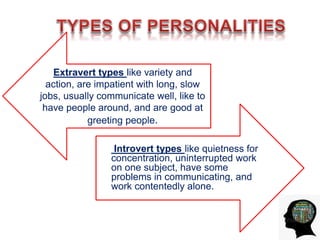
Extravert types like variety and
action, are impatient with long, slow
jobs, usually communicate well, like to
have people around, and are good at
greeting people.
Introvert types like quietness for
concentration, uninterrupted work
on one subject, have some
problems in communicating, and
work contentedly alone.
REACTIVE
Life Happens to me !
CREATIVE
I Make Life Happen !
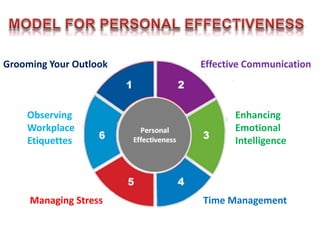
Observing
Workplace
Etiquettes
Grooming Your Outlook Effective Communication
Enhancing
Emotional
Intelligence
Time Management
Managing Stress
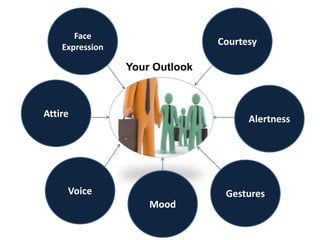
Attire
Alertness
Courtesy
Voice
Mood
Face
Expression
Gestures
Your Outlook
Communication is a two way process
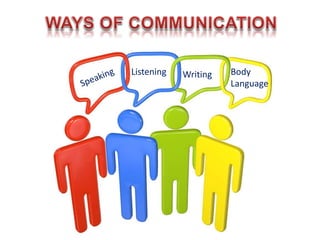
Listening Writing Body
Language
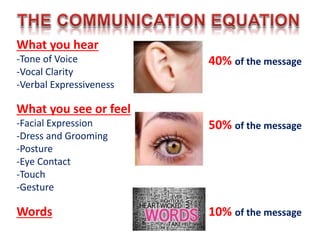
What you hear
-Tone of Voice
-Vocal Clarity
-Verbal Expressiveness
40% of the message
What you see or feel
-Facial Expression
-Dress and Grooming
-Posture
-Eye Contact
-Touch
-Gesture
50% of the message
Words 10% of the message
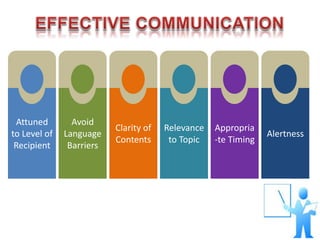
Attuned
to Level of
Recipient
Avoid
Language
Barriers
Clarity of
Contents
Relevance
to Topic
Appropria
-te Timing
Alertness
The capacity for recognizing our own feelings and those of
others, for motivating ourselves, and for managing emotions
well in ourselves and in our relationships.
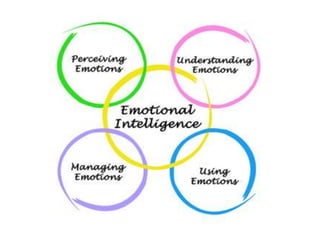
Emotional intelligence is essential in effective leadership
and has a direct impact on work performance.
People with strong emotional intelligence test results
are more likely to succeed than with other people
whose strength areas are in either relevant previous
experience or traditional IQ scores.
There is a strong correlation between how well an
individual handled personal emotions and the
willingness of others to work with that individual.
A leader with a positive mood and attitude tends to
interact with others in a way that results in a positive,
helpful, and cooperative workgroup, thereby
increasing workplace efficiency.
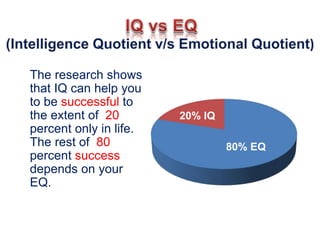
20% IQ
80% EQ
The research shows
that IQ can help you
to be successful to
the extent of 20
percent only in life.
The rest of 80
percent success
depends on your
EQ.
Can EQ be developed
YES!!!
 You can develop your EQ by
upgrading your emotional
skills.
 The popular thinking that EQ
is entirely inherited is
incorrect.
 Emotional Intelligence is not
fixed at birth.
 There is no emotional
intelligence genes as such
that we know of today.
 It is something one has
learned.
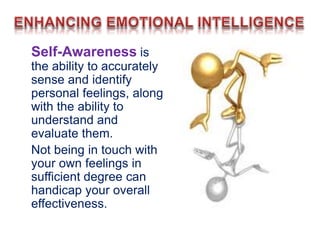
Self-Awareness is
the ability to accurately
sense and identify
personal feelings, along
with the ability to
understand and
evaluate them.
Not being in touch with
your own feelings in
sufficient degree can
handicap your overall
effectiveness.
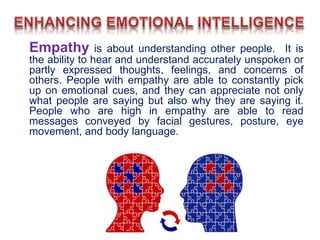
Empathy is about understanding other people. It is
the ability to hear and understand accurately unspoken or
partly expressed thoughts, feelings, and concerns of
others. People with empathy are able to constantly pick
up on emotional cues, and they can appreciate not only
what people are saying but also why they are saying it.
People who are high in empathy are able to read
messages conveyed by facial gestures, posture, eye
movement, and body language.
Influence is the
ability to persuade,
convince, or impact
other to get them to
go along with or
support your agenda.
Influence is about
grabbing someone’s
attention and passing
on something they
want to hear.
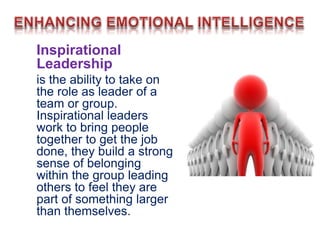
Inspirational
Leadership
is the ability to take on
the role as leader of a
team or group.
Inspirational leaders
work to bring people
together to get the job
done, they build a strong
sense of belonging
within the group leading
others to feel they are
part of something larger
than themselves.
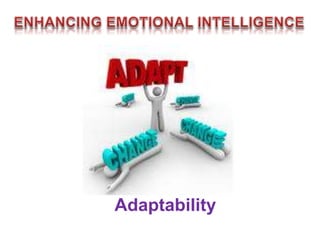
Adaptability
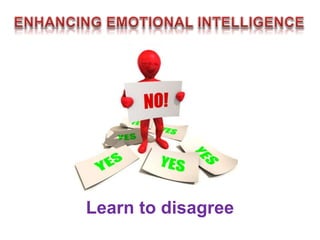
Learn to disagree
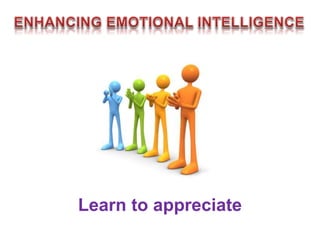
Learn to appreciate
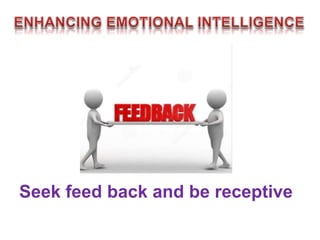
Seek feed back and be receptive
Go beyond official
Optimism
Tolerance
Empowerment
Have fun at workplace
Taking initiative
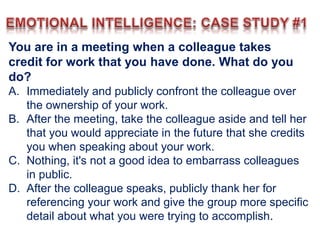
You are in a meeting when a colleague takes
credit for work that you have done. What do you
do?
A. Immediately and publicly confront the colleague over
the ownership of your work.
B. After the meeting, take the colleague aside and tell her
that you would appreciate in the future that she credits
you when speaking about your work.
C. Nothing, it's not a good idea to embarrass colleagues
in public.
D. After the colleague speaks, publicly thank her for
referencing your work and give the group more specific
detail about what you were trying to accomplish.
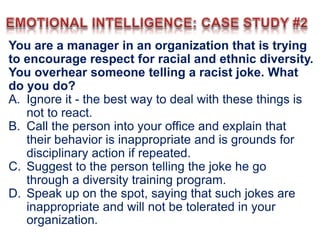
You are a manager in an organization that is trying
to encourage respect for racial and ethnic diversity.
You overhear someone telling a racist joke. What
do you do?
A. Ignore it - the best way to deal with these things is
not to react.
B. Call the person into your office and explain that
their behavior is inappropriate and is grounds for
disciplinary action if repeated.
C. Suggest to the person telling the joke he go
through a diversity training program.
D. Speak up on the spot, saying that such jokes are
inappropriate and will not be tolerated in your
organization.
You have recently been assigned a young officer in
your team, and have noticed that he appears to be
unable to make the simplest of decisions without
seeking advice from you. What do you do?
A. Accept that he does not have what it take to succeed
around here' and find others in your team to take on his
tasks.
B. Put impact of this deficiency in his career progression.
C. Purposely give him lots of complex decisions to make so
that he will become more confident in the role.
D. Engineer an ongoing series of challenging but
manageable experiences for him, and make yourself
available to act as his mentor.
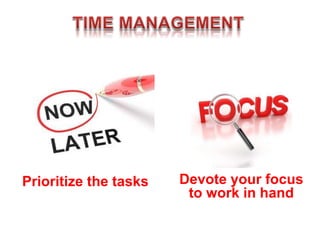
Prioritize the tasks Devote your focus
to work in hand
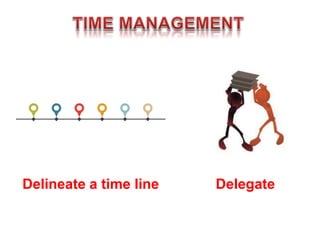
Delineate a time line Delegate
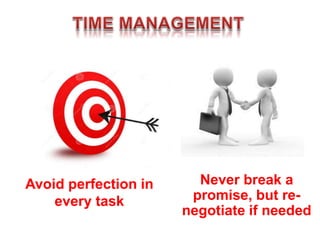
Avoid perfection in
every task
Never break a
promise, but re-
negotiate if needed
Learn to say No
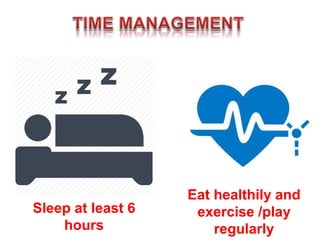
Sleep at least 6
hours
Eat healthily and
exercise /play
regularly
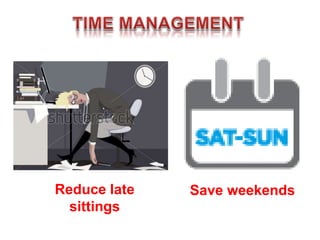
Reduce late
sittings
Save weekends
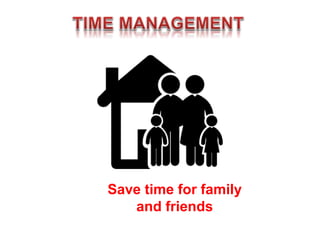
Save time for family
and friends
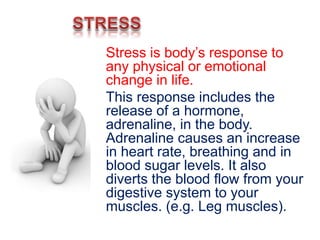
Stress is body’s response to
any physical or emotional
change in life.
This response includes the
release of a hormone,
adrenaline, in the body.
Adrenaline causes an increase
in heart rate, breathing and in
blood sugar levels. It also
diverts the blood flow from your
digestive system to your
muscles. (e.g. Leg muscles).
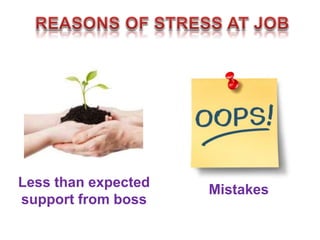
Less than expected
support from boss
Mistakes
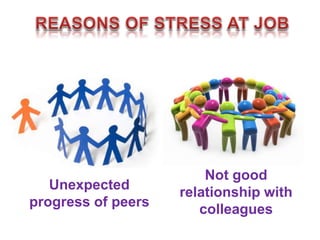
Unexpected
progress of peers
Not good
relationship with
colleagues
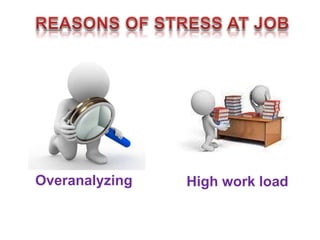
Overanalyzing High work load
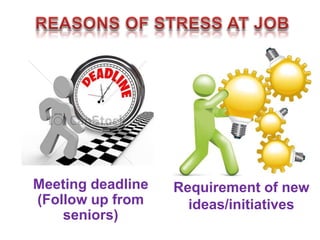
Meeting deadline
(Follow up from
seniors)
Requirement of new
ideas/initiatives
Keep
Expectation
Low
Be assertive
Being assertive
involves standing
up for your
personal rights and
expressing your
thoughts, feelings
and beliefs directly,
honestly and
spontaneously in
ways that do not
infringe the rights
of others.
Get organized
Do not overload
your mind.
Prioritizing
objectives, duties
and activities
makes them
manageable and
achievable.
Ventilation
“A problem shared
is a problem
halved”.
Develop a support
network thru
friends to talk with.
It is not always
events that are
stressful but how
we perceive them.
Take time out.
In a professional
sense, it is your
behavior towards
colleagues which is
in their best interest.
It help smooth the wheels of daily interaction in
office.
Good work outcome and happy co-existence even
if there is mutual dislike or disinterest.
Ensure that you do not become office enemy
number 1.
Modifies distracting behavior and develops
admired conduct.
Enables you to be confident in variety of settings
with a variety of people.
Colleagues are bothered by officers who:
• Have poor personal hygiene.
• Leave personal belongings in other people’s work spaces.
• Frequent complain.
• Don’t acknowledge you unless you speak to them directly.
• Wear clothing that is dirty, too casual, or distracting in some
other way.
• Drop in on you while working and don’t ask if its okay to
interrupt.
• Habitually arrive late at meetings.
• Gossip.
• Borrow things but forget to return them.
• Speak too loudly on the telephone.
• Cough or sniffle excessively
“Don’t reserve your best behavior for special
occasions. You can’t have two sets of
manners, two social codes – one for those
you admire and want to impress, another for
those whom you consider unimportant. You
must be the same to all people.”
• If you want to be a good manager as well as
a leader, there is a lot to learn. The most
fundamental lesson is that it starts with your
own personal effectiveness.
• Know yourself. Listen to feedback. Build on
your strengths. Build relationships.
• Do what you say you will do. Manage your
time.
• If we can just find people who do those things
well, the rest tends to take care of itself.
Improving Personal Effectiveness

Improving Personal Effectiveness

  • 1.
  • 2.
    We are allborn with a natural temperament – a comfort zone that determines our behavior patterns. Some of these behavior patterns make us great – but may also drive others uncomfortable. Every team will consist of individuals with different temperament types, each will have their own use guide. Although it is difficult to change who you are, there are definite actions that you can take to make the most of your temperament.
  • 3.
    Personal Effectiveness isoften conceived as a set of competences, capabilities or qualities. Objective of this presentation is to share some ideas to help improve your effectiveness in a corporate environment.
  • 4.
    Extravert types likevariety and action, are impatient with long, slow jobs, usually communicate well, like to have people around, and are good at greeting people. Introvert types like quietness for concentration, uninterrupted work on one subject, have some problems in communicating, and work contentedly alone.
  • 5.
    REACTIVE Life Happens tome ! CREATIVE I Make Life Happen !
  • 6.
    Observing Workplace Etiquettes Grooming Your OutlookEffective Communication Enhancing Emotional Intelligence Time Management Managing Stress
  • 7.
  • 8.
    Communication is atwo way process
  • 9.
  • 10.
    What you hear -Toneof Voice -Vocal Clarity -Verbal Expressiveness 40% of the message What you see or feel -Facial Expression -Dress and Grooming -Posture -Eye Contact -Touch -Gesture 50% of the message Words 10% of the message
  • 11.
    Attuned to Level of Recipient Avoid Language Barriers Clarityof Contents Relevance to Topic Appropria -te Timing Alertness
  • 12.
    The capacity forrecognizing our own feelings and those of others, for motivating ourselves, and for managing emotions well in ourselves and in our relationships.
  • 14.
    Emotional intelligence isessential in effective leadership and has a direct impact on work performance. People with strong emotional intelligence test results are more likely to succeed than with other people whose strength areas are in either relevant previous experience or traditional IQ scores. There is a strong correlation between how well an individual handled personal emotions and the willingness of others to work with that individual. A leader with a positive mood and attitude tends to interact with others in a way that results in a positive, helpful, and cooperative workgroup, thereby increasing workplace efficiency.
  • 15.
    20% IQ 80% EQ Theresearch shows that IQ can help you to be successful to the extent of 20 percent only in life. The rest of 80 percent success depends on your EQ.
  • 16.
    Can EQ bedeveloped
  • 17.
    YES!!!  You candevelop your EQ by upgrading your emotional skills.  The popular thinking that EQ is entirely inherited is incorrect.  Emotional Intelligence is not fixed at birth.  There is no emotional intelligence genes as such that we know of today.  It is something one has learned.
  • 18.
    Self-Awareness is the abilityto accurately sense and identify personal feelings, along with the ability to understand and evaluate them. Not being in touch with your own feelings in sufficient degree can handicap your overall effectiveness.
  • 19.
    Empathy is aboutunderstanding other people. It is the ability to hear and understand accurately unspoken or partly expressed thoughts, feelings, and concerns of others. People with empathy are able to constantly pick up on emotional cues, and they can appreciate not only what people are saying but also why they are saying it. People who are high in empathy are able to read messages conveyed by facial gestures, posture, eye movement, and body language.
  • 20.
    Influence is the abilityto persuade, convince, or impact other to get them to go along with or support your agenda. Influence is about grabbing someone’s attention and passing on something they want to hear.
  • 21.
    Inspirational Leadership is the abilityto take on the role as leader of a team or group. Inspirational leaders work to bring people together to get the job done, they build a strong sense of belonging within the group leading others to feel they are part of something larger than themselves.
  • 22.
  • 23.
  • 24.
  • 25.
    Seek feed backand be receptive
  • 26.
  • 27.
  • 28.
  • 29.
  • 30.
    Have fun atworkplace
  • 31.
  • 32.
    You are ina meeting when a colleague takes credit for work that you have done. What do you do? A. Immediately and publicly confront the colleague over the ownership of your work. B. After the meeting, take the colleague aside and tell her that you would appreciate in the future that she credits you when speaking about your work. C. Nothing, it's not a good idea to embarrass colleagues in public. D. After the colleague speaks, publicly thank her for referencing your work and give the group more specific detail about what you were trying to accomplish.
  • 33.
    You are amanager in an organization that is trying to encourage respect for racial and ethnic diversity. You overhear someone telling a racist joke. What do you do? A. Ignore it - the best way to deal with these things is not to react. B. Call the person into your office and explain that their behavior is inappropriate and is grounds for disciplinary action if repeated. C. Suggest to the person telling the joke he go through a diversity training program. D. Speak up on the spot, saying that such jokes are inappropriate and will not be tolerated in your organization.
  • 34.
    You have recentlybeen assigned a young officer in your team, and have noticed that he appears to be unable to make the simplest of decisions without seeking advice from you. What do you do? A. Accept that he does not have what it take to succeed around here' and find others in your team to take on his tasks. B. Put impact of this deficiency in his career progression. C. Purposely give him lots of complex decisions to make so that he will become more confident in the role. D. Engineer an ongoing series of challenging but manageable experiences for him, and make yourself available to act as his mentor.
  • 36.
    Prioritize the tasksDevote your focus to work in hand
  • 37.
    Delineate a timeline Delegate
  • 38.
    Avoid perfection in everytask Never break a promise, but re- negotiate if needed
  • 39.
  • 40.
    Sleep at least6 hours Eat healthily and exercise /play regularly
  • 41.
  • 42.
    Save time forfamily and friends
  • 43.
    Stress is body’sresponse to any physical or emotional change in life. This response includes the release of a hormone, adrenaline, in the body. Adrenaline causes an increase in heart rate, breathing and in blood sugar levels. It also diverts the blood flow from your digestive system to your muscles. (e.g. Leg muscles).
  • 44.
    Less than expected supportfrom boss Mistakes
  • 45.
    Unexpected progress of peers Notgood relationship with colleagues
  • 46.
  • 47.
    Meeting deadline (Follow upfrom seniors) Requirement of new ideas/initiatives
  • 48.
  • 49.
    Be assertive Being assertive involvesstanding up for your personal rights and expressing your thoughts, feelings and beliefs directly, honestly and spontaneously in ways that do not infringe the rights of others.
  • 50.
    Get organized Do notoverload your mind. Prioritizing objectives, duties and activities makes them manageable and achievable.
  • 51.
    Ventilation “A problem shared isa problem halved”. Develop a support network thru friends to talk with. It is not always events that are stressful but how we perceive them.
  • 52.
  • 53.
    In a professional sense,it is your behavior towards colleagues which is in their best interest.
  • 54.
    It help smooththe wheels of daily interaction in office. Good work outcome and happy co-existence even if there is mutual dislike or disinterest. Ensure that you do not become office enemy number 1. Modifies distracting behavior and develops admired conduct. Enables you to be confident in variety of settings with a variety of people.
  • 55.
    Colleagues are botheredby officers who: • Have poor personal hygiene. • Leave personal belongings in other people’s work spaces. • Frequent complain. • Don’t acknowledge you unless you speak to them directly. • Wear clothing that is dirty, too casual, or distracting in some other way. • Drop in on you while working and don’t ask if its okay to interrupt. • Habitually arrive late at meetings. • Gossip. • Borrow things but forget to return them. • Speak too loudly on the telephone. • Cough or sniffle excessively
  • 56.
    “Don’t reserve yourbest behavior for special occasions. You can’t have two sets of manners, two social codes – one for those you admire and want to impress, another for those whom you consider unimportant. You must be the same to all people.”
  • 57.
    • If youwant to be a good manager as well as a leader, there is a lot to learn. The most fundamental lesson is that it starts with your own personal effectiveness. • Know yourself. Listen to feedback. Build on your strengths. Build relationships. • Do what you say you will do. Manage your time. • If we can just find people who do those things well, the rest tends to take care of itself.

Editor's Notes

  • #6 Learning Resources Centre, UNDP
  • #59 Now Questions are welcomed for the both parts of the presentation.