Introduction to Management Accounting
BIFS
Session 2
Prof. Deepali Kalia
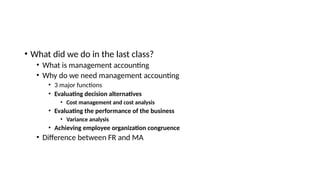
• What did we do in the last class?
• What is management accounting
• Why do we need management accounting
• 3 major functions
• Evaluating decision alternatives
• Cost management and cost analysis
• Evaluating the performance of the business
• Variance analysis
• Achieving employee organization congruence
• Difference between FR and MA
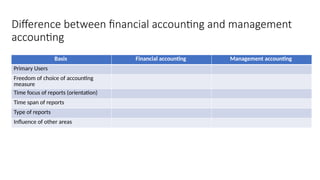
Difference between financial accounting and management
accounting
Basis Financial accounting Management accounting
Primary Users
Freedom of choice of accounting
measure
Time focus of reports (orientation)
Time span of reports
Type of reports
Influence of other areas
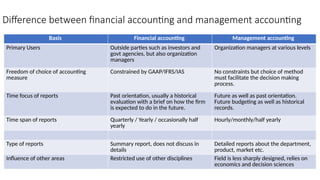
Difference between financial accounting and management accounting
Basis Financial accounting Management accounting
Primary Users Outside parties such as investors and
govt agencies, but also organization
managers
Organization managers at various levels
Freedom of choice of accounting
measure
Constrained by GAAP/IFRS/IAS No constraints but choice of method
must facilitate the decision making
process.
Time focus of reports Past orientation, usually a historical
evaluation with a brief on how the firm
is expected to do in the future.
Future as well as past orientation.
Future budgeting as well as historical
records.
Time span of reports Quarterly / Yearly / occasionally half
yearly
Hourly/monthly/half yearly
Type of reports Summary report, does not discuss in
details
Detailed reports about the department,
product, market etc.
Influence of other areas Restricted use of other disciplines Field is less sharply designed, relies on
economics and decision sciences
What is cost?
• A sacrifice made, usually measured by resources given up, to achieve a
particular purpose.
• Monetary value of resources that are utilized to generate revenue.
• For example?
• You made a sacrifice, gave up your sleep, to gain, either knowledge, or
attendance, or both.
• So, the cost of learning, is giving up on sleep!
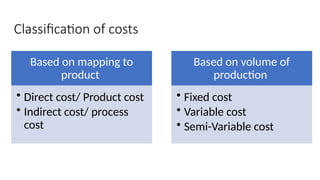
Classification of costs
Based on mapping to
product
• Direct cost/ Product cost
• Indirect cost/ process
cost
Based on volume of
production
• Fixed cost
• Variable cost
• Semi-Variable cost
Product costs
• Product cost: Cost assigned to goods that were either purchased, or
manufactured for resale.
• For a manufacturing firm what will the product cost include?
• All the costs incurred for converting it from raw material to FG
• And for the retailer, what will the product cost include?
• The cost of procuring it from the vendor + Transportation if any
• Other name for this cost is inventoriable cost/ Direct cost
• Examples of Product cost?
• Material
• Labour
Period costs
• All costs of the year, which are not product costs, are called as period
costs.
• These costs are identified based on the year (or the time frame for which
they are incurred) instead of on the basis of a product.
• Also known as indirect costs
• Our indirect costs, are also referred to as the overheads of the company
• Examples?
• R & D
• Selling and administrative
• Advertising, promotion, salary
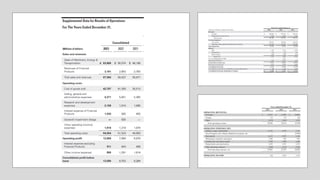
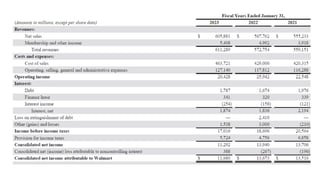
Exploring industry context:
Understanding where product and period costs show up in the
income statement
Understanding types of costs
• Based on changes in volume:
• It is important to understand how costs change in relation to changes in
activities of the organization, this activity can be either production, or providing
services.
• Fixed cost
• Remains unchanged, even if the level of activity keeps changing
• For example, depreciation, lease expense, rent
• What about fixed cost per unit?
• The total fixed cost remains unchanged with changes in level of production, however,
the per unit total cost decreases with the level of activity
• So for every additional unit, the fixed cost per unit will ______.
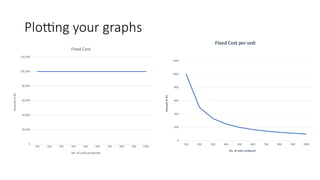
• Assume that the fixed expense for a company is Rs. 1,00,000 and the number of units
increase by 100. You have 3 minutes to plot the fixed cost and the fixed cost per unit.
Plotting your graphs
100 200 300 400 500 600 700 800 900 1000
0
20,000
40,000
60,000
80,000
100,000
120,000
Fixed Cost
No. of units produced
Amount
in
Rs.
100 200 300 400 500 600 700 800 900 1000
0
200
400
600
800
1000
1200
Fixed Cost per unit
No. of units produced
Amount
in
Rs.
Plotting your graphs
0 200 400 600 800 1000 1200
0
10000
20000
30000
40000
50000
60000
70000
80000
90000
Variable Cost
No. of units
Amount
in
Rs.
100 200 300 400 500 600 700 800 900 1000
0
10
20
30
40
50
60
70
80
90
Variable cost per unit
No. of units
Amount
in
Rs.
Plotting your graphs
0 200 400 600 800 1000 1200
0
20000
40000
60000
80000
100000
120000
140000
160000
180000
200000
?
Number of units produced
Amount
in
Rs.
Semi Variable or semi- Fixed costs
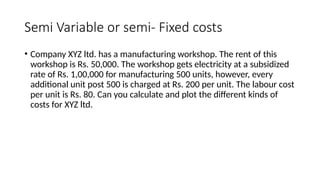
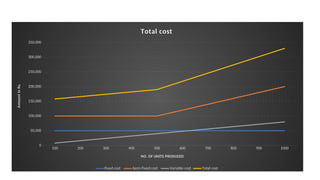
• Company XYZ ltd. has a manufacturing workshop. The rent of this
workshop is Rs. 50,000. The workshop gets electricity at a subsidized
rate of Rs. 1,00,000 for manufacturing 500 units, however, every
additional unit post 500 is charged at Rs. 200 per unit. The labour cost
per unit is Rs. 80. Can you calculate and plot the different kinds of
costs for XYZ ltd.
100 200 300 400 500 600 700 800 900 1000
0
50,000
100,000
150,000
200,000
250,000
300,000
350,000
Total cost
Fixed cost Semi Fixed cost Variable cost Total cost
NO. OF UNITS PRODUCED
Amount
in
Rs.
What is a cost driver?
• Consider the assembly line of Peelakamal ltd., a manufacturing company, involved in the process of
making tables.
• The process of making the table involves:
• Unloading raw material/ semi – finished wooden tables from trucks. For each truck unloaded,
workers are paid Rs 100.
• Next, smoothening out the texture, labour working on this process are paid @ Rs. 20 a piece.
• Finally the table is spray painted and varnished, for which the product passes through a machine.
The machine runs in lots of 10. Labour working on this machine are paid Rs. 30 per lot.
• The amount which is paid to labour (direct expense) is not actually dependent on the total number
of tables the company manufactures, instead on other factors, these other factors are known as
Cost Drivers.
• A cost driver is any activity or an event, which causes the cost to be incurred. Here, the costs are
being incurred.
• Here the costs are being incurred because of unloading, smoothening and varnishing. Which are
the actual cost drivers of the total labour cost for the month, or the year.
Quick check!
• Weather a cost is direct or indirect, actually depends upon which
department is under consideration
Other key terms
• Sunk cost
• Opportunity cost
• Differential cost
• Incremental cost
• Marginal cost
• Cost per unit/ average cost
• Step cost

MA_Session 2 for accouting cost amdn.pptx

  • 1.
    Introduction to ManagementAccounting BIFS Session 2 Prof. Deepali Kalia
  • 2.
    • What didwe do in the last class? • What is management accounting • Why do we need management accounting • 3 major functions • Evaluating decision alternatives • Cost management and cost analysis • Evaluating the performance of the business • Variance analysis • Achieving employee organization congruence • Difference between FR and MA
  • 3.
    Difference between financialaccounting and management accounting Basis Financial accounting Management accounting Primary Users Freedom of choice of accounting measure Time focus of reports (orientation) Time span of reports Type of reports Influence of other areas
  • 4.
    Difference between financialaccounting and management accounting Basis Financial accounting Management accounting Primary Users Outside parties such as investors and govt agencies, but also organization managers Organization managers at various levels Freedom of choice of accounting measure Constrained by GAAP/IFRS/IAS No constraints but choice of method must facilitate the decision making process. Time focus of reports Past orientation, usually a historical evaluation with a brief on how the firm is expected to do in the future. Future as well as past orientation. Future budgeting as well as historical records. Time span of reports Quarterly / Yearly / occasionally half yearly Hourly/monthly/half yearly Type of reports Summary report, does not discuss in details Detailed reports about the department, product, market etc. Influence of other areas Restricted use of other disciplines Field is less sharply designed, relies on economics and decision sciences
  • 5.
    What is cost? •A sacrifice made, usually measured by resources given up, to achieve a particular purpose. • Monetary value of resources that are utilized to generate revenue. • For example? • You made a sacrifice, gave up your sleep, to gain, either knowledge, or attendance, or both. • So, the cost of learning, is giving up on sleep!
  • 6.
    Classification of costs Basedon mapping to product • Direct cost/ Product cost • Indirect cost/ process cost Based on volume of production • Fixed cost • Variable cost • Semi-Variable cost
  • 7.
    Product costs • Productcost: Cost assigned to goods that were either purchased, or manufactured for resale. • For a manufacturing firm what will the product cost include? • All the costs incurred for converting it from raw material to FG • And for the retailer, what will the product cost include? • The cost of procuring it from the vendor + Transportation if any • Other name for this cost is inventoriable cost/ Direct cost • Examples of Product cost? • Material • Labour
  • 8.
    Period costs • Allcosts of the year, which are not product costs, are called as period costs. • These costs are identified based on the year (or the time frame for which they are incurred) instead of on the basis of a product. • Also known as indirect costs • Our indirect costs, are also referred to as the overheads of the company • Examples? • R & D • Selling and administrative • Advertising, promotion, salary
  • 9.
    Exploring industry context: Understandingwhere product and period costs show up in the income statement
  • 12.
    Understanding types ofcosts • Based on changes in volume: • It is important to understand how costs change in relation to changes in activities of the organization, this activity can be either production, or providing services. • Fixed cost • Remains unchanged, even if the level of activity keeps changing • For example, depreciation, lease expense, rent • What about fixed cost per unit? • The total fixed cost remains unchanged with changes in level of production, however, the per unit total cost decreases with the level of activity • So for every additional unit, the fixed cost per unit will ______. • Assume that the fixed expense for a company is Rs. 1,00,000 and the number of units increase by 100. You have 3 minutes to plot the fixed cost and the fixed cost per unit.
  • 13.
    Plotting your graphs 100200 300 400 500 600 700 800 900 1000 0 20,000 40,000 60,000 80,000 100,000 120,000 Fixed Cost No. of units produced Amount in Rs. 100 200 300 400 500 600 700 800 900 1000 0 200 400 600 800 1000 1200 Fixed Cost per unit No. of units produced Amount in Rs.
  • 14.
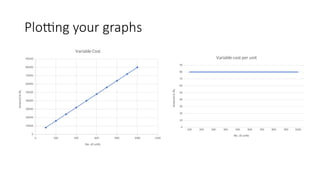
    Plotting your graphs 0200 400 600 800 1000 1200 0 10000 20000 30000 40000 50000 60000 70000 80000 90000 Variable Cost No. of units Amount in Rs. 100 200 300 400 500 600 700 800 900 1000 0 10 20 30 40 50 60 70 80 90 Variable cost per unit No. of units Amount in Rs.
  • 15.
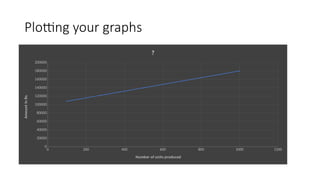
    Plotting your graphs 0200 400 600 800 1000 1200 0 20000 40000 60000 80000 100000 120000 140000 160000 180000 200000 ? Number of units produced Amount in Rs.
  • 16.
    Semi Variable orsemi- Fixed costs • Company XYZ ltd. has a manufacturing workshop. The rent of this workshop is Rs. 50,000. The workshop gets electricity at a subsidized rate of Rs. 1,00,000 for manufacturing 500 units, however, every additional unit post 500 is charged at Rs. 200 per unit. The labour cost per unit is Rs. 80. Can you calculate and plot the different kinds of costs for XYZ ltd.
  • 17.
    100 200 300400 500 600 700 800 900 1000 0 50,000 100,000 150,000 200,000 250,000 300,000 350,000 Total cost Fixed cost Semi Fixed cost Variable cost Total cost NO. OF UNITS PRODUCED Amount in Rs.
  • 18.
    What is acost driver? • Consider the assembly line of Peelakamal ltd., a manufacturing company, involved in the process of making tables. • The process of making the table involves: • Unloading raw material/ semi – finished wooden tables from trucks. For each truck unloaded, workers are paid Rs 100. • Next, smoothening out the texture, labour working on this process are paid @ Rs. 20 a piece. • Finally the table is spray painted and varnished, for which the product passes through a machine. The machine runs in lots of 10. Labour working on this machine are paid Rs. 30 per lot. • The amount which is paid to labour (direct expense) is not actually dependent on the total number of tables the company manufactures, instead on other factors, these other factors are known as Cost Drivers. • A cost driver is any activity or an event, which causes the cost to be incurred. Here, the costs are being incurred. • Here the costs are being incurred because of unloading, smoothening and varnishing. Which are the actual cost drivers of the total labour cost for the month, or the year.
  • 19.
    Quick check! • Weathera cost is direct or indirect, actually depends upon which department is under consideration
  • 20.
    Other key terms •Sunk cost • Opportunity cost • Differential cost • Incremental cost • Marginal cost • Cost per unit/ average cost • Step cost