Cost Concepts - 1
COST CONCEPTS
AND CLASSIFICATIONS
Fixed vs Direct vs
Variable Indirect
Functional vs Behavioral
Cost Concepts - 2
COST CLASSIFICATIONS
Functional
Product
Marketing
R&D
Admin
Cost Concepts - 3
COST CLASSIFICATIONS
Functional – Product Detail
Product
Marketing
R&D
Admin
Materials
Labor
Mfg.
Overhead
Prime costs = Dir. Materials + Dir. Labor
Conversion costs = Dir. Labor + Total Mfg.
Overhead
Cost Concepts - 4
COST CLASSIFICATIONS
Behavioral
Product
Marketing
R&D
Admin
Fixed
Variable
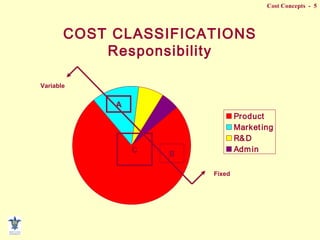
Cost Concepts - 5
COST CLASSIFICATIONS
Responsibility
Product
Marketing
R&D
Admin
Fixed
Variable
A
B
C
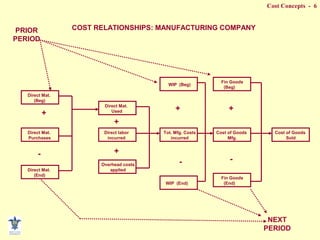
Cost Concepts - 6
COST RELATIONSHIPS: MANUFACTURING COMPANY
Direct Mat.
(Beg)
Direct Mat.
Purchases
Direct Mat.
(End)
Direct labor
incurred
Direct Mat.
Used
+
-
Overhead costs
applied
Tot. Mfg. Costs
incurred
Cost of Goods
Mfg.
Cost of Goods
Sold
WIP (Beg)
WIP (End)
++
--
Fin Goods
(End)
Fin Goods
(Beg)
+
+
PRIOR
PERIOD
NEXT
PERIOD
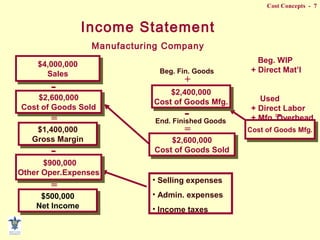
Cost Concepts - 7
Income Statement
Manufacturing Company
Beg. WIP
+ Direct Mat’l
Used
+ Direct Labor
+ Mfg. Overhead
- End. WIP
=
Cost of Goods Mfg.Cost of Goods Mfg.
Beg. Fin. Goods
+
$2,400,000
Cost of Goods Mfg.
$2,400,000
Cost of Goods Mfg.
-End. Finished Goods
=
$2,600,000
Cost of Goods Sold
$2,600,000
Cost of Goods Sold
$4,000,000
Sales
$4,000,000
Sales
-
$2,600,000
Cost of Goods Sold
$2,600,000
Cost of Goods Sold
=
$1,400,000
Gross Margin
$1,400,000
Gross Margin
-
• Selling expenses
• Admin. expenses
• Income taxes
$900,000
Other Oper.Expenses
$900,000
Other Oper.Expenses
=
$500,000
Net Income
$500,000
Net Income
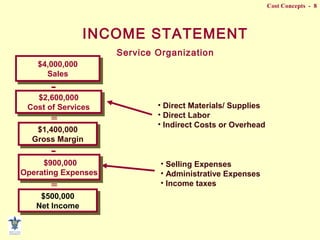
Cost Concepts - 8
• Selling Expenses
• Administrative Expenses
• Income taxes
• Direct Materials/ Supplies
• Direct Labor
• Indirect Costs or Overhead
INCOME STATEMENT
Service Organization
$2,600,000
Cost of Services
$2,600,000
Cost of Services
$900,000
Operating Expenses
$900,000
Operating Expenses
$4,000,000
Sales
$4,000,000
Sales
$500,000
Net Income
$500,000
Net Income
$1,400,000
Gross Margin
$1,400,000
Gross Margin
-
=
-
=
Cost Concepts - 9
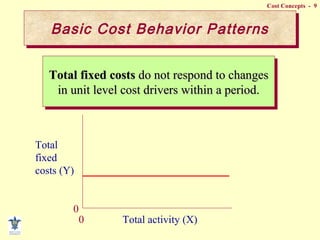
Total fixed costsTotal fixed costs do not respond to changesdo not respond to changes
in unit level cost drivers within a period.in unit level cost drivers within a period.
Total fixed costsTotal fixed costs do not respond to changesdo not respond to changes
in unit level cost drivers within a period.in unit level cost drivers within a period.
Total
fixed
costs (Y)
Total activity (X)
0
0
Basic Cost Behavior PatternsBasic Cost Behavior Patterns
Cost Concepts - 10
Committed fixed costs are
required to maintain the
current service or production
capacity to fill previous legal
commitments.
Committed fixed costs are
required to maintain the
current service or production
capacity to fill previous legal
commitments.
Fixed CostsFixed Costs
Cost Concepts - 11
Discretionary fixed costs are set
at a fixed amount each year at the
discretion of management.
Discretionary fixed costs are set
at a fixed amount each year at the
discretion of management.
Fixed CostsFixed Costs
Cost Concepts - 12
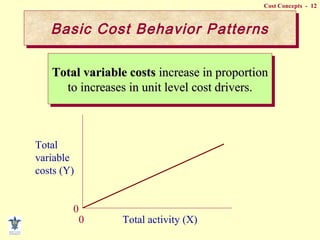
Total variable costsTotal variable costs increase in proportionincrease in proportion
to increases in unit level cost drivers.to increases in unit level cost drivers.
Total variable costsTotal variable costs increase in proportionincrease in proportion
to increases in unit level cost drivers.to increases in unit level cost drivers.
Total
variable
costs (Y)
Total activity (X)
0
0
Basic Cost Behavior PatternsBasic Cost Behavior Patterns
Cost Concepts - 13
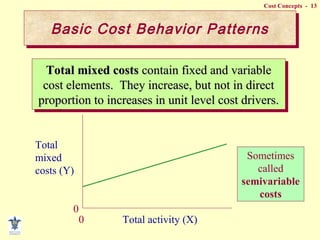
Total mixed costsTotal mixed costs contain fixed and variablecontain fixed and variable
cost elements. They increase, but not in directcost elements. They increase, but not in direct
proportion to increases in unit level cost drivers.proportion to increases in unit level cost drivers.
Total mixed costsTotal mixed costs contain fixed and variablecontain fixed and variable
cost elements. They increase, but not in directcost elements. They increase, but not in direct
proportion to increases in unit level cost drivers.proportion to increases in unit level cost drivers.
Total
mixed
costs (Y)
Total activity (X)
0
0
Sometimes
called
semivariable
costs
Basic Cost Behavior PatternsBasic Cost Behavior Patterns
Cost Concepts - 14
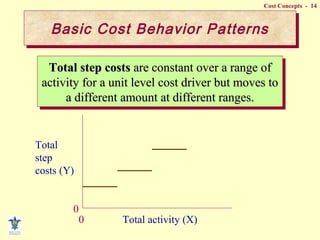
Total step costsTotal step costs are constant over a range ofare constant over a range of
activity for a unit level cost driver but moves toactivity for a unit level cost driver but moves to
a different amount at different ranges.a different amount at different ranges.
Total step costsTotal step costs are constant over a range ofare constant over a range of
activity for a unit level cost driver but moves toactivity for a unit level cost driver but moves to
a different amount at different ranges.a different amount at different ranges.
Total
step
costs (Y)
Total activity (X)
0
0
Basic Cost Behavior PatternsBasic Cost Behavior Patterns
Cost Concepts - 15
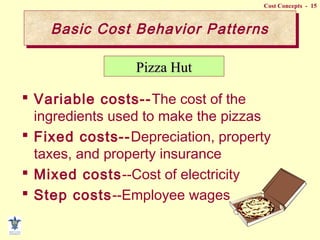
 Variable costs--The cost of the
ingredients used to make the pizzas
 Fixed costs--Depreciation, property
taxes, and property insurance
 Mixed costs--Cost of electricity
 Step costs--Employee wages
Basic Cost Behavior PatternsBasic Cost Behavior Patterns
Pizza HutPizza Hut
Cost Concepts - 16
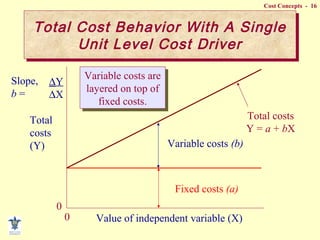
Total
costs
(Y)
Value of independent variable (X)
0
0
Fixed costs (a)
Variable costs (b)
Total costs
Y = a + bX
Variable costs are
layered on top of
fixed costs.
Variable costs are
layered on top of
fixed costs.
Slope,
b =
∆Y
∆X
Total Cost Behavior With A Single
Unit Level Cost Driver
Total Cost Behavior With A Single
Unit Level Cost Driver
Cost Concepts - 17
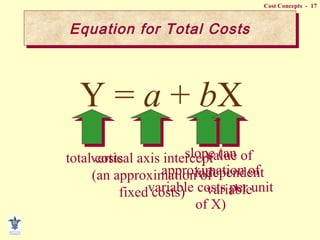
Y = a + bX
total costsvertical axis intercept
(an approximation of
fixed costs)
slope (an
approximation of
variable costs per unit
of X)
value of
independent
variable
Equation for Total CostsEquation for Total Costs
Cost Concepts - 18
Methods for Separating Mixed Cost
Into Fixed and Variable
Components
 Scatterplot Method
 The High-Low Method
 Specific quantitative methods
– The Method of Least Squares
Cost Concepts - 19
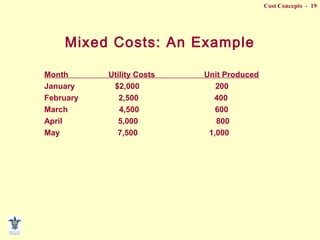
Month Utility Costs Unit Produced
January $2,000 200
February 2,500 400
March 4,500 600
April 5,000 800
May 7,500 1,000
Mixed Costs: An Example
Cost Concepts - 20
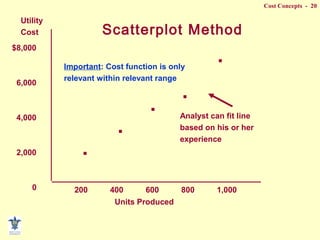
Units Produced
Utility
Cost
$8,000
6,000
4,000
2,000
0 200 400 600 800 1,000
.
Scatterplot Method
.
.
.
.
Analyst can fit line
based on his or her
experience
Important: Cost function is only
relevant within relevant range
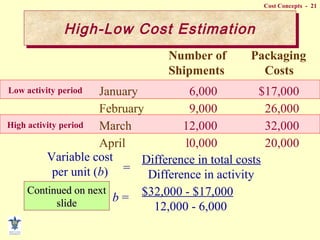
Cost Concepts - 21
High activity period
Low activity period
Number of Packaging
Shipments Costs
January 6,000 $17,000
February 9,000 26,000
March 12,000 32,000
April l0,000 20,000
Variable cost
per unit (b) =
Difference in total costs
Difference in activity
b = $32,000 - $17,000
12,000 - 6,000
Continued on nextContinued on next
slideslide
High-Low Cost EstimationHigh-Low Cost Estimation
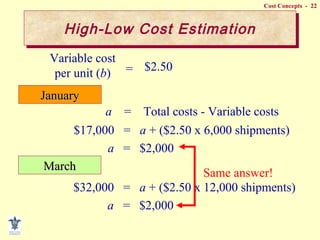
Cost Concepts - 22
Variable cost
per unit (b) = $2.50
JanuaryJanuary
a = Total costs - Variable costs
$17,000 = a + ($2.50 x 6,000 shipments)
a = $2,000
MarchMarch
$32,000 = a + ($2.50 x 12,000 shipments)
a = $2,000
Same answer!
High-Low Cost EstimationHigh-Low Cost Estimation
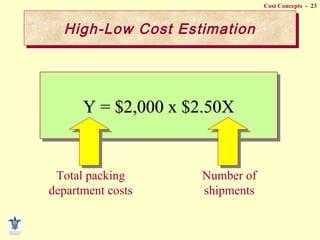
Cost Concepts - 23
Y = $2,000 x $2.50XY = $2,000 x $2.50XY = $2,000 x $2.50XY = $2,000 x $2.50X
Total packing
department costs
Number of
shipments
High-Low Cost EstimationHigh-Low Cost Estimation
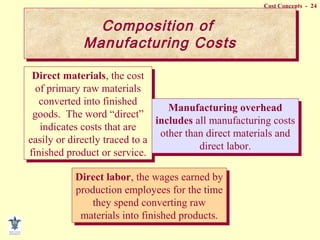
Cost Concepts - 24
Direct materials, the cost
of primary raw materials
converted into finished
goods. The word “direct”
indicates costs that are
easily or directly traced to a
finished product or service.
Direct materials, the cost
of primary raw materials
converted into finished
goods. The word “direct”
indicates costs that are
easily or directly traced to a
finished product or service.
Direct labor, the wages earned by
production employees for the time
they spend converting raw
materials into finished products.
Direct labor, the wages earned by
production employees for the time
they spend converting raw
materials into finished products.
Manufacturing overhead
includes all manufacturing costs
other than direct materials and
direct labor.
Manufacturing overhead
includes all manufacturing costs
other than direct materials and
direct labor.
Composition of
Manufacturing Costs
Composition of
Manufacturing Costs
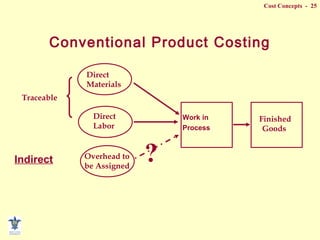
Cost Concepts - 25
Direct
Materials
Direct
Labor
Overhead to
be Assigned
Finished
Goods
Conventional Product Costing
Work in
Process
Traceable
Indirect ?
Cost Concepts - 26
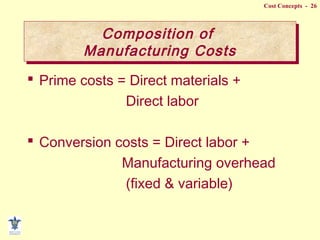
 Prime costs = Direct materials +
Direct labor
 Conversion costs = Direct labor +
Manufacturing overhead
(fixed & variable)
Composition of
Manufacturing Costs
Composition of
Manufacturing Costs
Cost Concepts - 27
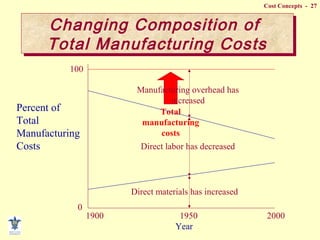
Percent of
Total
Manufacturing
Costs
0
100
1900 1950 2000
Year
Total
manufacturing
costs
Direct materials has increased
Direct labor has decreased
Manufacturing overhead has
increased
Changing Composition of
Total Manufacturing Costs
Changing Composition of
Total Manufacturing Costs
Cost Concepts - 28
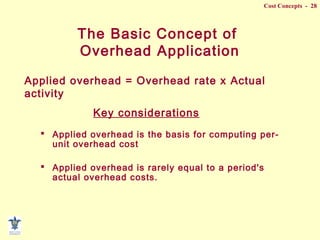
The Basic Concept of
Overhead Application
Applied overhead = Overhead rate x Actual
activity
 Applied overhead is the basis for computing per-
unit overhead cost
 Applied overhead is rarely equal to a period's
actual overhead costs.
Key considerations
Cost Concepts - 29
CONVENTIONAL PRODUCT
COSTING
Overhead Application
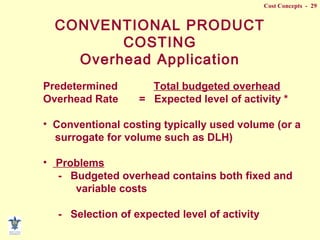
Predetermined Total budgeted overhead
Overhead Rate = Expected level of activity *
• Conventional costing typically used volume (or a
surrogate for volume such as DLH)
• Problems
- Budgeted overhead contains both fixed and
variable costs
- Selection of expected level of activity
Cost Concepts - 30
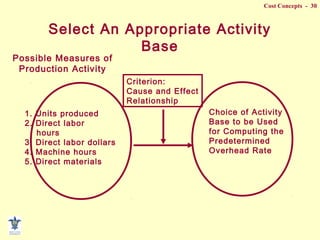
Select An Appropriate Activity
Base
Criterion:
Cause and Effect
Relationship
Possible Measures of
Production Activity
1. Units produced
2. Direct labor
hours
3. Direct labor dollars
4. Machine hours
5. Direct materials
Choice of Activity
Base to be Used
for Computing the
Predetermined
Overhead Rate
Cost Concepts - 31
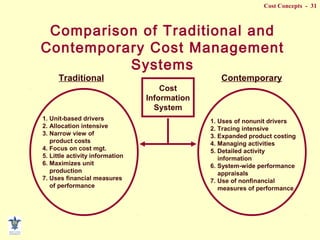
Comparison of Traditional and
Contemporary Cost Management
Systems
Cost
Information
System
Traditional Contemporary
1. Unit-based drivers
2. Allocation intensive
3. Narrow view of
product costs
4. Focus on cost mgt.
5. Little activity information
6. Maximizes unit
production
7. Uses financial measures
of performance
1. Uses of nonunit drivers
2. Tracing intensive
3. Expanded product costing
4. Managing activities
5. Detailed activity
information
6. System-wide performance
appraisals
7. Use of nonfinancial
measures of performance
Cost Concepts - 32
Impact of Computers on
Manufacturing
Impact of Computers on
Manufacturing
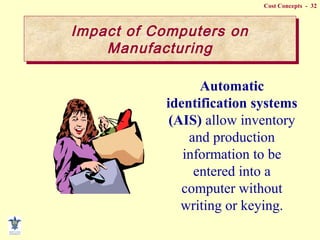
Automatic
identification systems
(AIS) allow inventory
and production
information to be
entered into a
computer without
writing or keying.
Cost Concepts - 33
Impact of Computers on
Manufacturing
Impact of Computers on
Manufacturing
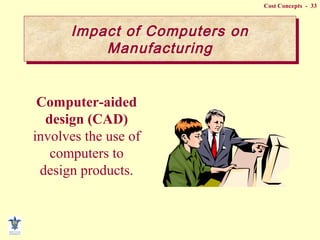
Computer-aided
design (CAD)
involves the use of
computers to
design products.
Cost Concepts - 34
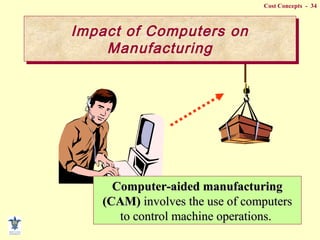
Computer-aided manufacturingComputer-aided manufacturing
(CAM)(CAM) involves the use of computersinvolves the use of computers
to control machine operations.to control machine operations.
Impact of Computers on
Manufacturing
Impact of Computers on
Manufacturing
Cost Concepts - 35
Impact of Computers on
Manufacturing
Impact of Computers on
Manufacturing
Flexible manufacturing
systems (FMS) are an extension
of computer-aided
manufacturing techniques
through a series of
manufacturing operations.
Flexible manufacturing
systems (FMS) are an extension
of computer-aided
manufacturing techniques
through a series of
manufacturing operations.
Computer-integrated
manufacturing (CIM) is the
ultimate extension of CAD, CAM,
and FMS concepts to a completed
automated and computer-
controlled factory.
Computer-integrated
manufacturing (CIM) is the
ultimate extension of CAD, CAM,
and FMS concepts to a completed
automated and computer-
controlled factory.
In their advanced stages, factories
utilizing flexible manufacturing
systems and computer-integrated
manufacturing are sometimes referred
to as “lights-out factories”because
they can be operated in the dark.
In their advanced stages, factories
utilizing flexible manufacturing
systems and computer-integrated
manufacturing are sometimes referred
to as “lights-out factories”because
they can be operated in the dark.

Cost concepts

  • 1.
    Cost Concepts -1 COST CONCEPTS AND CLASSIFICATIONS Fixed vs Direct vs Variable Indirect Functional vs Behavioral
  • 2.
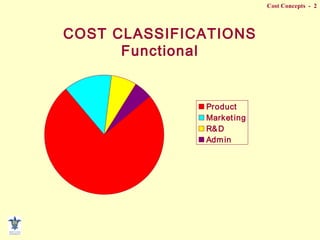
    Cost Concepts -2 COST CLASSIFICATIONS Functional Product Marketing R&D Admin
  • 3.
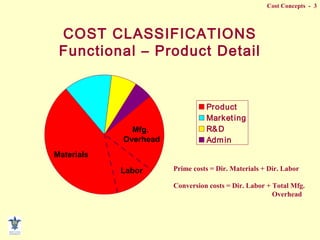
    Cost Concepts -3 COST CLASSIFICATIONS Functional – Product Detail Product Marketing R&D Admin Materials Labor Mfg. Overhead Prime costs = Dir. Materials + Dir. Labor Conversion costs = Dir. Labor + Total Mfg. Overhead
  • 4.
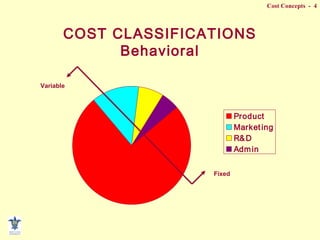
    Cost Concepts -4 COST CLASSIFICATIONS Behavioral Product Marketing R&D Admin Fixed Variable
  • 5.
    Cost Concepts -5 COST CLASSIFICATIONS Responsibility Product Marketing R&D Admin Fixed Variable A B C
  • 6.
    Cost Concepts -6 COST RELATIONSHIPS: MANUFACTURING COMPANY Direct Mat. (Beg) Direct Mat. Purchases Direct Mat. (End) Direct labor incurred Direct Mat. Used + - Overhead costs applied Tot. Mfg. Costs incurred Cost of Goods Mfg. Cost of Goods Sold WIP (Beg) WIP (End) ++ -- Fin Goods (End) Fin Goods (Beg) + + PRIOR PERIOD NEXT PERIOD
  • 7.
    Cost Concepts -7 Income Statement Manufacturing Company Beg. WIP + Direct Mat’l Used + Direct Labor + Mfg. Overhead - End. WIP = Cost of Goods Mfg.Cost of Goods Mfg. Beg. Fin. Goods + $2,400,000 Cost of Goods Mfg. $2,400,000 Cost of Goods Mfg. -End. Finished Goods = $2,600,000 Cost of Goods Sold $2,600,000 Cost of Goods Sold $4,000,000 Sales $4,000,000 Sales - $2,600,000 Cost of Goods Sold $2,600,000 Cost of Goods Sold = $1,400,000 Gross Margin $1,400,000 Gross Margin - • Selling expenses • Admin. expenses • Income taxes $900,000 Other Oper.Expenses $900,000 Other Oper.Expenses = $500,000 Net Income $500,000 Net Income
  • 8.
    Cost Concepts -8 • Selling Expenses • Administrative Expenses • Income taxes • Direct Materials/ Supplies • Direct Labor • Indirect Costs or Overhead INCOME STATEMENT Service Organization $2,600,000 Cost of Services $2,600,000 Cost of Services $900,000 Operating Expenses $900,000 Operating Expenses $4,000,000 Sales $4,000,000 Sales $500,000 Net Income $500,000 Net Income $1,400,000 Gross Margin $1,400,000 Gross Margin - = - =
  • 9.
    Cost Concepts -9 Total fixed costsTotal fixed costs do not respond to changesdo not respond to changes in unit level cost drivers within a period.in unit level cost drivers within a period. Total fixed costsTotal fixed costs do not respond to changesdo not respond to changes in unit level cost drivers within a period.in unit level cost drivers within a period. Total fixed costs (Y) Total activity (X) 0 0 Basic Cost Behavior PatternsBasic Cost Behavior Patterns
  • 10.
    Cost Concepts -10 Committed fixed costs are required to maintain the current service or production capacity to fill previous legal commitments. Committed fixed costs are required to maintain the current service or production capacity to fill previous legal commitments. Fixed CostsFixed Costs
  • 11.
    Cost Concepts -11 Discretionary fixed costs are set at a fixed amount each year at the discretion of management. Discretionary fixed costs are set at a fixed amount each year at the discretion of management. Fixed CostsFixed Costs
  • 12.
    Cost Concepts -12 Total variable costsTotal variable costs increase in proportionincrease in proportion to increases in unit level cost drivers.to increases in unit level cost drivers. Total variable costsTotal variable costs increase in proportionincrease in proportion to increases in unit level cost drivers.to increases in unit level cost drivers. Total variable costs (Y) Total activity (X) 0 0 Basic Cost Behavior PatternsBasic Cost Behavior Patterns
  • 13.
    Cost Concepts -13 Total mixed costsTotal mixed costs contain fixed and variablecontain fixed and variable cost elements. They increase, but not in directcost elements. They increase, but not in direct proportion to increases in unit level cost drivers.proportion to increases in unit level cost drivers. Total mixed costsTotal mixed costs contain fixed and variablecontain fixed and variable cost elements. They increase, but not in directcost elements. They increase, but not in direct proportion to increases in unit level cost drivers.proportion to increases in unit level cost drivers. Total mixed costs (Y) Total activity (X) 0 0 Sometimes called semivariable costs Basic Cost Behavior PatternsBasic Cost Behavior Patterns
  • 14.
    Cost Concepts -14 Total step costsTotal step costs are constant over a range ofare constant over a range of activity for a unit level cost driver but moves toactivity for a unit level cost driver but moves to a different amount at different ranges.a different amount at different ranges. Total step costsTotal step costs are constant over a range ofare constant over a range of activity for a unit level cost driver but moves toactivity for a unit level cost driver but moves to a different amount at different ranges.a different amount at different ranges. Total step costs (Y) Total activity (X) 0 0 Basic Cost Behavior PatternsBasic Cost Behavior Patterns
  • 15.
    Cost Concepts -15  Variable costs--The cost of the ingredients used to make the pizzas  Fixed costs--Depreciation, property taxes, and property insurance  Mixed costs--Cost of electricity  Step costs--Employee wages Basic Cost Behavior PatternsBasic Cost Behavior Patterns Pizza HutPizza Hut
  • 16.
    Cost Concepts -16 Total costs (Y) Value of independent variable (X) 0 0 Fixed costs (a) Variable costs (b) Total costs Y = a + bX Variable costs are layered on top of fixed costs. Variable costs are layered on top of fixed costs. Slope, b = ∆Y ∆X Total Cost Behavior With A Single Unit Level Cost Driver Total Cost Behavior With A Single Unit Level Cost Driver
  • 17.
    Cost Concepts -17 Y = a + bX total costsvertical axis intercept (an approximation of fixed costs) slope (an approximation of variable costs per unit of X) value of independent variable Equation for Total CostsEquation for Total Costs
  • 18.
    Cost Concepts -18 Methods for Separating Mixed Cost Into Fixed and Variable Components  Scatterplot Method  The High-Low Method  Specific quantitative methods – The Method of Least Squares
  • 19.
    Cost Concepts -19 Month Utility Costs Unit Produced January $2,000 200 February 2,500 400 March 4,500 600 April 5,000 800 May 7,500 1,000 Mixed Costs: An Example
  • 20.
    Cost Concepts -20 Units Produced Utility Cost $8,000 6,000 4,000 2,000 0 200 400 600 800 1,000 . Scatterplot Method . . . . Analyst can fit line based on his or her experience Important: Cost function is only relevant within relevant range
  • 21.
    Cost Concepts -21 High activity period Low activity period Number of Packaging Shipments Costs January 6,000 $17,000 February 9,000 26,000 March 12,000 32,000 April l0,000 20,000 Variable cost per unit (b) = Difference in total costs Difference in activity b = $32,000 - $17,000 12,000 - 6,000 Continued on nextContinued on next slideslide High-Low Cost EstimationHigh-Low Cost Estimation
  • 22.
    Cost Concepts -22 Variable cost per unit (b) = $2.50 JanuaryJanuary a = Total costs - Variable costs $17,000 = a + ($2.50 x 6,000 shipments) a = $2,000 MarchMarch $32,000 = a + ($2.50 x 12,000 shipments) a = $2,000 Same answer! High-Low Cost EstimationHigh-Low Cost Estimation
  • 23.
    Cost Concepts -23 Y = $2,000 x $2.50XY = $2,000 x $2.50XY = $2,000 x $2.50XY = $2,000 x $2.50X Total packing department costs Number of shipments High-Low Cost EstimationHigh-Low Cost Estimation
  • 24.
    Cost Concepts -24 Direct materials, the cost of primary raw materials converted into finished goods. The word “direct” indicates costs that are easily or directly traced to a finished product or service. Direct materials, the cost of primary raw materials converted into finished goods. The word “direct” indicates costs that are easily or directly traced to a finished product or service. Direct labor, the wages earned by production employees for the time they spend converting raw materials into finished products. Direct labor, the wages earned by production employees for the time they spend converting raw materials into finished products. Manufacturing overhead includes all manufacturing costs other than direct materials and direct labor. Manufacturing overhead includes all manufacturing costs other than direct materials and direct labor. Composition of Manufacturing Costs Composition of Manufacturing Costs
  • 25.
    Cost Concepts -25 Direct Materials Direct Labor Overhead to be Assigned Finished Goods Conventional Product Costing Work in Process Traceable Indirect ?
  • 26.
    Cost Concepts -26  Prime costs = Direct materials + Direct labor  Conversion costs = Direct labor + Manufacturing overhead (fixed & variable) Composition of Manufacturing Costs Composition of Manufacturing Costs
  • 27.
    Cost Concepts -27 Percent of Total Manufacturing Costs 0 100 1900 1950 2000 Year Total manufacturing costs Direct materials has increased Direct labor has decreased Manufacturing overhead has increased Changing Composition of Total Manufacturing Costs Changing Composition of Total Manufacturing Costs
  • 28.
    Cost Concepts -28 The Basic Concept of Overhead Application Applied overhead = Overhead rate x Actual activity  Applied overhead is the basis for computing per- unit overhead cost  Applied overhead is rarely equal to a period's actual overhead costs. Key considerations
  • 29.
    Cost Concepts -29 CONVENTIONAL PRODUCT COSTING Overhead Application Predetermined Total budgeted overhead Overhead Rate = Expected level of activity * • Conventional costing typically used volume (or a surrogate for volume such as DLH) • Problems - Budgeted overhead contains both fixed and variable costs - Selection of expected level of activity
  • 30.
    Cost Concepts -30 Select An Appropriate Activity Base Criterion: Cause and Effect Relationship Possible Measures of Production Activity 1. Units produced 2. Direct labor hours 3. Direct labor dollars 4. Machine hours 5. Direct materials Choice of Activity Base to be Used for Computing the Predetermined Overhead Rate
  • 31.
    Cost Concepts -31 Comparison of Traditional and Contemporary Cost Management Systems Cost Information System Traditional Contemporary 1. Unit-based drivers 2. Allocation intensive 3. Narrow view of product costs 4. Focus on cost mgt. 5. Little activity information 6. Maximizes unit production 7. Uses financial measures of performance 1. Uses of nonunit drivers 2. Tracing intensive 3. Expanded product costing 4. Managing activities 5. Detailed activity information 6. System-wide performance appraisals 7. Use of nonfinancial measures of performance
  • 32.
    Cost Concepts -32 Impact of Computers on Manufacturing Impact of Computers on Manufacturing Automatic identification systems (AIS) allow inventory and production information to be entered into a computer without writing or keying.
  • 33.
    Cost Concepts -33 Impact of Computers on Manufacturing Impact of Computers on Manufacturing Computer-aided design (CAD) involves the use of computers to design products.
  • 34.
    Cost Concepts -34 Computer-aided manufacturingComputer-aided manufacturing (CAM)(CAM) involves the use of computersinvolves the use of computers to control machine operations.to control machine operations. Impact of Computers on Manufacturing Impact of Computers on Manufacturing
  • 35.
    Cost Concepts -35 Impact of Computers on Manufacturing Impact of Computers on Manufacturing Flexible manufacturing systems (FMS) are an extension of computer-aided manufacturing techniques through a series of manufacturing operations. Flexible manufacturing systems (FMS) are an extension of computer-aided manufacturing techniques through a series of manufacturing operations. Computer-integrated manufacturing (CIM) is the ultimate extension of CAD, CAM, and FMS concepts to a completed automated and computer- controlled factory. Computer-integrated manufacturing (CIM) is the ultimate extension of CAD, CAM, and FMS concepts to a completed automated and computer- controlled factory. In their advanced stages, factories utilizing flexible manufacturing systems and computer-integrated manufacturing are sometimes referred to as “lights-out factories”because they can be operated in the dark. In their advanced stages, factories utilizing flexible manufacturing systems and computer-integrated manufacturing are sometimes referred to as “lights-out factories”because they can be operated in the dark.