WelcometoOurPresentation
ClassificationofCost
Group Members..
Name Id No.
Urmi Akter
Zakir Hossain
Moynul Islam
Shihab
Shanzida Binty Hafiz MBA180205111
Definition of Cost:
 An amount that has to be paid or given up in order to get something.
 In business, cost is usually a monetary valuation of (1) effort, (2) material, (3)
resources, (4) time and utilities consumed, (5) risks incurred, and (6) opportunity
forgone in production and delivery of a good or service. All expenses are costs,
but not all costs (such as those incurred in acquisition of an income-generating
asset) are expenses.
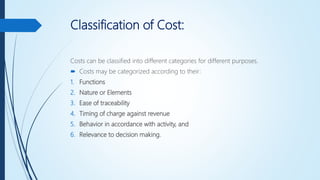
Classification of Cost:
Costs can be classified into different categories for different purposes.
 Costs may be categorized according to their:
1. Functions
2. Nature or Elements
3. Ease of traceability
4. Timing of charge against revenue
5. Behavior in accordance with activity, and
6. Relevance to decision making.
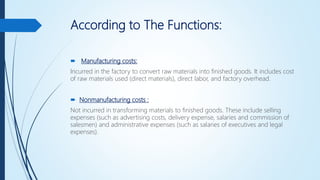
According to The Functions:
 Manufacturing costs:
Incurred in the factory to convert raw materials into finished goods. It includes cost
of raw materials used (direct materials), direct labor, and factory overhead.
 Nonmanufacturing costs :
Not incurred in transforming materials to finished goods. These include selling
expenses (such as advertising costs, delivery expense, salaries and commission of
salesmen) and administrative expenses (such as salaries of executives and legal
expenses).
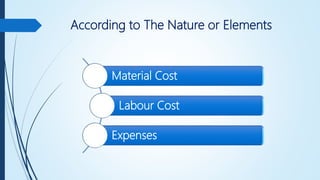
According to The Nature or Elements
Material Cost
Labour Cost
Expenses
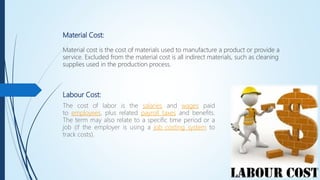
Material Cost:
Material cost is the cost of materials used to manufacture a product or provide a
service. Excluded from the material cost is all indirect materials, such as cleaning
supplies used in the production process.
Labour Cost:
The cost of labor is the salaries and wages paid
to employees, plus related payroll taxes and benefits.
The term may also relate to a specific time period or a
job (if the employer is using a job costing system to
track costs).
Expenses:
An expense is the reduction in value of an asset as it is used to
generate revenue. If the underlying asset is to be used over a long period of time,
the expense takes the form of depreciation, and is charged ratably over the useful
life of the asset.
According to Ease of Traceability
 Direct Costs:
Those that can be traced directly to a particular object of costing such as a particular product,
department, or branch. Examples include materials and direct labor. Some operating expenses
can also be classified as direct costs, such as advertising cost for a particular product.
 Indirect Costs:
Those that cannot be traced to a particular object of costing. They are also called common
costs or joint costs. Indirect costs include factory overhead and operating costs that benefit
more than one product, department, or branch.
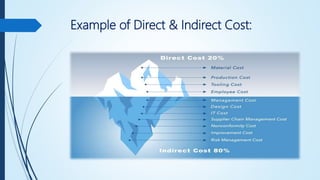
Example of Direct & Indirect Cost:
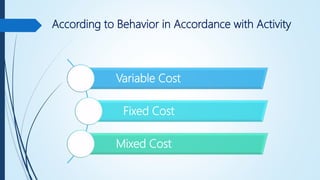
According to Behavior in Accordance with Activity
Variable Cost
Fixed Cost
Mixed Cost
Variable Cost:
These costs tend to vary with the volume of output. Any increase in the volume of
production results in an increase in the variable cost and vice versa. Example: cost of
material, cost of labour etc.
Fixed Cost:
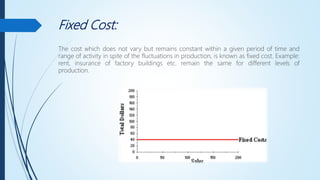
The cost which does not vary but remains constant within a given period of time and
range of activity in spite of the fluctuations in production, is known as fixed cost. Example:
rent, insurance of factory buildings etc. remain the same for different levels of
production.
Mixed Cost:
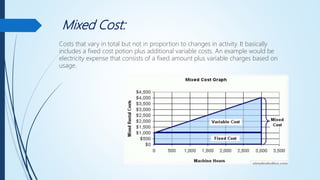
Costs that vary in total but not in proportion to changes in activity. It basically
includes a fixed cost potion plus additional variable costs. An example would be
electricity expense that consists of a fixed amount plus variable charges based on
usage.
Accounting cost classification p pt.

Accounting cost classification p pt.

  • 1.
  • 2.
    Group Members.. Name IdNo. Urmi Akter Zakir Hossain Moynul Islam Shihab Shanzida Binty Hafiz MBA180205111
  • 3.
    Definition of Cost: An amount that has to be paid or given up in order to get something.  In business, cost is usually a monetary valuation of (1) effort, (2) material, (3) resources, (4) time and utilities consumed, (5) risks incurred, and (6) opportunity forgone in production and delivery of a good or service. All expenses are costs, but not all costs (such as those incurred in acquisition of an income-generating asset) are expenses.
  • 4.
    Classification of Cost: Costscan be classified into different categories for different purposes.  Costs may be categorized according to their: 1. Functions 2. Nature or Elements 3. Ease of traceability 4. Timing of charge against revenue 5. Behavior in accordance with activity, and 6. Relevance to decision making.
  • 5.
    According to TheFunctions:  Manufacturing costs: Incurred in the factory to convert raw materials into finished goods. It includes cost of raw materials used (direct materials), direct labor, and factory overhead.  Nonmanufacturing costs : Not incurred in transforming materials to finished goods. These include selling expenses (such as advertising costs, delivery expense, salaries and commission of salesmen) and administrative expenses (such as salaries of executives and legal expenses).
  • 6.
    According to TheNature or Elements Material Cost Labour Cost Expenses
  • 7.
    Material Cost: Material costis the cost of materials used to manufacture a product or provide a service. Excluded from the material cost is all indirect materials, such as cleaning supplies used in the production process. Labour Cost: The cost of labor is the salaries and wages paid to employees, plus related payroll taxes and benefits. The term may also relate to a specific time period or a job (if the employer is using a job costing system to track costs).
  • 8.
    Expenses: An expense isthe reduction in value of an asset as it is used to generate revenue. If the underlying asset is to be used over a long period of time, the expense takes the form of depreciation, and is charged ratably over the useful life of the asset.
  • 9.
    According to Easeof Traceability  Direct Costs: Those that can be traced directly to a particular object of costing such as a particular product, department, or branch. Examples include materials and direct labor. Some operating expenses can also be classified as direct costs, such as advertising cost for a particular product.  Indirect Costs: Those that cannot be traced to a particular object of costing. They are also called common costs or joint costs. Indirect costs include factory overhead and operating costs that benefit more than one product, department, or branch.
  • 10.
    Example of Direct& Indirect Cost:
  • 11.
    According to Behaviorin Accordance with Activity Variable Cost Fixed Cost Mixed Cost
  • 12.
    Variable Cost: These coststend to vary with the volume of output. Any increase in the volume of production results in an increase in the variable cost and vice versa. Example: cost of material, cost of labour etc.
  • 13.
    Fixed Cost: The costwhich does not vary but remains constant within a given period of time and range of activity in spite of the fluctuations in production, is known as fixed cost. Example: rent, insurance of factory buildings etc. remain the same for different levels of production.
  • 14.
    Mixed Cost: Costs thatvary in total but not in proportion to changes in activity. It basically includes a fixed cost potion plus additional variable costs. An example would be electricity expense that consists of a fixed amount plus variable charges based on usage.