Cost  Classifications Chapter 2
Classification of cost According to: Nature/ Elements Function  Degree of traceability to product Change in volume Controllability Normality
Classification of cost contd…. Time Planning & control In relationship with accounting period Association with product Managerial decisions
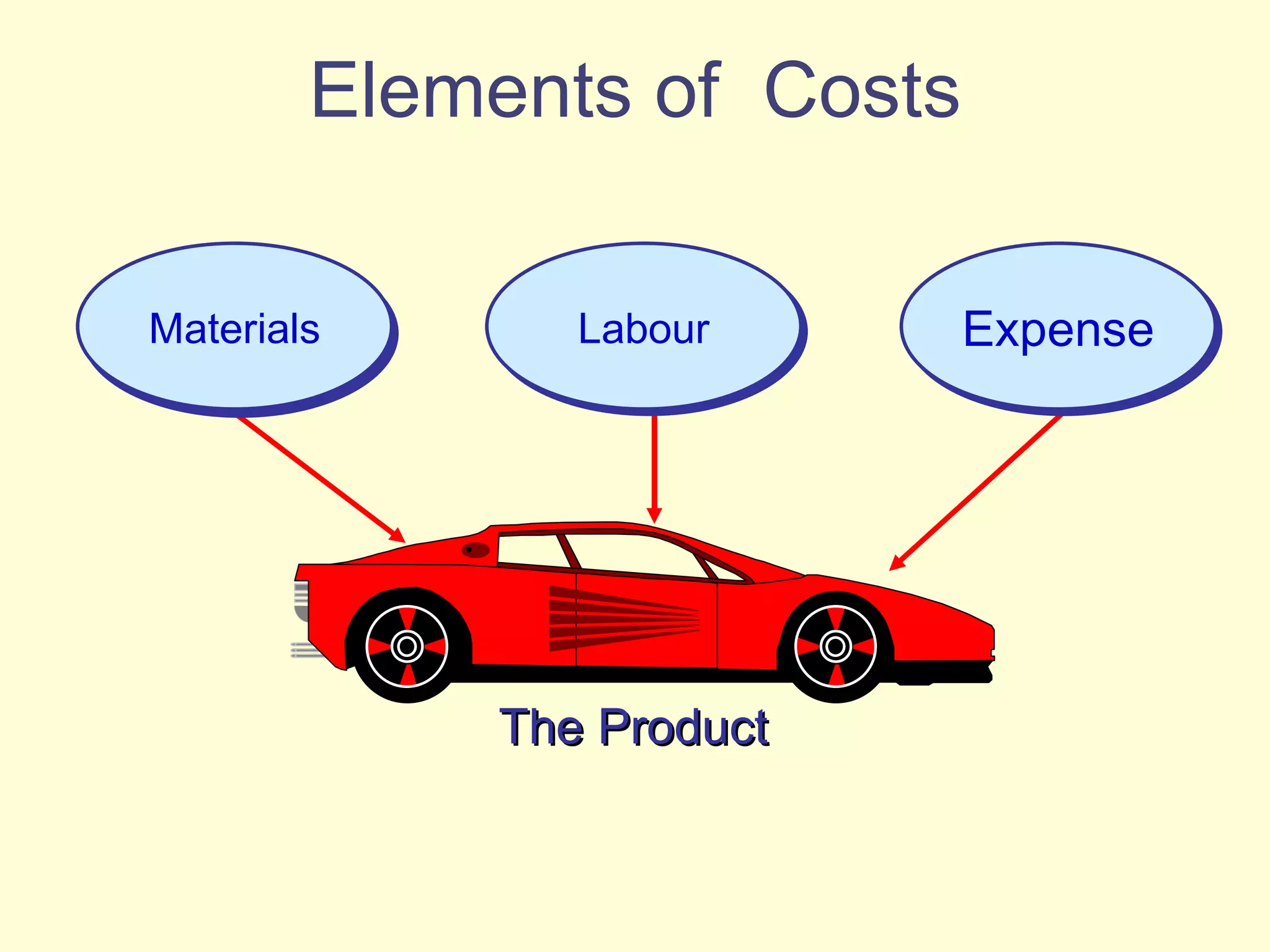
Elements of  Costs The Product Materials Labour Expense
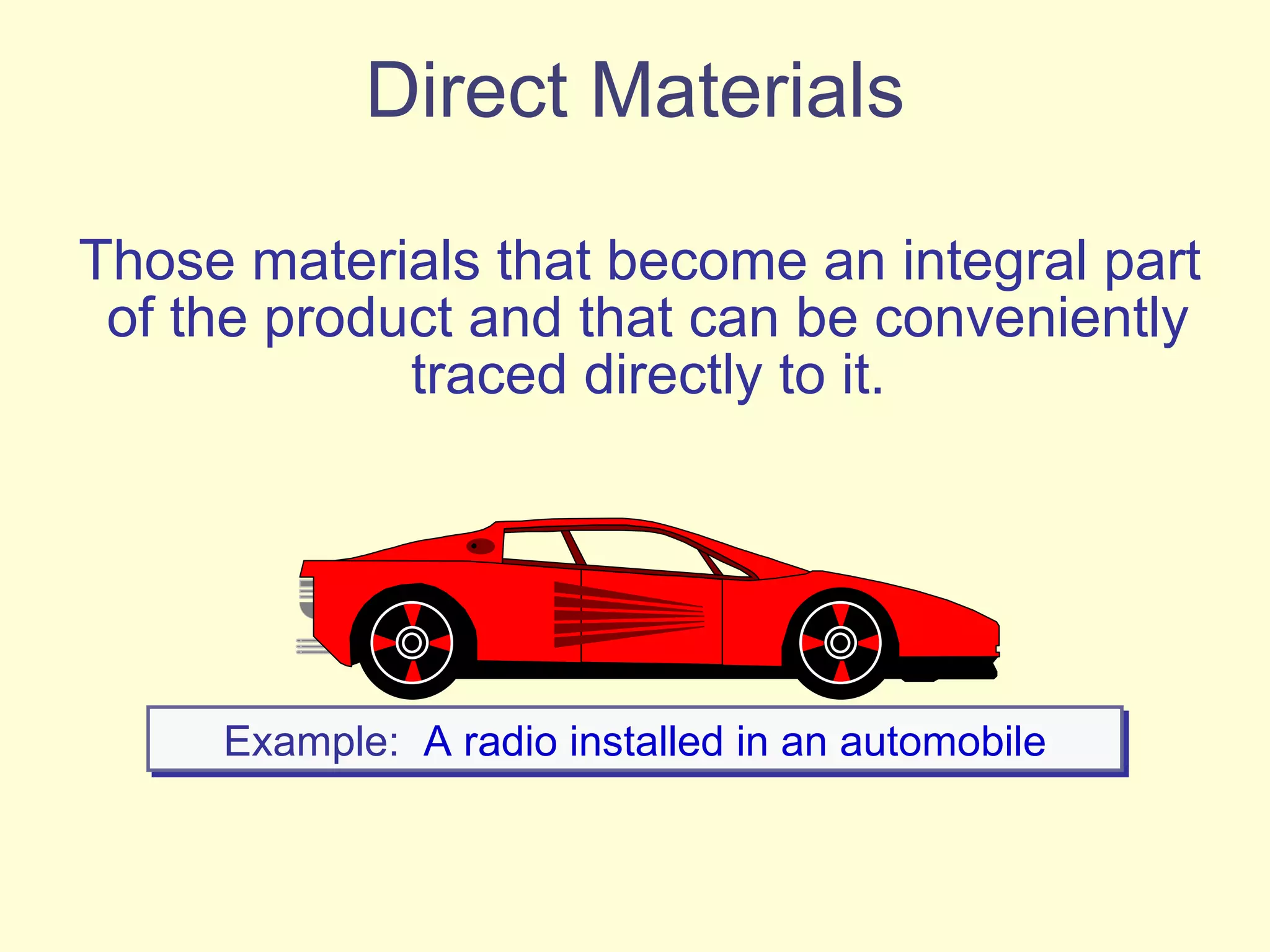
Direct Materials Those materials that become an integral part of the product and that can be conveniently traced directly to it. Example:   A radio installed in an automobile
Indirect Material Those materials that  do not become an integral part of the product but which helps in production.  Example: indirect materials Materials used to support the production process.  Examples:   lubricants and cleaning supplies used in the automobile assembly plant.
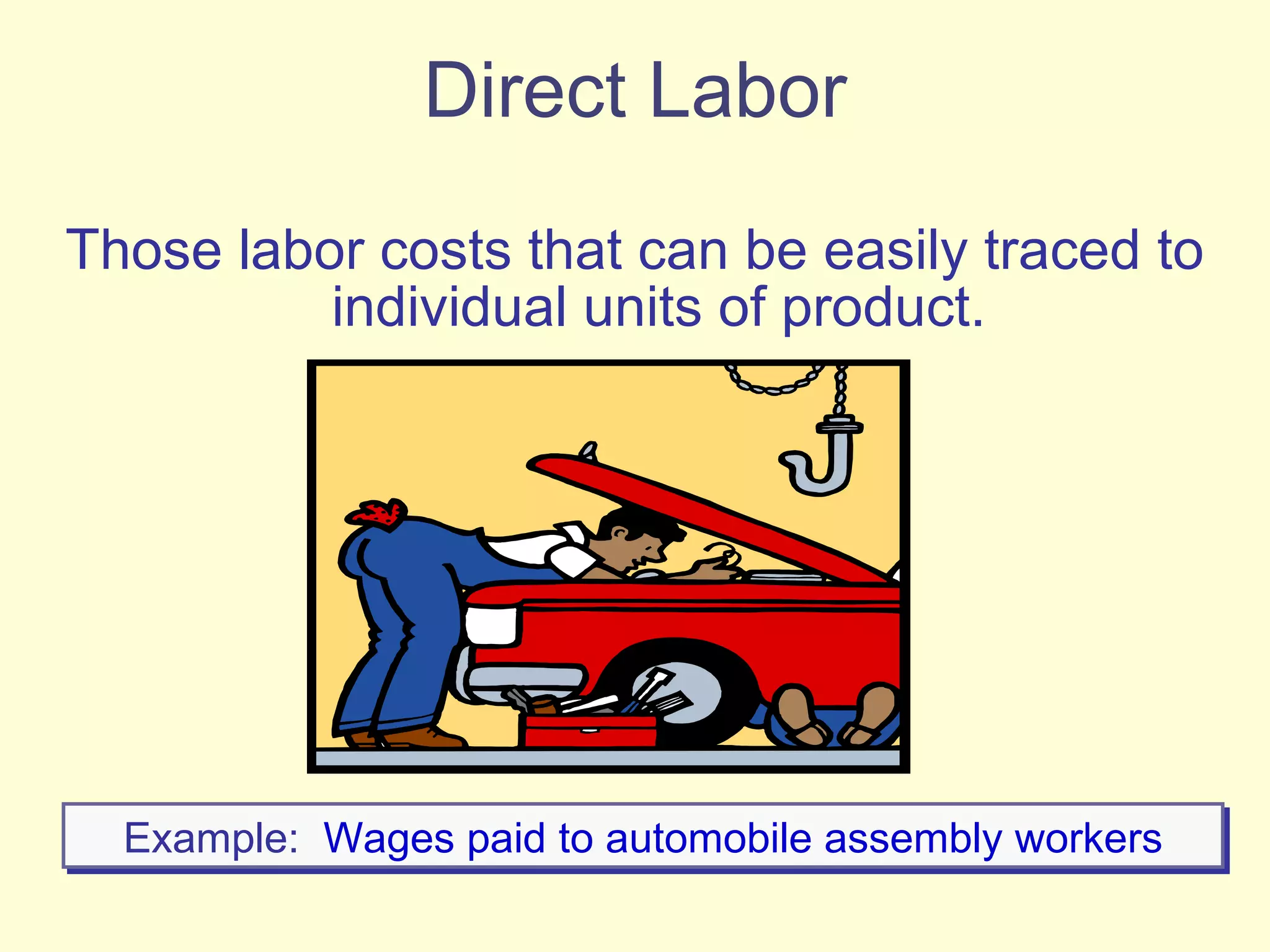
Direct Labor Those labor costs that can be easily traced to individual units of product. Example:   Wages paid to automobile assembly workers
Indirect Labour Those labor costs that cannot be easily traced to individual units of product. Examples:   Indirect labor  Wages paid to employees who are not directly involved in production work.  Examples:   maintenance workers, janitors and security guards.
Expense  The cost of services provided to an undertaking and the notional cost of the use of owned asset. Expenses are of two types: Direct expense Indirect expense
Expense Direct expense is an expense which is incurred with manufacture of a product.  Eg: Purchase of raw materials, factory labour, factory wages, electricity  Indirect expense also called as overhead are additional expenses which are incurred on bringing a product to final customer. Eg: Sales and Distribution, Office Salary,  office electricity, office water, printing and stationery, outsourcing expenses, advertising expenses etc.
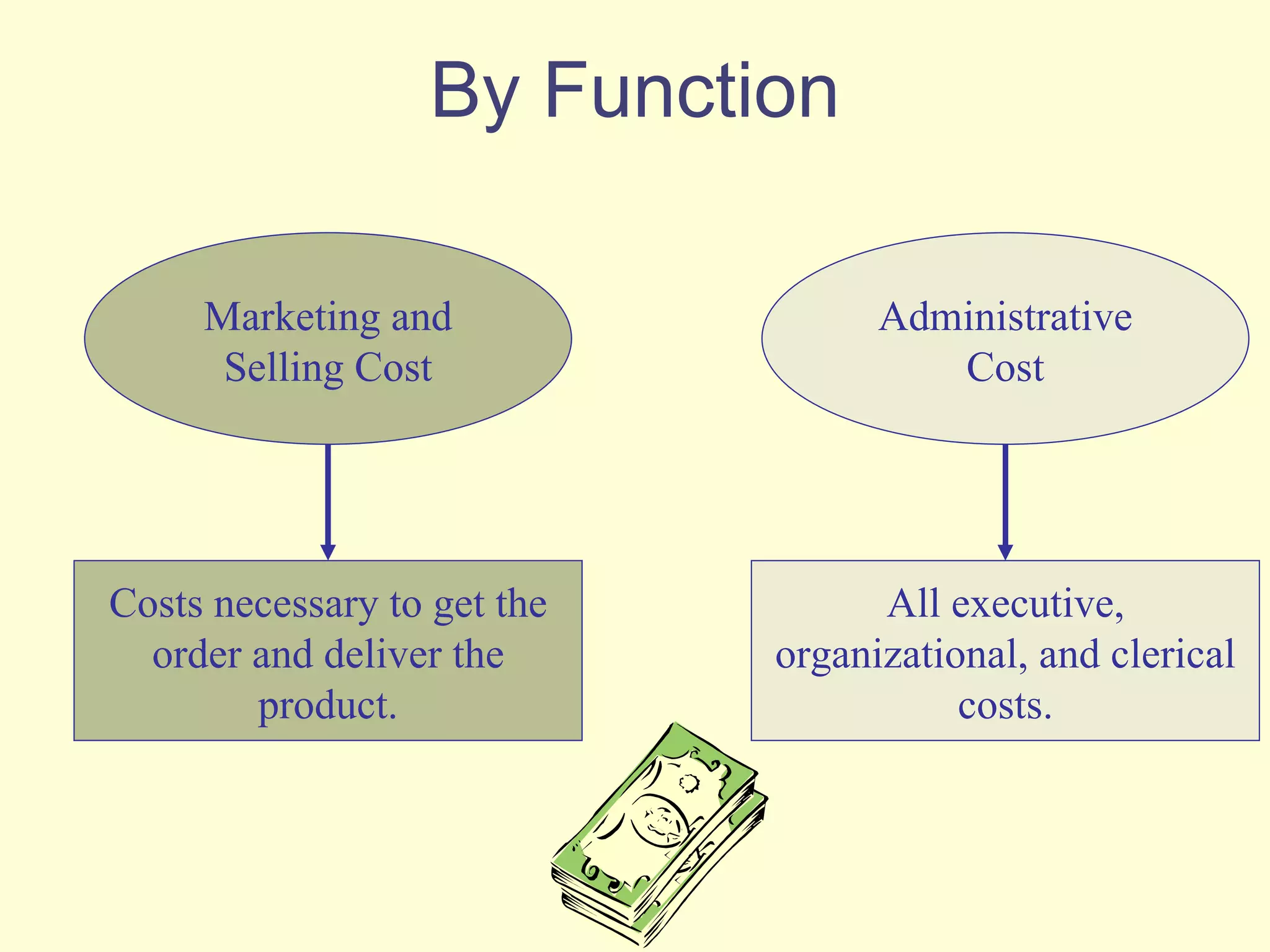
By Function Marketing and Selling Cost Costs necessary to get the order and deliver the product. Administrative Cost All executive, organizational, and clerical costs.
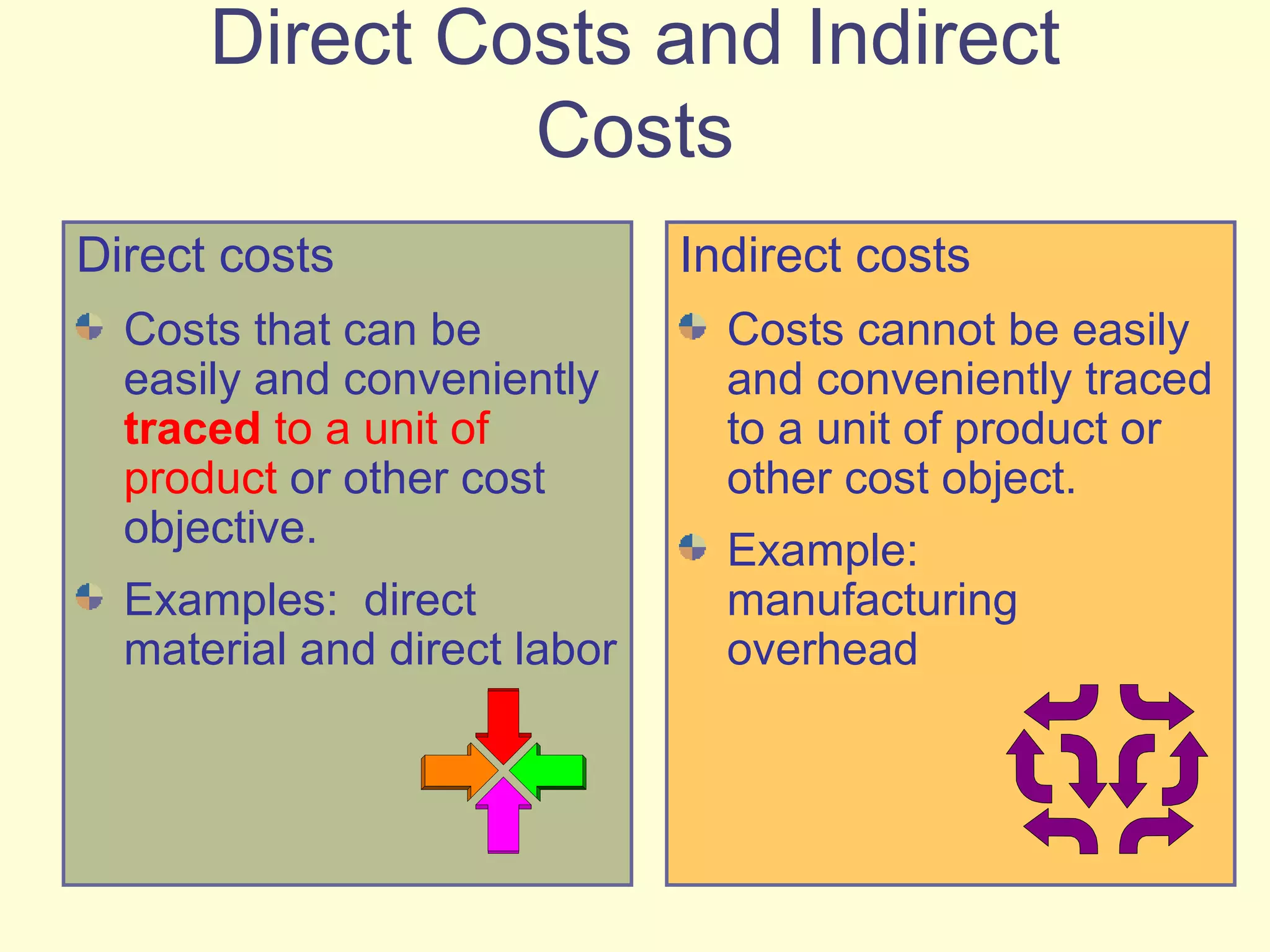
Direct Costs and Indirect Costs Direct costs Costs that can be easily and conveniently  traced  to a unit of product  or other cost objective. Examples:  direct material and direct labor Indirect costs Costs cannot be easily and conveniently traced to a unit of product or other cost object.  Example:  manufacturing overhead
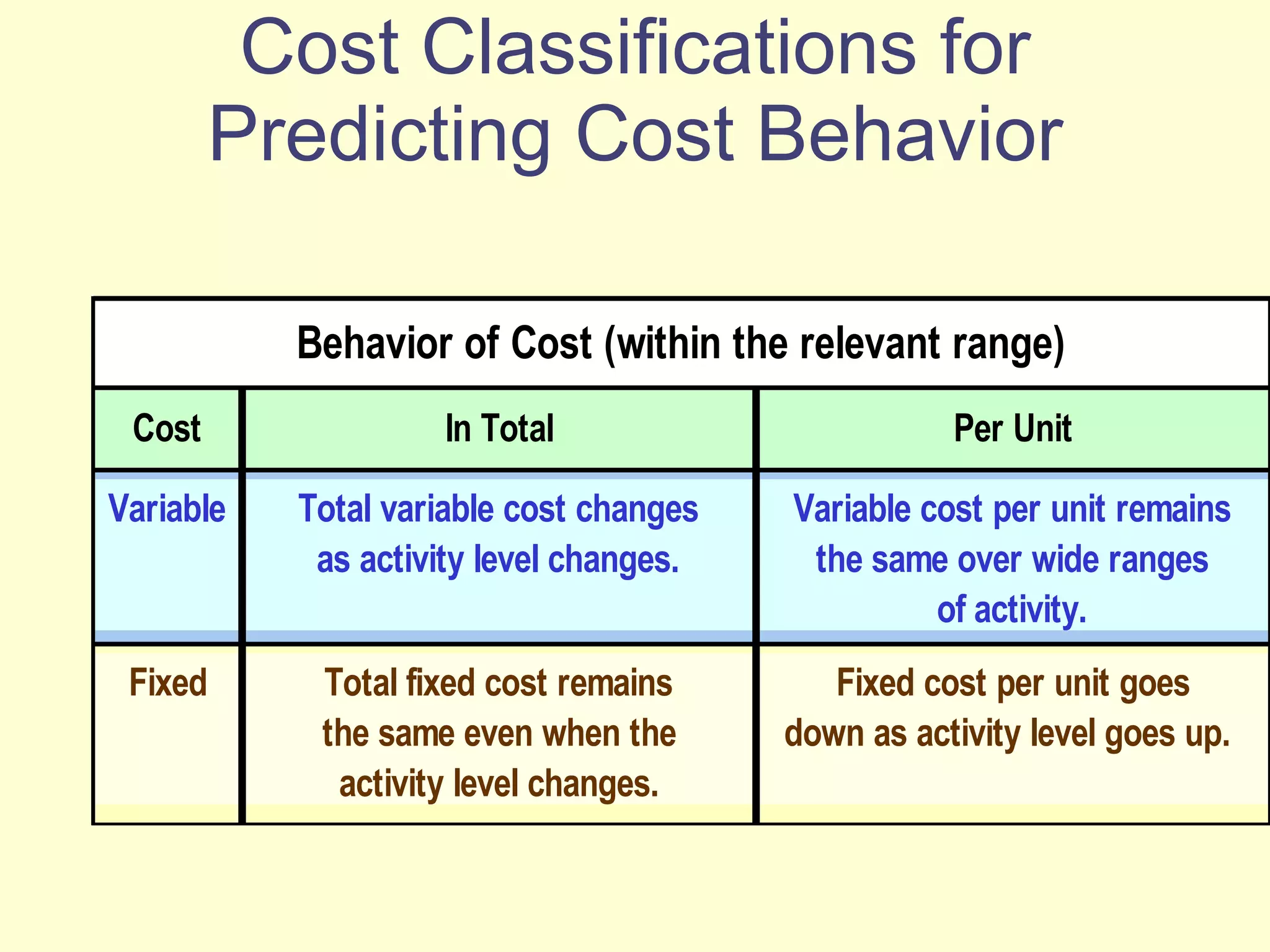
Cost Classifications for Predicting Cost Behavior How a cost will react to  changes  in the level of business activity. Total  variable costs   change when  activity  changes. Total  fixed costs   remain unchanged when  activity  changes.
A Cell Phone Bill…. Family Plan for cell phone usage, unlimited nights and weekends, $60.00 Includes 250 text messages Any text messages above 250 are $0.10 per text sent AND $0.10 text received. You do NOT have a DATA PLAN and pay $0.01 per KB
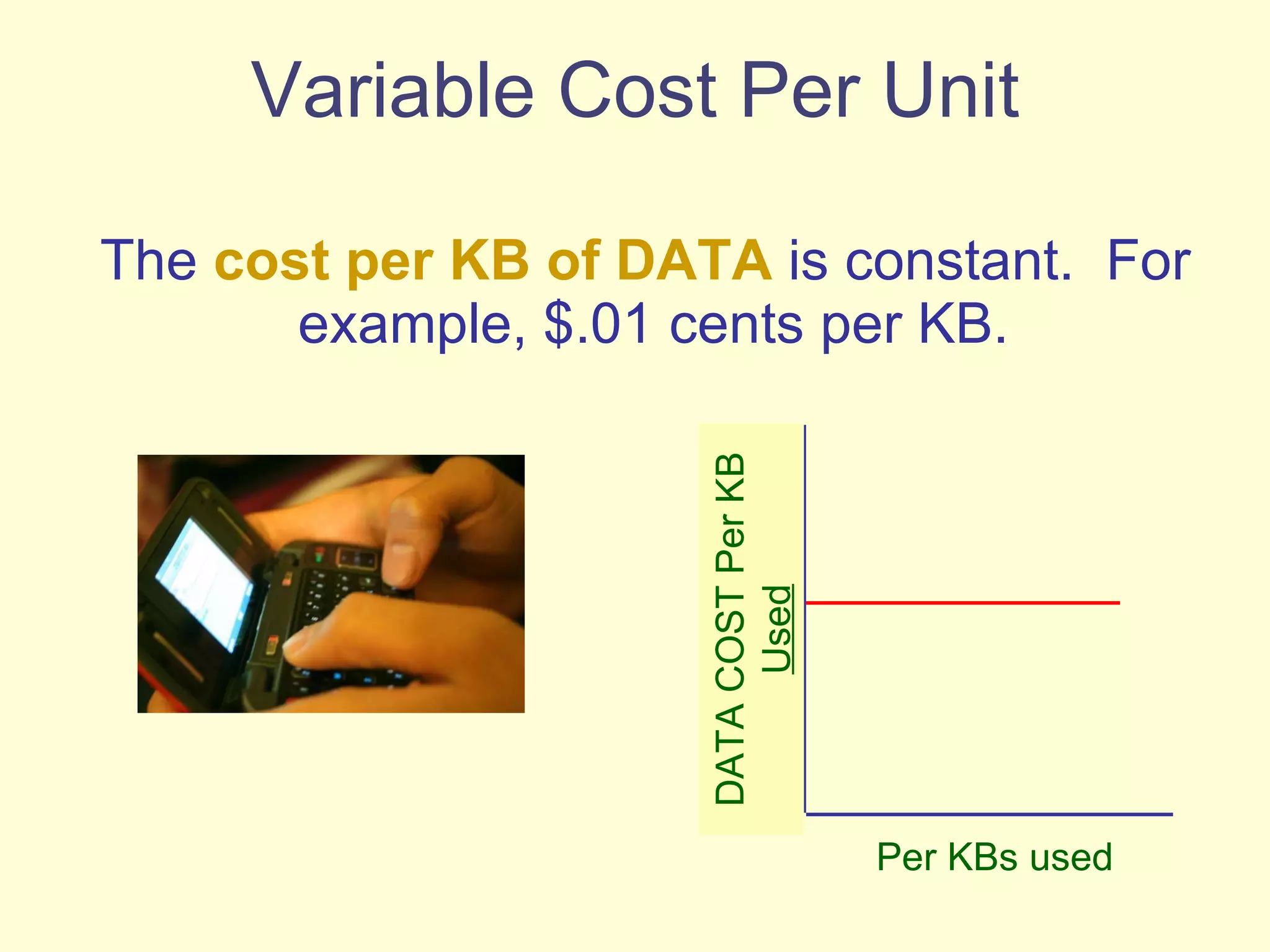
Variable Cost Per Unit The  cost per KB of DATA  is constant.  For example, $.01 cents per KB. DATA COST Per KB  Used Per KBs used Per Minute Telephone Charge
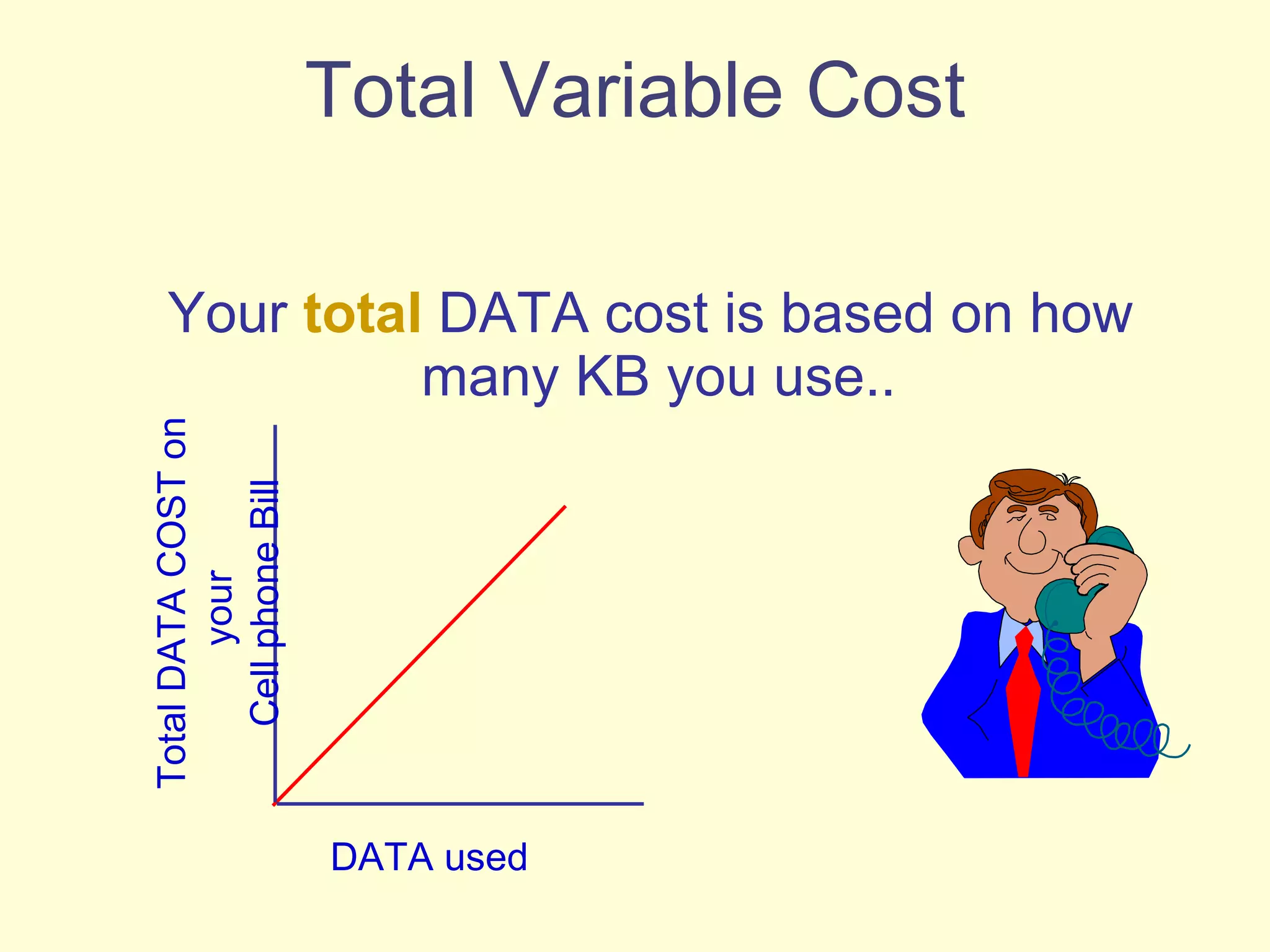
Total Variable Cost Your  total  DATA cost is based on how many KB you use.. DATA used Total DATA COST on your  Cell phone Bill
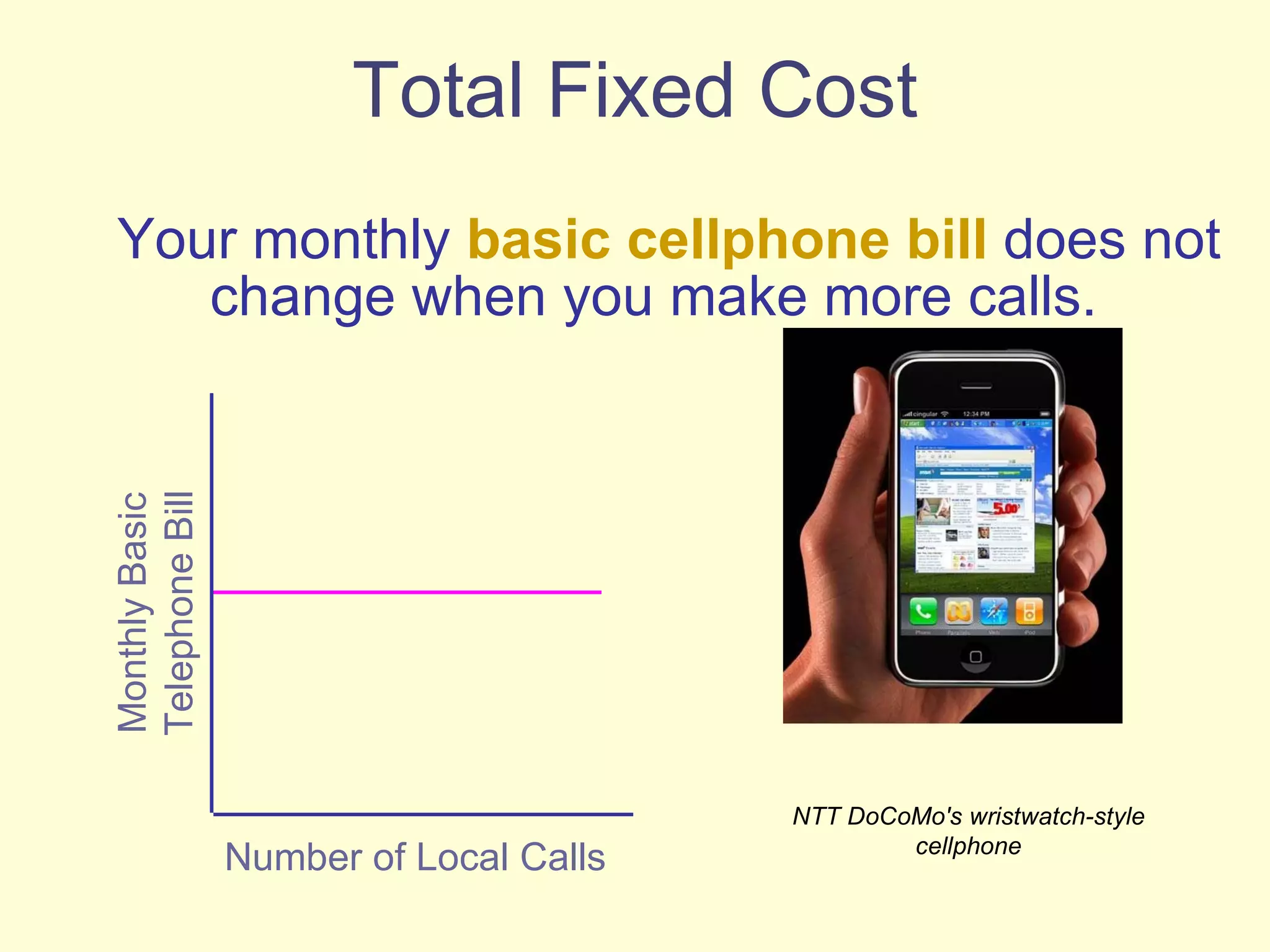
Total Fixed Cost Your monthly  basic cellphone bill  does not change when you make more calls.  NTT DoCoMo's wristwatch-style cellphone Number of Local Calls Monthly Basic Telephone Bill
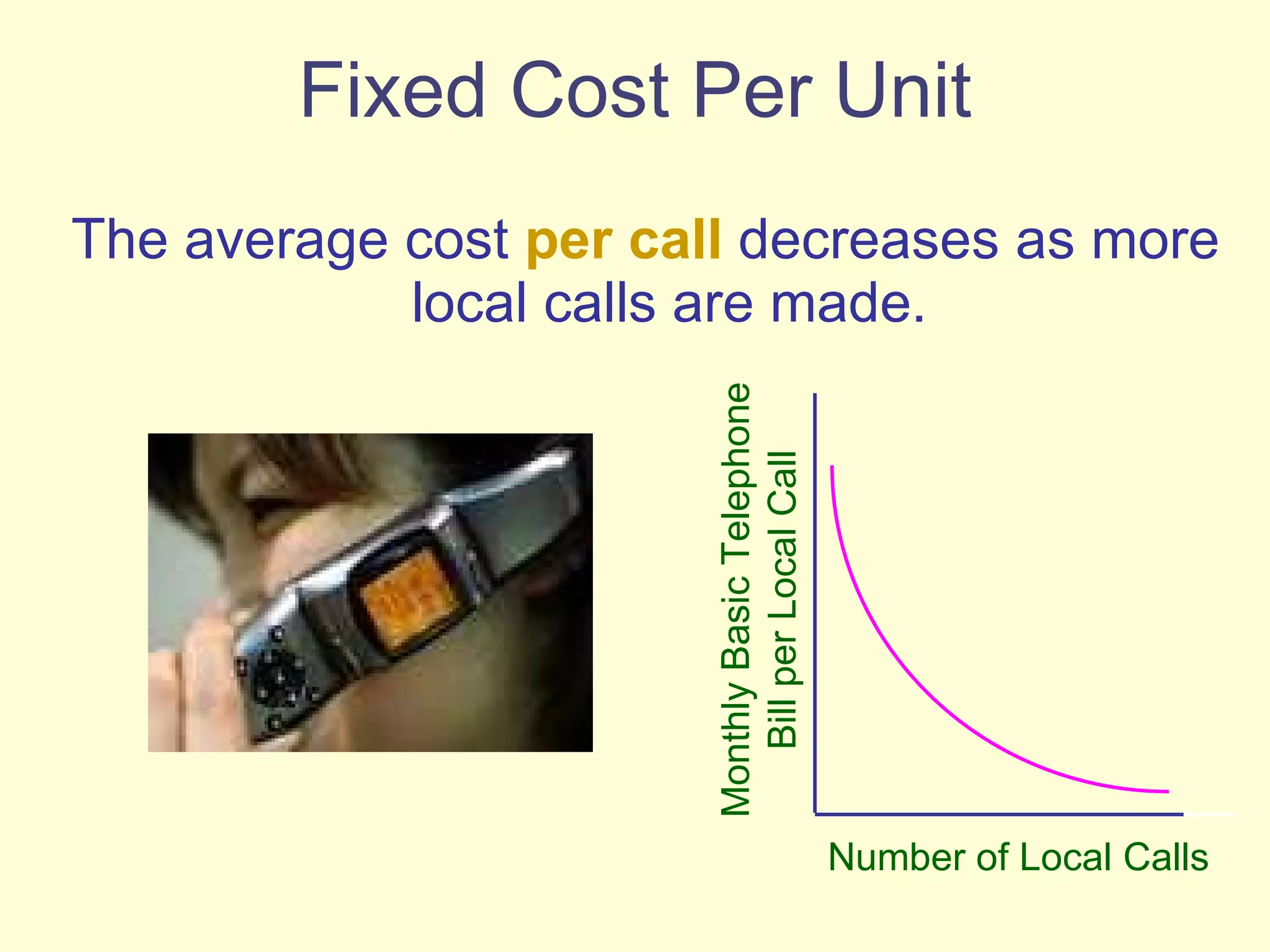
Fixed Cost Per Unit The average cost  per call  decreases as more local calls are made. Number of Local Calls  Monthly Basic Telephone Bill per Local Call
Cost Classifications for Predicting Cost Behavior
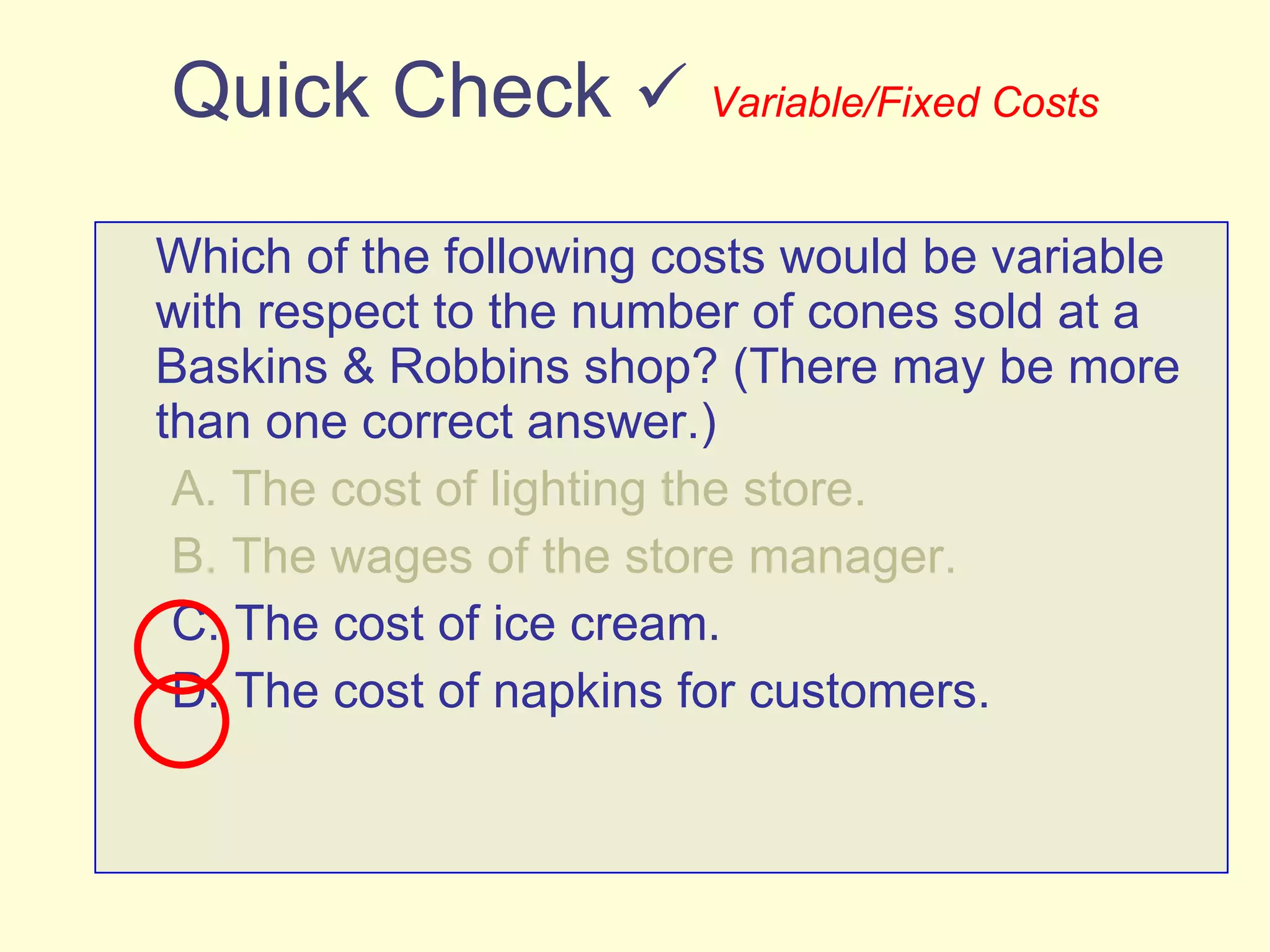
Quick Check     Variable/Fixed Costs Which of the following costs would be variable with respect to the number of cones sold at a Baskins & Robbins shop? (There may be more than one correct answer.) A. The cost of lighting the store. B. The wages of the store manager. C. The cost of ice cream. D. The cost of napkins for customers.
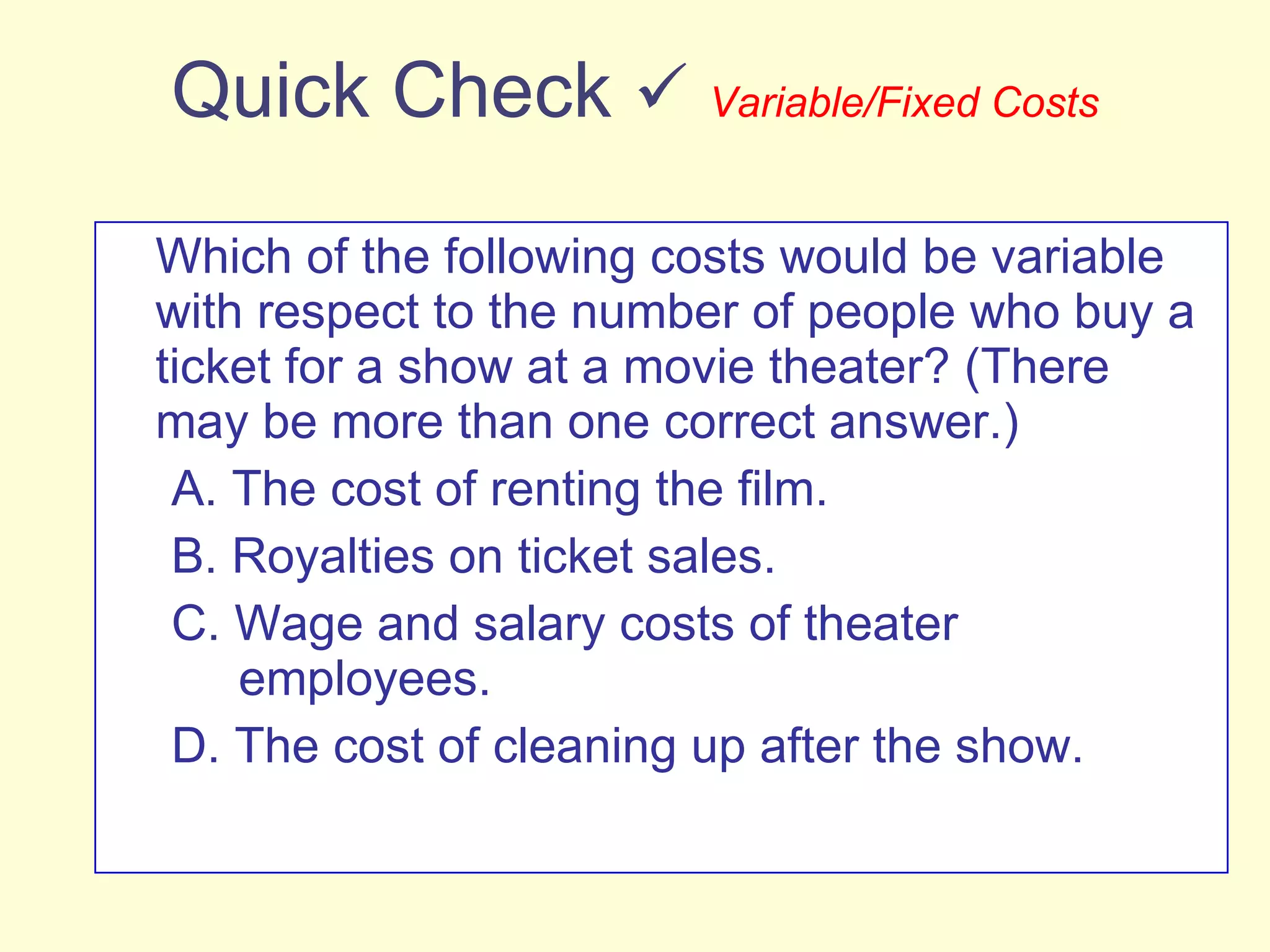
Quick Check     Variable/Fixed Costs Which of the following costs would be variable with respect to the number of people who buy a ticket for a show at a movie theater? (There may be more than one correct answer.) A. The cost of renting the film. B. Royalties on ticket sales. C. Wage and salary costs of theater    employees. D. The cost of cleaning up after the show.
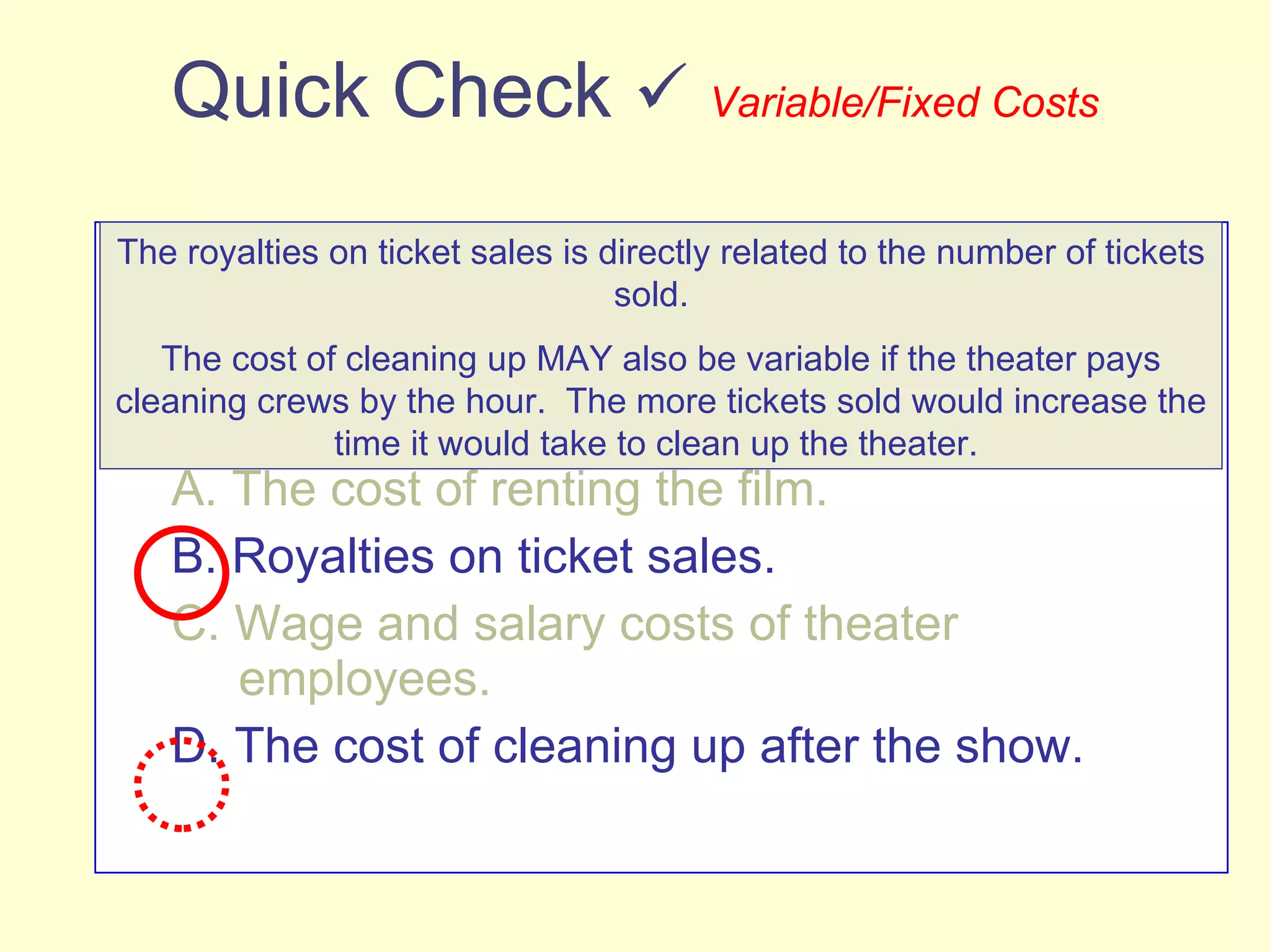
Quick Check     Variable/Fixed Costs Which of the following costs would be variable with respect to the number of people who buy a ticket for a show at a movie theater? (There may be more than one correct answer.) A. The cost of renting the film. B. Royalties on ticket sales. C. Wage and salary costs of theater    employees. D. The cost of cleaning up after the show. The royalties on ticket sales is directly related to the number of tickets sold.  The cost of cleaning up MAY also be variable if the theater pays cleaning crews by the hour.  The more tickets sold would increase the time it would take to clean up the theater.
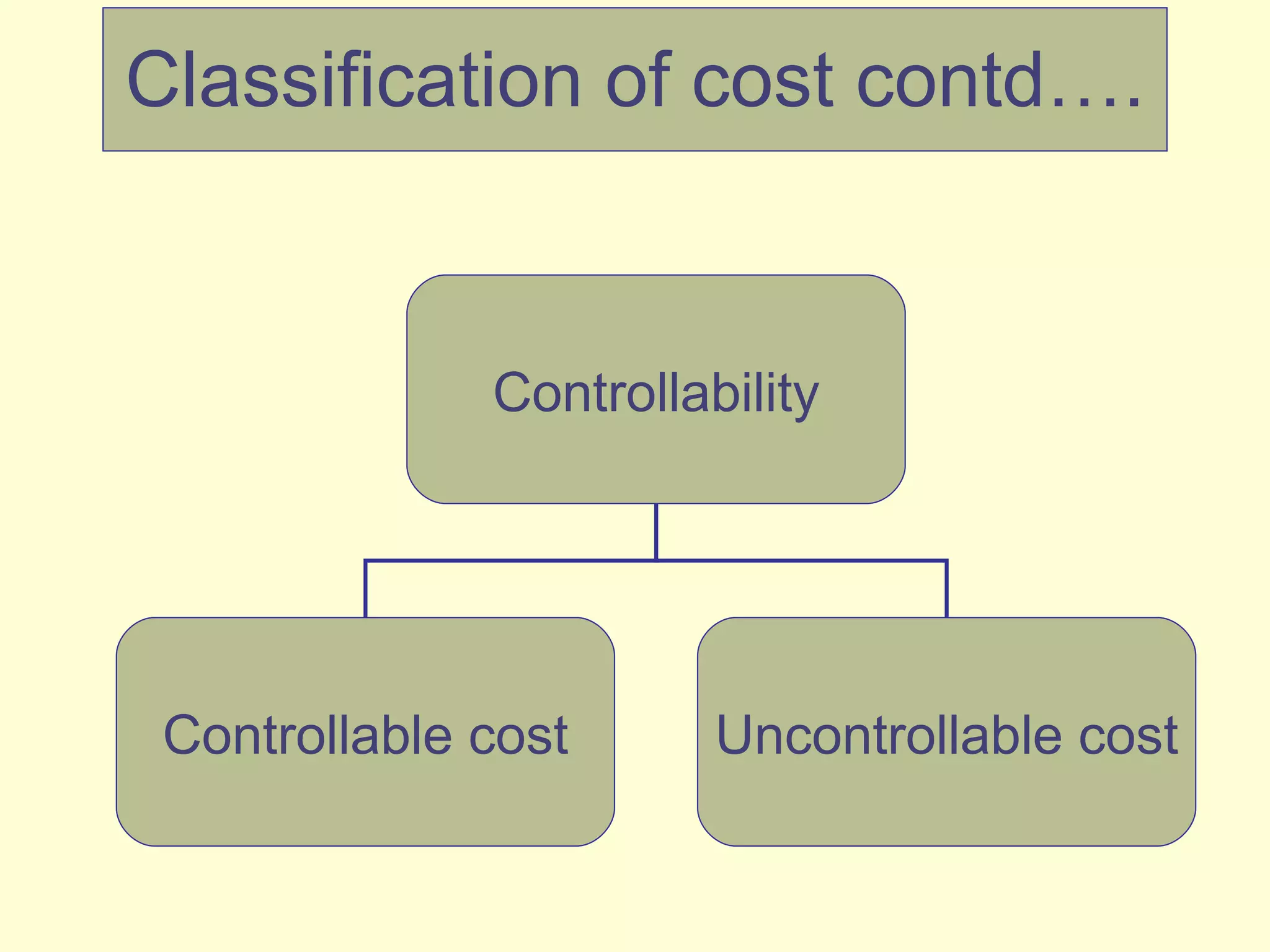
Classification of cost contd…. Controllability Controllable cost Uncontrollable cost
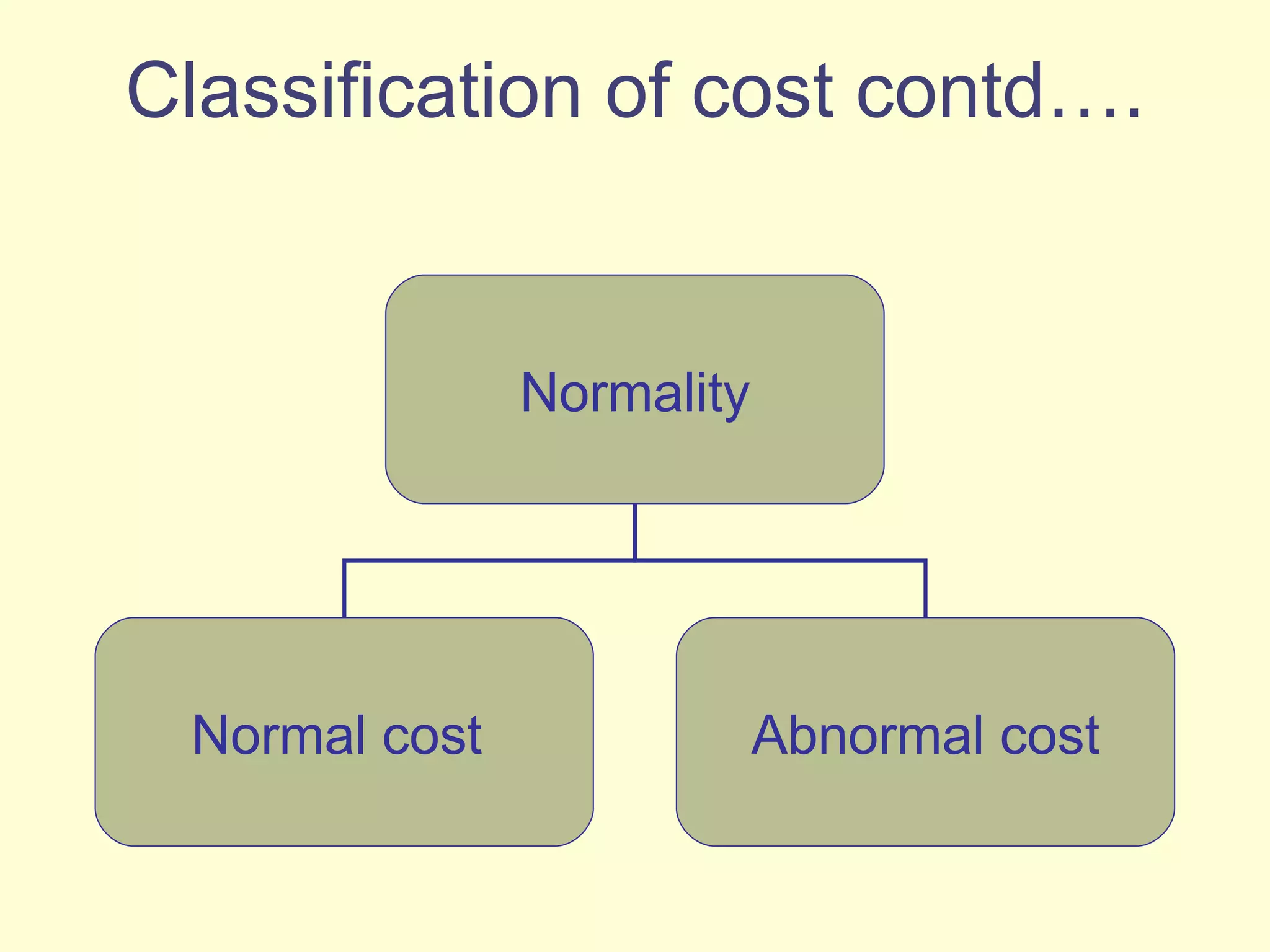
Classification of cost contd…. Normality Normal cost  Abnormal cost
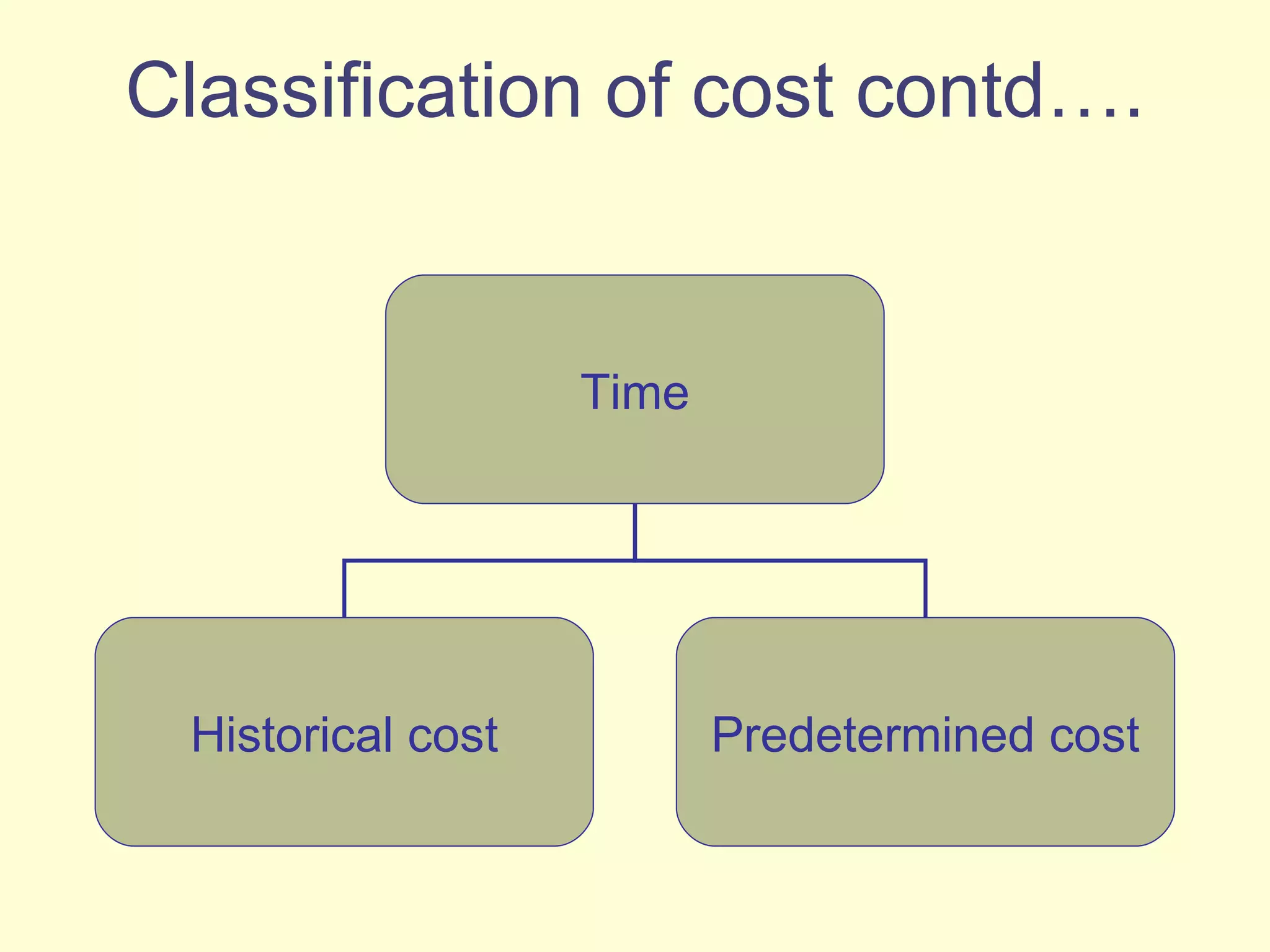
Classification of cost contd…. Time Historical cost Predetermined cost
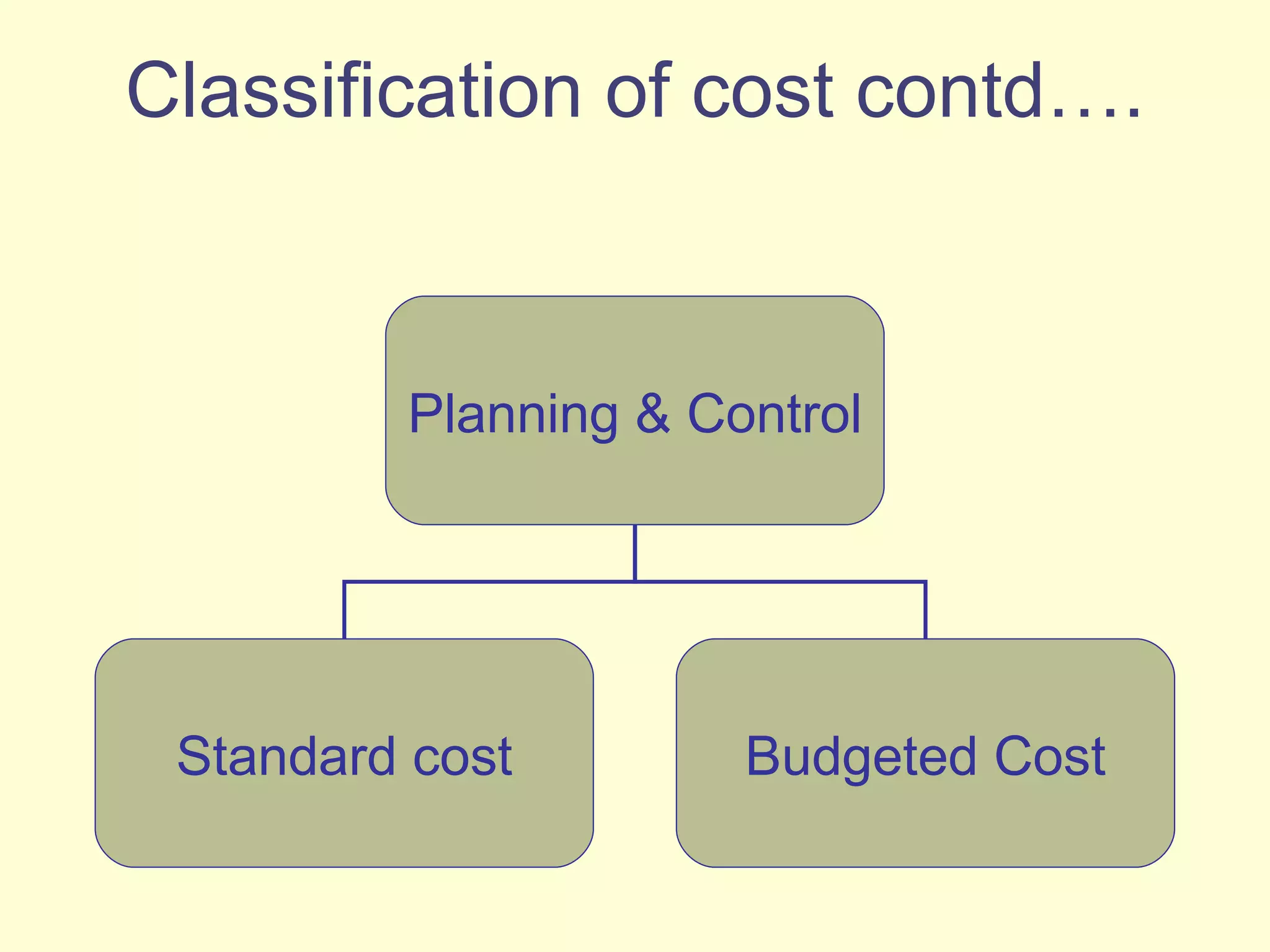
Classification of cost contd…. Planning & Control Standard cost Budgeted Cost
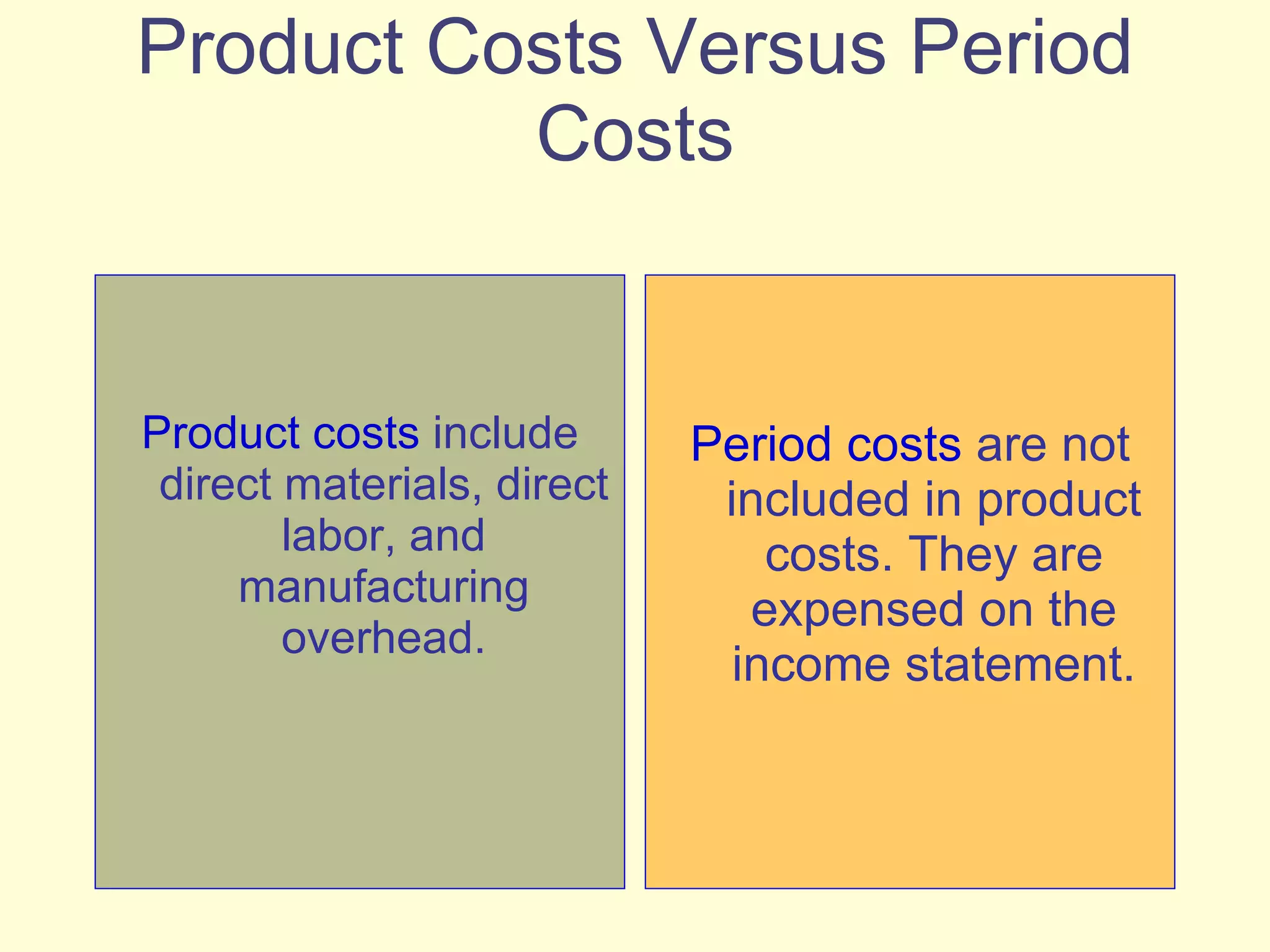
Product Costs Versus Period Costs Product costs  include direct materials, direct labor, and manufacturing overhead. Period costs  are not included in product costs. They are expensed on the income statement.
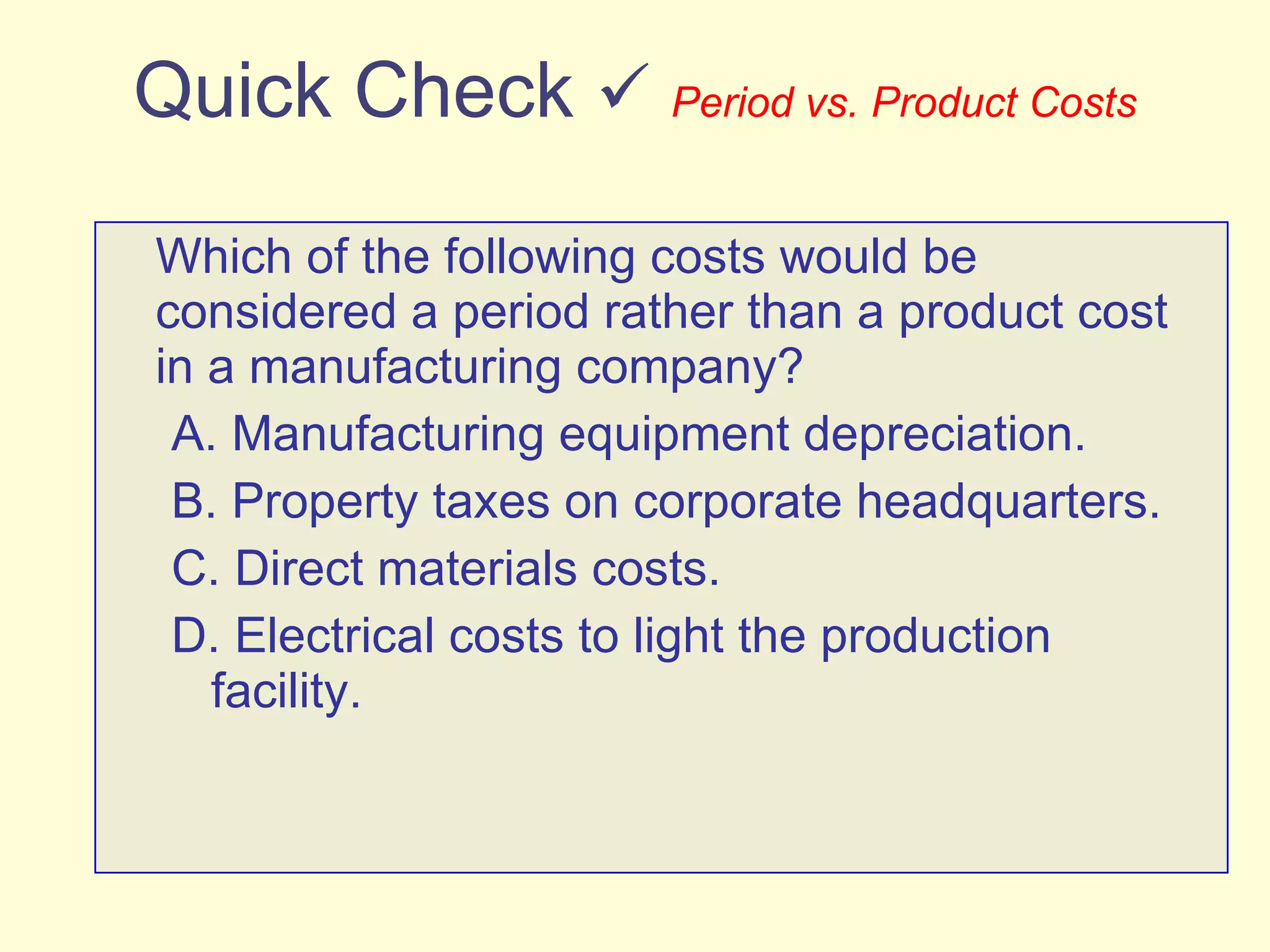
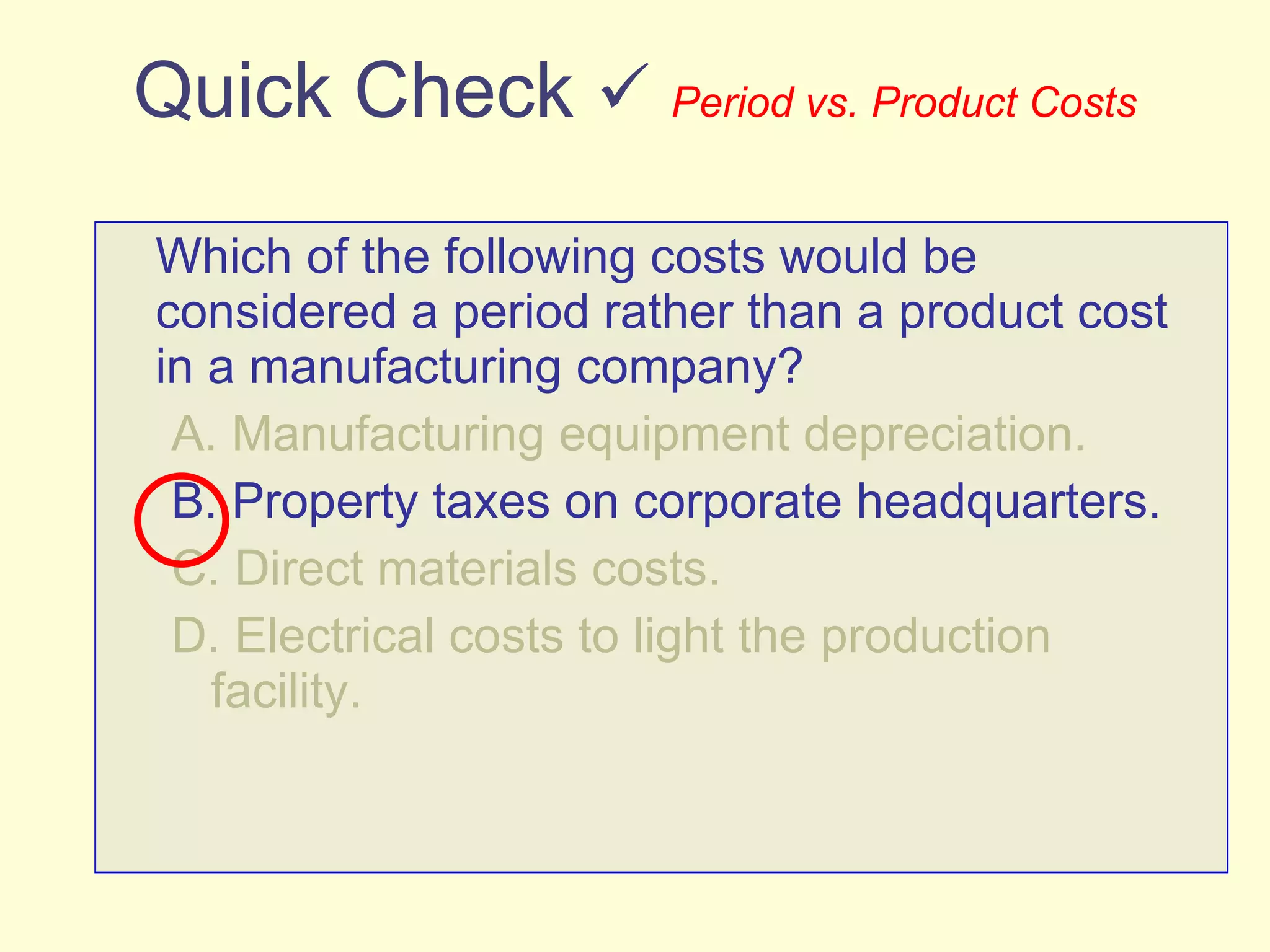
Quick Check     Period vs. Product Costs Which of the following costs would be considered a period rather than a product cost in a manufacturing company? A. Manufacturing equipment depreciation. B. Property taxes on corporate headquarters. C. Direct materials costs. D. Electrical costs to light the production facility.
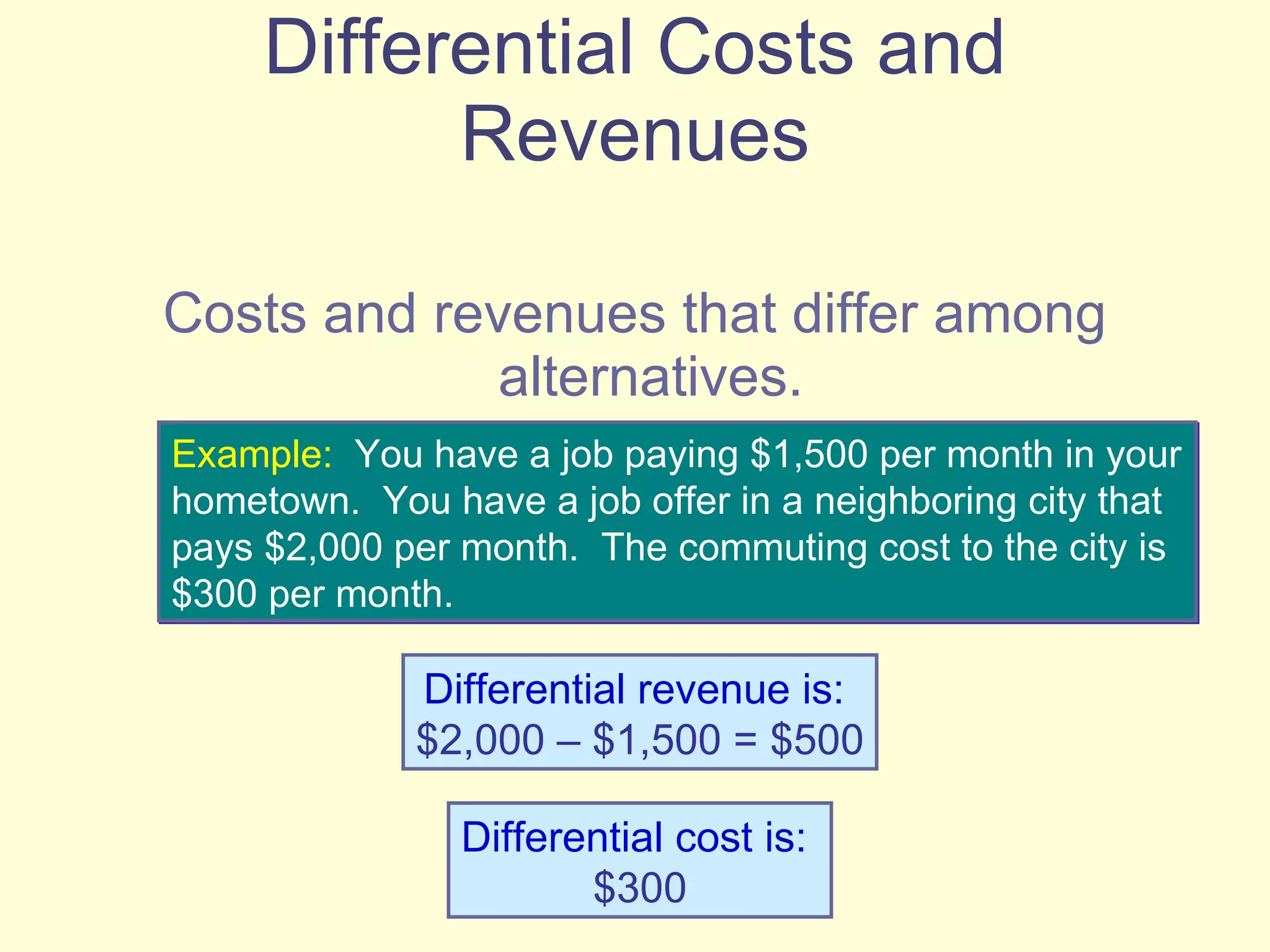
Differential Costs and Revenues Costs and revenues that differ among alternatives.  Example:   You have a job paying $1,500 per month in your hometown.  You have a job offer in a neighboring city that pays $2,000 per month.  The commuting cost to the city is $300 per month.  Differential revenue is:   $2,000 – $1,500 = $500 Differential cost is:   $300
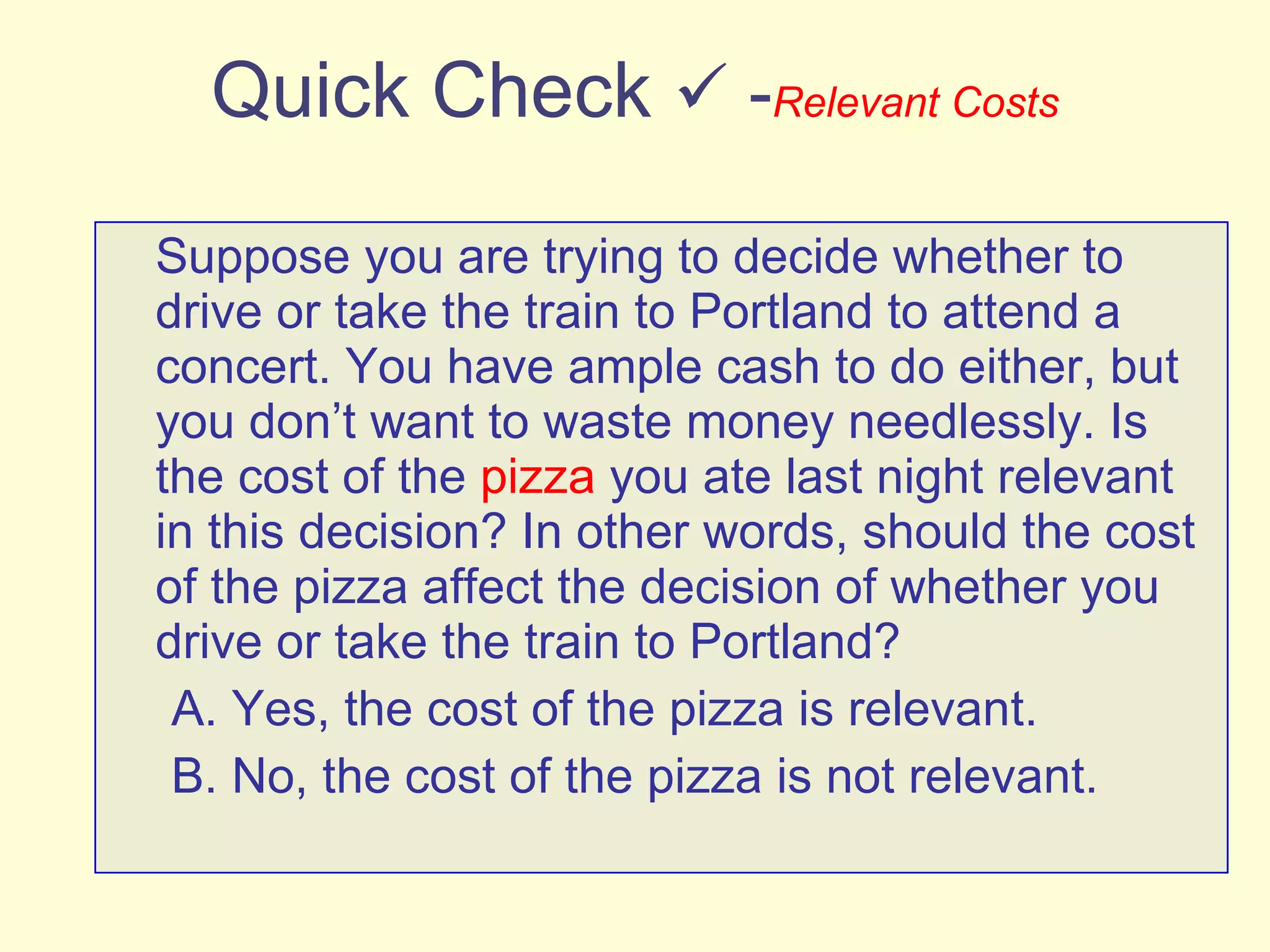
Quick Check    - Relevant Costs Suppose you are trying to decide whether to drive or take the train to Portland to attend a concert. You have ample cash to do either, but you don’t want to waste money needlessly. Is the cost of the  pizza  you ate last night relevant in this decision? In other words, should the cost of the pizza affect the decision of whether you drive or take the train to Portland? A. Yes, the cost of the pizza is relevant. B. No, the cost of the pizza is not relevant.
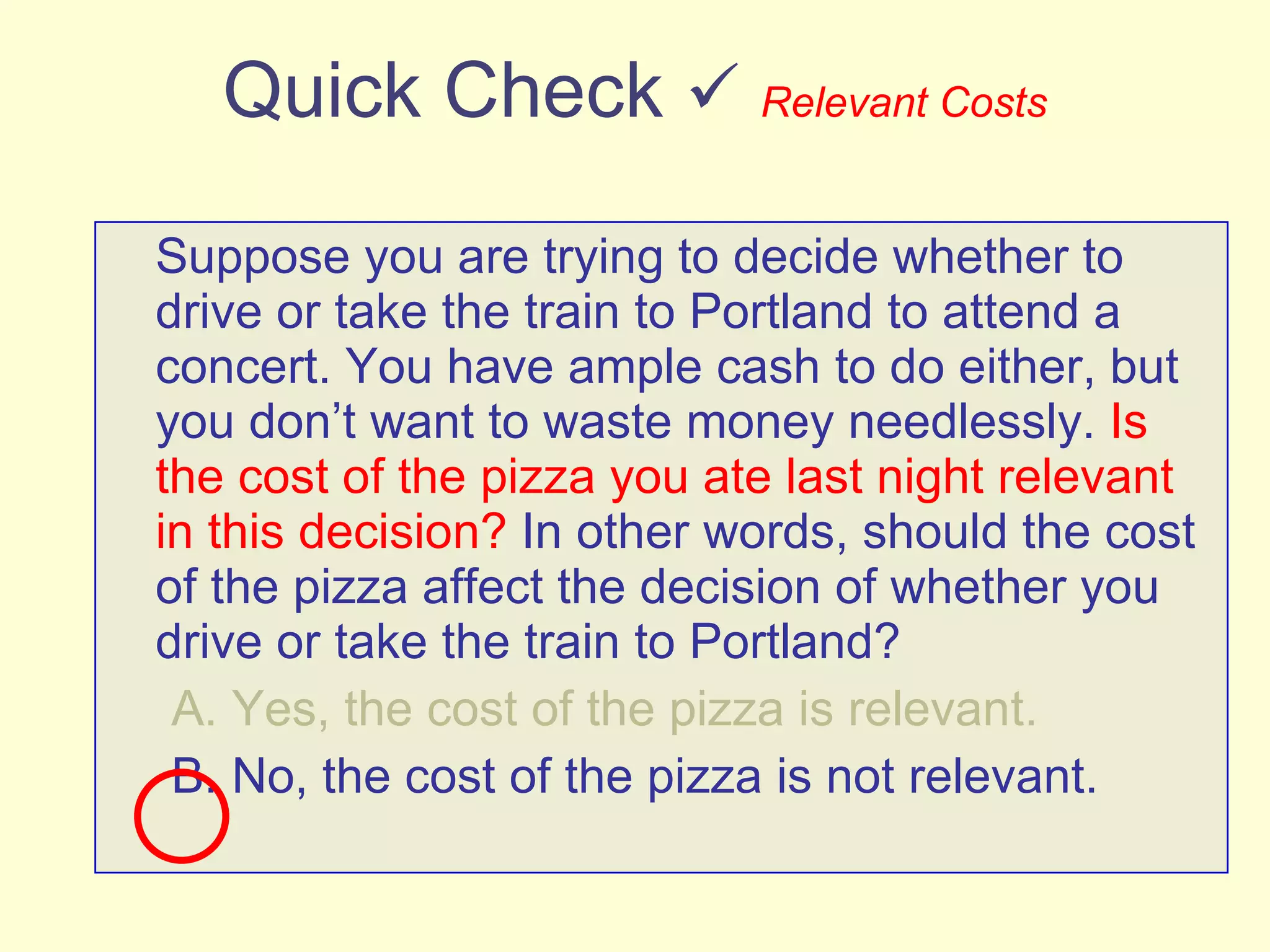
Quick Check     Relevant Costs Suppose you are trying to decide whether to drive or take the train to Portland to attend a concert. You have ample cash to do either, but you don’t want to waste money needlessly.  Is the cost of the pizza you ate last night relevant in this decision?  In other words, should the cost of the pizza affect the decision of whether you drive or take the train to Portland? A. Yes, the cost of the pizza is relevant. B. No, the cost of the pizza is not relevant.
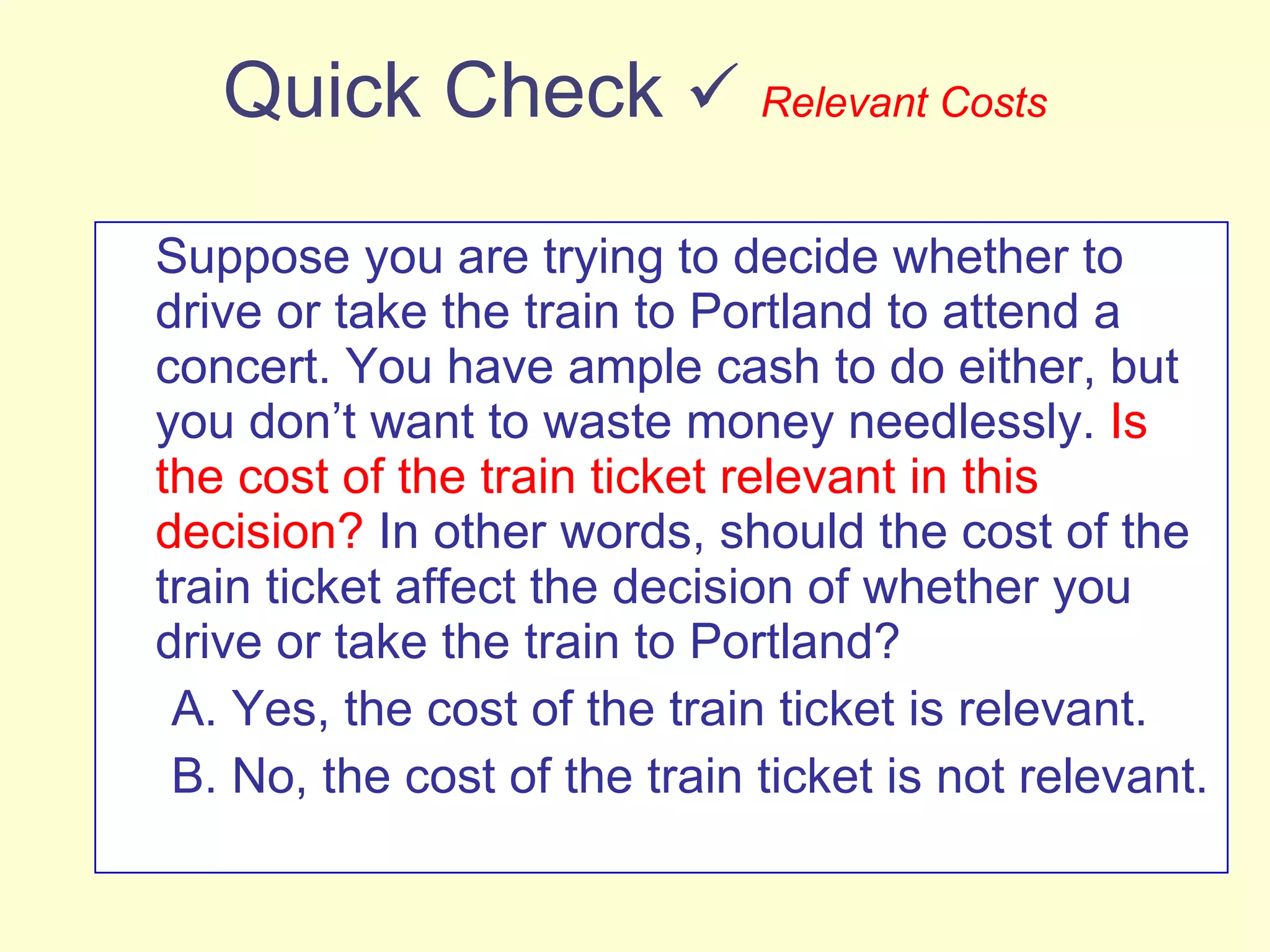
Quick Check     Relevant Costs Suppose you are trying to decide whether to drive or take the train to Portland to attend a concert. You have ample cash to do either, but you don’t want to waste money needlessly.  Is the cost of the train ticket relevant in this decision?  In other words, should the cost of the train ticket affect the decision of whether you drive or take the train to Portland? A. Yes, the cost of the train ticket is relevant. B. No, the cost of the train ticket is not relevant.
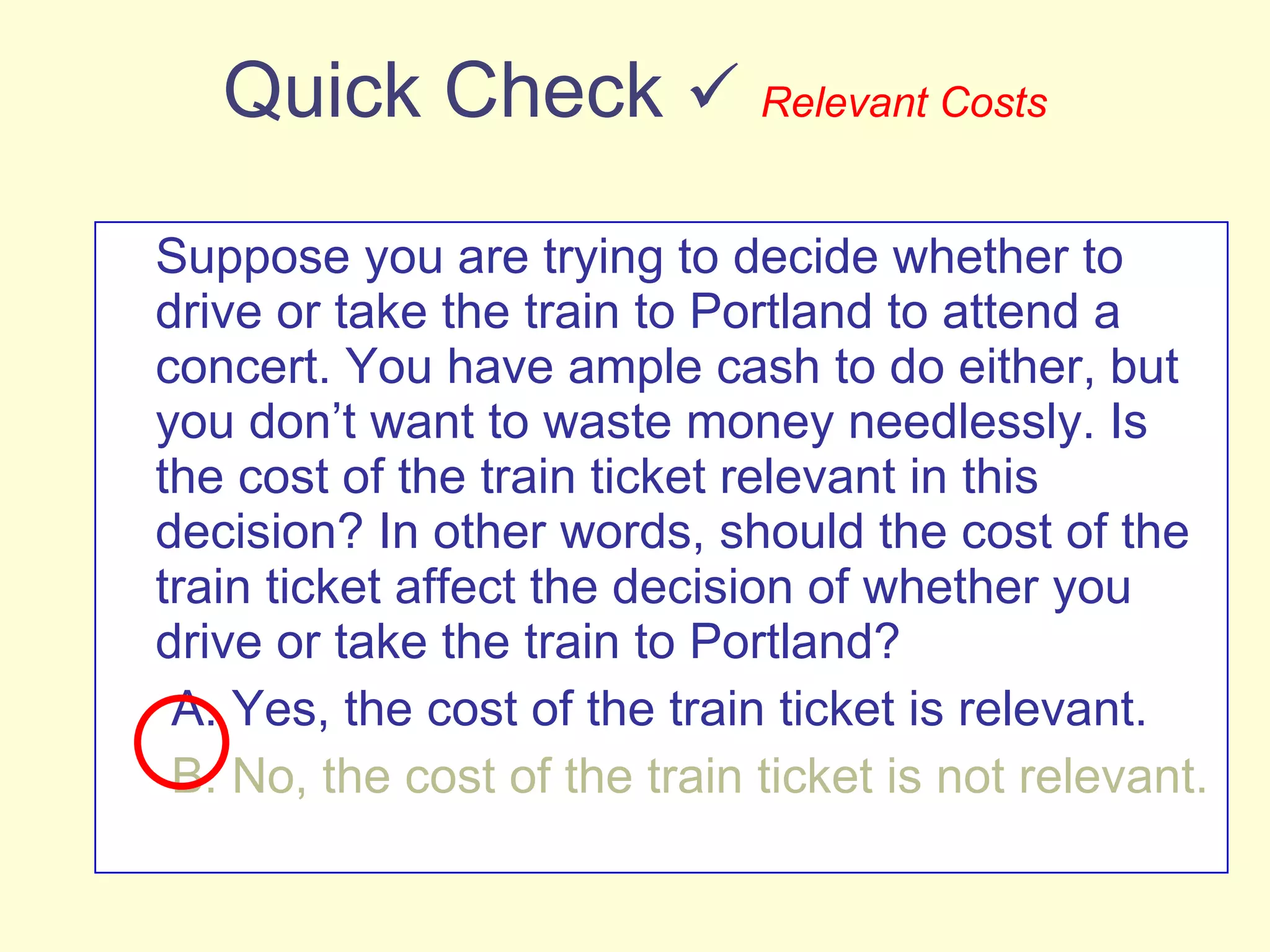
Quick Check     Relevant Costs Suppose you are trying to decide whether to drive or take the train to Portland to attend a concert. You have ample cash to do either, but you don’t want to waste money needlessly. Is the cost of the train ticket relevant in this decision? In other words, should the cost of the train ticket affect the decision of whether you drive or take the train to Portland? A. Yes, the cost of the train ticket is relevant. B. No, the cost of the train ticket is not relevant.
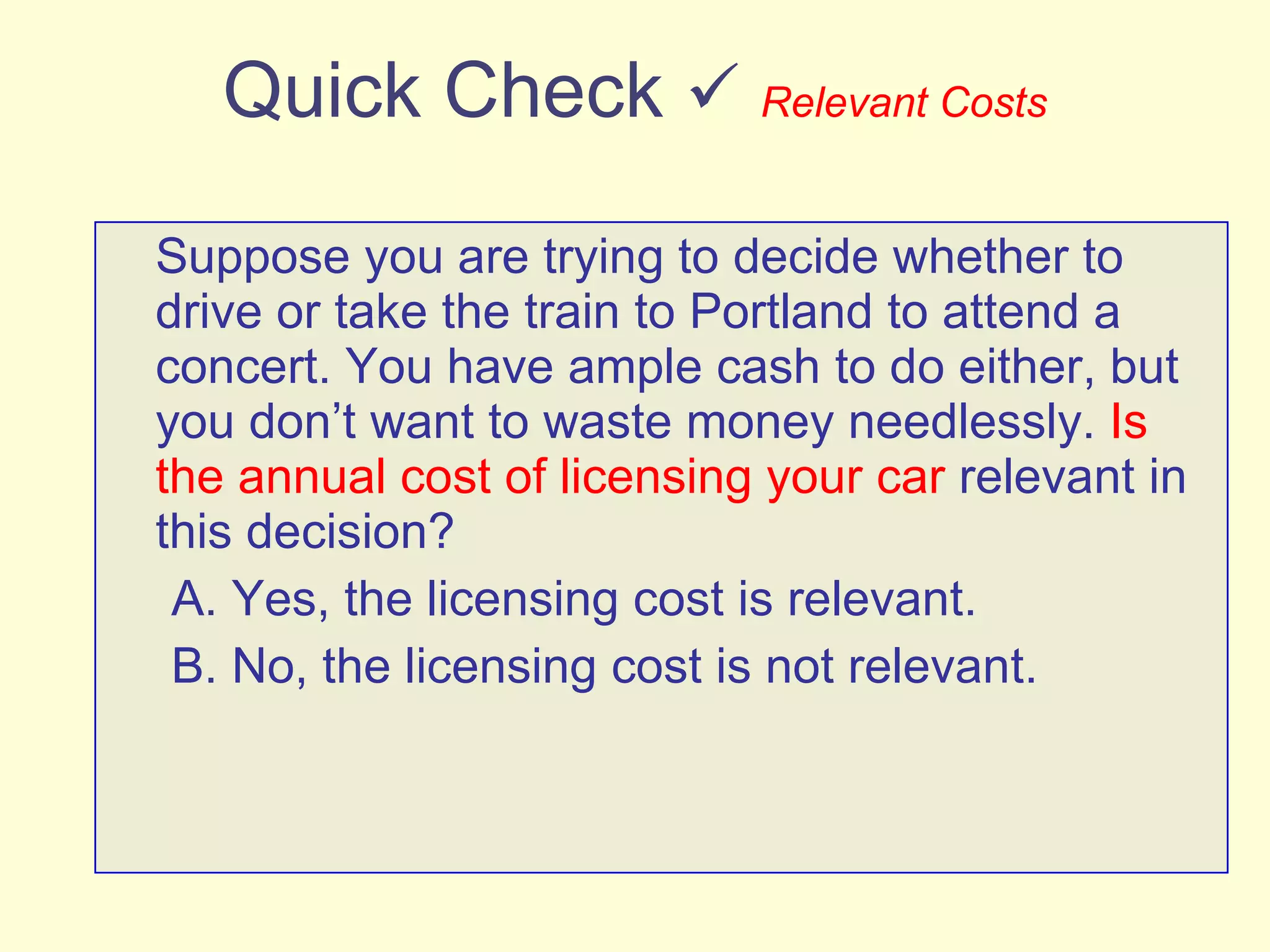
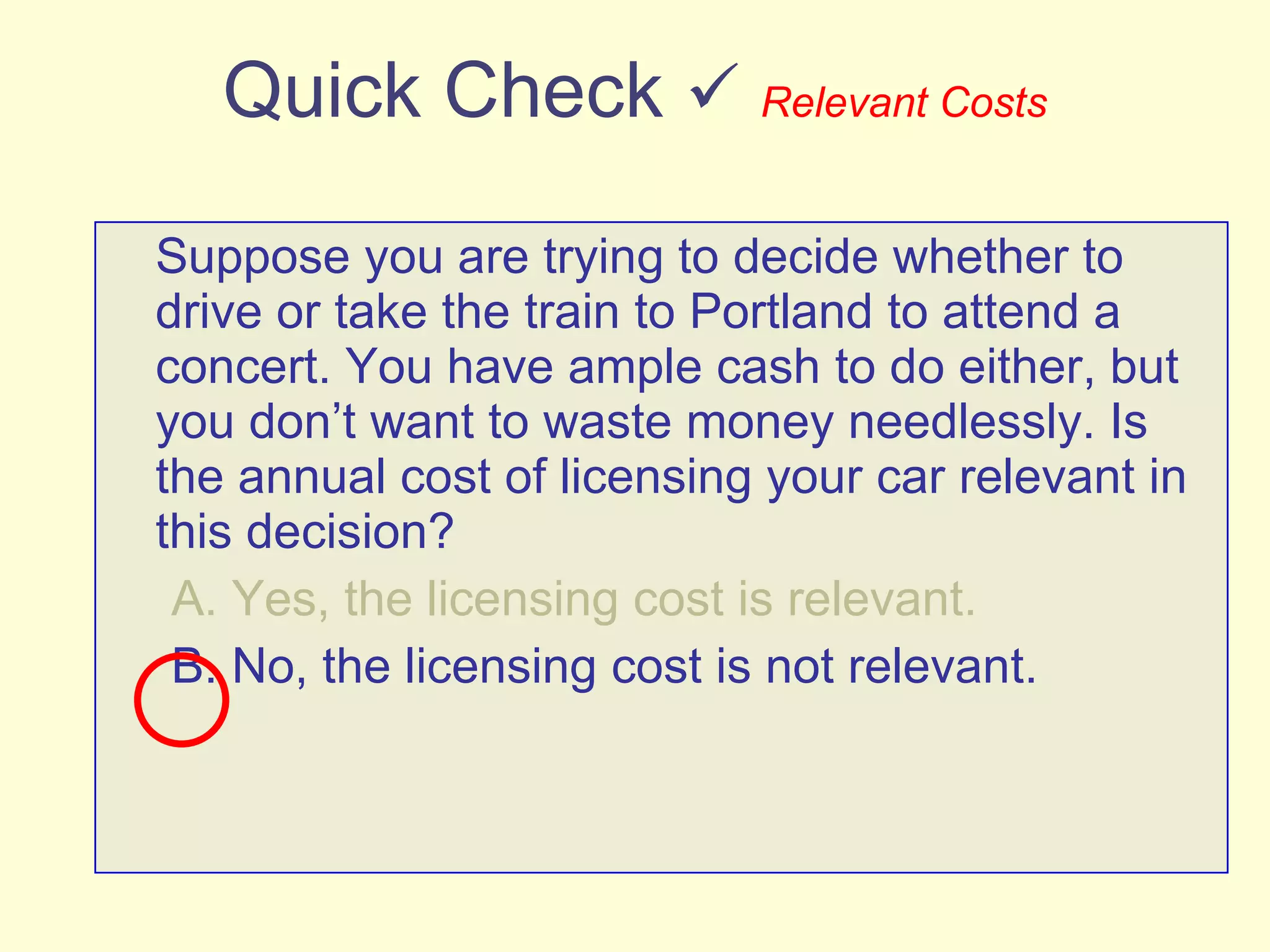
Quick Check     Relevant Costs Suppose you are trying to decide whether to drive or take the train to Portland to attend a concert. You have ample cash to do either, but you don’t want to waste money needlessly.  Is the annual cost of licensing your car  relevant in this decision? A. Yes, the licensing cost is relevant. B. No, the licensing cost is not relevant.
Quick Check     Relevant Costs Suppose you are trying to decide whether to drive or take the train to Portland to attend a concert. You have ample cash to do either, but you don’t want to waste money needlessly. Is the annual cost of licensing your car relevant in this decision? A. Yes, the licensing cost is relevant. B. No, the licensing cost is not relevant.
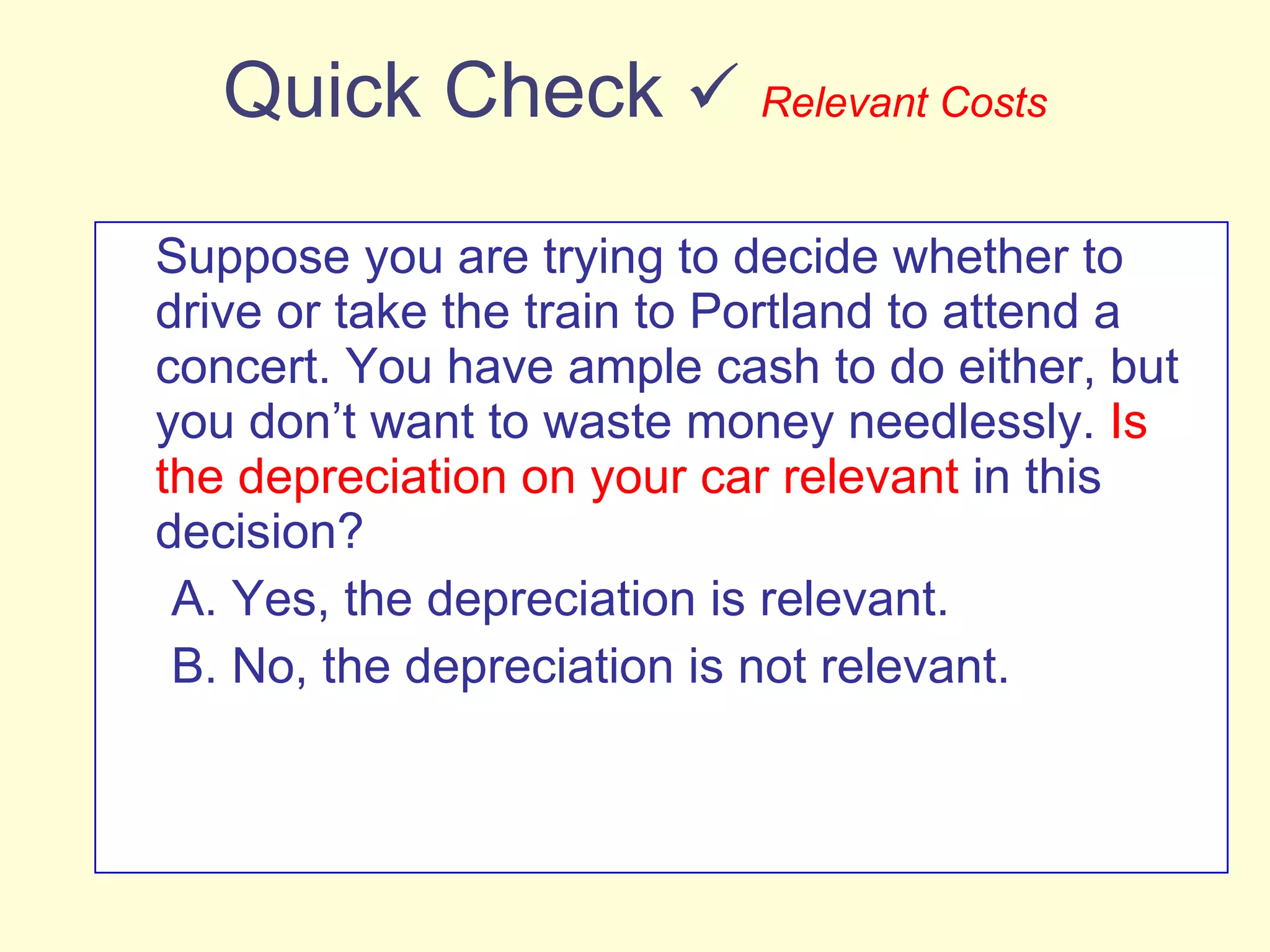
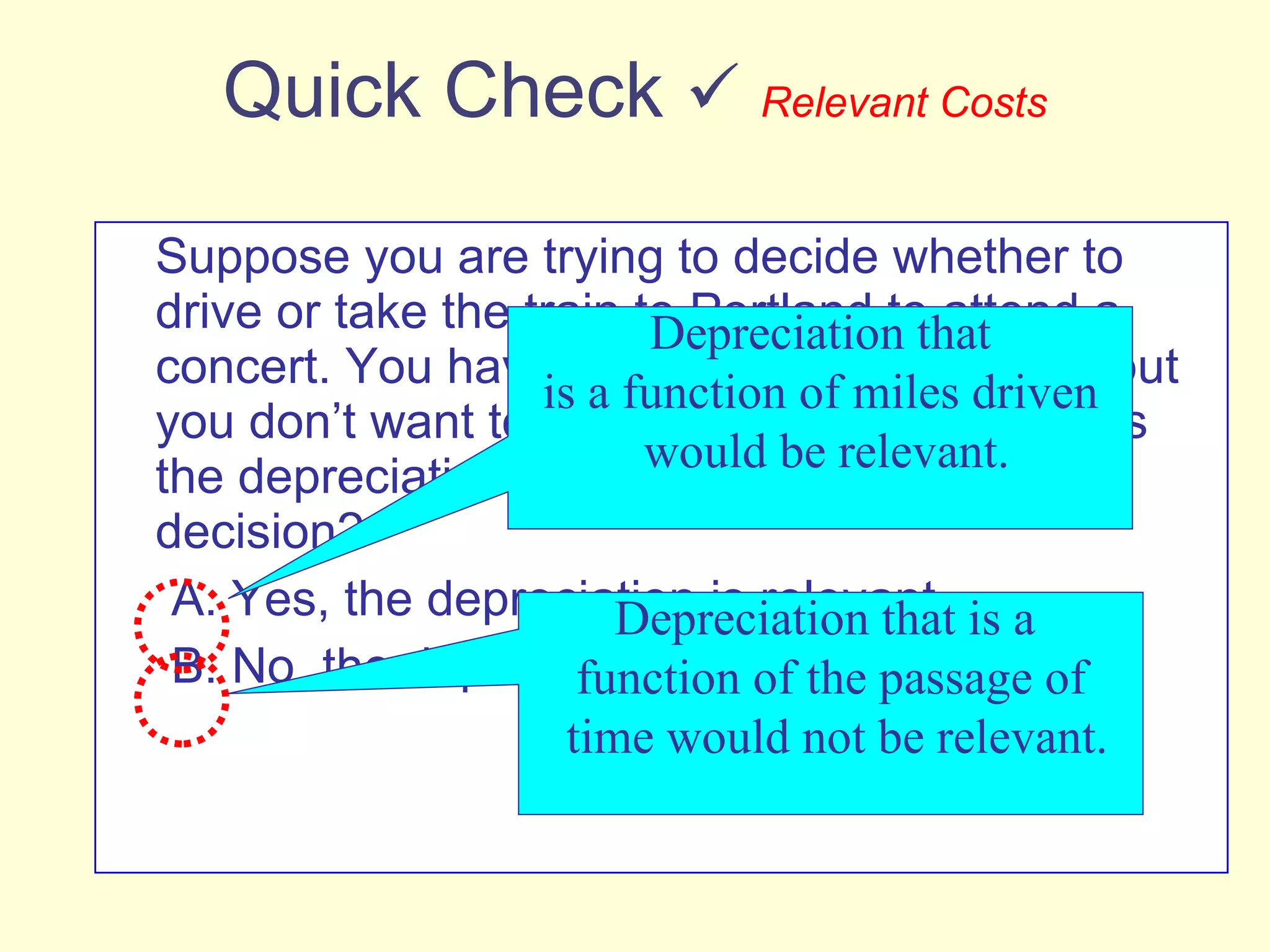
Quick Check     Relevant Costs Suppose you are trying to decide whether to drive or take the train to Portland to attend a concert. You have ample cash to do either, but you don’t want to waste money needlessly.  Is the depreciation on your car relevant  in this decision? A. Yes, the depreciation is relevant. B. No, the depreciation is not relevant.
Quick Check     Relevant Costs Suppose you are trying to decide whether to drive or take the train to Portland to attend a concert. You have ample cash to do either, but you don’t want to waste money needlessly. Is the depreciation on your car relevant in this decision? A. Yes, the depreciation is relevant. B. No, the depreciation is not relevant. Depreciation that is a function of miles driven would be relevant. Depreciation that is a  function of the passage of time would not be relevant.
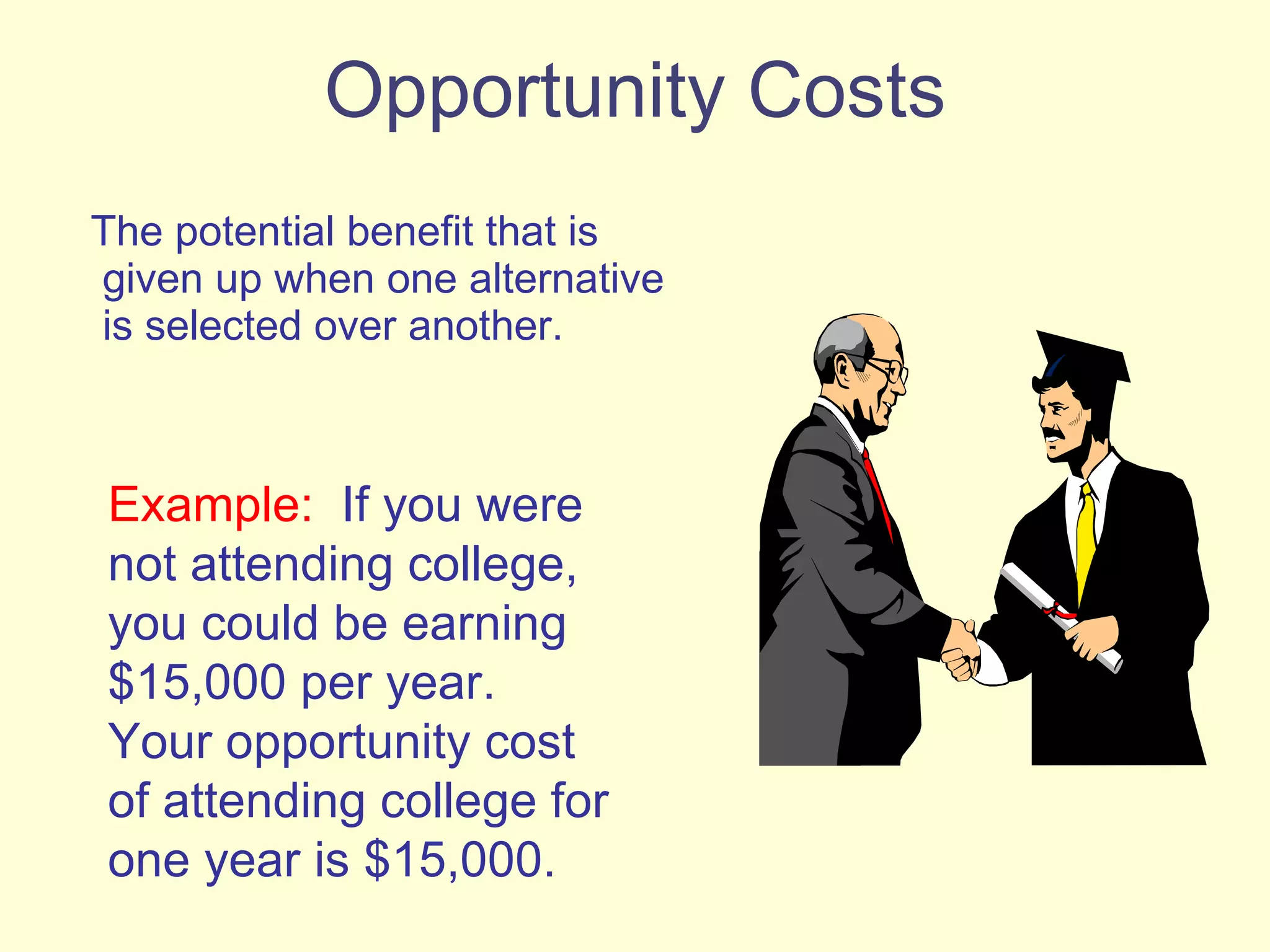
Opportunity Costs The potential benefit that is given up when one alternative is selected over another. Example:   If you were not attending college, you could be earning $15,000 per year.  Your opportunity cost of attending college for one year is $15,000.
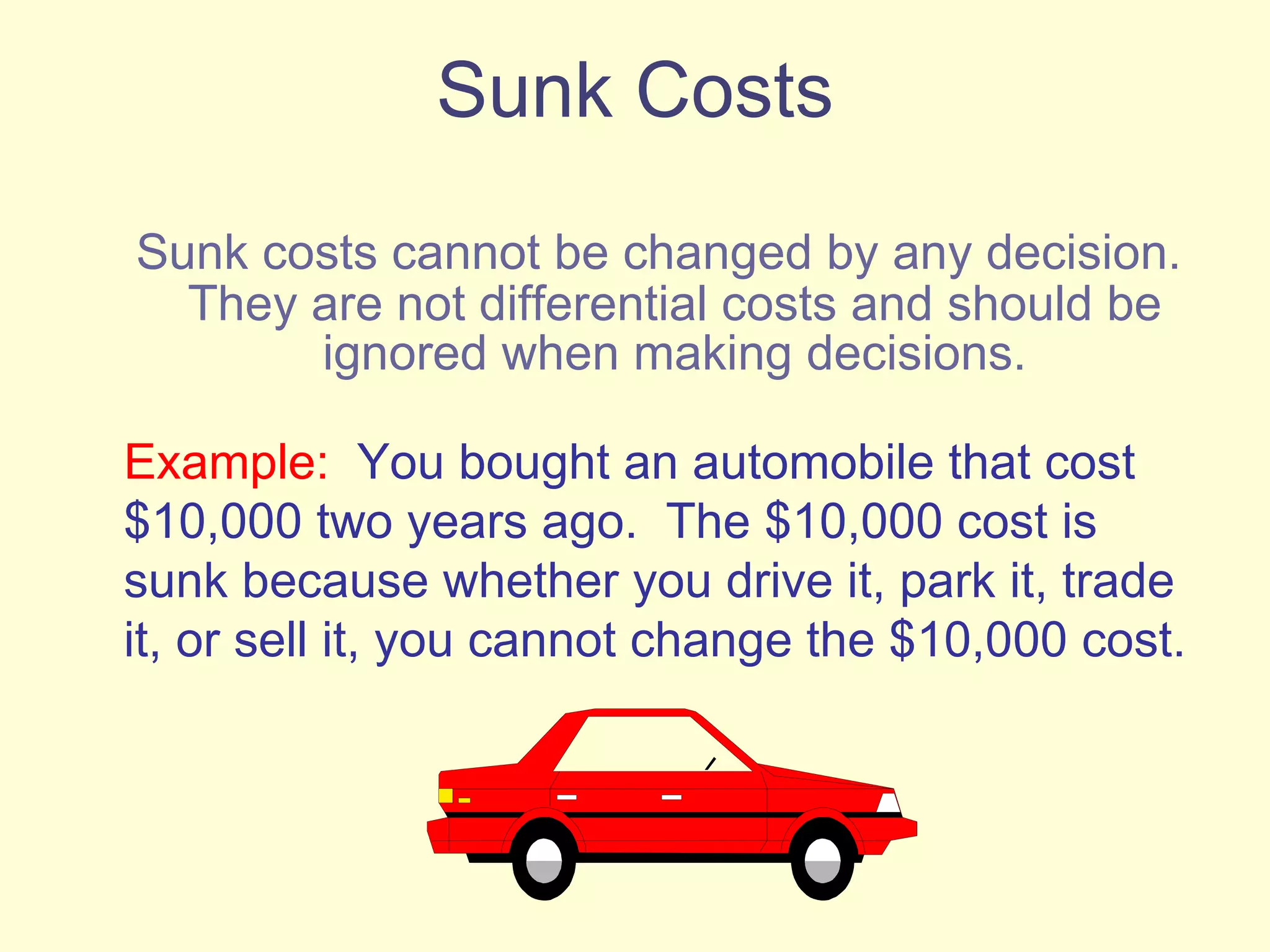
Sunk Costs Sunk costs cannot be changed by any decision. They are not differential costs and should be ignored when making decisions. Example:   You bought an automobile that cost $10,000 two years ago.  The $10,000 cost is sunk because whether you drive it, park it, trade it, or sell it, you cannot change the $10,000 cost.
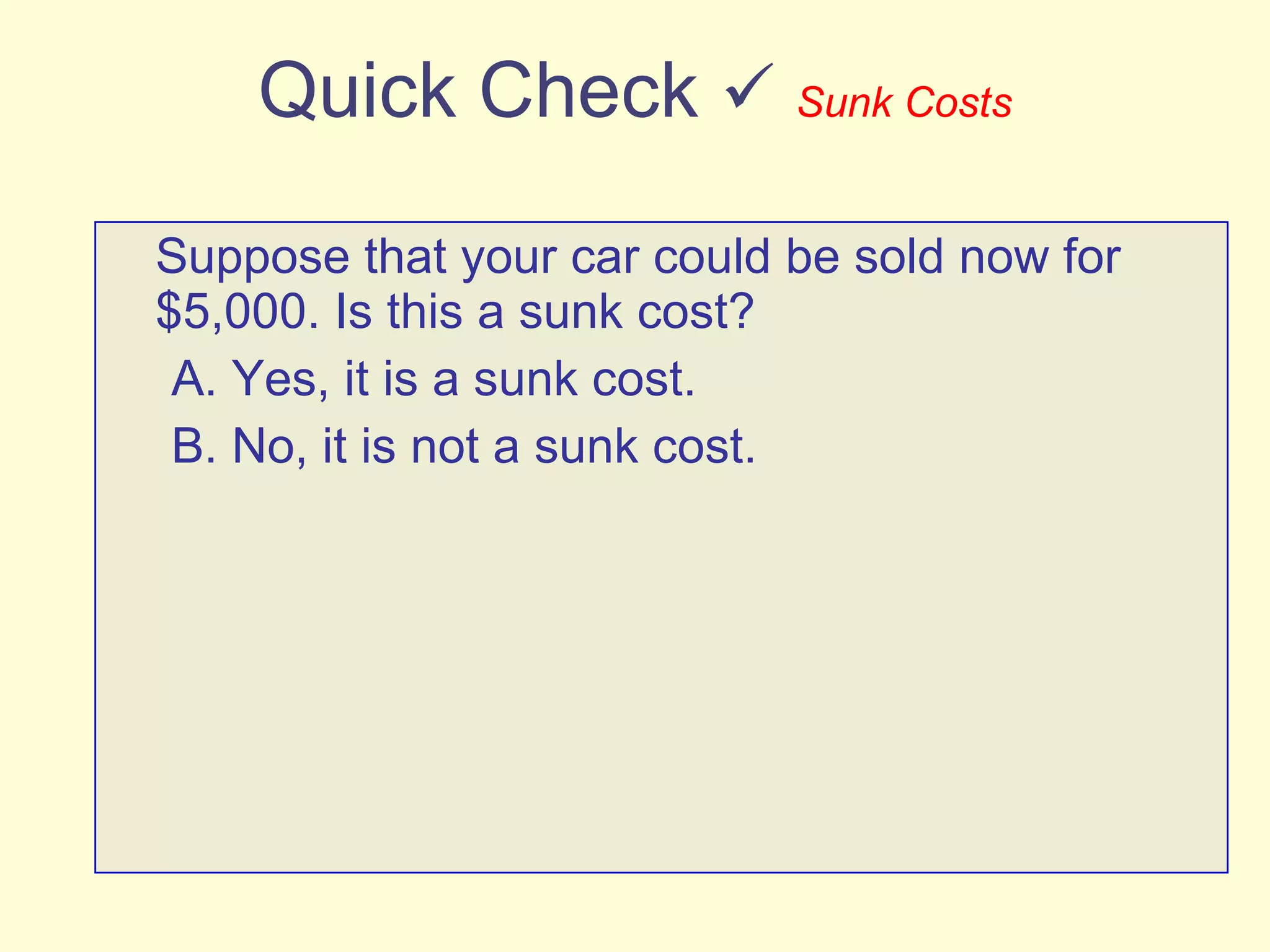
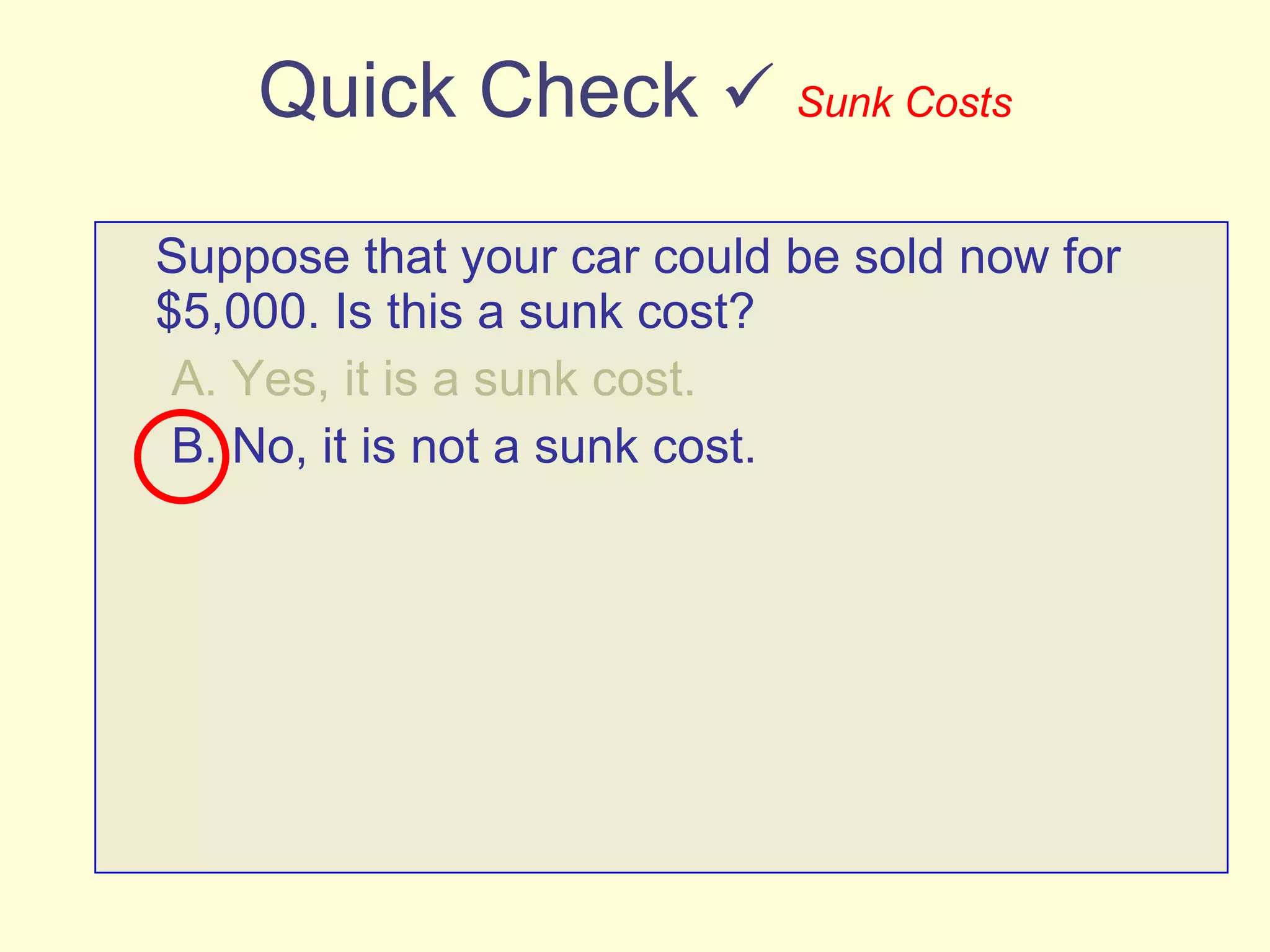
Quick Check     Sunk Costs Suppose that your car could be sold now for $5,000. Is this a sunk cost? A. Yes, it is a sunk cost. B. No, it is not a sunk cost.

Cost classification

  • 1.
  • 2.
    Classification of costAccording to: Nature/ Elements Function Degree of traceability to product Change in volume Controllability Normality
  • 3.
    Classification of costcontd…. Time Planning & control In relationship with accounting period Association with product Managerial decisions
  • 4.
    Elements of Costs The Product Materials Labour Expense
  • 5.
    Direct Materials Thosematerials that become an integral part of the product and that can be conveniently traced directly to it. Example: A radio installed in an automobile
  • 6.
    Indirect Material Thosematerials that do not become an integral part of the product but which helps in production. Example: indirect materials Materials used to support the production process. Examples: lubricants and cleaning supplies used in the automobile assembly plant.
  • 7.
    Direct Labor Thoselabor costs that can be easily traced to individual units of product. Example: Wages paid to automobile assembly workers
  • 8.
    Indirect Labour Thoselabor costs that cannot be easily traced to individual units of product. Examples: Indirect labor Wages paid to employees who are not directly involved in production work. Examples: maintenance workers, janitors and security guards.
  • 9.
    Expense Thecost of services provided to an undertaking and the notional cost of the use of owned asset. Expenses are of two types: Direct expense Indirect expense
  • 10.
    Expense Direct expenseis an expense which is incurred with manufacture of a product. Eg: Purchase of raw materials, factory labour, factory wages, electricity Indirect expense also called as overhead are additional expenses which are incurred on bringing a product to final customer. Eg: Sales and Distribution, Office Salary, office electricity, office water, printing and stationery, outsourcing expenses, advertising expenses etc.
  • 11.
    By Function Marketingand Selling Cost Costs necessary to get the order and deliver the product. Administrative Cost All executive, organizational, and clerical costs.
  • 12.
    Direct Costs andIndirect Costs Direct costs Costs that can be easily and conveniently traced to a unit of product or other cost objective. Examples: direct material and direct labor Indirect costs Costs cannot be easily and conveniently traced to a unit of product or other cost object. Example: manufacturing overhead
  • 13.
    Cost Classifications forPredicting Cost Behavior How a cost will react to changes in the level of business activity. Total variable costs change when activity changes. Total fixed costs remain unchanged when activity changes.
  • 14.
    A Cell PhoneBill…. Family Plan for cell phone usage, unlimited nights and weekends, $60.00 Includes 250 text messages Any text messages above 250 are $0.10 per text sent AND $0.10 text received. You do NOT have a DATA PLAN and pay $0.01 per KB
  • 15.
    Variable Cost PerUnit The cost per KB of DATA is constant. For example, $.01 cents per KB. DATA COST Per KB Used Per KBs used Per Minute Telephone Charge
  • 16.
    Total Variable CostYour total DATA cost is based on how many KB you use.. DATA used Total DATA COST on your Cell phone Bill
  • 17.
    Total Fixed CostYour monthly basic cellphone bill does not change when you make more calls. NTT DoCoMo's wristwatch-style cellphone Number of Local Calls Monthly Basic Telephone Bill
  • 18.
    Fixed Cost PerUnit The average cost per call decreases as more local calls are made. Number of Local Calls Monthly Basic Telephone Bill per Local Call
  • 19.
    Cost Classifications forPredicting Cost Behavior
  • 20.
    Quick Check  Variable/Fixed Costs Which of the following costs would be variable with respect to the number of cones sold at a Baskins & Robbins shop? (There may be more than one correct answer.) A. The cost of lighting the store. B. The wages of the store manager. C. The cost of ice cream. D. The cost of napkins for customers.
  • 21.
    Quick Check  Variable/Fixed Costs Which of the following costs would be variable with respect to the number of cones sold at a Baskins & Robbins shop? (There may be more than one correct answer.) A. The cost of lighting the store. B. The wages of the store manager. C. The cost of ice cream. D. The cost of napkins for customers.
  • 22.
    Quick Check  Variable/Fixed Costs Which of the following costs would be variable with respect to the number of people who buy a ticket for a show at a movie theater? (There may be more than one correct answer.) A. The cost of renting the film. B. Royalties on ticket sales. C. Wage and salary costs of theater employees. D. The cost of cleaning up after the show.
  • 23.
    Quick Check  Variable/Fixed Costs Which of the following costs would be variable with respect to the number of people who buy a ticket for a show at a movie theater? (There may be more than one correct answer.) A. The cost of renting the film. B. Royalties on ticket sales. C. Wage and salary costs of theater employees. D. The cost of cleaning up after the show. The royalties on ticket sales is directly related to the number of tickets sold. The cost of cleaning up MAY also be variable if the theater pays cleaning crews by the hour. The more tickets sold would increase the time it would take to clean up the theater.
  • 24.
    Classification of costcontd…. Controllability Controllable cost Uncontrollable cost
  • 25.
    Classification of costcontd…. Normality Normal cost Abnormal cost
  • 26.
    Classification of costcontd…. Time Historical cost Predetermined cost
  • 27.
    Classification of costcontd…. Planning & Control Standard cost Budgeted Cost
  • 28.
    Product Costs VersusPeriod Costs Product costs include direct materials, direct labor, and manufacturing overhead. Period costs are not included in product costs. They are expensed on the income statement.
  • 29.
    Quick Check  Period vs. Product Costs Which of the following costs would be considered a period rather than a product cost in a manufacturing company? A. Manufacturing equipment depreciation. B. Property taxes on corporate headquarters. C. Direct materials costs. D. Electrical costs to light the production facility.
  • 30.
    Quick Check  Period vs. Product Costs Which of the following costs would be considered a period rather than a product cost in a manufacturing company? A. Manufacturing equipment depreciation. B. Property taxes on corporate headquarters. C. Direct materials costs. D. Electrical costs to light the production facility.
  • 31.
    Differential Costs andRevenues Costs and revenues that differ among alternatives. Example: You have a job paying $1,500 per month in your hometown. You have a job offer in a neighboring city that pays $2,000 per month. The commuting cost to the city is $300 per month. Differential revenue is: $2,000 – $1,500 = $500 Differential cost is: $300
  • 32.
    Quick Check  - Relevant Costs Suppose you are trying to decide whether to drive or take the train to Portland to attend a concert. You have ample cash to do either, but you don’t want to waste money needlessly. Is the cost of the pizza you ate last night relevant in this decision? In other words, should the cost of the pizza affect the decision of whether you drive or take the train to Portland? A. Yes, the cost of the pizza is relevant. B. No, the cost of the pizza is not relevant.
  • 33.
    Quick Check  Relevant Costs Suppose you are trying to decide whether to drive or take the train to Portland to attend a concert. You have ample cash to do either, but you don’t want to waste money needlessly. Is the cost of the pizza you ate last night relevant in this decision? In other words, should the cost of the pizza affect the decision of whether you drive or take the train to Portland? A. Yes, the cost of the pizza is relevant. B. No, the cost of the pizza is not relevant.
  • 34.
    Quick Check  Relevant Costs Suppose you are trying to decide whether to drive or take the train to Portland to attend a concert. You have ample cash to do either, but you don’t want to waste money needlessly. Is the cost of the train ticket relevant in this decision? In other words, should the cost of the train ticket affect the decision of whether you drive or take the train to Portland? A. Yes, the cost of the train ticket is relevant. B. No, the cost of the train ticket is not relevant.
  • 35.
    Quick Check  Relevant Costs Suppose you are trying to decide whether to drive or take the train to Portland to attend a concert. You have ample cash to do either, but you don’t want to waste money needlessly. Is the cost of the train ticket relevant in this decision? In other words, should the cost of the train ticket affect the decision of whether you drive or take the train to Portland? A. Yes, the cost of the train ticket is relevant. B. No, the cost of the train ticket is not relevant.
  • 36.
    Quick Check  Relevant Costs Suppose you are trying to decide whether to drive or take the train to Portland to attend a concert. You have ample cash to do either, but you don’t want to waste money needlessly. Is the annual cost of licensing your car relevant in this decision? A. Yes, the licensing cost is relevant. B. No, the licensing cost is not relevant.
  • 37.
    Quick Check  Relevant Costs Suppose you are trying to decide whether to drive or take the train to Portland to attend a concert. You have ample cash to do either, but you don’t want to waste money needlessly. Is the annual cost of licensing your car relevant in this decision? A. Yes, the licensing cost is relevant. B. No, the licensing cost is not relevant.
  • 38.
    Quick Check  Relevant Costs Suppose you are trying to decide whether to drive or take the train to Portland to attend a concert. You have ample cash to do either, but you don’t want to waste money needlessly. Is the depreciation on your car relevant in this decision? A. Yes, the depreciation is relevant. B. No, the depreciation is not relevant.
  • 39.
    Quick Check  Relevant Costs Suppose you are trying to decide whether to drive or take the train to Portland to attend a concert. You have ample cash to do either, but you don’t want to waste money needlessly. Is the depreciation on your car relevant in this decision? A. Yes, the depreciation is relevant. B. No, the depreciation is not relevant. Depreciation that is a function of miles driven would be relevant. Depreciation that is a function of the passage of time would not be relevant.
  • 40.
    Opportunity Costs Thepotential benefit that is given up when one alternative is selected over another. Example: If you were not attending college, you could be earning $15,000 per year. Your opportunity cost of attending college for one year is $15,000.
  • 41.
    Sunk Costs Sunkcosts cannot be changed by any decision. They are not differential costs and should be ignored when making decisions. Example: You bought an automobile that cost $10,000 two years ago. The $10,000 cost is sunk because whether you drive it, park it, trade it, or sell it, you cannot change the $10,000 cost.
  • 42.
    Quick Check  Sunk Costs Suppose that your car could be sold now for $5,000. Is this a sunk cost? A. Yes, it is a sunk cost. B. No, it is not a sunk cost.
  • 43.
    Quick Check  Sunk Costs Suppose that your car could be sold now for $5,000. Is this a sunk cost? A. Yes, it is a sunk cost. B. No, it is not a sunk cost.