Knee dislocation Dr. Ahmed Abdel-Ghani Orthopaedic surgeon Afif general hospital
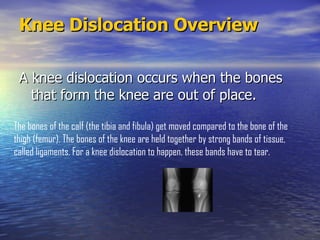
Knee Dislocation Overview A knee dislocation occurs when the bones that form the knee are out of place. The bones of the calf  ( the tibia and fibula )  get moved compared to the bone of the thigh  ( femur ).  The bones of the knee are held together by strong bands of tissue, called ligaments .  For a knee dislocation to happen, these bands have to tear.
Definition of knee dislocation: Knee dislocations are ligamentous disruptions with loss of continuity of tibiofemoral articulation . A combination of tears of the  ( ACL ) ,  ( PCL ) ,  ( MCL ) ,  ( LCL ) , and other stabilizing structures are typical of knee dislocations .  The vast majority of knee dislocations involve disruption of both the ACL and PCL.
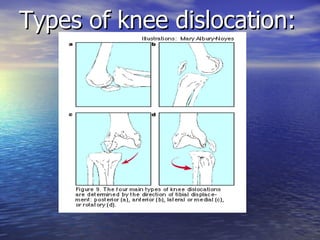
Types of knee dislocation:
Knee Dislocation Causes: Knee dislocations are rare .  They usually happen only after:  major trauma, including falls, car crashes, and other high - speed injuries.
Knee Dislocation Symptoms: there will be a large amount of pain in the knee. Sometimes, there will be no feeling below the knee. knee relocates, it will become swollen. You may not be able to feel a pulse in the foot.
Knee dislocation evaluation: History   Physical Examination   The initial evaluation of an injured knee includes an examination for loss of skin integrity and knee deformities that could be evidence of fractures or patellar or tibiofemoral dislocations. Special tests: For each ligament.
Knee dislocation evaluation:   (con.) Examination of pulses. X - rays.   An arteriogram.   Examination of nerves.
Knee Dislocation Treatment: Relocation :  The doctor will move the lower leg back into position. Immobilization :  To keep further injury from happening and to help with the beginning of healing, the entire knee joint will be kept in a splint or immobilizer. Referral:
Follow - up:   The knee should be immobilized, and the patient should be given  crutches .   Do not put weight on the affected leg .  Elevate the leg as much as possible.   Follow up.
Important message : Almost all knee dislocations require surgery because major injury to the artery occurs in 21-32% of all knee dislocations.   After appropriate treatment and surgery, however, results have been good .  Knees return close to normal in most cases .  Chronic pain is a common problem, occurring in 46% of cases.

Knee Dislocation 2

  • 1.
    Knee dislocation Dr.Ahmed Abdel-Ghani Orthopaedic surgeon Afif general hospital
  • 2.
    Knee Dislocation OverviewA knee dislocation occurs when the bones that form the knee are out of place. The bones of the calf ( the tibia and fibula ) get moved compared to the bone of the thigh ( femur ). The bones of the knee are held together by strong bands of tissue, called ligaments . For a knee dislocation to happen, these bands have to tear.
  • 3.
    Definition of kneedislocation: Knee dislocations are ligamentous disruptions with loss of continuity of tibiofemoral articulation . A combination of tears of the ( ACL ) , ( PCL ) , ( MCL ) , ( LCL ) , and other stabilizing structures are typical of knee dislocations . The vast majority of knee dislocations involve disruption of both the ACL and PCL.
  • 4.
    Types of kneedislocation:
  • 5.
    Knee Dislocation Causes:Knee dislocations are rare . They usually happen only after: major trauma, including falls, car crashes, and other high - speed injuries.
  • 6.
    Knee Dislocation Symptoms:there will be a large amount of pain in the knee. Sometimes, there will be no feeling below the knee. knee relocates, it will become swollen. You may not be able to feel a pulse in the foot.
  • 7.
    Knee dislocation evaluation:History Physical Examination The initial evaluation of an injured knee includes an examination for loss of skin integrity and knee deformities that could be evidence of fractures or patellar or tibiofemoral dislocations. Special tests: For each ligament.
  • 8.
    Knee dislocation evaluation: (con.) Examination of pulses. X - rays. An arteriogram. Examination of nerves.
  • 9.
    Knee Dislocation Treatment:Relocation : The doctor will move the lower leg back into position. Immobilization : To keep further injury from happening and to help with the beginning of healing, the entire knee joint will be kept in a splint or immobilizer. Referral:
  • 10.
    Follow - up: The knee should be immobilized, and the patient should be given crutches . Do not put weight on the affected leg . Elevate the leg as much as possible. Follow up.
  • 11.
    Important message :Almost all knee dislocations require surgery because major injury to the artery occurs in 21-32% of all knee dislocations. After appropriate treatment and surgery, however, results have been good . Knees return close to normal in most cases . Chronic pain is a common problem, occurring in 46% of cases.