



Pelvic Floor Muscles
Naeem Rahbar
BPT
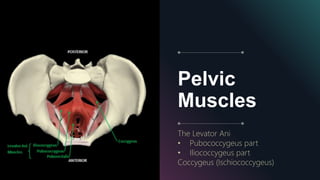
Pelvic
Muscles
The Levator Ani
• Pubococcygeus part
• Iliococcygeus part
Coccygeus (Ischiococcygeus)
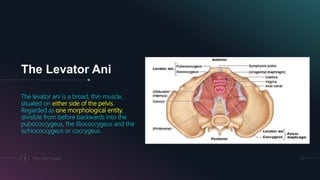
The Levator Ani
The levator ani is a broad, thin muscle,
situated on either side of the pelvis.
Regarded as one morphological entity,
divisible from before backwards into the
pubococcygeus, the Illiococcygeus and the
ischiococcygeus or coccygeus.
3 Pelvic Floor Muscles
Pelvic Floor Muscles4
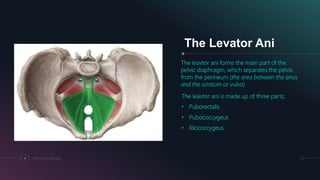
The Levator Ani
The leavtor ani forms the main part of the
pelvic diaphragm, which separates the pelvis
from the perineum (the area between the anus
and the scrotum or vulva)
The leavtor ani is made up of three parts;
• Puborectalis
• Pubococcygeus
• Illiococcygeus
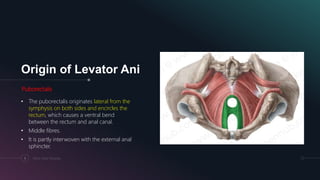
Origin of Levator Ani
Puborectalis
Pelvic Floor Muscles5
• The puborectalis originates lateral from the
symphysis on both sides and encircles the
rectum, which causes a ventral bend
between the rectum and anal canal.
• Middle fibres.
• It is partly interwoven with the external anal
sphincter.
Origin of Levator Ani
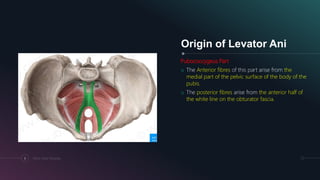
Pubococcygeus Part
o The Anterior fibres of this part arise from the
medial part of the pelvic surface of the body of the
pubis.
o The posterior fibres arise from the anterior half of
the white line on the obturator fascia.
6 Pelvic Floor Muscles
Pelvic Floor Muscles7
Origin of Levator Ani
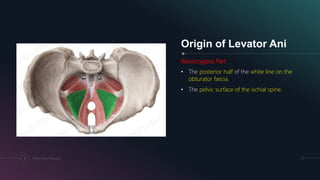
Iliococcygeus Part
• The posterior half of the white line on the
obturator fascia.
• The pelvic surface of the ischial spine.
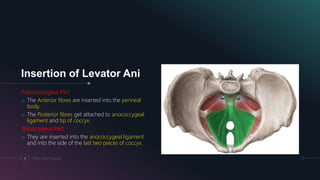
Insertion of Levator Ani
Pubococcygeus Part
o The Anterior fibres are inserted into the perineal
body.
o The Posterior fibres get attached to anococcygeal
ligament and tip of coccyx.
Iliococcygeus Part
o They are inserted into the anococcygeal ligament
and into the side of the last two pieces of coccyx.
8 Pelvic Floor Muscles
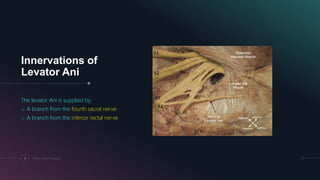
Innervations of
Levator Ani
The levator Ani is supplied by:
o A branch from the fourth sacral nerve
o A branch from the inferior rectal nerve
9 Pelvic Floor Muscles
Action of Levator Ani
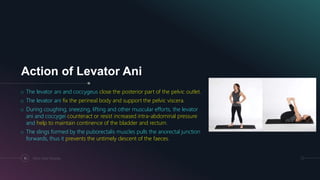
o The levator ani and coccygeus close the posterior part of the pelvic outlet.
o The levator ani fix the perineal body and support the pelvic viscera.
o During coughing, sneezing, lifting and other muscular efforts, the levator
ani and coccygei counteract or resist increased intra-abdominal pressure
and help to maintain continence of the bladder and rectum.
o The slings formed by the puborectalis muscles pulls the anorectal junction
forwards, thus it prevents the untimely descent of the faeces.
10 Pelvic Floor Muscles
Coccygeus
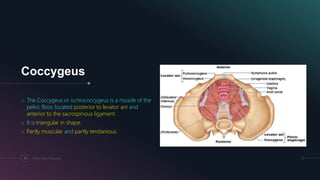
o The Coccygeus or ischiococcygeus is a muscle of the
pelvic floor, located posterior to levator ani and
anterior to the sacrospinous ligament.
o It is triangular in shape.
o Partly muscular and partly tendanious.
11 Pelvic Floor Muscles
Pelvic Floor Muscles12
Origin of Coccygeus
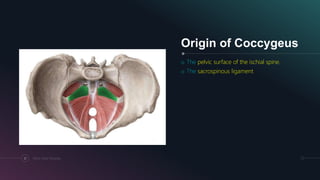
o The pelvic surface of the ischial spine.
o The sacrospinous ligament.
Insertion of
Coccygeus
Pelvic Floor Muscles13
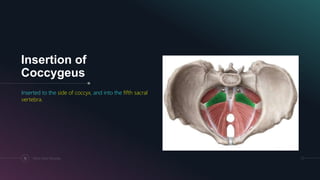
Inserted to the side of coccyx, and into the fifth sacral
vertebra.
Pelvic Floor Muscles14
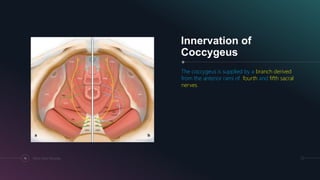
Innervation of
Coccygeus
The coccygeus is supplied by a branch derived
from the anterior rami of fourth and fifth sacral
nerves.
Action of Coccygeus
Pelvic Floor Muscles15
o The levator ani and coccygeus close the posterior part of the pelvic outlet.
o The levator ani fix the perineal body and support the pelvic viscera.
o During coughing, sneezing, lifting and other muscular efforts, the levator ani and coccygei counteract or
resist increased intra-abdominal pressure and help to maintain continence of the bladder and rectum.
o The slings formed by the puborectalis muscles pulls the anorectal junction forwards, thus it prevents the
untimely descent of the faeces.
o The coccygeus pulls forwards and supports the coccyx, after it has been pressed backwards during
defecation, parturition or childbirth.
Clinical Anatomy
The muscles of the pelvic floor maybe injured
during parturition. When the perineal body is
torn, and has not been repaired satisfactorily,
the contraction of anterior fibres of the levator
ani increases the normal gap in the pelvic
floor, instead of decreasing it. This results in
the prolapse of the uterus.
16 Pelvic Floor Muscles
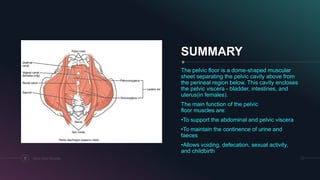
SUMMARY
The pelvic floor is a dome-shaped muscular
sheet separating the pelvic cavity above from
the perineal region below. This cavity encloses
the pelvic viscera - bladder, intestines, and
uterus(in females).
The main function of the pelvic
floor muscles are:
•To support the abdominal and pelvic viscera
•To maintain the continence of urine and
faeces
•Allows voiding, defecation, sexual activity,
and childbirth
17 Pelvic Floor Muscles
References
BD Chaurasia’s Human Anatomy vol 2
https://www.physio-pedia.com/Pelvic_Floor_Anatomy
www.kenhub.com
Pelvic Floor Muscles18
THANK YOU!
Naeem Rahbar
BPT Student at Sree Anjaneya College
Of Paramedical Sciences
Email:
naeemrahbar13@gmail.com

Pelvic floor muscles

  • 1.
  • 2.
    Pelvic Muscles The Levator Ani •Pubococcygeus part • Iliococcygeus part Coccygeus (Ischiococcygeus)
  • 3.
    The Levator Ani Thelevator ani is a broad, thin muscle, situated on either side of the pelvis. Regarded as one morphological entity, divisible from before backwards into the pubococcygeus, the Illiococcygeus and the ischiococcygeus or coccygeus. 3 Pelvic Floor Muscles
  • 4.
    Pelvic Floor Muscles4 TheLevator Ani The leavtor ani forms the main part of the pelvic diaphragm, which separates the pelvis from the perineum (the area between the anus and the scrotum or vulva) The leavtor ani is made up of three parts; • Puborectalis • Pubococcygeus • Illiococcygeus
  • 5.
    Origin of LevatorAni Puborectalis Pelvic Floor Muscles5 • The puborectalis originates lateral from the symphysis on both sides and encircles the rectum, which causes a ventral bend between the rectum and anal canal. • Middle fibres. • It is partly interwoven with the external anal sphincter.
  • 6.
    Origin of LevatorAni Pubococcygeus Part o The Anterior fibres of this part arise from the medial part of the pelvic surface of the body of the pubis. o The posterior fibres arise from the anterior half of the white line on the obturator fascia. 6 Pelvic Floor Muscles
  • 7.
    Pelvic Floor Muscles7 Originof Levator Ani Iliococcygeus Part • The posterior half of the white line on the obturator fascia. • The pelvic surface of the ischial spine.
  • 8.
    Insertion of LevatorAni Pubococcygeus Part o The Anterior fibres are inserted into the perineal body. o The Posterior fibres get attached to anococcygeal ligament and tip of coccyx. Iliococcygeus Part o They are inserted into the anococcygeal ligament and into the side of the last two pieces of coccyx. 8 Pelvic Floor Muscles
  • 9.
    Innervations of Levator Ani Thelevator Ani is supplied by: o A branch from the fourth sacral nerve o A branch from the inferior rectal nerve 9 Pelvic Floor Muscles
  • 10.
    Action of LevatorAni o The levator ani and coccygeus close the posterior part of the pelvic outlet. o The levator ani fix the perineal body and support the pelvic viscera. o During coughing, sneezing, lifting and other muscular efforts, the levator ani and coccygei counteract or resist increased intra-abdominal pressure and help to maintain continence of the bladder and rectum. o The slings formed by the puborectalis muscles pulls the anorectal junction forwards, thus it prevents the untimely descent of the faeces. 10 Pelvic Floor Muscles
  • 11.
    Coccygeus o The Coccygeusor ischiococcygeus is a muscle of the pelvic floor, located posterior to levator ani and anterior to the sacrospinous ligament. o It is triangular in shape. o Partly muscular and partly tendanious. 11 Pelvic Floor Muscles
  • 12.
    Pelvic Floor Muscles12 Originof Coccygeus o The pelvic surface of the ischial spine. o The sacrospinous ligament.
  • 13.
    Insertion of Coccygeus Pelvic FloorMuscles13 Inserted to the side of coccyx, and into the fifth sacral vertebra.
  • 14.
    Pelvic Floor Muscles14 Innervationof Coccygeus The coccygeus is supplied by a branch derived from the anterior rami of fourth and fifth sacral nerves.
  • 15.
    Action of Coccygeus PelvicFloor Muscles15 o The levator ani and coccygeus close the posterior part of the pelvic outlet. o The levator ani fix the perineal body and support the pelvic viscera. o During coughing, sneezing, lifting and other muscular efforts, the levator ani and coccygei counteract or resist increased intra-abdominal pressure and help to maintain continence of the bladder and rectum. o The slings formed by the puborectalis muscles pulls the anorectal junction forwards, thus it prevents the untimely descent of the faeces. o The coccygeus pulls forwards and supports the coccyx, after it has been pressed backwards during defecation, parturition or childbirth.
  • 16.
    Clinical Anatomy The musclesof the pelvic floor maybe injured during parturition. When the perineal body is torn, and has not been repaired satisfactorily, the contraction of anterior fibres of the levator ani increases the normal gap in the pelvic floor, instead of decreasing it. This results in the prolapse of the uterus. 16 Pelvic Floor Muscles
  • 17.
    SUMMARY The pelvic flooris a dome-shaped muscular sheet separating the pelvic cavity above from the perineal region below. This cavity encloses the pelvic viscera - bladder, intestines, and uterus(in females). The main function of the pelvic floor muscles are: •To support the abdominal and pelvic viscera •To maintain the continence of urine and faeces •Allows voiding, defecation, sexual activity, and childbirth 17 Pelvic Floor Muscles
  • 18.
    References BD Chaurasia’s HumanAnatomy vol 2 https://www.physio-pedia.com/Pelvic_Floor_Anatomy www.kenhub.com Pelvic Floor Muscles18
  • 19.
    THANK YOU! Naeem Rahbar BPTStudent at Sree Anjaneya College Of Paramedical Sciences Email: naeemrahbar13@gmail.com