PERINEUM
By Dr. Piyush
Introduction
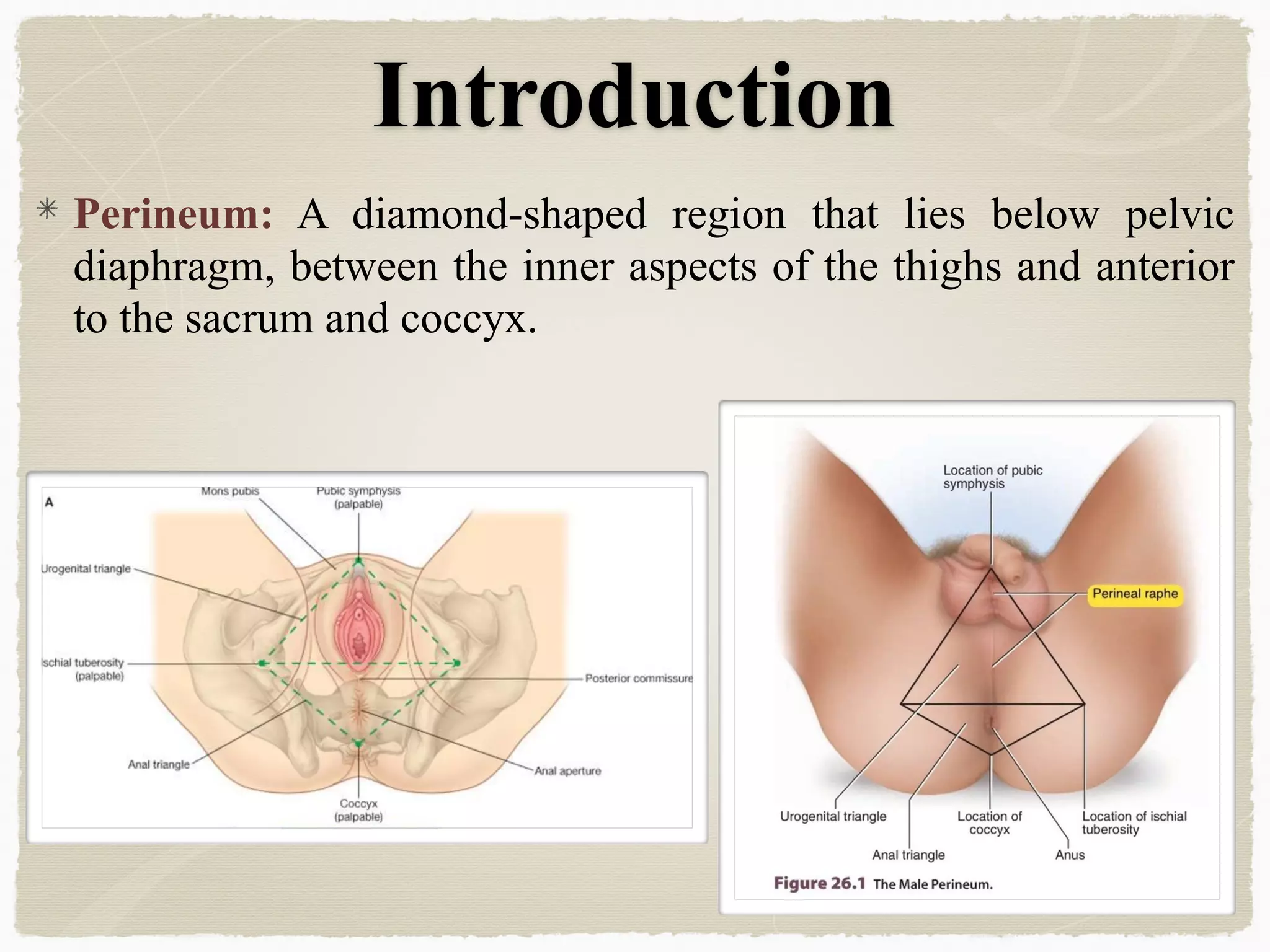
Perineum: A diamond-shaped region that lies below pelvic
diaphragm, between the inner aspects of the thighs and anterior
to the sacrum and coccyx.
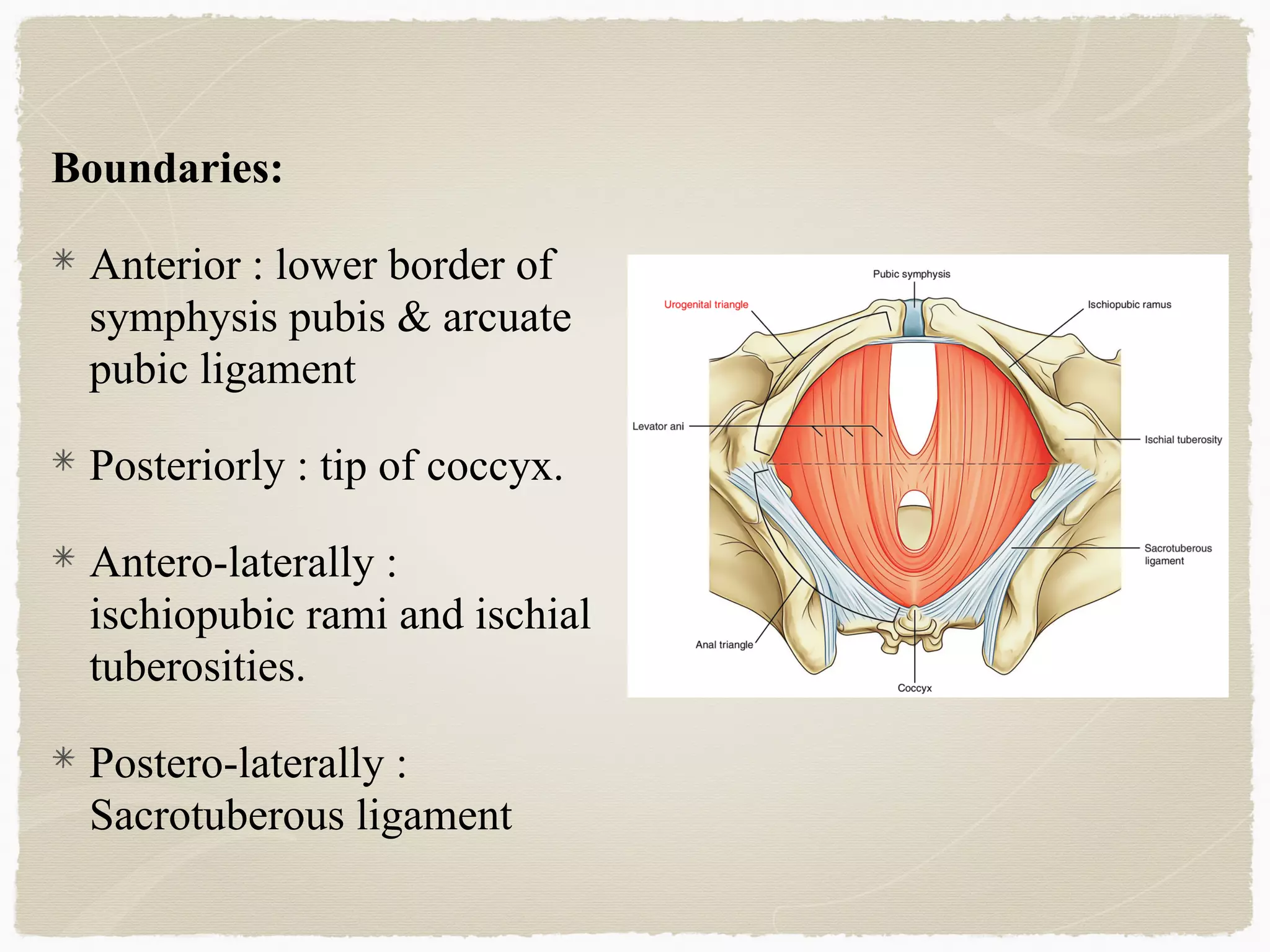
Boundaries:
Anterior : lower border of
symphysis pubis & arcuate
pubic ligament
Posteriorly : tip of coccyx.
Antero-laterally :
ischiopubic rami and ischial
tuberosities.
Postero-laterally :
Sacrotuberous ligament
Divisions:
1. Urogenital triangle
2. Anal triangle
Approx.120º angle between
the planes of both triangle
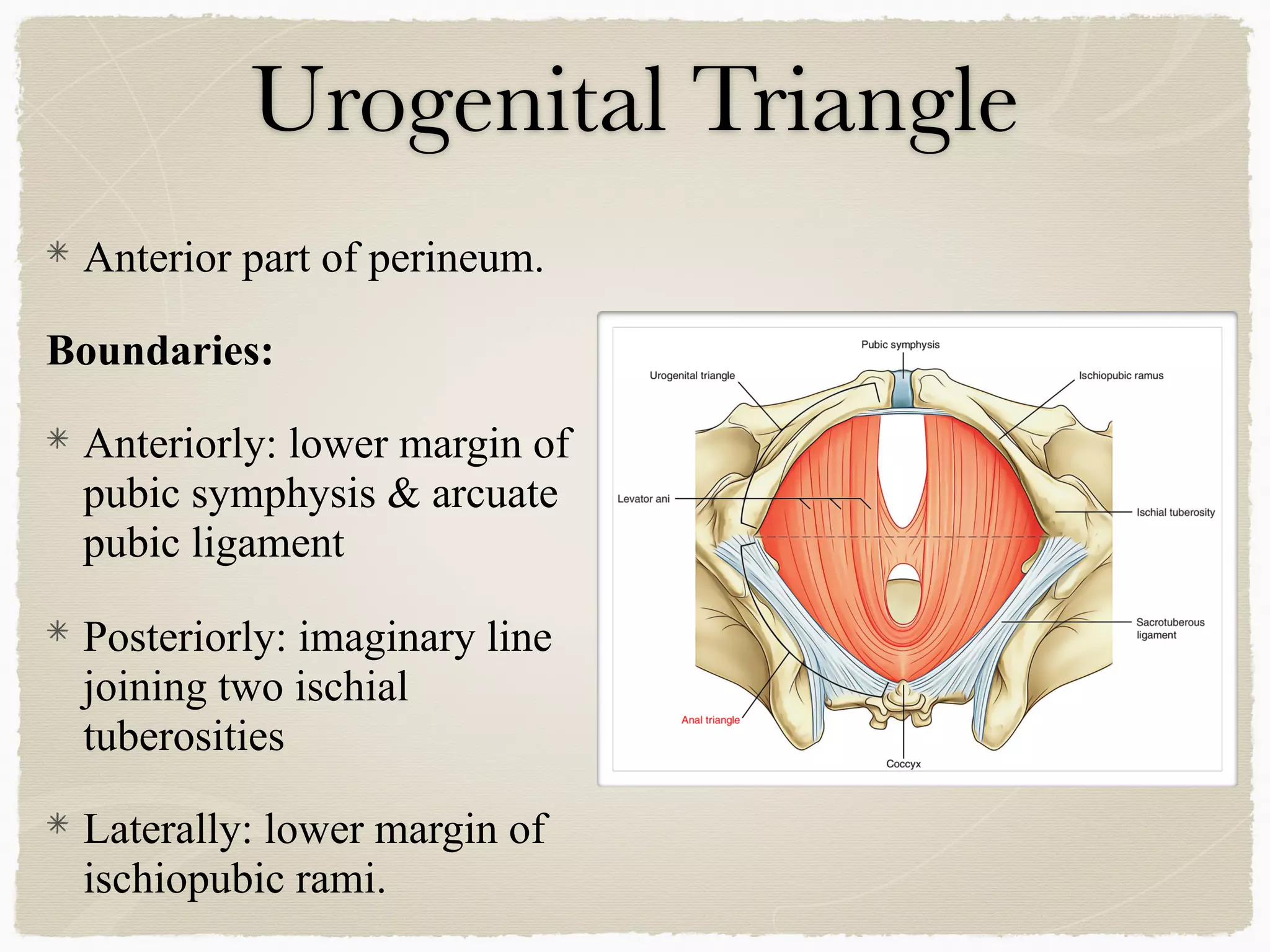
Urogenital Triangle
Anterior part of perineum.
Boundaries:
Anteriorly: lower margin of
pubic symphysis & arcuate
pubic ligament
Posteriorly: imaginary line
joining two ischial
tuberosities
Laterally: lower margin of
ischiopubic rami.
Superficially : skin and superficial fascia
Deep: thin endopelvic fascia
The urogenital triangle is divided into two parts by a strong perineal membrane.
The deep perineal space lies above the membrane.
The superficial perineal space lies below it.
Dissection in the urogenital
triangle region reveals following
layers from superficial to deep:
1. Skin
2. Fatty layer of superficial facia
3. Membranous layer of superficial
facia (Colles facia)
4. Contents of superficial perineal
space
5. Perineal membrane (inf. Layer
of urogenital diaphragm)
6. Contents of deep perineal space
7. Endopelvic facia (Superior facia
of urogenital diaphragm)
Skin:
In male: midline raphe continuous with raphe of scrotum.
In female: perineal raphe leading to midline cleft called
vestibule between two labia minora.
Raphe indicates development from fusion of two symmetrical
halves.
Fatty layer of superficial facia: continuous with the fatty
layer of superficial facia in lower abdomen - facia of camper.
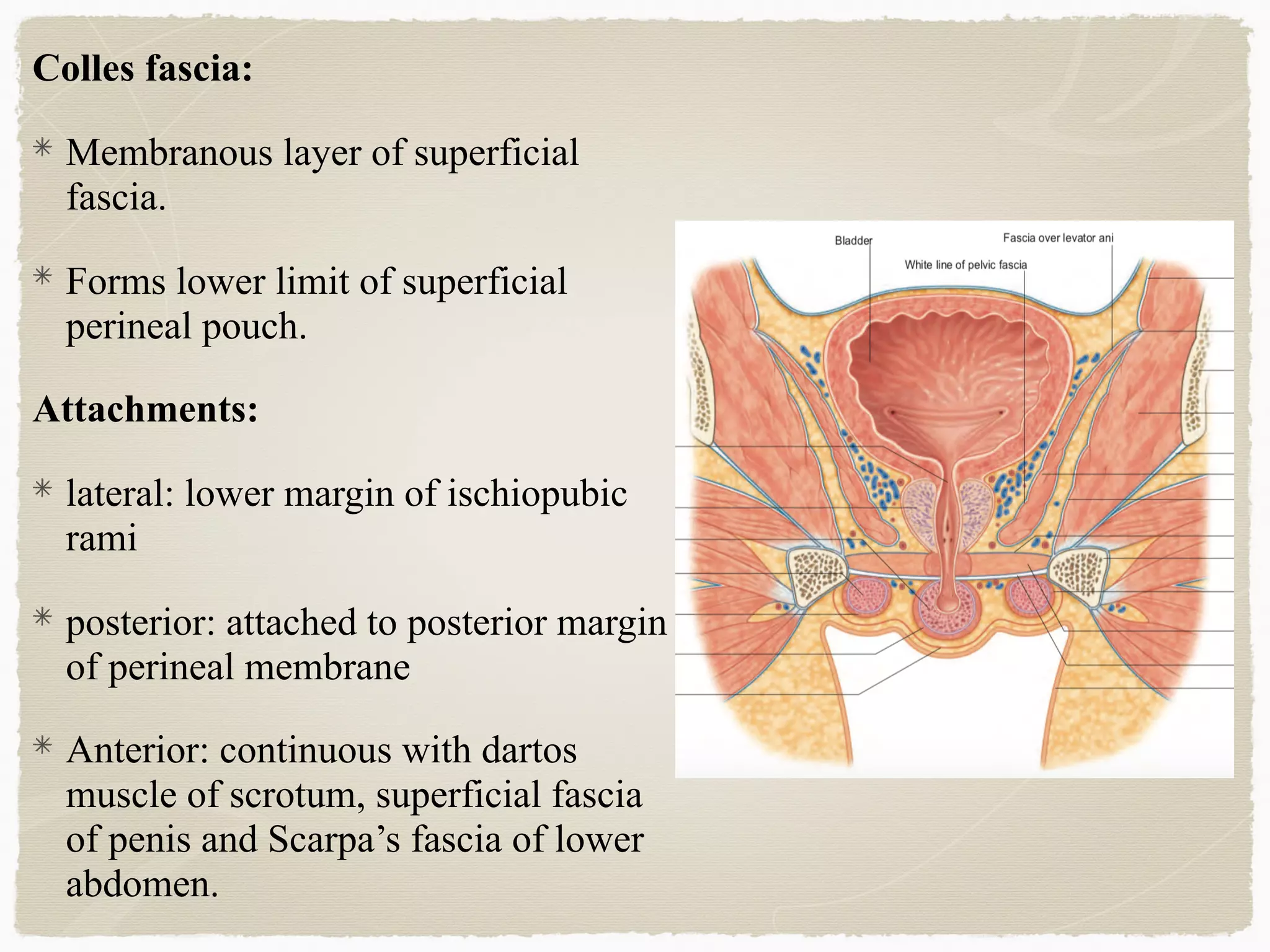
Colles fascia:
Membranous layer of superficial
fascia.
Forms lower limit of superficial
perineal pouch.
Attachments:
lateral: lower margin of ischiopubic
rami
posterior: attached to posterior margin
of perineal membrane
Anterior: continuous with dartos
muscle of scrotum, superficial fascia
of penis and Scarpa’s fascia of lower
abdomen.
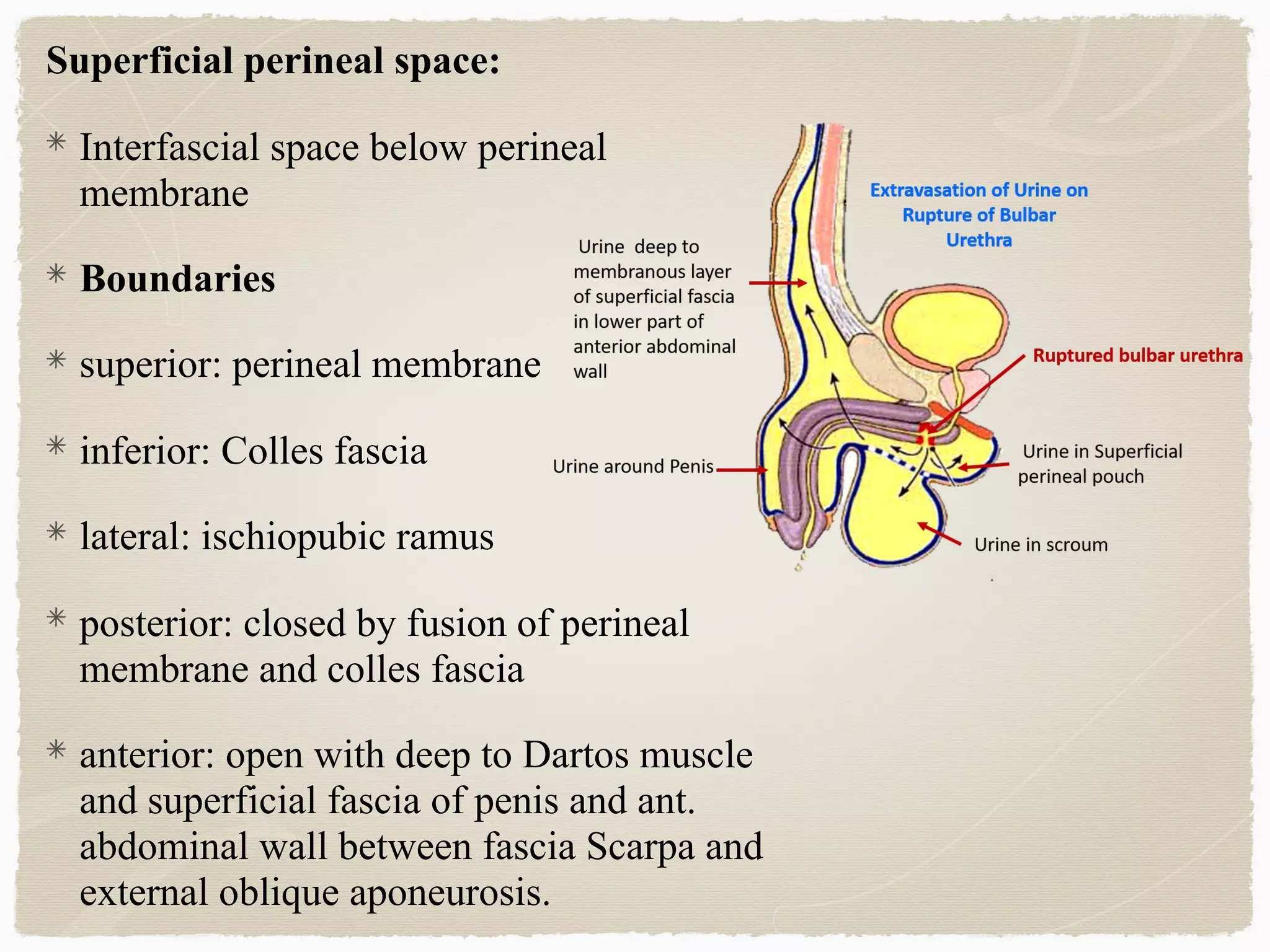
Superficial perineal space:
Interfascial space below perineal
membrane
Boundaries
superior: perineal membrane
inferior: Colles fascia
lateral: ischiopubic ramus
posterior: closed by fusion of perineal
membrane and colles fascia
anterior: open with deep to Dartos muscle
and superficial fascia of penis and ant.
abdominal wall between fascia Scarpa and
external oblique aponeurosis.
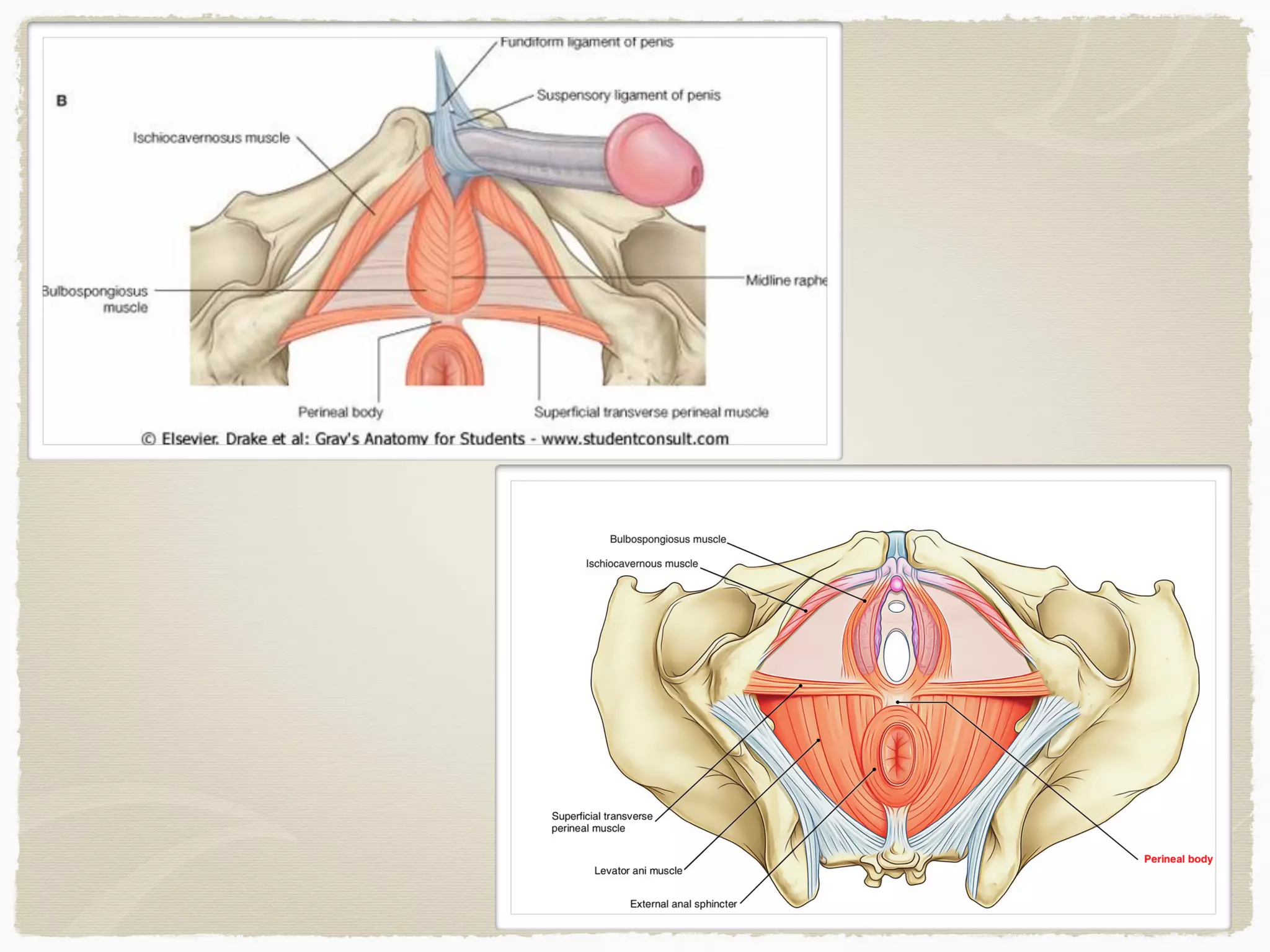
Contents:
A. Muscles:
Ischiocavernosus: cover crus
penis or crus clitoridis.
Transversus perinei
superficialis
Bulbospongiosus: cover bulb
of penis or bulb of vestibule.
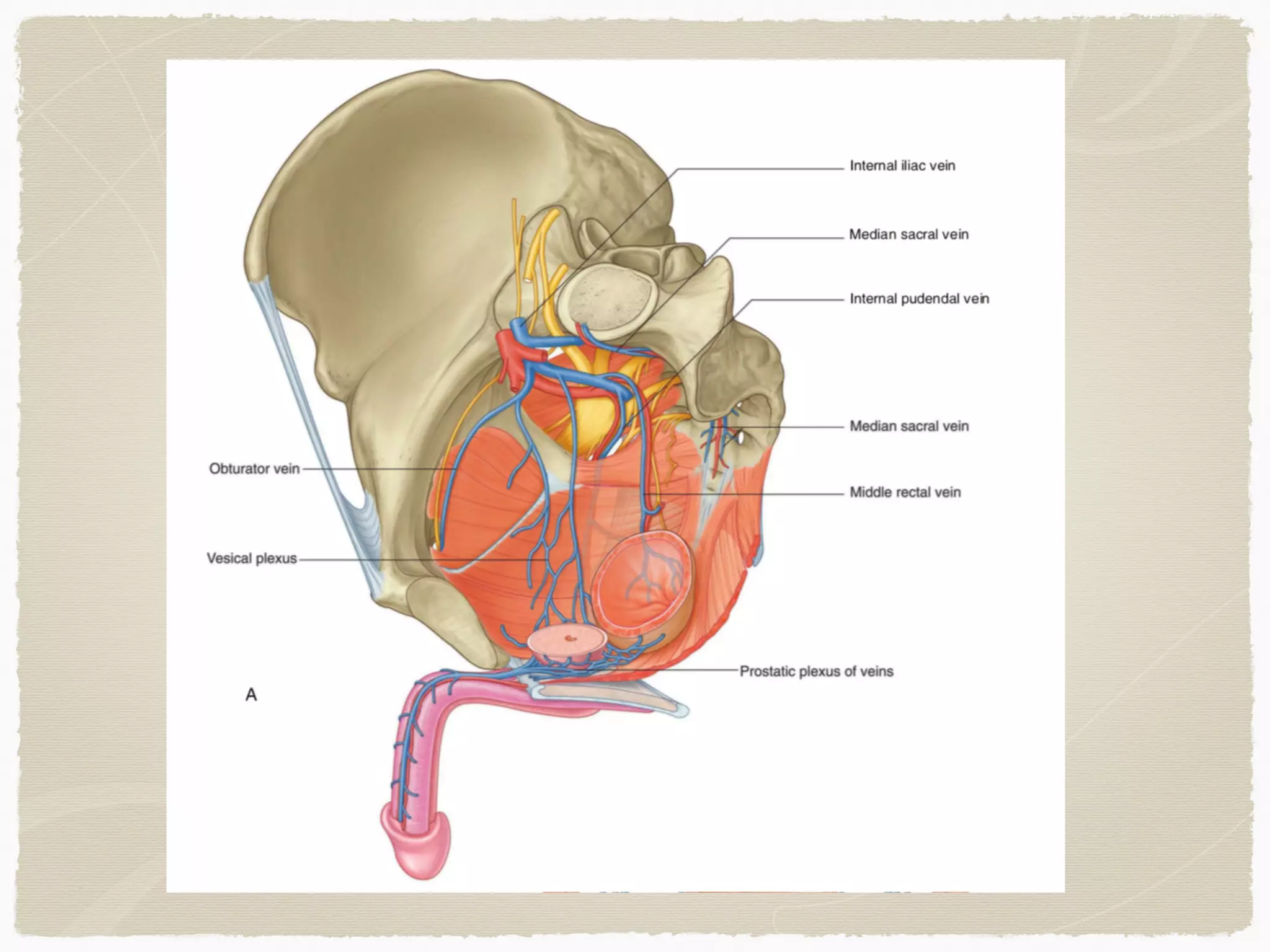
B. Blood vessels
Posterior scrotal/labial arteries - branch of perineal or internal
pudendal artery
Transverse perineal artery- branch of perineal artery.
C. Nerves
Posterior scrotal/ labial
nerves: branches of
superficial perineal nerve
Perineal branch of
posterior femoral
cutaneous nerve.
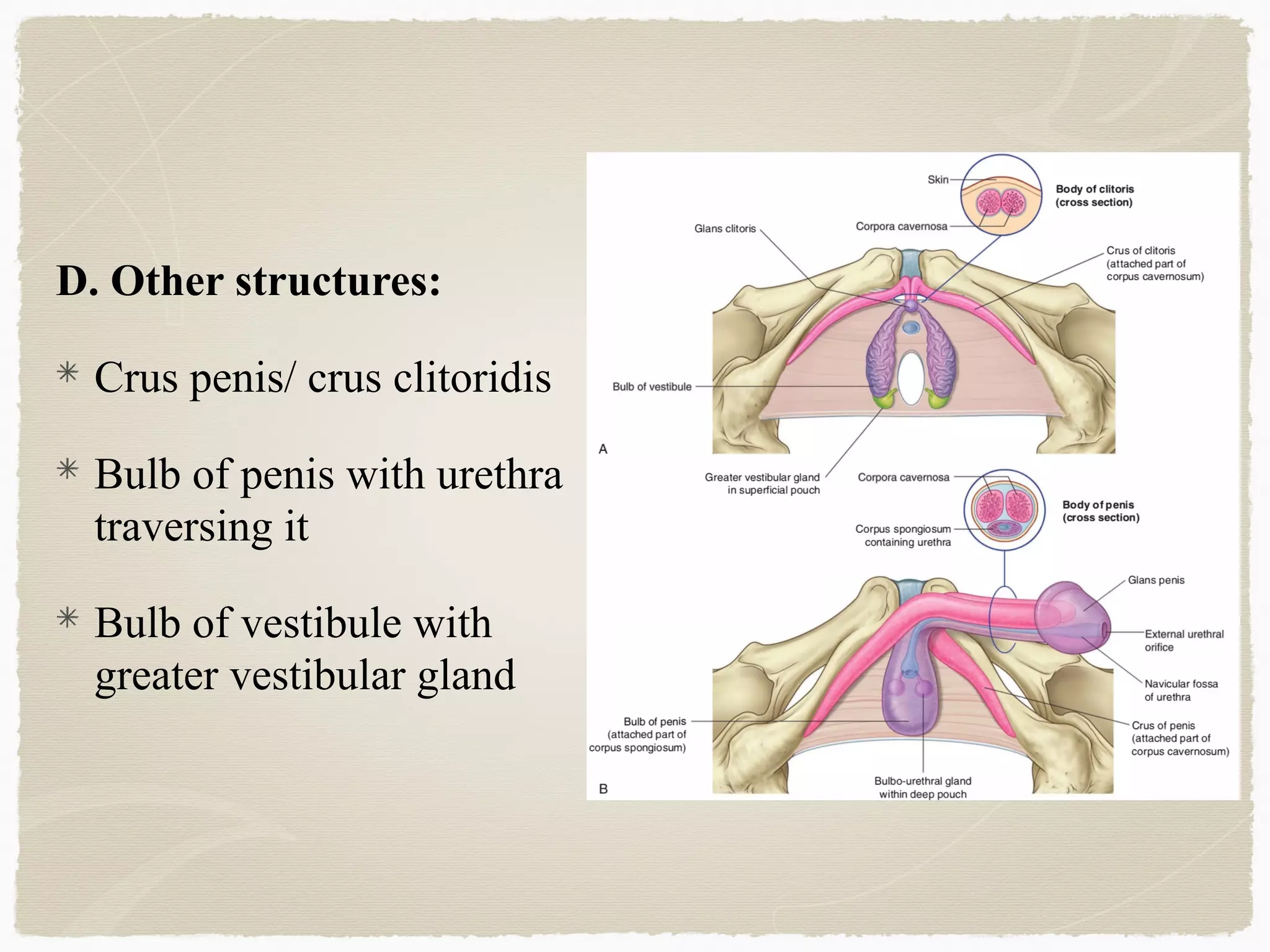
D. Other structures:
Crus penis/ crus clitoridis
Bulb of penis with urethra
traversing it
Bulb of vestibule with
greater vestibular gland
Perineal membrane
Inferior fascia of
urogenital diaphragm
Triangular; apex
directed in the front
Stretched between
pubic arch
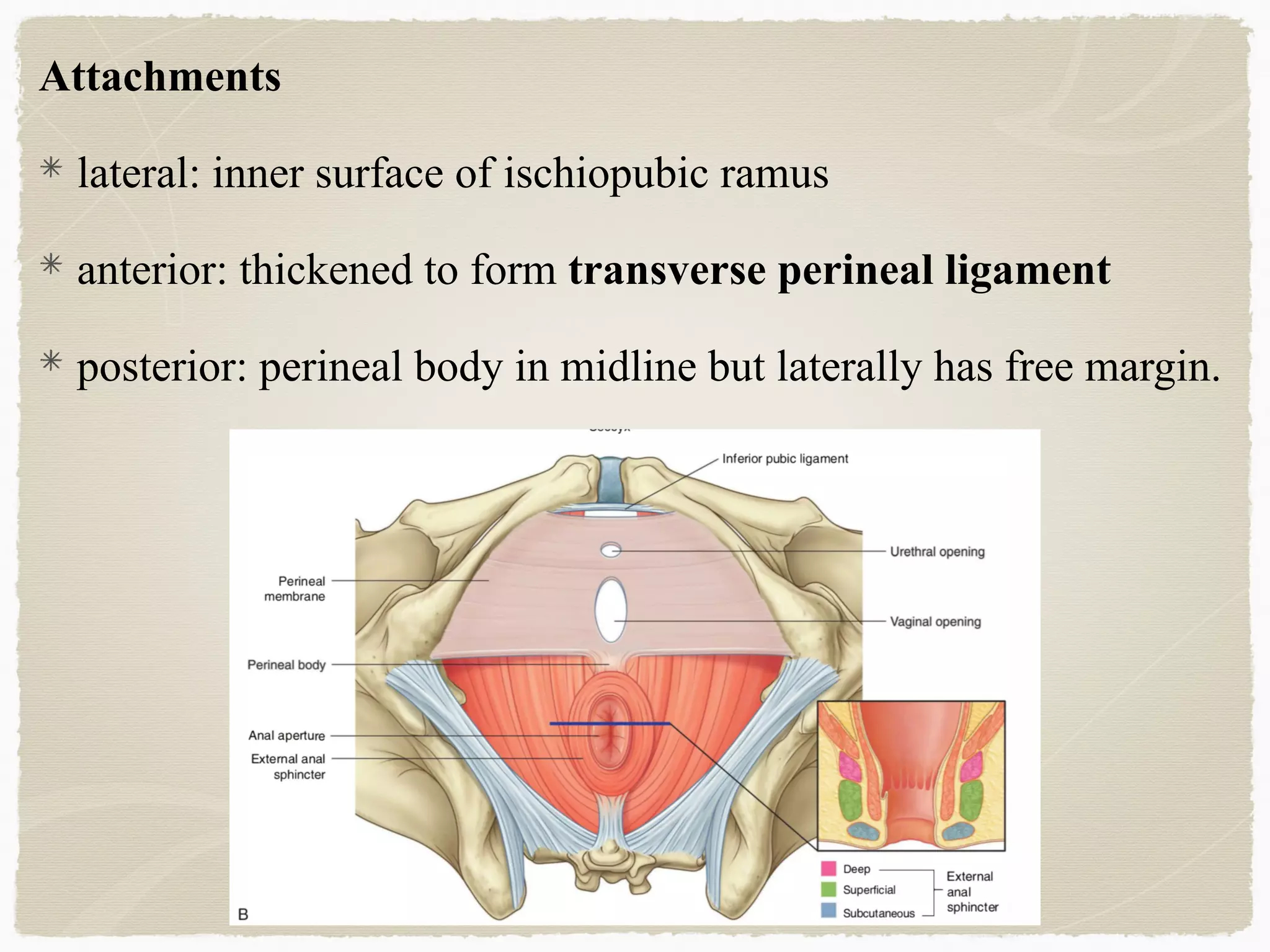
Attachments
lateral: inner surface of ischiopubic ramus
anterior: thickened to form transverse perineal ligament
posterior: perineal body in midline but laterally has free margin.
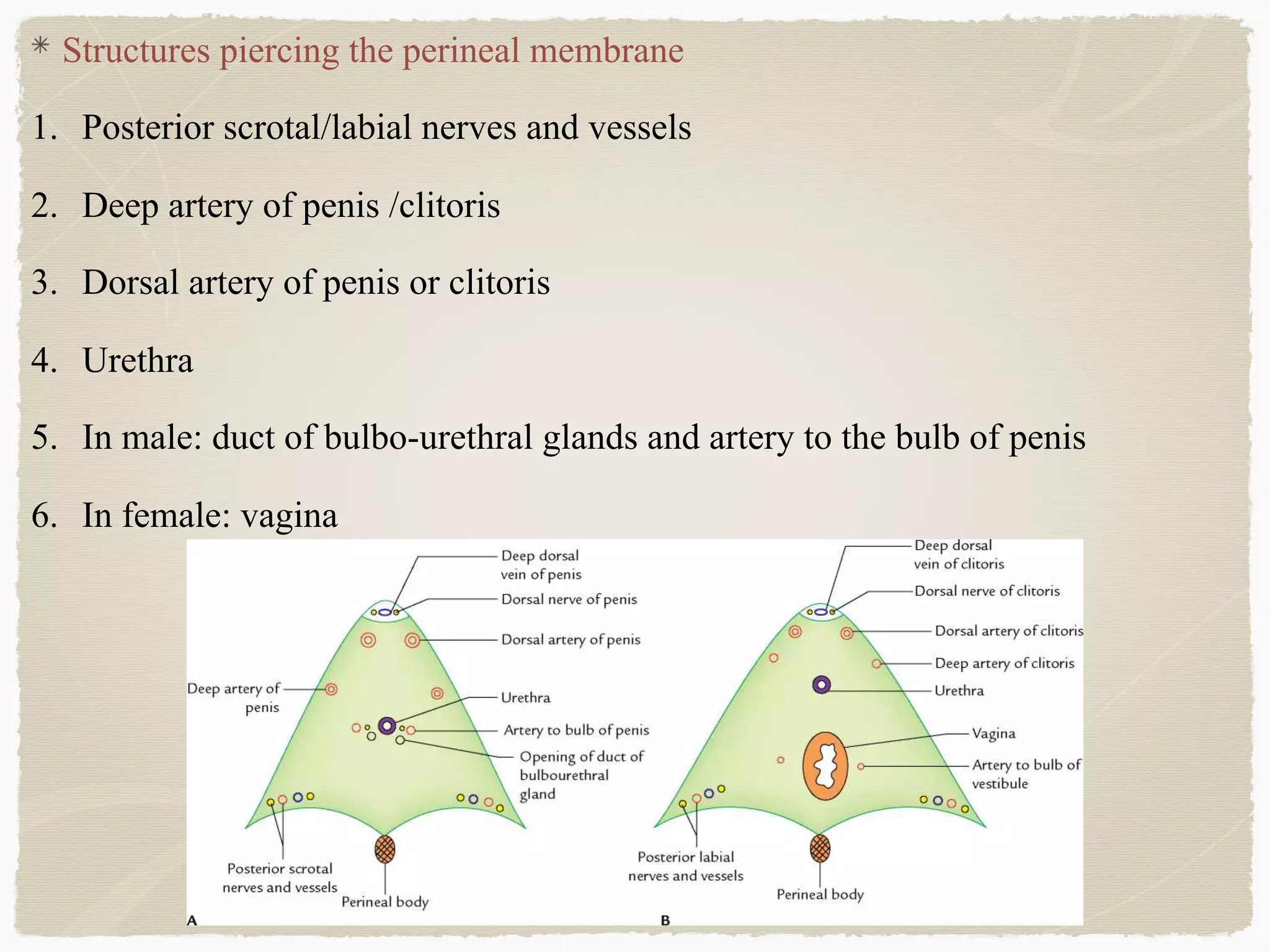
Structures piercing the perineal membrane
1. Posterior scrotal/labial nerves and vessels
2. Deep artery of penis /clitoris
3. Dorsal artery of penis or clitoris
4. Urethra
5. In male: duct of bulbo-urethral glands and artery to the bulb of penis
6. In female: vagina
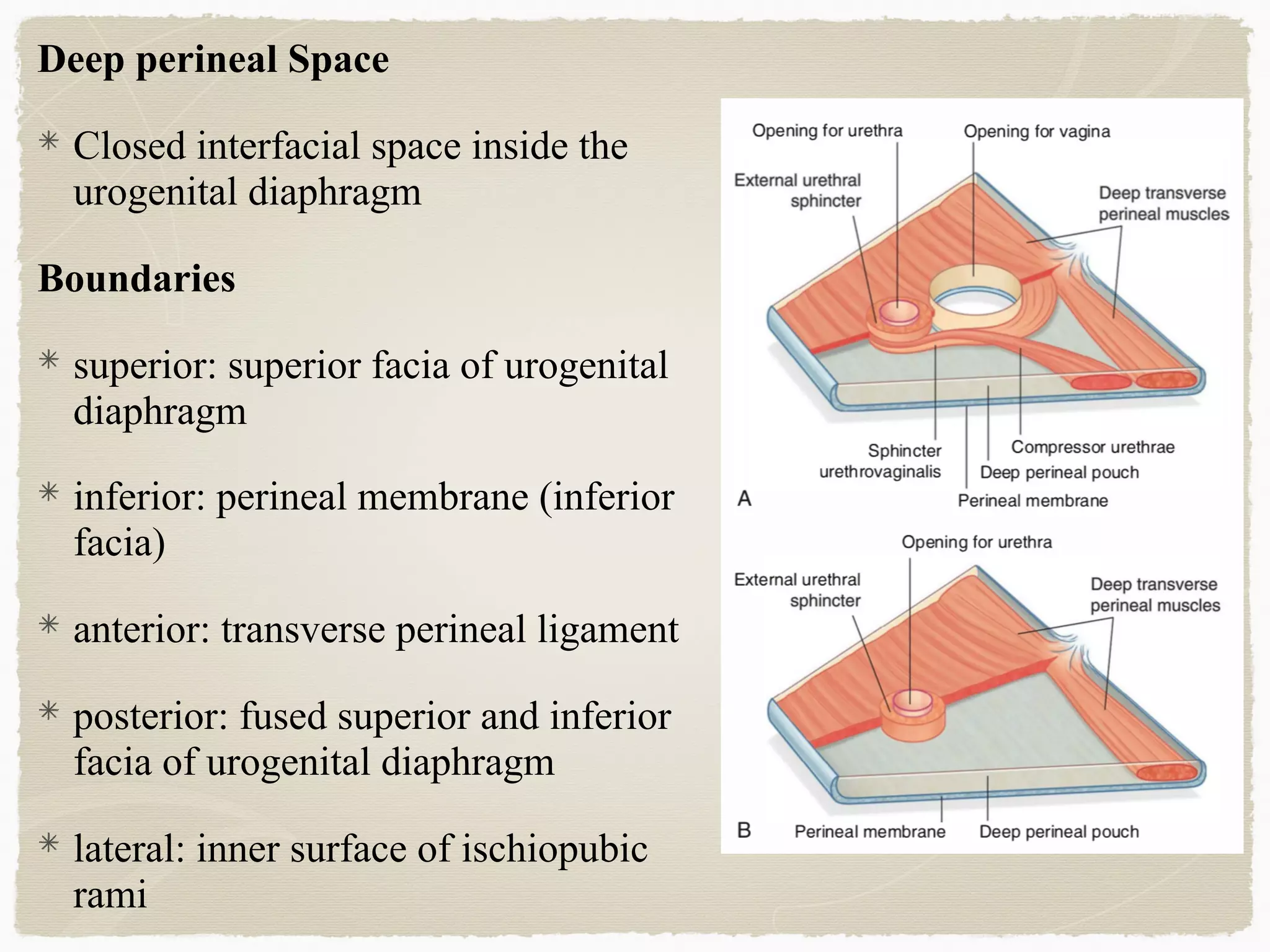
Deep perineal Space
Closed interfacial space inside the
urogenital diaphragm
Boundaries
superior: superior facia of urogenital
diaphragm
inferior: perineal membrane (inferior
facia)
anterior: transverse perineal ligament
posterior: fused superior and inferior
facia of urogenital diaphragm
lateral: inner surface of ischiopubic
rami
Contents:
A. Muscles
Sphincter urethrae: surround membranous urethra
Transversus perinei profundus
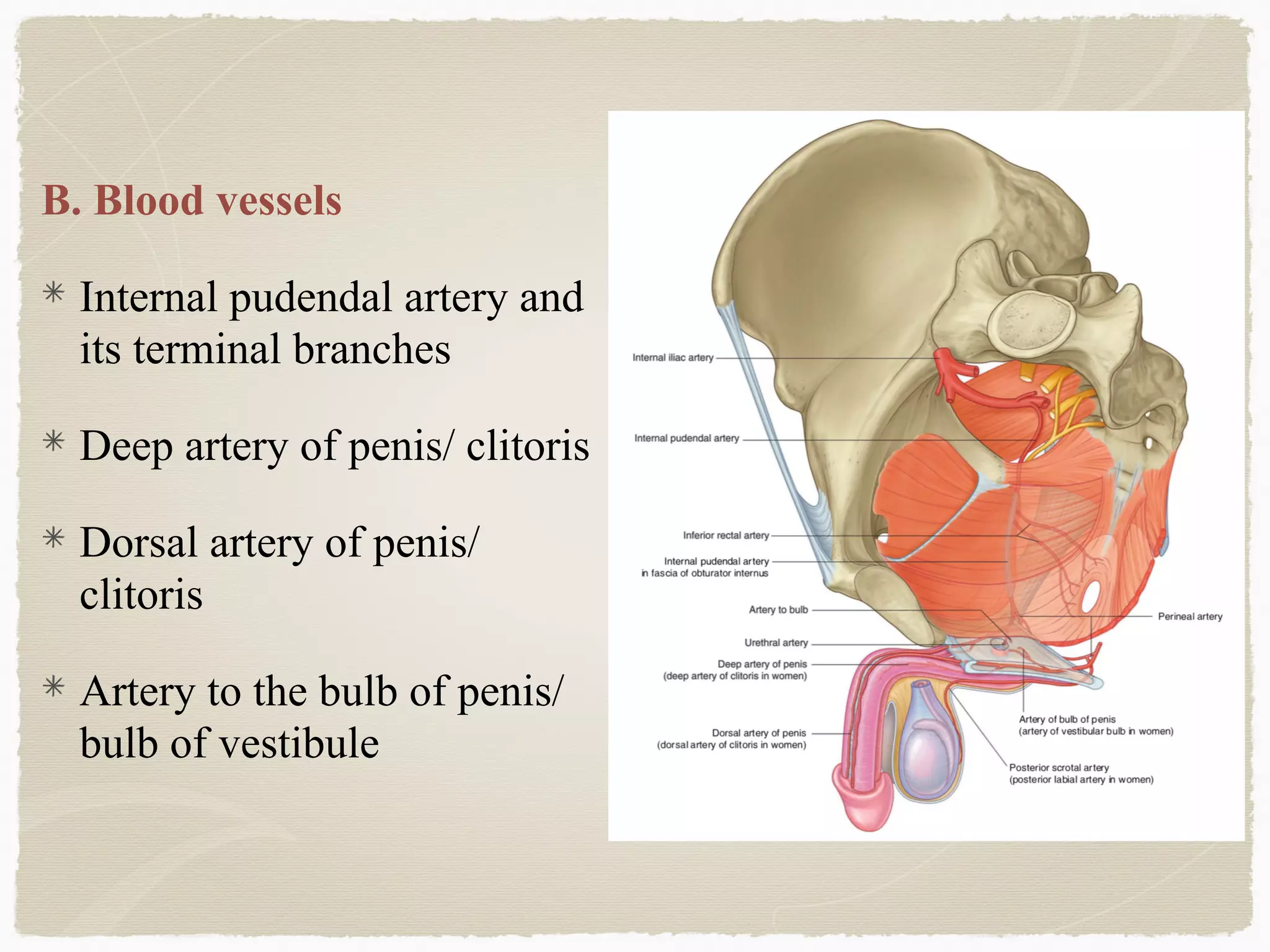
B. Blood vessels
Internal pudendal artery and
its terminal branches
Deep artery of penis/ clitoris
Dorsal artery of penis/
clitoris
Artery to the bulb of penis/
bulb of vestibule
C. Nerves
Dorsal nerve of penis/
clitoris
D. Other structures
Membranous urethra
Bulbo-urethral glands in male
Vagina in female
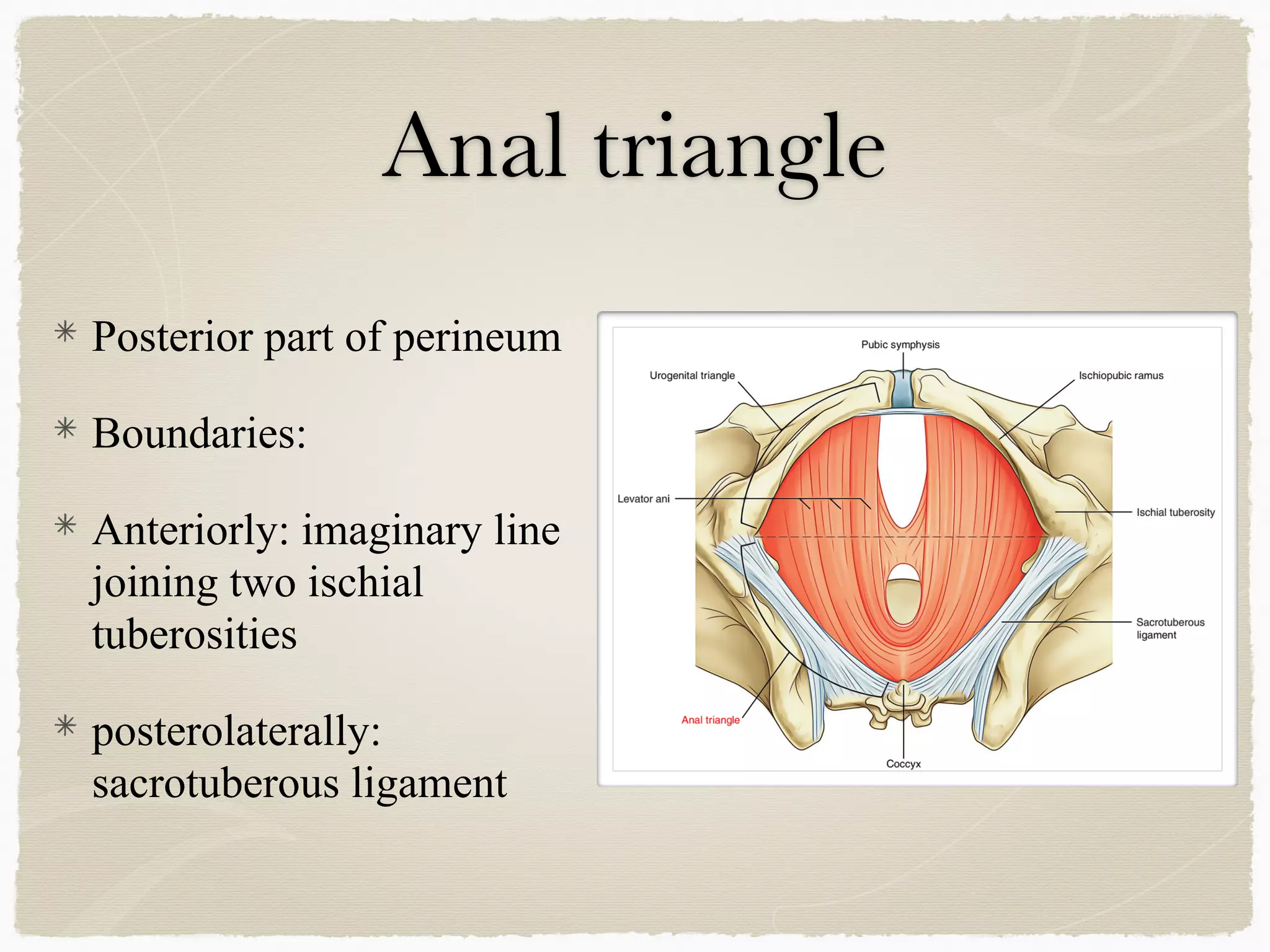
Posterior part of perineum
Boundaries:
Anteriorly: imaginary line
joining two ischial
tuberosities
posterolaterally:
sacrotuberous ligament
Anal triangle
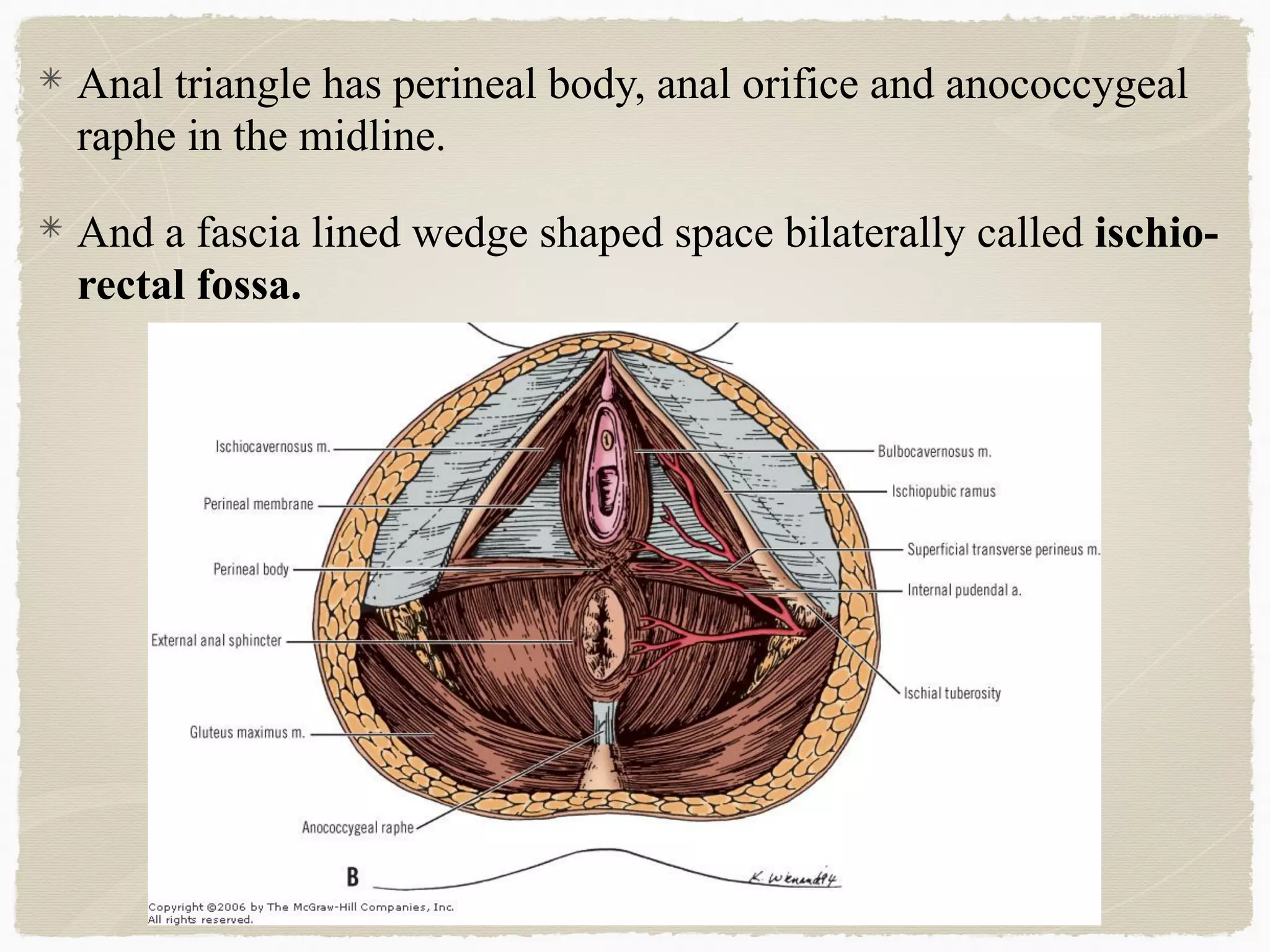
Anal triangle has perineal body, anal orifice and anococcygeal
raphe in the midline.
And a fascia lined wedge shaped space bilaterally called ischio-
rectal fossa.
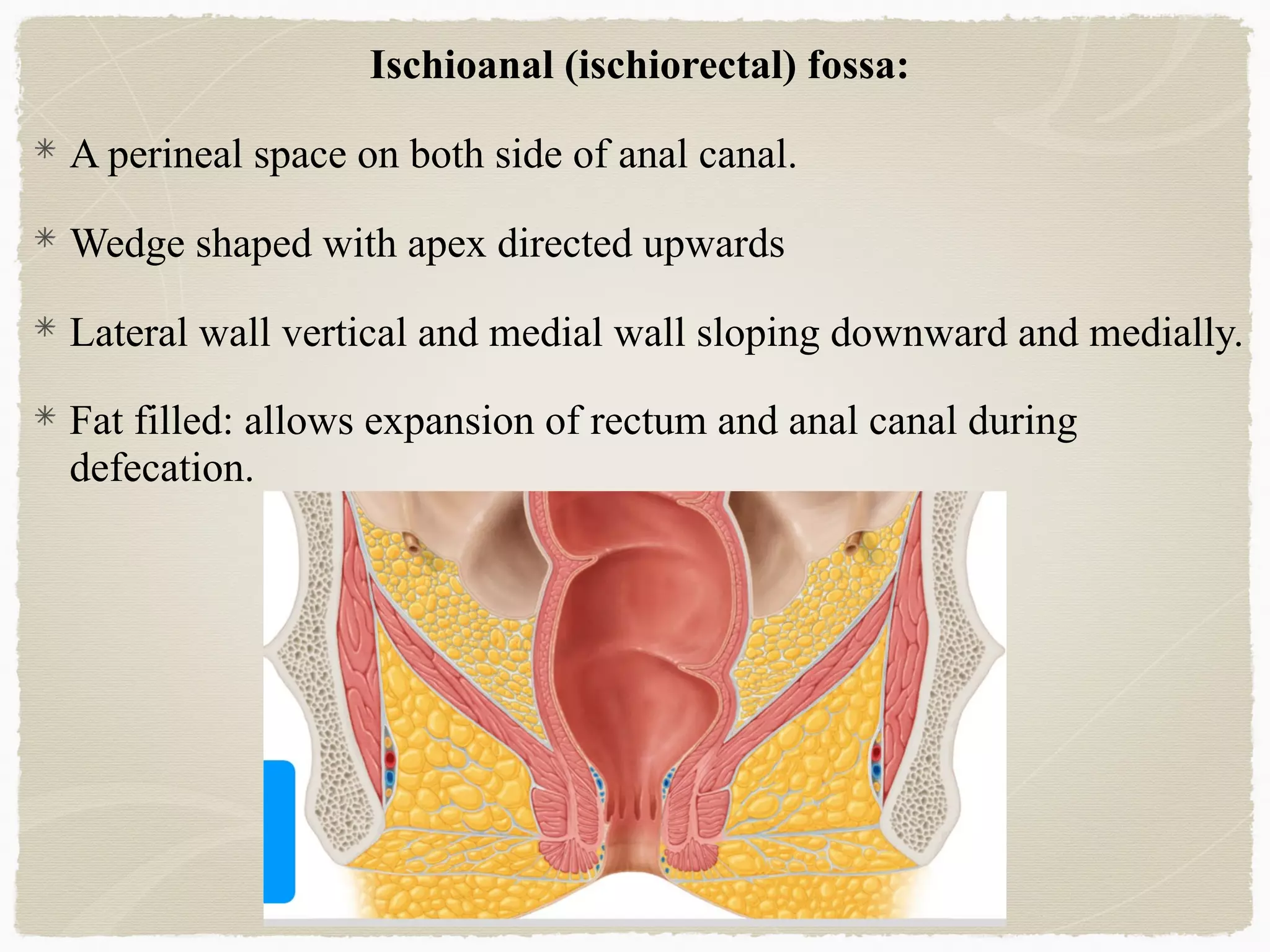
Ischioanal (ischiorectal) fossa:
A perineal space on both side of anal canal.
Wedge shaped with apex directed upwards
Lateral wall vertical and medial wall sloping downward and medially.
Fat filled: allows expansion of rectum and anal canal during
defecation.
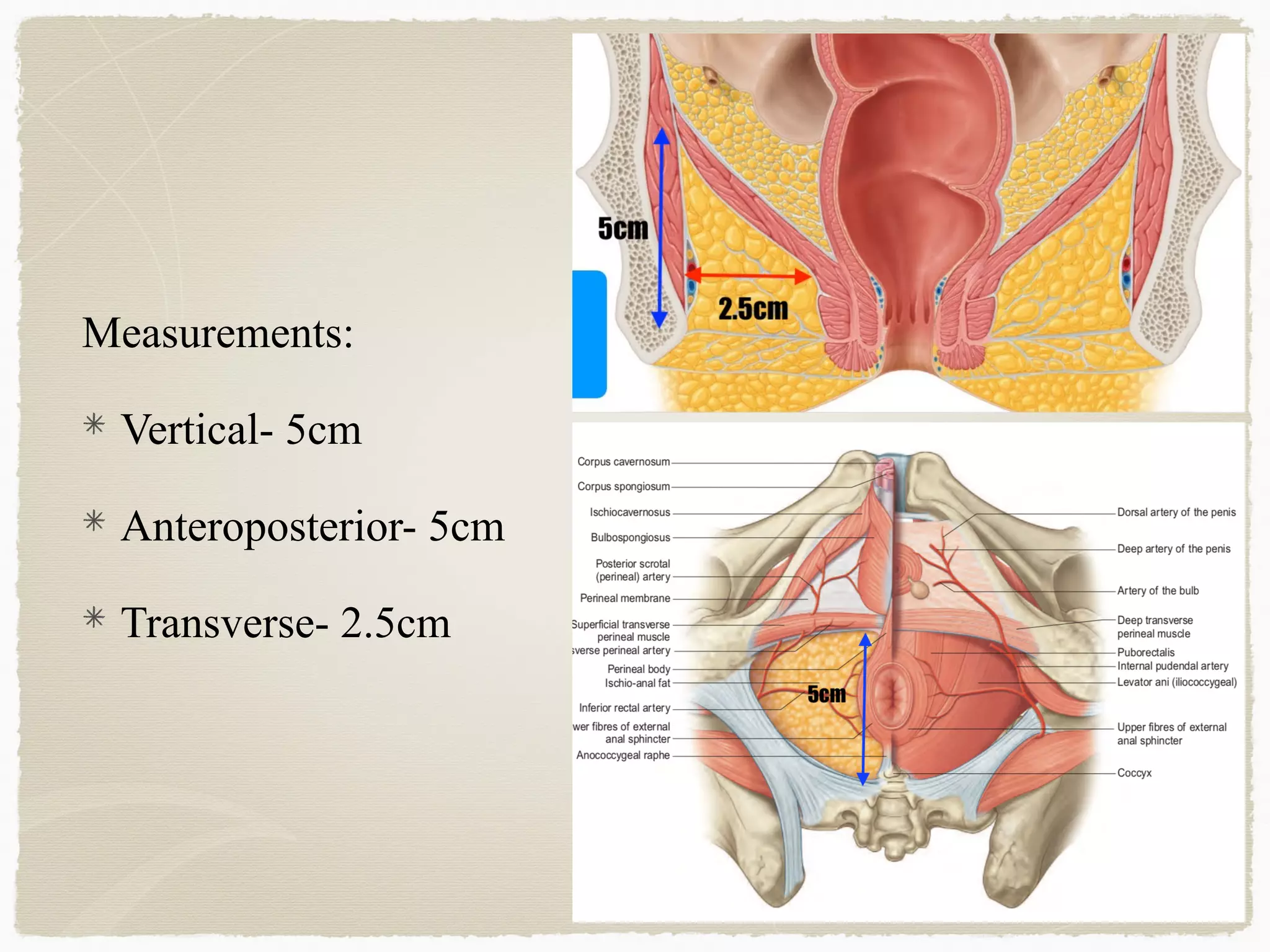
Measurements:
Vertical- 5cm
Anteroposterior- 5cm
Transverse- 2.5cm
Boundaries
Laterally : obturator internus and
its fascia & ischial tuberosity
Medially: levator ani covered by
anal fascia & external anal
sphincter
Anteriorly: superficial and deep
transverse perineal muscles.
Posteriorly: sacrotuberous
ligament covered by gluteus
Maximus
Apex: fusion of obturator and
anal fascia
Base: skin and superficial fascia
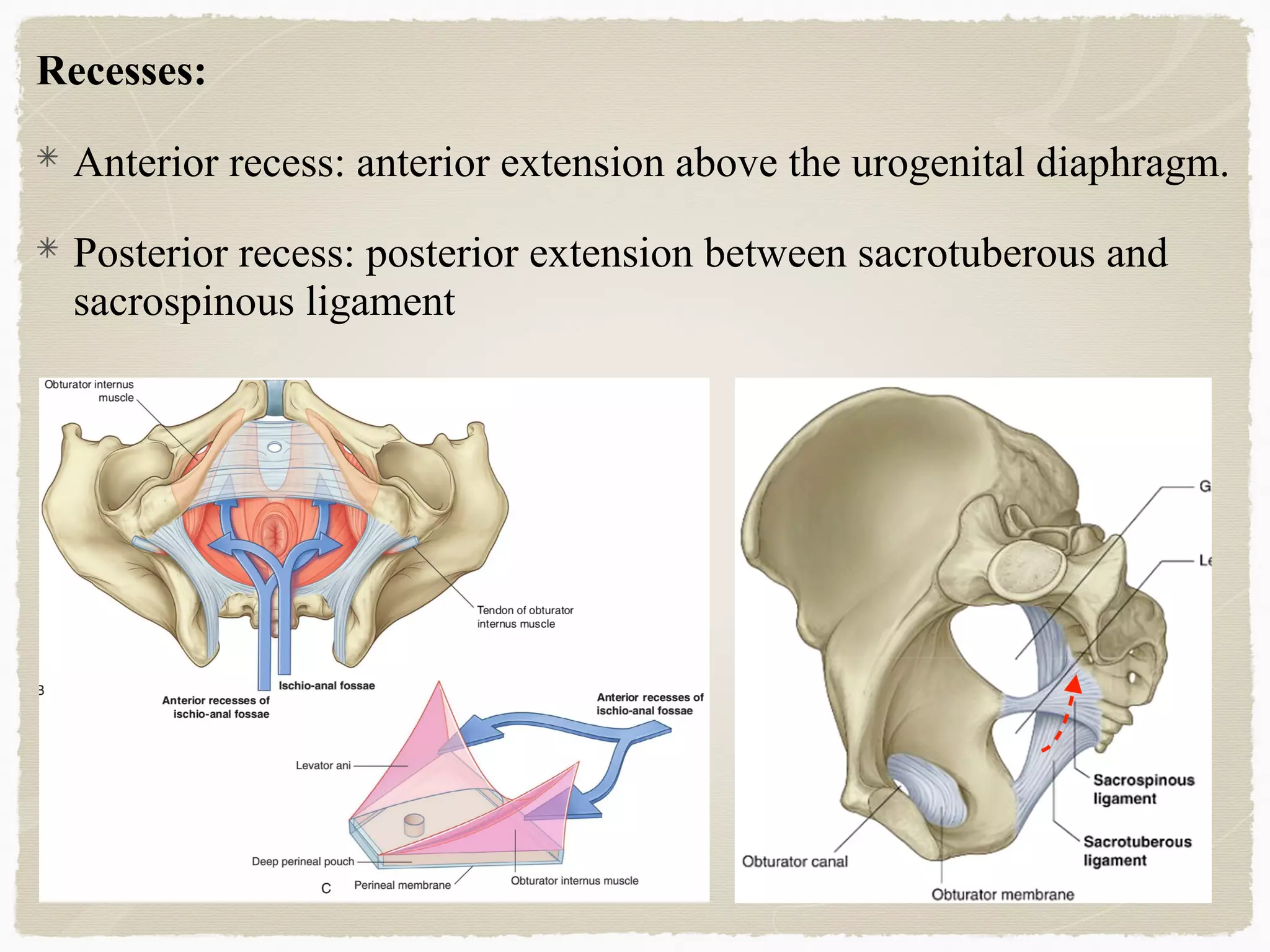
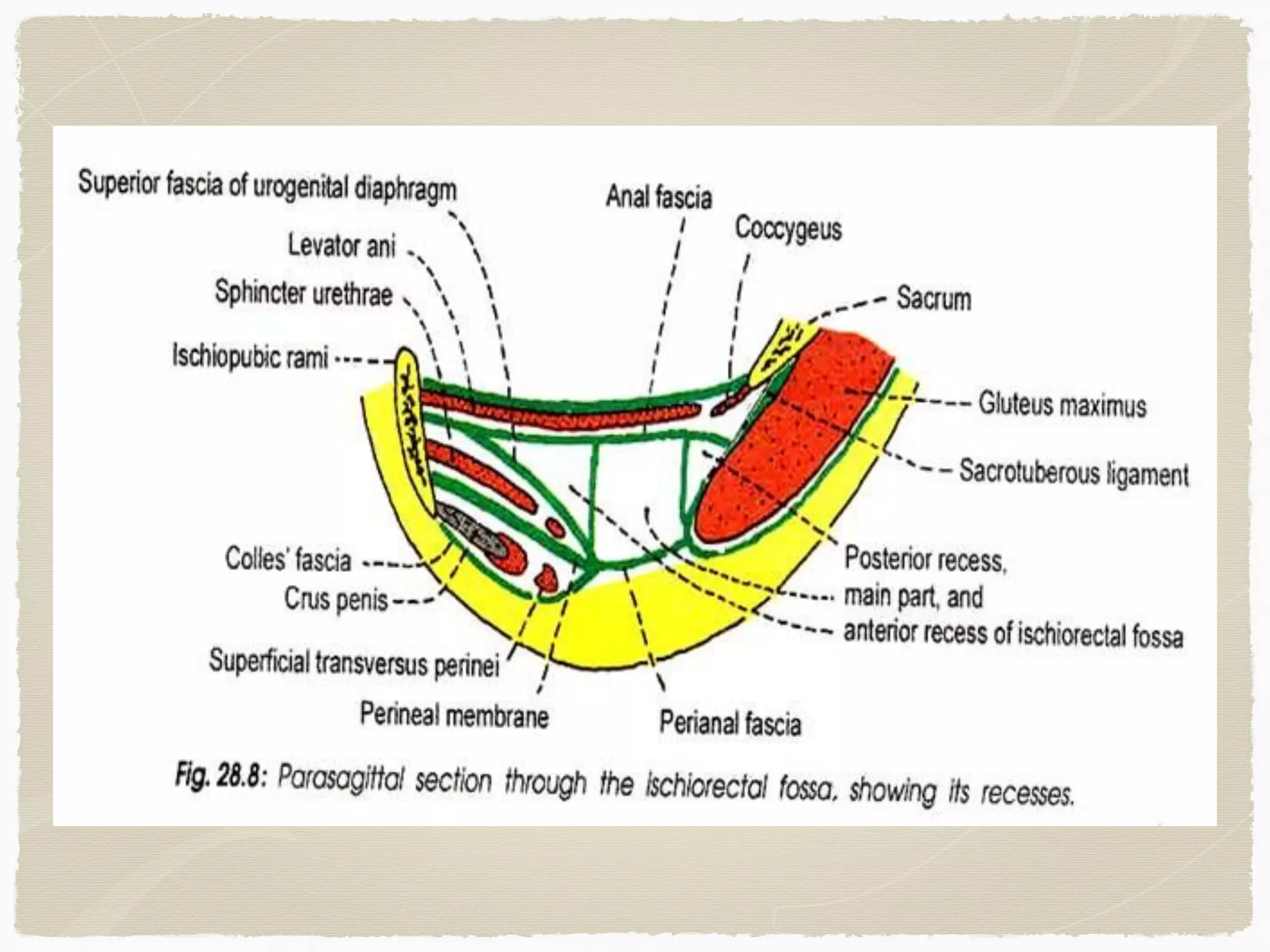
Recesses:
Anterior recess: anterior extension above the urogenital diaphragm.
Posterior recess: posterior extension between sacrotuberous and
sacrospinous ligament
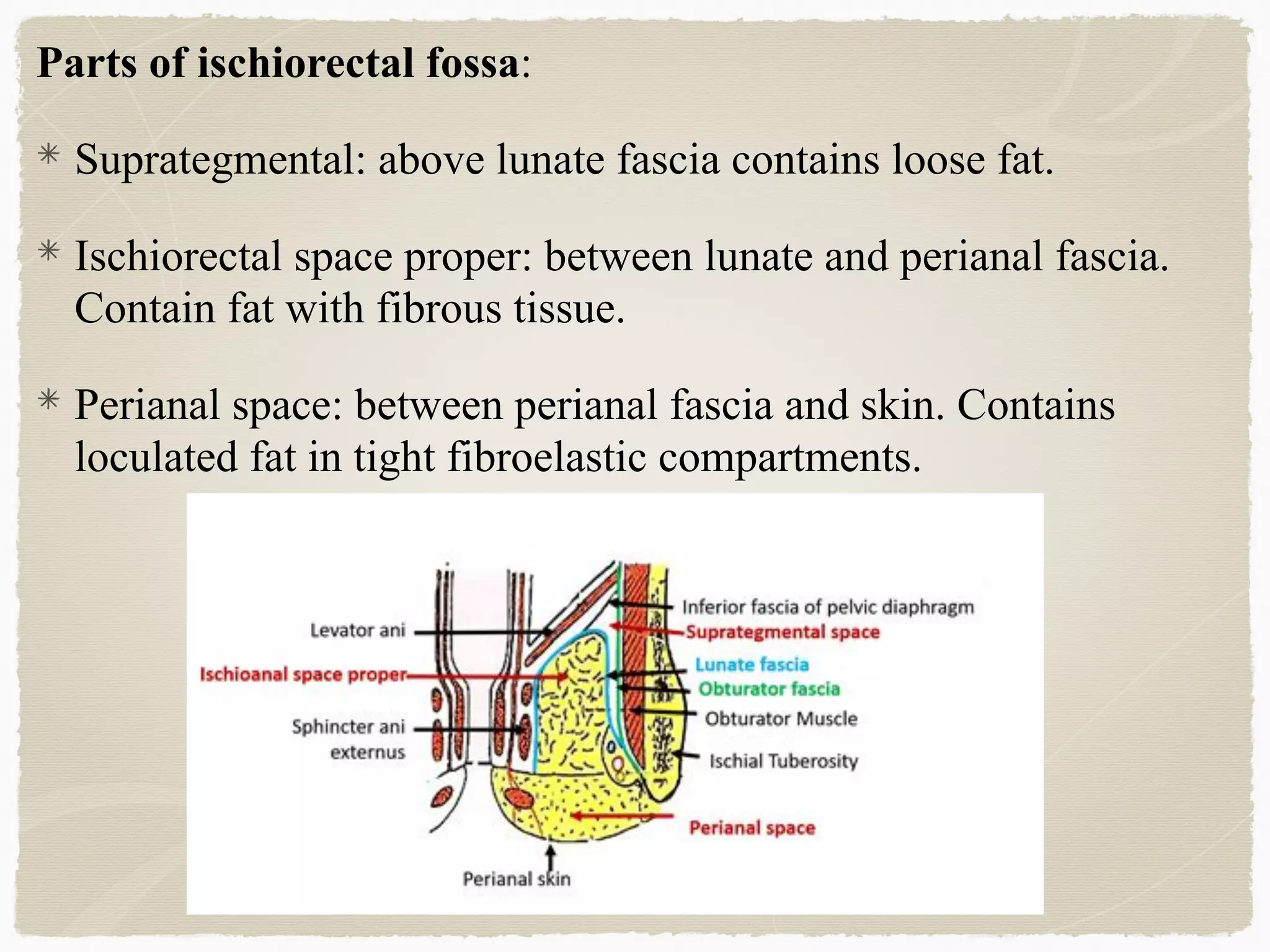
Lunate fascia:
Arched fascia in ischiorectal fossa
Starts from the periosteum of ischial tuberosity makes medial wall
of pudendal canal, lines obturator fascia goes towards apex and
lines anal fascia blends with it at the level of white line of Hilton.
Summit of this facia called tegmentum.
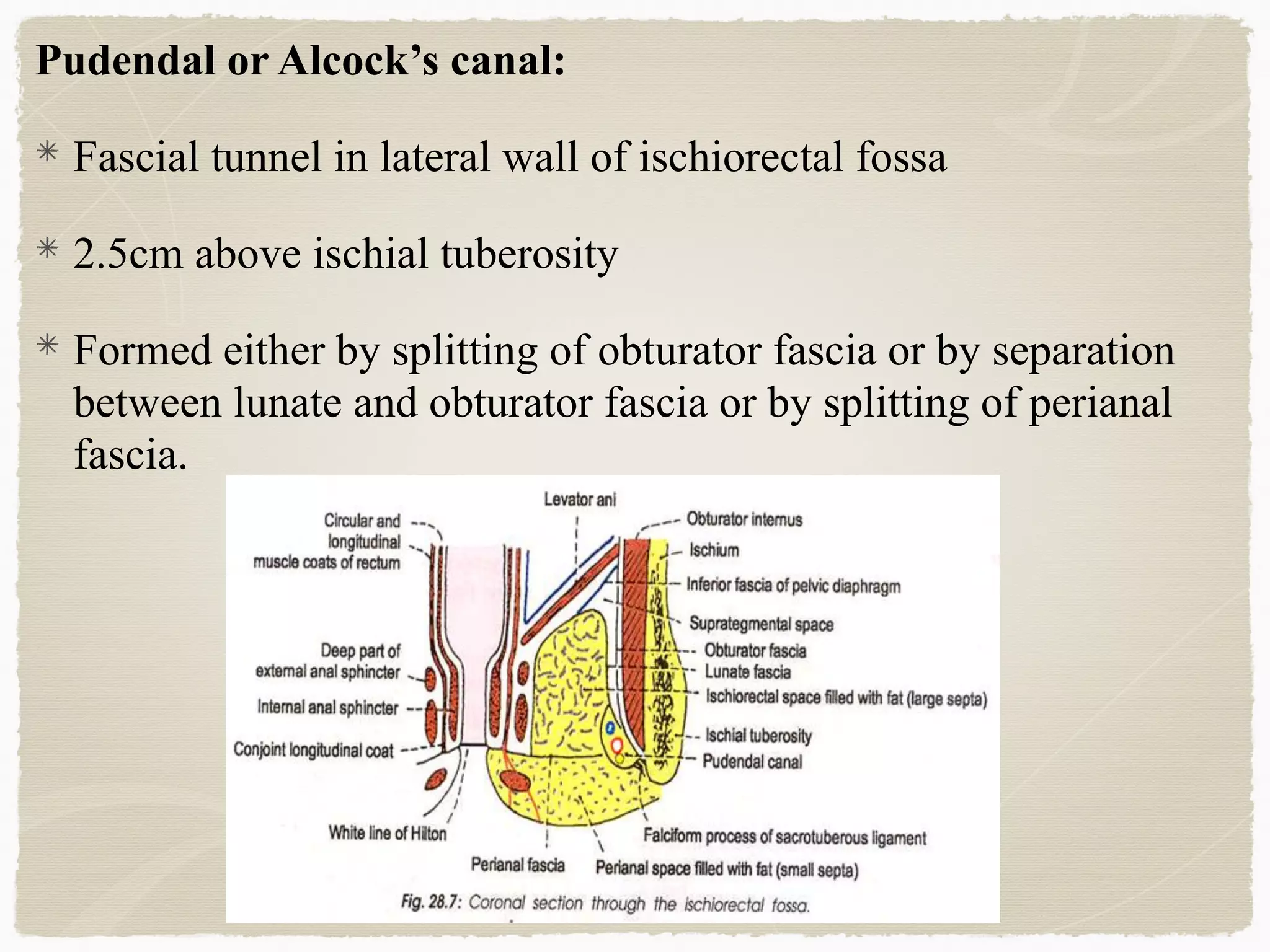
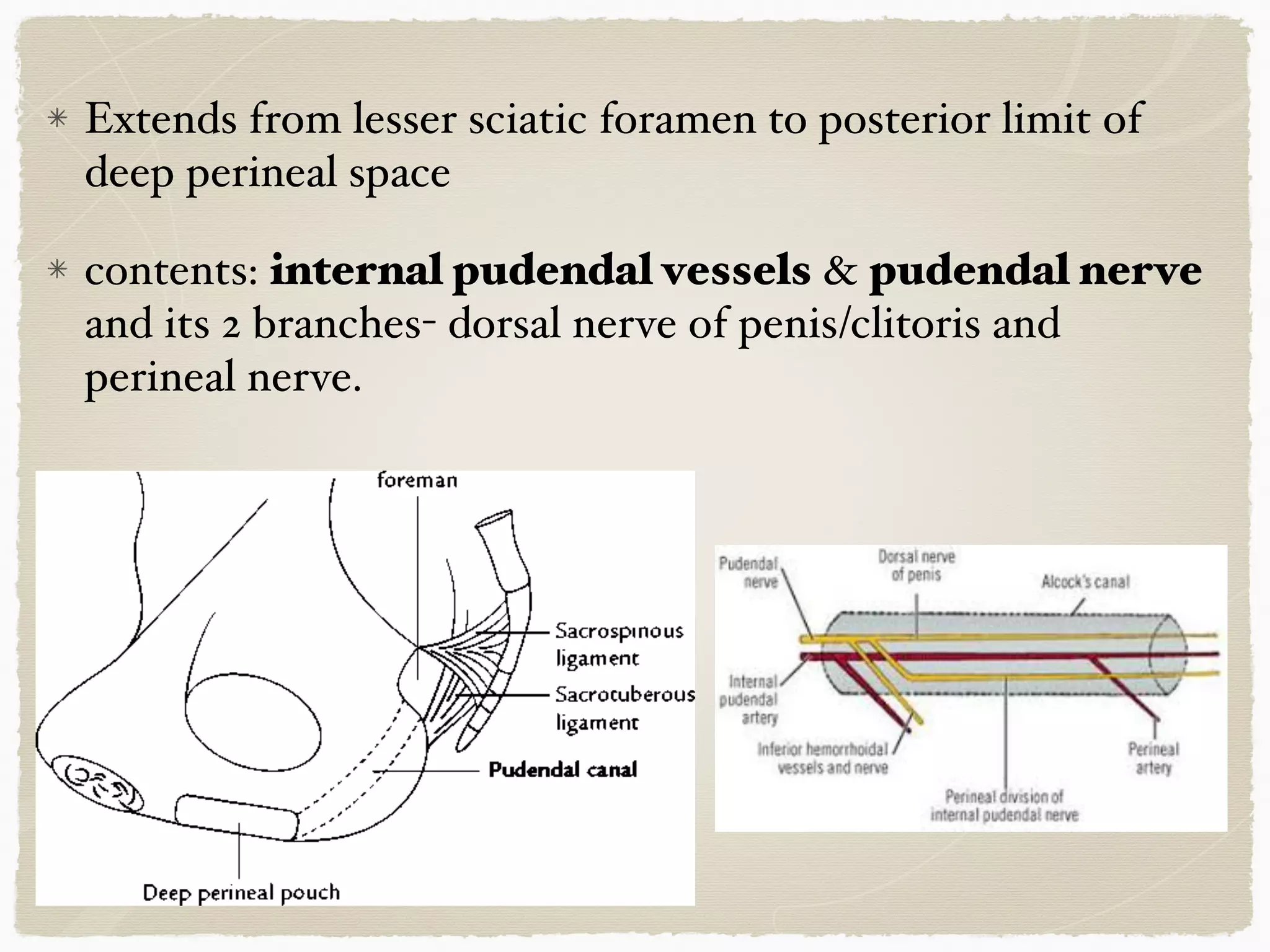
Pudendal or Alcock’s canal:
Fascial tunnel in lateral wall of ischiorectal fossa
2.5cm above ischial tuberosity
Formed either by splitting of obturator fascia or by separation
between lunate and obturator fascia or by splitting of perianal
fascia.
Extends from lesser sciatic foramen to posterior limit of
deep perineal space
contents: internal pudendal vessels & pudendal nerve
and its 2 branches- dorsal nerve of penis/clitoris and
perineal nerve.
Parts of ischiorectal fossa:
Suprategmental: above lunate fascia contains loose fat.
Ischiorectal space proper: between lunate and perianal fascia.
Contain fat with fibrous tissue.
Perianal space: between perianal fascia and skin. Contains
loculated fat in tight fibroelastic compartments.
Contents
Internal pudendal vessels
and pudendal nerve
Inferior rectal vessels and
nerve
Posterior scrotal/labial
vessels and nerves
Perineal branch of 4th and
perforating branch of 2nd
and 3rd sacral nerve.
Fat pad.
Urethral rupture: commonest site is rupture of proximal
spongy urethra below perineal membrane
Mode of injury : perineal structure crushed between inferior
pubic ramus and any hard object like crossbar of bicycle
Applied
Urine escapes through the rupture into the superficial perineal
pouch, descends into the scrotum, around penis and upto the
anterior abdominal wall.
May even reach axilla but never enter thigh due to fusion of
fascia scarpa and fascia lata just below inguinal ligament.
Ischiorectal abscess: loose fat so an abscess in this region may
grow to a large size before producing pain.
Perianal abscess: fat is in tight compartments so the abscess is
very painful due to tension caused by building pus.
Abscess bursting in the anal canal may produce fistula in ano.
Perineal tear:
Commonly during parturition of nullipara women
Perineal tear if not repaired cause prolapse
Prevented by using Episiotomy.
Pudendal block: for perineal anesthesia.
Generally done in 2nd stage of labour to perform or repair
episiotomy.
Transvaginal and Transperineal approach.
Grays Anatomy. 41st edition. Chapter 72.
Grays anatomy for students. 3rd edition. Chapter 5.
A. K. Dutta. Essentials of Human anatomy.
Netter’s atlas of Human Anatomy.
Bibliography
THANK YOU

Perineum

  • 1.
  • 2.
    Introduction Perineum: A diamond-shapedregion that lies below pelvic diaphragm, between the inner aspects of the thighs and anterior to the sacrum and coccyx.
  • 3.
    Boundaries: Anterior : lowerborder of symphysis pubis & arcuate pubic ligament Posteriorly : tip of coccyx. Antero-laterally : ischiopubic rami and ischial tuberosities. Postero-laterally : Sacrotuberous ligament
  • 4.
    Divisions: 1. Urogenital triangle 2.Anal triangle Approx.120º angle between the planes of both triangle
  • 5.
    Urogenital Triangle Anterior partof perineum. Boundaries: Anteriorly: lower margin of pubic symphysis & arcuate pubic ligament Posteriorly: imaginary line joining two ischial tuberosities Laterally: lower margin of ischiopubic rami.
  • 6.
    Superficially : skinand superficial fascia Deep: thin endopelvic fascia The urogenital triangle is divided into two parts by a strong perineal membrane. The deep perineal space lies above the membrane. The superficial perineal space lies below it.
  • 7.
    Dissection in theurogenital triangle region reveals following layers from superficial to deep: 1. Skin 2. Fatty layer of superficial facia 3. Membranous layer of superficial facia (Colles facia) 4. Contents of superficial perineal space 5. Perineal membrane (inf. Layer of urogenital diaphragm) 6. Contents of deep perineal space 7. Endopelvic facia (Superior facia of urogenital diaphragm)
  • 8.
    Skin: In male: midlineraphe continuous with raphe of scrotum. In female: perineal raphe leading to midline cleft called vestibule between two labia minora. Raphe indicates development from fusion of two symmetrical halves.
  • 9.
    Fatty layer ofsuperficial facia: continuous with the fatty layer of superficial facia in lower abdomen - facia of camper.
  • 10.
    Colles fascia: Membranous layerof superficial fascia. Forms lower limit of superficial perineal pouch. Attachments: lateral: lower margin of ischiopubic rami posterior: attached to posterior margin of perineal membrane Anterior: continuous with dartos muscle of scrotum, superficial fascia of penis and Scarpa’s fascia of lower abdomen.
  • 12.
    Superficial perineal space: Interfascialspace below perineal membrane Boundaries superior: perineal membrane inferior: Colles fascia lateral: ischiopubic ramus posterior: closed by fusion of perineal membrane and colles fascia anterior: open with deep to Dartos muscle and superficial fascia of penis and ant. abdominal wall between fascia Scarpa and external oblique aponeurosis.
  • 13.
    Contents: A. Muscles: Ischiocavernosus: covercrus penis or crus clitoridis. Transversus perinei superficialis Bulbospongiosus: cover bulb of penis or bulb of vestibule.
  • 15.
    B. Blood vessels Posteriorscrotal/labial arteries - branch of perineal or internal pudendal artery Transverse perineal artery- branch of perineal artery.
  • 16.
    C. Nerves Posterior scrotal/labial nerves: branches of superficial perineal nerve Perineal branch of posterior femoral cutaneous nerve.
  • 17.
    D. Other structures: Cruspenis/ crus clitoridis Bulb of penis with urethra traversing it Bulb of vestibule with greater vestibular gland
  • 18.
    Perineal membrane Inferior fasciaof urogenital diaphragm Triangular; apex directed in the front Stretched between pubic arch
  • 19.
    Attachments lateral: inner surfaceof ischiopubic ramus anterior: thickened to form transverse perineal ligament posterior: perineal body in midline but laterally has free margin.
  • 20.
    Structures piercing theperineal membrane 1. Posterior scrotal/labial nerves and vessels 2. Deep artery of penis /clitoris 3. Dorsal artery of penis or clitoris 4. Urethra 5. In male: duct of bulbo-urethral glands and artery to the bulb of penis 6. In female: vagina
  • 21.
    Deep perineal Space Closedinterfacial space inside the urogenital diaphragm Boundaries superior: superior facia of urogenital diaphragm inferior: perineal membrane (inferior facia) anterior: transverse perineal ligament posterior: fused superior and inferior facia of urogenital diaphragm lateral: inner surface of ischiopubic rami
  • 22.
    Contents: A. Muscles Sphincter urethrae:surround membranous urethra Transversus perinei profundus
  • 23.
    B. Blood vessels Internalpudendal artery and its terminal branches Deep artery of penis/ clitoris Dorsal artery of penis/ clitoris Artery to the bulb of penis/ bulb of vestibule
  • 25.
    C. Nerves Dorsal nerveof penis/ clitoris
  • 26.
    D. Other structures Membranousurethra Bulbo-urethral glands in male Vagina in female
  • 27.
    Posterior part ofperineum Boundaries: Anteriorly: imaginary line joining two ischial tuberosities posterolaterally: sacrotuberous ligament Anal triangle
  • 28.
    Anal triangle hasperineal body, anal orifice and anococcygeal raphe in the midline. And a fascia lined wedge shaped space bilaterally called ischio- rectal fossa.
  • 29.
    Ischioanal (ischiorectal) fossa: Aperineal space on both side of anal canal. Wedge shaped with apex directed upwards Lateral wall vertical and medial wall sloping downward and medially. Fat filled: allows expansion of rectum and anal canal during defecation.
  • 30.
  • 31.
    Boundaries Laterally : obturatorinternus and its fascia & ischial tuberosity Medially: levator ani covered by anal fascia & external anal sphincter Anteriorly: superficial and deep transverse perineal muscles. Posteriorly: sacrotuberous ligament covered by gluteus Maximus Apex: fusion of obturator and anal fascia Base: skin and superficial fascia
  • 32.
    Recesses: Anterior recess: anteriorextension above the urogenital diaphragm. Posterior recess: posterior extension between sacrotuberous and sacrospinous ligament
  • 34.
    Lunate fascia: Arched fasciain ischiorectal fossa Starts from the periosteum of ischial tuberosity makes medial wall of pudendal canal, lines obturator fascia goes towards apex and lines anal fascia blends with it at the level of white line of Hilton. Summit of this facia called tegmentum.
  • 35.
    Pudendal or Alcock’scanal: Fascial tunnel in lateral wall of ischiorectal fossa 2.5cm above ischial tuberosity Formed either by splitting of obturator fascia or by separation between lunate and obturator fascia or by splitting of perianal fascia.
  • 36.
    Extends from lessersciatic foramen to posterior limit of deep perineal space contents: internal pudendal vessels & pudendal nerve and its 2 branches- dorsal nerve of penis/clitoris and perineal nerve.
  • 37.
    Parts of ischiorectalfossa: Suprategmental: above lunate fascia contains loose fat. Ischiorectal space proper: between lunate and perianal fascia. Contain fat with fibrous tissue. Perianal space: between perianal fascia and skin. Contains loculated fat in tight fibroelastic compartments.
  • 38.
    Contents Internal pudendal vessels andpudendal nerve Inferior rectal vessels and nerve Posterior scrotal/labial vessels and nerves Perineal branch of 4th and perforating branch of 2nd and 3rd sacral nerve. Fat pad.
  • 39.
    Urethral rupture: commonestsite is rupture of proximal spongy urethra below perineal membrane Mode of injury : perineal structure crushed between inferior pubic ramus and any hard object like crossbar of bicycle Applied
  • 40.
    Urine escapes throughthe rupture into the superficial perineal pouch, descends into the scrotum, around penis and upto the anterior abdominal wall. May even reach axilla but never enter thigh due to fusion of fascia scarpa and fascia lata just below inguinal ligament.
  • 41.
    Ischiorectal abscess: loosefat so an abscess in this region may grow to a large size before producing pain. Perianal abscess: fat is in tight compartments so the abscess is very painful due to tension caused by building pus. Abscess bursting in the anal canal may produce fistula in ano.
  • 42.
    Perineal tear: Commonly duringparturition of nullipara women Perineal tear if not repaired cause prolapse Prevented by using Episiotomy.
  • 43.
    Pudendal block: forperineal anesthesia. Generally done in 2nd stage of labour to perform or repair episiotomy. Transvaginal and Transperineal approach.
  • 44.
    Grays Anatomy. 41stedition. Chapter 72. Grays anatomy for students. 3rd edition. Chapter 5. A. K. Dutta. Essentials of Human anatomy. Netter’s atlas of Human Anatomy. Bibliography
  • 45.