PAEDIATRIC
EMERGENCIES
MISBAH MOHAMMAD
EM/PEM CONSULTANT
PED CLINICAL LEAD
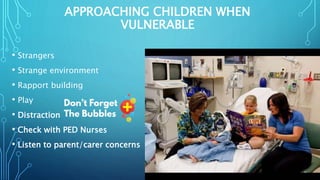
APPROACHING CHILDREN WHEN
VULNERABLE
• Strangers
• Strange environment
• Rapport building
• Play
• Distraction
• Check with PED Nurses
• Listen to parent/carer concerns
HISTORY TAKING
• Source of history
• Witness of the story – nursery/school notes
• Delayed or timely presentation – timeline – reattendance
• Professional curiosity – exploring – non-judgemental
• Birth History
• Vaccination History
• Social History including safeguarding history
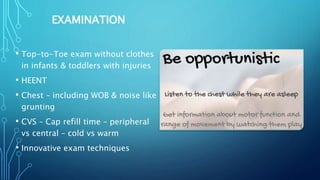
EXAMINATION
• Top-to-Toe exam without clothes
in infants & toddlers with injuries
• HEENT
• Chest – including WOB & noise like
grunting
• CVS – Cap refill time – peripheral
vs central – cold vs warm
• Innovative exam techniques
COMMON PRESENTATIONS
• Fever including Croup
• Wheeze, DIB
• Injuries
• ***NEEDLE in a HAYSTACK – SEPSIS & SAFEGUARDING CONCERN
FEVER
• URTI (including Tonsillitis) &/or EAR INFECTION – Abx or no
Abx
• Chest Infection – CXR or no CXR
• UTI – Culture or no Culture; Abx or no Abx
• Meningitis/Meningococcal Sepsis/Encephalitis
• Septic arthritis, discitis
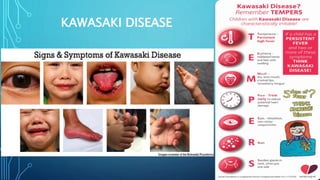
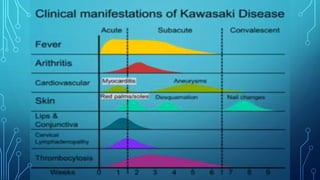
• ***KAWASAKI DISEASE
• ***PIMS-TS
Fever in under 5s: assessment and initial management
NICE guideline [NG143] Published: 07 November 2019
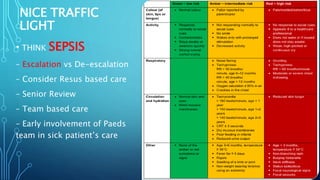
NICE TRAFFIC
LIGHT
• THINK SEPSIS
– Escalation vs De-escalation
– Consider Resus based care
– Senior Review
– Team based care
– Early involvement of Paeds
team in sick patient’s care
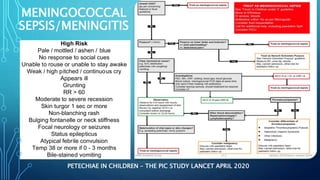
MENINGOCOCCAL
SEPSIS/MENINGITIS
High Risk
Pale / mottled / ashen / blue
No response to social cues
Unable to rouse or unable to stay awake
Weak / high pitched / continuous cry
Appears ill
Grunting
RR > 60
Moderate to severe recession
Skin turgor 1 sec or more
Non-blanching rash
Bulging fontanelle or neck stiffness
Focal neurology or seizures
Status epilepticus
Atypical febrile convulsion
Temp 38 or more if 0 - 3 months
Bile-stained vomiting
or swollen
y
No below
PETECHIAE IN CHILDREN – THE PIC STUDY LANCET APRIL 2020
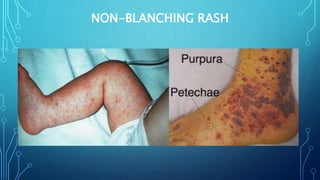
NON-BLANCHING RASH
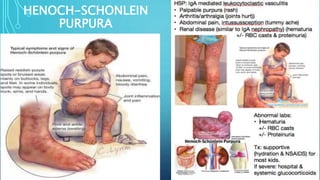
HENOCH-SCHONLEIN
PURPURA
KAWASAKI DISEASE
PIMS – TS
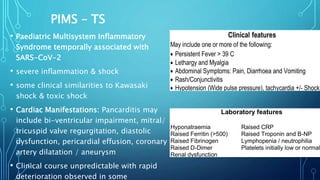
• Paediatric Multisystem Inflammatory
Syndrome temporally associated with
SARS-CoV-2
• severe inflammation & shock
• some clinical similarities to Kawasaki
shock & toxic shock
• Cardiac Manifestations: Pancarditis may
include bi-ventricular impairment, mitral/
tricuspid valve regurgitation, diastolic
dysfunction, pericardial effusion, coronary
artery dilatation / aneurysm
• Clinical course unpredictable with rapid
deterioration observed in some
Clinical features
May include one or more of the following:
Persistent Fever > 39 C
Lethargy and Myalgia
Abdominal Symptoms: Pain, Diarrhoea and Vomiting
Rash/Conjunctivitis
Hypotension (Wide pulse pressure), tachycardia +/- Shock
Initial management
Examination:
Exclude potential septic foci and careful cardiac assessme
(liver, JVP, cardiac / thoracic ratio on CXR)
Resuscitation:
If signs of shock – fluid resuscitation (10ml/kg aliquots) wit
shock. This syndrome has some clinical similarities to Kawas
illness. In the majority of patients, coronavirus has not been d
SARS-CoV-2 infection is present in some. The likeliest mechan
Significant similarity in presen
Septic shock - may require higher volume fluid resuscitat
Peritonitis -negative laparotomy reported in some cases:
ediatric Critical Care
ediatric Multisystem Inflammatory Syndrome temporally associated with SARS-CoV-2
Clinical features
include one or more of the following:
ersistent Fever > 39 C
thargy and Myalgia
bdominal Symptoms: Pain, Diarrhoea and Vomiting
ash/Conjunctivitis
ypotension (Wide pulse pressure), tachycardia +/- Shock
Covid-19 pandemic has been temporally associated with the emergence of a paediatric presentation of severe inflammatio
k. This syndrome has some clinical similarities to Kawasaki shock and toxic shock. Patients have presented with mild to s
ss. In the majority of patients, coronavirus has not been detected by PCR on throat/nasal swabs, however serological eviden
S-CoV-2 infection is present in some. The likeliest mechanism is a delayed antibody-mediated dysregulated host immune resp
Laboratory features
Hyponatraemia Raised CRP
Raised Ferritin (>500) Raised Troponin and B-NP
Raised Fibrinogen Lymphopenia / neutrophilia
Raised D-Dimer Platelets initially low or normal
Renal dysfunction
Significant similarity in presentation with other paediatric conditions
ic shock - may require higher volume fluid resuscitation and source control: senior clinical review
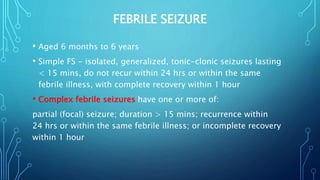
FEBRILE SEIZURE
• Aged 6 months to 6 years
• Simple FS - isolated, generalized, tonic-clonic seizures lasting
< 15 mins, do not recur within 24 hrs or within the same
febrile illness, with complete recovery within 1 hour
• Complex febrile seizures have one or more of:
partial (focal) seizure; duration > 15 mins; recurrence within
24 hrs or within the same febrile illness; or incomplete recovery
within 1 hour
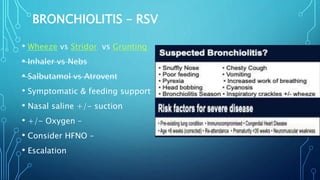
BRONCHIOLITIS – RSV
• Wheeze vs Stridor vs Grunting
• Inhaler vs Nebs
• Salbutamol vs Atrovent
• Symptomatic & feeding support
• Nasal saline +/- suction
• +/- Oxygen –
• Consider HFNO –
• Escalation
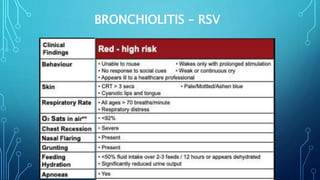
BRONCHIOLITIS – RSV
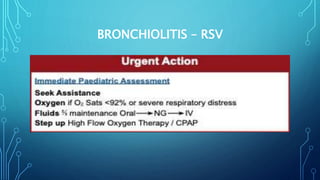
BRONCHIOLITIS – RSV
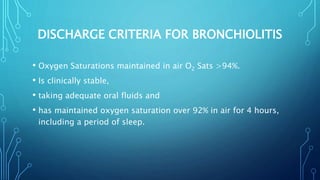
DISCHARGE CRITERIA FOR BRONCHIOLITIS
• Oxygen Saturations maintained in air O2 Sats >94%.
• Is clinically stable,
• taking adequate oral fluids and
• has maintained oxygen saturation over 92% in air for 4 hours,
including a period of sleep.
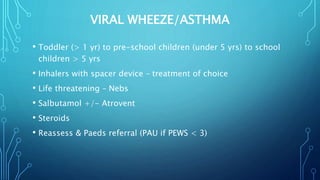
VIRAL WHEEZE/ASTHMA
• Toddler (> 1 yr) to pre-school children (under 5 yrs) to school
children > 5 yrs
• Inhalers with spacer device – treatment of choice
• Life threatening – Nebs
• Salbutamol +/- Atrovent
• Steroids
• Reassess & Paeds referral (PAU if PEWS < 3)
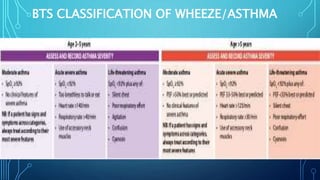
BTS CLASSIFICATION OF WHEEZE/ASTHMA
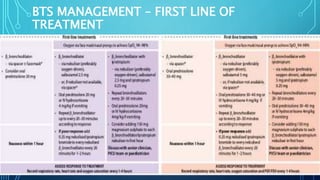
BTS MANAGEMENT – FIRST LINE OF
TREATMENT
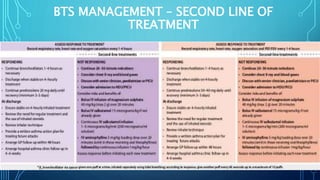
BTS MANAGEMENT – SECOND LINE OF
TREATMENT
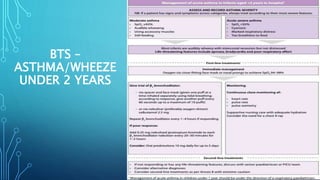
BTS –
ASTHMA/WHEEZE
UNDER 2 YEARS
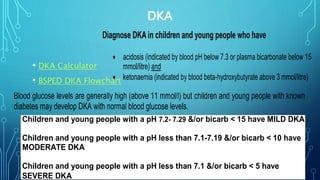
DKA
• DKA Calculator
• BSPED DKA Flowchart
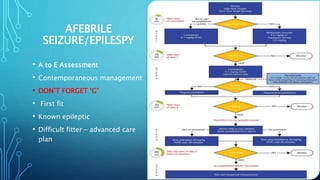
AFEBRILE
SEIZURE/EPILESPY
• A to E Assessment
• Contemporaneous management
• DON’T FORGET ‘G’
• First fit
• Known epileptic
• Difficult fitter – advanced care
plan
INJURIES
• MOI – think major trauma – senior involve +/- Paeds trauma
team activation
• Presentation – timely or delayed
• Professional curiosity
• Patient safety – Resus or Cubicle
• Primary, secondary & tertiary victims in polytrauma Paeds
(unwell)
• Debrief
INJURIES – HEAD INJURIES
• NICE Head Injury guidance to follow
• MOI
• Scary sight for parents –
LOC, Drowsy, Irregular Breathing, Floppy, Palor
Usually come around in few minutes – observation
INJURIES – LIMB INJURIES
• Long Bone fractures
• Age-appropriate injuries (NAI vs
AI)
• MOI – corroboration
• Supracondylar Fractures
• Femur/TF Fractures in infants
• Toddler fracture vs Trampoline
fracture
• Limping child – traumatic vs
atraumatic
NON-ACCIDENTAL INJURIES
• Story – MOI, TOI (any delay – reason)
• Witness
• Corroborate – story vs injury sustained
• Low threshold
• Professional curiosity
• Pattern – bruising - Body Mapping
SICK CHILDREN
• Scary
• Team based-approach led by senior
• Paeds team involvement
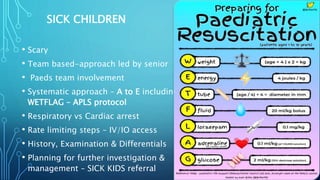
• Systematic approach – A to E including
WETFLAG – APLS protocol
• Respiratory vs Cardiac arrest
• Rate limiting steps – IV/IO access
• History, Examination & Differentials
• Planning for further investigation &
management – SICK KIDS referral
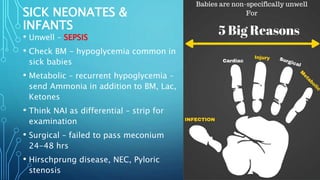
SICK NEONATES &
INFANTS
• Unwell – SEPSIS
• Check BM - hypoglycemia common in
sick babies
• Metabolic – recurrent hypoglycemia –
send Ammonia in addition to BM, Lac,
Ketones
• Think NAI as differential – strip for
examination
• Surgical – failed to pass meconium
24-48 hrs
• Hirschprung disease, NEC, Pyloric
stenosis
ANY QUESTION?
SUMMARY
• Age-appropriate approach & management
• A to E assessment – ongoing & recurrent
• Talk to PED Nurses +/- Paeds SpR – concerns or no concerns
• Senior involvement +/- review
• Resources – AskEARL, PiP, NICE guidance, Senior think-tank,
Paeds Team
• CPD learning – Spottingthesickchild.org.uk; RCEMLearning
induction module
THANK YOU

Paediatric Emergencies

  • 1.
  • 2.
    APPROACHING CHILDREN WHEN VULNERABLE •Strangers • Strange environment • Rapport building • Play • Distraction • Check with PED Nurses • Listen to parent/carer concerns
  • 3.
    HISTORY TAKING • Sourceof history • Witness of the story – nursery/school notes • Delayed or timely presentation – timeline – reattendance • Professional curiosity – exploring – non-judgemental • Birth History • Vaccination History • Social History including safeguarding history
  • 4.
    EXAMINATION • Top-to-Toe examwithout clothes in infants & toddlers with injuries • HEENT • Chest – including WOB & noise like grunting • CVS – Cap refill time – peripheral vs central – cold vs warm • Innovative exam techniques
  • 5.
    COMMON PRESENTATIONS • Feverincluding Croup • Wheeze, DIB • Injuries • ***NEEDLE in a HAYSTACK – SEPSIS & SAFEGUARDING CONCERN
  • 6.
    FEVER • URTI (includingTonsillitis) &/or EAR INFECTION – Abx or no Abx • Chest Infection – CXR or no CXR • UTI – Culture or no Culture; Abx or no Abx • Meningitis/Meningococcal Sepsis/Encephalitis • Septic arthritis, discitis • ***KAWASAKI DISEASE • ***PIMS-TS Fever in under 5s: assessment and initial management NICE guideline [NG143] Published: 07 November 2019
  • 7.
    NICE TRAFFIC LIGHT • THINKSEPSIS – Escalation vs De-escalation – Consider Resus based care – Senior Review – Team based care – Early involvement of Paeds team in sick patient’s care
  • 8.
    MENINGOCOCCAL SEPSIS/MENINGITIS High Risk Pale /mottled / ashen / blue No response to social cues Unable to rouse or unable to stay awake Weak / high pitched / continuous cry Appears ill Grunting RR > 60 Moderate to severe recession Skin turgor 1 sec or more Non-blanching rash Bulging fontanelle or neck stiffness Focal neurology or seizures Status epilepticus Atypical febrile convulsion Temp 38 or more if 0 - 3 months Bile-stained vomiting or swollen y No below PETECHIAE IN CHILDREN – THE PIC STUDY LANCET APRIL 2020
  • 9.
  • 10.
  • 11.
  • 13.
    PIMS – TS •Paediatric Multisystem Inflammatory Syndrome temporally associated with SARS-CoV-2 • severe inflammation & shock • some clinical similarities to Kawasaki shock & toxic shock • Cardiac Manifestations: Pancarditis may include bi-ventricular impairment, mitral/ tricuspid valve regurgitation, diastolic dysfunction, pericardial effusion, coronary artery dilatation / aneurysm • Clinical course unpredictable with rapid deterioration observed in some Clinical features May include one or more of the following: Persistent Fever > 39 C Lethargy and Myalgia Abdominal Symptoms: Pain, Diarrhoea and Vomiting Rash/Conjunctivitis Hypotension (Wide pulse pressure), tachycardia +/- Shock Initial management Examination: Exclude potential septic foci and careful cardiac assessme (liver, JVP, cardiac / thoracic ratio on CXR) Resuscitation: If signs of shock – fluid resuscitation (10ml/kg aliquots) wit shock. This syndrome has some clinical similarities to Kawas illness. In the majority of patients, coronavirus has not been d SARS-CoV-2 infection is present in some. The likeliest mechan Significant similarity in presen Septic shock - may require higher volume fluid resuscitat Peritonitis -negative laparotomy reported in some cases: ediatric Critical Care ediatric Multisystem Inflammatory Syndrome temporally associated with SARS-CoV-2 Clinical features include one or more of the following: ersistent Fever > 39 C thargy and Myalgia bdominal Symptoms: Pain, Diarrhoea and Vomiting ash/Conjunctivitis ypotension (Wide pulse pressure), tachycardia +/- Shock Covid-19 pandemic has been temporally associated with the emergence of a paediatric presentation of severe inflammatio k. This syndrome has some clinical similarities to Kawasaki shock and toxic shock. Patients have presented with mild to s ss. In the majority of patients, coronavirus has not been detected by PCR on throat/nasal swabs, however serological eviden S-CoV-2 infection is present in some. The likeliest mechanism is a delayed antibody-mediated dysregulated host immune resp Laboratory features Hyponatraemia Raised CRP Raised Ferritin (>500) Raised Troponin and B-NP Raised Fibrinogen Lymphopenia / neutrophilia Raised D-Dimer Platelets initially low or normal Renal dysfunction Significant similarity in presentation with other paediatric conditions ic shock - may require higher volume fluid resuscitation and source control: senior clinical review
  • 14.
    FEBRILE SEIZURE • Aged6 months to 6 years • Simple FS - isolated, generalized, tonic-clonic seizures lasting < 15 mins, do not recur within 24 hrs or within the same febrile illness, with complete recovery within 1 hour • Complex febrile seizures have one or more of: partial (focal) seizure; duration > 15 mins; recurrence within 24 hrs or within the same febrile illness; or incomplete recovery within 1 hour
  • 15.
    BRONCHIOLITIS – RSV •Wheeze vs Stridor vs Grunting • Inhaler vs Nebs • Salbutamol vs Atrovent • Symptomatic & feeding support • Nasal saline +/- suction • +/- Oxygen – • Consider HFNO – • Escalation
  • 16.
  • 17.
  • 18.
    DISCHARGE CRITERIA FORBRONCHIOLITIS • Oxygen Saturations maintained in air O2 Sats >94%. • Is clinically stable, • taking adequate oral fluids and • has maintained oxygen saturation over 92% in air for 4 hours, including a period of sleep.
  • 19.
    VIRAL WHEEZE/ASTHMA • Toddler(> 1 yr) to pre-school children (under 5 yrs) to school children > 5 yrs • Inhalers with spacer device – treatment of choice • Life threatening – Nebs • Salbutamol +/- Atrovent • Steroids • Reassess & Paeds referral (PAU if PEWS < 3)
  • 20.
    BTS CLASSIFICATION OFWHEEZE/ASTHMA
  • 21.
    BTS MANAGEMENT –FIRST LINE OF TREATMENT
  • 22.
    BTS MANAGEMENT –SECOND LINE OF TREATMENT
  • 23.
  • 24.
    DKA • DKA Calculator •BSPED DKA Flowchart
  • 25.
    AFEBRILE SEIZURE/EPILESPY • A toE Assessment • Contemporaneous management • DON’T FORGET ‘G’ • First fit • Known epileptic • Difficult fitter – advanced care plan
  • 26.
    INJURIES • MOI –think major trauma – senior involve +/- Paeds trauma team activation • Presentation – timely or delayed • Professional curiosity • Patient safety – Resus or Cubicle • Primary, secondary & tertiary victims in polytrauma Paeds (unwell) • Debrief
  • 27.
    INJURIES – HEADINJURIES • NICE Head Injury guidance to follow • MOI • Scary sight for parents – LOC, Drowsy, Irregular Breathing, Floppy, Palor Usually come around in few minutes – observation
  • 28.
    INJURIES – LIMBINJURIES • Long Bone fractures • Age-appropriate injuries (NAI vs AI) • MOI – corroboration • Supracondylar Fractures • Femur/TF Fractures in infants • Toddler fracture vs Trampoline fracture • Limping child – traumatic vs atraumatic
  • 29.
    NON-ACCIDENTAL INJURIES • Story– MOI, TOI (any delay – reason) • Witness • Corroborate – story vs injury sustained • Low threshold • Professional curiosity • Pattern – bruising - Body Mapping
  • 30.
    SICK CHILDREN • Scary •Team based-approach led by senior • Paeds team involvement • Systematic approach – A to E including WETFLAG – APLS protocol • Respiratory vs Cardiac arrest • Rate limiting steps – IV/IO access • History, Examination & Differentials • Planning for further investigation & management – SICK KIDS referral
  • 31.
    SICK NEONATES & INFANTS •Unwell – SEPSIS • Check BM - hypoglycemia common in sick babies • Metabolic – recurrent hypoglycemia – send Ammonia in addition to BM, Lac, Ketones • Think NAI as differential – strip for examination • Surgical – failed to pass meconium 24-48 hrs • Hirschprung disease, NEC, Pyloric stenosis
  • 32.
  • 33.
    SUMMARY • Age-appropriate approach& management • A to E assessment – ongoing & recurrent • Talk to PED Nurses +/- Paeds SpR – concerns or no concerns • Senior involvement +/- review • Resources – AskEARL, PiP, NICE guidance, Senior think-tank, Paeds Team • CPD learning – Spottingthesickchild.org.uk; RCEMLearning induction module
  • 34.