Pediatric Dysrhythmias
Board Review
Dr. Sahar K.K. AttiaDr. Sahar K.K. Attia
Pediatric Specialist,KKHPediatric Specialist,KKH.
May ,2015
Pediatric dysrhythmias
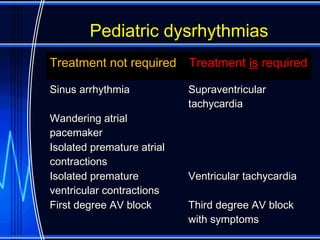
Treatment not requiredTreatment not required TreatmentTreatment isis requiredrequired
Sinus arrhythmiaSinus arrhythmia SupraventricularSupraventricular
tachycardiatachycardia
Wandering atrialWandering atrial
pacemakerpacemaker
Isolated premature atrialIsolated premature atrial
contractionscontractions
Isolated prematureIsolated premature
ventricular contractionsventricular contractions
Ventricular tachycardiaVentricular tachycardia
First degree AV blockFirst degree AV block Third degree AV blockThird degree AV block
with symptomswith symptoms
Pediatric dysrhythmias
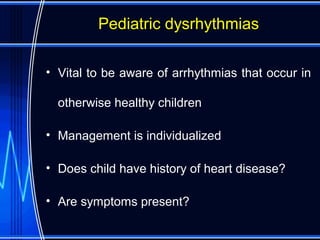
• Vital to be aware of arrhythmias that occur in
otherwise healthy children
• Management is individualized
• Does child have history of heart disease?
• Are symptoms present?
Sinus arrhythmia
• Most common irregularity of heart rhythm
seen in children
• Normal variant
• Reflects healthy interaction between
autonomic respiratory and cardiac control
activity in CNS.
• Heart rate increases during inspiration and
decreases during respiration
Sinus arrhythmia
Wandering atrial pacemaker
• Atrial pacemaker shifts from sinus node
to another atrial site.
• Normal variant, irregular rhythm
Isolated PAC’sIsolated PAC’s
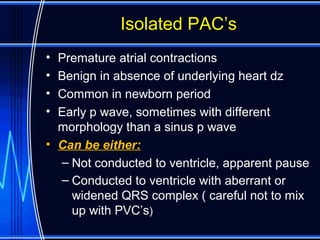
• Premature atrial contractions
• Benign in absence of underlying heart dz
• Common in newborn period
• Early p wave, sometimes with different
morphology than a sinus p wave
• Can be either:
– Not conducted to ventricle, apparent pause
– Conducted to ventricle with aberrant or
widened QRS complex ( careful not to mix
up with PVC’s)
Isolated PAC’sIsolated PAC’s
Premature Ventricular ContractionsPremature Ventricular Contractions
(PVC’s)(PVC’s)
• Not very commonly seen in children
• Incidence of 0.3 to 2.2 %
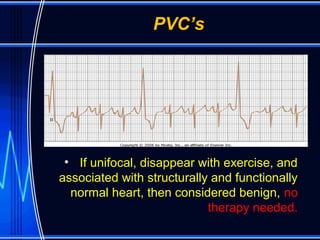
• Early, wide QRS complexes
• T waves in opposite direction of QRS
• Unifocal PVC’s are most encountered
type.
• Bigeminy, sinus beat followed by PVC,
repeating as a pattern, also frequently
seen.
PVC’s
• If unifocal, disappear with exercise, and
associated with structurally and functionally
normal heart, then considered benign, no
therapy needed.
PVC’s evaluation
• 12 lead EKG, Echocardiogram
• Perhaps Holter monitoring
• Brief exercise in office to see if ectopy
suppressed or more frequent
• Multifocal or paired PVC’s more
worrisome
• Medications usually not needed
• Advise patients to avoid caffeine and
other stimulants
First degree AV block
• Commonly seen (up to 6% normal
neonates)
• PR interval is greater than upper limits of
normal for a given age
• PR interval is age and rate dependent
• 70-170 msec in newborns is normal
• 80-220 msec in young children and
adults
• Generally does not cause bradycardia
since AV conduction remains intact
First degree AV blockFirst degree AV block
• Diseases that can be associated with first
degree AV block:
- rheumatic fever, rubella, mumps,
hypothermia, cardiomyopathy, electrolyte
disturbances
Third degree AV block
• AKA complete heart block
• Most common cause of abnormal
bradycardia in infants and children.
• Complete disassociation between P
waves and QRS complexes
Third degree AV block
• Can be congenital – in this case it is
strongly associated with maternal SLE.
• Mom of an infant should be worked up.
• Most common structural heart defect
associated is corrected transposition of
great vessels
Third degree AV block
• May be asymptomatic – follow clinically
• Slower the heart rate, and wide QRS
escape rhythms place into high risk
group
• May need implantable pacemaker:
-significant bradycardias, syncope,
exercise intolerance, ventricular
dysrhythmias, or ventricular arrhythmias,
structural disease.
• Possible acute treatment: isoproterenol
Supraventricular tachycardia
• Most common abnormal tachycardia
seen in pediatric practice
• Most common arrhythmia requiring
treatment in pediatric population
• Most frequent age presentation: 1st
3
months of life, 2nd
peaks @ 8-10 and in
adolescense
• Rapid, regular, usually narrow QRS
rhythm, originating above the ventricles
SVT
Figure 5-42 Supraventricular tachycardia
- Note a normal QRS complex tachycardia at a
rate of 214 beats/minute without visible P
waves.
SVT
• Paroxysmal, sudden onset & offset
• Rates of SVT vary with age
• Overall average rate for all ages: 235 bpm
–1st
9 months of life: avg rate is 270 bpm
–Older children: avg rate is 210
bpm( 180-250)
• P waves difficult to define, but 1:1 with
QRS
• Important to differentiate from sinus tach
SVTSVT
• Older kids can describe a sensation
of a fast heart rate, palpitations, or
chest tightness.
• Hemodynamic compromise in
newborns and those with structural
heart disease
• Those with typical symptoms would
benefit from cardiac consultation
SVT - Treatment
 Goal:
- Identify unstable patients, differentiate from
sinus tachycardia, and terminate the
rhythm
- Vagal maneuvers in stable patients.
 Adenosine if IV access readily available
– Stop conduction through AV node
– Helps to define p waves if unsure of etiology
– 0.1 mg/kg (max 6 mg), repeat 0.2 mg/kg ( max 12
mg) in line closest to central circulation
– Need continuous ECG and BP monitoring
SVT - Treatment
• Synchronized cardioversion
• Amiodarone, Procainamide if above
unsuccessful.
• Transesophageal atrial pacing can
also be performed
SVT - Treatment
• Need post conversion EKG – identify those with
WPW syndrome ( 25 % pts with SVT)
• Will also need an echo – identify structural
problems
• Radiofrequency catheter ablation
– Frontline treatment
– Very effective
– Cutoff points usually are 5 y.o. and 15 kg, unless severe
SVT
• Observation and expectant management
• Medications
– Digoxin and beta blockers as first line
– Flecainide, sotalol, amiodarone
Other SVT’s
• A flutter, A fib, ectopic atrial
tachycardia, junctional tachycardias.
• Not commonly seen in pediatric patients
• Adenosine does not terminate these
rhythms, originate above AV node
• Treatments: procainamide, amiodarone,
cardioversion, or ablation
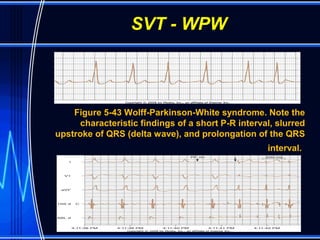
SVT - WPW
Figure 5-43 Wolff-Parkinson-White syndrome. Note the
characteristic findings of a short P-R interval, slurred
upstroke of QRS (delta wave), and prolongation of the QRS
interval.
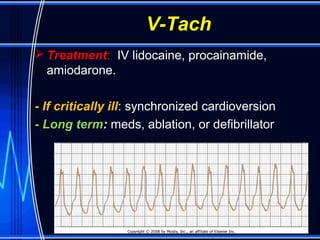
Ventricular tachycardiaVentricular tachycardia
• Sustained V-tach is uncommon, needs
workup
• Regular wide complex tachycardia
• Atrioventricular dissociation
• Life threatening arryhthmia
• Often presents in those who have had
open heart surgical repair, or those with
cardiomyopathies, myocarditis, or tumors
V-Tach
 Treatment: IV lidocaine, procainamide,
amiodarone.
- If critically ill: synchronized cardioversion
- Long term: meds, ablation, or defibrillator
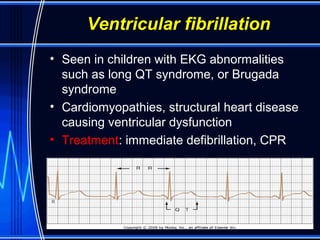
Ventricular fibrillation
• Seen in children with EKG abnormalities
such as long QT syndrome, or Brugada
syndrome
• Cardiomyopathies, structural heart disease
causing ventricular dysfunction
• Treatment: immediate defibrillation, CPR
V-fib
• Brugada syndrome – inherited
arrhythmia, autosomal dominant person
goes into v-fib, faints, dies suddenly.
Treatment: defibrillator, careful screening
PEDIATRIC DYSRHYTHMIA 2015

PEDIATRIC DYSRHYTHMIA 2015

  • 1.
    Pediatric Dysrhythmias Board Review Dr.Sahar K.K. AttiaDr. Sahar K.K. Attia Pediatric Specialist,KKHPediatric Specialist,KKH. May ,2015
  • 3.
    Pediatric dysrhythmias Treatment notrequiredTreatment not required TreatmentTreatment isis requiredrequired Sinus arrhythmiaSinus arrhythmia SupraventricularSupraventricular tachycardiatachycardia Wandering atrialWandering atrial pacemakerpacemaker Isolated premature atrialIsolated premature atrial contractionscontractions Isolated prematureIsolated premature ventricular contractionsventricular contractions Ventricular tachycardiaVentricular tachycardia First degree AV blockFirst degree AV block Third degree AV blockThird degree AV block with symptomswith symptoms
  • 4.
    Pediatric dysrhythmias • Vitalto be aware of arrhythmias that occur in otherwise healthy children • Management is individualized • Does child have history of heart disease? • Are symptoms present?
  • 5.
    Sinus arrhythmia • Mostcommon irregularity of heart rhythm seen in children • Normal variant • Reflects healthy interaction between autonomic respiratory and cardiac control activity in CNS. • Heart rate increases during inspiration and decreases during respiration
  • 6.
  • 7.
    Wandering atrial pacemaker •Atrial pacemaker shifts from sinus node to another atrial site. • Normal variant, irregular rhythm
  • 8.
    Isolated PAC’sIsolated PAC’s •Premature atrial contractions • Benign in absence of underlying heart dz • Common in newborn period • Early p wave, sometimes with different morphology than a sinus p wave • Can be either: – Not conducted to ventricle, apparent pause – Conducted to ventricle with aberrant or widened QRS complex ( careful not to mix up with PVC’s)
  • 9.
  • 10.
    Premature Ventricular ContractionsPrematureVentricular Contractions (PVC’s)(PVC’s) • Not very commonly seen in children • Incidence of 0.3 to 2.2 % • Early, wide QRS complexes • T waves in opposite direction of QRS • Unifocal PVC’s are most encountered type. • Bigeminy, sinus beat followed by PVC, repeating as a pattern, also frequently seen.
  • 11.
    PVC’s • If unifocal,disappear with exercise, and associated with structurally and functionally normal heart, then considered benign, no therapy needed.
  • 12.
    PVC’s evaluation • 12lead EKG, Echocardiogram • Perhaps Holter monitoring • Brief exercise in office to see if ectopy suppressed or more frequent • Multifocal or paired PVC’s more worrisome • Medications usually not needed • Advise patients to avoid caffeine and other stimulants
  • 13.
    First degree AVblock • Commonly seen (up to 6% normal neonates) • PR interval is greater than upper limits of normal for a given age • PR interval is age and rate dependent • 70-170 msec in newborns is normal • 80-220 msec in young children and adults • Generally does not cause bradycardia since AV conduction remains intact
  • 14.
    First degree AVblockFirst degree AV block • Diseases that can be associated with first degree AV block: - rheumatic fever, rubella, mumps, hypothermia, cardiomyopathy, electrolyte disturbances
  • 15.
    Third degree AVblock • AKA complete heart block • Most common cause of abnormal bradycardia in infants and children. • Complete disassociation between P waves and QRS complexes
  • 16.
    Third degree AVblock • Can be congenital – in this case it is strongly associated with maternal SLE. • Mom of an infant should be worked up. • Most common structural heart defect associated is corrected transposition of great vessels
  • 17.
    Third degree AVblock • May be asymptomatic – follow clinically • Slower the heart rate, and wide QRS escape rhythms place into high risk group • May need implantable pacemaker: -significant bradycardias, syncope, exercise intolerance, ventricular dysrhythmias, or ventricular arrhythmias, structural disease. • Possible acute treatment: isoproterenol
  • 18.
    Supraventricular tachycardia • Mostcommon abnormal tachycardia seen in pediatric practice • Most common arrhythmia requiring treatment in pediatric population • Most frequent age presentation: 1st 3 months of life, 2nd peaks @ 8-10 and in adolescense • Rapid, regular, usually narrow QRS rhythm, originating above the ventricles
  • 19.
    SVT Figure 5-42 Supraventriculartachycardia - Note a normal QRS complex tachycardia at a rate of 214 beats/minute without visible P waves.
  • 20.
    SVT • Paroxysmal, suddenonset & offset • Rates of SVT vary with age • Overall average rate for all ages: 235 bpm –1st 9 months of life: avg rate is 270 bpm –Older children: avg rate is 210 bpm( 180-250) • P waves difficult to define, but 1:1 with QRS • Important to differentiate from sinus tach
  • 21.
    SVTSVT • Older kidscan describe a sensation of a fast heart rate, palpitations, or chest tightness. • Hemodynamic compromise in newborns and those with structural heart disease • Those with typical symptoms would benefit from cardiac consultation
  • 22.
    SVT - Treatment Goal: - Identify unstable patients, differentiate from sinus tachycardia, and terminate the rhythm - Vagal maneuvers in stable patients.  Adenosine if IV access readily available – Stop conduction through AV node – Helps to define p waves if unsure of etiology – 0.1 mg/kg (max 6 mg), repeat 0.2 mg/kg ( max 12 mg) in line closest to central circulation – Need continuous ECG and BP monitoring
  • 23.
    SVT - Treatment •Synchronized cardioversion • Amiodarone, Procainamide if above unsuccessful. • Transesophageal atrial pacing can also be performed
  • 24.
    SVT - Treatment •Need post conversion EKG – identify those with WPW syndrome ( 25 % pts with SVT) • Will also need an echo – identify structural problems • Radiofrequency catheter ablation – Frontline treatment – Very effective – Cutoff points usually are 5 y.o. and 15 kg, unless severe SVT • Observation and expectant management • Medications – Digoxin and beta blockers as first line – Flecainide, sotalol, amiodarone
  • 25.
    Other SVT’s • Aflutter, A fib, ectopic atrial tachycardia, junctional tachycardias. • Not commonly seen in pediatric patients • Adenosine does not terminate these rhythms, originate above AV node • Treatments: procainamide, amiodarone, cardioversion, or ablation
  • 26.
    SVT - WPW Figure5-43 Wolff-Parkinson-White syndrome. Note the characteristic findings of a short P-R interval, slurred upstroke of QRS (delta wave), and prolongation of the QRS interval.
  • 27.
    Ventricular tachycardiaVentricular tachycardia •Sustained V-tach is uncommon, needs workup • Regular wide complex tachycardia • Atrioventricular dissociation • Life threatening arryhthmia • Often presents in those who have had open heart surgical repair, or those with cardiomyopathies, myocarditis, or tumors
  • 28.
    V-Tach  Treatment: IVlidocaine, procainamide, amiodarone. - If critically ill: synchronized cardioversion - Long term: meds, ablation, or defibrillator
  • 29.
    Ventricular fibrillation • Seenin children with EKG abnormalities such as long QT syndrome, or Brugada syndrome • Cardiomyopathies, structural heart disease causing ventricular dysfunction • Treatment: immediate defibrillation, CPR
  • 30.
    V-fib • Brugada syndrome– inherited arrhythmia, autosomal dominant person goes into v-fib, faints, dies suddenly. Treatment: defibrillator, careful screening