Pedagogy, curriculum
& assessment
Jon Curtis-Brignell
Assistant Head: Teaching and Learning
Redesigning
Schooling
What kind of teaching for what
kind of learning?
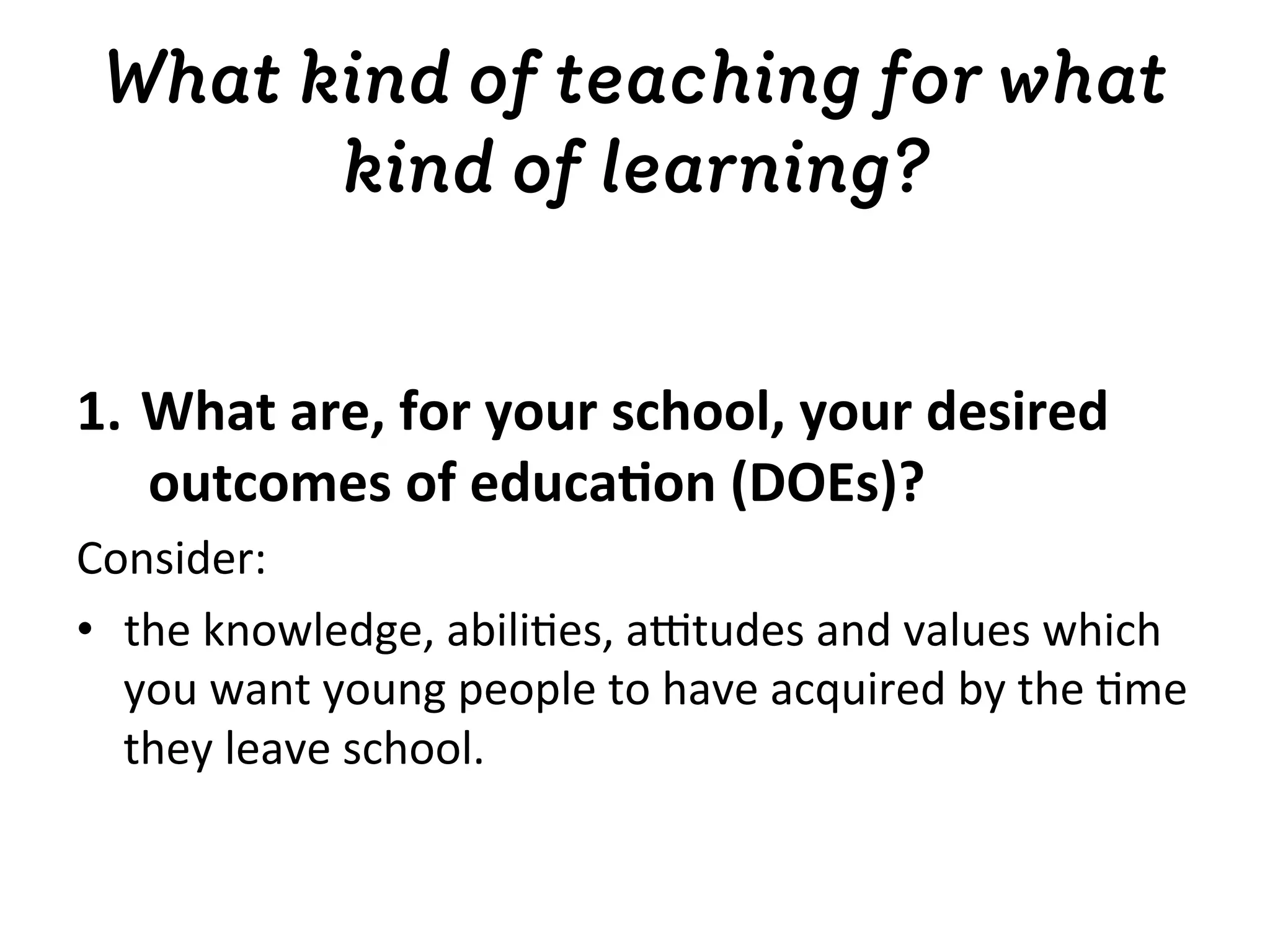
1.  What	
  are,	
  for	
  your	
  school,	
  your	
  desired	
  
outcomes	
  of	
  educa5on	
  (DOEs)?	
  
Consider:	
  
•  the	
  knowledge,	
  abili4es,	
  a5tudes	
  and	
  values	
  which	
  
you	
  want	
  young	
  people	
  to	
  have	
  acquired	
  by	
  the	
  4me	
  
they	
  leave	
  school.	
  	
  
What kind of teaching for what
kind of learning?
	
  
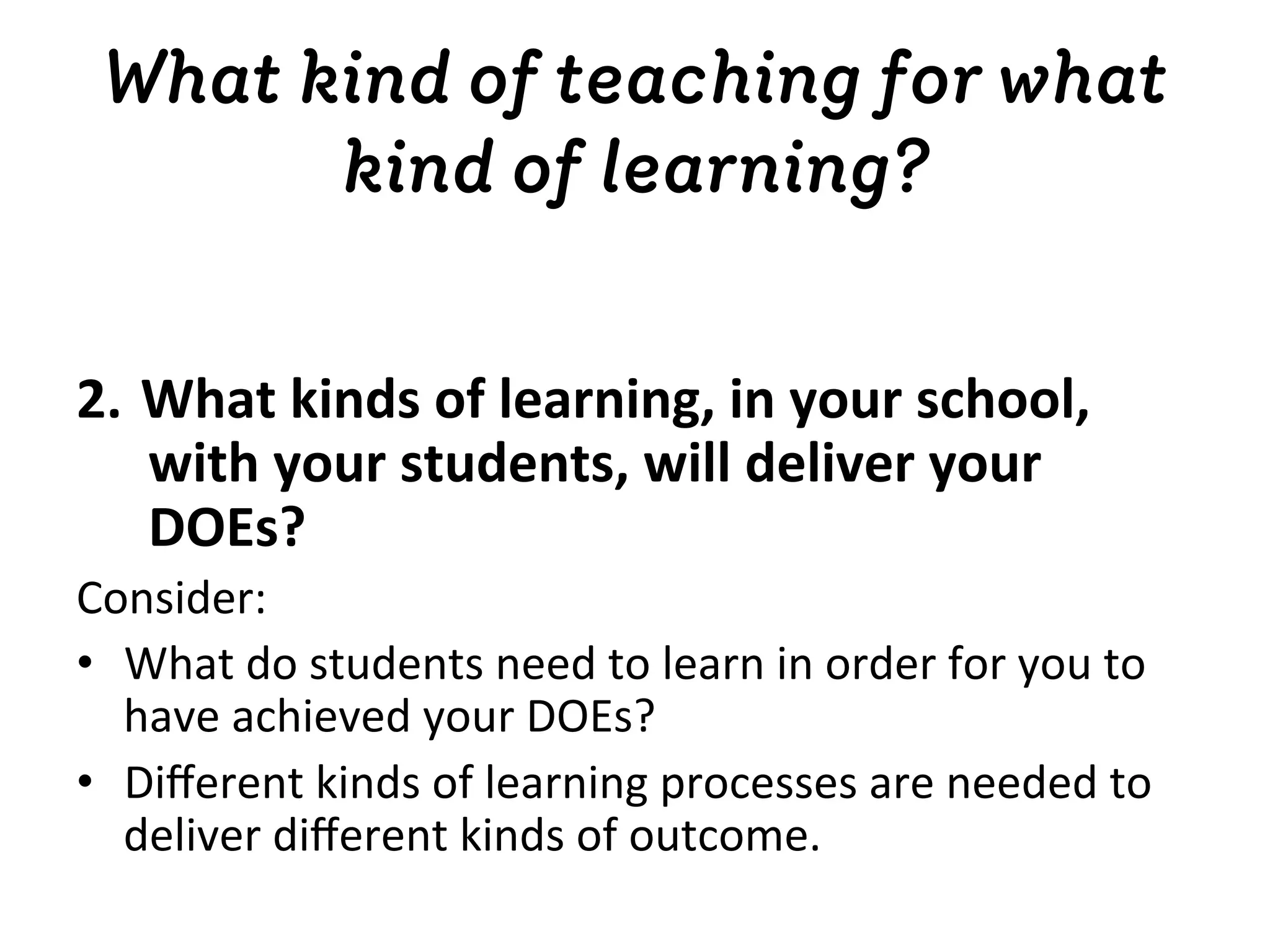
2.  What	
  kinds	
  of	
  learning,	
  in	
  your	
  school,	
  
with	
  your	
  students,	
  will	
  deliver	
  your	
  
DOEs?	
  
Consider:	
  
•  What	
  do	
  students	
  need	
  to	
  learn	
  in	
  order	
  for	
  you	
  to	
  
have	
  achieved	
  your	
  DOEs?	
  
•  Different	
  kinds	
  of	
  learning	
  processes	
  are	
  needed	
  to	
  
deliver	
  different	
  kinds	
  of	
  outcome.	
  	
  
What kind of teaching for what
kind of learning?
	
  
3.  What	
  kinds	
  of	
  teaching	
  will	
  lead	
  to	
  the	
  
kind	
  of	
  learning	
  that	
  is	
  needed?	
  
Consider:	
  
•  Teaching	
  is	
  a	
  way	
  of	
  engaging	
  different	
  kinds	
  of	
  
learning	
  processes	
  in	
  learners’	
  minds.	
  It	
  depends	
  on	
  
s4mula4ng	
  and	
  engaging	
  the	
  kinds	
  of	
  learning	
  that	
  
will	
  deliver	
  the	
  outcomes	
  you	
  said	
  you	
  valued.	
  	
  
What kind of teaching for what
kind of learning?
	
  
4.  What	
  kind	
  of	
  leadership	
  is	
  required	
  to	
  create	
  
the	
  kinds	
  of	
  teaching	
  and	
  learning	
  which	
  are	
  
desired,	
  and	
  so	
  ensure	
  that	
  students	
  leave	
  
your	
  school	
  with	
  your	
  DOEs?	
  	
  
Consider:	
  	
  
•  Only	
  when	
  you	
  have	
  some	
  clarity	
  about	
  the	
  first	
  three	
  
ques4ons	
  can	
  you	
  begin	
  to	
  priori4se	
  the	
  leadership	
  
strategies	
  that	
  will	
  cul4vate	
  the	
  necessary	
  kinds	
  of	
  
pedagogy.	


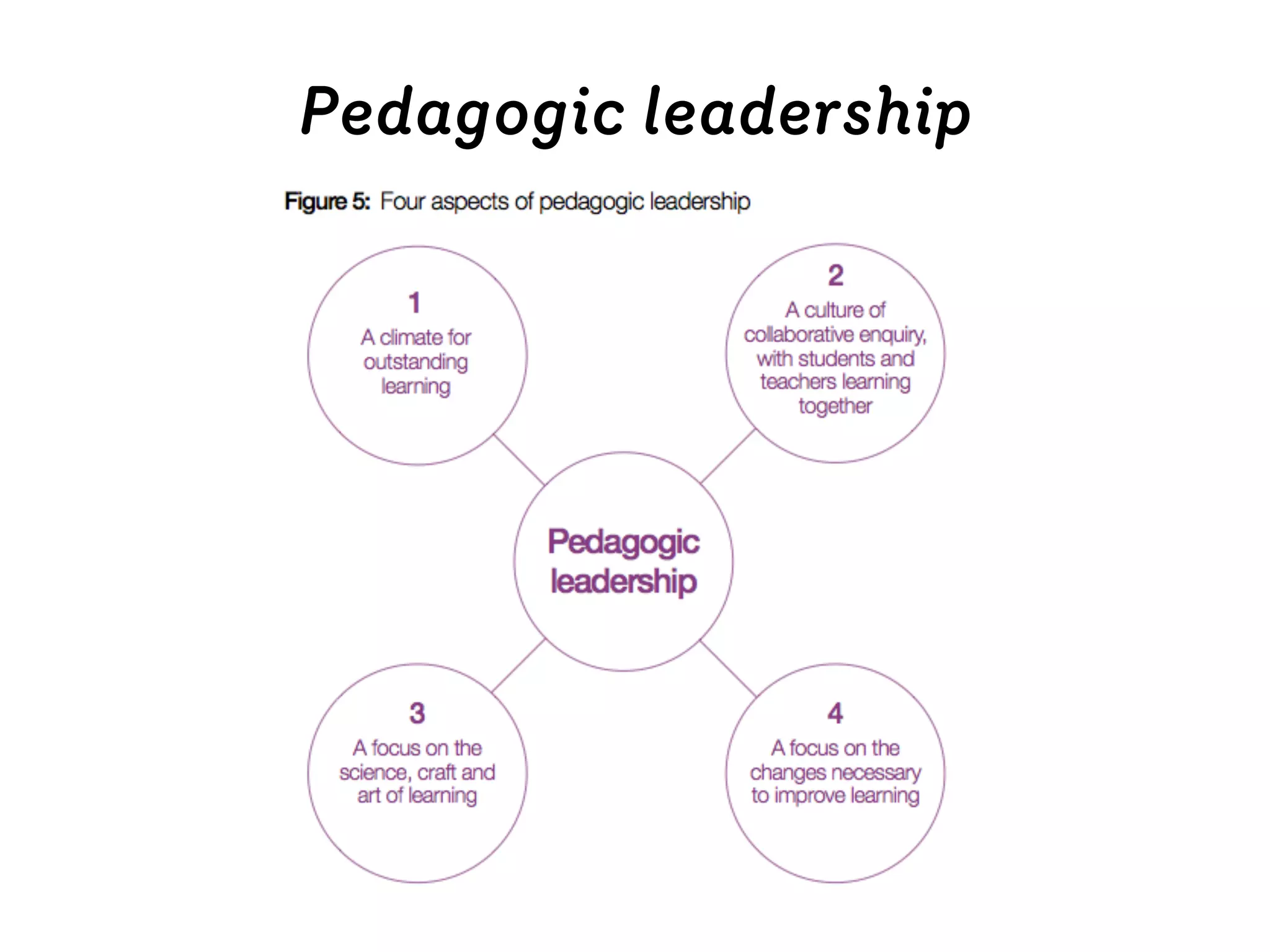
Pedagogic leadership
A culture of and for learning


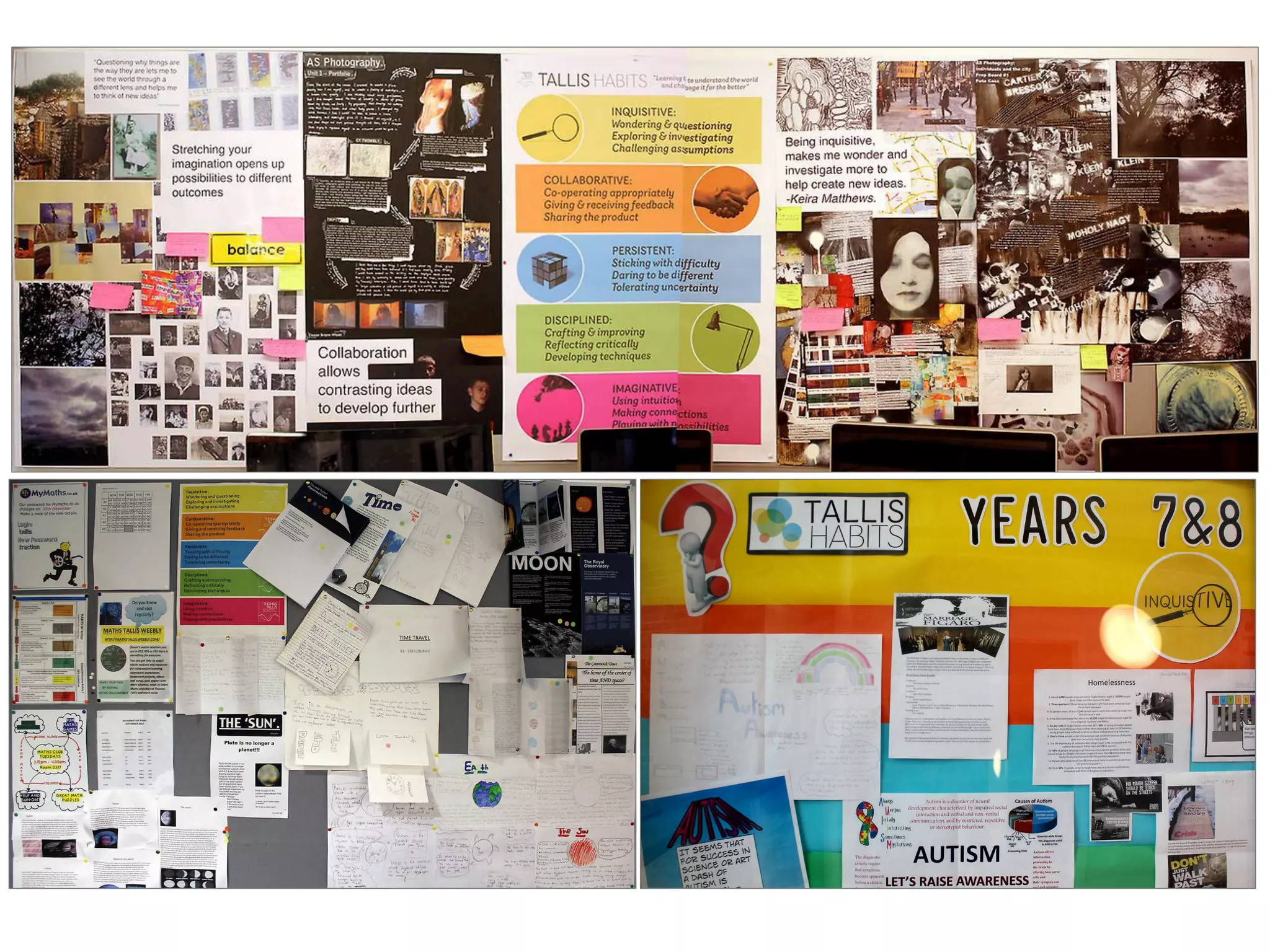
A	
  school	
  signals	
  its	
  values	
  through	
  different	
  aspects	
  of	
  
its	
  culture.	
  There	
  are	
  the	
  visible,	
  public	
  espousals	
  of	
  
these	
  values	
  through	
  brochures,	
  websites,	
  speeches,	
  
newsle:ers	
  and	
  other	
  publica;ons.	


  (Lucas	
  and	
  Claxton,	
  2013)	
  
A culture of and for learning


Most	
  importantly,	
  values	
  are	
  conveyed	
  moment-­‐by-­‐
moment	
  by	
  teachers	
  in	
  classrooms	
  –	
  through	
  their	
  
running	
  commentary;	
  the	
  kinds	
  of	
  ac;vi;es	
  they	
  
create;	
  the	
  way	
  they	
  lay	
  out	
  the	
  furniture	
  or	
  configure	
  
group	
  work;	
  the	
  kind	
  of	
  language	
  they	
  use	
  and	
  the	
  
example	
  they	
  set.	


  (Lucas	
  and	
  Claxton,	
  2013)	
  
Curriculum is pedagogy
The	
  failure	
  to	
  realise	
  that	
  curriculum	
  is	
  pedagogy	
  has	
  
been	
  one	
  of	
  the	
  great	
  tragedies	
  of	
  the	
  last	
  quarter-­‐
century	
  in	
  England’s	
  educa;on	
  system….	
  curriculum	
  
development	
  is	
  an	
  inherently	
  crea;ve	
  process.	
  It	
  is	
  the	
  
process	
  by	
  which	
  teachers	
  take	
  the	
  desired	
  outcomes	
  
from	
  the	
  intended	
  curriculum	
  and	
  convert	
  them	
  into	
  
engaging	
  ac;vi;es	
  in	
  classrooms.	


  -­‐	
  Dylan	
  Wiliam,	
  Principled	
  Curriculum	
  Design	


Curriculum is pedagogy
•  We	
  need	
  to	
  create	
  ‘real’	
  understanding	
  (powerful	
  knowledge)	
  
•  Depth	
  before	
  breadth	
  –	
  focus	
  on	
  excellence	
  
•  The	
  Trivium:	
  Grammar,	
  Dialec4c	
  and	
  Rhetoric	
  
•  Extended	
  enquiries	
  (independence)	
  
•  PorRolios	
  of	
  excellence	
  
•  Interleaving	
  rather	
  than	
  blocking	
  content	
  
•  Embedded	
  forma4ve	
  assessment	
  
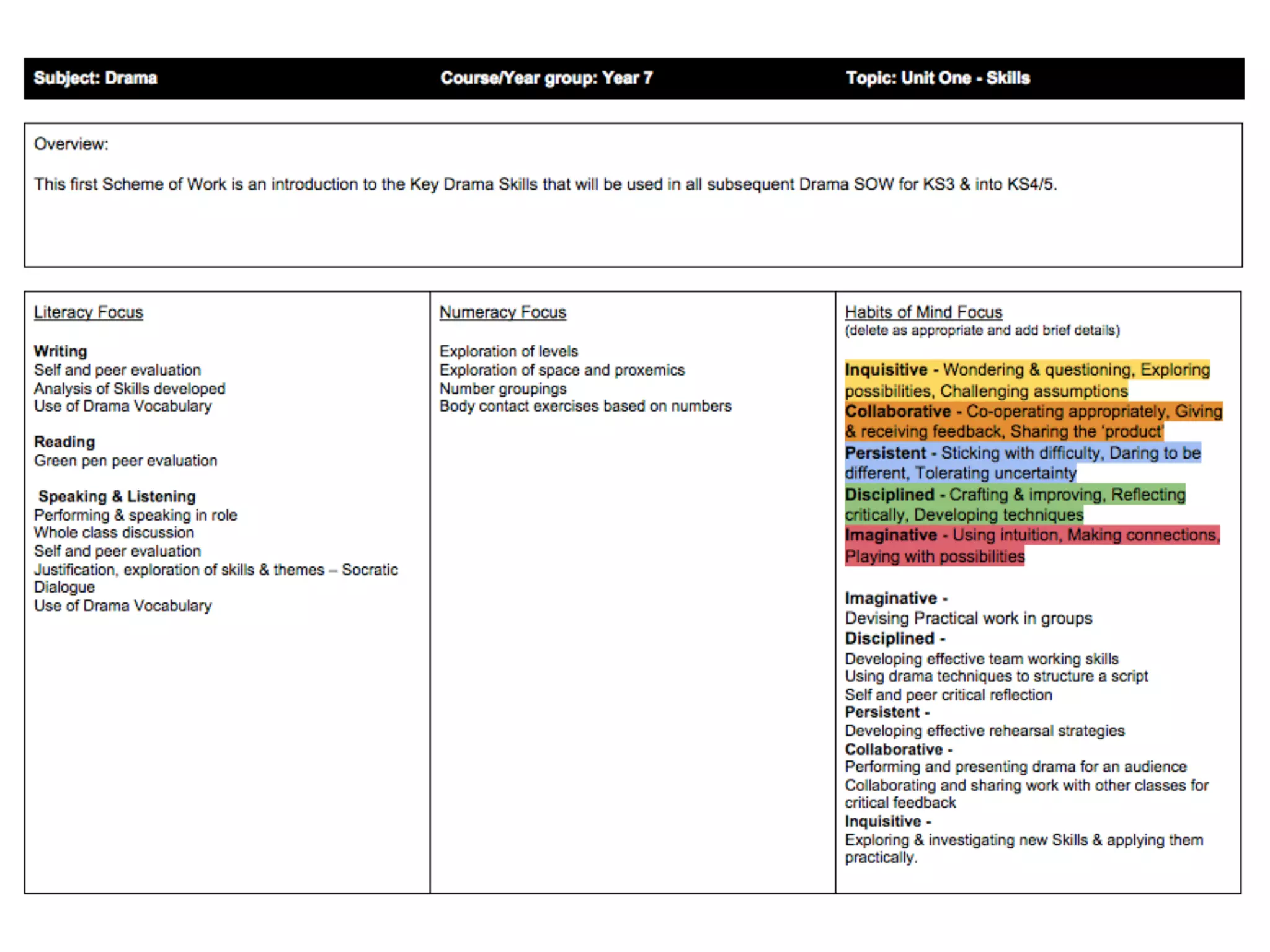
•  Habits	
  of	
  Mind	
  
What is your ‘signature pedagogy’?
Signature	
  pedagogies	
  make	
  a	
  difference.	
  They	
  form	
  
habits	
  of	
  the	
  mind,	
  habits	
  of	
  the	
  hand	
  and	
  habits	
  of	
  
the	
  heart….	
  they	
  prefigure	
  the	
  culture	
  of	
  professional	
  
work	
  and	
  provide	
  the	
  early	
  socialisa;on	
  into	
  the	
  
prac;ces	
  and	
  values	
  of	
  a	
  field.	
  Whether	
  in	
  a	
  lecture	
  
hall	
  or	
  a	
  lab,	
  in	
  a	
  design	
  studio	
  or	
  a	
  clinical	
  seNng,	
  the	
  
way	
  we	
  teach	
  will	
  shape	
  how	
  professionals	
  behave…	


  (Shulman,	
  2005)	


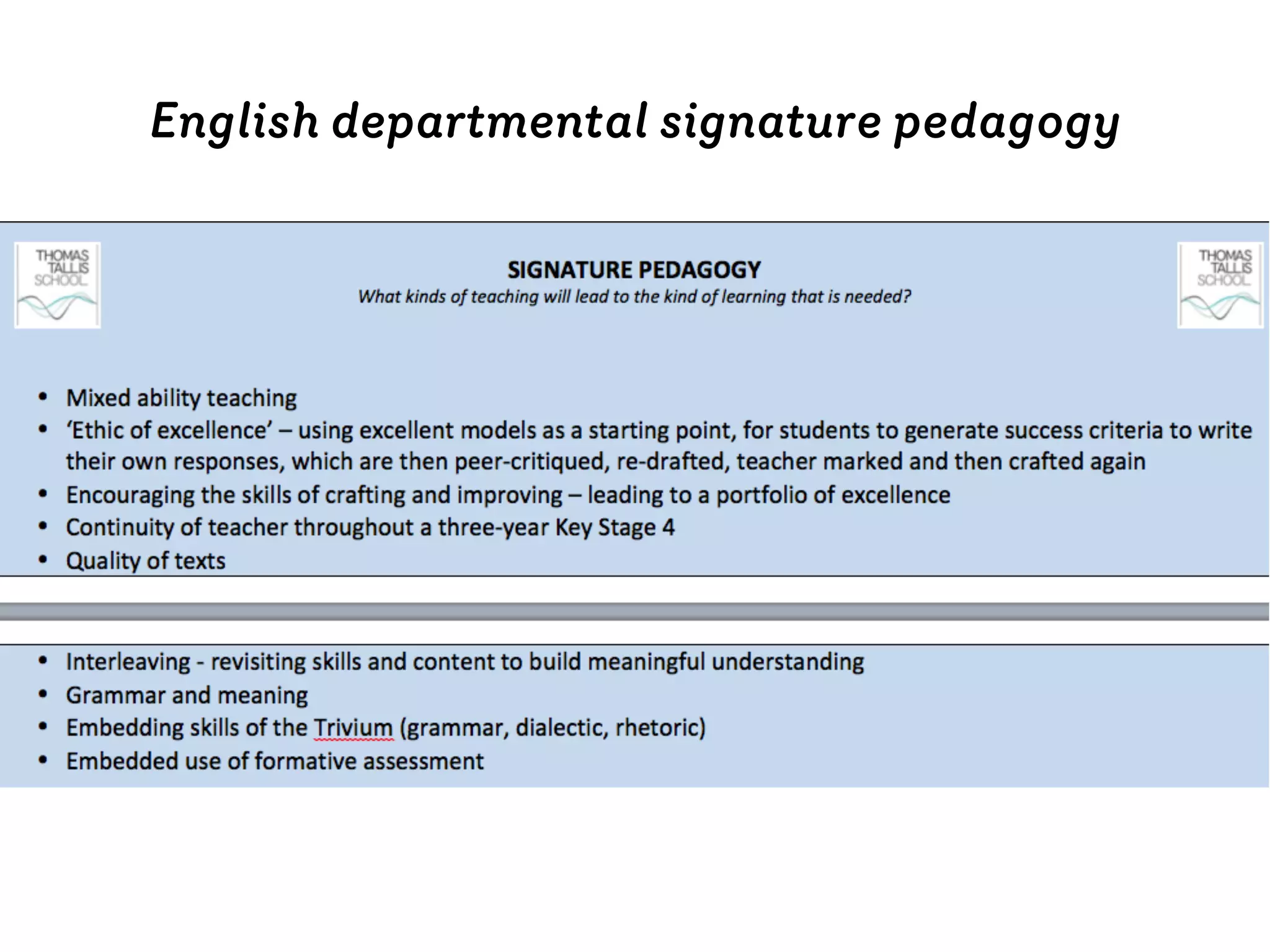
English departmental signature pedagogy
The backward design of a curriculum
•  Define	
  what	
  a	
  learner/historian/mathema4cian/
ar4st	
  /etc	
  should	
  know	
  and	
  be	
  able	
  to	
  do	
  by	
  y11/13,	
  
and	
  then	
  work	
  backwards	
  to	
  devise	
  a	
  programme	
  of	
  
study	
  from	
  y7	
  to	
  achieve	
  that.	


This	
  will	
  include:	
  
•  ‘Big	
  ideas’	
  /	
  threshold	
  concepts	
  
•  Powerful	
  knowledge	
  (‘knowing	
  that…’)	
  
•  Key	
  skills	
  (‘knowing	
  how	
  to…’)	
  
Programme of study
Obviously	
  in	
  secondary	
  schools,	
  the	
  content	
  of	
  GCSE	
  
will	
  have	
  a	
  strong	
  influence	
  on	
  the	
  selec<on	
  of	
  ‘big	
  
ideas’.	
  But	
  schools	
  should	
  be	
  careful	
  not	
  to	
  assume	
  that	
  
GCSE	
  syllabuses	
  embody	
  all	
  the	
  big	
  ideas	
  that	
  will	
  be	
  
important,	
  either	
  for	
  further	
  study,	
  or	
  for	
  life	
  aCer	
  
school…Focusing	
  only	
  on	
  what	
  is	
  important	
  for	
  
examina<on	
  success	
  may	
  help	
  the	
  school	
  succeed,	
  but	
  
is	
  likely	
  to	
  be	
  disastrous	
  for	
  current	
  secondary	
  school	
  
students.	
  
-­‐	
  Dylan	
  Wiliam,	
  Principled	
  Assessment	
  Design	
  
Threshold concepts / big ideas
	
  
Learning	
  should	
  be	
  an	
  adventure,	
  not	
  a	
  journey.	


  -­‐	
  Mar4n	
  Robinson	
  
A	
  threshold	
  concept	
  can	
  be	
  considered	
  as	
  akin	
  to	
  a	
  portal,	
  
opening	
  up	
  a	
  new	
  and	
  previously	
  inaccessible	
  way	
  of	
  
thinking	
  about	
  something.	
  It	
  represents	
  a	
  transformed	
  way	
  
of	
  understanding,	
  or	
  interpre<ng,	
  or	
  viewing	
  something	
  
without	
  which	
  the	
  learner	
  cannot	
  progress.	
  As	
  a	
  
consequence	
  of	
  comprehending	
  a	
  threshold	
  concept	
  there	
  
may	
  thus	
  be	
  a	
  transformed	
  internal	
  view	
  of	
  subject	
  maQer,	
  
subject	
  landscape,	
  or	
  even	
  world	
  view.	


  Jan	
  Meyer	
  and	
  Ray	
  Land,	
  “Threshold	
  Concepts	
  and	
  
Troublesome	
  Knowledge:	
  Linkages	
  to	
  Ways	
  of	
  Thinking	
  and	
  
Prac<sing	
  within	
  the	
  Disciplines”,	


Examples of Threshold Concepts
Threshold concepts are:
•  Integra5ve:	
  Once	
  learned,	
  they	
  are	
  likely	
  to	
  bring	
  together	
  different	
  
parts	
  of	
  the	
  subject	
  which	
  you	
  hadn’t	
  previously	
  seen	
  as	
  connected.	
  
•  Transforma5ve:	
  Once	
  understood,	
  they	
  change	
  the	
  way	
  you	
  see	
  the	
  
subject	
  and	
  yourself.	
  
•  Irreversible:	
  They	
  are	
  difficult	
  to	
  unlearn	
  –	
  once	
  you’ve	
  passed	
  through	
  
it’s	
  difficult	
  to	
  see	
  how	
  it	
  was	
  possible	
  not	
  to	
  have	
  understood	
  before.	
  
•  Recons5tu5ve:	
  They	
  may	
  shi`	
  your	
  sense	
  of	
  self	
  over	
  4me.	
  This	
  is	
  
ini4ally	
  more	
  likely	
  to	
  be	
  no4ced	
  by	
  others,	
  usually	
  teachers.	
  
•  Troublesome:	
  They	
  are	
  likely	
  to	
  present	
  you	
  with	
  a	
  degree	
  of	
  difficulty	
  
and	
  may	
  some4mes	
  seem	
  incoherent	
  or	
  counter-­‐intui4ve.	
  
•  Discursive:	
  The	
  student’s	
  ability	
  to	
  use	
  the	
  language	
  associated	
  with	
  that	
  
subject	
  changes	
  as	
  they	
  change.	
  It’s	
  the	
  change	
  from	
  using	
  scien4fic	
  
keywords	
  in	
  everyday	
  language	
  to	
  being	
  able	
  to	
  fluently	
  communicate	
  in	
  
the	
  academic	
  language	
  of	
  science.	
  
Big ideas in English
•  The	
  rela4onship	
  between	
  context	
  and	
  meaning	
  
•  The	
  rela4onship	
  between	
  form,	
  structure	
  and	
  
meaning	
  
•  The	
  rela4onship	
  between	
  language	
  and	
  meaning	
  
•  The	
  rela4onship	
  between	
  grammar	
  and	
  meaning	
  
•  The	
  rela4onship	
  between	
  the	
  writer	
  and	
  the	
  reader	
  
in	
  construc4ng	
  meaning:	
  the	
  role	
  of	
  interpreta4on.	


Threshold concepts from a SoL on Poetry
•  What	
  it	
  means	
  to	
  be	
  poe4c:	
  the	
  no4on	
  of	
  cra`ing	
  
poe4c	
  language.	
  
•  The	
  nature	
  and	
  importance	
  of	
  figura4ve	
  language	
  and	
  
metaphor.	
  
•  The	
  kinds	
  and	
  importance	
  of	
  poe4c	
  form.	
  
•  The	
  impact	
  of	
  structure	
  on	
  meaning;	
  structural	
  
devices	
  such	
  as	
  metre,	
  rhythm,	
  rhyme	
  that	
  are	
  used	
  
to	
  achieve	
  this.	
  
•  The	
  role	
  of	
  the	
  reader	
  in	
  construc4ng	
  meaning:	
  
'informed	
  personal	
  response'.	
  
•  Ambiguity	
  of	
  interpreta5on	
  	
  
The English draft model
Schemes of Learning - Consistency
Don’t forget
•  Consider	
  transi4on	
  (map	
  the	
  gap)	
  
•  Inspire	
  and	
  interest	
  students	
  
•  Build	
  in	
  tes4ng,	
  assessment	
  and	
  challenge	
  
•  Build	
  in	
  real	
  understanding	
  (not	
  teaching	
  by	
  numbers)	
  
•  High	
  expecta4ons	
  -­‐	
  you	
  get	
  what	
  you	
  seele	
  for.	
  
Learning	
  is	
  what	
  happens	
  when	
  students	
  are	
  
forced	
  to	
  think	
  hard!	
  
Assessment without levels
“What	
  we	
  want	
  is	
  a	
  model	
  of	
  ability	
  based	
  on	
  each	
  child	
  being	
  capable	
  
of	
  anything	
  and	
  us	
  looking	
  progressively,	
  through	
  assessment,	
  at	
  what	
  
ideas	
  a	
  child	
  has	
  understood.”	


  Tim	
  Oates,	
  Cambridge	
  Assessment	
  
“A	
  culture	
  shiC	
  regarding	
  the	
  nature,	
  range	
  and	
  purposes	
  of	
  assessment	
  
needs	
  to	
  take	
  place,	
  in	
  recogni<on	
  of	
  the	
  new	
  opportuni<es	
  provided	
  
both	
  by	
  the	
  new	
  curriculum	
  and	
  the	
  removal	
  of	
  levels.”	
  
NCTL	
  Report	
  September	
  2014	


“Assessment	
  should	
  be	
  the	
  servant,	
  not	
  the	
  master,	
  of	
  the	
  learning.”	
  
Dylan	
  Wiliam	
  
Why change from levels?
•  Can become a “label” that creates a fixed mindset
•  Don’t deepen understanding – too general
•  Accuracy of levels (especially sub levels) is unreliable
•  They do not always progress smoothly to GCSE
•  Successful schools and nations don’t use them
•  Wording is often both confusing and limiting
•  They no longer exist
What do we NEED from a new assessment
system?
•  Forma4ve	
  and	
  summa4ve	
  
•  Fits	
  with	
  new	
  KS3	
  Na4onal	
  Curriculum	
  
•  To	
  measure	
  progress	
  accurately	
  	
  
•  To	
  benchmark	
  against	
  KS2	
  and	
  KS4	
  
•  To	
  allow	
  meaningful	
  &	
  understandable	
  
parental	
  repor4ng	
  
What do we WANT from a new assessment system?
•  Smooth	
  transi4on	
  through	
  key	
  stages	
  	
  
•  To	
  allow	
  a	
  “growth	
  mindset”	
  focused	
  on	
  effort	
  
and	
  progress	
  
•  To	
  provide	
  real	
  stretch	
  and	
  challenge	
  at	
  all	
  levels	
  
•  To	
  develop	
  our	
  ‘habits’	
  
Progress so far?
•  Spoken	
  to	
  our	
  primary	
  feeder	
  schools	
  
•  Lots	
  of	
  research	
  in	
  current	
  thinking	
  
•  Curriculum	
  working	
  group	
  
•  Lots	
  of	
  mee4ngs	
  with	
  curriculum	
  leaders	
  and	
  departments	
  
•  Presented	
  to	
  governors	
  
•  Consulta4on	
  with	
  parents	
  
•  Consulta4on	
  with	
  students	
  
New proposal
A	
  dual	
  system	
  on	
  :	
  
1.  Effort	
  towards	
  Tallis	
  Habits	
  reported	
  3	
  4mes	
  a	
  year	
  
2.  Progress	
  in	
  subject	
  specific	
  competencies	
  reported	
  
twice	
  a	
  year	


Addresses the feedback points 1 and 2 from the previous slide
Habits of Mind
•  Effort	
  towards	
  the	
  Habits	
  ‘ideal’	
  is	
  reported	
  using	
  words	
  
•  Students	
  will	
  self-­‐assess	
  their	
  Habits	
  
•  Parents	
  will	
  also	
  assess	
  their	
  Habits	
  
•  Differences	
  between	
  teacher,	
  student	
  and	
  parent	
  discussed	
  
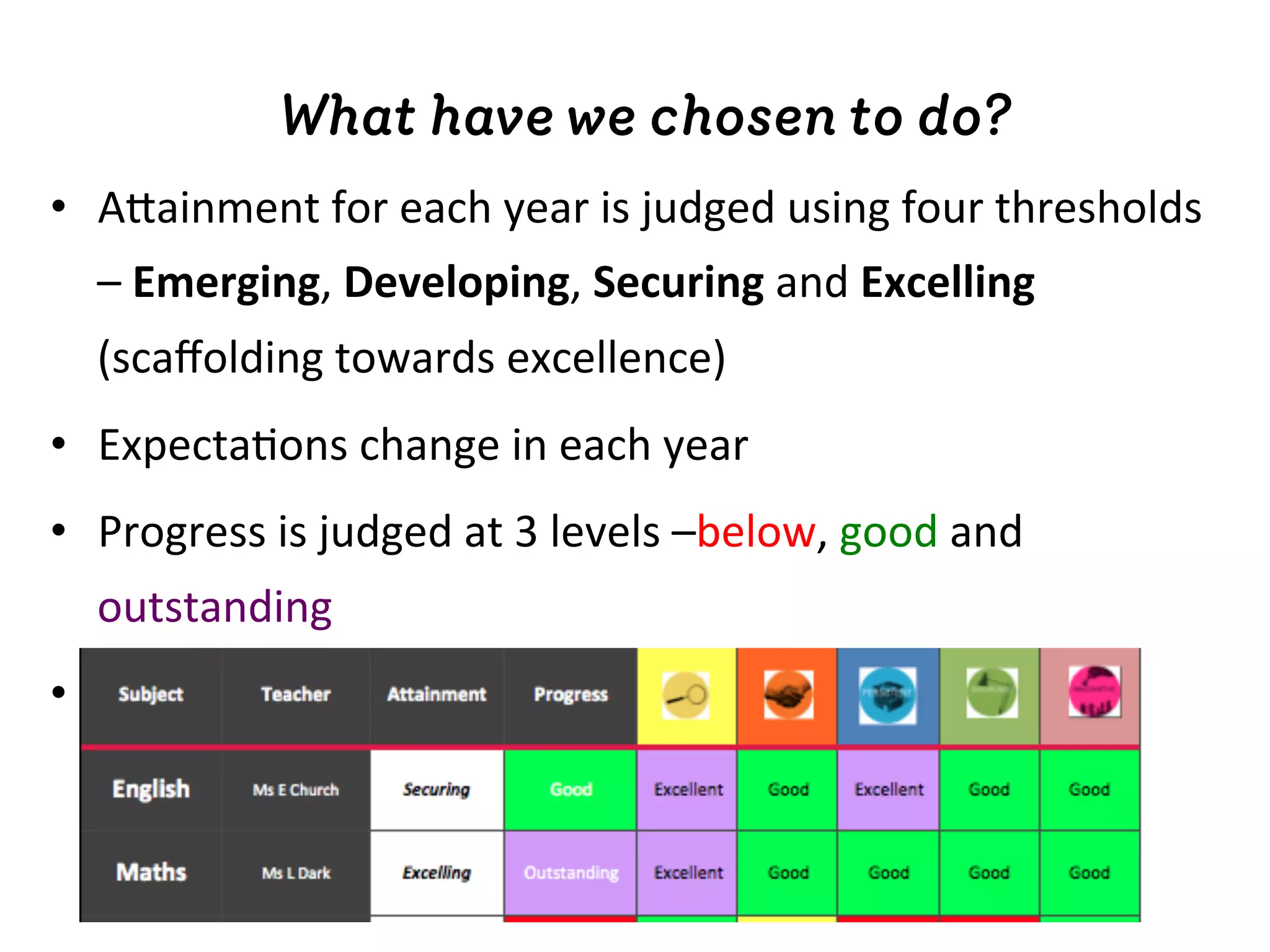
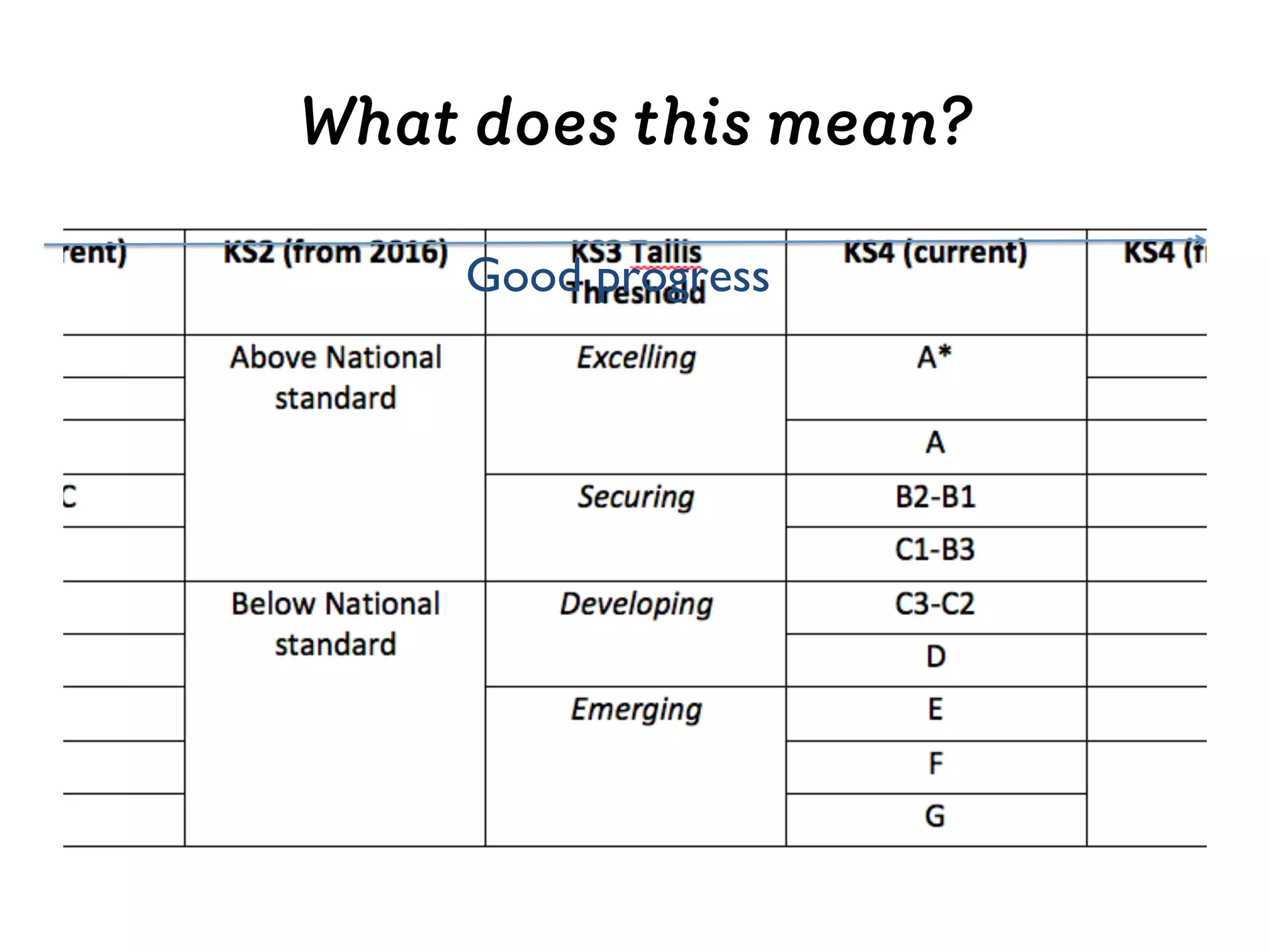
What have we chosen to do?
•  Aeainment	
  for	
  each	
  year	
  is	
  judged	
  using	
  four	
  thresholds	
  
–	
  Emerging,	
  Developing,	
  Securing	
  and	
  Excelling	
  
(scaffolding	
  towards	
  excellence)	
  
•  Expecta4ons	
  change	
  in	
  each	
  year	
  
•  Progress	
  is	
  judged	
  at	
  3	
  levels	
  –below,	
  good	
  and	
  
outstanding	
  
•  More	
  importance	
  given	
  to	
  effort	
  towards	
  each	
  of	
  our	
  
Habits	
  
What does this mean?
Good progress
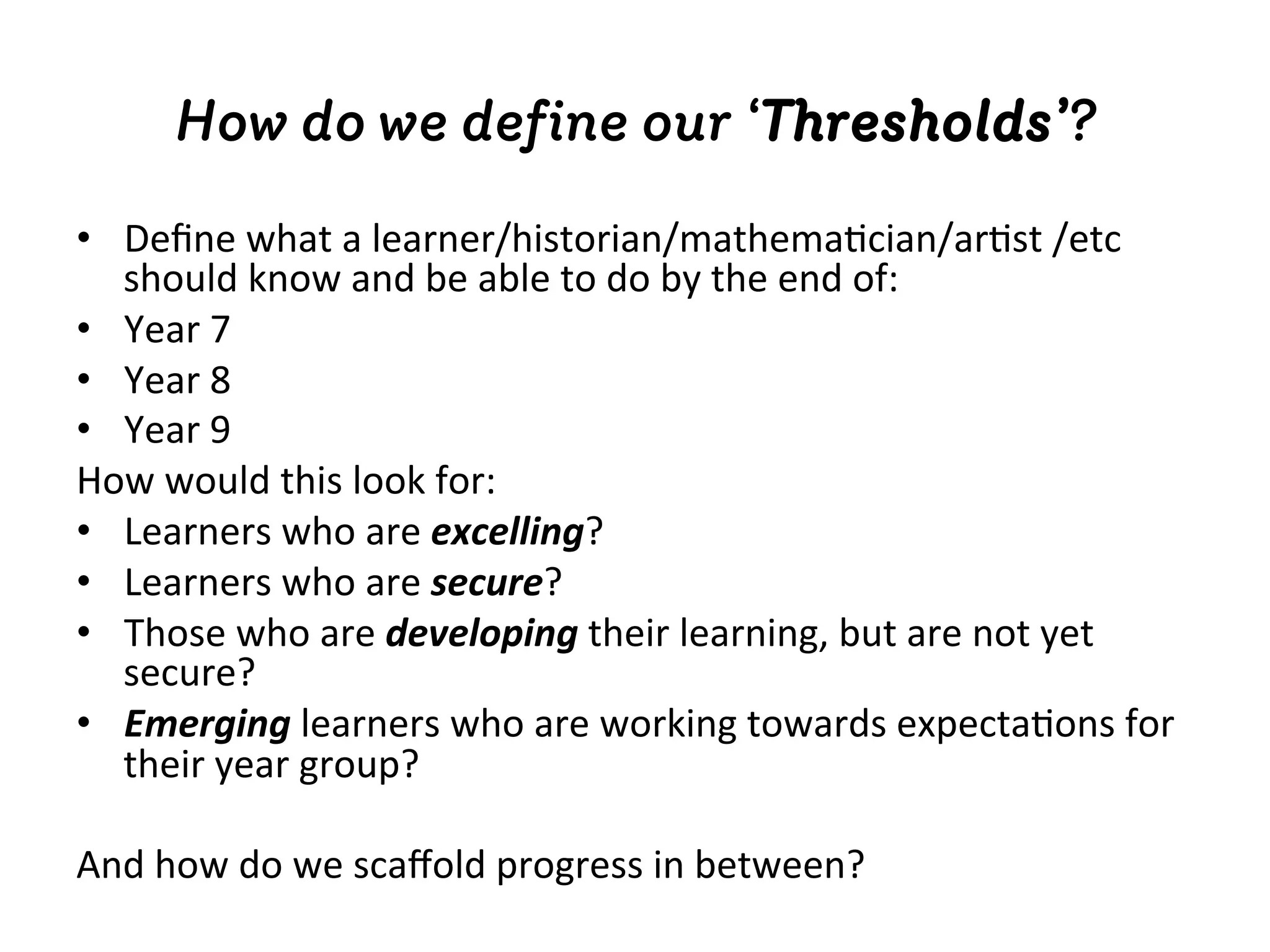
How do we define our ‘Thresholds’?
•  Define	
  what	
  a	
  learner/historian/mathema4cian/ar4st	
  /etc	
  
should	
  know	
  and	
  be	
  able	
  to	
  do	
  by	
  the	
  end	
  of:	
  
•  Year	
  7	
  
•  Year	
  8	
  
•  Year	
  9	
  
How	
  would	
  this	
  look	
  for:	
  
•  Learners	
  who	
  are	
  excelling?	
  
•  Learners	
  who	
  are	
  secure?	
  
•  Those	
  who	
  are	
  developing	
  their	
  learning,	
  but	
  are	
  not	
  yet	
  
secure?	
  
•  Emerging	
  learners	
  who	
  are	
  working	
  towards	
  expecta4ons	
  for	
  
their	
  year	
  group?	
  
And	
  how	
  do	
  we	
  scaffold	
  progress	
  in	
  between?	
  
Tracking progress and reporting to
parents
In	
  tracking	
  progress	
  and	
  repor4ng	
  to	
  parents,	
  we	
  will	
  
look	
  at	
  performance	
  rela4ve	
  to	
  baseline	
  threshold:	
  
•  Working	
  below	
  baseline	
  threshold	
  –	
  Below	
  expected	
  
progress.	
  
•  Working	
  within	
  their	
  baseline	
  threshold	
  –	
  Good	
  
progress.	
  
•  Working	
  above	
  their	
  baseline	
  threshold	
  or	
  at	
  the	
  top	
  
of	
  or	
  beyond	
  the	
  Excelling	
  threshold	
  –	
  Outstanding	
  
progress.	
  
The draft VMPA model
Assessment	
  fails	
  to	
  focus	
  on	
  the	
  skills	
  that	
  are	
  
relevant	
  in	
  life	
  in	
  the	
  21st	
  century.	
  Assessment	
  has	
  
been	
  called	
  the	
  “hidden	
  curriculum”	
  as	
  it	
  is	
  an	
  
important	
  driver	
  of	
  students’	
  study	
  habits.	
  Unless	
  we	
  
rethink	
  our	
  approach	
  to	
  assessment,	
  it	
  will	
  be	
  very	
  
difficult	
  to	
  produce	
  a	
  meaningful	
  change	
  in	
  
educa<on.	
  
-­‐-­‐Eric	
  Mazur	
  

Pedagogy, curriculum and assessment

  • 1.
    Pedagogy, curriculum & assessment JonCurtis-Brignell Assistant Head: Teaching and Learning
  • 2.
  • 6.
    What kind ofteaching for what kind of learning? 1.  What  are,  for  your  school,  your  desired   outcomes  of  educa5on  (DOEs)?   Consider:   •  the  knowledge,  abili4es,  a5tudes  and  values  which   you  want  young  people  to  have  acquired  by  the  4me   they  leave  school.    
  • 7.
    What kind ofteaching for what kind of learning?   2.  What  kinds  of  learning,  in  your  school,   with  your  students,  will  deliver  your   DOEs?   Consider:   •  What  do  students  need  to  learn  in  order  for  you  to   have  achieved  your  DOEs?   •  Different  kinds  of  learning  processes  are  needed  to   deliver  different  kinds  of  outcome.    
  • 8.
    What kind ofteaching for what kind of learning?   3.  What  kinds  of  teaching  will  lead  to  the   kind  of  learning  that  is  needed?   Consider:   •  Teaching  is  a  way  of  engaging  different  kinds  of   learning  processes  in  learners’  minds.  It  depends  on   s4mula4ng  and  engaging  the  kinds  of  learning  that   will  deliver  the  outcomes  you  said  you  valued.    
  • 9.
    What kind ofteaching for what kind of learning?   4.  What  kind  of  leadership  is  required  to  create   the  kinds  of  teaching  and  learning  which  are   desired,  and  so  ensure  that  students  leave   your  school  with  your  DOEs?     Consider:     •  Only  when  you  have  some  clarity  about  the  first  three   ques4ons  can  you  begin  to  priori4se  the  leadership   strategies  that  will  cul4vate  the  necessary  kinds  of   pedagogy.      
  • 10.
  • 11.
    A culture ofand for learning     A  school  signals  its  values  through  different  aspects  of   its  culture.  There  are  the  visible,  public  espousals  of   these  values  through  brochures,  websites,  speeches,   newsle:ers  and  other  publica;ons.          (Lucas  and  Claxton,  2013)  
  • 15.
    A culture ofand for learning     Most  importantly,  values  are  conveyed  moment-­‐by-­‐ moment  by  teachers  in  classrooms  –  through  their   running  commentary;  the  kinds  of  ac;vi;es  they   create;  the  way  they  lay  out  the  furniture  or  configure   group  work;  the  kind  of  language  they  use  and  the   example  they  set.          (Lucas  and  Claxton,  2013)  
  • 16.
    Curriculum is pedagogy The  failure  to  realise  that  curriculum  is  pedagogy  has   been  one  of  the  great  tragedies  of  the  last  quarter-­‐ century  in  England’s  educa;on  system….  curriculum   development  is  an  inherently  crea;ve  process.  It  is  the   process  by  which  teachers  take  the  desired  outcomes   from  the  intended  curriculum  and  convert  them  into   engaging  ac;vi;es  in  classrooms.        -­‐  Dylan  Wiliam,  Principled  Curriculum  Design        
  • 17.
    Curriculum is pedagogy • We  need  to  create  ‘real’  understanding  (powerful  knowledge)   •  Depth  before  breadth  –  focus  on  excellence   •  The  Trivium:  Grammar,  Dialec4c  and  Rhetoric   •  Extended  enquiries  (independence)   •  PorRolios  of  excellence   •  Interleaving  rather  than  blocking  content   •  Embedded  forma4ve  assessment   •  Habits  of  Mind  
  • 18.
    What is your‘signature pedagogy’? Signature  pedagogies  make  a  difference.  They  form   habits  of  the  mind,  habits  of  the  hand  and  habits  of   the  heart….  they  prefigure  the  culture  of  professional   work  and  provide  the  early  socialisa;on  into  the   prac;ces  and  values  of  a  field.  Whether  in  a  lecture   hall  or  a  lab,  in  a  design  studio  or  a  clinical  seNng,  the   way  we  teach  will  shape  how  professionals  behave…              (Shulman,  2005)    
  • 19.
  • 20.
    The backward designof a curriculum •  Define  what  a  learner/historian/mathema4cian/ ar4st  /etc  should  know  and  be  able  to  do  by  y11/13,   and  then  work  backwards  to  devise  a  programme  of   study  from  y7  to  achieve  that.       This  will  include:   •  ‘Big  ideas’  /  threshold  concepts   •  Powerful  knowledge  (‘knowing  that…’)   •  Key  skills  (‘knowing  how  to…’)  
  • 21.
    Programme of study Obviously  in  secondary  schools,  the  content  of  GCSE   will  have  a  strong  influence  on  the  selec<on  of  ‘big   ideas’.  But  schools  should  be  careful  not  to  assume  that   GCSE  syllabuses  embody  all  the  big  ideas  that  will  be   important,  either  for  further  study,  or  for  life  aCer   school…Focusing  only  on  what  is  important  for   examina<on  success  may  help  the  school  succeed,  but   is  likely  to  be  disastrous  for  current  secondary  school   students.   -­‐  Dylan  Wiliam,  Principled  Assessment  Design  
  • 22.
    Threshold concepts /big ideas   Learning  should  be  an  adventure,  not  a  journey.            -­‐  Mar4n  Robinson   A  threshold  concept  can  be  considered  as  akin  to  a  portal,   opening  up  a  new  and  previously  inaccessible  way  of   thinking  about  something.  It  represents  a  transformed  way   of  understanding,  or  interpre<ng,  or  viewing  something   without  which  the  learner  cannot  progress.  As  a   consequence  of  comprehending  a  threshold  concept  there   may  thus  be  a  transformed  internal  view  of  subject  maQer,   subject  landscape,  or  even  world  view.      Jan  Meyer  and  Ray  Land,  “Threshold  Concepts  and   Troublesome  Knowledge:  Linkages  to  Ways  of  Thinking  and   Prac<sing  within  the  Disciplines”,      
  • 23.
  • 24.
    Threshold concepts are: • Integra5ve:  Once  learned,  they  are  likely  to  bring  together  different   parts  of  the  subject  which  you  hadn’t  previously  seen  as  connected.   •  Transforma5ve:  Once  understood,  they  change  the  way  you  see  the   subject  and  yourself.   •  Irreversible:  They  are  difficult  to  unlearn  –  once  you’ve  passed  through   it’s  difficult  to  see  how  it  was  possible  not  to  have  understood  before.   •  Recons5tu5ve:  They  may  shi`  your  sense  of  self  over  4me.  This  is   ini4ally  more  likely  to  be  no4ced  by  others,  usually  teachers.   •  Troublesome:  They  are  likely  to  present  you  with  a  degree  of  difficulty   and  may  some4mes  seem  incoherent  or  counter-­‐intui4ve.   •  Discursive:  The  student’s  ability  to  use  the  language  associated  with  that   subject  changes  as  they  change.  It’s  the  change  from  using  scien4fic   keywords  in  everyday  language  to  being  able  to  fluently  communicate  in   the  academic  language  of  science.  
  • 25.
    Big ideas inEnglish •  The  rela4onship  between  context  and  meaning   •  The  rela4onship  between  form,  structure  and   meaning   •  The  rela4onship  between  language  and  meaning   •  The  rela4onship  between  grammar  and  meaning   •  The  rela4onship  between  the  writer  and  the  reader   in  construc4ng  meaning:  the  role  of  interpreta4on.    
  • 26.
    Threshold concepts froma SoL on Poetry •  What  it  means  to  be  poe4c:  the  no4on  of  cra`ing   poe4c  language.   •  The  nature  and  importance  of  figura4ve  language  and   metaphor.   •  The  kinds  and  importance  of  poe4c  form.   •  The  impact  of  structure  on  meaning;  structural   devices  such  as  metre,  rhythm,  rhyme  that  are  used   to  achieve  this.   •  The  role  of  the  reader  in  construc4ng  meaning:   'informed  personal  response'.   •  Ambiguity  of  interpreta5on    
  • 27.
  • 28.
    Schemes of Learning- Consistency
  • 29.
    Don’t forget •  Consider  transi4on  (map  the  gap)   •  Inspire  and  interest  students   •  Build  in  tes4ng,  assessment  and  challenge   •  Build  in  real  understanding  (not  teaching  by  numbers)   •  High  expecta4ons  -­‐  you  get  what  you  seele  for.   Learning  is  what  happens  when  students  are   forced  to  think  hard!  
  • 30.
    Assessment without levels “What  we  want  is  a  model  of  ability  based  on  each  child  being  capable   of  anything  and  us  looking  progressively,  through  assessment,  at  what   ideas  a  child  has  understood.”          Tim  Oates,  Cambridge  Assessment   “A  culture  shiC  regarding  the  nature,  range  and  purposes  of  assessment   needs  to  take  place,  in  recogni<on  of  the  new  opportuni<es  provided   both  by  the  new  curriculum  and  the  removal  of  levels.”   NCTL  Report  September  2014     “Assessment  should  be  the  servant,  not  the  master,  of  the  learning.”   Dylan  Wiliam  
  • 31.
    Why change fromlevels? •  Can become a “label” that creates a fixed mindset •  Don’t deepen understanding – too general •  Accuracy of levels (especially sub levels) is unreliable •  They do not always progress smoothly to GCSE •  Successful schools and nations don’t use them •  Wording is often both confusing and limiting •  They no longer exist
  • 32.
    What do weNEED from a new assessment system? •  Forma4ve  and  summa4ve   •  Fits  with  new  KS3  Na4onal  Curriculum   •  To  measure  progress  accurately     •  To  benchmark  against  KS2  and  KS4   •  To  allow  meaningful  &  understandable   parental  repor4ng  
  • 33.
    What do weWANT from a new assessment system? •  Smooth  transi4on  through  key  stages     •  To  allow  a  “growth  mindset”  focused  on  effort   and  progress   •  To  provide  real  stretch  and  challenge  at  all  levels   •  To  develop  our  ‘habits’  
  • 34.
    Progress so far? • Spoken  to  our  primary  feeder  schools   •  Lots  of  research  in  current  thinking   •  Curriculum  working  group   •  Lots  of  mee4ngs  with  curriculum  leaders  and  departments   •  Presented  to  governors   •  Consulta4on  with  parents   •  Consulta4on  with  students  
  • 35.
    New proposal A  dual  system  on  :   1.  Effort  towards  Tallis  Habits  reported  3  4mes  a  year   2.  Progress  in  subject  specific  competencies  reported   twice  a  year     Addresses the feedback points 1 and 2 from the previous slide
  • 36.
    Habits of Mind • Effort  towards  the  Habits  ‘ideal’  is  reported  using  words   •  Students  will  self-­‐assess  their  Habits   •  Parents  will  also  assess  their  Habits   •  Differences  between  teacher,  student  and  parent  discussed  
  • 37.
    What have wechosen to do? •  Aeainment  for  each  year  is  judged  using  four  thresholds   –  Emerging,  Developing,  Securing  and  Excelling   (scaffolding  towards  excellence)   •  Expecta4ons  change  in  each  year   •  Progress  is  judged  at  3  levels  –below,  good  and   outstanding   •  More  importance  given  to  effort  towards  each  of  our   Habits  
  • 38.
    What does thismean? Good progress
  • 39.
    How do wedefine our ‘Thresholds’? •  Define  what  a  learner/historian/mathema4cian/ar4st  /etc   should  know  and  be  able  to  do  by  the  end  of:   •  Year  7   •  Year  8   •  Year  9   How  would  this  look  for:   •  Learners  who  are  excelling?   •  Learners  who  are  secure?   •  Those  who  are  developing  their  learning,  but  are  not  yet   secure?   •  Emerging  learners  who  are  working  towards  expecta4ons  for   their  year  group?   And  how  do  we  scaffold  progress  in  between?  
  • 40.
    Tracking progress andreporting to parents In  tracking  progress  and  repor4ng  to  parents,  we  will   look  at  performance  rela4ve  to  baseline  threshold:   •  Working  below  baseline  threshold  –  Below  expected   progress.   •  Working  within  their  baseline  threshold  –  Good   progress.   •  Working  above  their  baseline  threshold  or  at  the  top   of  or  beyond  the  Excelling  threshold  –  Outstanding   progress.  
  • 41.
  • 42.
    Assessment  fails  to  focus  on  the  skills  that  are   relevant  in  life  in  the  21st  century.  Assessment  has   been  called  the  “hidden  curriculum”  as  it  is  an   important  driver  of  students’  study  habits.  Unless  we   rethink  our  approach  to  assessment,  it  will  be  very   difficult  to  produce  a  meaningful  change  in   educa<on.   -­‐-­‐Eric  Mazur