a new model of scholing or  secondary education redesigned
Views on Redesign Fundament a l  and out of the box :  Use all knowledge about learning, teaching and business organization   Forget traditions   Ignore all regulations but stay within limits of school budget terms of examinations
What was the outcome:  A school for   all  junior college students    1- 4 VMBO en  1-3 H/V   A school as a service-orientated organisation not a  producti on hall A new grouping of students Another use of teachers Another building and use of ICT
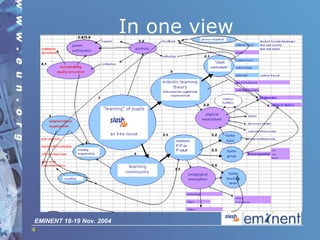
In one view
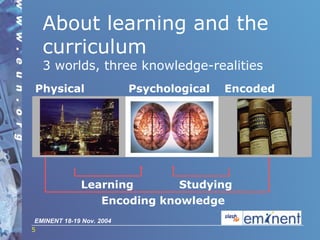
About learning and the curriculum  3  worlds, three knowledge-realities Encoding   knowledge Physical Psychological Encoded                 Learning Studying
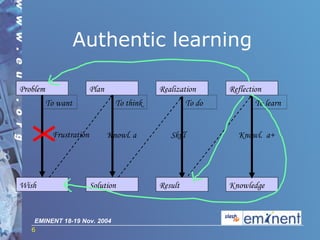
Authentic learning Problem To want Wish Frustration To do To think Result Solution Realization Plan Knowl. a Skill To learn Knowledge Reflection Knowl.  a+
Authentic learning Learning in a realistic setting leads to real knowledge Learning starting from an authentic problem leads to real knowledge The core-concepts, ideas, problems etc. together should cover the knowledge fields related to the attainment targets Cooperative learning accelerates learning, deepens insights, is more fun
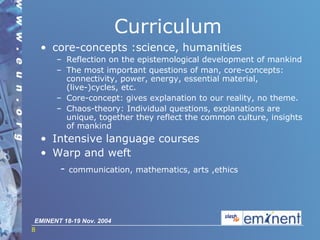
Curriculum core-concepts :science, humanities Reflection on the epistemological development of mankind The most important questions of man, core-concepts: connectivity, power, energy, essential material, (live-)cycles, etc. Core-concept: gives explanation to our reality, no theme. Chaos-theory: Individual questions, explanations are unique, together they reflect the common culture, insights of mankind Intensi ve   language courses Warp and weft -  communication, mathematics, arts ,ethics
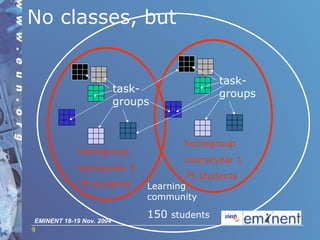
No classes ,  but Learning community 150  students home gro u p courseyear 1 75 students task -gro u p s home gro u p courseyear 1 75 students task -gro u p s
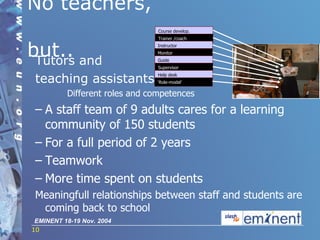
No teachers,  but.. Tutors and  teaching assistants Different roles and competences A staff team of 9 adults cares for a learning community of 150 students For a full period of 2 years Teamwork  More time spent on students  Meaningfull relationships between staff and students are coming back to school Course develop. Trainer /coach Instructor Monitor Guide Supervisor Help desk ‘ Role-model’
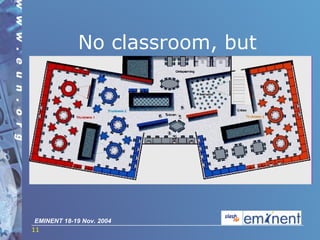
No classroom, but
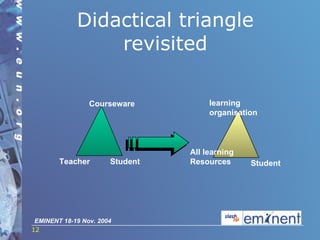
Didactical triangle revisited Teacher Student Courseware All learning Resources Student learning   organisation
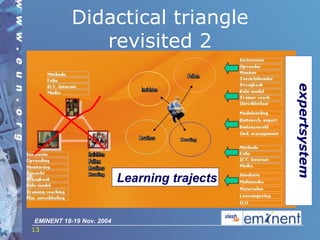
Didactical triangle revisited 2 expertsystem Learning trajects
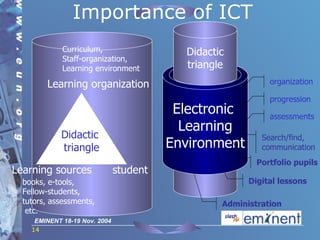
Importance of ICT Learning sources student Didactic  triangle Learning organization books, e-tools, Fellow-students, tutors, assessments, etc.  Curriculum, Staff-organization,  Learning environment Administration Digital lessons Portfolio pupils Search/find, communication assessments progression organization Electronic  Learning Environment Didactic triangle
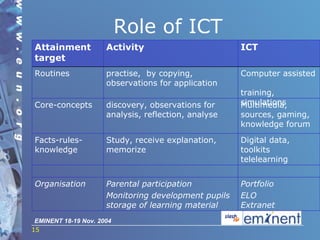
Role of ICT Portfolio ELO  Extranet Parental participation Monitoring development pupils storage of learning material Organisation Computer assisted  training, simulations practise,  by copying, observations for application Routines Digital data, toolkits telelearning Study, receive explanation, memorize Facts-rules-knowledge Multimedia, sources, gaming, knowledge forum discovery, observations for analysis, reflection, analyse Core-concepts ICT Activity Attainment target
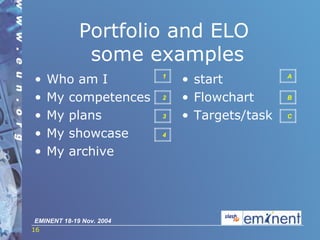
Portfolio and ELO  some examples Who am I My competences My plans My showcase My archive start Flowchart Targets/task 1 2 3 4 A B C
And now: how about you “ What seems relevant to you? What would you like to implement in  your schools, your practice?  What is holding you back?
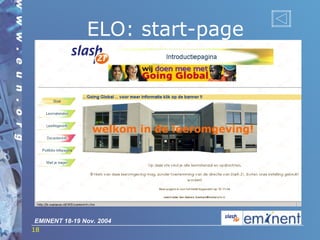
ELO: start-page
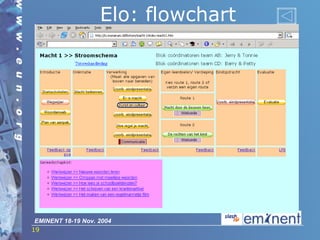
Elo: flowchart
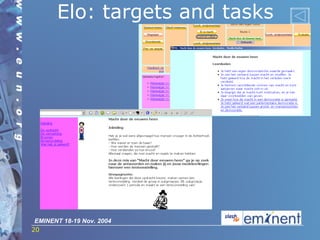
Elo: targets and tasks
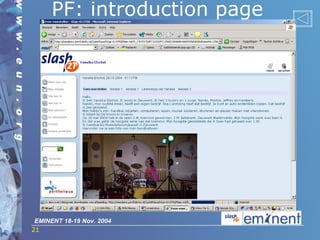
PF: introduction page
PF: my showcase
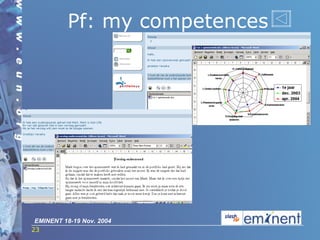
Pf: my competences
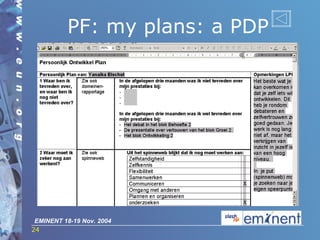
PF: my plans: a PDP


Eminent Presentation Henk Van Dieten

  • 1.
    a new modelof scholing or secondary education redesigned
  • 2.
    Views on RedesignFundament a l and out of the box : Use all knowledge about learning, teaching and business organization Forget traditions Ignore all regulations but stay within limits of school budget terms of examinations
  • 3.
    What was theoutcome: A school for all junior college students 1- 4 VMBO en 1-3 H/V A school as a service-orientated organisation not a producti on hall A new grouping of students Another use of teachers Another building and use of ICT
  • 4.
  • 5.
    About learning andthe curriculum 3 worlds, three knowledge-realities Encoding knowledge Physical Psychological Encoded                 Learning Studying
  • 6.
    Authentic learning ProblemTo want Wish Frustration To do To think Result Solution Realization Plan Knowl. a Skill To learn Knowledge Reflection Knowl. a+
  • 7.
    Authentic learning Learningin a realistic setting leads to real knowledge Learning starting from an authentic problem leads to real knowledge The core-concepts, ideas, problems etc. together should cover the knowledge fields related to the attainment targets Cooperative learning accelerates learning, deepens insights, is more fun
  • 8.
    Curriculum core-concepts :science,humanities Reflection on the epistemological development of mankind The most important questions of man, core-concepts: connectivity, power, energy, essential material, (live-)cycles, etc. Core-concept: gives explanation to our reality, no theme. Chaos-theory: Individual questions, explanations are unique, together they reflect the common culture, insights of mankind Intensi ve language courses Warp and weft - communication, mathematics, arts ,ethics
  • 9.
    No classes , but Learning community 150 students home gro u p courseyear 1 75 students task -gro u p s home gro u p courseyear 1 75 students task -gro u p s
  • 10.
    No teachers, but.. Tutors and teaching assistants Different roles and competences A staff team of 9 adults cares for a learning community of 150 students For a full period of 2 years Teamwork More time spent on students Meaningfull relationships between staff and students are coming back to school Course develop. Trainer /coach Instructor Monitor Guide Supervisor Help desk ‘ Role-model’
  • 11.
  • 12.
    Didactical triangle revisitedTeacher Student Courseware All learning Resources Student learning organisation
  • 13.
    Didactical triangle revisited2 expertsystem Learning trajects
  • 14.
    Importance of ICTLearning sources student Didactic triangle Learning organization books, e-tools, Fellow-students, tutors, assessments, etc. Curriculum, Staff-organization, Learning environment Administration Digital lessons Portfolio pupils Search/find, communication assessments progression organization Electronic Learning Environment Didactic triangle
  • 15.
    Role of ICTPortfolio ELO Extranet Parental participation Monitoring development pupils storage of learning material Organisation Computer assisted training, simulations practise, by copying, observations for application Routines Digital data, toolkits telelearning Study, receive explanation, memorize Facts-rules-knowledge Multimedia, sources, gaming, knowledge forum discovery, observations for analysis, reflection, analyse Core-concepts ICT Activity Attainment target
  • 16.
    Portfolio and ELO some examples Who am I My competences My plans My showcase My archive start Flowchart Targets/task 1 2 3 4 A B C
  • 17.
    And now: howabout you “ What seems relevant to you? What would you like to implement in your schools, your practice? What is holding you back?
  • 18.
  • 19.
  • 20.
  • 21.
  • 22.
  • 23.
  • 24.
  • 25.
  • 26.
  • 27.
  • 28.

Editor's Notes

  • #2 Marianum   /21 is closely related to the Marianum. The Marianum offers a broad scale of education (vmbo, havo and vwo). It is based in two locations; Groenlo and Lichtenvoorde. /21 has the responsibility to meet the high quality standards of the Marianum.   Stichting Carmelcollege   The Stichting Carmelcollege is one of the largest schoolboards in the Netherlands for secondary education. It is responsible for 35.000 pupils at 20 schools. The welfare of the human being is of immense importance. A school is enthusiastically encouraged by the Stichting Carmelcollege to create an appropriate study environment, where children are prepared for their future.   Their choice to support this alternative method of education is a positive action that fits their attitude. Our society and labour market have changed drastically in the last decennia. The Stichting Carmelcollege is aware of this and takes it as her responsibility to provide the appropriate education. /21 is a logical step for a board that places the pupil in the central role.