ENGLISH
SYLLABUS
Third Cycle of
Basic Education
Elías Antonio Saca
                            Presidente de la República
                                 Ana Vilma de Escobar
                        Vicepresidenta de la República
                                 Darlyn Xiomara Meza
                              Ministra de Educación
     José Luis Guzmán                                         Carlos Benjamín Orozco
Viceministro de Educación                                Viceministro de Tecnología
                                Norma Carolina Ramírez
                    Directora General de Educación

                             Ana Lorena Guevara de Varela
                    Directora Nacional de Educación
                               Manuel Antonio Menjívar
                    Gerente de Gestión Pedagógica
                               Rosa Margarita Montalvo
                         Jefe de la Unidad Académica
                            Wendy Cristela Menéndez Cruz
                            Jefa de Programa Compite

                                 Equipo técnico
                        •    Augusto Antonio Cornejo Huezo
                        •    Herbert Ovidio Aparicio Castellanos
                        •    José Isaías Parada Díaz
                        •    José Trinidad Galdámez Sáenz

                            Apoyo técnico externo
                                 • Ana María Mendoza
                                 • Carmen Castillo
                                 • Edgar Nicolás Ayala

                                                                                               ISBN 978-99923-58-62-7
                                                                                 © Copyright Ministerio de Educación de El Salvador 2008
                                                             Derechos Reservados. Prohibida su venta. Esta publicación puede ser reproducida en todo o en parte,
                                                                           reconociendo los derechos del Ministerio de Educación de El Salvador.
Dear Teachers:

Within the framework of the 2021 National Education Plan, The Ministry of Education is pleased to
make this updated version of the English Syllabus for the Third Cycle of Basic Education available
to you . Its content is coherent with our constructivist, humanist and socially committed curricular
orientation. At the same time, it incorporates the vision of developing competencies, making the
principles of the policy “Currículo al Servicio del Aprendizaje” be put into practice.

As part of this policy The Ministry of Education has renewed the guidelines for the evaluation of
learning to match the competencies proposal and the needed type of evaluation for our educational
system: an evaluation in the service of learning. This is possible if high expectations are placed on
our students and if they are told that with effort and steadiness they eventually can achieve their
goals.

The Ministry of Education takes advantage of this opportunity to manifest our trust in you. We know
you will read and analyze this Syllabus with an attitude geared towards learning and improving,
taking into account your experience and studies in education.

The Ministry of Education believes in your commitment to the mission which has been entrusted to
us - that the children, young men and women of El Salvador obtain better learning achievements
and develop integrally.


          Darlyn Xiomara Meza                                               José Luis Guzmán
          Minister of Education                                         Vice - Minister of Education
4
    English syllabus for the third cycle
I. Introduction to The English Curriculum for The Third Cycle of Basic Education
    The English Curriculum for the Third Cycle of Basic Education                                Finally, objectives, contents and achievement indicators are clearly
features a curricular proposal in order to address the need to respond the                       presented in each unit of study.
questions teachers should have as they plan their classes. These questions
                                                                                                 The English curriculum has been designed upon the standard proficiency
are properly answered through the following curricular components:
                                                                                                 levels to be reached in each grade and cycle of education. On the other
                   QUESTIONS                                   CURRICULAR COMPONENTS             hand, it is flexible to teachers’ creativity to contextualize it to their teaching
                                                                                                 environment to successfully achieve the stated objectives and language
         What do teachers teach for?                                 Competencies/Objectives
                                                                                                 proficiency levels.
          What must students learn?                                              Contents
                                                                                                 Syllabus innovations
                   How to teach?                                     Methodological guidelines
                                                                                                 The English curriculum designed and implemented in 1998 is definitely
                                                                        Evaluation guidelines    one of the sources for the designing and implementation of the current
    How, when and what to evaluate?                                    Achievement indicators    version; although, it is worth stating that this is a functional/notional
                                                                                                 syllabus embracing the communicative approach for its development in
                                                                                                 order to achieve objectives and language proficiency levels. The most
The English curriculum is based on these curricular components which
                                                                                                 remarkable features are detailed below1:
are developed as follows:
            Description of competencies, proficiency levels and approach that                    a. Objectives
            orients the English subject development.
                                                                                                 Objectives are presented by cycle of education, grade and in each unit
            Presentation of contents aligned with the subject objectives and                     of study.
            allow the structuring of units of study.
                                                                                                 Objectives aim at achieving language and preparation for life
            The methodological guidelines provide specific recommendations
                                                                                                 competencies, that is the reason why they are formulated using action
            for the sequencing of units. They describe, in logical order, the
                                                                                                 verbs introducing the goals to be reached by means of procedures.
            stages to develop language competencies through the delivering
                                                                                                 Afterwards, concepts and attitudes are presented embedded in the
            and practicing of language functions. In addition they provide
                                                                                                 objectives, thus, articulating the three types of knowledge. Besides, the
            general recommendations and it is up to teachers to improve
                                                                                                 “what for” or learning purpose is finally stated to connect contents with
            them. The English syllabus features general methodological
                                                                                                 life and students’ needs.
            guidelines per cycle of education.
            Evaluation is developed through suggestions and criteria
            applicable to diagnostic, formative and summative evaluation
            functions.

1 Currículo al Servicio del Aprendizaje, Ministerio de Educación, San Salvador, 2007.
                                                                                                                                                                                               5
                                                                                                                                                        English syllabus for the third cycle
Language proficiency levels                                                     The conceptual, procedural and attitudinal contents have the same
                                                                                    relevance because the importance and articulation of knowing, doing,
    Language proficiency levels are given by cycle of education and grade.          knowing what to be, and coexisting, is only reflected through their
    They are meant to serve as guiding references for planning, delivering and      integration. The challenge relies on overcoming the trend to solely” teach”
    evaluating teaching and learning to eventually reach the set language           or learn by heart. They have a space and importance of their own but
    proficiency levels2 by cycle of education and grade.                            must not be understood anymore as a synonym of successful learning.
                                                                                    This takes place only when the three types of contents are articulated.
    b. Contents
                                                                                    Procedural contents deserve special attention because there is a potential
    Presentation of content sets                                                    risk of confusing them with methodology. Cesar Coll4 defines them as
                                                                                    follows:
    The English syllabus presents and describes the sets of contents by each
    grade providing an insightful view on how they are structured from the          “They are always concerned with certain concrete forms of performance,
    simple to the complex, from the immediate students’ world to the farthest       whose most salient feature is that they take place in a systematic and
    and most abstract world, properly integrating and balancing the three           orderly fashion, and that performance is purposely addressed to achieve
    types of contents or knowledge: conceptual, procedural and attitudinal          a definite goal“
    and joining language learning, ranging from the mastery of simple daily
    language functions to the mastery of more complicated and sophisticated         Procedural contents are not new in the curriculum, whereas the practical
    discourse. This new version of the English Syllabus has structured units of     dimension or concepts application has been long fostered for decades.
    study in a different form; these differences are highlighted in a comparative   They have been labeled before as techniques, skills, strategies, algorithms,
    chart of the former syllabus with the current one.                              etc. When categorizing them as contents, the procedures are subjected to
                                                                                    planning and control in much the very same way activities are adequately
    Three types of contents: conceptual, procedural and attitudinal                 prepared to guarantee the learning of other types of contents5.

    Contents’ relevance relies on their contribution to achieve the stated          Sequencing of contents
    objectives as well as language and preparation for life competencies.
    Antoni Zabala3 defines contents as follows:                                     The scope and sequence has been meticulously elaborated vertically
                                                                                    and horizontally to guarantee that teachers will deliver teaching in a
    “Set of skills, attitudes and knowledge needed for development of               scaffolding fashion and students will construct knowledge in the same
    competencies. They are categorized in three large groups depending on           way.
    how they are related with knowing, knowing what to do or to be, that
    is to say, conceptual contents, (deeds, concepts and conceptual systems),       Moreover, contents are suited to address students’ needs, interests and
    procedural contents (skills, techniques, methods, strategies..etc.) and         problems to connect learning with background knowledge, previous life
    attitudinal contents (attitudes, norms and values)”                             experiences and a sense of usefulness; therefore, learning will emerge as
                                                                                    a likeable, enjoyable and meaningful task.


                                                                                                2 The American Council on the Teaching of Foreign Languages, Proficiency Guidelines, New York, 1989.
6                                                                                   3 Marco Curricular. Antoni Zabala. Documento de referencia de consulta para el Ministerio de Educación, página 21.
                                                                                                       4
                                                                                                         Los Contenidos de la Reforma. Cesar Coll y otros. Editorial Santillana. Aula XXI, 1992, página 85.
       English syllabus for the third cycle                                                                                                                                              5
                                                                                                                                                                                          Ibid. Página 103.
Besides, standardized minimum proficiency levels have been set to be                     The constant follow up outlined in the achievement indicators implies
reached by the end of each grade and cycle of education; thus, assuring                  the providing of prompt and opportune academic reinforcement to those
teachers and students have clear teaching and learning standards to                      students who need it and the making of planning and teaching adaptations
pursue.                                                                                  to adequately address different students’ learning styles.

c. Evaluation                                                                            Graphic description of units
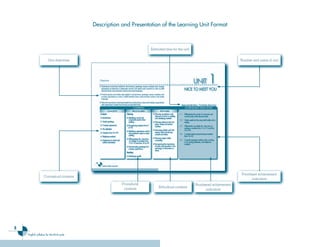
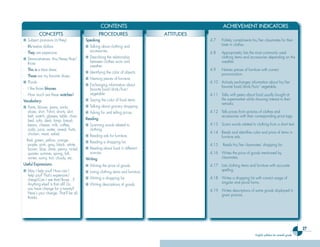
Achievement indicators6 constitute one of the most salient innovations.                         Grade, number and name of unit: They are the unit general
Achievement indicators prove the expected learning outcomes in                                  data.
relationship with objectives and contents of each unit. They are useful                         Estimated time of completion for the unit: Approximate number of
in assessing students’ learning because they point out expected                                 hours to be allocated to the development of each unit.
performance; therefore, they must be considered for assessment and                              Objectives of unit: They express what is expected to be achieved
academic reinforcement activities. In this English syllabus, achievement                        by the students at the end of each unit.
indicators are meant to evaluate students’ development of language and
                                                                                                Conceptual, procedural and attitudinal contents: They comprise
preparation for life competencies.                                                              the concepts, procedures and attitudes that must be acquired by
                                                                                                students through the mediation of the teaching-learning process.
Achievement indicators are numbered correlatively in each unit of study.
Example, 5.1 means that the indicator belongs to unit five and is the                           Achievement indicators: They are sample evidence that students
indicator number one.                                                                           have reached the stated objectives at the end of each unit.

d. Academic Reinforcement
Evaluation results must be used to support and orient teaching planning
as well as students’ learning. Through the analysis of evaluation results,
teachers could decide on what to feedback, and how to reshape their
teaching approach to address students’ affective and learning needs,
thus, preventing frustration and dislike towards English subject as well
as drop out.

Through performance outcomes teachers and students may assess
learning quality, understand how learning took place and weigh the
obstacles faced during the process. Consequently, teachers and students
will look into the causes that made learning difficult recognizing that it
is often not because students neglect the studies or are unable to have
success7.

6
  Evaluación al Servicio del Aprendizaje, Ministerio de Educación, San Salvador, 2007.
7
 Evaluación al Servicio del Aprendizaje, Ministerio de Educación, San Salvador, 2007.                                                                                            7
                                                                                                                                          English syllabus for the third cycle
Description and Presentation of the Learning Unit Format


                                                                    Estimated time for the unit


                       Unit objectives                                                                                   Number and name of unit


                                                                                                                         Prioritized achievement
                   Conceptual contents
                                                                                                                                 indicators
                                                       Procedural                                 Numbered achievement
                                                        contents         Attitudinal contents
                                                                                                       indicators


8
    English syllabus for the third cycle
II. Third Cycle Curriculum
The Third Cycle Curriculum is organized in subjects with a number of                                                           Implementing the English curriculum implies doing curricular adaptations
hours as follows:                                                                                                              to meet the students’ needs and adjusting it to the conditions of the
                                                                                                                               context. This contextualization is expedited by the “Proyecto Curricular de
                                                                                                                               Centro” (PCC)8 in which teachers’ agreements on curricular components
              Subjects                           Seventh                    Eighth                         Ninth               (competencies/objectives, contents, methodology and evaluation) are
                                       Hours per     Hours per       Hours per       Hours per     Hours per       Hours per   registered, these agreements are worked out based on students’ academic
                                         week          year            week            year          week            year      achievements, mission and diagnose of the educational institution.
    Language and Literature                  5            200           5             200             5              200
    Mathematics                              5            200           5             200             5              200
                                                                                                                               Teachers should definitely consider the PCC pedagogical agreements
    Science                                  5            200           5             200             5              200
    Social Studies
                                                                                                                               and the English syllabus as key references for didactic planning. Both
                                             5            200           5             200             5              200
                                                                                                                               instruments complement each other.
    English                                  3            120           3             120             3              120
    Physical Education                       2            80            2              80             2               80
    Total of hours.                       25             1,000          25            1,000           25            1,000      Cross-Curricular Themes


On the understanding that there will be three English classes per week                                                         The cross-curricular themes contribute to the students’ integral education
and one hundred and twenty hours of classes in a school year, the six units                                                    because it is through their socialization that a democratic society plenty of
of study that make up the curriculum for the school year will be developed                                                     values is consolidated, a society where people and nature are respected
in the following estimated time:                                                                                               and people are able to solve personal, local and nation’s problems.


                                                                                                                               The cross-curricular themes9 are an essential part of the syllabus and
                                                     Units of study                                         Hours
        Grades                                                                                             per year            should be applied in the development of the contents. The present
                              1          2           3           4               5            6                                document includes the following cross-curricular themes: Human
      Seventh grade          12          12          27          28           14              27             120               Rights Education, Environmental Education, Population Education,
      Eighth grade            9          12          24          27           24              24             120               Comprehensive Preventive Education, Education for Equal Opportunity,
      Ninth grade            12          9           24          24           27              24             120               Health Education, Education for The Consumer and Values Education.


8
    For further information, read section on Proyecto Curricular de Centro. Currículo al Servicio del Aprendizaje, Ministerio de Educación, San Salvador, 2007.
9
    Fundamentos Curriculares de la Educación Nacional. Ministerio de Educación, páginas 115- 116, El Salvador, 1999.                                                                                                      9
                                                                                                                                                                                   English syllabus for the third cycle
III. Presentation of the English Subject, Approach, Language Proficiency Levels, and Content Blocks
     Presentation of the English Subject
     The English Syllabus for the Third Cycle of Basic Education focuses on      b. It applies to both written and spoken language.
     the development of language competencies essential for communicating        c. It is context-specific, as communication always takes place in a
     and properly interacting with the environment. Developing these                particular context or situation. The competent language user will
     competencies implies the learning of concepts, the domain of procedures        know how to make appropriate choices in register and style to fit the
     and the adopting of attitudes integrally. This integration guarantees the      particular situation in which communication occurs.
     acquisition of the expected competencies.
                                                                                 d. It is important to distinguish between competence and performance.
     This syllabus promotes the development of five competencies: oral              Competence is what one knows. Performance is what one does. Only
     comprehension (listening), oral production (speaking), reading                 performance is observable, however, and it is only through performance
     comprehension (reading) and writing production (writing). Such                 that competence can be developed, maintained, and evaluated.
     competencies are developed through a spiral process to internalize
     language functions by using the language in different contexts and
     circumstances with a given degree of accuracy and fluency.                  In conclusion, the conceptualization of the term proficiency includes
                                                                                 specifications about the competency levels attained in terms of the
     The Communicative Approach                                                  functions performed, the contexts in which the language user can function,
                                                                                 and the accuracy with which the language is used. Thus, the notion of
     The communicative approach pursues the development of communicative
                                                                                 proficiency enables us to broaden our understanding of communicative
     competence. The terms competence and performance became
                                                                                 competence to include more than the “threshold level” needed to simply
     fundamental to Chomsky’s (1965) theory of transformational-generative
                                                                                 get one’s message across.
     grammar.

     Chomsky distinguished between a native speaker’s underlying
     competence -referring to knowledge of the language, including rules of
     grammar, vocabulary, and how linguistic elements can be combined to
     form acceptable sentences- and the individual’s performance- or actual
     production and comprehension of specific linguistic events.

     In a definition of communicative competence, Savignon outlines the
     following characteristics:

     a. Communicative competence is a dynamic concept that depends on the
        negotiation of meaning between two or more persons who share some
        knowledge of the language. Thus, communicative competence can be
        said to be an interpersonal trait.


10
        English syllabus for the third cycle
General Communicative Competence Level to be Reached by The End of The Third Cycle of Basic Education
By the end of the third cycle of basic education students’ communicative competence will be characterized by the ability to communicate minimally with
learned material.

                                                                                                        Competencies
      Grade                            Listening                                     Speaking                                     Reading                         Writing
                          Understanding is limited to                    Oral production consists of                      Able occasionally to identify   Able to form some letters in
                                                                                                                                                                                                     Novice
          7th Grade


                          occasional isolated words,                     isolated words and perhaps                       isolated words and/or           an alphabetic system, in
                                                                                                                                                          languages whose writing
                                                                                                                                                                                                     Low10
                          such as cognates, borrowed                     a few high-frequency phrases.                    major phrases when strongly
          1 AÑO


                          words, and high-frequency                      Essentially no func-tional                       supported by context.           systems use syllabaries or
                          social conventions.Essentially                 communicative ability.                                                           characters, writer is able
                          no ability to comprehend-                                                                                                       to both copy and produce
                          even short utterances.                                                                                                          the basic strokes. Can
                                                                                                                                                          produce romanization of
                                                                                                                                                          isolated characters, where
                                                                                                                                                          applicable.

                          Able to understand some                        Oral production continues                        Able to recognize the           Able to copy or transcribe                 Novice
                          short utterances, particularly                 to consist of isolated words                     symbols of an alphabetic        familiar words or phrases
                                                                         and learned phrases within
                                                                                                                                                                                                      Mid
                          where context strongly                                                                          and/or syllabic writing         and reproduce some from
                          supports understanding and                     very predictable areas of                        system and/or a limited         memory. No practical
          8th Grade


                          speech is clearly audible.                     need, although quantity is                       number of characters in a       communicative writing
                          Comprehends words and                          increased. Vocabulary is                         system that uses characters.    skills.
                          phrases from simple questions,                 sufficient only for handling                      The reader can identify an
                          statements, high-frequency                     simple, elementary needs                         increasing number of highly
                                                                         and expressing basic
                          commands and courtesy                                                                           contextualized words and/or
                                                                         courtesies. Utterances rarely
                          formulae about topics related                                                                   phrases including cognates
                                                                         consist of more than two
                          to basic personal information                                                                   and borrowed words,
                                                                         or three words and show
                          or the immediate physical                      frequent long pauses and                         where appropriate. Material
                          setting. Requires long                         repetition of interlocutor’s                     understood rarely exceeds a
                          pauses, repetition and/or                      words. Speaker may have                          single phrase at a time, and
                          a slower rate of speech for                    some difficulty producing                        rereading may be required.
                          assimilation.                                  even the simplest utterances.
                                                                         Some Novice-Mid speakers
                                                                         will be understood only with
                                                                         great difficulty.

10
     Levels of Proficiency. The American Council on the Teaching of Foreign Languages, ACTFL Guidelines, New York, 1989
                                                                                                                                                                                                                    11
                                                                                                                                                                             English syllabus for the third cycle
Competencies
     Grade                                   Listening               Speaking                          Reading                            Writing
                           Able to understand short-        Able to satisfy partially         Has sufficient control of the      Able to write simple fixed          Novice
                           learned utterances and           the requirements of basic         writing system to interpret       expressions and limited             High
                           some       sentence-length       communicative exchanges           written language in areas         memorized material. Can
        9th Grade
         1 AÑO


                           utterances, particularly         by relying heavily on learned     of practical need. Where          supply information on simple
                           where context strongly           utterances but occasionally       vocabulary has been learned,      forms and documents. Can
                           supports understanding and       expanding these through           can read for instructional        write names, numbers, dates,
                           speech is clearly audible.       simple combinations of their      and directional purposes          own nationality, and other
                           Comprehends            words     elements. Can ask questions       standardized messages,            simple autobiographical
                           and phrases from simple          or make statements involving      phrases or expressions, such      information as well as some
                           questions, statements, high-     learned material. Speech          as some items on menus,           short phrases and simple lists.
                           frequency commands and           continues to consist of learned   schedules, timetables, maps,      Can write all the symbols in
                           courtesy formulae. May           utterances rather than of         and signs. At times, but not on   an alphabetic or syllabic
                           require repetition, rephrasing   personalized, situationally       a consistent basis, the Basic-    system or 50-100 characters
                           and/or a slowed rate of          adapted ones. Vocabulary          High level reader may be          or compounds in a character
                           speech for comprehension.        centers on areas such as          able to derive meaning from       writing system. Spelling and
                                                            basic objects, places, and        material at a slightly higher     representation of symbols
                                                            most common kinship terms.        level where context and/or        (letters, syllables, characters)
                                                            Pronunciation may still be        extralinguistic background        may be partially correct.
                                                            strongly influenced by first        knowledge are supportive.
                                                            language. Errors are frequent
                                                            and, in spite of repetition,
                                                            some Novice-High speakers
                                                            will have difficulty being
                                                            understood.


12
      English syllabus for the third cycle
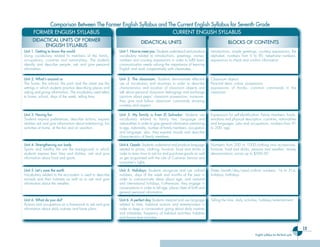
Comparison Between The Former English Syllabus and The Current English Syllabus for Seventh Grade
      FORMER ENGLISH SYLLABUS                                                                       CURRENT ENGLISH SYLLABUS
     DIDACTICAL UNITS OF FORMER                                              DIDACTICAL UNITS                                            BLOCKS OF CONTENTS
          ENGLISH SYLLABUS
Unit 1. Getting to know the world                             Unit 1. Nice to meet you: Students understand and produce       Introductions, simple greetings, courtesy expressions, the
Using vocabulary related to members of the family,            vocabulary related to introductions, greetings, names,          alphabet, numbers from 0 to 90, telephone numbers,
occupations, countries and nationalities. The students        numbers and courtesy expressions in order to fulfill basic       expressions to check and confirm information
identify and describe people, ask and give personal           communication needs valuing the importance of learning
information.                                                  English and work cooperatively with classmates.

Unit 2. What’s around us                                      Unit 2. The classroom: Students demonstrate effective           Classroom objects
The home, the school, the park and the street are the         use of vocabulary and structures in order to describe           Personal items, colors, possessions
settings in which students practice describing places and     characteristics and location of classroom objects and           expressions of thanks, common commands in the
asking and giving informa-tion. The vocabulary used refers    talk about personal classroom belongings and exchange           classroom
to home, school, days of the week, telling time.              opinions about peers’ classroom possessions; moreover,
                                                              they give and follow classroom commands showing
                                                              courtesy and respect.

Unit 3. Having fun                                            Unit 3. My family is from El Salvador: Students use             Expressions for self-identification, family members, foods,
Students express preferences, describe actions, express       vocabulary related to family ties, language and                 emotions and physical description, countries, nationalities
abilities ask and give informa-tion about entertaining, fun   nationalities in order to give general information pertaining   and languages, jobs and occupations, numbers from 91
activities at home, at the fair and on vacation.              to age, nationality, number of family members, occupation       to 200, age
                                                              and language; also, they express moods and describe
                                                              characteristics of family members.

Unit 4. Strengthening our body                                Unit 4. Goods: Students understand and produce language         Numbers from 200 to 1000,clothing and accessories,
Sports and healthy life are the background in which           related to prices, clothing, furniture, food and drinks in      furniture, food and drinks, seasons and weather, money
students express their likes and dislikes, ask and give       order to learn how to ask for and purchase goods as well        denominations, prices up to $500.00
information about food and sports.                            as get acquainted with the role of Customer Service and
                                                              consumer’s rights.

Unit 5. Let’s save the earth                                  Unit 5. Holidays: Students recognize and use ordinal            Dates (month/day/year),ordinal numbers: 1st to 31st,
Vocabulary related to the eco-system is used to describe      numbers, days of the week and months of the year in             holidays, birthdays
animals and their habitats as well as to ask and give         order to communicate ideas about age, and national
information about the weather.                                and international holidays. Furthermore, they engage in
                                                              conversations in order to tell age, place/date of birth and
                                                              general personal information.

Unit 6. What do you do?                                       Unit 6. A perfect day Students interpret and use language       Telling the time, daily activities, hobbies/entertainment
Actions and occupations as a framework to ask and give        related to time, habitual actions and entertainment in
information about daily routines and future plans.            order to keep a conversation going about daily routines
                                                              and schedules, frequency of habitual activities, hobbies
                                                              and leisure time activities.


                                                                                                                                                                                                    13
                                                                                                                                                             English syllabus for the third cycle
Comparison Between The Former English Syllabus and The Current English Syllabus for Eighth Grade
            FORMER ENGLISH SYLLABUS                                                                      CURRENT ENGLISH SYLLABUS
           DIDACTICAL UNITS OF FORMER                                              DIDACTICAL UNITS                                           BLOCKS OF CONTENTS
                ENGLISH SYLLABUS
     Unit 1. Every day life                                         Unit 1. Getting to know my classmates: Students understand     Formal and informal introductions, greetings and leave-
     The students describe their daily routine, and favorite        and produce language related to introductions, greetings       takings, nicknames, vocabulary and expressions to
     activities, give reasons for their likes and dislikes, and     and leave-takings, personal information, likes and dislikes    exchange personal information, likes and dislikes
     plan future acti-vities.                                       in order to respectfully exchange personal information with
                                                                    peers and others and simultaneously develop a positive
                                                                    attitude toward English.

     Unit 2. Tales from other lands                                 Unit 2. My school: Students identify vocabulary related        Identification of facilities, personnel, objects and
     Salvadorian short stories and traditions are the settings in   to school facilities, personnel, courses, equipment, and       equipment at school, comparison of objects, courses and
     which students practice narrating and writing short stories,   activities in order to recognize characteristics and make      facilities, description of school activities
     talking about the past and expressing their preferences.       comparisons. They produce language using comparatives
                                                                    and superlatives to denote degree in the school environment
                                                                    and develop an attitude of respect and commitment toward
                                                                    the school.

     Unit 3. The wonders of nature                                  Unit 3. My home: Students recognize and produce                House and furniture, physical appearance of relatives,
     Students talk and write about changes in their personality     language related to house, furniture, physical appearance      personality of relatives, meaning of home
     and their body, ask and give infor-mation about food,          and personality types in order to describe their own houses
     describe a place, and ex-press the need to preserve            and family members; besides, they are encouraged
     nature.                                                        sensitive behavior by using respectful language to improve
                                                                    relationships among family members.

     Unit 4. The world of sports                                    Unit 4. Let’s go shopping : Students recognize and produce     Clothing and personal care items, home appliances,
     The sense of cooperating in sports is the background           language related to clothes, personal care items, home         review of colors, prices up to $1000.00, groceries and
     in which students talk about sports and other activities,      appliances, groceries, and prices in order to exchange         produce
     describe and com-pare different occupations, and accept        daily use information as well as value the importance of
     or reject an invitation.                                       learning a foreign language as a tool to communicate ideas
                                                                    in the economic and social context.

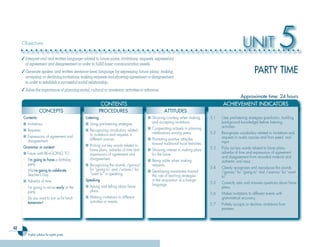
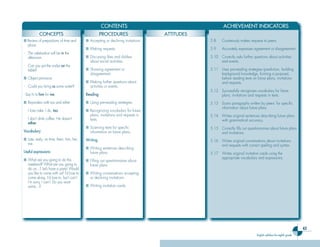
     Unit 5. Let’s enjoy music                                      Unit 5. Party time: Students interpret and generate language   Invitations, requests. expressions of agreement and
     Vocabulary related to music, native musical instruments        related to future plans, invitations, requests, expressions    disagreement
     and traditional festivities and food, are used to express      of agreement and disagreement in order to fulfill basic
     abilities, preferences, des-cribe people and places and        communication needs and value the importance of planning
     narrate past events                                            social, cultural or academic activities in advance.

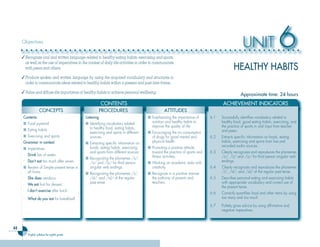
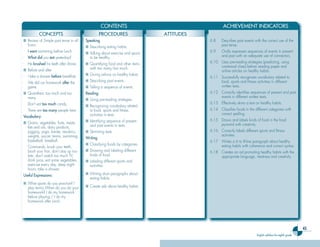
     Unit 6. Not quantity but quality                               Unit 6. Healthy habits: Students recognize language related    Food pyramid, eating habits, exercising and sports
     Eating out and types of food as a framework to express         to healthy eating habits, exercising and sports, as well as
     preferences, compare prices and quality, accept or refuse      the use of imperatives to give suggestions; in addition,
     an invitation and make suggestions.                            they value and diffuse the importance of healthy habits to
                                                                    achieve personal well-being.


14
       English syllabus for the third cycle
Comparison Between The Former English Syllabus and The Current English Syllabus for Ninth Grade
      FORMER ENGLISH SYLLABUS                                                                       CURRENT ENGLISH SYLLABUS
     DIDACTICAL UNITS OF FORMER                                              DIDACTICAL UNITS                                            BLOCKS OF CONTENTS
          ENGLISH SYLLABUS
Unit 1. Our roots                                            Unit 1. Making friends in the neighborhood : Students            Professional and academic background of relatives and
The students read and write about the past, describe         identify and produce language related to professional            neighbors, plans for the weekend, expressions to make
continuous actions in the past, talk about traditions, and   and academic background, plans for the weekend and               formal and informal invitations expressions to accept/
describe some social changes in El Salvador.                 invitations in a past-present-future time framework. They        refuse formal and informal invitations
                                                             also improve the skills to make friends, which is of practical
                                                             use in the classroom, the school and the neighborhood.

Unit 2. Heroes are coming back                               Unit 2. The neighborhood: Students identify and demonstrate      Locations in the neighborhood, directions in the
Some geographical locations, traffic signs,                   effective language use to ask for and give directions to get     neighborhood, locations in a building
personal characteristics and behavior make up the            to places in the neighborhood or offices in a building, and
framework in which students ask and give directions to       simultaneously develop a sense of awareness to be helpful
a place, follow instructions on social behavior, describe    to other people who need directions.
people, and express desires and plans.


Unit 3. Life in the future                                   Unit 3. My hometown: Students comprehend and generate            Tourist attractions, festivities, local/regional food,
Students describe what may happen in the future,             discourse to convey information on tourist attractions,          hometown history
express obligations and plans for the future and make        festivities, local/regional food, and hometown’s history
predictions.                                                 and consequently promote cultural identity.


Unit 4. The living planet                                    Unit 4. It’s on sale!: Students understand and articulate        Food, shopping , numbers 1000 to 1,000,000, prices
The eco-system and weather conditions are the                discourse expressing data on foods, numbers, prices,             up to $1,000,000.00
background in which students talk about mythology,           shopping and implicitly encourage good spending habits.
develop environmental awareness and describe the
weather in different places.

Unit 5. Towns and cities in the world                        Unit 5. Entertainment: Students understand and elaborate         Leisure time activities (music, movies, books, games,
The students describe cities around the world, ask           messages, at sentence and paragraph levels, on leisure           sports)
and give information about holidays and means of             time activities and decisively socialize the practice of sound
transportation, express opinions about cities, and create    leisure time activities as a means to preserve physical and
a strong awareness about environmental problems.             mental health and boost general cultural growth.

 Unit 6. The magic screen                                    Unit 6. You should visit the doctor: Students get meaning and    Parts of the body, health problems, medications, feelings,
Television and the movie as a source of reference to ask     operate successfully in communicating messages concerning        suggestions
and give information about preferences concerning kinds      to parts of the body, health problems, medications, feelings,
of movies, describe present and past events, express         suggestions and acquire good health care-taking habits to
opinions and make suggestions.                               keep body healthy and be more productive in studies and
                                                             work.


                                                                                                                                                                                                   15
                                                                                                                                                            English syllabus for the third cycle
IV. Methodological Guidelines
     These general methodological guidelines are intended to present a                      giving students the opportunity to construct hypothesis that may be
     general vision of the communicative approach and related methods. The                  tested through practice.
     application of its basic tenets will allow students to develop language and        13. The teacher must create the appropriate conditions for learning. To do
     preparation for life competencies; besides, teachers will be enhanced to               so, teachers must guide learners in the acquisition process by using
     deliver a humane, meaningful, motivating and effective teaching.                       activities that are not only structure-oriented.

     1. The communicative approach emphasizes comprehension and                         The following methodological guidelines can be useful for teachers to
         negotiation of meaning more than production of structures. Students            plan and deliver English teaching in the classroom:
         can learn to communicate through interacting, and understand that
         the appropriate morpho-syntactical structures are developed once the           1. Explore background knowledge on the topic to be taught.
         interaction begins.                                                            2. Begin classes with a lead-in or an icebreaker and present language in
     2. English teachers and students must create an atmosphere of mutual                   context.
         respect and objectivity on the part of the listener in order to understand     3. Do controlled and free language practice.
         better.                                                                        4. Integrate macro skills and sub-skills in the teaching-learning process.
     3. This approach also develops cooperation and solidarity among the                5. Time and pace your teaching.
         students, which they will carry on to their professional lives.                6. Create situations for using language for communication in varied
     4. The communicative approach is student-centered. What is taught and                  contexts.
         how it is taught are intimately related with what is learned and how it        7. Encourage students to communicate as early as possible, in the
         is learned. The teaching learning process must be varied.                          teaching-learning process.
     5. This approach demands that the classroom be a center of interaction             8. Mostly use target language in your classes.
         between the teacher and the students, and among the students                   9. Promote interaction and team work among students.
         themselves.                                                                    10. Use authentic materials and input as much as possible.
     6. The classroom must be organized in teams. Of course, this does not              11. Provide opportunities for students to practice an array of language
         mean that work must always be done in teams.                                       functions needed to go through basic survival situations as well as
     7. The communicative approach makes learning take place in a real                      uncommon and complicated ones.
         situational context and it also makes it meaningful in a variety of            12. Care for equally promoting discourse fluency and accuracy.
         situations of everyday life. Upon finishing ninth grade, students will         13. Address students’ cognitive needs as well affective ones.
         have acquired the fundamental communicative skills to face reality             14. Create a comfortable, confident and likeable teaching–learning
         skillfully.                                                                        atmosphere.
     8. Conceptual, procedural and attitudinal contents must not be isolated,           15. Use proper error correction techniques in order to not hurt students’
         since all of them are strictly related to the communicative act. Attitudinal       feelings and hinder class participation.
         contents play an important role in the learning process.                       16. Promote cross-cultural understanding and harmonious exchange with
     9. Communicative strategies must also be accounted for in the learning                 other cultures.
         process. Teachers should make students aware of the way strategies             17. Teach across the curriculum to facilitate the education of exemplifying
         are used to take full advantage of them.                                           human beings and future professionals.
     10. Learning strategies are equally important since they contribute to the         18. Wrap up classes to elicit the intended class learning and move on with
         construction of the English language linguistic system. However, they              the certainty the students have internalized knowledge to be successful
         need to be taught and controlled.                                                  in the forthcoming classes.
     11. Errors made by the students must not be seen as faults, but as evidence        19. Provide feedback in case it is needed; evaluate students’ learning and
         of the dynamic nature of the learning process.                                     your teaching.
     12. English teachers should be aware that English is learned through a
         creative construction process, being exposed to authentic material,

16
        English syllabus for the third cycle
V. Evaluation Guidelines
Evaluation tenets                                                                                         thought and continuity in a text. The competent language user will also
Teachers must take into account evaluation tenets to plan and administer                                  be skilled in expressing and judging the relationship among the different
tests. They state that evaluation is holistic or integrating, continuous,                                 ideas in a text (Coherence).
motivating, just and fair, systematic and participatory12.
                                                                                                          Strategic competence involves use of verbal and nonverbal communication
Competencies to be evaluated                                                                              strategies to compensate for gaps in the language user’s knowledge of
Teachers will ponder students learning outcomes by evaluating the                                         the code or for breakdown in communication for other reasons. The more
following competencies13.                                                                                 proficient or communicatively competent an individual becomes, the less
                                                                                                          he or she needs to draw on strategic competence. This competency goal
Oral comprehension (listening) is the skill to listen and interpret oral                                  is to produce oral discourse in a conversation to interchange general and
messages effectively in diverse communicative contexts. It has to do                                      specific information on various topics.
with identifying general and specific information orally articulated in a
conversation among interlocutors or understanding texts reproduced by                                     Reading comprehension (reading) is an interactive process where the
electronic means (cassettes, recorded CDs, radio or videos).                                              reader uses information from a text and relates it with his/her experience
                                                                                                          to make meaning out of it. The goal of this competency is to understand
Oral production (speaking) is the capacity of communicating orally                                        general and specific information from written texts on various topics to
making use of grammatical, sociolinguistic discourse and strategic                                        enrich the English learning level for interacting in diverse communicative
competencies14:                                                                                           contexts.

Grammatical competence refers to the degree to which the language user                                    Writing production (writing) is a graphic representation of the language
has mastered the linguistic code. It includes knowledge of vocabulary, rules                              that uses conventional, systematic and identifiable signs. The goal of this
of pronunciation and spelling, word formation, and sentence structure.                                    competency is to write general and specific texts on socio-cultural and
                                                                                                          scientific topics to express ideas, emotions and thoughts with diverse
Sociolinguistic competence addresses the extent to which grammatical                                      communicative purposes.
forms can be used or understood appropriately in various contexts to
convey specific communicative functions, such as persuading, describing,                                  Preparation for life competencies
narrating, and giving commands. Factors like topic, role of the participants,                             These allude to the attitudinal contents through which attitudes,
and the setting will determine the appropriateness of the speaker’s attitude                              norms and values are socialized in school forging the character and
and his choice of style or register.                                                                      personality of humane and educated persons and citizens. Therefore, this
                                                                                                          dimension of the teaching learning process is subjected to be evaluated
Discourse competence involves the ability to combine ideas to achieve                                     through students’ proper behavior when being confronted with real life
cohesion in form and coherence in thought. A person with a highly                                         situations.
developed degree of discourse competence will know how to use cohesive
devices, such as pronouns and grammatical connectors (i.e. conjunctions,
adverbs, and transitional phrases and expressions), to achieve unity of

12 Evaluación al Servicio del Aprendizaje, Ministerio de Educación, 2007.
13 Currículo al Servicio del Aprendizaje. Ministerio de Educación, 2007.                                                                                                                            17
14
   Teaching Language in Context. Proficiency-Oriented Instruction, Alice C Omaggio, 1986, pages 7-8.
                                                                                                                                                             English syllabus for the third cycle
Types of evaluation                                                              Criteria to evaluate oral production: fluency, pronunciation, vocabulary,
     To evaluate students’ language learning teachers must rely on norm-              grammatical competence, strategic competence, sociolinguistic
     referenced testing but mostly on criterion-reference testing15. Criterion-       competence and discourse competence.
     referenced-testing classifies students according to whether or not they are
     able to perform some tasks or set of tasks satisfactorily. The tasks are set,    Criteria to evaluate writing production: grammar, vocabulary, mechanics,
     and the performances.                                                            fluency and form20.

     A list of kinds of tests is provided for teachers to choose from the ones that
     adjust to the intended evaluation purposes:

     Diagnostic tests16 are used to identify student’s strengths and weaknesses.
     They are intended primarily to ascertain what further teaching is necessary.
     Consequently, they can be used at the beginning of each grade or cycle of
     education to diagnose student’s proficiency level.

     Progress achievement tests17 as their name suggests, are intended to
     measure the progress that students are making. Therefore, this kind of
     tests can be used halfway a grade or cycle of education to gather reliable
     evidence of learning progress.

     Final achievement tests18 are those administered at the end of a course
     of study. They can be used to evaluate final learning achievement at the
     end of each grade or cycle of education.

     Proficiency tests 19 are designed to measure people’s ability in a language
     regardless of any training they may have had before. The content of a
     proficiency test, therefore, is not based on the content or objectives
     of language courses that may have followed. Rather, it is based on a
     specification of what candidates have to be able to do in the language in
     order to be considered proficient. Being proficient means having sufficient
     command of the language for a particular purpose.

     Evaluation criteria. The following are suggested criteria to evaluate oral
     and written production.


                                                                                                                    15
                                                                                                                         Testing for Language Teachers. Arthur Hughes, 1989, pages 17-18.
18                                                                                                                         16
                                                                                                                              Testing for Language Teachers. Arthur Hughes, 1989, page 13.
                                                                                                                                                                             17
                                                                                                                                                                                Ibid, page 10.
        English syllabus for the third cycle                                                                                                                                  18
                                                                                                                                                                                 Ibid, page 10
                                                                                                                                                                                19
                                                                                                                                                                                   Ibid, page 9
                                                                                                                                                                       10
                                                                                                                                                                          Ibid, pages 91-93.
Seventh Grade


ENGLISH
Seventh grade general objectives.
By the end of seventh grade, students will be able to:

   Understand vocabulary related to introductions, greetings, names, numbers and courtesy
   expressions by interacting with peers in order to fulfill basic communication needs.

   Use vocabulary and structures by practicing dialogues in order to describe and locate
   classroom objects, talk about personal belongings, give and follow classroom
   commands showing courtesy and respect.

   Use vocabulary related to family ties, age, language, nationalities and physical traits
   by writing sentences and short paragraphs and engaging in dialogues in order to
   exchange personal information and describe family members.

   Understand and produce language related to shopping by reading and interacting
   with peers in order to purchase goods and get acquainted with the role of Customer
   Service.

   Interpret and use language related to time, habitual actions and entertainment by
   asking and responding to questions in order to talk about daily routines and leisure
   time activities.
Objectives

     ✓ Understand vocabulary related to introductions, greetings, names, numbers and courtesy
       expressions by listening to classmates, teacher and taped audio material in order to fulfill
                                                                                                                                                UNIT                     1
       intended basic communication needs in the target language.
     ✓ Produce spoken and written texts related to introductions, greetings, names, numbers, and
       courtesy expressions in order to fulfill intended basic communication needs in the target
                                                                                                                                  NICE TO MEET YOU
       language.
     ✓ Value the importance of learning English by participating in class and working cooperatively
       with classmates to initiate the learning process effectively.                                                                          Approximate time: 12 hours
                                                         CONTENTS                                                                 ACHIEVEMENT INDICATORS
                  CONCEPTS                               PROCEDURES                            ATTITUDES
     Contents:                               Listening                              ■ Showing acceptance and                1.1   Differentiates the sounds of consonant and vowel
     ■ Introductions                         ■ Identifying vowel and consonant        tolerance of errors in spelling and         sounds at the discourse level.
                                               sounds when spelling.                  identifying numbers.                  1.2   Clearly spells his/her name both orally and in
     ■ Simple greetings
                                             ■ Recognizing numbers from 0 to        ■ Showing interest to find out peers’          writing.
     ■ Courtesy expressions                                                           names and phone numbers.
                                               90.                                                                          1.3   Differentiates accurately the –teen and –ty endings
     ■ The alphabet                                                                 ■ Interacting politely and with               in numbers from 13 to 19 and from 30 to 90.
                                             ■ Identifying expressions used to
     ■ Numbers from 0 to 90                    ask someone’s name or name             respect when introducing oneself      1.4   Correctly names and pronounces numbers from 0
                                               spelling.                              and others.                                 to 90.
     ■ Telephone numbers
                                             ■ Differentiating the –teen from –ty   ■ Showing respect while                 1.5   Correctly expresses numbers when counting to 50,
     ■ Expressions to check and confirm                                                conversing.
       information                             endings in numbers from 13 to                                                      giving addresses, and telephone numbers.
                                               19 and from 30 to 90.                ■ Recognizing the importance            1.6   Respectfully exchanges greetings and courtesy
     Grammar in context:                                                              of stress and intonation in the
     ■ Verb to be: affirmative statements     ■ Discriminating greetings from                                                      expressions in a dialogue.
                                               courtesy expressions.                  exchange of information or ideas.
     - I am Pablo Cortés.
     - She is my classmate.                  Speaking
                                             ■ Introducing oneself.
                                             ■ Asking for and giving personal
                                               information.
                                             ■ Clarifying information given when
                                               spelling names and last names,
                                               and giving information.


20
        English syllabus for seventh grade
CONTENTS                                           ACHIEVEMENT INDICATORS
          CONCEPTS                              PROCEDURES                     ATTITUDES
■ Possessive adjectives: my your,     ■ Spelling names and last names.                     1.7    Asks questions to confirm spelling and numbers.
  his, her.                           ■ Exchanging telephone numbers.                      1.8    Shows politeness and respect when addressing
- What’s your telephone number?       ■ Greeting people.                                          others.
- My telephone number is              ■ Saying courtesy expressions.                       1.9    Scans a text for information related with numbers
  22483371.                                                                                       and names.
                                      ■ Striking up simple conversations
■ Subject pronouns: I, you, he, she     by greeting, giving personal                       1.10 Identifies greetings and courtesy expressions in a
- I am a student.                       information, and using courtesy                         simple text.
- He is my friend                       expressions.                                       1.11 Writes the numbers from 0 to 90 accurately.
Vocabulary:                           Reading                                              1.12 Writes dialogues using greetings and courtesy
                                      ■ Recognizing letters of the alphabet.                    expressions correctly.
■ First/middle/last names
Useful expressions:                   ■ Recognizing telephone numbers.
■ How do you spell…? How do you       ■ Identifying greetings and courtesy
  say…? Could you spell Could you       expressions.
  spell your…? How are you? How       Writing
  are you doing? Good, fine, O.K.,     ■ Copying telephone numbers.
  not bad. Courtesy expressions:
  please, thank you, sorry, pardon    ■ Spelling and writing names and last
  me.Hi, hello, good morning, good      names
  afternoon, bye, good-bye, see you   ■ Writing dialogues using greetings,
  later.                                giving personal information and
                                        courtesy expressions.


                                                                                                                                                              21
                                                                                                                         English syllabus for seventh grade
Objectives

     ✓ Demonstrate effective use of intended vocabulary and structures in order to describe
                                                                                                                                              UNIT                    2
                                                                                                                                     THE CLASSROOM
       characteristics and location of classroom objects both orally and in writing.
     ✓ Talk about personal classroom belongings using demonstrative adjectives in order to exchange
       opinions about peers’ classroom possessions.
     ✓ Give and follow classroom commands showing courtesy and respect in order to communicate
       within the classroom setting.

                                                                                                                                            Approximate time: 12 hours
                                                          CONTENTS                                                              ACHIEVEMENT INDICATORS
                   CONCEPTS                               PROCEDURES                             ATTITUDES
      Contents:                               Listening                                ■ Following the class behavior     2.1   Accurately identifies personal classroom objects
      ■ Classroom objects                     ■ Identifying vocabulary related to        code.                                  and belongings.

      ■ Personal items                          classroom objects.                     ■ Thanking someone to show         2.2   Clearly recognizes expressions of thanks in audio
                                              ■ Recognizing expressions of               gratitude.                             sources.
      ■ Colors
                                                thanks.                                ■ Showing respect for others’      2.3   Responds physically to classroom commands.
      ■ Possessions                                                                      belongings.
                                              ■ Responding to classroom                                                   2.4   Accurately discriminates the phonetic difference
      ■ Expressions of thanks                   commands.                              ■ Cooperating with peers in the          between this /ðıs/ and these /ðiz/
      ■ Common commands in the                ■ Identifying and associating              classroom.                       2.5   Names classroom objects with correct
        classroom                               prepositions of place with spatial     ■ Showing politeness when giving         pronunciation.
      Grammar in context:                       location.                                commands.                        2.6   Describes classmates’ classroom belongings.
      ■ To be: wh-questions, yes-no           ■ Discriminating the phonetic
        questions, negative statements,
                                                difference between this /ðıs/
        and short answers
                                                and these /ðiz/


22
         English syllabus for seventh grade
CONTENTS                                          ACHIEVEMENT INDICATORS
          CONCEPTS                             PROCEDURES                     ATTITUDES
- Where is the eraser?                ■ Identifying the plural form of                    2.7    Locates classroom objects using the prepositions
- Whose book is this?                   classroom objects.                                       in/on/at/under.
- Is your shirt expensive?            Speaking                                            2.8    Thanks peers with appropriate expressions.
- Yes, it is. No, it’s not.           ■ Naming classroom objects.                         2.9    Uses possessive adjectives accurately to talk
- My book isn’t here.                 ■ Describing classroom objects                             about classroom belongings.
■ Indefinite articles: a/an              (color and location).                             2.10    Expresses commands appropriate to intended
- I have a red dress.                 ■ Saying thank you.                                        purpose and situation.
- This is an orange notebook.         ■ Strengthening the use of                          2.11   Pronounces this /ðıs/ and these /ðiz/ correctly.
■ Prepositions of place: in/on/at/      possessive adjectives to express                  2.12   Successfully scans a text for classroom vocabulary.
  under                                 possessions.                                      2.13   Reads and identifies expressions of courtesy and
- Put your books on the desk.         ■ Using commands to give                                   thanks.
- Is your pen under the table?          instructions.                                     2.14   Spells the names of classroom objects accurately.
■ Demonstratives: this/these/that/    ■ Pronouncing the right phoneme of                  2.15   Writes the correct form of the plural of nouns.
  those                                 this and these.                                   2.16   Writes 3 to 4-sentence descriptions of color and
- What is this?                       ■ Pronouncing the right phonemes                           location of classroom objects.
- What are these?                       for plural endings.
- Those are markers.                  Reading
■ Plurals                             ■ Scanning for classroom
- I have three books.                   vocabulary.
- Those are big boxes.                ■ Identifying expressions of courtesy
Vocabulary:                             and thanks in different sources.
■ Board, eraser, book, notebook,      Writing
  pencil, pen, teacher, student,      ■ Spelling vocabulary related
  desk, chair, table, liquid paper,     to classroom objects and
  pencil sharpener, backpack,           commands.
  pencil case, box, etc.              ■ Writing the plural of nouns.
Useful expressions:                   ■ Writing descriptions of classroom
■ Go to the board. Close/open           objects.
  your books/the door, the
  windows. Work in groups/pairs.
  Make a circle. Sit down, stand
  up, erase the board, turn on/off
  the computer/lights. Thank you.
  Thanks. Thanks a lot. Thank you
  very much. You’re welcome.


                                                                                                                                                             23
                                                                                                                        English syllabus for seventh grade
Objectives                                                                                                                                  UNIT                    3
     ✓ Use vocabulary related to family ties, language and nationalities in both oral and written
       discourse in order to give general information pertaining to age, nationality, number of family
                                                                                                                                   MY FAMILY IS FROM
       members, job, occupation and language.
     ✓ Express moods and qualities of people both orally and in writing to describe characteristics of
                                                                                                                                        EL SALVADOR
       family members.
                                                                                                                                               Approximate time: 27 hours
                                                          CONTENTS                                                                 ACHIEVEMENT INDICATORS
                   CONCEPTS                               PROCEDURES                           ATTITUDES
      Contents:                               Listening                              ■ Showing interest in the               3.1   Correctly identifies family ties, people’s
                                                                                       information exchanged by peers.             nationalities, language and age from audio
      ■ Expressions for self-identification    ■ Listening and listing family ties.                                                 sources.
      ■ Family members                                                               ■ Showing respect toward peers’
                                              ■ Listening and identifying people’s     descriptions.                         3.2   Matches words from audio input with pictures of
      ■ Moods, emotions and physical            nationality, language and age.                                                     occupations appropriately.
        description                                                                  ■ Demonstrating empathy before
                                              ■ Listening and matching words           others’ concerns.                     3.3   Accurately circles descriptive adjectives for mood
      ■ Countries, nationalities and            with pictures of occupations.
        languages                                                                                                                  and physical description of family members in a
                                                                                     ■ Showing interest in identifying             given text.
      ■ Jobs and occupations                  ■ Recognizing adjectives for mood        and pronouncing the phonemes
                                                and physical description.              of the genitive case.                 3.4   Clearly discriminates and reproduces the
      ■ Numbers from 91 to 200
                                                                                                                                   phonemes / s/, /z/, and /ez/ of the genitive
                                                                                                                                                                e
      ■ Age                                   ■ Listening and discriminating the     ■ Being tolerant to others’ reactions         case.
                                                phonemes / s/, /z/, and /ez/    e
                                                                                       to someone’s physical description.
      Grammar in context:                       of the genitive case.                                                        3.5   Identifies himself/herself with appropriate
      ■ To be: yes-no questions,                                                     ■ Preventing the use of pejorative            vocabulary.
        affirmative/negative statements,                                                language to describe family
        wh-questions (what/where/how)                                                  members.                              3.6   Uses the correct word to identify family members.
      - Are you from San Salvador?
      - She’s from Spain.
      - My parents are not Salvadoran.
      - Where are you from?


24
         English syllabus for seventh grade
CONTENTS                                           ACHIEVEMENT INDICATORS
           CONCEPTS                                PROCEDURES                      ATTITUDES
■ Introduction to the past of be:        Speaking                                              3.7    Tells family member’s nationality, language and
  affirmative statements                  ■ Identifying oneself.                                       age without errors.
- I was born in Peru.                    ■ Telling the number of family                        3.8    Exchanges information about oneself and others
- My friends were here yesterday.          members in his/her family.                                 using accurate vocabulary and pronunciation.
■ Questions with do/does                 ■ Naming different family ties.                       3.9    Describes someone’s mood with respect.
- Do you live in Sonsonate?              ■ Exchanging information about                        3.10 Accurately pronounces the phonemes /s/, /z/,
                                           family members.                                          and /ez/ of the genitive case.
                                                                                                             e
- What does your father do?
                                         ■ Telling someone’s age, language                     3.11 Correctly incorporates the auxiliary do/does in
■ Subject pronouns: all forms                                                                       negative and interrogative statements.
                                           and nationality.
- He is my best friend.                                                                        3.12 Scans basic vocabulary of family ties from a short
                                         ■ Describing physical traits of family
- They are my grandparents.                members.                                                 written paragraph without mistakes.
■ Genitive case: ´s                      ■ Describing people’s mood.                           3.13 Reads a list of most common adjectives
                                                                                                    describing people’s mood with correct
- My aunt’s nationality is               ■ Pronouncing the phonemes /s/,                            pronunciation.
  Honduran.                                /z/, and /ez/ of the genitive
                                                        e
                                           case.                                               3.14 Reads his/her classmate’s descriptions of physical
- What’s your friend’s age?                                                                         appearance at a sentence level.
Vocabulary:                              ■ Incorporating the auxiliary do/
                                           does in negative and interrogative                  3.15 Draws a family tree and writes a textual
■ Mother, father, sister, brother,                                                                  transcription of the ties without mistakes.
  cousins, aunt, uncle, grandfather,       statements.
  grandmother, teacher, student,         Reading                                               3.16 Writes a list of the 7 most important family
  secretary, accountant, doctor,                                                                    members.
  nurse, lawyer, police officer,          ■ Scanning vocabulary of family ties.
                                                                                               3.17 Writes a short paragraph about physical
  carpenter, plumber, fire fighter,        ■ Reading list of adjectives describing                    description of family members with no or few
  security guard, homemaker,               people’s mood.                                           grammatical mistakes.
  Salvadoran, Canadian,                  ■ Reading and recognizing
  Mexican, Guatemalan,                                                                         3.18 Avoids using pejorative language to describe
                                           descriptions of physical                                 someone’s physical appearance in oral and
  Honduran, Nicaraguan, Costa              appearance.
  Rican, North American , happy,                                                                    written texts.
  sad, angry, quiet, shy, outgoing,      Writing
  polite, impolite, tall, short, thin,
  chubby, good looking, ugly.            ■ Drawing a family tree.
Useful Expressions:
                                         ■ Listing family members.
■ What’s your nationality? How old
  are you? I’m ….years old. What         ■ Writing about physical traits.
  are you like? What’s he/she
  like? Tell me about…How many           ■ Writing an e-mail describing
  people are there in your family?         oneself and others.


                                                                                                                                                                  25
                                                                                                                             English syllabus for seventh grade
Objectives


     ✓ Understand both oral and written language related to prices, clothing, furniture, food and
                                                                                                                                                UNIT                     4
       drinks in order to learn how to ask for and purchase goods in the target language.
     ✓ Produce oral and written language related to prices, clothing, furniture, food and drinks in
       order to establish communication when purchasing goods.
                                                                                                                                                                 GOODS
     ✓ Get acquainted with the role of Customer Service through authentic material in order to
       become aware of consumer’s rights.
                                                                                                                                               Approximate time: 28 hours
                                                          CONTENTS                                                                ACHIEVEMENT INDICATORS
                   CONCEPTS                               PROCEDURES                             ATTITUDES
      Contents:                               Listening                                ■ Participating in oral exchanges    4.1   Clearly discriminates numbers from 200 to 1000
                                                                                         actively.                                from diverse recorded material.
      ■ Numbers from 200 to 1000              ■ Discriminating numbers from 200
                                                to 1000 in different sources.          ■ Showing appreciation for his/her   4.2   Accurately writes down the prices of different
      ■ Clothing and accessories                                                         classmates’ remarks.                     clothing items and accessories from oral sources.
                                              ■ Identifying prices.
      ■ Furniture                                                                      ■ Complimenting his/her              4.3   Identifies different clothing items and accessories
                                              ■ Listening and listing clothing items     classmates’ preferences for              by correctly pointing at them.
      ■ Food and drinks                         and accessories.                         clothing and accessories.
                                                                                                                            4.4   Discriminates colors of the most commonly used
      ■ Seasons and weather                   ■ Discriminating among colors.           ■ Becoming aware of consumers’             clothing items, accessories, furniture, food and
                                                                                         rights and the role of Customer          drinks.
      ■ Money denominations                   ■ Recognizing names of furniture in        Service.
                                                oral discourse.                                                             4.5   Identifies and circles food mentioned in a
      ■ Prices up to $500.00
                                                                                       ■ Developing awareness of the              recording..
                                              ■ Associating oral input about food        value of money.
      Grammar in context:                       and drinks to pictures.                                                     4.6   Actively gets involved in conversations about
      ■ Questions with How much…?                                                                                                 clothes, accessories, furniture, food and drinks.

      - How much is that shirt?

      - How much are these oranges?


26
         English syllabus for seventh grade
CONTENTS                                           ACHIEVEMENT INDICATORS
            CONCEPTS                                PROCEDURES                      ATTITUDES
■ Subject pronouns (it/they)              Speaking                                              4.7    Politely compliments his/her classmates for their
- It’s twelve dollars.                    ■ Talking about clothing and                                 taste in clothes.
- They are expensive.                       accessories.                                        4.8    Appropriately lists the most commonly used
■ Demonstratives: this/these/that/        ■ Describing the relationship                                clothing items and accessories depending on the
  those                                     between clothes worn and                                   weather.
                                            weather.
- This is a blue dress.                                                                         4.9    Names pieces of furniture with correct
                                          ■ Identifying the color of objects.                          pronunciation.
- Those are my favorite shoes.
                                          ■ Naming pieces of furniture.
■ Plurals                                                                                       4.10 Actively exchanges information about his/her
                                          ■ Exchanging information about                             favorite food/drink/fruit/ vegetable.
- I like those blouses.                     favorite food/drink/fruit/
- How much are these watches?               vegetable.                                          4.11 Talks with peers about food usually bought at
Vocabulary:                               ■ Saying the color of food items.                          the supermarket while showing interest to their
                                                                                                     remarks.
■ Pants, blouse, jeans, socks,            ■ Talking about grocery shopping.
  shoes, shirt, T-shirt, shorts, skirt,   ■ Asking for and telling prices.                      4.12 Tells prices from pictures of clothes and
  belt, watch, glasses, table, chair,                                                                accessories with their corresponding price tags.
  bed, sofa, desk, lamp, bread,           Reading
  beans, cheese, milk, coffee,            ■ Scanning words related to                           4.13 Scans words related to clothing from a short text.
  soda, juice, water, cereal, fruits,       clothing.
  chicken, meat, salad.                                                                         4.14 Reads and identifies color and price of items in
                                          ■ Reading ads for furniture.                               furniture ads.
  Red, green, yellow, orange,             ■ Reading a shopping list.
   purple, pink, gray, black, white,                                                            4.15    Reads his/her classmates’ shopping list.
   brown, blue, dime, penny, nickel,      ■ Reading about food in different
   quarter, summer, spring, fall,           sources.                                            4.16 Writes the price of goods mentioned by
   winter, sunny, hot, cloudy, etc.       Writing                                                    classmates.
Useful Expressions:                       ■ Writing the price of goods.                         4.17 Lists clothing items and furniture with accurate
■ May I help you? How can I               ■ Listing clothing items and furniture.                    spelling.
  help you? That’s expensive/
  cheap!Can I see that/those…?            ■ Writing a shopping list.                            4.18 Writes a shopping list with correct usage of
  Anything else? Is that all? Do          ■ Writing descriptions of goods.                           singular and plural forms.
  you have change for a twenty?                                                                 4.19 Writes descriptions of some goods displayed in
  Here’s your change. That’ll be all,                                                                given pictures.
  thanks.


                                                                                                                                                                   27
                                                                                                                              English syllabus for seventh grade
Objectives
                                                                                                                                                   UNIT                     5
                                                                                                                                                              HOLIDAYS
     ✓ Recognize and use ordinal numbers, days of the week and months of the year in order to
       communicate ideas about age, holidays and the most frequent activities carried out during
       holidays.
     ✓ Engage in lively conversations in order to tell age, place/date of birth and general personal
       information as well as to describe national and international holidays and the most frequent
       activities carried out during these holidays.

                                                                                                                                                 Approximate time: 14 hours
                                                               CONTENTS                                                             ACHIEVEMENT INDICATORS
                   CONCEPTS                                    PROCEDURES                           ATTITUDES
      Contents:                                    Listening                              ■ Showing respect before peers’     5.1   Identifies the correct day of the week from a list of
      ■ Dates (month/day/year)                     ■ Listening and circling days of the     accounts on ways they celebrate         dates in a conversation and diverse oral input about
                                                     week in different sources.             holidays.                               people’s age.
      ■ Ordinal numbers: 1 to 31    st        st

                                                   ■ Identifying months in different      ■ Being interested in classmates’   5.2   Identifies and writes the months mentioned in diverse
      ■ Holidays                                                                            participation.                          listening input.
                                                      sources.
      ■ Birthdays                                                                         ■ Being polite when asking and      5.3   Identifies and associates action verbs from audio
                                                   ■ Associating dates to holidays.
      Grammar in context:                                                                   answering questions.                    material with the corresponding holiday.
                                                   ■ Identifying action verbs
      ■ Prepositions of time: in, on                 associated with holidays.            ■ Tolerating classmates’ language   5.4   Successfully picks out specific information from
                                                                                            skills weaknesses.                      conversations of peers, teacher and audio related to
      - Independence Day is in                     ■ Picking out specific information                                                age and holidays.
        September.                                   about age and holidays.              ■ Cooperating with other students
                                                                                            in group activities               5.5   Clearly distinguishes and applies the rising and
      - What do you do on Mother’s                 ■ Distinguishing the intonation of                                               falling intonation of questions.
        Day?                                         yes-no and wh- questions.
                                                                                                                              5.6   Differentiates and correctly reproduces the phonemes
      ■ To be: wh-questions                        ■ Differentiating the phonemes                                                   /s/, /z/, and /ez/ of the third person singular in
                                                                                                                                                     e
      - When is your birthday?                       /s/, /z/, and /ez/ of the third
                                                                        e
                                                                                                                                    affirmative sentences in the present tense.
                                                     person singular.
      - What is the main holiday in San                                                                                       5.7   Accurately pronounces the days of the week and
        Salvador?                                                                                                                   months of the year.


28
         English syllabus for seventh grade
CONTENTS                                      ACHIEVEMENT INDICATORS
          CONCEPTS                              PROCEDURES                 ATTITUDES
■ Do/Does: wh- Questions              Speaking                                         5.8    Tells the dates of birthdays, holidays and important
- What do you do on your              ■ Saying days of the week and                           events with adequate word order and correct use
  birthday?                             months of the year.                                   of the prepositions in and on.
- When do you celebrate Labor         ■ Telling dates.                                 5.9    Gives the right pronunciation to the ending of the
  Day?                                                                                        ordinal numbers.
                                      ■ Pronouncing ordinal numbers.
■ The present tense: action verbs                                                      5.10 Says the ordinal numbers in the correct sequence
                                      ■ Saying ordinal numbers in                           up to 31st.
  in all forms                          sequence.
- We eat lots of food for                                                              5.11 Asks and tells people’s age, date and place of
                                      ■ Asking and telling people’s age,                    birth with correct pronunciation and grammatical
  Christmas.                            date and place of birth.                            accuracy.
- She doesn’t work on New Year’s      ■ Asking and telling names of
  Eve.                                                                                 5.12 Asks and tells names of streets with the correct use
                                        streets with ordinal numbers.                       of ordinal numbers.
Vocabulary:                           ■ Asking and answering wh- and                   5.13 Asks and answers wh- and yes-no questions in the
■ Monday, Tuesday, Wednesday,           yes-no questions in the present                     present tense with grammatical accuracy.
  Thursday, Friday, Saturday,           tense.
  Sunday. January, February,                                                           5.14 Respectfully describes his/her town’s and family’s
                                      ■ Describing common activities for                    common activities for holidays.
  March, April, May, June, July,        holidays.
  August, September, October,                                                          5.15 Successfully matches written descriptions with the
  November, December.                 Reading                                               holiday described.
  Holy Week, Mother’s Day,            ■ Reading and matching                           5.16 Reads and recognizes dates of holidays and
  Independence Day, Teacher’s           descriptions with holidays.                         events in calendars, magazine and newspaper
  Day, Christmas, New Year’s Eve,                                                           articles.
  All Souls’ Day, Day of the Cross,   ■ Reading and recognizing dates.
  Labor Day. Go, like, have,          ■ Reading and paraphrasing                       5.17 Reads and paraphrases classmates’ written
  dance, eat, drink.                    classmates’ written paragraphs.                     paragraphs on holidays and celebrations.
                                      Writing                                          5.18    Correctly writes the spelling of ordinal numbers
Useful Expressions:                                                                           next to its graphic symbol.
                                      ■ Writing the spelling of ordinal
■ What’s your favorite holiday?         numbers.                                       5.19 Writes the days of the week and months of the
  How do you celebrate…?                                                                    year with accurate spelling.
  What’s special about that day?      ■ Writing days of the week and
                                        months of the year.                            5.20 Writes grammatically correct sentences in the
  My birthday is coming. My                                                                 present tense from prompts provided by the
  birthday is on…What does your       ■ Writing sentences from prompts.                     teacher.
  family do on…?
                                      ■ Writing descriptive paragraphs.                5.21 Writes 5 to 6 -line paragraphs describing most
                                                                                            common actions done by family members during
                                                                                            holidays.


                                                                                                                                                          29
                                                                                                                     English syllabus for seventh grade
Objectives


     ✓ Recognize language related to time, habitual actions and entertainment in order to establish
                                                                                                                                                 UNIT                      6
       a conversation about daily routines, schedules, frequency of activities, personal hobbies and
       leisure time activities.
     ✓ Use vocabulary and structures learned, by exchanging oral and written language, in order to
                                                                                                                                               A PERFECT DAY
       talk about daily routines, daily schedules, frequency of habitual activities, personal hobbies
       and leisure time activities.

                                                                                                                                                Approximate time: 27 hours
                                                         CONTENTS                                                                  ACHIEVEMENT INDICATORS
                  CONCEPTS                               PROCEDURES                             ATTITUDES
      Contents:                              Listening                               ■ Appreciating his/her classmates’      6.1   Clearly recognizes different forms to tell the time
      ■ Telling the time                     ■ Recognizing the time in English.        comments and opinions.                      of the day in diverse oral input.
      ■ Daily activities                     ■ Associating time expressions to       ■ Showing enthusiasm while              6.2   Identifies an associates time expressions from
                                               different moments of the day.           narrating accounts.                         audio sources to different moments of the day.
      ■ Hobbies/entertainment
                                             ■ Recognizing the use of                ■ Listening attentively to classmates   6.3   Attentively listens and identifies actions in the past
      Grammar in context:                                                              and teacher.                                from teacher’s and classmates’ stories.
                                               prepositions of time.
      ■ Prepositions of time: in, on, at                                             ■ Asking and answering questions        6.4   Clearly differentiates and reproduces the
                                             ■ Identifying verbs to describe daily
      - I do my homework in the                activities.                             politely.                                   phonemes /t/, /d/, and /ed/ of the regular
                                                                                                                                                                 e
        afternoon.                                                                   ■ Helping shier students feel                 past tense.
                                             ■ Recognizing vocabulary related
      - We eat dinner at six o’clock.          to hobbies and leisure time             confident while speaking.              6.5   Uses appropriate expressions to tell the hours,
                                               activities.                           ■ Being aware that mistakes are               half hours, quarters and minutes.
      - She plays tennis on Saturdays.
                                             ■ Associating adverbs to the              part of the learning process.         6.6   Appropriately asks and answers questions
      ■ Frequency adverbs                                                                                                          dealing with daily routines and habits.
                                               frequency of habitual activities.     ■ Being thorough at incorporating
      - I usually eat lunch at school.                                                 new language. studied in class to     6.7   Accurately tells the frequency of some habitual
                                             ■ Distinguishing the use of “did” to
      - He never wakes up after eight.         express the past.                       classroom use.                              activities in El Salvador.

      - We hardly ever watch TV at           ■ Differentiating the phonemes /t/,     ■ Using his/her imagination and         6.8   Confidently exchanges information about their
        night.                                 /d/, and /ed/ of the regular
                                                            e                          creativity to perform specific               daily schedule for personal activities at home,
                                               past tense.                             tasks.                                      work and school.


30
        English syllabus for seventh grade
CONTENTS                                            ACHIEVEMENT INDICATORS
          CONCEPTS                               PROCEDURES                        ATTITUDES
■ Introduction to simple past:          Speaking                                               6.9    Eagerly asks and answers questions about hobbies
  questions with what and where         ■ Asking and telling the time.                                and recreational activities.
  and affirmative statements             ■ Sharing information about daily                      6.10    Uses his/her imagination vividly to engage in
- What did you do yesterday?               routines and habits.                                       classroom discussions related to the description of
- Where did you go on Saturday?         ■ Telling the frequency of some                               a perfect day.
- I went to the park last weekend.         habitual activities.                                6.11   Narrates an exciting experience in the past, using
■ Expressions of time                   ■ Exchanging information about                                the correct form of the most common regular
- I exercise in the morning.               hobbies and recreational                                   and irregular verbs and the right intonation to
- My parents went to the movies            activities.                                                communicate meaning.
  last night.                           ■ Discussing the elements of a                         6.12   Correctly pronounces the phonemes /t/, /d/,
- Yesterday I had an exam.                 perfect day.                                               and /ed/ of the regular past tense.
                                                                                                            e
Vocabulary:                             ■ Narrating an exciting experience                     6.13   Incorporates the auxiliary “did” in negative and
■ In the morning/ afternoon/               in the past.                                               interrogative statements of the past tense.
  evening, at night/ noon/              ■ Expressing likes and dislikes.                       6.14   Successfully reads vocabulary classified by
  midnight, o’ clock, a quarter after   ■ Pronouncing the phonemes /t/,                               categories, related to daily activities, hobbies
  …, a quarter to …., yesterday,           /d/, and /ed/ of the regular
                                                        e                                             and the entertainment business.
  last night, last weekend, usually,       past tense.                                         6.15   Appropriately matches words with definitions
  often, never, always, hardly ever,    ■ Incorporating “did” to questions                            from authentic written sources.
  rarely, wake up, get up, take,           and negative statements.                            6.16   Guesses vocabulary from context from a reading
  eat, have, brush, get, dress, go,     ■ Using the right intonation to                               on leisure time activities.
  play, study, watch, live.                communicate meaning.                                6.17   Reads and paraphrases classmates’ descriptions
Useful Expressions:                     Reading                                                       showing respect and enthusiasm.
■ What time is it? It’s….What           ■ Reading vocabulary classified by                      6.18   Skims a text about hobbies and leisure time activities.
  time do you wake up? I wake              categories.                                         6.19   Successfully scans specific information from a
  up at…What are your hobbies?          ■ Matching words with definitions.                             given text.
  What do you do every day?             ■ Guessing vocabulary from context.                    6.20   Writes sentences about likes and dislikes using
  How often do you…? How was            ■ Reading classmates’ descriptions.                           verbs in the affirmative and negative form
  your weekend?                         ■ Getting the main idea of a text.                     6.21   Correctly completes timetables in information gap
                                        ■ Scanning texts for specific information                      activities.
                                        Writing                                                6.22   Fills in the blanks of controlled written drills with
                                        ■ Writing sentences about likes and                           the past tense of verbs.
                                           dislikes.                                           6.23   Lists her/his favorite hobbies and recreational
                                        ■ Completing timetables.                                      activities by categories and with correct spelling.
                                        ■ Completing controlled written drills.                6.24   Writes an 8 to 10-line description of daily
                                        ■ Listing hobbies and recreational                            routines incorporating frequency adverbs and
                                           activities.                                                affirmative, negative and interrogative sentences
                                        ■ Writing short descriptions of daily                         in the present tense.
                                           routines.                                           6.25   Writes a 6 to 8-line paragraph describing a
                                        ■ Writing a paragraph describing                              perfect day he/she had, with unity, correct
                                           a perfect day.                                             spelling and the accurate use of the past tense


                                                                                                                                                                   31
                                                                                                                              English syllabus for seventh grade
Eighth Grade


ENGLISH
Eighth grade general objectives.
By the end of eighth grade, students will be able to:

   Identify vocabulary related to school facilities, personnel, courses, equipment, and
   activities by listening to texts and peers in order to recognize characteristics of the
   school environment and develop an attitude of respect and commitment toward it.

   Understand and produce language related to housing, furniture, physical appearance
   and personality, by interacting with peers, in order to exchange personal information
   and opinions with respect and courtesy.

   Recognize and produce language related to goods, by interacting with peers, in order
   to exchange opinions and ideas about their economic and social context.

   Interpret and generate language related to future plans, invitations, requests,
   expressions of agreement and disagreement by writing texts and listening to oral input
   in order to exchange ideas in social, cultural or academic situations.

   Recognize and produce language related to healthy life habits by describing activities
   and giving suggestions in order to exchange opinions about the importance of healthy
   habits.
Objectives

✓ Understand sentence-level written and oral language related to introductions, greetings and
                                                                                                                                             UNIT                          1
  leave-takings , personal information, likes and dislikes by listening to authentic conversations
  and audio material in order to communicate with peers and others.                                                            GETTING TO KNOW
✓ Produce oral and written sentence-level texts related to introductions, greetings and leave-
  takings, personal information, likes and dislikes by using vocabulary, expressions and
                                                                                                                                  MY CLASSMATES
  grammatical structures to fulfill basic communication needs in English.
✓ Develop a positive attitude toward English to exchange personal information with respect and
  establish a cordial relationship with peers.
                                                                                                                                              Approximate time: 9 hours
                                                     CONTENTS                                                                  ACHIEVEMENT INDICATORS
             CONCEPTS                                PROCEDURES                             ATTITUDES
 Contents:                               Listening                               ■ Demonstrating interest in listening   1.1   Recognizes formal and informal introductions,
                                                                                   to personal information.                    greetings and leave takings.
 ■ Formal and informal introductions,    ■ Recognizing formal and informal
   greetings and leave-takings             introductions, greetings and leave    ■ Showing respect for others when       1.2   Clearly identifies deletions and clusters
                                           takings.                                exchanging personal information.            in language when exchanging personal
 ■ Nicknames                                                                                                                   information.
                                         ■ Identifying deletions and clusters    ■ Cooperating with peers in
 ■ Vocabulary and expressions to           in language used to exchange            teamwork.                             1.3   Recognizes the phonemes /s/, /z/, and /ez/           e
   exchange personal information           personal information.                                                               of the third person singular form in audio and
                                                                                 ■ Developing a positive attitude              written sources.
 ■ Likes and dislikes                    ■ Recognizing the phonemes /s/,           toward sharing personal
                                           /z/, and /ez/ of the third
                                                        e                          preferences with peers.               1.4   Expresses formal and informal greetings with
 Grammar in context:                       person singular form of action                                                      correct pronunciation and intonation.
                                           verbs..                               ■ Participating in dialogues with
 ■ Review of verb to be and the                                                    confidence.                            1.5   Introduces himself/herself and others correctly.
   simple present                        Speaking
                                                                                                                         1.6   Addresses his/her teachers and partners
 - Ana is a good student.                ■ Greeting and introducing people                                                     adequately, formally and informally.
                                           formally and informally.
 - Luis plays baseball.

 - Do you like sports?


                                                                                                                                                                                           33
                                                                                                                                                       English syllabus for eighth grade
CONTENTS                                                                    ACHIEVEMENT INDICATORS
                  CONCEPTS                               PROCEDURES                              ATTITUDES
     ■ Review of possessive adjectives         ■ Using titles and nicknames when      ■ Completing academic tasks with       1.7    Asks and answers short questions related to
       (my, your, his, her, our, their)          addressing others.                     creativity.                                 personal information.
     - My last name is López.                  ■ Asking for personal information.     ■ Showing acceptance and               1.8    Correctly asks and answers short questions to find
     - Our teacher is Mr. Ruiz.                ■ Asking for and expressing likes        tolerance of errors as part of the          out personal likes and dislikes.
     ■ Review of subject pronouns (I,            and dislikes about music, sports,      learning process.
                                                 and movies.                                                                 1.9    Expresses likes and dislikes with confidence and
       you, he, she, it, we, you, they)                                                                                             clarity.
     - I like soccer. It is fun.               Reading
                                               ■ Scanning for personal information.                                          1.10 Finds specific information in written texts.
     - They are my friends.
     Vocabulary:                               ■ Identifying key words related to                                            1.11 Identifies main ideas in short written texts.
                                                 personal preferences and physical
     ■ Titles: Mr., Miss, Mrs. Ms.               activities.                                                                 1.12 Fills out information cards using the required
     ■ Leisure time activities: listen to      ■ Identifying main ideas related to                                                personal information with clarity and accuracy.
       music, net surfing, watch TV,              recreational activities.
       go bike riding, play sports, read                                                                                     1.13 Writes a personal ad with the required
       magazines, play video games, go         Writing                                                                            information and creativity.
       out with friends, visit relatives, go   ■ Filling out personal information
                                                                                                                             1.14 Writes original e-mails to greet with appropriate
       shopping, go to the park, go to           cards.
                                                                                                                                  vocabulary and grammar.
       the movies, go dancing, etc.            ■ Writing a personal ad.
     ■ Basketball, soccer, softball,                                                                                         1.15 Labels illustrations related to personal likes and
                                               ■ Writing e-mails to greet.
       volleyball, chess, magazines,                                                                                              dislikes with the correct vocabulary.
       e-mail, chat room, movies: science      ■ Writing original sentences and
       fiction, adventure, drama, thrillers,      dialogues related to personal                                               1.16 Writes original dialogues about personal
       soap operas, television series,           information, likes, and dislikes.                                                information and preferences with correct spelling
       documentaries, etc.                                                                                                        and syntax.
                                               ■ Writing about sports and other
     Useful expressions:                         personal preferences.
     ■ Could you spell your…? Excuse
       me, are you….? This is Maria.
       Maria, this is Pedro. Nice
       meeting you! Sorry, but I have to
       go. Nice talking to you. Talk to
       you later. Take care!
     ■ What do you do in your spare
       time? What does she/he do in
       her/his spare time? Do you like
       pop music? I watch TV. I listen
       to music. I play soccer. I like
       listening to classical music.


34
        English syllabus for eighth grade
Objectives


✓ Identify vocabulary related to school facilities, personnel, courses, equipment, and activities
                                                                                                                                          UNIT                          2
  in order to recognize characteristics and make comparisons.
✓ Produce oral and written language by comparing people, objects, and different issues in a                                                    MY SCHOOL
  school setting.
✓ Develop an attitude of respect and commitment toward the school by becoming aware of
  characteristics and differences in order to create a positive learning environment.

                                                                                                                                         Approximate time: 12 hours
                                                    CONTENTS                                                                ACHIEVEMENT INDICATORS
             CONCEPTS                               PROCEDURES                            ATTITUDES
 Contents:                              Listening                               ■ Showing respect to the school       2.1   Identifies places, objects, and courses at school
 ■ Identification of facilities,         ■ Identifying vocabulary related to       personnel.                                in audio sources.
   personnel, objects and equipment       objects, personnel, courses, and      ■ Developing tolerance toward         2.2   Identifies information about comparisons when
   at school                              places in the school.                   personal and physical                     listening to recorded material.
 ■ Comparison of objects, courses       ■ Picking out key information on the      differences.                        2.3   Correctly reproduces the sound for /ð/ in the
   and facilities                         characteristics of school objects,    ■ Showing interest in constant              and than.
 ■ Description of school activities       personnel, courses and facilities.      practice to polish pronunciation.   2.4   Correctly names and pronounces vocabulary
 Grammar in context:                    ■ Recognizing the phoneme /ð/           ■ Showing respect toward other              related to school facilities, personnel, and
                                          in the definite article “the” and in     people’s possessions.                     courses.
 ■ Review of the verb to be               “than”.                               ■ Completing academic tasks with      2.5   Orally compares things, people, and places with
 - This is the library.                 Speaking                                  creativity.                               respect and grammatical accuracy.
 - They are secretaries.                ■ Identifying and naming the            ■ Cooperating actively in team        2.6   Confidently expresses preferences on school
 ■ Comparative of adjectives:             different areas, personnel,             work.                                     activities.
                                          courses, and activities in the                                              2.7   Identifies vocabulary related to school facilities,
 - This room is nicer than the other
                                          school.                                                                           personnel, courses and activities in texts.
   one.


                                                                                                                                                                                        35
                                                                                                                                                    English syllabus for eighth grade
CONTENTS                                           ACHIEVEMENT INDICATORS
                  CONCEPTS                              PROCEDURES                     ATTITUDES
     - The cafeteria is bigger than the       ■ Comparing the areas, personnel,                    2.8    Identifies differences between school objects,
       main office.                              courses, and activities in the                            places, and courses with precision in written
     - The laboratory is more modern            school.                                                   material.
       than the cafeteria.                    ■ Expressing the superlatives of                     2.9    Scans an article for specific vocabulary related
     ■ Superlative of adjectives:               the different areas, courses, and                         to comparisons of school objects, places, and
                                                activities in the school.                                 activities.
     - Our school is the biggest in the
       country.                               Reading                                              2.10 Labels the different school areas and personnel
                                              ■ Recognizing vocabulary related                          using the correct vocabulary.
     - This is the most important
       assignment.                              to school.                                         2.11 Writes original sentences using comparatives and
                                              ■ Identifying differences between                         superlatives.
     ■ Possessive pronouns: mine, yours,
       his, hers, ours, theirs                  objects and places in different                    2.12 Draws and labels posters with creativity.
                                                sources.
     - This book is hers.
                                              ■ Scanning for specific language
     - They are friends of ours.                related to the different levels of
     ■ Review of indefinite articles: a/an       comparison.
     - We have a printer in our               Writing
       classroom.                             ■ Labeling the school areas.
     - Math is an interesting class.          ■ Illustrating and labeling the school
     ■ Definite article the                      personnel.
     - The microscope in the lab is old.      ■ Writing comparisons.
     Vocabulary:                              ■ Making posters related to courses
                                                or subjects.
     ■ School facilities: classroom,
       laboratory, library, cafeteria,
       principal’s office, office, gym, yard,
       play ground, BKB court, soccer
       field, computer room, teachers’
       room, bathroom.
     ■ School personnel: principal,
       teacher, secretary, janitor,
       psychologist, P.E. teacher.

     ■ Equipment: projector, microscope,
       computer, keyboard, CPU,
       printer, fax machine, photocopier,
       scanner, bookshelves.


36
        English syllabus for eighth grade
CONTENTS                 ACHIEVEMENT INDICATORS
          CONCEPTS                     PROCEDURES   ATTITUDES
■ Courses: Mathematics, Science,
  Social Studies, English, Spanish
  Language and Literature, Physical
  Education, Technology.

■ School activities: Science Fair,
  Achievement Fair, Literature
  contest, competitions, song
  festival, gastronomic festival,
  civics week.

Useful expressions:

■ What do you have in your
  classroom? There is/There are….
  What classes do you have?
  What is the easiest/ hardest
  class? Who’s the principal at your
  school? What’s your teacher’s
  name? Who´s your best friend?


                                                                                                               37
                                                                           English syllabus for eighth grade
Objectives

     ✓ Recognize oral and written language related to house, furniture, physical appearance and
                                                                                                                                              UNIT                    3
       personality types by listening to audio material and reading texts in order to describe their
       own houses and family members.
     ✓ Produce oral and written language by describing house spaces and furniture, physical
                                                                                                                                                        MY HOME
       appearance, and personality of family members, in order to communicate the ideas of home
       and family.
     ✓ Encourage a sensitive behavior by using respectful language in order to improve relationships
       among family members.
                                                                                                                                             Approximate time: 24 hours

                                                       CONTENTS                                                                  ACHIEVEMENT INDICATORS
                   CONCEPTS                           PROCEDURES                                ATTITUDES
      Contents:                              Listening                                ■ Reinforcing the values of          3.1   Identifies places and furniture in the house,
      ■ House and furniture                  ■ Identifying vocabulary related           tolerance, respect, and support          physical features and personality types in
      ■ Physical appearance of relatives         to places, furniture, physical         in the family.                           audio sources.
      ■ Personality of relatives                 appearance, personality and          ■ Showing respect toward             3.2   Answers oral questions related to physical
      ■ Meaning of home                          values in the family.                  the differences in physical              appearance and personality of relatives
      Grammar in context:                    ■ Picking out key words about              appearance and personality
      ■ Adjectives for describing                places and furniture in the house,     among peers.
                                                                                                                                 with accuracy.
        appearance and personality               physical appearance, personality     ■ Cooperating to keep a clean        3.3   Successfully recognizes people from oral
      - My mom is short and slim.                and values in the family.              and healthy environment at               physical and personality descriptions.
      - Your sister is pretty.               ■ Recognizing people through               home.                              3.4   Lists the different spaces and furniture in the
      ■ Be + adjective                           physical and personality             ■ Being conscious about the                house.
                                                 descriptions.                          importance of having good          3.5   Classifies and locates the furniture in the
      - I’m outgoing.                        Speaking                                   relationships at home.                   different rooms.
                                             ■ Listing the different areas and                                             3.6   Describes the physical appearance as well
      - Paul is quiet.                           furniture in the house.                                                         as personality of the family members with
                                                                                                                                 complete and correct sentences.
                                             ■ Asking and telling about people’s      ■ Creating expectation for further   3.7   Asks and answers questions about family
                                               appearance.                              learning improvement.                    members’ appearance and personality.

                                             ■ Asking about people’s personality      ■ Practicing cooperation when        3.8   Confidently gives short speeches about favorite
                                                                                        working in teams.                        chores at home.


38
         English syllabus for eighth grade
CONTENTS                                            ACHIEVEMENT INDICATORS
           CONCEPTS                                 PROCEDURES                      ATTITUDES
■ Simple present wh- questions            ■ Describing people’s personality.                    3.9    Identifies vocabulary for spaces in the house and
- What does your brother look like?       ■ Describe people’s physical                                 furniture in written material.
- Where do you do your homework?            appearance.                                         3.10 Properly identifies main ideas about family topics
■ Review of prepositions of place: in,                                                               in texts.
  at, on                                  ■ Expressing the meaning of home.
- I do my homework in my bedroom.         ■ Talking about favorite chores at                    3.11 Successfully scans a text for specific information
- The family room is on the second          home.                                                    on people’s features and personality.
  floor.                                                                                         3.12 Draws and labels the different spaces at home
Vocabulary:                               Reading
                                                                                                     with creativity.
■ Places in the house:living room,        ■ Recognizing vocabulary related to
  kitchen, dining room, bedroom,            places in the house.                                3.13 Describes the family members with the correct
  bathroom, garden, yard, garage,                                                                    vocabulary and grammatical structures.
                                          ■ Identifying main ideas in texts about
  stairs, first floor, second floor, home                                                          3.14 Writes synonyms and antonyms for vocabulary
                                            home and family.
  safety, protection, comfort, support,                                                              related to home and family with accuracy.
  etc.                                    ■ Scanning for specific language
                                            related to physical appearance and                  3.15 Writes a 75-word description about the use of
■ Furniture: sofa, armchairs, coffee
                                            personality                                              the most important pieces of furniture at home.
  table, lamp, mirror, telephone,
  television set, clock, refrigerator,    Writing
  stove, microwave oven, sink, table,
  chairs, china cabinet, curtains, bed,   ■ Illustrating and labeling the spaces
  closet, wardrobe, fan, bookcase.          at home.
■ Physical appearance: tall, short,       ■ Writing descriptions of people.
  thin, heavy, slim, good-looking,
                                          ■ Investigating and copying the
  pretty, handsome, beautiful, ugly,
                                            meaning of words related to values
  young, middle- aged, blond/
                                            in the family.
  gray/ brown/ black hair, curly/
  wavy/straight hair, blue/green/         ■ Writing synonyms and antonyms
  brown eyes, brunette, clear, dark         for vocabulary related to home
  skin.                                     and family.
■ Personality: outgoing, shy,             ■ Describing the uses of furniture
  easygoing, talkative, stubborn,           and appliances.
  quiet, friendly, serious.
Useful expressions:
■ This is my family. Who is she?
  Which one is your sister? That’s/
  She’s my sister, mother. That’s/
  He’s my father, brother.Where’s
  your mother? My mother is in the
  garden. What does home mean?


                                                                                                                                                                  39
                                                                                                                              English syllabus for eighth grade
Objectives


     ✓ Recognize oral and written language related to clothes, personal care items, home appliances,
                                                                                                                                               UNIT                    4
       groceries, and prices by reading antd listening to classmates, teacher and taped audio material
       in order to exchange daily use information.
     ✓ Produce spoken and written language related to clothes, personal care items, home
                                                                                                                                 LET’S GO SHOPPING
       appliances, groceries, and prices in order to fulfill basic communication needs.
     ✓ Value the importance of learning a foreign language as a tool to communicate ideas in the
       economic and social context.

                                                                                                                                             Approximate time: 27 hours
                                                         CONTENTS                                                                 ACHIEVEMENT INDICATORS
                  CONCEPTS                               PROCEDURES                            ATTITUDES
      Contents:                              Listening                               ■ Stress the importance of dressing   4.1   Successfully recognizes vocabulary and key
                                                                                       appropriately at school and out           words related to clothing, personal care items,
      ■ Clothing and personal care items     ■ Identifying vocabulary related          of school.                                home appliances and groceries from recorded
                                               to clothing, personal care items,                                                 material.
      ■ Home appliances                        home appliances, groceries and        ■ Interacting with respect when
                                               produce in different sources.           asking and answering about          4.2   Recognizes prices up to $1000.00 from peers
      ■ Review of colors                                                               prices.                                   and teacher’s oral input and recorded material.
                                             ■ Picking out key words on colors,
      ■ Prices up to $1000.00                  clothing, personal care items,        ■ Promoting the development of        4.3   Clearly discriminates and reproduces the
                                               home appliances and groceries           local commerce and industry.              phoneme /0/ in numbers three, thirteen, thirty
      ■ Groceries and produce
                                               from different sources.                                                           and thousand.
                                                                                     ■ Becoming aware of the relation
      Grammar in context:
                                             ■ Recognizing prices of clothing          quality-price when choosing         4.4   Describes what his/her partners are wearing with
      ■ Present continuous                     and personal care items, home           items.                                    correct word order.
                                               appliances and groceries.
      - What is she wearing?                                                         ■ Showing interest in purchasing      4.5   Correctly asks and answers questions about
                                             ■ Discriminating the sound / 0 / in       healthy and environment-friendly          colors of items.
      - I’m wearing a red blouse and           numbers.                                foods and items.
        blue jeans.                                                                                                        4.6   Asks for and gives prices up to one thousand with
                                                                                                                                 correct pronunciation and grammatical accuracy.


40
        English syllabus for eighth grade
CONTENTS                                         ACHIEVEMENT INDICATORS
           CONCEPTS                                  PROCEDURES                    ATTITUDES
■ How much versus how many                 Speaking                                            4.7    Clearly names samples and illustrations of
- How much rice do you need?               ■ Asking about and describing the                          groceries and foods.
- How many oranges do you want?              clothes and colors people are                     4.8    Accurately uses some/any when describing
                                             wearing.                                                 recipes or favorite foods.
■ Quantifiers
                                           ■ Asking about and telling the color
- There is some milk in the                  of items.                                         4.9    Uses quantifiers correctly when listing count and
  refrigerator.                                                                                       mass nouns.
                                           ■ Asking for and giving prices.
- I need a lot of apples for the                                                               4.10 Scans newspaper and magazine articles for
  cake.                                    ■ Listing groceries and produce.
                                                                                                    vocabulary related to clothing and personal care
■ Count and mass nouns                     ■ Naming home appliances in a                            items.
                                             house.
- I need a little salt for the salad.                                                          4.11 Successfully recognizes prices on paper and
                                           ■ Asking and answering about the
- Would you like some carrots?               existence of different groceries or                    online catalogs.
■ Any / some                                 foods.
                                                                                               4.12 Creatively illustrates and labels clothing and
- We don’t have any juice.                 ■ Talking about favorite foods.                          personal care items.
- There are some cookies left.             Reading
                                                                                               4.13 Correctly fills out questionnaires about prices of
Vocabulary:                                ■ Recognizing vocabulary for                             clothing, personal care items, home appliances
                                             clothing, personal care items,                         and groceries.
■ Trousers, jacket, suit, raincoat,          home appliances and groceries.
  sandals, sneakers, boots, tie, hat,                                                          4.14 Writes sentence-level descriptions about people’s
  cap, TV, stereo, DVD, camcorder,         ■ Scanning for prices up to one
                                             thousand in different sources.                         clothes with adequate syntax and correct
  cell phone, microwave oven,                                                                       spelling.
  refrigerator, stove, a can of, a box     ■ Extracting main ideas on
  of, a bottle of, a head of, a crate        shopping from different texts.                    4.15 Writes simple recipes with correct spelling and
  of, a bowl of, a loaf of, a slice of,                                                             appropriate usage of quantifiers.
  a little, a few, a lot of, a bag of, a   Writing
  pound of, tuna, rice, orange juice,      ■ Illustrating and labeling clothing
  lettuce, grapes, soup, bread,              items, home appliances and
  ham, salt, sugar, pineapples,              groceries.
  watermelon, cream, oil, ground           ■ Filling out questionnaires on
  beef.                                      prices.
Useful Expressions:
■ How can I help you? I need/              ■ Writing sentence-level
  want/would like…., please. Are             descriptions about people’s
  there any…? Is there any….?                clothes.
  Do you have any….? What else             ■ Writing simple recipes.
  do we need? Let’s go shopping.
  That’s all


                                                                                                                                                                 41
                                                                                                                             English syllabus for eighth grade
Objectives


     ✓ Interpret oral and written language related to future plans, invitations, requests, expressions
                                                                                                                                                   UNIT                      5
       of agreement and disagreement in order to fulfill basic communication needs.
     ✓ Generate spoken and written sentence-level language by expressing future plans, making,                                                              PARTY TIME
       accepting, or declining invitations, making requests and showing agreement or disagreement
       in order to establish a successful social relationship.
     ✓ Value the importance of planning social, cultural or academic activities in advance.
                                                                                                                                                  Approximate time: 24 hours
                                                         CONTENTS                                                                    ACHIEVEMENT INDICATORS
                   CONCEPTS                              PROCEDURES                             ATTITUDES
      Contents:                              Listening                               ■ Showing courtesy when making            5.1   Uses pre-listening strategies (prediction, building
      ■ Invitations                          ■ Using pre-listening strategies.         and accepting invitations.                    background knowledge) before listening
                                                                                     ■ Cooperating actively in planning              activities.
      ■ Requests                             ■ Recognizing vocabulary related
                                               to invitations and requests in          celebrations among peers.               5.2   Recognizes vocabulary related to invitations and
      ■ Expressions of agreement and                                                                                                 requests in audio sources and from peers’ oral
        disagreement                           different sources.                    ■ Promoting positive attitudes
                                                                                       toward traditional local festivities.         input.
      Grammar in context:                    ■ Picking out key words related to
                                               future plans, adverbs of time and     ■ Showing interest in making plans        5.3   Picks out key words related to future plans,
      ■ Future with BE+GOING TO                expressions of agreement and            for the future.                               adverbs of time and expressions of agreement
                                               disagreement.                                                                         and disagreement from recorded material and
      - I’m going to have a birthday                                                 ■ Being polite when making                      authentic oral input.
        party.                               ■ Recognizing the sounds /gonna/          requests.
                                               for “going to” and /wanna/ for                                                  5.4   Clearly recognizes and reproduces the sounds
      - We’re going to celebrate                                                     ■ Developing awareness toward                   /gonna/ for “going to” and /wanna/ for “want
        Teacher’s Day.                         “want to” in speaking.                  the role of learning strategies               to”.
      ■ Adverbs of time                      Speaking                                  in the acquisition of a foreign
                                                                                       language.                               5.5   Correctly asks and answers questions about future
      - I’m going to arrive early at the     ■ Asking and telling about future                                                       plans.
        party.                                 plans.
                                                                                                                               5.6   Makes invitations to different events with
      - Do you want to join us for lunch     ■ Making invitations to different                                                       grammatical accuracy.
        tomorrow?                              activities or events.
                                                                                                                               5.7   Politely accepts or declines invitations from
                                                                                                                                     partners.


42
         English syllabus for eighth grade
CONTENTS                                          ACHIEVEMENT INDICATORS
           CONCEPTS                                 PROCEDURES                    ATTITUDES
■ Review of prepositions of time and      ■ Accepting or declining invitations.               5.8    Courteously makes requests to peers.
  place
                                          ■ Making requests.                                  5.9    Accurately expresses agreement or disagreement.
- The celebration will be in the
  afternoon.                              ■ Discussing likes and dislikes                     5.10 Correctly asks further questions about activities
                                            about social activities.                               and events.
- Can you put the sodas on the
  table?                                  ■ Showing agreement or                              5.11 Uses pre-reading strategies (prediction, building
                                            disagreement.                                          background knowledge, forming a purpose),
■ Object pronouns                                                                                  before reading texts on future plans, invitations
                                          ■ Making further questions about                         and requests.
- Could you bring us some water?            activities or events.
                                                                                              5.12 Successfully recognizes vocabulary for future
- Say hi to him for me.                   Reading                                                  plans, invitations and requests in texts.
■ Rejoinders with too and either          ■ Using pre-reading strategies.                     5.13 Scans paragraphs written by peers’ for specific
                                                                                                   information about future plans.
- I love cake. I do, too.                 ■ Recognizing vocabulary for future
                                            plans, invitations and requests in                5.14 Writes original sentences describing future plans
- I don’t drink coffee. He doesn’t          texts.                                                 with grammatical accuracy.
  either.
                                          ■ Scanning texts for specific                        5.15 Correctly fills out questionnaires about future plans
Vocabulary:                                 information on future plans.                           and invitations.
■ Late, early, on time, them, him, her,   Writing                                             5.16 Writes original conversations about invitations
  me.                                                                                              and requests with correct spelling and syntax.
                                          ■ Writing sentences describing
Useful expressions:                         future plans.                                     5.17 Writes original invitation cards using the
■ What are you going to do this                                                                    appropriate vocabulary and expressions.
                                          ■ Filling out questionnaires about
  weekend? What are you going to            future plans.
  do on...? Let’s have a party! Would
  you like to come with us? I’d love to   ■ Writing conversations accepting
  come along. I’d love to, but I can’t.     or declining invitations.
  I’m sorry, I can’t. Do you want
  some…?                                  ■ Writing invitation cards.


                                                                                                                                                                 43
                                                                                                                             English syllabus for eighth grade
Objectives


     ✓ Recognize oral and written language related to healthy eating habits, exercising and sports,
                                                                                                                                                 UNIT                    6
       as well as the use of imperatives in the context of daily life activities in order to communicate
       with peers and others.                                                                                                              HEALTHY HABITS
     ✓ Produce spoken and written language by using the acquired vocabulary and structures in
       order to communicate ideas related to healthy habits within a present and past time frame.

     ✓ Value and diffuse the importance of healthy habits to achieve personal wellbeing.                                                       Approximate time: 24 hours
                                                          CONTENTS                                                                 ACHIEVEMENT INDICATORS
                   CONCEPTS                               PROCEDURES                             ATTITUDES
      Contents:                               Listening                                ■ Emphasizing the importance of       6.1   Successfully identifies vocabulary related to
      ■ Food pyramid                          ■ Identifying vocabulary related           nutrition and healthy habits to           healthy food, good eating habits, exercising, and
                                                to healthy food, eating habits,          improve the quality of life.              the practice of sports in oral input from teacher
      ■ Eating habits                                                                                                              and peers.
                                                exercising and sports in different     ■ Encouraging the no consumption
      ■ Exercising and sports                   sources.                                 of drugs for good mental and        6.2   Extracts specific information on foods, eating
      Grammar in context:                     ■ Extracting specific information on        physical health.                          habits, exercising and sports from live and
                                                foods, eating habits, exercising,      ■ Promoting a positive attitude             recorded audio sources.
      ■ Imperatives
                                                and sports from different sources.       toward the practice of sports and   6.3   Clearly recognizes and reproduces the phonemes
      - Drink lots of water.                                                             fitness activities.                        /s/, /z/ and /iz/ for third person singular verb
                                              ■ Recognizing the phonemes /s/,
      - Don’t eat too much after seven.         /z/ and /iz/ for third person          ■ Working on academic tasks with            endings.
      ■ Review of Simple present tense in       singular verb endings.                   creativity.                         6.4   Clearly recognizes and reproduces the phonemes
        all forms                             ■ Recognizing the phonemes /t/,          ■ Recognize in a positive manner            /t/, /d/, and /id/ of the regular past tense.
      - She does aerobics.                      /d/, and /id/ of the regular             the authority of parents and        6.5   Describes personal eating and exercising habits
                                                past tense.                              teachers.                                 with appropriate vocabulary and correct use of
      - We eat fruit for dessert.
                                                                                                                                   the present tense.
      - I don’t exercise after lunch.
                                                                                                                             6.6   Correctly quantifies food and other items by using
      - What do you eat for breakfast?                                                                                             too many and too much.

                                                                                                                             6.7   Politely gives advice by using affirmative and
                                                                                                                                   negative imperatives.


44
         English syllabus for eighth grade
CONTENTS                                       ACHIEVEMENT INDICATORS
          CONCEPTS                               PROCEDURES                  ATTITUDES
■ Review of Simple past tense in all   Speaking                                          6.8    Describes past events with the correct use of the
  forms                                ■ Describing eating habits.                              past tense.
- I went swimming before lunch.        ■ Talking about exercise and sports               6.9    Orally expresses sequences of events in present
- What did you eat yesterday?            to be healthy.                                         and past with an adequate use of connectors.
- He brushed his teeth after dinner.   ■ Quantifying food and other items                6.10 Uses pre-reading strategies (predicting, using
                                         with too many/too much.                              contextual clues) before reading paper and
■ Before and after                                                                            online articles on healthy habits.
- I take a shower before breakfast.    ■ Giving advice on healthy habits.
                                                                                         6.11 Successfully recognizes vocabulary related to
- We did our homework after the        ■ Describing past events.                              food, sports and fitness activities in different
  game.                                ■ Telling a sequence of events.                        written texts.
■ Quantifiers: too much and too         Reading                                           6.12 Correctly identifies sequences of present and past
  many                                                                                        events in different written texts.
                                       ■ Using pre-reading strategies.
- Don’t eat too much candy.                                                              6.13 Effectively skims a text on healthy habits.
                                       ■ Recognizing vocabulary related
- There are too many people here.        to food, sports and fitness                      6.14 Classifies foods in the different categories with
                                         activities in texts.                                 correct spelling.
Vocabulary:
                                       ■ Identifying sequence of present                 6.15 Draws and labels kinds of food in the food
■ Grains, vegetables, fruits, meats,                                                          pyramid with creativity.
  fats and oils, dairy products,         and past events in texts.
  jogging, yoga, karate, aerobics,     ■ Skimming texts.                                 6.16 Correctly labels different sports and fitness
  weights, soccer, tennis, swimming,                                                          activities.
                                       Writing
  basketball, baseball.                                                                  6.17 Writes a 6 to 8-line paragraph about healthy
                                       ■ Classifying foods by categories.                     eating habits with coherence and correct syntax.
  Commands: brush your teeth,
  brush your hair, don’t stay up too   ■ Drawing and labeling different                  6.18 Creates an ad promoting healthy habits with the
  late, don’t watch too much TV,         kinds of food.                                       appropriate language, neatness and creativity.
  drink juice, eat some vegetables,    ■ Labeling different sports and
  exercise every day, sleep eight        activities.
  hours, take a shower.
Useful Expressions:                    ■ Writing short paragraphs about
                                         eating habits.
■ What sports do you practice? I
  play tennis.When do you do your      ■ Create ads about healthy habits.
  homework? I do my homework
  before playing./ I do my
  homework after lunch.


                                                                                                                                                            45
                                                                                                                        English syllabus for eighth grade
Ninth Grade


ENGLISH
Ninth grade general objectives
By the end of ninth grade, students will be able to:

   Recognize and produce language dealing with professional and academic background,
   plans and invitations, by reading and writing texts, in order to exchange information.

   Generate language by asking for and giving directions in the neighborhood or in a
   building in order to helpfully communicate with friends and neighbors.

   Comprehend and generate language by describing hometown’s history and
   attractions, in order to achieve communication and promote cultural identity.

   Understand and articulate discourse by expressing data on food, numbers, prices and
   shopping in order to communicate and foster good spending habits.

   Produce language related to health problems, feelings, and leisure time activities by
   describing issues and giving suggestions to communicate ideas and promote good
   health habits and sound leisure time activities.
Objectives

✓ Recognize combinations and recombinations of oral and written language related to
                                                                                                                                         UNIT                          1
  professional and academic background, plans for the weekend and invitations by listening
  and reading content-related texts within a past-present-future time framework in order to
                                                                                                                 MAKING FRIENDS IN THE
  communicate in the target language.
✓ Produce oral and written sentence-level texts, by combining and recombining acquired                                NEIGHBORHOOD
  vocabulary, stating information on professional and academic background, plans for the
  weekend and invitations to neighbors within a past-present-future time in order to fulfill
  intended communication needs in the target language.                                                                                  Approximate time: 12 hours
                                                  CONTENTS                                                                  ACHIEVEMENT INDICATORS
            CONCEPTS                              PROCEDURES                          ATTITUDES
Contents:                             Listening                            ■ Keeping confidentiality on others’     1.1     Confidentially selects information on people’s
■ Professional and academic           ■ Selecting key information on         professional and academic                     professional and academic background.
  background of relatives and           people’s professional and            records.                              1.2     Effectively identifies plans for the weekend from
  neighbors                             academic background.               ■ Promoting sound activities for the            audio sources.
■ Plans for the weekend               ■ Recognizing plans for the            weekend among neighbors.              1.3     Recognizes acceptance or refusal of invitations.
■ Expressions to make formal and        weekend from different sources.    ■ Valuing the role of socialization     1.4     Politely gives and elicits information on people’s
  informal invitations                ■ Recognizing acceptance or            among neighbors.                              professional and academic background.
■ Expressions to accept/refuse          refusal of invitations.            ■ Expressing acceptance or refusal      1.5     Expresses plans for the weekend stressing on
  formal and informal invitations     Speaking                               properly when being invited.                  the relevance of socialization among peers and
Grammar in context:                   ■ Giving and eliciting information   ■ Appreciating the importance of                neighbors and the practice of sound activities.
                                        on professional and academic         intonation in communication of        1.6     Cordially invites someone formally or informally to
■ Will/be going to in all forms                                              meaning.
                                        background.                                                                        share sound activities for the weekend.
- I’ll go to the museum.
                                      ■ Expressing plans for the weekend                                           1.7     Respectfully accepts or refuses invitations using
- He’s going to do the dishes.                                                                                             proper grammar, vocabulary and suprasegmental
                                      ■ Inviting someone, formally or
■ Yes-no questions.                     informally, to join you.                                                           features.
- Are you going to see a movie?       ■ Accepting or refusing an                                                   1.8     Identifies information on people’s professional and
                                        invitation.                                                                        academic background in job application forms,
                                                                                                                           records and résumés.
                                                                                                                   1.9     Recognizes plans for the weekend in a simple text.
                                                                                                                   1.10 Infers ideas of acceptance and refusal of invitations.


                                                                                                                                                                                       47
                                                                                                                                                    English syllabus for ninth grade
CONTENTS                                          ACHIEVEMENT INDICATORS
                  CONCEPTS                            PROCEDURES                   ATTITUDES
     ■ Information questions, short and     Reading                                            1.11 Fills out professional and academic records.
       long answers                         ■ Identifying information on                       1.12 Writes a simple résumé clearly and neatly.
     - Where are you going to have a          people’s professional and                        1.13 Writes about plans for the weekend using proper
       picnic?                                academic background.                                  grammar and assertive language.
     - We’re going to have a picnic at      ■ Recognizing plans for the                        1.14 Elaborates invitations (notes, cards, flyers.) with
       the lake.                              weekend.                                              appropriate word choice and grammatical
     ■ Possessive pronouns                  ■ Inferring ideas of acceptance and                     accuracy.
     - A friend of mine is coming.            refusal.                                         1.15 Properly expresses acceptance or refusal of
     - This basket is ours.                 Writing                                                 invitations in writing.
     Vocabulary:                            ■ Filling out professional and
                                              academic records.
     ■ Buddy, cool, guys, a friend of
       mine/ours, picnic, barbecue,         ■ Writing a résumé.
       soccer game, basketball game,        ■ Stating plans for the weekend.
       house chores (do the dishes, cook,   ■ Writing invitations (notes, cards,
       mop and sweep, water the plants/       flyers).
       garden), go to church.
     Useful expressions:
     ■ I’d like you to meet…. Just call
       me…. What’s up? Do you want to
       join us? Would you like to go with
       us? Do you want to come along?
       I’d love to, but… I’m sorry, but…
       I’d be glad to. Where did you
       study….? Where did you work….?
       Where are you studying? Where
       are you working?


48
        English syllabus for ninth grade
Objectives


✓ Identify language related to directions and locations in the context of the neighborhood by
                                                                                                                                          UNIT                          2
  discriminating or picking out information from recorded material, conversations or written
  texts to understand and follow directions.
                                                                                                                      THE NEIGHBORHOOD
✓ Demonstrate effective use of the learned language oral and written by successfully asking for
  and giving directions in order to find places in the neighborhood or in a building.
                                                                                                                                          Approximate time: 9 hours
                                                    CONTENTS                                                                ACHIEVEMENT INDICATORS
            CONCEPTS                                PROCEDURES                           ATTITUDES
Contents:                               Listening                              ■ Acting in a helpful manner when     2.1   Locates places in the neighborhood and in a
■ Locations in the neighborhood         ■ Locating places in the                 giving directions to others.              building plan.
■ Directions in the neighborhood          neighborhood and in a building.      ■ Being patient and understanding     2.2   Follows oral directions in the neighborhood and
                                        ■ Following oral directions.             with people who request detailed          in a building.
■ Locations in a building                                                        directions.
                                        Speaking                                                                     2.3   Politely asks for directions to get to places in the
Grammar in context:                                                            ■ Showing friendliness and                  neighborhood and in a building.
■ Prepositions of place                 ■ Asking for directions in the           hospitality to people who request
                                          neighborhood and in a building.                                            2.4   Gives directions in the neighborhood and
                                                                                 directions.                               in a building showing respect, support and
- The store is across from the bank.
                                        ■ Giving directions in the             ■ Show respect and support to               friendliness.
- The doctor’s office is on the second     neighborhood and in a building.        people who are lost searching
  floor.                                                                                                              2.5   Successfully reads neighborhood maps and
                                        Reading                                  for locations in the neighborhood         building plans.
■ Review of ordinal numbers                                                      and in a building.
                                        ■ Reading a map of the                                                       2.6   Successfully follows written directions to get to
- The office is the second door on the     neighborhood.                        ■ Showing creativity when                   places in the neighborhood and in a building.
  right.                                                                         performing academic tasks.
                                        ■ Reading a building plan.
- She lives on Third Avenue.
                                        ■ Following written information
■ Possessive of names                     (street signs, labels) in the
- That is Lidia’s house.                  neighborhood and in a building.
- Carlos’s sister lives around the
  corner.


                                                                                                                                                                                        49
                                                                                                                                                     English syllabus for ninth grade
CONTENTS                                    ACHIEVEMENT INDICATORS
                  CONCEPTS                               PROCEDURES                ATTITUDES
     ■ Imperatives                             Writing                                         2.7   Writes directions to get to places in the
     - Walk two blocks and turn left.          ■ Writing directions to get                           neighborhood and in a building with vocabulary
                                                 to or locate places in the                          and grammatical accuracy.
     ■ Adverbs of location
                                                 neighborhood and in a building.               2.8   Writes street signs and labels with correct
     - The bathroom is over there.                                                                   spelling.
                                               ■ Writing street signs or labels.
     - The post office is near here.                                                            2.9   Draws original maps or plans with creativity.
                                               ■ Drawing neighborhood maps or
     Vocabulary:                                 building plans.
     ■ Across from, next to, on the
       corner of, in front of, at the corner
       of, behind, first floor, second
       floor, Luis’s, Adriana’s, turn right,
       turn left, go/walk/drive straight
       ahead, near, far, here, there.
     ■ Post office, supermarket,
       basketball court, soccer, gym,
       clinic, drugstore.
     Useful expressions:
     ■ Excuse me, where is the library?
       It’s….Where can I find a store?
       How do I get to the post office?
       It’s not far from here. You can’t
       miss it.


50
        English syllabus for ninth grade
Objectives


✓ Comprehend language related to tourist attractions, festivities, local/regional food and
                                                                                                                                            UNIT                           3
  hometown, embedded in spoken and written discourse, in order to communicate in the target
  language.                                                                                                                        MY HOMETOWN
✓ Generate oral and written discourse by using the acquired vocabulary and structures in order
  to convey information on tourist attractions, festivities, local/regional food and hometown’s
  history and concurrently promote cultural identity.

                                                                                                                                          Approximate time: 24 hours

                                                   CONTENTS                                                                   ACHIEVEMENT INDICATORS
            CONCEPTS                               PROCEDURES                             ATTITUDES
Contents:                              Listening                               ■ Caring for the promotion of           3.1   Identifies main ideas and key information on
■ Tourist attractions                  ■ Identifying main and key                hometown’s tourist attractions              hometown’s tourist attractions and festivities from
                                         information on hometown’s tourist       among fellow citizens and                   radio or TV commercials.
■ Festivities                                                                    foreigners.
                                         attractions and festivities.                                                  3.2   Lists types of local/regional food and their
■ Local/regional food                                                          ■ Keeping and diffusing the                   characteristics when listening to a text read by the
                                       ■ Listing types of local/ regional
■ Hometown history                       foods and their characteristics.        historical and cultural value of            teacher.
                                                                                 hometown’s festivities, customs       3.3   Recognizes hometown’s major historical events
Grammar in context:                    ■ Recognizing on a timeline basis         and traditions.
                                         a hometown’s historical events by                                                   when listening to a recapitulation made by the
■ Simple present in all forms                                                  ■ Promoting the consumption of                teacher.
                                         areas: religion, economy, industry,
- Do you eat tamales on weekends?        technology, education, customs          tasty and healthy local/regional      3.4   Talks about good childhood memories in his/her
                                         and traditions.                         foods.                                      hometown with confidence.
- El Salvador has beautiful beaches.
                                       Speaking                                ■ Proudly diffusing hometown’s          3.5    Asks for and gives information on hometown’s
■ Past of be in all forms
                                                                                 history as a cultural treasure that         tourist attractions to classmates, fellow citizens and
- My grandfather was the mayor of      ■ Talking about childhood                 strengthens identity.
  the town.                              memories.                                                                           foreigners.
                                                                               ■ Developing a sense of belonging       3.6   Provides basic information on hometown’s main
- They weren’t born here.              ■ Asking for and giving information       and awareness to preserve
                                         on hometown’s tourist attractions.                                                  festivities to classmates, fellow citizens and
                                                                                 cultural identity.                          foreigners.


                                                                                                                                                                                           51
                                                                                                                                                        English syllabus for ninth grade
CONTENTS                                             ACHIEVEMENT INDICATORS
                  CONCEPTS                              PROCEDURES                        ATTITUDES
     ■ Simple past: regular and irregular     ■ Providing basic information on                        3.7    Describes the types of local/regional foods to
       verbs in all forms                       hometown’s main festivities.                                 classmates, fellow citizens and foreigners.
     - Did you eat at that restaurant?        ■ Describing types of local/regional                    3.8    Expresses, in a simple way but with coherence,
     - They founded the city in 1800.           foods.                                                       major historical events and phases of hometown’s
                                              ■ Describing major historical events                           history.
     ■ Used to
                                                and phases of a hometown’s                            3.9    Scans names and places of hometown’s tourist
     - My hometown used to be quiet.            history.                                                     attractions from brochures, booklets or newspaper
     - People used to make handcrafts.        Reading                                                        ads.
     Vocabulary:                              ■ Scanning names of places and                          3.10 Recognizes concepts and definitions related to
                                                hometown’s tourist attractions from                        hometown’s festivities from brochures, booklets or
     ■ Restaurant, names of lakes,                                                                         newspaper ads.
       hills, mountains, rivers, historical     texts.
       sites, archeological sites, crops,     ■ Recognizing concepts and                              3.11 Identifies names and characteristics of local/
       handcrafts, food, town festivities,      definitions related to hometown’s                           regional foods from a magazine, internet articles
       quesadillas, pupusas, corn               festivities in texts.                                      or stories written by the teacher.
       tamales, etc.                                                                                  3.12 Singles out major hometown’s historical events
                                              ■ Identifying names and
     Useful expressions:                        characteristics of local/regional                          and phases from a magazine, internet articles or
                                                foods.                                                     stories written by the teacher.
     ■ What are your town’s main
       tourist attractions? You can visit…    ■ Singling out major historical events                  3.13 Writes short paragraphs, brochures and flyers
       People like to celebrate… People         and phases of a hometown’s history                         containing general and specific information on
       used to go/eat/make…What                 in a text.                                                 hometown’s tourist attractions, festivities and
       are quesadillas exactly? When                                                                       local/regional foods.
       do people eat….?Who was the            Writing
                                                                                                      3.14 Does research to write a two-page report on
       founder of…?                           ■ Writing of texts including general                         hometown’s history.
                                                and specific information on a
                                                town’s tourist attractions, festivities
                                                and local/regional foods.
                                              ■ Writing about a town’s historical
                                                events in chronological order and
                                                by areas: religion, economy,
                                                industry, technology, education,
                                                customs and traditions.


52
        English syllabus for ninth grade
Objectives


✓ Understand oral and written language related to foods, numbers, prices and shopping by
                                                                                                                                          UNIT                         4
                                                                                                                                           IT’S ON SALE!
  listening to and reading different sources in order to satisfy specific communication needs.

✓ Articulate oral and written discourse expressing data on foods, numbers, prices and shopping
  in order to communicate with others and implicitly foster good spending habits.

                                                                                                                                        Approximate time: 24 hours
                                                   CONTENTS                                                                 ACHIEVEMENT INDICATORS
            CONCEPTS                               PROCEDURES                            ATTITUDES
Contents:                              Listening                              ■ Fostering the practice of shopping    4.1   Identifies names of food from recordings and other
■ Food                                 ■ Identifying names of foods.            for the healthiest food and quality         oral input.
                                                                                goods.                                4.2   Discriminates numbers from 1000 up to
■ Shopping                             ■ Discriminating numbers from
                                         1000 up to 1,000,000.                ■ Promoting the habit of spending             1,000,000 from recordings and other oral input.
■ Numbers from 1000 to                                                          just the necessary on food and
  1,000,000                            ■ Recognizing prices of foods and                                              4.3   Recognizes prices of food and other objects from
                                                                                goods.                                      radio or TV commercials.
■ Prices up to $1,000,000.00             objects.
                                                                              ■ Cleverly choosing the best            4.4   Gets the notions of agreement and disagreement
Grammar in context:                    ■ Getting the notions of agreement       places to go shopping for food,
                                         and disagreement.                                                                  from radio or TV commercials.
                                                                                appliances and other objects.
■ Rejoinders                                                                                                          4.5   Successfully picks out details and main ideas on
                                       ■ Picking out details and main         ■ Reasonably agreeing and
- She’s not going shopping. Me           ideas from shopping transactions.                                                  shopping transactions from oral input.
                                                                                disagreeing with others on the
  neither.                                                                      food to buy for daily consumption.    4.6   Correctly says names, and types of food.
                                       Speaking
- This radio is expensive and so is                                           ■ Being critical and analytical on      4.7   Compares prices and quality of food, appliances
  that one.                            ■ Saying names and types of food.
                                                                                the kind and quality of food and            and other objects with grammatical accuracy.
■ Connectors                           ■ Comparing prices and quality           items bought for personal use.
                                         of food, appliances and other                                                4.8   Correctly expresses superlative degrees on prices
- This is expensive, but it’s good       objects.                                                                           and quality of food, appliances and other objects.
  quality.                                                                                                            4.9   Correctly and politely agrees and disagrees on
                                       ■ Expressing superlative degrees
- I’m coming to the party and so is      on prices and quality of food,                                                     likes and opinions about food, appliances and
  he.                                    appliances and other objects.                                                      other objects.


                                                                                                                                                                                       53
                                                                                                                                                    English syllabus for ninth grade
CONTENTS                                          ACHIEVEMENT INDICATORS
                  CONCEPTS                            PROCEDURES                      ATTITUDES
     ■ Comparative degree of                  ■ Agreeing and disagreeing on                       4.10    Confidently shops for food and personal care
       adjectives: equality, inferiority,       opinions and facts.                                      items at supermarket or stores.
       superiority                            ■ Shopping for food and personal                    4.11 Uses pre-reading strategies before reading
     - This TV is as expensive as that          care items.                                            articles on food and shopping.
       computer.                              Reading                                             4.12 Scans names and prices of food and objects
     - Candy is less healthy than fruits.     ■ Pre-reading a text.                                    from a written text.
     ■ Superlative of adjectives:             ■ Scanning names and prices of food                 4.13 Extracts, the notions of agreement and
       inferiority and superiority              and objects from texts.                                disagreement from written conversations and texts
     - This is the most expensive, but it’s   ■ Extracting the notions of agreement                    on shopping.
       the most colorful one.                   and disagreement from different                   4.14 Skims main ideas from articles on food and
     - Sugars are the least essential           sources.                                               shopping.
       items in your diet.                    ■ Skimming a text for main ideas.                   4.15 Lists, by kinds and categories, food and objects
     Vocabulary:                              Writing                                                  with correct spelling.
     ■ Neither, either, so, too, and, but,    ■ Listing food and objects by kind                  4.16 Makes numbers to pay for a shopping
       as expensive as, less expensive          and category.                                          transaction.
       than, more expensive than,             ■ Making numbers to pay for a                       4.17 Writes down shopping lists with correct use of
       the least expensive, the most            shopping transaction.                                  vocabulary.
       expensive, the worst, the best         ■ Writing down shopping lists.                      4.18 States, at a sentence level, likes and dislikes on
     ■ Poultry, dairy products, meats,        ■ Stating likes and dislikes on food,                    food, appliances and other objects.
       vegetables, cereals, pasta,              appliances and other objects.                     4.19 Compares, at a sentence level, prices and quality
       beverages, pastries, living room                                                                of food, appliances and other objects.
       set, dining room set, plasma TV,       ■ Comparing prices and quality of
       home theater, iPod, mp3 player,          food, appliances and other objects.               4.20 Writes paragraph-level reports on purchasing
       palm, laptop, car, bicycle,            ■ Writing paragraphs on                                  goods with correct syntax.
       motorcycle.                              purchasing goods.
     Useful expressions:
     ■ Do you want to go shopping?
       Look at that! It’s on sale! It’s
       a bargain! Can I see that/
       those…? What do you think?
       It looks nice, but….How about
       this/these…? Maybe next time.


54
        English syllabus for ninth grade
Objectives

✓ Interpret oral and written language messages related to leisure time activities in spoken and
                                                                                                                                                UNIT                           5
  written discourse in order to fulfill communication needs.
✓ Produce, at sentence and paragraph levels, oral and written discourse about leisure time
  activities in order to exchange ideas in the target language.                                                                          ENTERTAINMENT
✓ Socialize decisively the practice of sound leisure time activities as a means to preserve physical
  and mental health as well as to boost cultural growth.

                                                                                                                                              Approximate time: 27 hours
                                                      CONTENTS                                                                   ACHIEVEMENT INDICATORS
             CONCEPTS                                 PROCEDURES                              ATTITUDES
 Contents:                                Listening                                ■ Consciously valuing the practice     5.1   Successfully identifies names of leisure time activities
 ■ Leisure time activities (music,        ■ Identifying names of leisure time        of sound leisure time activities           in audio and oral input.
   movies, books, games, sports)            activities in different sources.         to preserve physical and mental      5.2   Screens out key information on leisure time activities
                                                                                     health.                                    from audio and oral sources.
 Grammar in context:                      ■ Screening out key information
                                            related to leisure time activities     ■ Participating diligently in the      5.3   Picks out details related to leisure time activities from
 ■ Present perfect                                                                   organization of valuable leisure
                                            from different sources.                                                             teacher’s and peers’ oral input.
 - Have you ever read Harry Potter?                                                  time activities among classmates
                                          ■ Picking out details related to           and friends.                         5.4   Successfully gets the notions of time, possibility
 - I’ve seen that movie three times.        leisure time activities from oral                                                   and frequency from audio and oral input related to
                                            input.                                 ■ Consciously planning and                   leisure time activities.
 ■ Modal auxiliaries: may, might,                                                    distributing time availability
   can, could                             ■ Getting the notions of time,             between studies and leisure time     5.5   Correctly and courteously asks for and gives
 - Could I borrow this book?                possibility and frequency from           activities.                                information about personal leisure time activities.
                                            oral input related to leisure time                                            5.6   Describes personal and others’ leisure time activities
 - We might go to the theater.              activities.                            ■ Appreciating the influence of
                                                                                     physical activities during leisure         with acquired vocabulary and expressions.
                                          Speaking                                   time on physical appearance.         5.7   Expresses degrees of possibilities related to leisure
                                          ■ Asking for and giving information                                                   time activities with grammatical accuracy.
                                            on personal leisure time activities.


                                                                                                                                                                                               55
                                                                                                                                                            English syllabus for ninth grade
CONTENTS                                                                    ACHIEVEMENT INDICATORS
                  CONCEPTS                           PROCEDURES                                ATTITUDES
     ■ Review of frequency adverbs         ■ Describing personal and others’         ■ Developing interest and fondness   5.8    Manifests degrees of frequency about leisure time
     - I always listen to music in my        leisure time activities.                  for leisure time activities that          activities with grammatical accuracy.
       bedroom.                            ■ Expressing degrees of possibility.        motivate growth of general         5.9    Respectfully expresses preferences on leisure time
                                                                                       culture.                                  activities.
     - We never watch TV during            ■ Manifesting degrees of frequency.
       meals.                              ■ Expressing preferences.                                                      5.10 Uses pre-reading strategies before reading
     Vocabulary:                                                                                                               books, magazines and booklets about leisure
                                           Reading                                                                             time activities.
     ■ Dancing, rap, electronic music,     ■ Using pre-reading strategies.
       rock and roll, classical music,                                                                                    5.11 Scans vocabulary related to leisure time activities
       new wave, singers, actors,          ■ Scanning vocabulary related to                                                    from newspapers and magazine articles.
       writers, chess, movies, video         leisure time activities from texts.                                          5.12 Skims main ideas related to leisure time activities
       games, soccer, novels, short        ■ Skimming main ideas about leisure                                                 from paper and online articles.
       stories, plays, poetry.               time activities from texts.                                                  5.13 Successfully recognizes the notions of time,
     Useful Expressions:                   ■ Recognizing in readings the notions                                               possibility and frequency in authentic written texts.
     ■ What do you do in your free           of time, possibility and frequency.                                          5.14 Lists down leisure time activities by categories.
       time? What’s your favorite          Writing                                                                        5.15 Writes sentences expressing possibility related to
       sport/book/ music? What are                                                                                             leisure time activities with correct grammar and
       your plans for the weekend? I’m     ■ Listing down leisure time activities
                                             by categories.                                                                    syntax.
       staying home. I have things to
       do. We’re going out. What’s         ■ Writing sentences expressing                                                 5.16 Writes sentences expressing frequency of leisure
       that book/movie about? That’s         possibility about leisure time                                                    time activities with correct grammar and syntax.
       interesting. That sounds funny/       activities.                                                                  5.17 Writes 6 to 7- line paragraphs describing leisure
       boring/ interesting.                                                                                                    time activities with coherence and correct syntax.
                                           ■ Writing sentences expressing
                                             frequency of leisure time activities.                                        5.18 Writes original dialogues related to leisure time
                                           ■ Writing short descriptive                                                         activities using the learned vocabulary and
                                             paragraphs.                                                                       grammar.
                                           ■ Writing personal reports about
                                             leisure time activities.
                                           ■ Writing dialogues about leisure
                                             time activities.


56
        English syllabus for ninth grade
Objectives

✓ Recognize oral and written language associated with different parts of the body, health
                                                                                                                                         UNIT                          6
  problems, medications, feelings and suggestions through listening and reading in order to
  fulfill intended communication needs.
✓ Generate messages concerning parts of the body, health problems, medications, feelings and
                                                                                                                           YOU SHOULD VISIT
  suggestions by producing comprehensive oral and written discourse in order to communicate
  successfully.                                                                                                                THE DOCTOR
✓ Acquire healthy habits to maintain a healthy body and be more productive in studies and work.


                                                                                                                                       Approximate time: 24 hours
                                                   CONTENTS                                                                ACHIEVEMENT INDICATORS
            CONCEPTS                               PROCEDURES                            ATTITUDES
Contents:                              Listening                               ■ Showing interest to know the       6.1   Clearly identifies the different parts of the body
■ Parts of the body                    ■ Identify the different parts of the     human body.                              from diverse oral input.
■ Health problems                        body.                                 ■ Openly and respectfully talking    6.2   Successfully recognizes health problems from audio
                                       ■ Recognizing health problems from        about emotional and physical             and oral input.
■ Medications                                                                    states.
                                         different sources.                                                         6.3   Successfully listens to audio sources and identifies
■ Feelings                                                                     ■ Being aware of the importance            symptoms related to health problems.
                                       ■ Listening for symptoms related to
■ Suggestions                            health problems.                        of consulting a professional for   6.4   Associates recommendations with health problems
                                                                                 medical prescription.                    from audio and oral input with no mistakes.
Grammar in context:                    ■ Associating recommendations to
                                         health problems.                      ■ Being empathic and                 6.5   Correctly relates medications with health problems
■ Adjectives                                                                     supportive with classmates
                                       ■ Relating medications with health                                                 from audio and oral input.
- I have a sore throat.                                                          and acquaintances who are
                                         problems.                               undergoing health problems.        6.6   Clearly gets the notions of good and bad
- My eyes are itchy.                                                                                                      emotional and physical states from authentic oral
                                       ■ Getting the notions of good and       ■ Consciously knowing the value
                                         bad emotional and physical states                                                sources.
                                                                                 of a prompt and proper medical
                                         from different sources.                 treatment.


                                                                                                                                                                                       57
                                                                                                                                                    English syllabus for ninth grade
CONTENTS                                        ACHIEVEMENT INDICATORS
                  CONCEPTS                               PROCEDURES                   ATTITUDES
     ■ Feel + adjective                        Speaking                                           6.7    Correctly says the parts of the body that have been
     - I feel sick.                            ■ Saying the parts of the body.                           taught.
     - He feels fantastic.                     ■ Talking about health problems.                   6.8    Correctly and coherently asks and talks about
                                                                                                         health problems.
     ■ Have + noun                             ■ Describing emotional and physical
                                                 states.                                          6.9    Accurately describes emotional and physical
     - She has a stomachache.                                                                            states.
     - Do you have the flu?                     ■ Giving recommendations and
                                                 instructions.                                    6.10 Accurately and respectfully gives suggestions and
     ■ Modal auxiliaries: should/                                                                      instructions to solve health problems.
       shouldn’t                               Reading
                                                                                                  6.11 Carefully scans specific information on health
     - You should visit the doctor.            ■ Scanning specific information on                       problems from authentic readings.
                                                 health problems from readings.
     - She shouldn’t move her leg.                                                                6.12 Correctly matches words with definitions on
                                               ■ Matching words with definitions.                       health problems.
     ■ Imperatives
                                               ■ Skimming main ideas on health                    6.13 Quickly skims main ideas on health problems
     - Don’t drink anything cold.                problems from readings.                               from paper and online readings.
     - Take some aspirin.                      ■ Reading medical prescriptions.                   6.14 Successfully reads simple prescriptions.
     Vocabulary:                               ■ Getting the notions of good and                  6.15 Clearly gets the notions of good and bad
     ■ hand, head, heel, knee, leg,              bad emotional and physical states                     emotional and physical states from diverse
       mouth, neck, nose, shoulder,              from readings.                                        readings.
       stomach, throat, thumb, backache,       Writing                                            6.16 Correctly writes the names of different parts of the
       cough, earache, fever, the flu,                                                                  body that have been taught.
       headache, sore eyes/throat,             ■ Writing the different parts of the
       antacid, aspirin, (cold) pills, cough     body.                                            6.17 Fills out prescriptions accurately.
       drops, cough syrup, eye drops,          ■ Filling out prescriptions.                       6.18 Describes health problems at sentence and
       better, fantastic, fine, great, awful,   ■ Describing health problems.                           paragraph levels with grammatical accuracy.
       exhausted, homesick,miserable,
       sick, sore, terrible, symptoms:         ■ Writing reports on solutions to                  6.19 Coherently and cohesively elaborates reports, at
       dizzy, nauseous,congested,                health problems.                                      paragraph levels, on how to properly deal with
       bloated, itchy, etc.                                                                            health problems.
     Useful Expressions:
     ■ What’s wrong? What’s the
       matter? How do you feel? I don’t
       feel well. I feel…
        What should I do? What do
        you recommend? Take care of
        yourself.


58
        English syllabus for ninth grade
VII. Glossary
Communicative approach: its main objective is to develop              and coherent communication with a given degree of fluency
communicative competence considering linguistic and                   and accuracy.
extralinguistic (gestures, body language, cultural distances or
differences) dimensions of language. It stresses on the               Method: It is a given way to approach teaching and learning
development of four competencies: oral comprehension                  based on selected tenets and procedures/techniques derived
(listening), oral production (speaking), reading comprehension        from theories of language, theories of learning and reflective
(reading) and writing production (writing), prioritizing on oral      teaching practices.
production.
                                                                      Notion: It refers to mental pictures or dimension ideas over size,
Competence: It refers to the person’s knowledge of the                age, color, comparison, time, and so on..
language, including rules of grammar, vocabulary and how
linguistic elements can be combined to form acceptable                Performance: It is the actual production and comprehension of
sentences, paragraphs or extended discourse.                          specific linguistic events.

Communicative competence: It refers to the learners’ ability to       Proficiency: It refers to language level performance with expert,
use vocabulary and grammatical rules as well as the ability to        correctness and facility obtained through systematic learning
form correct utterances and use them appropriately according          or acquisition. It is divided into several levels ranging from
to the context.                                                       novice low to superior according to the ACTFL proficiency
                                                                      guidelines.
Contents: It is the set of socially relevant cultural forms and
knowledge chosen to be part of an area serving its general            Proficiency tests: They are designed to measure people’s
objectives. The contents’ relevance depends on their role to          ability in a language obtained through systematic learning or
achieve the development of competencies. Contents are                 acquisition. Its content is based on a specification of what
classified in three types: conceptual, procedural and attitudinal     candidates have to be able to do in the language in order to be
contents.                                                             considered proficient. Being proficient means having sufficient
                                                                      command of the language for a particular purpose.
Functional/notional syllabus: the course content is based on
functions not grammatical structures. Examples of functions           Target language: The language a learner is trying to learn in
include: informing, agreeing, apologizing, requesting,                addition to his/her native language. It’s also called L2.
promising, and so on. Examples of notions include size, age,
                                                                      Technique: It refers to the procedures/activities, aligned with a
color, comparison, time, and so on.
                                                                      given method, that are actually used in the classroom to
Language function: It refers to the language act through which        develop contents, language competencies and preparation for
a speaker expresses his/her intended message using grammar,           life competencies.
vocabulary, phrases, formulaic expressions, gestures, etc to
make himself/herself be understood. It is the most specific
distinctive feature of communicative competence because it
makes teachers and students move away from structural
teaching and learning, to serve the major purpose of cohesive


                                                                                                                                                        59
                                                                                                                 English syllabus for the third cycle
VIII. References
     a. Bibliographical References                                                                     MADSEN, HAROLD, S. (1983). Techniques in Testing. New York: Oxford
                                                                                                       University Press.
                ANDER-EGG, EZEQUIEL (1996). La Planificación Educativa: Conceptos,                     MIKULECKY, BEATRICE S. (1990). A Short Course in Teaching Reading
                Métodos, Estrategias y Técnicas para Educadores. Buenos Aires: Editorial               Skills. New York: Addison-Wesley Publishing Company.
                Magisterio del Río de la Plata.                                                        OMAGGIO, ALICE, C. (1986). Teaching Language in Context. Proficiency-
                BROWN, H. DOUGLAS (1987). Principles of Language Learning and                          oriented Instruction. Boston, Massachusetts: Heinle and Heinle Publishers,
                Teaching. Second Edition. Englewood Cliff, New Jersey: Prentice Hall, Inc.             Inc.
                BUCK, KATHRYN ET AL (1989). The ACTFL Oral Proficiency Interview:                      RAIMES, ANN. (1983). Techniques in Teaching Writing. New York: Oxford
                Tester Training Manual. New York.                                                      University Press.
                CARTER, RONALD ET AL (2001). The Cambridge Guide to Teaching                           RICHARDS C, JACK ET AL (2001). Methodology in Language Teaching. An
                English to Speakers of Other Languages. New York: Cambridge University                 Anthology of Current Practice. New York: Cambridge University Press.
                Press.                                                                                 UR, PENNY. (1984). Teaching Listening Comprehension. New York:
                CELLCE-MURCIA, MARIANNE ET AL (1988). Techniques and Resources                         Cambridge University Press.
                in Teaching Grammar. New York: Oxford University Press.                                WILLIAMS, MARION ET AL (1977). Psychology for Language Teachers. A
                COLL, CÉSAR ET AL (1992). Los Contenidos en La Reforma: Enseñanza y                    Social Constructivist Approach. New York: Cambridge University Press.
                Aprendizaje de Conceptos, Procedimientos y Actitudes. Madrid: Grupo                    WONG, RITA (1987). Focus on English Rhythm and Intonation. New Jersey:
                Santillana de Ediciones, S.A.                                                          Prentice Hall Regents.
                GALLEGO BADILLO, RÓMULO (1999). Competencias Cognoscitivas: Un
                Enfoque Epistemológico, Pedagógico y Didáctico. Santa fe de Bogotá:            b. Electronic sources
                Cooperativa Editorial Magisterio.
                HUGHES, ARTHUR (1989). Testing for Language Teachers. New York:                        http://elllo.org/
                Cambridge University Press.                                                            http://esl.about.com/
                KRAHNKE, KARL (1987). Approaches to Syllabus Design for Foreign                        http://www.esl-lab.com/
                Language Teaching. New Jersey: Prentice Hall Regents.                                  http://www.eslreading.org/
                LARSEN-FREEMAN, DIANE (1986). Techniques and Principles in Language                    http://www.freeducation.co.uk/links/eslactivities.html
                Teaching. New York: Oxford University Press.                                           http://www.lclark.edu/~krauss/usia/kids.html


                                   This edition consists of 11,000 copies. It was printed with funds from the Government of the Republic of El Salvador
                                                          Provided by the Commission for Education, Social Peace and Security

                                                                           Printed in Perú by Quebecor World
                                                                                     August 20, 2008


60
        English syllabus for the third cycle

Ingles Tercer Ciclo

  • 1.
  • 2.
    Elías Antonio Saca Presidente de la República Ana Vilma de Escobar Vicepresidenta de la República Darlyn Xiomara Meza Ministra de Educación José Luis Guzmán Carlos Benjamín Orozco Viceministro de Educación Viceministro de Tecnología Norma Carolina Ramírez Directora General de Educación Ana Lorena Guevara de Varela Directora Nacional de Educación Manuel Antonio Menjívar Gerente de Gestión Pedagógica Rosa Margarita Montalvo Jefe de la Unidad Académica Wendy Cristela Menéndez Cruz Jefa de Programa Compite Equipo técnico • Augusto Antonio Cornejo Huezo • Herbert Ovidio Aparicio Castellanos • José Isaías Parada Díaz • José Trinidad Galdámez Sáenz Apoyo técnico externo • Ana María Mendoza • Carmen Castillo • Edgar Nicolás Ayala ISBN 978-99923-58-62-7 © Copyright Ministerio de Educación de El Salvador 2008 Derechos Reservados. Prohibida su venta. Esta publicación puede ser reproducida en todo o en parte, reconociendo los derechos del Ministerio de Educación de El Salvador.
  • 3.
    Dear Teachers: Within theframework of the 2021 National Education Plan, The Ministry of Education is pleased to make this updated version of the English Syllabus for the Third Cycle of Basic Education available to you . Its content is coherent with our constructivist, humanist and socially committed curricular orientation. At the same time, it incorporates the vision of developing competencies, making the principles of the policy “Currículo al Servicio del Aprendizaje” be put into practice. As part of this policy The Ministry of Education has renewed the guidelines for the evaluation of learning to match the competencies proposal and the needed type of evaluation for our educational system: an evaluation in the service of learning. This is possible if high expectations are placed on our students and if they are told that with effort and steadiness they eventually can achieve their goals. The Ministry of Education takes advantage of this opportunity to manifest our trust in you. We know you will read and analyze this Syllabus with an attitude geared towards learning and improving, taking into account your experience and studies in education. The Ministry of Education believes in your commitment to the mission which has been entrusted to us - that the children, young men and women of El Salvador obtain better learning achievements and develop integrally. Darlyn Xiomara Meza José Luis Guzmán Minister of Education Vice - Minister of Education
  • 4.
    4 English syllabus for the third cycle
  • 5.
    I. Introduction toThe English Curriculum for The Third Cycle of Basic Education The English Curriculum for the Third Cycle of Basic Education Finally, objectives, contents and achievement indicators are clearly features a curricular proposal in order to address the need to respond the presented in each unit of study. questions teachers should have as they plan their classes. These questions The English curriculum has been designed upon the standard proficiency are properly answered through the following curricular components: levels to be reached in each grade and cycle of education. On the other QUESTIONS CURRICULAR COMPONENTS hand, it is flexible to teachers’ creativity to contextualize it to their teaching environment to successfully achieve the stated objectives and language What do teachers teach for? Competencies/Objectives proficiency levels. What must students learn? Contents Syllabus innovations How to teach? Methodological guidelines The English curriculum designed and implemented in 1998 is definitely Evaluation guidelines one of the sources for the designing and implementation of the current How, when and what to evaluate? Achievement indicators version; although, it is worth stating that this is a functional/notional syllabus embracing the communicative approach for its development in order to achieve objectives and language proficiency levels. The most The English curriculum is based on these curricular components which remarkable features are detailed below1: are developed as follows: Description of competencies, proficiency levels and approach that a. Objectives orients the English subject development. Objectives are presented by cycle of education, grade and in each unit Presentation of contents aligned with the subject objectives and of study. allow the structuring of units of study. Objectives aim at achieving language and preparation for life The methodological guidelines provide specific recommendations competencies, that is the reason why they are formulated using action for the sequencing of units. They describe, in logical order, the verbs introducing the goals to be reached by means of procedures. stages to develop language competencies through the delivering Afterwards, concepts and attitudes are presented embedded in the and practicing of language functions. In addition they provide objectives, thus, articulating the three types of knowledge. Besides, the general recommendations and it is up to teachers to improve “what for” or learning purpose is finally stated to connect contents with them. The English syllabus features general methodological life and students’ needs. guidelines per cycle of education. Evaluation is developed through suggestions and criteria applicable to diagnostic, formative and summative evaluation functions. 1 Currículo al Servicio del Aprendizaje, Ministerio de Educación, San Salvador, 2007. 5 English syllabus for the third cycle
  • 6.
    Language proficiency levels The conceptual, procedural and attitudinal contents have the same relevance because the importance and articulation of knowing, doing, Language proficiency levels are given by cycle of education and grade. knowing what to be, and coexisting, is only reflected through their They are meant to serve as guiding references for planning, delivering and integration. The challenge relies on overcoming the trend to solely” teach” evaluating teaching and learning to eventually reach the set language or learn by heart. They have a space and importance of their own but proficiency levels2 by cycle of education and grade. must not be understood anymore as a synonym of successful learning. This takes place only when the three types of contents are articulated. b. Contents Procedural contents deserve special attention because there is a potential Presentation of content sets risk of confusing them with methodology. Cesar Coll4 defines them as follows: The English syllabus presents and describes the sets of contents by each grade providing an insightful view on how they are structured from the “They are always concerned with certain concrete forms of performance, simple to the complex, from the immediate students’ world to the farthest whose most salient feature is that they take place in a systematic and and most abstract world, properly integrating and balancing the three orderly fashion, and that performance is purposely addressed to achieve types of contents or knowledge: conceptual, procedural and attitudinal a definite goal“ and joining language learning, ranging from the mastery of simple daily language functions to the mastery of more complicated and sophisticated Procedural contents are not new in the curriculum, whereas the practical discourse. This new version of the English Syllabus has structured units of dimension or concepts application has been long fostered for decades. study in a different form; these differences are highlighted in a comparative They have been labeled before as techniques, skills, strategies, algorithms, chart of the former syllabus with the current one. etc. When categorizing them as contents, the procedures are subjected to planning and control in much the very same way activities are adequately Three types of contents: conceptual, procedural and attitudinal prepared to guarantee the learning of other types of contents5. Contents’ relevance relies on their contribution to achieve the stated Sequencing of contents objectives as well as language and preparation for life competencies. Antoni Zabala3 defines contents as follows: The scope and sequence has been meticulously elaborated vertically and horizontally to guarantee that teachers will deliver teaching in a “Set of skills, attitudes and knowledge needed for development of scaffolding fashion and students will construct knowledge in the same competencies. They are categorized in three large groups depending on way. how they are related with knowing, knowing what to do or to be, that is to say, conceptual contents, (deeds, concepts and conceptual systems), Moreover, contents are suited to address students’ needs, interests and procedural contents (skills, techniques, methods, strategies..etc.) and problems to connect learning with background knowledge, previous life attitudinal contents (attitudes, norms and values)” experiences and a sense of usefulness; therefore, learning will emerge as a likeable, enjoyable and meaningful task. 2 The American Council on the Teaching of Foreign Languages, Proficiency Guidelines, New York, 1989. 6 3 Marco Curricular. Antoni Zabala. Documento de referencia de consulta para el Ministerio de Educación, página 21. 4 Los Contenidos de la Reforma. Cesar Coll y otros. Editorial Santillana. Aula XXI, 1992, página 85. English syllabus for the third cycle 5 Ibid. Página 103.
  • 7.
    Besides, standardized minimumproficiency levels have been set to be The constant follow up outlined in the achievement indicators implies reached by the end of each grade and cycle of education; thus, assuring the providing of prompt and opportune academic reinforcement to those teachers and students have clear teaching and learning standards to students who need it and the making of planning and teaching adaptations pursue. to adequately address different students’ learning styles. c. Evaluation Graphic description of units Achievement indicators6 constitute one of the most salient innovations. Grade, number and name of unit: They are the unit general Achievement indicators prove the expected learning outcomes in data. relationship with objectives and contents of each unit. They are useful Estimated time of completion for the unit: Approximate number of in assessing students’ learning because they point out expected hours to be allocated to the development of each unit. performance; therefore, they must be considered for assessment and Objectives of unit: They express what is expected to be achieved academic reinforcement activities. In this English syllabus, achievement by the students at the end of each unit. indicators are meant to evaluate students’ development of language and Conceptual, procedural and attitudinal contents: They comprise preparation for life competencies. the concepts, procedures and attitudes that must be acquired by students through the mediation of the teaching-learning process. Achievement indicators are numbered correlatively in each unit of study. Example, 5.1 means that the indicator belongs to unit five and is the Achievement indicators: They are sample evidence that students indicator number one. have reached the stated objectives at the end of each unit. d. Academic Reinforcement Evaluation results must be used to support and orient teaching planning as well as students’ learning. Through the analysis of evaluation results, teachers could decide on what to feedback, and how to reshape their teaching approach to address students’ affective and learning needs, thus, preventing frustration and dislike towards English subject as well as drop out. Through performance outcomes teachers and students may assess learning quality, understand how learning took place and weigh the obstacles faced during the process. Consequently, teachers and students will look into the causes that made learning difficult recognizing that it is often not because students neglect the studies or are unable to have success7. 6 Evaluación al Servicio del Aprendizaje, Ministerio de Educación, San Salvador, 2007. 7 Evaluación al Servicio del Aprendizaje, Ministerio de Educación, San Salvador, 2007. 7 English syllabus for the third cycle
  • 8.
    Description and Presentationof the Learning Unit Format Estimated time for the unit Unit objectives Number and name of unit Prioritized achievement Conceptual contents indicators Procedural Numbered achievement contents Attitudinal contents indicators 8 English syllabus for the third cycle
  • 9.
    II. Third CycleCurriculum The Third Cycle Curriculum is organized in subjects with a number of Implementing the English curriculum implies doing curricular adaptations hours as follows: to meet the students’ needs and adjusting it to the conditions of the context. This contextualization is expedited by the “Proyecto Curricular de Centro” (PCC)8 in which teachers’ agreements on curricular components Subjects Seventh Eighth Ninth (competencies/objectives, contents, methodology and evaluation) are Hours per Hours per Hours per Hours per Hours per Hours per registered, these agreements are worked out based on students’ academic week year week year week year achievements, mission and diagnose of the educational institution. Language and Literature 5 200 5 200 5 200 Mathematics 5 200 5 200 5 200 Teachers should definitely consider the PCC pedagogical agreements Science 5 200 5 200 5 200 Social Studies and the English syllabus as key references for didactic planning. Both 5 200 5 200 5 200 instruments complement each other. English 3 120 3 120 3 120 Physical Education 2 80 2 80 2 80 Total of hours. 25 1,000 25 1,000 25 1,000 Cross-Curricular Themes On the understanding that there will be three English classes per week The cross-curricular themes contribute to the students’ integral education and one hundred and twenty hours of classes in a school year, the six units because it is through their socialization that a democratic society plenty of of study that make up the curriculum for the school year will be developed values is consolidated, a society where people and nature are respected in the following estimated time: and people are able to solve personal, local and nation’s problems. The cross-curricular themes9 are an essential part of the syllabus and Units of study Hours Grades per year should be applied in the development of the contents. The present 1 2 3 4 5 6 document includes the following cross-curricular themes: Human Seventh grade 12 12 27 28 14 27 120 Rights Education, Environmental Education, Population Education, Eighth grade 9 12 24 27 24 24 120 Comprehensive Preventive Education, Education for Equal Opportunity, Ninth grade 12 9 24 24 27 24 120 Health Education, Education for The Consumer and Values Education. 8 For further information, read section on Proyecto Curricular de Centro. Currículo al Servicio del Aprendizaje, Ministerio de Educación, San Salvador, 2007. 9 Fundamentos Curriculares de la Educación Nacional. Ministerio de Educación, páginas 115- 116, El Salvador, 1999. 9 English syllabus for the third cycle
  • 10.
    III. Presentation ofthe English Subject, Approach, Language Proficiency Levels, and Content Blocks Presentation of the English Subject The English Syllabus for the Third Cycle of Basic Education focuses on b. It applies to both written and spoken language. the development of language competencies essential for communicating c. It is context-specific, as communication always takes place in a and properly interacting with the environment. Developing these particular context or situation. The competent language user will competencies implies the learning of concepts, the domain of procedures know how to make appropriate choices in register and style to fit the and the adopting of attitudes integrally. This integration guarantees the particular situation in which communication occurs. acquisition of the expected competencies. d. It is important to distinguish between competence and performance. This syllabus promotes the development of five competencies: oral Competence is what one knows. Performance is what one does. Only comprehension (listening), oral production (speaking), reading performance is observable, however, and it is only through performance comprehension (reading) and writing production (writing). Such that competence can be developed, maintained, and evaluated. competencies are developed through a spiral process to internalize language functions by using the language in different contexts and circumstances with a given degree of accuracy and fluency. In conclusion, the conceptualization of the term proficiency includes specifications about the competency levels attained in terms of the The Communicative Approach functions performed, the contexts in which the language user can function, and the accuracy with which the language is used. Thus, the notion of The communicative approach pursues the development of communicative proficiency enables us to broaden our understanding of communicative competence. The terms competence and performance became competence to include more than the “threshold level” needed to simply fundamental to Chomsky’s (1965) theory of transformational-generative get one’s message across. grammar. Chomsky distinguished between a native speaker’s underlying competence -referring to knowledge of the language, including rules of grammar, vocabulary, and how linguistic elements can be combined to form acceptable sentences- and the individual’s performance- or actual production and comprehension of specific linguistic events. In a definition of communicative competence, Savignon outlines the following characteristics: a. Communicative competence is a dynamic concept that depends on the negotiation of meaning between two or more persons who share some knowledge of the language. Thus, communicative competence can be said to be an interpersonal trait. 10 English syllabus for the third cycle
  • 11.
    General Communicative CompetenceLevel to be Reached by The End of The Third Cycle of Basic Education By the end of the third cycle of basic education students’ communicative competence will be characterized by the ability to communicate minimally with learned material. Competencies Grade Listening Speaking Reading Writing Understanding is limited to Oral production consists of Able occasionally to identify Able to form some letters in Novice 7th Grade occasional isolated words, isolated words and perhaps isolated words and/or an alphabetic system, in languages whose writing Low10 such as cognates, borrowed a few high-frequency phrases. major phrases when strongly 1 AÑO words, and high-frequency Essentially no func-tional supported by context. systems use syllabaries or social conventions.Essentially communicative ability. characters, writer is able no ability to comprehend- to both copy and produce even short utterances. the basic strokes. Can produce romanization of isolated characters, where applicable. Able to understand some Oral production continues Able to recognize the Able to copy or transcribe Novice short utterances, particularly to consist of isolated words symbols of an alphabetic familiar words or phrases and learned phrases within Mid where context strongly and/or syllabic writing and reproduce some from supports understanding and very predictable areas of system and/or a limited memory. No practical 8th Grade speech is clearly audible. need, although quantity is number of characters in a communicative writing Comprehends words and increased. Vocabulary is system that uses characters. skills. phrases from simple questions, sufficient only for handling The reader can identify an statements, high-frequency simple, elementary needs increasing number of highly and expressing basic commands and courtesy contextualized words and/or courtesies. Utterances rarely formulae about topics related phrases including cognates consist of more than two to basic personal information and borrowed words, or three words and show or the immediate physical frequent long pauses and where appropriate. Material setting. Requires long repetition of interlocutor’s understood rarely exceeds a pauses, repetition and/or words. Speaker may have single phrase at a time, and a slower rate of speech for some difficulty producing rereading may be required. assimilation. even the simplest utterances. Some Novice-Mid speakers will be understood only with great difficulty. 10 Levels of Proficiency. The American Council on the Teaching of Foreign Languages, ACTFL Guidelines, New York, 1989 11 English syllabus for the third cycle
  • 12.
    Competencies Grade Listening Speaking Reading Writing Able to understand short- Able to satisfy partially Has sufficient control of the Able to write simple fixed Novice learned utterances and the requirements of basic writing system to interpret expressions and limited High some sentence-length communicative exchanges written language in areas memorized material. Can 9th Grade 1 AÑO utterances, particularly by relying heavily on learned of practical need. Where supply information on simple where context strongly utterances but occasionally vocabulary has been learned, forms and documents. Can supports understanding and expanding these through can read for instructional write names, numbers, dates, speech is clearly audible. simple combinations of their and directional purposes own nationality, and other Comprehends words elements. Can ask questions standardized messages, simple autobiographical and phrases from simple or make statements involving phrases or expressions, such information as well as some questions, statements, high- learned material. Speech as some items on menus, short phrases and simple lists. frequency commands and continues to consist of learned schedules, timetables, maps, Can write all the symbols in courtesy formulae. May utterances rather than of and signs. At times, but not on an alphabetic or syllabic require repetition, rephrasing personalized, situationally a consistent basis, the Basic- system or 50-100 characters and/or a slowed rate of adapted ones. Vocabulary High level reader may be or compounds in a character speech for comprehension. centers on areas such as able to derive meaning from writing system. Spelling and basic objects, places, and material at a slightly higher representation of symbols most common kinship terms. level where context and/or (letters, syllables, characters) Pronunciation may still be extralinguistic background may be partially correct. strongly influenced by first knowledge are supportive. language. Errors are frequent and, in spite of repetition, some Novice-High speakers will have difficulty being understood. 12 English syllabus for the third cycle
  • 13.
    Comparison Between TheFormer English Syllabus and The Current English Syllabus for Seventh Grade FORMER ENGLISH SYLLABUS CURRENT ENGLISH SYLLABUS DIDACTICAL UNITS OF FORMER DIDACTICAL UNITS BLOCKS OF CONTENTS ENGLISH SYLLABUS Unit 1. Getting to know the world Unit 1. Nice to meet you: Students understand and produce Introductions, simple greetings, courtesy expressions, the Using vocabulary related to members of the family, vocabulary related to introductions, greetings, names, alphabet, numbers from 0 to 90, telephone numbers, occupations, countries and nationalities. The students numbers and courtesy expressions in order to fulfill basic expressions to check and confirm information identify and describe people, ask and give personal communication needs valuing the importance of learning information. English and work cooperatively with classmates. Unit 2. What’s around us Unit 2. The classroom: Students demonstrate effective Classroom objects The home, the school, the park and the street are the use of vocabulary and structures in order to describe Personal items, colors, possessions settings in which students practice describing places and characteristics and location of classroom objects and expressions of thanks, common commands in the asking and giving informa-tion. The vocabulary used refers talk about personal classroom belongings and exchange classroom to home, school, days of the week, telling time. opinions about peers’ classroom possessions; moreover, they give and follow classroom commands showing courtesy and respect. Unit 3. Having fun Unit 3. My family is from El Salvador: Students use Expressions for self-identification, family members, foods, Students express preferences, describe actions, express vocabulary related to family ties, language and emotions and physical description, countries, nationalities abilities ask and give informa-tion about entertaining, fun nationalities in order to give general information pertaining and languages, jobs and occupations, numbers from 91 activities at home, at the fair and on vacation. to age, nationality, number of family members, occupation to 200, age and language; also, they express moods and describe characteristics of family members. Unit 4. Strengthening our body Unit 4. Goods: Students understand and produce language Numbers from 200 to 1000,clothing and accessories, Sports and healthy life are the background in which related to prices, clothing, furniture, food and drinks in furniture, food and drinks, seasons and weather, money students express their likes and dislikes, ask and give order to learn how to ask for and purchase goods as well denominations, prices up to $500.00 information about food and sports. as get acquainted with the role of Customer Service and consumer’s rights. Unit 5. Let’s save the earth Unit 5. Holidays: Students recognize and use ordinal Dates (month/day/year),ordinal numbers: 1st to 31st, Vocabulary related to the eco-system is used to describe numbers, days of the week and months of the year in holidays, birthdays animals and their habitats as well as to ask and give order to communicate ideas about age, and national information about the weather. and international holidays. Furthermore, they engage in conversations in order to tell age, place/date of birth and general personal information. Unit 6. What do you do? Unit 6. A perfect day Students interpret and use language Telling the time, daily activities, hobbies/entertainment Actions and occupations as a framework to ask and give related to time, habitual actions and entertainment in information about daily routines and future plans. order to keep a conversation going about daily routines and schedules, frequency of habitual activities, hobbies and leisure time activities. 13 English syllabus for the third cycle
  • 14.
    Comparison Between TheFormer English Syllabus and The Current English Syllabus for Eighth Grade FORMER ENGLISH SYLLABUS CURRENT ENGLISH SYLLABUS DIDACTICAL UNITS OF FORMER DIDACTICAL UNITS BLOCKS OF CONTENTS ENGLISH SYLLABUS Unit 1. Every day life Unit 1. Getting to know my classmates: Students understand Formal and informal introductions, greetings and leave- The students describe their daily routine, and favorite and produce language related to introductions, greetings takings, nicknames, vocabulary and expressions to activities, give reasons for their likes and dislikes, and and leave-takings, personal information, likes and dislikes exchange personal information, likes and dislikes plan future acti-vities. in order to respectfully exchange personal information with peers and others and simultaneously develop a positive attitude toward English. Unit 2. Tales from other lands Unit 2. My school: Students identify vocabulary related Identification of facilities, personnel, objects and Salvadorian short stories and traditions are the settings in to school facilities, personnel, courses, equipment, and equipment at school, comparison of objects, courses and which students practice narrating and writing short stories, activities in order to recognize characteristics and make facilities, description of school activities talking about the past and expressing their preferences. comparisons. They produce language using comparatives and superlatives to denote degree in the school environment and develop an attitude of respect and commitment toward the school. Unit 3. The wonders of nature Unit 3. My home: Students recognize and produce House and furniture, physical appearance of relatives, Students talk and write about changes in their personality language related to house, furniture, physical appearance personality of relatives, meaning of home and their body, ask and give infor-mation about food, and personality types in order to describe their own houses describe a place, and ex-press the need to preserve and family members; besides, they are encouraged nature. sensitive behavior by using respectful language to improve relationships among family members. Unit 4. The world of sports Unit 4. Let’s go shopping : Students recognize and produce Clothing and personal care items, home appliances, The sense of cooperating in sports is the background language related to clothes, personal care items, home review of colors, prices up to $1000.00, groceries and in which students talk about sports and other activities, appliances, groceries, and prices in order to exchange produce describe and com-pare different occupations, and accept daily use information as well as value the importance of or reject an invitation. learning a foreign language as a tool to communicate ideas in the economic and social context. Unit 5. Let’s enjoy music Unit 5. Party time: Students interpret and generate language Invitations, requests. expressions of agreement and Vocabulary related to music, native musical instruments related to future plans, invitations, requests, expressions disagreement and traditional festivities and food, are used to express of agreement and disagreement in order to fulfill basic abilities, preferences, des-cribe people and places and communication needs and value the importance of planning narrate past events social, cultural or academic activities in advance. Unit 6. Not quantity but quality Unit 6. Healthy habits: Students recognize language related Food pyramid, eating habits, exercising and sports Eating out and types of food as a framework to express to healthy eating habits, exercising and sports, as well as preferences, compare prices and quality, accept or refuse the use of imperatives to give suggestions; in addition, an invitation and make suggestions. they value and diffuse the importance of healthy habits to achieve personal well-being. 14 English syllabus for the third cycle
  • 15.
    Comparison Between TheFormer English Syllabus and The Current English Syllabus for Ninth Grade FORMER ENGLISH SYLLABUS CURRENT ENGLISH SYLLABUS DIDACTICAL UNITS OF FORMER DIDACTICAL UNITS BLOCKS OF CONTENTS ENGLISH SYLLABUS Unit 1. Our roots Unit 1. Making friends in the neighborhood : Students Professional and academic background of relatives and The students read and write about the past, describe identify and produce language related to professional neighbors, plans for the weekend, expressions to make continuous actions in the past, talk about traditions, and and academic background, plans for the weekend and formal and informal invitations expressions to accept/ describe some social changes in El Salvador. invitations in a past-present-future time framework. They refuse formal and informal invitations also improve the skills to make friends, which is of practical use in the classroom, the school and the neighborhood. Unit 2. Heroes are coming back Unit 2. The neighborhood: Students identify and demonstrate Locations in the neighborhood, directions in the Some geographical locations, traffic signs, effective language use to ask for and give directions to get neighborhood, locations in a building personal characteristics and behavior make up the to places in the neighborhood or offices in a building, and framework in which students ask and give directions to simultaneously develop a sense of awareness to be helpful a place, follow instructions on social behavior, describe to other people who need directions. people, and express desires and plans. Unit 3. Life in the future Unit 3. My hometown: Students comprehend and generate Tourist attractions, festivities, local/regional food, Students describe what may happen in the future, discourse to convey information on tourist attractions, hometown history express obligations and plans for the future and make festivities, local/regional food, and hometown’s history predictions. and consequently promote cultural identity. Unit 4. The living planet Unit 4. It’s on sale!: Students understand and articulate Food, shopping , numbers 1000 to 1,000,000, prices The eco-system and weather conditions are the discourse expressing data on foods, numbers, prices, up to $1,000,000.00 background in which students talk about mythology, shopping and implicitly encourage good spending habits. develop environmental awareness and describe the weather in different places. Unit 5. Towns and cities in the world Unit 5. Entertainment: Students understand and elaborate Leisure time activities (music, movies, books, games, The students describe cities around the world, ask messages, at sentence and paragraph levels, on leisure sports) and give information about holidays and means of time activities and decisively socialize the practice of sound transportation, express opinions about cities, and create leisure time activities as a means to preserve physical and a strong awareness about environmental problems. mental health and boost general cultural growth. Unit 6. The magic screen Unit 6. You should visit the doctor: Students get meaning and Parts of the body, health problems, medications, feelings, Television and the movie as a source of reference to ask operate successfully in communicating messages concerning suggestions and give information about preferences concerning kinds to parts of the body, health problems, medications, feelings, of movies, describe present and past events, express suggestions and acquire good health care-taking habits to opinions and make suggestions. keep body healthy and be more productive in studies and work. 15 English syllabus for the third cycle
  • 16.
    IV. Methodological Guidelines These general methodological guidelines are intended to present a giving students the opportunity to construct hypothesis that may be general vision of the communicative approach and related methods. The tested through practice. application of its basic tenets will allow students to develop language and 13. The teacher must create the appropriate conditions for learning. To do preparation for life competencies; besides, teachers will be enhanced to so, teachers must guide learners in the acquisition process by using deliver a humane, meaningful, motivating and effective teaching. activities that are not only structure-oriented. 1. The communicative approach emphasizes comprehension and The following methodological guidelines can be useful for teachers to negotiation of meaning more than production of structures. Students plan and deliver English teaching in the classroom: can learn to communicate through interacting, and understand that the appropriate morpho-syntactical structures are developed once the 1. Explore background knowledge on the topic to be taught. interaction begins. 2. Begin classes with a lead-in or an icebreaker and present language in 2. English teachers and students must create an atmosphere of mutual context. respect and objectivity on the part of the listener in order to understand 3. Do controlled and free language practice. better. 4. Integrate macro skills and sub-skills in the teaching-learning process. 3. This approach also develops cooperation and solidarity among the 5. Time and pace your teaching. students, which they will carry on to their professional lives. 6. Create situations for using language for communication in varied 4. The communicative approach is student-centered. What is taught and contexts. how it is taught are intimately related with what is learned and how it 7. Encourage students to communicate as early as possible, in the is learned. The teaching learning process must be varied. teaching-learning process. 5. This approach demands that the classroom be a center of interaction 8. Mostly use target language in your classes. between the teacher and the students, and among the students 9. Promote interaction and team work among students. themselves. 10. Use authentic materials and input as much as possible. 6. The classroom must be organized in teams. Of course, this does not 11. Provide opportunities for students to practice an array of language mean that work must always be done in teams. functions needed to go through basic survival situations as well as 7. The communicative approach makes learning take place in a real uncommon and complicated ones. situational context and it also makes it meaningful in a variety of 12. Care for equally promoting discourse fluency and accuracy. situations of everyday life. Upon finishing ninth grade, students will 13. Address students’ cognitive needs as well affective ones. have acquired the fundamental communicative skills to face reality 14. Create a comfortable, confident and likeable teaching–learning skillfully. atmosphere. 8. Conceptual, procedural and attitudinal contents must not be isolated, 15. Use proper error correction techniques in order to not hurt students’ since all of them are strictly related to the communicative act. Attitudinal feelings and hinder class participation. contents play an important role in the learning process. 16. Promote cross-cultural understanding and harmonious exchange with 9. Communicative strategies must also be accounted for in the learning other cultures. process. Teachers should make students aware of the way strategies 17. Teach across the curriculum to facilitate the education of exemplifying are used to take full advantage of them. human beings and future professionals. 10. Learning strategies are equally important since they contribute to the 18. Wrap up classes to elicit the intended class learning and move on with construction of the English language linguistic system. However, they the certainty the students have internalized knowledge to be successful need to be taught and controlled. in the forthcoming classes. 11. Errors made by the students must not be seen as faults, but as evidence 19. Provide feedback in case it is needed; evaluate students’ learning and of the dynamic nature of the learning process. your teaching. 12. English teachers should be aware that English is learned through a creative construction process, being exposed to authentic material, 16 English syllabus for the third cycle
  • 17.
    V. Evaluation Guidelines Evaluationtenets thought and continuity in a text. The competent language user will also Teachers must take into account evaluation tenets to plan and administer be skilled in expressing and judging the relationship among the different tests. They state that evaluation is holistic or integrating, continuous, ideas in a text (Coherence). motivating, just and fair, systematic and participatory12. Strategic competence involves use of verbal and nonverbal communication Competencies to be evaluated strategies to compensate for gaps in the language user’s knowledge of Teachers will ponder students learning outcomes by evaluating the the code or for breakdown in communication for other reasons. The more following competencies13. proficient or communicatively competent an individual becomes, the less he or she needs to draw on strategic competence. This competency goal Oral comprehension (listening) is the skill to listen and interpret oral is to produce oral discourse in a conversation to interchange general and messages effectively in diverse communicative contexts. It has to do specific information on various topics. with identifying general and specific information orally articulated in a conversation among interlocutors or understanding texts reproduced by Reading comprehension (reading) is an interactive process where the electronic means (cassettes, recorded CDs, radio or videos). reader uses information from a text and relates it with his/her experience to make meaning out of it. The goal of this competency is to understand Oral production (speaking) is the capacity of communicating orally general and specific information from written texts on various topics to making use of grammatical, sociolinguistic discourse and strategic enrich the English learning level for interacting in diverse communicative competencies14: contexts. Grammatical competence refers to the degree to which the language user Writing production (writing) is a graphic representation of the language has mastered the linguistic code. It includes knowledge of vocabulary, rules that uses conventional, systematic and identifiable signs. The goal of this of pronunciation and spelling, word formation, and sentence structure. competency is to write general and specific texts on socio-cultural and scientific topics to express ideas, emotions and thoughts with diverse Sociolinguistic competence addresses the extent to which grammatical communicative purposes. forms can be used or understood appropriately in various contexts to convey specific communicative functions, such as persuading, describing, Preparation for life competencies narrating, and giving commands. Factors like topic, role of the participants, These allude to the attitudinal contents through which attitudes, and the setting will determine the appropriateness of the speaker’s attitude norms and values are socialized in school forging the character and and his choice of style or register. personality of humane and educated persons and citizens. Therefore, this dimension of the teaching learning process is subjected to be evaluated Discourse competence involves the ability to combine ideas to achieve through students’ proper behavior when being confronted with real life cohesion in form and coherence in thought. A person with a highly situations. developed degree of discourse competence will know how to use cohesive devices, such as pronouns and grammatical connectors (i.e. conjunctions, adverbs, and transitional phrases and expressions), to achieve unity of 12 Evaluación al Servicio del Aprendizaje, Ministerio de Educación, 2007. 13 Currículo al Servicio del Aprendizaje. Ministerio de Educación, 2007. 17 14 Teaching Language in Context. Proficiency-Oriented Instruction, Alice C Omaggio, 1986, pages 7-8. English syllabus for the third cycle
  • 18.
    Types of evaluation Criteria to evaluate oral production: fluency, pronunciation, vocabulary, To evaluate students’ language learning teachers must rely on norm- grammatical competence, strategic competence, sociolinguistic referenced testing but mostly on criterion-reference testing15. Criterion- competence and discourse competence. referenced-testing classifies students according to whether or not they are able to perform some tasks or set of tasks satisfactorily. The tasks are set, Criteria to evaluate writing production: grammar, vocabulary, mechanics, and the performances. fluency and form20. A list of kinds of tests is provided for teachers to choose from the ones that adjust to the intended evaluation purposes: Diagnostic tests16 are used to identify student’s strengths and weaknesses. They are intended primarily to ascertain what further teaching is necessary. Consequently, they can be used at the beginning of each grade or cycle of education to diagnose student’s proficiency level. Progress achievement tests17 as their name suggests, are intended to measure the progress that students are making. Therefore, this kind of tests can be used halfway a grade or cycle of education to gather reliable evidence of learning progress. Final achievement tests18 are those administered at the end of a course of study. They can be used to evaluate final learning achievement at the end of each grade or cycle of education. Proficiency tests 19 are designed to measure people’s ability in a language regardless of any training they may have had before. The content of a proficiency test, therefore, is not based on the content or objectives of language courses that may have followed. Rather, it is based on a specification of what candidates have to be able to do in the language in order to be considered proficient. Being proficient means having sufficient command of the language for a particular purpose. Evaluation criteria. The following are suggested criteria to evaluate oral and written production. 15 Testing for Language Teachers. Arthur Hughes, 1989, pages 17-18. 18 16 Testing for Language Teachers. Arthur Hughes, 1989, page 13. 17 Ibid, page 10. English syllabus for the third cycle 18 Ibid, page 10 19 Ibid, page 9 10 Ibid, pages 91-93.
  • 19.
    Seventh Grade ENGLISH Seventh gradegeneral objectives. By the end of seventh grade, students will be able to: Understand vocabulary related to introductions, greetings, names, numbers and courtesy expressions by interacting with peers in order to fulfill basic communication needs. Use vocabulary and structures by practicing dialogues in order to describe and locate classroom objects, talk about personal belongings, give and follow classroom commands showing courtesy and respect. Use vocabulary related to family ties, age, language, nationalities and physical traits by writing sentences and short paragraphs and engaging in dialogues in order to exchange personal information and describe family members. Understand and produce language related to shopping by reading and interacting with peers in order to purchase goods and get acquainted with the role of Customer Service. Interpret and use language related to time, habitual actions and entertainment by asking and responding to questions in order to talk about daily routines and leisure time activities.
  • 20.
    Objectives ✓ Understand vocabulary related to introductions, greetings, names, numbers and courtesy expressions by listening to classmates, teacher and taped audio material in order to fulfill UNIT 1 intended basic communication needs in the target language. ✓ Produce spoken and written texts related to introductions, greetings, names, numbers, and courtesy expressions in order to fulfill intended basic communication needs in the target NICE TO MEET YOU language. ✓ Value the importance of learning English by participating in class and working cooperatively with classmates to initiate the learning process effectively. Approximate time: 12 hours CONTENTS ACHIEVEMENT INDICATORS CONCEPTS PROCEDURES ATTITUDES Contents: Listening ■ Showing acceptance and 1.1 Differentiates the sounds of consonant and vowel ■ Introductions ■ Identifying vowel and consonant tolerance of errors in spelling and sounds at the discourse level. sounds when spelling. identifying numbers. 1.2 Clearly spells his/her name both orally and in ■ Simple greetings ■ Recognizing numbers from 0 to ■ Showing interest to find out peers’ writing. ■ Courtesy expressions names and phone numbers. 90. 1.3 Differentiates accurately the –teen and –ty endings ■ The alphabet ■ Interacting politely and with in numbers from 13 to 19 and from 30 to 90. ■ Identifying expressions used to ■ Numbers from 0 to 90 ask someone’s name or name respect when introducing oneself 1.4 Correctly names and pronounces numbers from 0 spelling. and others. to 90. ■ Telephone numbers ■ Differentiating the –teen from –ty ■ Showing respect while 1.5 Correctly expresses numbers when counting to 50, ■ Expressions to check and confirm conversing. information endings in numbers from 13 to giving addresses, and telephone numbers. 19 and from 30 to 90. ■ Recognizing the importance 1.6 Respectfully exchanges greetings and courtesy Grammar in context: of stress and intonation in the ■ Verb to be: affirmative statements ■ Discriminating greetings from expressions in a dialogue. courtesy expressions. exchange of information or ideas. - I am Pablo Cortés. - She is my classmate. Speaking ■ Introducing oneself. ■ Asking for and giving personal information. ■ Clarifying information given when spelling names and last names, and giving information. 20 English syllabus for seventh grade
  • 21.
    CONTENTS ACHIEVEMENT INDICATORS CONCEPTS PROCEDURES ATTITUDES ■ Possessive adjectives: my your, ■ Spelling names and last names. 1.7 Asks questions to confirm spelling and numbers. his, her. ■ Exchanging telephone numbers. 1.8 Shows politeness and respect when addressing - What’s your telephone number? ■ Greeting people. others. - My telephone number is ■ Saying courtesy expressions. 1.9 Scans a text for information related with numbers 22483371. and names. ■ Striking up simple conversations ■ Subject pronouns: I, you, he, she by greeting, giving personal 1.10 Identifies greetings and courtesy expressions in a - I am a student. information, and using courtesy simple text. - He is my friend expressions. 1.11 Writes the numbers from 0 to 90 accurately. Vocabulary: Reading 1.12 Writes dialogues using greetings and courtesy ■ Recognizing letters of the alphabet. expressions correctly. ■ First/middle/last names Useful expressions: ■ Recognizing telephone numbers. ■ How do you spell…? How do you ■ Identifying greetings and courtesy say…? Could you spell Could you expressions. spell your…? How are you? How Writing are you doing? Good, fine, O.K., ■ Copying telephone numbers. not bad. Courtesy expressions: please, thank you, sorry, pardon ■ Spelling and writing names and last me.Hi, hello, good morning, good names afternoon, bye, good-bye, see you ■ Writing dialogues using greetings, later. giving personal information and courtesy expressions. 21 English syllabus for seventh grade
  • 22.
    Objectives ✓ Demonstrate effective use of intended vocabulary and structures in order to describe UNIT 2 THE CLASSROOM characteristics and location of classroom objects both orally and in writing. ✓ Talk about personal classroom belongings using demonstrative adjectives in order to exchange opinions about peers’ classroom possessions. ✓ Give and follow classroom commands showing courtesy and respect in order to communicate within the classroom setting. Approximate time: 12 hours CONTENTS ACHIEVEMENT INDICATORS CONCEPTS PROCEDURES ATTITUDES Contents: Listening ■ Following the class behavior 2.1 Accurately identifies personal classroom objects ■ Classroom objects ■ Identifying vocabulary related to code. and belongings. ■ Personal items classroom objects. ■ Thanking someone to show 2.2 Clearly recognizes expressions of thanks in audio ■ Recognizing expressions of gratitude. sources. ■ Colors thanks. ■ Showing respect for others’ 2.3 Responds physically to classroom commands. ■ Possessions belongings. ■ Responding to classroom 2.4 Accurately discriminates the phonetic difference ■ Expressions of thanks commands. ■ Cooperating with peers in the between this /ðıs/ and these /ðiz/ ■ Common commands in the ■ Identifying and associating classroom. 2.5 Names classroom objects with correct classroom prepositions of place with spatial ■ Showing politeness when giving pronunciation. Grammar in context: location. commands. 2.6 Describes classmates’ classroom belongings. ■ To be: wh-questions, yes-no ■ Discriminating the phonetic questions, negative statements, difference between this /ðıs/ and short answers and these /ðiz/ 22 English syllabus for seventh grade
  • 23.
    CONTENTS ACHIEVEMENT INDICATORS CONCEPTS PROCEDURES ATTITUDES - Where is the eraser? ■ Identifying the plural form of 2.7 Locates classroom objects using the prepositions - Whose book is this? classroom objects. in/on/at/under. - Is your shirt expensive? Speaking 2.8 Thanks peers with appropriate expressions. - Yes, it is. No, it’s not. ■ Naming classroom objects. 2.9 Uses possessive adjectives accurately to talk - My book isn’t here. ■ Describing classroom objects about classroom belongings. ■ Indefinite articles: a/an (color and location). 2.10 Expresses commands appropriate to intended - I have a red dress. ■ Saying thank you. purpose and situation. - This is an orange notebook. ■ Strengthening the use of 2.11 Pronounces this /ðıs/ and these /ðiz/ correctly. ■ Prepositions of place: in/on/at/ possessive adjectives to express 2.12 Successfully scans a text for classroom vocabulary. under possessions. 2.13 Reads and identifies expressions of courtesy and - Put your books on the desk. ■ Using commands to give thanks. - Is your pen under the table? instructions. 2.14 Spells the names of classroom objects accurately. ■ Demonstratives: this/these/that/ ■ Pronouncing the right phoneme of 2.15 Writes the correct form of the plural of nouns. those this and these. 2.16 Writes 3 to 4-sentence descriptions of color and - What is this? ■ Pronouncing the right phonemes location of classroom objects. - What are these? for plural endings. - Those are markers. Reading ■ Plurals ■ Scanning for classroom - I have three books. vocabulary. - Those are big boxes. ■ Identifying expressions of courtesy Vocabulary: and thanks in different sources. ■ Board, eraser, book, notebook, Writing pencil, pen, teacher, student, ■ Spelling vocabulary related desk, chair, table, liquid paper, to classroom objects and pencil sharpener, backpack, commands. pencil case, box, etc. ■ Writing the plural of nouns. Useful expressions: ■ Writing descriptions of classroom ■ Go to the board. Close/open objects. your books/the door, the windows. Work in groups/pairs. Make a circle. Sit down, stand up, erase the board, turn on/off the computer/lights. Thank you. Thanks. Thanks a lot. Thank you very much. You’re welcome. 23 English syllabus for seventh grade
  • 24.
    Objectives UNIT 3 ✓ Use vocabulary related to family ties, language and nationalities in both oral and written discourse in order to give general information pertaining to age, nationality, number of family MY FAMILY IS FROM members, job, occupation and language. ✓ Express moods and qualities of people both orally and in writing to describe characteristics of EL SALVADOR family members. Approximate time: 27 hours CONTENTS ACHIEVEMENT INDICATORS CONCEPTS PROCEDURES ATTITUDES Contents: Listening ■ Showing interest in the 3.1 Correctly identifies family ties, people’s information exchanged by peers. nationalities, language and age from audio ■ Expressions for self-identification ■ Listening and listing family ties. sources. ■ Family members ■ Showing respect toward peers’ ■ Listening and identifying people’s descriptions. 3.2 Matches words from audio input with pictures of ■ Moods, emotions and physical nationality, language and age. occupations appropriately. description ■ Demonstrating empathy before ■ Listening and matching words others’ concerns. 3.3 Accurately circles descriptive adjectives for mood ■ Countries, nationalities and with pictures of occupations. languages and physical description of family members in a ■ Showing interest in identifying given text. ■ Jobs and occupations ■ Recognizing adjectives for mood and pronouncing the phonemes and physical description. of the genitive case. 3.4 Clearly discriminates and reproduces the ■ Numbers from 91 to 200 phonemes / s/, /z/, and /ez/ of the genitive e ■ Age ■ Listening and discriminating the ■ Being tolerant to others’ reactions case. phonemes / s/, /z/, and /ez/ e to someone’s physical description. Grammar in context: of the genitive case. 3.5 Identifies himself/herself with appropriate ■ To be: yes-no questions, ■ Preventing the use of pejorative vocabulary. affirmative/negative statements, language to describe family wh-questions (what/where/how) members. 3.6 Uses the correct word to identify family members. - Are you from San Salvador? - She’s from Spain. - My parents are not Salvadoran. - Where are you from? 24 English syllabus for seventh grade
  • 25.
    CONTENTS ACHIEVEMENT INDICATORS CONCEPTS PROCEDURES ATTITUDES ■ Introduction to the past of be: Speaking 3.7 Tells family member’s nationality, language and affirmative statements ■ Identifying oneself. age without errors. - I was born in Peru. ■ Telling the number of family 3.8 Exchanges information about oneself and others - My friends were here yesterday. members in his/her family. using accurate vocabulary and pronunciation. ■ Questions with do/does ■ Naming different family ties. 3.9 Describes someone’s mood with respect. - Do you live in Sonsonate? ■ Exchanging information about 3.10 Accurately pronounces the phonemes /s/, /z/, family members. and /ez/ of the genitive case. e - What does your father do? ■ Telling someone’s age, language 3.11 Correctly incorporates the auxiliary do/does in ■ Subject pronouns: all forms negative and interrogative statements. and nationality. - He is my best friend. 3.12 Scans basic vocabulary of family ties from a short ■ Describing physical traits of family - They are my grandparents. members. written paragraph without mistakes. ■ Genitive case: ´s ■ Describing people’s mood. 3.13 Reads a list of most common adjectives describing people’s mood with correct - My aunt’s nationality is ■ Pronouncing the phonemes /s/, pronunciation. Honduran. /z/, and /ez/ of the genitive e case. 3.14 Reads his/her classmate’s descriptions of physical - What’s your friend’s age? appearance at a sentence level. Vocabulary: ■ Incorporating the auxiliary do/ does in negative and interrogative 3.15 Draws a family tree and writes a textual ■ Mother, father, sister, brother, transcription of the ties without mistakes. cousins, aunt, uncle, grandfather, statements. grandmother, teacher, student, Reading 3.16 Writes a list of the 7 most important family secretary, accountant, doctor, members. nurse, lawyer, police officer, ■ Scanning vocabulary of family ties. 3.17 Writes a short paragraph about physical carpenter, plumber, fire fighter, ■ Reading list of adjectives describing description of family members with no or few security guard, homemaker, people’s mood. grammatical mistakes. Salvadoran, Canadian, ■ Reading and recognizing Mexican, Guatemalan, 3.18 Avoids using pejorative language to describe descriptions of physical someone’s physical appearance in oral and Honduran, Nicaraguan, Costa appearance. Rican, North American , happy, written texts. sad, angry, quiet, shy, outgoing, Writing polite, impolite, tall, short, thin, chubby, good looking, ugly. ■ Drawing a family tree. Useful Expressions: ■ Listing family members. ■ What’s your nationality? How old are you? I’m ….years old. What ■ Writing about physical traits. are you like? What’s he/she like? Tell me about…How many ■ Writing an e-mail describing people are there in your family? oneself and others. 25 English syllabus for seventh grade
  • 26.
    Objectives ✓ Understand both oral and written language related to prices, clothing, furniture, food and UNIT 4 drinks in order to learn how to ask for and purchase goods in the target language. ✓ Produce oral and written language related to prices, clothing, furniture, food and drinks in order to establish communication when purchasing goods. GOODS ✓ Get acquainted with the role of Customer Service through authentic material in order to become aware of consumer’s rights. Approximate time: 28 hours CONTENTS ACHIEVEMENT INDICATORS CONCEPTS PROCEDURES ATTITUDES Contents: Listening ■ Participating in oral exchanges 4.1 Clearly discriminates numbers from 200 to 1000 actively. from diverse recorded material. ■ Numbers from 200 to 1000 ■ Discriminating numbers from 200 to 1000 in different sources. ■ Showing appreciation for his/her 4.2 Accurately writes down the prices of different ■ Clothing and accessories classmates’ remarks. clothing items and accessories from oral sources. ■ Identifying prices. ■ Furniture ■ Complimenting his/her 4.3 Identifies different clothing items and accessories ■ Listening and listing clothing items classmates’ preferences for by correctly pointing at them. ■ Food and drinks and accessories. clothing and accessories. 4.4 Discriminates colors of the most commonly used ■ Seasons and weather ■ Discriminating among colors. ■ Becoming aware of consumers’ clothing items, accessories, furniture, food and rights and the role of Customer drinks. ■ Money denominations ■ Recognizing names of furniture in Service. oral discourse. 4.5 Identifies and circles food mentioned in a ■ Prices up to $500.00 ■ Developing awareness of the recording.. ■ Associating oral input about food value of money. Grammar in context: and drinks to pictures. 4.6 Actively gets involved in conversations about ■ Questions with How much…? clothes, accessories, furniture, food and drinks. - How much is that shirt? - How much are these oranges? 26 English syllabus for seventh grade
  • 27.
    CONTENTS ACHIEVEMENT INDICATORS CONCEPTS PROCEDURES ATTITUDES ■ Subject pronouns (it/they) Speaking 4.7 Politely compliments his/her classmates for their - It’s twelve dollars. ■ Talking about clothing and taste in clothes. - They are expensive. accessories. 4.8 Appropriately lists the most commonly used ■ Demonstratives: this/these/that/ ■ Describing the relationship clothing items and accessories depending on the those between clothes worn and weather. weather. - This is a blue dress. 4.9 Names pieces of furniture with correct ■ Identifying the color of objects. pronunciation. - Those are my favorite shoes. ■ Naming pieces of furniture. ■ Plurals 4.10 Actively exchanges information about his/her ■ Exchanging information about favorite food/drink/fruit/ vegetable. - I like those blouses. favorite food/drink/fruit/ - How much are these watches? vegetable. 4.11 Talks with peers about food usually bought at Vocabulary: ■ Saying the color of food items. the supermarket while showing interest to their remarks. ■ Pants, blouse, jeans, socks, ■ Talking about grocery shopping. shoes, shirt, T-shirt, shorts, skirt, ■ Asking for and telling prices. 4.12 Tells prices from pictures of clothes and belt, watch, glasses, table, chair, accessories with their corresponding price tags. bed, sofa, desk, lamp, bread, Reading beans, cheese, milk, coffee, ■ Scanning words related to 4.13 Scans words related to clothing from a short text. soda, juice, water, cereal, fruits, clothing. chicken, meat, salad. 4.14 Reads and identifies color and price of items in ■ Reading ads for furniture. furniture ads. Red, green, yellow, orange, ■ Reading a shopping list. purple, pink, gray, black, white, 4.15 Reads his/her classmates’ shopping list. brown, blue, dime, penny, nickel, ■ Reading about food in different quarter, summer, spring, fall, sources. 4.16 Writes the price of goods mentioned by winter, sunny, hot, cloudy, etc. Writing classmates. Useful Expressions: ■ Writing the price of goods. 4.17 Lists clothing items and furniture with accurate ■ May I help you? How can I ■ Listing clothing items and furniture. spelling. help you? That’s expensive/ cheap!Can I see that/those…? ■ Writing a shopping list. 4.18 Writes a shopping list with correct usage of Anything else? Is that all? Do ■ Writing descriptions of goods. singular and plural forms. you have change for a twenty? 4.19 Writes descriptions of some goods displayed in Here’s your change. That’ll be all, given pictures. thanks. 27 English syllabus for seventh grade
  • 28.
    Objectives UNIT 5 HOLIDAYS ✓ Recognize and use ordinal numbers, days of the week and months of the year in order to communicate ideas about age, holidays and the most frequent activities carried out during holidays. ✓ Engage in lively conversations in order to tell age, place/date of birth and general personal information as well as to describe national and international holidays and the most frequent activities carried out during these holidays. Approximate time: 14 hours CONTENTS ACHIEVEMENT INDICATORS CONCEPTS PROCEDURES ATTITUDES Contents: Listening ■ Showing respect before peers’ 5.1 Identifies the correct day of the week from a list of ■ Dates (month/day/year) ■ Listening and circling days of the accounts on ways they celebrate dates in a conversation and diverse oral input about week in different sources. holidays. people’s age. ■ Ordinal numbers: 1 to 31 st st ■ Identifying months in different ■ Being interested in classmates’ 5.2 Identifies and writes the months mentioned in diverse ■ Holidays participation. listening input. sources. ■ Birthdays ■ Being polite when asking and 5.3 Identifies and associates action verbs from audio ■ Associating dates to holidays. Grammar in context: answering questions. material with the corresponding holiday. ■ Identifying action verbs ■ Prepositions of time: in, on associated with holidays. ■ Tolerating classmates’ language 5.4 Successfully picks out specific information from skills weaknesses. conversations of peers, teacher and audio related to - Independence Day is in ■ Picking out specific information age and holidays. September. about age and holidays. ■ Cooperating with other students in group activities 5.5 Clearly distinguishes and applies the rising and - What do you do on Mother’s ■ Distinguishing the intonation of falling intonation of questions. Day? yes-no and wh- questions. 5.6 Differentiates and correctly reproduces the phonemes ■ To be: wh-questions ■ Differentiating the phonemes /s/, /z/, and /ez/ of the third person singular in e - When is your birthday? /s/, /z/, and /ez/ of the third e affirmative sentences in the present tense. person singular. - What is the main holiday in San 5.7 Accurately pronounces the days of the week and Salvador? months of the year. 28 English syllabus for seventh grade
  • 29.
    CONTENTS ACHIEVEMENT INDICATORS CONCEPTS PROCEDURES ATTITUDES ■ Do/Does: wh- Questions Speaking 5.8 Tells the dates of birthdays, holidays and important - What do you do on your ■ Saying days of the week and events with adequate word order and correct use birthday? months of the year. of the prepositions in and on. - When do you celebrate Labor ■ Telling dates. 5.9 Gives the right pronunciation to the ending of the Day? ordinal numbers. ■ Pronouncing ordinal numbers. ■ The present tense: action verbs 5.10 Says the ordinal numbers in the correct sequence ■ Saying ordinal numbers in up to 31st. in all forms sequence. - We eat lots of food for 5.11 Asks and tells people’s age, date and place of ■ Asking and telling people’s age, birth with correct pronunciation and grammatical Christmas. date and place of birth. accuracy. - She doesn’t work on New Year’s ■ Asking and telling names of Eve. 5.12 Asks and tells names of streets with the correct use streets with ordinal numbers. of ordinal numbers. Vocabulary: ■ Asking and answering wh- and 5.13 Asks and answers wh- and yes-no questions in the ■ Monday, Tuesday, Wednesday, yes-no questions in the present present tense with grammatical accuracy. Thursday, Friday, Saturday, tense. Sunday. January, February, 5.14 Respectfully describes his/her town’s and family’s ■ Describing common activities for common activities for holidays. March, April, May, June, July, holidays. August, September, October, 5.15 Successfully matches written descriptions with the November, December. Reading holiday described. Holy Week, Mother’s Day, ■ Reading and matching 5.16 Reads and recognizes dates of holidays and Independence Day, Teacher’s descriptions with holidays. events in calendars, magazine and newspaper Day, Christmas, New Year’s Eve, articles. All Souls’ Day, Day of the Cross, ■ Reading and recognizing dates. Labor Day. Go, like, have, ■ Reading and paraphrasing 5.17 Reads and paraphrases classmates’ written dance, eat, drink. classmates’ written paragraphs. paragraphs on holidays and celebrations. Writing 5.18 Correctly writes the spelling of ordinal numbers Useful Expressions: next to its graphic symbol. ■ Writing the spelling of ordinal ■ What’s your favorite holiday? numbers. 5.19 Writes the days of the week and months of the How do you celebrate…? year with accurate spelling. What’s special about that day? ■ Writing days of the week and months of the year. 5.20 Writes grammatically correct sentences in the My birthday is coming. My present tense from prompts provided by the birthday is on…What does your ■ Writing sentences from prompts. teacher. family do on…? ■ Writing descriptive paragraphs. 5.21 Writes 5 to 6 -line paragraphs describing most common actions done by family members during holidays. 29 English syllabus for seventh grade
  • 30.
    Objectives ✓ Recognize language related to time, habitual actions and entertainment in order to establish UNIT 6 a conversation about daily routines, schedules, frequency of activities, personal hobbies and leisure time activities. ✓ Use vocabulary and structures learned, by exchanging oral and written language, in order to A PERFECT DAY talk about daily routines, daily schedules, frequency of habitual activities, personal hobbies and leisure time activities. Approximate time: 27 hours CONTENTS ACHIEVEMENT INDICATORS CONCEPTS PROCEDURES ATTITUDES Contents: Listening ■ Appreciating his/her classmates’ 6.1 Clearly recognizes different forms to tell the time ■ Telling the time ■ Recognizing the time in English. comments and opinions. of the day in diverse oral input. ■ Daily activities ■ Associating time expressions to ■ Showing enthusiasm while 6.2 Identifies an associates time expressions from different moments of the day. narrating accounts. audio sources to different moments of the day. ■ Hobbies/entertainment ■ Recognizing the use of ■ Listening attentively to classmates 6.3 Attentively listens and identifies actions in the past Grammar in context: and teacher. from teacher’s and classmates’ stories. prepositions of time. ■ Prepositions of time: in, on, at ■ Asking and answering questions 6.4 Clearly differentiates and reproduces the ■ Identifying verbs to describe daily - I do my homework in the activities. politely. phonemes /t/, /d/, and /ed/ of the regular e afternoon. ■ Helping shier students feel past tense. ■ Recognizing vocabulary related - We eat dinner at six o’clock. to hobbies and leisure time confident while speaking. 6.5 Uses appropriate expressions to tell the hours, activities. ■ Being aware that mistakes are half hours, quarters and minutes. - She plays tennis on Saturdays. ■ Associating adverbs to the part of the learning process. 6.6 Appropriately asks and answers questions ■ Frequency adverbs dealing with daily routines and habits. frequency of habitual activities. ■ Being thorough at incorporating - I usually eat lunch at school. new language. studied in class to 6.7 Accurately tells the frequency of some habitual ■ Distinguishing the use of “did” to - He never wakes up after eight. express the past. classroom use. activities in El Salvador. - We hardly ever watch TV at ■ Differentiating the phonemes /t/, ■ Using his/her imagination and 6.8 Confidently exchanges information about their night. /d/, and /ed/ of the regular e creativity to perform specific daily schedule for personal activities at home, past tense. tasks. work and school. 30 English syllabus for seventh grade
  • 31.
    CONTENTS ACHIEVEMENT INDICATORS CONCEPTS PROCEDURES ATTITUDES ■ Introduction to simple past: Speaking 6.9 Eagerly asks and answers questions about hobbies questions with what and where ■ Asking and telling the time. and recreational activities. and affirmative statements ■ Sharing information about daily 6.10 Uses his/her imagination vividly to engage in - What did you do yesterday? routines and habits. classroom discussions related to the description of - Where did you go on Saturday? ■ Telling the frequency of some a perfect day. - I went to the park last weekend. habitual activities. 6.11 Narrates an exciting experience in the past, using ■ Expressions of time ■ Exchanging information about the correct form of the most common regular - I exercise in the morning. hobbies and recreational and irregular verbs and the right intonation to - My parents went to the movies activities. communicate meaning. last night. ■ Discussing the elements of a 6.12 Correctly pronounces the phonemes /t/, /d/, - Yesterday I had an exam. perfect day. and /ed/ of the regular past tense. e Vocabulary: ■ Narrating an exciting experience 6.13 Incorporates the auxiliary “did” in negative and ■ In the morning/ afternoon/ in the past. interrogative statements of the past tense. evening, at night/ noon/ ■ Expressing likes and dislikes. 6.14 Successfully reads vocabulary classified by midnight, o’ clock, a quarter after ■ Pronouncing the phonemes /t/, categories, related to daily activities, hobbies …, a quarter to …., yesterday, /d/, and /ed/ of the regular e and the entertainment business. last night, last weekend, usually, past tense. 6.15 Appropriately matches words with definitions often, never, always, hardly ever, ■ Incorporating “did” to questions from authentic written sources. rarely, wake up, get up, take, and negative statements. 6.16 Guesses vocabulary from context from a reading eat, have, brush, get, dress, go, ■ Using the right intonation to on leisure time activities. play, study, watch, live. communicate meaning. 6.17 Reads and paraphrases classmates’ descriptions Useful Expressions: Reading showing respect and enthusiasm. ■ What time is it? It’s….What ■ Reading vocabulary classified by 6.18 Skims a text about hobbies and leisure time activities. time do you wake up? I wake categories. 6.19 Successfully scans specific information from a up at…What are your hobbies? ■ Matching words with definitions. given text. What do you do every day? ■ Guessing vocabulary from context. 6.20 Writes sentences about likes and dislikes using How often do you…? How was ■ Reading classmates’ descriptions. verbs in the affirmative and negative form your weekend? ■ Getting the main idea of a text. 6.21 Correctly completes timetables in information gap ■ Scanning texts for specific information activities. Writing 6.22 Fills in the blanks of controlled written drills with ■ Writing sentences about likes and the past tense of verbs. dislikes. 6.23 Lists her/his favorite hobbies and recreational ■ Completing timetables. activities by categories and with correct spelling. ■ Completing controlled written drills. 6.24 Writes an 8 to 10-line description of daily ■ Listing hobbies and recreational routines incorporating frequency adverbs and activities. affirmative, negative and interrogative sentences ■ Writing short descriptions of daily in the present tense. routines. 6.25 Writes a 6 to 8-line paragraph describing a ■ Writing a paragraph describing perfect day he/she had, with unity, correct a perfect day. spelling and the accurate use of the past tense 31 English syllabus for seventh grade
  • 32.
    Eighth Grade ENGLISH Eighth gradegeneral objectives. By the end of eighth grade, students will be able to: Identify vocabulary related to school facilities, personnel, courses, equipment, and activities by listening to texts and peers in order to recognize characteristics of the school environment and develop an attitude of respect and commitment toward it. Understand and produce language related to housing, furniture, physical appearance and personality, by interacting with peers, in order to exchange personal information and opinions with respect and courtesy. Recognize and produce language related to goods, by interacting with peers, in order to exchange opinions and ideas about their economic and social context. Interpret and generate language related to future plans, invitations, requests, expressions of agreement and disagreement by writing texts and listening to oral input in order to exchange ideas in social, cultural or academic situations. Recognize and produce language related to healthy life habits by describing activities and giving suggestions in order to exchange opinions about the importance of healthy habits.
  • 33.
    Objectives ✓ Understand sentence-levelwritten and oral language related to introductions, greetings and UNIT 1 leave-takings , personal information, likes and dislikes by listening to authentic conversations and audio material in order to communicate with peers and others. GETTING TO KNOW ✓ Produce oral and written sentence-level texts related to introductions, greetings and leave- takings, personal information, likes and dislikes by using vocabulary, expressions and MY CLASSMATES grammatical structures to fulfill basic communication needs in English. ✓ Develop a positive attitude toward English to exchange personal information with respect and establish a cordial relationship with peers. Approximate time: 9 hours CONTENTS ACHIEVEMENT INDICATORS CONCEPTS PROCEDURES ATTITUDES Contents: Listening ■ Demonstrating interest in listening 1.1 Recognizes formal and informal introductions, to personal information. greetings and leave takings. ■ Formal and informal introductions, ■ Recognizing formal and informal greetings and leave-takings introductions, greetings and leave ■ Showing respect for others when 1.2 Clearly identifies deletions and clusters takings. exchanging personal information. in language when exchanging personal ■ Nicknames information. ■ Identifying deletions and clusters ■ Cooperating with peers in ■ Vocabulary and expressions to in language used to exchange teamwork. 1.3 Recognizes the phonemes /s/, /z/, and /ez/ e exchange personal information personal information. of the third person singular form in audio and ■ Developing a positive attitude written sources. ■ Likes and dislikes ■ Recognizing the phonemes /s/, toward sharing personal /z/, and /ez/ of the third e preferences with peers. 1.4 Expresses formal and informal greetings with Grammar in context: person singular form of action correct pronunciation and intonation. verbs.. ■ Participating in dialogues with ■ Review of verb to be and the confidence. 1.5 Introduces himself/herself and others correctly. simple present Speaking 1.6 Addresses his/her teachers and partners - Ana is a good student. ■ Greeting and introducing people adequately, formally and informally. formally and informally. - Luis plays baseball. - Do you like sports? 33 English syllabus for eighth grade
  • 34.
    CONTENTS ACHIEVEMENT INDICATORS CONCEPTS PROCEDURES ATTITUDES ■ Review of possessive adjectives ■ Using titles and nicknames when ■ Completing academic tasks with 1.7 Asks and answers short questions related to (my, your, his, her, our, their) addressing others. creativity. personal information. - My last name is López. ■ Asking for personal information. ■ Showing acceptance and 1.8 Correctly asks and answers short questions to find - Our teacher is Mr. Ruiz. ■ Asking for and expressing likes tolerance of errors as part of the out personal likes and dislikes. ■ Review of subject pronouns (I, and dislikes about music, sports, learning process. and movies. 1.9 Expresses likes and dislikes with confidence and you, he, she, it, we, you, they) clarity. - I like soccer. It is fun. Reading ■ Scanning for personal information. 1.10 Finds specific information in written texts. - They are my friends. Vocabulary: ■ Identifying key words related to 1.11 Identifies main ideas in short written texts. personal preferences and physical ■ Titles: Mr., Miss, Mrs. Ms. activities. 1.12 Fills out information cards using the required ■ Leisure time activities: listen to ■ Identifying main ideas related to personal information with clarity and accuracy. music, net surfing, watch TV, recreational activities. go bike riding, play sports, read 1.13 Writes a personal ad with the required magazines, play video games, go Writing information and creativity. out with friends, visit relatives, go ■ Filling out personal information 1.14 Writes original e-mails to greet with appropriate shopping, go to the park, go to cards. vocabulary and grammar. the movies, go dancing, etc. ■ Writing a personal ad. ■ Basketball, soccer, softball, 1.15 Labels illustrations related to personal likes and ■ Writing e-mails to greet. volleyball, chess, magazines, dislikes with the correct vocabulary. e-mail, chat room, movies: science ■ Writing original sentences and fiction, adventure, drama, thrillers, dialogues related to personal 1.16 Writes original dialogues about personal soap operas, television series, information, likes, and dislikes. information and preferences with correct spelling documentaries, etc. and syntax. ■ Writing about sports and other Useful expressions: personal preferences. ■ Could you spell your…? Excuse me, are you….? This is Maria. Maria, this is Pedro. Nice meeting you! Sorry, but I have to go. Nice talking to you. Talk to you later. Take care! ■ What do you do in your spare time? What does she/he do in her/his spare time? Do you like pop music? I watch TV. I listen to music. I play soccer. I like listening to classical music. 34 English syllabus for eighth grade
  • 35.
    Objectives ✓ Identify vocabularyrelated to school facilities, personnel, courses, equipment, and activities UNIT 2 in order to recognize characteristics and make comparisons. ✓ Produce oral and written language by comparing people, objects, and different issues in a MY SCHOOL school setting. ✓ Develop an attitude of respect and commitment toward the school by becoming aware of characteristics and differences in order to create a positive learning environment. Approximate time: 12 hours CONTENTS ACHIEVEMENT INDICATORS CONCEPTS PROCEDURES ATTITUDES Contents: Listening ■ Showing respect to the school 2.1 Identifies places, objects, and courses at school ■ Identification of facilities, ■ Identifying vocabulary related to personnel. in audio sources. personnel, objects and equipment objects, personnel, courses, and ■ Developing tolerance toward 2.2 Identifies information about comparisons when at school places in the school. personal and physical listening to recorded material. ■ Comparison of objects, courses ■ Picking out key information on the differences. 2.3 Correctly reproduces the sound for /ð/ in the and facilities characteristics of school objects, ■ Showing interest in constant and than. ■ Description of school activities personnel, courses and facilities. practice to polish pronunciation. 2.4 Correctly names and pronounces vocabulary Grammar in context: ■ Recognizing the phoneme /ð/ ■ Showing respect toward other related to school facilities, personnel, and in the definite article “the” and in people’s possessions. courses. ■ Review of the verb to be “than”. ■ Completing academic tasks with 2.5 Orally compares things, people, and places with - This is the library. Speaking creativity. respect and grammatical accuracy. - They are secretaries. ■ Identifying and naming the ■ Cooperating actively in team 2.6 Confidently expresses preferences on school ■ Comparative of adjectives: different areas, personnel, work. activities. courses, and activities in the 2.7 Identifies vocabulary related to school facilities, - This room is nicer than the other school. personnel, courses and activities in texts. one. 35 English syllabus for eighth grade
  • 36.
    CONTENTS ACHIEVEMENT INDICATORS CONCEPTS PROCEDURES ATTITUDES - The cafeteria is bigger than the ■ Comparing the areas, personnel, 2.8 Identifies differences between school objects, main office. courses, and activities in the places, and courses with precision in written - The laboratory is more modern school. material. than the cafeteria. ■ Expressing the superlatives of 2.9 Scans an article for specific vocabulary related ■ Superlative of adjectives: the different areas, courses, and to comparisons of school objects, places, and activities in the school. activities. - Our school is the biggest in the country. Reading 2.10 Labels the different school areas and personnel ■ Recognizing vocabulary related using the correct vocabulary. - This is the most important assignment. to school. 2.11 Writes original sentences using comparatives and ■ Identifying differences between superlatives. ■ Possessive pronouns: mine, yours, his, hers, ours, theirs objects and places in different 2.12 Draws and labels posters with creativity. sources. - This book is hers. ■ Scanning for specific language - They are friends of ours. related to the different levels of ■ Review of indefinite articles: a/an comparison. - We have a printer in our Writing classroom. ■ Labeling the school areas. - Math is an interesting class. ■ Illustrating and labeling the school ■ Definite article the personnel. - The microscope in the lab is old. ■ Writing comparisons. Vocabulary: ■ Making posters related to courses or subjects. ■ School facilities: classroom, laboratory, library, cafeteria, principal’s office, office, gym, yard, play ground, BKB court, soccer field, computer room, teachers’ room, bathroom. ■ School personnel: principal, teacher, secretary, janitor, psychologist, P.E. teacher. ■ Equipment: projector, microscope, computer, keyboard, CPU, printer, fax machine, photocopier, scanner, bookshelves. 36 English syllabus for eighth grade
  • 37.
    CONTENTS ACHIEVEMENT INDICATORS CONCEPTS PROCEDURES ATTITUDES ■ Courses: Mathematics, Science, Social Studies, English, Spanish Language and Literature, Physical Education, Technology. ■ School activities: Science Fair, Achievement Fair, Literature contest, competitions, song festival, gastronomic festival, civics week. Useful expressions: ■ What do you have in your classroom? There is/There are…. What classes do you have? What is the easiest/ hardest class? Who’s the principal at your school? What’s your teacher’s name? Who´s your best friend? 37 English syllabus for eighth grade
  • 38.
    Objectives ✓ Recognize oral and written language related to house, furniture, physical appearance and UNIT 3 personality types by listening to audio material and reading texts in order to describe their own houses and family members. ✓ Produce oral and written language by describing house spaces and furniture, physical MY HOME appearance, and personality of family members, in order to communicate the ideas of home and family. ✓ Encourage a sensitive behavior by using respectful language in order to improve relationships among family members. Approximate time: 24 hours CONTENTS ACHIEVEMENT INDICATORS CONCEPTS PROCEDURES ATTITUDES Contents: Listening ■ Reinforcing the values of 3.1 Identifies places and furniture in the house, ■ House and furniture ■ Identifying vocabulary related tolerance, respect, and support physical features and personality types in ■ Physical appearance of relatives to places, furniture, physical in the family. audio sources. ■ Personality of relatives appearance, personality and ■ Showing respect toward 3.2 Answers oral questions related to physical ■ Meaning of home values in the family. the differences in physical appearance and personality of relatives Grammar in context: ■ Picking out key words about appearance and personality ■ Adjectives for describing places and furniture in the house, among peers. with accuracy. appearance and personality physical appearance, personality ■ Cooperating to keep a clean 3.3 Successfully recognizes people from oral - My mom is short and slim. and values in the family. and healthy environment at physical and personality descriptions. - Your sister is pretty. ■ Recognizing people through home. 3.4 Lists the different spaces and furniture in the ■ Be + adjective physical and personality ■ Being conscious about the house. descriptions. importance of having good 3.5 Classifies and locates the furniture in the - I’m outgoing. Speaking relationships at home. different rooms. ■ Listing the different areas and 3.6 Describes the physical appearance as well - Paul is quiet. furniture in the house. as personality of the family members with complete and correct sentences. ■ Asking and telling about people’s ■ Creating expectation for further 3.7 Asks and answers questions about family appearance. learning improvement. members’ appearance and personality. ■ Asking about people’s personality ■ Practicing cooperation when 3.8 Confidently gives short speeches about favorite working in teams. chores at home. 38 English syllabus for eighth grade
  • 39.
    CONTENTS ACHIEVEMENT INDICATORS CONCEPTS PROCEDURES ATTITUDES ■ Simple present wh- questions ■ Describing people’s personality. 3.9 Identifies vocabulary for spaces in the house and - What does your brother look like? ■ Describe people’s physical furniture in written material. - Where do you do your homework? appearance. 3.10 Properly identifies main ideas about family topics ■ Review of prepositions of place: in, in texts. at, on ■ Expressing the meaning of home. - I do my homework in my bedroom. ■ Talking about favorite chores at 3.11 Successfully scans a text for specific information - The family room is on the second home. on people’s features and personality. floor. 3.12 Draws and labels the different spaces at home Vocabulary: Reading with creativity. ■ Places in the house:living room, ■ Recognizing vocabulary related to kitchen, dining room, bedroom, places in the house. 3.13 Describes the family members with the correct bathroom, garden, yard, garage, vocabulary and grammatical structures. ■ Identifying main ideas in texts about stairs, first floor, second floor, home 3.14 Writes synonyms and antonyms for vocabulary home and family. safety, protection, comfort, support, related to home and family with accuracy. etc. ■ Scanning for specific language related to physical appearance and 3.15 Writes a 75-word description about the use of ■ Furniture: sofa, armchairs, coffee personality the most important pieces of furniture at home. table, lamp, mirror, telephone, television set, clock, refrigerator, Writing stove, microwave oven, sink, table, chairs, china cabinet, curtains, bed, ■ Illustrating and labeling the spaces closet, wardrobe, fan, bookcase. at home. ■ Physical appearance: tall, short, ■ Writing descriptions of people. thin, heavy, slim, good-looking, ■ Investigating and copying the pretty, handsome, beautiful, ugly, meaning of words related to values young, middle- aged, blond/ in the family. gray/ brown/ black hair, curly/ wavy/straight hair, blue/green/ ■ Writing synonyms and antonyms brown eyes, brunette, clear, dark for vocabulary related to home skin. and family. ■ Personality: outgoing, shy, ■ Describing the uses of furniture easygoing, talkative, stubborn, and appliances. quiet, friendly, serious. Useful expressions: ■ This is my family. Who is she? Which one is your sister? That’s/ She’s my sister, mother. That’s/ He’s my father, brother.Where’s your mother? My mother is in the garden. What does home mean? 39 English syllabus for eighth grade
  • 40.
    Objectives ✓ Recognize oral and written language related to clothes, personal care items, home appliances, UNIT 4 groceries, and prices by reading antd listening to classmates, teacher and taped audio material in order to exchange daily use information. ✓ Produce spoken and written language related to clothes, personal care items, home LET’S GO SHOPPING appliances, groceries, and prices in order to fulfill basic communication needs. ✓ Value the importance of learning a foreign language as a tool to communicate ideas in the economic and social context. Approximate time: 27 hours CONTENTS ACHIEVEMENT INDICATORS CONCEPTS PROCEDURES ATTITUDES Contents: Listening ■ Stress the importance of dressing 4.1 Successfully recognizes vocabulary and key appropriately at school and out words related to clothing, personal care items, ■ Clothing and personal care items ■ Identifying vocabulary related of school. home appliances and groceries from recorded to clothing, personal care items, material. ■ Home appliances home appliances, groceries and ■ Interacting with respect when produce in different sources. asking and answering about 4.2 Recognizes prices up to $1000.00 from peers ■ Review of colors prices. and teacher’s oral input and recorded material. ■ Picking out key words on colors, ■ Prices up to $1000.00 clothing, personal care items, ■ Promoting the development of 4.3 Clearly discriminates and reproduces the home appliances and groceries local commerce and industry. phoneme /0/ in numbers three, thirteen, thirty ■ Groceries and produce from different sources. and thousand. ■ Becoming aware of the relation Grammar in context: ■ Recognizing prices of clothing quality-price when choosing 4.4 Describes what his/her partners are wearing with ■ Present continuous and personal care items, home items. correct word order. appliances and groceries. - What is she wearing? ■ Showing interest in purchasing 4.5 Correctly asks and answers questions about ■ Discriminating the sound / 0 / in healthy and environment-friendly colors of items. - I’m wearing a red blouse and numbers. foods and items. blue jeans. 4.6 Asks for and gives prices up to one thousand with correct pronunciation and grammatical accuracy. 40 English syllabus for eighth grade
  • 41.
    CONTENTS ACHIEVEMENT INDICATORS CONCEPTS PROCEDURES ATTITUDES ■ How much versus how many Speaking 4.7 Clearly names samples and illustrations of - How much rice do you need? ■ Asking about and describing the groceries and foods. - How many oranges do you want? clothes and colors people are 4.8 Accurately uses some/any when describing wearing. recipes or favorite foods. ■ Quantifiers ■ Asking about and telling the color - There is some milk in the of items. 4.9 Uses quantifiers correctly when listing count and refrigerator. mass nouns. ■ Asking for and giving prices. - I need a lot of apples for the 4.10 Scans newspaper and magazine articles for cake. ■ Listing groceries and produce. vocabulary related to clothing and personal care ■ Count and mass nouns ■ Naming home appliances in a items. house. - I need a little salt for the salad. 4.11 Successfully recognizes prices on paper and ■ Asking and answering about the - Would you like some carrots? existence of different groceries or online catalogs. ■ Any / some foods. 4.12 Creatively illustrates and labels clothing and - We don’t have any juice. ■ Talking about favorite foods. personal care items. - There are some cookies left. Reading 4.13 Correctly fills out questionnaires about prices of Vocabulary: ■ Recognizing vocabulary for clothing, personal care items, home appliances clothing, personal care items, and groceries. ■ Trousers, jacket, suit, raincoat, home appliances and groceries. sandals, sneakers, boots, tie, hat, 4.14 Writes sentence-level descriptions about people’s cap, TV, stereo, DVD, camcorder, ■ Scanning for prices up to one thousand in different sources. clothes with adequate syntax and correct cell phone, microwave oven, spelling. refrigerator, stove, a can of, a box ■ Extracting main ideas on of, a bottle of, a head of, a crate shopping from different texts. 4.15 Writes simple recipes with correct spelling and of, a bowl of, a loaf of, a slice of, appropriate usage of quantifiers. a little, a few, a lot of, a bag of, a Writing pound of, tuna, rice, orange juice, ■ Illustrating and labeling clothing lettuce, grapes, soup, bread, items, home appliances and ham, salt, sugar, pineapples, groceries. watermelon, cream, oil, ground ■ Filling out questionnaires on beef. prices. Useful Expressions: ■ How can I help you? I need/ ■ Writing sentence-level want/would like…., please. Are descriptions about people’s there any…? Is there any….? clothes. Do you have any….? What else ■ Writing simple recipes. do we need? Let’s go shopping. That’s all 41 English syllabus for eighth grade
  • 42.
    Objectives ✓ Interpret oral and written language related to future plans, invitations, requests, expressions UNIT 5 of agreement and disagreement in order to fulfill basic communication needs. ✓ Generate spoken and written sentence-level language by expressing future plans, making, PARTY TIME accepting, or declining invitations, making requests and showing agreement or disagreement in order to establish a successful social relationship. ✓ Value the importance of planning social, cultural or academic activities in advance. Approximate time: 24 hours CONTENTS ACHIEVEMENT INDICATORS CONCEPTS PROCEDURES ATTITUDES Contents: Listening ■ Showing courtesy when making 5.1 Uses pre-listening strategies (prediction, building ■ Invitations ■ Using pre-listening strategies. and accepting invitations. background knowledge) before listening ■ Cooperating actively in planning activities. ■ Requests ■ Recognizing vocabulary related to invitations and requests in celebrations among peers. 5.2 Recognizes vocabulary related to invitations and ■ Expressions of agreement and requests in audio sources and from peers’ oral disagreement different sources. ■ Promoting positive attitudes toward traditional local festivities. input. Grammar in context: ■ Picking out key words related to future plans, adverbs of time and ■ Showing interest in making plans 5.3 Picks out key words related to future plans, ■ Future with BE+GOING TO expressions of agreement and for the future. adverbs of time and expressions of agreement disagreement. and disagreement from recorded material and - I’m going to have a birthday ■ Being polite when making authentic oral input. party. ■ Recognizing the sounds /gonna/ requests. for “going to” and /wanna/ for 5.4 Clearly recognizes and reproduces the sounds - We’re going to celebrate ■ Developing awareness toward /gonna/ for “going to” and /wanna/ for “want Teacher’s Day. “want to” in speaking. the role of learning strategies to”. ■ Adverbs of time Speaking in the acquisition of a foreign language. 5.5 Correctly asks and answers questions about future - I’m going to arrive early at the ■ Asking and telling about future plans. party. plans. 5.6 Makes invitations to different events with - Do you want to join us for lunch ■ Making invitations to different grammatical accuracy. tomorrow? activities or events. 5.7 Politely accepts or declines invitations from partners. 42 English syllabus for eighth grade
  • 43.
    CONTENTS ACHIEVEMENT INDICATORS CONCEPTS PROCEDURES ATTITUDES ■ Review of prepositions of time and ■ Accepting or declining invitations. 5.8 Courteously makes requests to peers. place ■ Making requests. 5.9 Accurately expresses agreement or disagreement. - The celebration will be in the afternoon. ■ Discussing likes and dislikes 5.10 Correctly asks further questions about activities about social activities. and events. - Can you put the sodas on the table? ■ Showing agreement or 5.11 Uses pre-reading strategies (prediction, building disagreement. background knowledge, forming a purpose), ■ Object pronouns before reading texts on future plans, invitations ■ Making further questions about and requests. - Could you bring us some water? activities or events. 5.12 Successfully recognizes vocabulary for future - Say hi to him for me. Reading plans, invitations and requests in texts. ■ Rejoinders with too and either ■ Using pre-reading strategies. 5.13 Scans paragraphs written by peers’ for specific information about future plans. - I love cake. I do, too. ■ Recognizing vocabulary for future plans, invitations and requests in 5.14 Writes original sentences describing future plans - I don’t drink coffee. He doesn’t texts. with grammatical accuracy. either. ■ Scanning texts for specific 5.15 Correctly fills out questionnaires about future plans Vocabulary: information on future plans. and invitations. ■ Late, early, on time, them, him, her, Writing 5.16 Writes original conversations about invitations me. and requests with correct spelling and syntax. ■ Writing sentences describing Useful expressions: future plans. 5.17 Writes original invitation cards using the ■ What are you going to do this appropriate vocabulary and expressions. ■ Filling out questionnaires about weekend? What are you going to future plans. do on...? Let’s have a party! Would you like to come with us? I’d love to ■ Writing conversations accepting come along. I’d love to, but I can’t. or declining invitations. I’m sorry, I can’t. Do you want some…? ■ Writing invitation cards. 43 English syllabus for eighth grade
  • 44.
    Objectives ✓ Recognize oral and written language related to healthy eating habits, exercising and sports, UNIT 6 as well as the use of imperatives in the context of daily life activities in order to communicate with peers and others. HEALTHY HABITS ✓ Produce spoken and written language by using the acquired vocabulary and structures in order to communicate ideas related to healthy habits within a present and past time frame. ✓ Value and diffuse the importance of healthy habits to achieve personal wellbeing. Approximate time: 24 hours CONTENTS ACHIEVEMENT INDICATORS CONCEPTS PROCEDURES ATTITUDES Contents: Listening ■ Emphasizing the importance of 6.1 Successfully identifies vocabulary related to ■ Food pyramid ■ Identifying vocabulary related nutrition and healthy habits to healthy food, good eating habits, exercising, and to healthy food, eating habits, improve the quality of life. the practice of sports in oral input from teacher ■ Eating habits and peers. exercising and sports in different ■ Encouraging the no consumption ■ Exercising and sports sources. of drugs for good mental and 6.2 Extracts specific information on foods, eating Grammar in context: ■ Extracting specific information on physical health. habits, exercising and sports from live and foods, eating habits, exercising, ■ Promoting a positive attitude recorded audio sources. ■ Imperatives and sports from different sources. toward the practice of sports and 6.3 Clearly recognizes and reproduces the phonemes - Drink lots of water. fitness activities. /s/, /z/ and /iz/ for third person singular verb ■ Recognizing the phonemes /s/, - Don’t eat too much after seven. /z/ and /iz/ for third person ■ Working on academic tasks with endings. ■ Review of Simple present tense in singular verb endings. creativity. 6.4 Clearly recognizes and reproduces the phonemes all forms ■ Recognizing the phonemes /t/, ■ Recognize in a positive manner /t/, /d/, and /id/ of the regular past tense. - She does aerobics. /d/, and /id/ of the regular the authority of parents and 6.5 Describes personal eating and exercising habits past tense. teachers. with appropriate vocabulary and correct use of - We eat fruit for dessert. the present tense. - I don’t exercise after lunch. 6.6 Correctly quantifies food and other items by using - What do you eat for breakfast? too many and too much. 6.7 Politely gives advice by using affirmative and negative imperatives. 44 English syllabus for eighth grade
  • 45.
    CONTENTS ACHIEVEMENT INDICATORS CONCEPTS PROCEDURES ATTITUDES ■ Review of Simple past tense in all Speaking 6.8 Describes past events with the correct use of the forms ■ Describing eating habits. past tense. - I went swimming before lunch. ■ Talking about exercise and sports 6.9 Orally expresses sequences of events in present - What did you eat yesterday? to be healthy. and past with an adequate use of connectors. - He brushed his teeth after dinner. ■ Quantifying food and other items 6.10 Uses pre-reading strategies (predicting, using with too many/too much. contextual clues) before reading paper and ■ Before and after online articles on healthy habits. - I take a shower before breakfast. ■ Giving advice on healthy habits. 6.11 Successfully recognizes vocabulary related to - We did our homework after the ■ Describing past events. food, sports and fitness activities in different game. ■ Telling a sequence of events. written texts. ■ Quantifiers: too much and too Reading 6.12 Correctly identifies sequences of present and past many events in different written texts. ■ Using pre-reading strategies. - Don’t eat too much candy. 6.13 Effectively skims a text on healthy habits. ■ Recognizing vocabulary related - There are too many people here. to food, sports and fitness 6.14 Classifies foods in the different categories with activities in texts. correct spelling. Vocabulary: ■ Identifying sequence of present 6.15 Draws and labels kinds of food in the food ■ Grains, vegetables, fruits, meats, pyramid with creativity. fats and oils, dairy products, and past events in texts. jogging, yoga, karate, aerobics, ■ Skimming texts. 6.16 Correctly labels different sports and fitness weights, soccer, tennis, swimming, activities. Writing basketball, baseball. 6.17 Writes a 6 to 8-line paragraph about healthy ■ Classifying foods by categories. eating habits with coherence and correct syntax. Commands: brush your teeth, brush your hair, don’t stay up too ■ Drawing and labeling different 6.18 Creates an ad promoting healthy habits with the late, don’t watch too much TV, kinds of food. appropriate language, neatness and creativity. drink juice, eat some vegetables, ■ Labeling different sports and exercise every day, sleep eight activities. hours, take a shower. Useful Expressions: ■ Writing short paragraphs about eating habits. ■ What sports do you practice? I play tennis.When do you do your ■ Create ads about healthy habits. homework? I do my homework before playing./ I do my homework after lunch. 45 English syllabus for eighth grade
  • 46.
    Ninth Grade ENGLISH Ninth gradegeneral objectives By the end of ninth grade, students will be able to: Recognize and produce language dealing with professional and academic background, plans and invitations, by reading and writing texts, in order to exchange information. Generate language by asking for and giving directions in the neighborhood or in a building in order to helpfully communicate with friends and neighbors. Comprehend and generate language by describing hometown’s history and attractions, in order to achieve communication and promote cultural identity. Understand and articulate discourse by expressing data on food, numbers, prices and shopping in order to communicate and foster good spending habits. Produce language related to health problems, feelings, and leisure time activities by describing issues and giving suggestions to communicate ideas and promote good health habits and sound leisure time activities.
  • 47.
    Objectives ✓ Recognize combinationsand recombinations of oral and written language related to UNIT 1 professional and academic background, plans for the weekend and invitations by listening and reading content-related texts within a past-present-future time framework in order to MAKING FRIENDS IN THE communicate in the target language. ✓ Produce oral and written sentence-level texts, by combining and recombining acquired NEIGHBORHOOD vocabulary, stating information on professional and academic background, plans for the weekend and invitations to neighbors within a past-present-future time in order to fulfill intended communication needs in the target language. Approximate time: 12 hours CONTENTS ACHIEVEMENT INDICATORS CONCEPTS PROCEDURES ATTITUDES Contents: Listening ■ Keeping confidentiality on others’ 1.1 Confidentially selects information on people’s ■ Professional and academic ■ Selecting key information on professional and academic professional and academic background. background of relatives and people’s professional and records. 1.2 Effectively identifies plans for the weekend from neighbors academic background. ■ Promoting sound activities for the audio sources. ■ Plans for the weekend ■ Recognizing plans for the weekend among neighbors. 1.3 Recognizes acceptance or refusal of invitations. ■ Expressions to make formal and weekend from different sources. ■ Valuing the role of socialization 1.4 Politely gives and elicits information on people’s informal invitations ■ Recognizing acceptance or among neighbors. professional and academic background. ■ Expressions to accept/refuse refusal of invitations. ■ Expressing acceptance or refusal 1.5 Expresses plans for the weekend stressing on formal and informal invitations Speaking properly when being invited. the relevance of socialization among peers and Grammar in context: ■ Giving and eliciting information ■ Appreciating the importance of neighbors and the practice of sound activities. on professional and academic intonation in communication of 1.6 Cordially invites someone formally or informally to ■ Will/be going to in all forms meaning. background. share sound activities for the weekend. - I’ll go to the museum. ■ Expressing plans for the weekend 1.7 Respectfully accepts or refuses invitations using - He’s going to do the dishes. proper grammar, vocabulary and suprasegmental ■ Inviting someone, formally or ■ Yes-no questions. informally, to join you. features. - Are you going to see a movie? ■ Accepting or refusing an 1.8 Identifies information on people’s professional and invitation. academic background in job application forms, records and résumés. 1.9 Recognizes plans for the weekend in a simple text. 1.10 Infers ideas of acceptance and refusal of invitations. 47 English syllabus for ninth grade
  • 48.
    CONTENTS ACHIEVEMENT INDICATORS CONCEPTS PROCEDURES ATTITUDES ■ Information questions, short and Reading 1.11 Fills out professional and academic records. long answers ■ Identifying information on 1.12 Writes a simple résumé clearly and neatly. - Where are you going to have a people’s professional and 1.13 Writes about plans for the weekend using proper picnic? academic background. grammar and assertive language. - We’re going to have a picnic at ■ Recognizing plans for the 1.14 Elaborates invitations (notes, cards, flyers.) with the lake. weekend. appropriate word choice and grammatical ■ Possessive pronouns ■ Inferring ideas of acceptance and accuracy. - A friend of mine is coming. refusal. 1.15 Properly expresses acceptance or refusal of - This basket is ours. Writing invitations in writing. Vocabulary: ■ Filling out professional and academic records. ■ Buddy, cool, guys, a friend of mine/ours, picnic, barbecue, ■ Writing a résumé. soccer game, basketball game, ■ Stating plans for the weekend. house chores (do the dishes, cook, ■ Writing invitations (notes, cards, mop and sweep, water the plants/ flyers). garden), go to church. Useful expressions: ■ I’d like you to meet…. Just call me…. What’s up? Do you want to join us? Would you like to go with us? Do you want to come along? I’d love to, but… I’m sorry, but… I’d be glad to. Where did you study….? Where did you work….? Where are you studying? Where are you working? 48 English syllabus for ninth grade
  • 49.
    Objectives ✓ Identify languagerelated to directions and locations in the context of the neighborhood by UNIT 2 discriminating or picking out information from recorded material, conversations or written texts to understand and follow directions. THE NEIGHBORHOOD ✓ Demonstrate effective use of the learned language oral and written by successfully asking for and giving directions in order to find places in the neighborhood or in a building. Approximate time: 9 hours CONTENTS ACHIEVEMENT INDICATORS CONCEPTS PROCEDURES ATTITUDES Contents: Listening ■ Acting in a helpful manner when 2.1 Locates places in the neighborhood and in a ■ Locations in the neighborhood ■ Locating places in the giving directions to others. building plan. ■ Directions in the neighborhood neighborhood and in a building. ■ Being patient and understanding 2.2 Follows oral directions in the neighborhood and ■ Following oral directions. with people who request detailed in a building. ■ Locations in a building directions. Speaking 2.3 Politely asks for directions to get to places in the Grammar in context: ■ Showing friendliness and neighborhood and in a building. ■ Prepositions of place ■ Asking for directions in the hospitality to people who request neighborhood and in a building. 2.4 Gives directions in the neighborhood and directions. in a building showing respect, support and - The store is across from the bank. ■ Giving directions in the ■ Show respect and support to friendliness. - The doctor’s office is on the second neighborhood and in a building. people who are lost searching floor. 2.5 Successfully reads neighborhood maps and Reading for locations in the neighborhood building plans. ■ Review of ordinal numbers and in a building. ■ Reading a map of the 2.6 Successfully follows written directions to get to - The office is the second door on the neighborhood. ■ Showing creativity when places in the neighborhood and in a building. right. performing academic tasks. ■ Reading a building plan. - She lives on Third Avenue. ■ Following written information ■ Possessive of names (street signs, labels) in the - That is Lidia’s house. neighborhood and in a building. - Carlos’s sister lives around the corner. 49 English syllabus for ninth grade
  • 50.
    CONTENTS ACHIEVEMENT INDICATORS CONCEPTS PROCEDURES ATTITUDES ■ Imperatives Writing 2.7 Writes directions to get to places in the - Walk two blocks and turn left. ■ Writing directions to get neighborhood and in a building with vocabulary to or locate places in the and grammatical accuracy. ■ Adverbs of location neighborhood and in a building. 2.8 Writes street signs and labels with correct - The bathroom is over there. spelling. ■ Writing street signs or labels. - The post office is near here. 2.9 Draws original maps or plans with creativity. ■ Drawing neighborhood maps or Vocabulary: building plans. ■ Across from, next to, on the corner of, in front of, at the corner of, behind, first floor, second floor, Luis’s, Adriana’s, turn right, turn left, go/walk/drive straight ahead, near, far, here, there. ■ Post office, supermarket, basketball court, soccer, gym, clinic, drugstore. Useful expressions: ■ Excuse me, where is the library? It’s….Where can I find a store? How do I get to the post office? It’s not far from here. You can’t miss it. 50 English syllabus for ninth grade
  • 51.
    Objectives ✓ Comprehend languagerelated to tourist attractions, festivities, local/regional food and UNIT 3 hometown, embedded in spoken and written discourse, in order to communicate in the target language. MY HOMETOWN ✓ Generate oral and written discourse by using the acquired vocabulary and structures in order to convey information on tourist attractions, festivities, local/regional food and hometown’s history and concurrently promote cultural identity. Approximate time: 24 hours CONTENTS ACHIEVEMENT INDICATORS CONCEPTS PROCEDURES ATTITUDES Contents: Listening ■ Caring for the promotion of 3.1 Identifies main ideas and key information on ■ Tourist attractions ■ Identifying main and key hometown’s tourist attractions hometown’s tourist attractions and festivities from information on hometown’s tourist among fellow citizens and radio or TV commercials. ■ Festivities foreigners. attractions and festivities. 3.2 Lists types of local/regional food and their ■ Local/regional food ■ Keeping and diffusing the characteristics when listening to a text read by the ■ Listing types of local/ regional ■ Hometown history foods and their characteristics. historical and cultural value of teacher. hometown’s festivities, customs 3.3 Recognizes hometown’s major historical events Grammar in context: ■ Recognizing on a timeline basis and traditions. a hometown’s historical events by when listening to a recapitulation made by the ■ Simple present in all forms ■ Promoting the consumption of teacher. areas: religion, economy, industry, - Do you eat tamales on weekends? technology, education, customs tasty and healthy local/regional 3.4 Talks about good childhood memories in his/her and traditions. foods. hometown with confidence. - El Salvador has beautiful beaches. Speaking ■ Proudly diffusing hometown’s 3.5 Asks for and gives information on hometown’s ■ Past of be in all forms history as a cultural treasure that tourist attractions to classmates, fellow citizens and - My grandfather was the mayor of ■ Talking about childhood strengthens identity. the town. memories. foreigners. ■ Developing a sense of belonging 3.6 Provides basic information on hometown’s main - They weren’t born here. ■ Asking for and giving information and awareness to preserve on hometown’s tourist attractions. festivities to classmates, fellow citizens and cultural identity. foreigners. 51 English syllabus for ninth grade
  • 52.
    CONTENTS ACHIEVEMENT INDICATORS CONCEPTS PROCEDURES ATTITUDES ■ Simple past: regular and irregular ■ Providing basic information on 3.7 Describes the types of local/regional foods to verbs in all forms hometown’s main festivities. classmates, fellow citizens and foreigners. - Did you eat at that restaurant? ■ Describing types of local/regional 3.8 Expresses, in a simple way but with coherence, - They founded the city in 1800. foods. major historical events and phases of hometown’s ■ Describing major historical events history. ■ Used to and phases of a hometown’s 3.9 Scans names and places of hometown’s tourist - My hometown used to be quiet. history. attractions from brochures, booklets or newspaper - People used to make handcrafts. Reading ads. Vocabulary: ■ Scanning names of places and 3.10 Recognizes concepts and definitions related to hometown’s tourist attractions from hometown’s festivities from brochures, booklets or ■ Restaurant, names of lakes, newspaper ads. hills, mountains, rivers, historical texts. sites, archeological sites, crops, ■ Recognizing concepts and 3.11 Identifies names and characteristics of local/ handcrafts, food, town festivities, definitions related to hometown’s regional foods from a magazine, internet articles quesadillas, pupusas, corn festivities in texts. or stories written by the teacher. tamales, etc. 3.12 Singles out major hometown’s historical events ■ Identifying names and Useful expressions: characteristics of local/regional and phases from a magazine, internet articles or foods. stories written by the teacher. ■ What are your town’s main tourist attractions? You can visit… ■ Singling out major historical events 3.13 Writes short paragraphs, brochures and flyers People like to celebrate… People and phases of a hometown’s history containing general and specific information on used to go/eat/make…What in a text. hometown’s tourist attractions, festivities and are quesadillas exactly? When local/regional foods. do people eat….?Who was the Writing 3.14 Does research to write a two-page report on founder of…? ■ Writing of texts including general hometown’s history. and specific information on a town’s tourist attractions, festivities and local/regional foods. ■ Writing about a town’s historical events in chronological order and by areas: religion, economy, industry, technology, education, customs and traditions. 52 English syllabus for ninth grade
  • 53.
    Objectives ✓ Understand oraland written language related to foods, numbers, prices and shopping by UNIT 4 IT’S ON SALE! listening to and reading different sources in order to satisfy specific communication needs. ✓ Articulate oral and written discourse expressing data on foods, numbers, prices and shopping in order to communicate with others and implicitly foster good spending habits. Approximate time: 24 hours CONTENTS ACHIEVEMENT INDICATORS CONCEPTS PROCEDURES ATTITUDES Contents: Listening ■ Fostering the practice of shopping 4.1 Identifies names of food from recordings and other ■ Food ■ Identifying names of foods. for the healthiest food and quality oral input. goods. 4.2 Discriminates numbers from 1000 up to ■ Shopping ■ Discriminating numbers from 1000 up to 1,000,000. ■ Promoting the habit of spending 1,000,000 from recordings and other oral input. ■ Numbers from 1000 to just the necessary on food and 1,000,000 ■ Recognizing prices of foods and 4.3 Recognizes prices of food and other objects from goods. radio or TV commercials. ■ Prices up to $1,000,000.00 objects. ■ Cleverly choosing the best 4.4 Gets the notions of agreement and disagreement Grammar in context: ■ Getting the notions of agreement places to go shopping for food, and disagreement. from radio or TV commercials. appliances and other objects. ■ Rejoinders 4.5 Successfully picks out details and main ideas on ■ Picking out details and main ■ Reasonably agreeing and - She’s not going shopping. Me ideas from shopping transactions. shopping transactions from oral input. disagreeing with others on the neither. food to buy for daily consumption. 4.6 Correctly says names, and types of food. Speaking - This radio is expensive and so is ■ Being critical and analytical on 4.7 Compares prices and quality of food, appliances that one. ■ Saying names and types of food. the kind and quality of food and and other objects with grammatical accuracy. ■ Connectors ■ Comparing prices and quality items bought for personal use. of food, appliances and other 4.8 Correctly expresses superlative degrees on prices - This is expensive, but it’s good objects. and quality of food, appliances and other objects. quality. 4.9 Correctly and politely agrees and disagrees on ■ Expressing superlative degrees - I’m coming to the party and so is on prices and quality of food, likes and opinions about food, appliances and he. appliances and other objects. other objects. 53 English syllabus for ninth grade
  • 54.
    CONTENTS ACHIEVEMENT INDICATORS CONCEPTS PROCEDURES ATTITUDES ■ Comparative degree of ■ Agreeing and disagreeing on 4.10 Confidently shops for food and personal care adjectives: equality, inferiority, opinions and facts. items at supermarket or stores. superiority ■ Shopping for food and personal 4.11 Uses pre-reading strategies before reading - This TV is as expensive as that care items. articles on food and shopping. computer. Reading 4.12 Scans names and prices of food and objects - Candy is less healthy than fruits. ■ Pre-reading a text. from a written text. ■ Superlative of adjectives: ■ Scanning names and prices of food 4.13 Extracts, the notions of agreement and inferiority and superiority and objects from texts. disagreement from written conversations and texts - This is the most expensive, but it’s ■ Extracting the notions of agreement on shopping. the most colorful one. and disagreement from different 4.14 Skims main ideas from articles on food and - Sugars are the least essential sources. shopping. items in your diet. ■ Skimming a text for main ideas. 4.15 Lists, by kinds and categories, food and objects Vocabulary: Writing with correct spelling. ■ Neither, either, so, too, and, but, ■ Listing food and objects by kind 4.16 Makes numbers to pay for a shopping as expensive as, less expensive and category. transaction. than, more expensive than, ■ Making numbers to pay for a 4.17 Writes down shopping lists with correct use of the least expensive, the most shopping transaction. vocabulary. expensive, the worst, the best ■ Writing down shopping lists. 4.18 States, at a sentence level, likes and dislikes on ■ Poultry, dairy products, meats, ■ Stating likes and dislikes on food, food, appliances and other objects. vegetables, cereals, pasta, appliances and other objects. 4.19 Compares, at a sentence level, prices and quality beverages, pastries, living room of food, appliances and other objects. set, dining room set, plasma TV, ■ Comparing prices and quality of home theater, iPod, mp3 player, food, appliances and other objects. 4.20 Writes paragraph-level reports on purchasing palm, laptop, car, bicycle, ■ Writing paragraphs on goods with correct syntax. motorcycle. purchasing goods. Useful expressions: ■ Do you want to go shopping? Look at that! It’s on sale! It’s a bargain! Can I see that/ those…? What do you think? It looks nice, but….How about this/these…? Maybe next time. 54 English syllabus for ninth grade
  • 55.
    Objectives ✓ Interpret oraland written language messages related to leisure time activities in spoken and UNIT 5 written discourse in order to fulfill communication needs. ✓ Produce, at sentence and paragraph levels, oral and written discourse about leisure time activities in order to exchange ideas in the target language. ENTERTAINMENT ✓ Socialize decisively the practice of sound leisure time activities as a means to preserve physical and mental health as well as to boost cultural growth. Approximate time: 27 hours CONTENTS ACHIEVEMENT INDICATORS CONCEPTS PROCEDURES ATTITUDES Contents: Listening ■ Consciously valuing the practice 5.1 Successfully identifies names of leisure time activities ■ Leisure time activities (music, ■ Identifying names of leisure time of sound leisure time activities in audio and oral input. movies, books, games, sports) activities in different sources. to preserve physical and mental 5.2 Screens out key information on leisure time activities health. from audio and oral sources. Grammar in context: ■ Screening out key information related to leisure time activities ■ Participating diligently in the 5.3 Picks out details related to leisure time activities from ■ Present perfect organization of valuable leisure from different sources. teacher’s and peers’ oral input. - Have you ever read Harry Potter? time activities among classmates ■ Picking out details related to and friends. 5.4 Successfully gets the notions of time, possibility - I’ve seen that movie three times. leisure time activities from oral and frequency from audio and oral input related to input. ■ Consciously planning and leisure time activities. ■ Modal auxiliaries: may, might, distributing time availability can, could ■ Getting the notions of time, between studies and leisure time 5.5 Correctly and courteously asks for and gives - Could I borrow this book? possibility and frequency from activities. information about personal leisure time activities. oral input related to leisure time 5.6 Describes personal and others’ leisure time activities - We might go to the theater. activities. ■ Appreciating the influence of physical activities during leisure with acquired vocabulary and expressions. Speaking time on physical appearance. 5.7 Expresses degrees of possibilities related to leisure ■ Asking for and giving information time activities with grammatical accuracy. on personal leisure time activities. 55 English syllabus for ninth grade
  • 56.
    CONTENTS ACHIEVEMENT INDICATORS CONCEPTS PROCEDURES ATTITUDES ■ Review of frequency adverbs ■ Describing personal and others’ ■ Developing interest and fondness 5.8 Manifests degrees of frequency about leisure time - I always listen to music in my leisure time activities. for leisure time activities that activities with grammatical accuracy. bedroom. ■ Expressing degrees of possibility. motivate growth of general 5.9 Respectfully expresses preferences on leisure time culture. activities. - We never watch TV during ■ Manifesting degrees of frequency. meals. ■ Expressing preferences. 5.10 Uses pre-reading strategies before reading Vocabulary: books, magazines and booklets about leisure Reading time activities. ■ Dancing, rap, electronic music, ■ Using pre-reading strategies. rock and roll, classical music, 5.11 Scans vocabulary related to leisure time activities new wave, singers, actors, ■ Scanning vocabulary related to from newspapers and magazine articles. writers, chess, movies, video leisure time activities from texts. 5.12 Skims main ideas related to leisure time activities games, soccer, novels, short ■ Skimming main ideas about leisure from paper and online articles. stories, plays, poetry. time activities from texts. 5.13 Successfully recognizes the notions of time, Useful Expressions: ■ Recognizing in readings the notions possibility and frequency in authentic written texts. ■ What do you do in your free of time, possibility and frequency. 5.14 Lists down leisure time activities by categories. time? What’s your favorite Writing 5.15 Writes sentences expressing possibility related to sport/book/ music? What are leisure time activities with correct grammar and your plans for the weekend? I’m ■ Listing down leisure time activities by categories. syntax. staying home. I have things to do. We’re going out. What’s ■ Writing sentences expressing 5.16 Writes sentences expressing frequency of leisure that book/movie about? That’s possibility about leisure time time activities with correct grammar and syntax. interesting. That sounds funny/ activities. 5.17 Writes 6 to 7- line paragraphs describing leisure boring/ interesting. time activities with coherence and correct syntax. ■ Writing sentences expressing frequency of leisure time activities. 5.18 Writes original dialogues related to leisure time ■ Writing short descriptive activities using the learned vocabulary and paragraphs. grammar. ■ Writing personal reports about leisure time activities. ■ Writing dialogues about leisure time activities. 56 English syllabus for ninth grade
  • 57.
    Objectives ✓ Recognize oraland written language associated with different parts of the body, health UNIT 6 problems, medications, feelings and suggestions through listening and reading in order to fulfill intended communication needs. ✓ Generate messages concerning parts of the body, health problems, medications, feelings and YOU SHOULD VISIT suggestions by producing comprehensive oral and written discourse in order to communicate successfully. THE DOCTOR ✓ Acquire healthy habits to maintain a healthy body and be more productive in studies and work. Approximate time: 24 hours CONTENTS ACHIEVEMENT INDICATORS CONCEPTS PROCEDURES ATTITUDES Contents: Listening ■ Showing interest to know the 6.1 Clearly identifies the different parts of the body ■ Parts of the body ■ Identify the different parts of the human body. from diverse oral input. ■ Health problems body. ■ Openly and respectfully talking 6.2 Successfully recognizes health problems from audio ■ Recognizing health problems from about emotional and physical and oral input. ■ Medications states. different sources. 6.3 Successfully listens to audio sources and identifies ■ Feelings ■ Being aware of the importance symptoms related to health problems. ■ Listening for symptoms related to ■ Suggestions health problems. of consulting a professional for 6.4 Associates recommendations with health problems medical prescription. from audio and oral input with no mistakes. Grammar in context: ■ Associating recommendations to health problems. ■ Being empathic and 6.5 Correctly relates medications with health problems ■ Adjectives supportive with classmates ■ Relating medications with health from audio and oral input. - I have a sore throat. and acquaintances who are problems. undergoing health problems. 6.6 Clearly gets the notions of good and bad - My eyes are itchy. emotional and physical states from authentic oral ■ Getting the notions of good and ■ Consciously knowing the value bad emotional and physical states sources. of a prompt and proper medical from different sources. treatment. 57 English syllabus for ninth grade
  • 58.
    CONTENTS ACHIEVEMENT INDICATORS CONCEPTS PROCEDURES ATTITUDES ■ Feel + adjective Speaking 6.7 Correctly says the parts of the body that have been - I feel sick. ■ Saying the parts of the body. taught. - He feels fantastic. ■ Talking about health problems. 6.8 Correctly and coherently asks and talks about health problems. ■ Have + noun ■ Describing emotional and physical states. 6.9 Accurately describes emotional and physical - She has a stomachache. states. - Do you have the flu? ■ Giving recommendations and instructions. 6.10 Accurately and respectfully gives suggestions and ■ Modal auxiliaries: should/ instructions to solve health problems. shouldn’t Reading 6.11 Carefully scans specific information on health - You should visit the doctor. ■ Scanning specific information on problems from authentic readings. health problems from readings. - She shouldn’t move her leg. 6.12 Correctly matches words with definitions on ■ Matching words with definitions. health problems. ■ Imperatives ■ Skimming main ideas on health 6.13 Quickly skims main ideas on health problems - Don’t drink anything cold. problems from readings. from paper and online readings. - Take some aspirin. ■ Reading medical prescriptions. 6.14 Successfully reads simple prescriptions. Vocabulary: ■ Getting the notions of good and 6.15 Clearly gets the notions of good and bad ■ hand, head, heel, knee, leg, bad emotional and physical states emotional and physical states from diverse mouth, neck, nose, shoulder, from readings. readings. stomach, throat, thumb, backache, Writing 6.16 Correctly writes the names of different parts of the cough, earache, fever, the flu, body that have been taught. headache, sore eyes/throat, ■ Writing the different parts of the antacid, aspirin, (cold) pills, cough body. 6.17 Fills out prescriptions accurately. drops, cough syrup, eye drops, ■ Filling out prescriptions. 6.18 Describes health problems at sentence and better, fantastic, fine, great, awful, ■ Describing health problems. paragraph levels with grammatical accuracy. exhausted, homesick,miserable, sick, sore, terrible, symptoms: ■ Writing reports on solutions to 6.19 Coherently and cohesively elaborates reports, at dizzy, nauseous,congested, health problems. paragraph levels, on how to properly deal with bloated, itchy, etc. health problems. Useful Expressions: ■ What’s wrong? What’s the matter? How do you feel? I don’t feel well. I feel… What should I do? What do you recommend? Take care of yourself. 58 English syllabus for ninth grade
  • 59.
    VII. Glossary Communicative approach:its main objective is to develop and coherent communication with a given degree of fluency communicative competence considering linguistic and and accuracy. extralinguistic (gestures, body language, cultural distances or differences) dimensions of language. It stresses on the Method: It is a given way to approach teaching and learning development of four competencies: oral comprehension based on selected tenets and procedures/techniques derived (listening), oral production (speaking), reading comprehension from theories of language, theories of learning and reflective (reading) and writing production (writing), prioritizing on oral teaching practices. production. Notion: It refers to mental pictures or dimension ideas over size, Competence: It refers to the person’s knowledge of the age, color, comparison, time, and so on.. language, including rules of grammar, vocabulary and how linguistic elements can be combined to form acceptable Performance: It is the actual production and comprehension of sentences, paragraphs or extended discourse. specific linguistic events. Communicative competence: It refers to the learners’ ability to Proficiency: It refers to language level performance with expert, use vocabulary and grammatical rules as well as the ability to correctness and facility obtained through systematic learning form correct utterances and use them appropriately according or acquisition. It is divided into several levels ranging from to the context. novice low to superior according to the ACTFL proficiency guidelines. Contents: It is the set of socially relevant cultural forms and knowledge chosen to be part of an area serving its general Proficiency tests: They are designed to measure people’s objectives. The contents’ relevance depends on their role to ability in a language obtained through systematic learning or achieve the development of competencies. Contents are acquisition. Its content is based on a specification of what classified in three types: conceptual, procedural and attitudinal candidates have to be able to do in the language in order to be contents. considered proficient. Being proficient means having sufficient command of the language for a particular purpose. Functional/notional syllabus: the course content is based on functions not grammatical structures. Examples of functions Target language: The language a learner is trying to learn in include: informing, agreeing, apologizing, requesting, addition to his/her native language. It’s also called L2. promising, and so on. Examples of notions include size, age, Technique: It refers to the procedures/activities, aligned with a color, comparison, time, and so on. given method, that are actually used in the classroom to Language function: It refers to the language act through which develop contents, language competencies and preparation for a speaker expresses his/her intended message using grammar, life competencies. vocabulary, phrases, formulaic expressions, gestures, etc to make himself/herself be understood. It is the most specific distinctive feature of communicative competence because it makes teachers and students move away from structural teaching and learning, to serve the major purpose of cohesive 59 English syllabus for the third cycle
  • 60.
    VIII. References a. Bibliographical References MADSEN, HAROLD, S. (1983). Techniques in Testing. New York: Oxford University Press. ANDER-EGG, EZEQUIEL (1996). La Planificación Educativa: Conceptos, MIKULECKY, BEATRICE S. (1990). A Short Course in Teaching Reading Métodos, Estrategias y Técnicas para Educadores. Buenos Aires: Editorial Skills. New York: Addison-Wesley Publishing Company. Magisterio del Río de la Plata. OMAGGIO, ALICE, C. (1986). Teaching Language in Context. Proficiency- BROWN, H. DOUGLAS (1987). Principles of Language Learning and oriented Instruction. Boston, Massachusetts: Heinle and Heinle Publishers, Teaching. Second Edition. Englewood Cliff, New Jersey: Prentice Hall, Inc. Inc. BUCK, KATHRYN ET AL (1989). The ACTFL Oral Proficiency Interview: RAIMES, ANN. (1983). Techniques in Teaching Writing. New York: Oxford Tester Training Manual. New York. University Press. CARTER, RONALD ET AL (2001). The Cambridge Guide to Teaching RICHARDS C, JACK ET AL (2001). Methodology in Language Teaching. An English to Speakers of Other Languages. New York: Cambridge University Anthology of Current Practice. New York: Cambridge University Press. Press. UR, PENNY. (1984). Teaching Listening Comprehension. New York: CELLCE-MURCIA, MARIANNE ET AL (1988). Techniques and Resources Cambridge University Press. in Teaching Grammar. New York: Oxford University Press. WILLIAMS, MARION ET AL (1977). Psychology for Language Teachers. A COLL, CÉSAR ET AL (1992). Los Contenidos en La Reforma: Enseñanza y Social Constructivist Approach. New York: Cambridge University Press. Aprendizaje de Conceptos, Procedimientos y Actitudes. Madrid: Grupo WONG, RITA (1987). Focus on English Rhythm and Intonation. New Jersey: Santillana de Ediciones, S.A. Prentice Hall Regents. GALLEGO BADILLO, RÓMULO (1999). Competencias Cognoscitivas: Un Enfoque Epistemológico, Pedagógico y Didáctico. Santa fe de Bogotá: b. Electronic sources Cooperativa Editorial Magisterio. HUGHES, ARTHUR (1989). Testing for Language Teachers. New York: http://elllo.org/ Cambridge University Press. http://esl.about.com/ KRAHNKE, KARL (1987). Approaches to Syllabus Design for Foreign http://www.esl-lab.com/ Language Teaching. New Jersey: Prentice Hall Regents. http://www.eslreading.org/ LARSEN-FREEMAN, DIANE (1986). Techniques and Principles in Language http://www.freeducation.co.uk/links/eslactivities.html Teaching. New York: Oxford University Press. http://www.lclark.edu/~krauss/usia/kids.html This edition consists of 11,000 copies. It was printed with funds from the Government of the Republic of El Salvador Provided by the Commission for Education, Social Peace and Security Printed in Perú by Quebecor World August 20, 2008 60 English syllabus for the third cycle