Towards a learning focused curriculum 1. Developing the ‘deep roots’ of learning Nechells Education Action Zone Gareth Mills Curriculum Innovation Partner Compass Learning
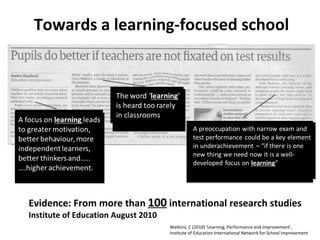
Towards a learning-focused school Evidence: From more than  100  international research studies Institute of Education August 2010 Watkins, C (2010) 'Learning, Performance and Improvement',  Institute of Education International Network for School Improvement
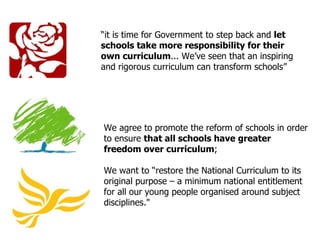
“ it is time for Government to step back and  let schools take more responsibility for their own curriculum ... We ’ ve seen that an inspiring and rigorous curriculum can transform schools ” We agree to promote the reform of schools in order to ensure  that all schools have greater freedom over curriculum ;  We want to  “ restore the National Curriculum to its original purpose – a minimum national entitlement for all our young people organised around subject disciplines."
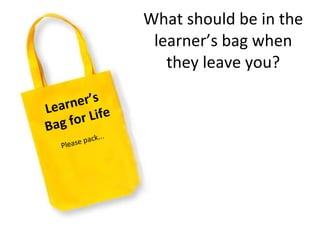
What should be in the learner ’ s bag when they leave you? Learner ’ s  Bag for Life Please pack...
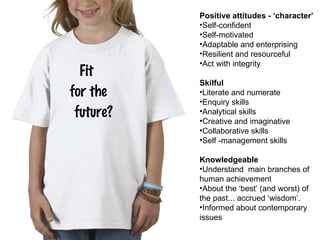
Fit  for the  future? Positive attitudes - ‘character’ Self-confident Self-motivated Adaptable and enterprising Resilient and resourceful Act with integrity Skilful Literate and numerate Enquiry skills Analytical skills Creative and imaginative Collaborative skills Self -management skills Knowledgeable Understand  main branches of human achievement About the  ‘ best ’  (and worst) of the past... accrued  ‘ wisdom ’ . Informed about contemporary issues
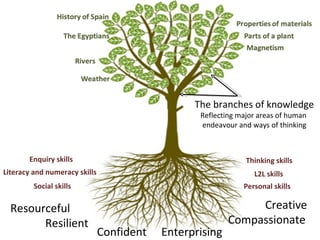
Resourceful Enterprising Resilient Creative Compassionate Confident The branches of knowledge Reflecting major areas of human  endeavour and ways of thinking Thinking skills Personal skills L2L skills Literacy and numeracy skills Enquiry skills Social skills
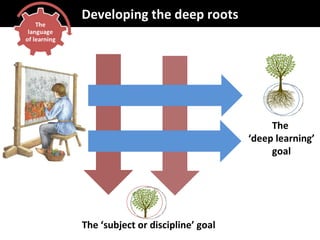
Developing the deep roots The  ‘ subject or discipline ’  goal The  ‘ deep learning ’  goal
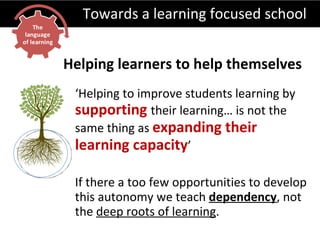
Towards a learning focused school ‘ Helping to improve students learning by  supporting   their learning… is not the same thing as  expanding their learning capacity ’ If there a too few opportunities to develop this autonomy we teach  dependency , not the  deep roots of learning . Helping learners to help themselves
Performance based learning Pupils engage in the scoping, development and realisation of a performance or an event e.g. An exhibition, a sporting event, a community event, a meal, a school production. It involves devising, developing, organising, rehearsing, arranging, collaborating and delivery. Design based learning Students create, evaluate, re-design products through stages of revision. This work involves, research, creativity, prototyping, testing, review, redevelopment etc. E.g. A community makeover,  a new playground, classroom of the future, a class/theme web-site.  Project based learning Students explore real world local or global issues and challenges. Eg. Safe cycle routes to school,  Recycling, regeneration Problem - enquiry based learning Pupils learning through the process of solving a problem and exploring a big question.  Identifying key questions or real problems. Eg.  Why causes child labour? Can you believe what you see and read? Deep learning pedagogies The language of learning
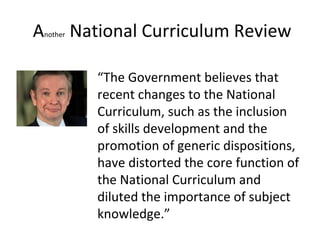
A nother  National Curriculum Review “ The Government believes that recent changes to the National Curriculum, such as the inclusion of skills development and the promotion of generic dispositions, have distorted the core function of the National Curriculum and diluted the importance of subject knowledge.”
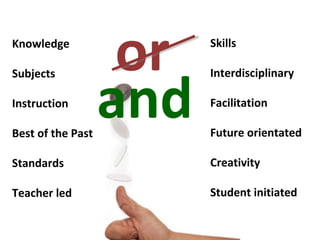
or Knowledge Subjects Instruction Best of the Past Standards Teacher led Skills Interdisciplinary Facilitation Future orientated Creativity Student initiated and
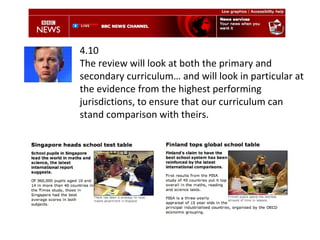
4.10  The review will look at both the primary and secondary curriculum… and will look in particular at the evidence from the highest performing jurisdictions, to ensure that our curriculum can stand comparison with theirs.
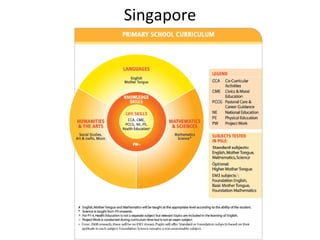
Singapore
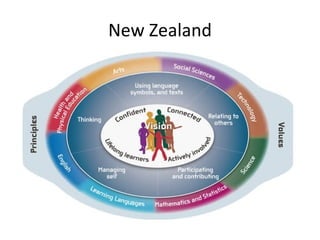
New Zealand
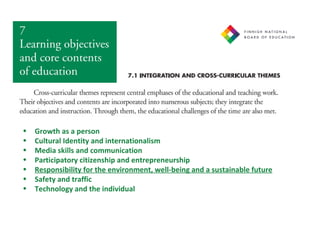
Growth as a person Cultural Identity and internationalism Media skills and communication Participatory citizenship and entrepreneurship Responsibility for the environment, well-being and a sustainable future Safety and traffic Technology and the individual
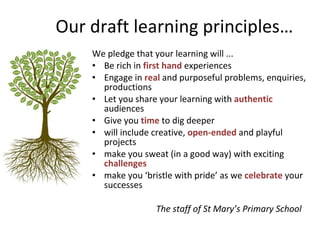
Our draft learning principles… We pledge that your learning will ... Be rich in  first hand  experiences Engage in  real   and purposeful problems, enquiries, productions Let you share your learning with  authentic  audiences Give you  time  to dig deeper will include creative,  open-ended  and playful projects make you sweat (in a good way) with exciting  challenges make you  ‘ bristle with pride ’  as we  celebrate  your successes The staff of St Mary ’ s Primary School
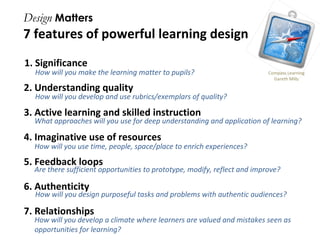
Design  Matters 7 features of powerful learning design 1. Significance 2. Understanding quality 3. Active learning and skilled instruction 4. Imaginative use of resources 5. Feedback loops 6. Authenticity  7. Relationships Compass Learning Gareth Mills How will you make the learning matter to pupils? How will you develop and use rubrics/exemplars of quality? What approaches will you use for deep understanding and application of learning? How will you develop a climate where learners are valued and mistakes seen as opportunities for learning? Are there sufficient opportunities to prototype, modify, reflect and improve? How will you design purposeful tasks and problems with authentic audiences? How will you use time, people, space/place to enrich experiences?
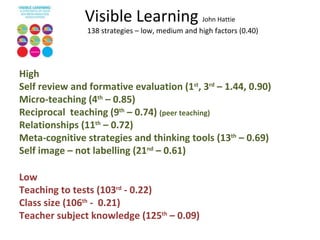
Visible Learning  John Hattie 138 strategies – low, medium and high factors (0.40) Low Teaching to tests (103 rd  - 0.22) Class size (106 th  -  0.21) Teacher subject knowledge (125 th  – 0.09) High Self review and formative evaluation (1 st , 3 rd  – 1.44, 0.90) Micro-teaching (4 th  – 0.85) Reciprocal  teaching (9 th  – 0.74)  (peer teaching) Relationships (11 th  – 0.72) Meta-cognitive strategies and thinking tools (13 th  – 0.69) Self image – not labelling (21 nd  – 0.61)
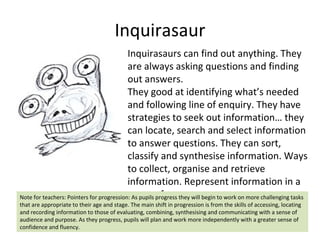
Inquirasaur Inquirasaurs can find out anything. They are always asking questions and finding out answers.  They good at identifying what’s needed and following line of enquiry. They have strategies to seek out information… they can locate, search and select information to answer questions. They can sort, classify and synthesise information. Ways to collect, organise and retrieve information. Represent information in a range of ways Note for teachers: Pointers for progression: As pupils progress they will begin to work on more challenging tasks that are appropriate to their age and stage. The main shift in progression is from the skills of accessing, locating and recording information to those of evaluating, combining, synthesising and communicating with a sense of audience and purpose. As they progress, pupils will plan and work more independently with a greater sense of confidence and fluency.
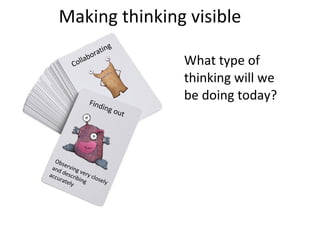
Making thinking visible  What type of thinking will we be doing today? Finding out Observing very closely and describing accurately Collaborating
Some classroom questions What are you doing? What are you learning? How are you learning? What types of thinking are you using?
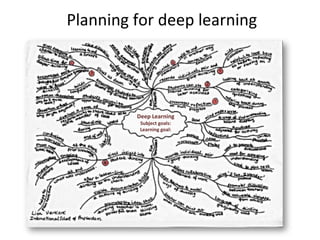
Planning for deep learning Deep Learning Subject goals: Learning goal: Name of school
Between Teacher and Child A quote from Hiam Ginnott “ I've come to the frightening conclusion that I am the decisive element in the classroom. It's my daily mood that makes the weather. As a teacher, I possess a tremendous power to make a child's life miserable or joyous. I can be a tool of torture or an instrument of inspiration. I can humiliate or humor, hurt or heal.  In all situations, it is my response that decides whether a crisis will be escalated or de-escalated and a child humanised or de-humanised.”

Gareth mills slides

  • 1.
    Towards a learningfocused curriculum 1. Developing the ‘deep roots’ of learning Nechells Education Action Zone Gareth Mills Curriculum Innovation Partner Compass Learning
  • 2.
    Towards a learning-focusedschool Evidence: From more than 100 international research studies Institute of Education August 2010 Watkins, C (2010) 'Learning, Performance and Improvement', Institute of Education International Network for School Improvement
  • 3.
    “ it istime for Government to step back and let schools take more responsibility for their own curriculum ... We ’ ve seen that an inspiring and rigorous curriculum can transform schools ” We agree to promote the reform of schools in order to ensure that all schools have greater freedom over curriculum ; We want to “ restore the National Curriculum to its original purpose – a minimum national entitlement for all our young people organised around subject disciplines."
  • 4.
    What should bein the learner ’ s bag when they leave you? Learner ’ s Bag for Life Please pack...
  • 5.
    Fit forthe future? Positive attitudes - ‘character’ Self-confident Self-motivated Adaptable and enterprising Resilient and resourceful Act with integrity Skilful Literate and numerate Enquiry skills Analytical skills Creative and imaginative Collaborative skills Self -management skills Knowledgeable Understand main branches of human achievement About the ‘ best ’ (and worst) of the past... accrued ‘ wisdom ’ . Informed about contemporary issues
  • 6.
    Resourceful Enterprising ResilientCreative Compassionate Confident The branches of knowledge Reflecting major areas of human endeavour and ways of thinking Thinking skills Personal skills L2L skills Literacy and numeracy skills Enquiry skills Social skills
  • 7.
    Developing the deeproots The ‘ subject or discipline ’ goal The ‘ deep learning ’ goal
  • 8.
    Towards a learningfocused school ‘ Helping to improve students learning by supporting their learning… is not the same thing as expanding their learning capacity ’ If there a too few opportunities to develop this autonomy we teach dependency , not the deep roots of learning . Helping learners to help themselves
  • 9.
    Performance based learningPupils engage in the scoping, development and realisation of a performance or an event e.g. An exhibition, a sporting event, a community event, a meal, a school production. It involves devising, developing, organising, rehearsing, arranging, collaborating and delivery. Design based learning Students create, evaluate, re-design products through stages of revision. This work involves, research, creativity, prototyping, testing, review, redevelopment etc. E.g. A community makeover, a new playground, classroom of the future, a class/theme web-site. Project based learning Students explore real world local or global issues and challenges. Eg. Safe cycle routes to school, Recycling, regeneration Problem - enquiry based learning Pupils learning through the process of solving a problem and exploring a big question. Identifying key questions or real problems. Eg. Why causes child labour? Can you believe what you see and read? Deep learning pedagogies The language of learning
  • 10.
    A nother National Curriculum Review “ The Government believes that recent changes to the National Curriculum, such as the inclusion of skills development and the promotion of generic dispositions, have distorted the core function of the National Curriculum and diluted the importance of subject knowledge.”
  • 11.
    or Knowledge SubjectsInstruction Best of the Past Standards Teacher led Skills Interdisciplinary Facilitation Future orientated Creativity Student initiated and
  • 12.
    4.10 Thereview will look at both the primary and secondary curriculum… and will look in particular at the evidence from the highest performing jurisdictions, to ensure that our curriculum can stand comparison with theirs.
  • 13.
  • 14.
  • 15.
    Growth as aperson Cultural Identity and internationalism Media skills and communication Participatory citizenship and entrepreneurship Responsibility for the environment, well-being and a sustainable future Safety and traffic Technology and the individual
  • 16.
    Our draft learningprinciples… We pledge that your learning will ... Be rich in first hand experiences Engage in real and purposeful problems, enquiries, productions Let you share your learning with authentic audiences Give you time to dig deeper will include creative, open-ended and playful projects make you sweat (in a good way) with exciting challenges make you ‘ bristle with pride ’ as we celebrate your successes The staff of St Mary ’ s Primary School
  • 17.
    Design Matters7 features of powerful learning design 1. Significance 2. Understanding quality 3. Active learning and skilled instruction 4. Imaginative use of resources 5. Feedback loops 6. Authenticity 7. Relationships Compass Learning Gareth Mills How will you make the learning matter to pupils? How will you develop and use rubrics/exemplars of quality? What approaches will you use for deep understanding and application of learning? How will you develop a climate where learners are valued and mistakes seen as opportunities for learning? Are there sufficient opportunities to prototype, modify, reflect and improve? How will you design purposeful tasks and problems with authentic audiences? How will you use time, people, space/place to enrich experiences?
  • 18.
    Visible Learning John Hattie 138 strategies – low, medium and high factors (0.40) Low Teaching to tests (103 rd - 0.22) Class size (106 th - 0.21) Teacher subject knowledge (125 th – 0.09) High Self review and formative evaluation (1 st , 3 rd – 1.44, 0.90) Micro-teaching (4 th – 0.85) Reciprocal teaching (9 th – 0.74) (peer teaching) Relationships (11 th – 0.72) Meta-cognitive strategies and thinking tools (13 th – 0.69) Self image – not labelling (21 nd – 0.61)
  • 19.
    Inquirasaur Inquirasaurs canfind out anything. They are always asking questions and finding out answers. They good at identifying what’s needed and following line of enquiry. They have strategies to seek out information… they can locate, search and select information to answer questions. They can sort, classify and synthesise information. Ways to collect, organise and retrieve information. Represent information in a range of ways Note for teachers: Pointers for progression: As pupils progress they will begin to work on more challenging tasks that are appropriate to their age and stage. The main shift in progression is from the skills of accessing, locating and recording information to those of evaluating, combining, synthesising and communicating with a sense of audience and purpose. As they progress, pupils will plan and work more independently with a greater sense of confidence and fluency.
  • 20.
    Making thinking visible What type of thinking will we be doing today? Finding out Observing very closely and describing accurately Collaborating
  • 21.
    Some classroom questionsWhat are you doing? What are you learning? How are you learning? What types of thinking are you using?
  • 22.
    Planning for deeplearning Deep Learning Subject goals: Learning goal: Name of school
  • 23.
    Between Teacher andChild A quote from Hiam Ginnott “ I've come to the frightening conclusion that I am the decisive element in the classroom. It's my daily mood that makes the weather. As a teacher, I possess a tremendous power to make a child's life miserable or joyous. I can be a tool of torture or an instrument of inspiration. I can humiliate or humor, hurt or heal. In all situations, it is my response that decides whether a crisis will be escalated or de-escalated and a child humanised or de-humanised.”