Peace in Indian Context
Emperor Asoka’s Kalinga War,
Conversion
By
M.VIJAYALAKSHMI
Assistant Professor
Objectives
At the end of the course the student teacher will
1. Understand the concept of peace education.
2. Understand the dynamics of transformation of
violence into Peace.
3. Understand the nature of conflicts and their
resolution.
4. Imbibe the knowledge, attitudes and skills
needed to achieve and sustain a global culture
of peace.
5. Adopt peace education in the curriculum.
Unit – 5: Peace in Indian Context
5.1 Peace in Ancient Indian Literature –
Thirukkural
5.2 Emperor Asoka’s Kalinga War, Conversion
5.3 Propagation of Peace - Jainism and
Buddhism
5.4 Gandhian Philosophy of Peace and Non-
Violence - Techniques of Non-Violence
Resistance - India a Peace-Loving Country:
Policy of Panch Sheel and Non-Alignment
Unit – 5: Peace in Indian Context
5.2 Emperor Asoka’s Kalinga War,
Conversion
300 BCE – 232 BCE
ASHOKA THE GREAT
Location
• ASHOKA BELONGS
TO MAURYAN DYNASTY
• HE IS THE THIRD KING
OF MAURYAN DYNASTY
BACKGROUND INFORMATION
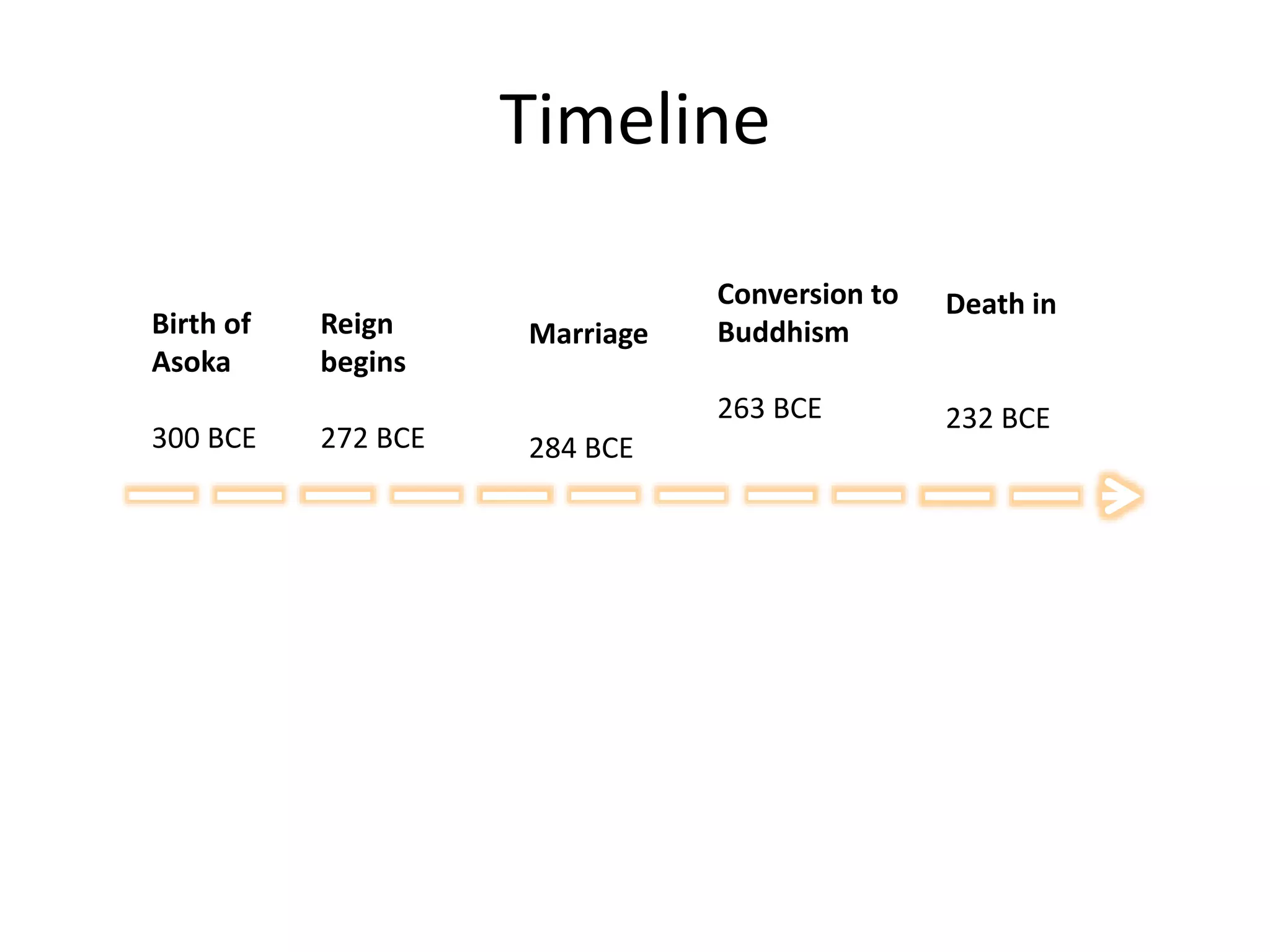
Timeline
Birth of
Asoka
300 BCE
Marriage
284 BCE
Conversion to
Buddhism
263 BCE
Reign
begins
272 BCE
Death in
232 BCE
• CHANDRAGUPTA MAURYA
• (Founder & grand father of Ashoka)
• BINDUSARA
(Second king & father of Ashoka)
• ASHOKA THE EMPEROR
(Third king)
MAURYA DYNASTY
• Founded Mauryan Dynasty
in 322 BC
• Gained power shortly after
Alexander ‘s death.
• Was crowned King at Taxila
• Had capital at Pataliputra
• His minister Chanakya
wrote Arthashastra
CHANDRAGUPTA MAURYA
• BEFORE THE KALINGA WAR
• AFTER THE KALINGA WAR
• LEGACY OF ASHOKA
ASHOKA THE GREAT
Ashokawas anointedthe new emperoror rulerof the mauryan
empire in274 BC
He is saidto have beenof a wicked nature and badtemper
Built hellon earth,an elaborateand horrifictorture chamber
Earnedhimthe name of chandashoka(sanskrit),meaning ashoka
the fierce
Expandedhis empireover the next eight years
BEFORE THE KALINGA WAR
ASHOKA THE GREAT
PART-I
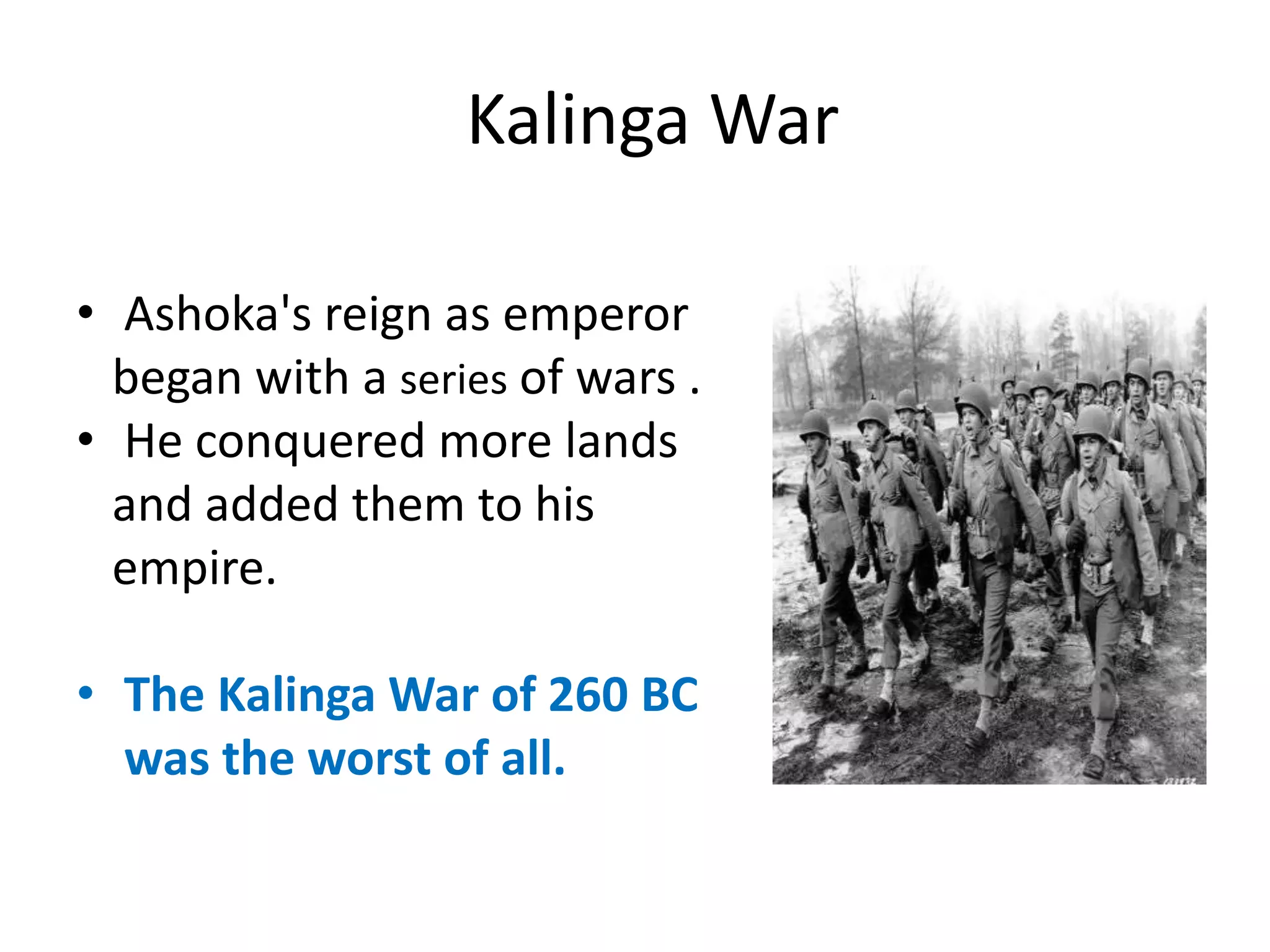
• Ashoka's reign as emperor
began with a series of wars .
• He conquered more lands
and added them to his
empire.
• The Kalinga War of 260 BC
was the worst of all.
Kalinga War
After the battle in a tour of city, he could see nothing
except burnt houses and scattered corpses.
This sight made him sick and he cried the famous
monologue:
What have I done? If this is a victory, what's a defeat
then? Is this a victory or a defeat? Is this justice or
injustice? Is it gallantry or a rout? Is it valor to kill innocent
children and women? Do I do it to widen the empire and
for prosperity or to destroy the other's kingdom and
splendor? One has lost her husband, someone else a
father, someone a child, someone an unborn infant....
What's this debris of the corpses? Are these marks of
victory or defeat? Are these vultures, crows, eagles the
messengers of death or evil?
Continued…..
•The mammoth loss of life and suffering witnessed
on the battlefield made him turn away from war
•He felt that he was the cause of the destruction
•His queen, Devi, who was a Buddhist, left him
after seeing the brutality at Kalinga
•Ashoka realized the consequences of wars and
battles
• The huge loss of life and
suffering witnessed on
the battlefield made him
turn away from war.
• So he was deeply
influenced by Buddhism,
and adopted the dharma
principles
A change of heart
AFTER THE KALINGA WAR
ASHOKA THE GREAT
PART - II
• A. Dharma Principles
• B. Spread of Buddhism
• C. Ashoka the Administrator
AFTER KALINGA WAR
The brutality of the conquest led Ashoka to adopt
Buddhism
Embraced buddhism under the brahmin buddhist sages,
radhaswami and manjushri
He made buddhism his state religion around 260 BC
 Can be credited with making the first serious attempt to
develop a Buddhist policy
Propagated and preached it within his domain and
worldwide from about 250 BC
The main principles of dharma
• nonviolence,
• tolerance of all sects,
• obedience to parents,
• respect for Brahmans , teachers & priests
• liberality towards friends,
• humane treatment of servants,
A. The Dharma Principles
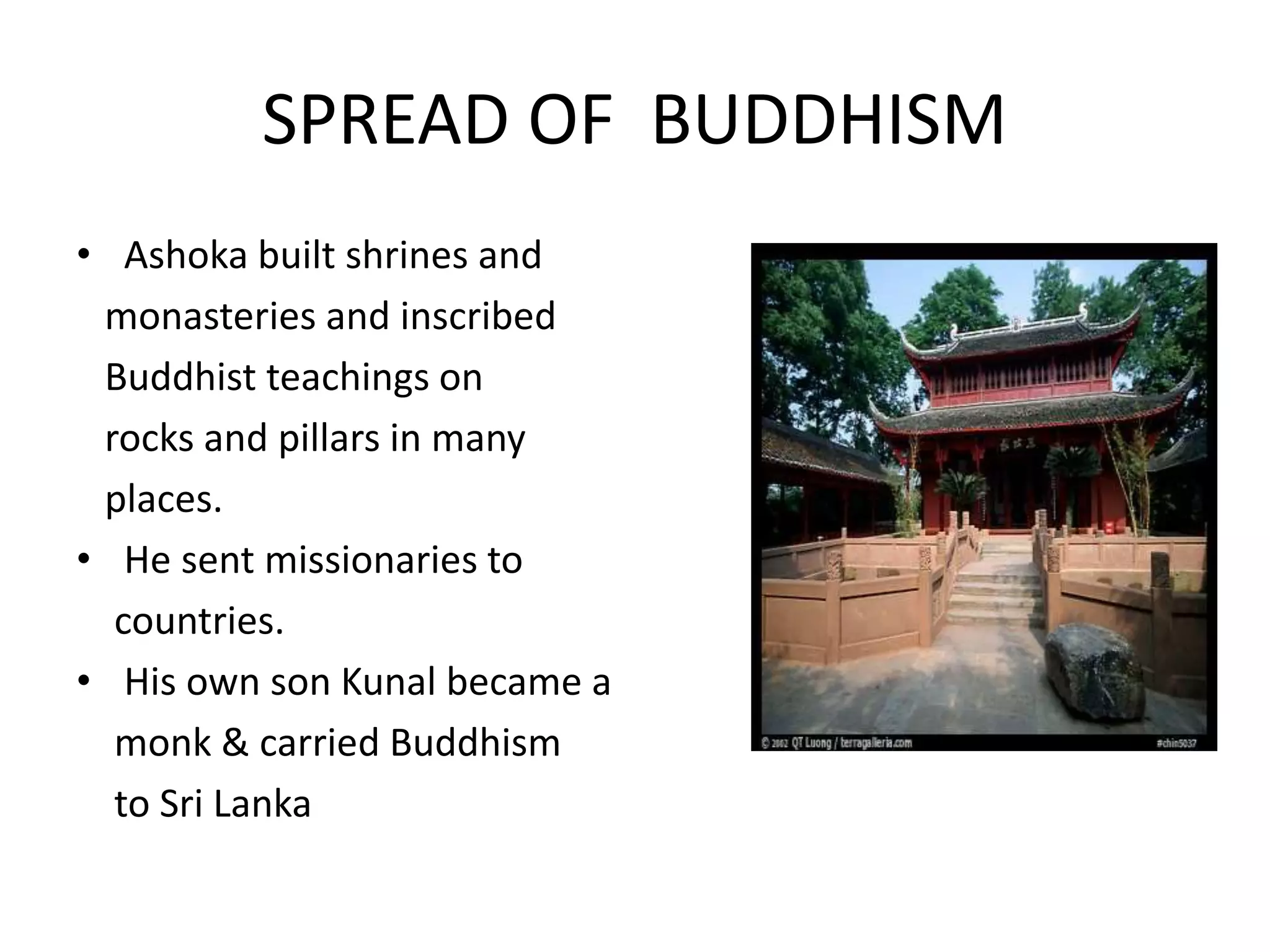
• Ashoka built shrines and
monasteries and inscribed
Buddhist teachings on
rocks and pillars in many
places.
• He sent missionaries to
countries.
• His own son Kunal became a
monk & carried Buddhism
to Sri Lanka
SPREAD OF BUDDHISM
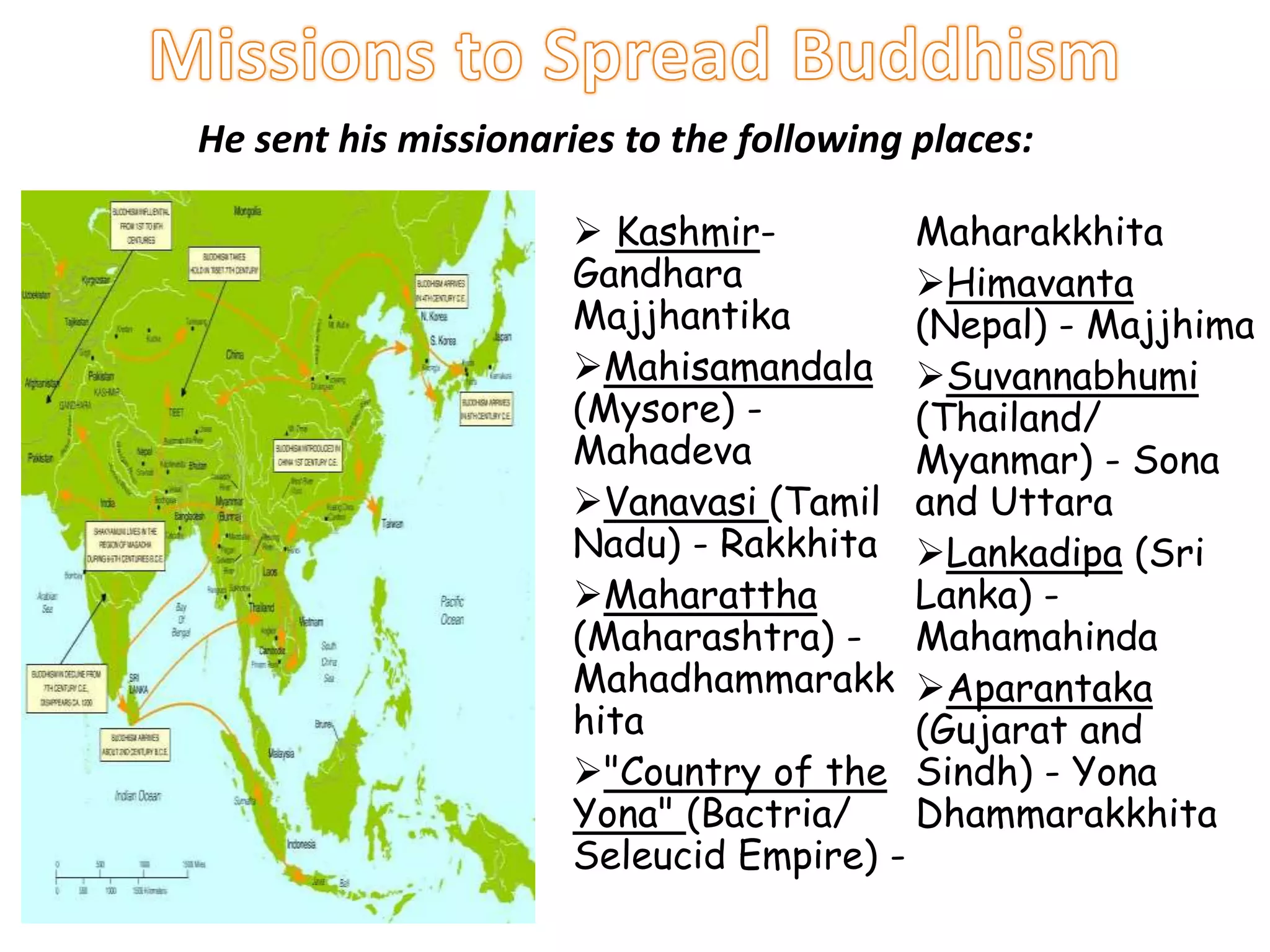
 Kashmir-
Gandhara
Majjhantika
Mahisamandala
(Mysore) -
Mahadeva
Vanavasi (Tamil
Nadu) - Rakkhita
Maharattha
(Maharashtra) -
Mahadhammarakk
hita
"Country of the
Yona" (Bactria/
Seleucid Empire) -
Maharakkhita
Himavanta
(Nepal) - Majjhima
Suvannabhumi
(Thailand/
Myanmar) - Sona
and Uttara
Lankadipa (Sri
Lanka) -
Mahamahinda
Aparantaka
(Gujarat and
Sindh) - Yona
Dhammarakkhita
He sent his missionaries to the following places:
DEATH & LEGACY
Ashoka ruled for an estimated forty years
He had numerous wives and many heirs but most
of their name are lost
He had entrusted to Mahindra and Sanghamitra
the job of making his state religion
Ashoka died in 232 BC
After his death, the Mauryan dynasty lasted
just fifty more years
The Edicts of King Ashoka
 The Rock Edicts -
THE FOURTEEN ROCK EDICTS
KALINGA ROCK EDICTS
MINOR ROCK EDICTS
THE SEVEN PILLAR EDICTS
MINOR PILLAR EDICTS
The pillars of Ashoka were erected by him during his reign in the 3rd
century BC
The Stupas of Sanchi are world famous and the stupa named
SanchiStupa was built by Emperor Ashoka
Ashoka's own words as known from his Edicts are:
"All men are my children. I am like a father to them. As every
father desires the good and the happiness of his children, I wish
that all men should be happy always”.
ROCK EDICTS OF AHOKA
Elephant at Kalinga war site-
Orissa
Minor Rock Edict site- Madhya
Pradesh
Rock Edict at Junagadh Major Rock Edict at Girnar,
Gujarat
• Ashoka taught and convinced people to love and respect all
living things.
• He insisted on the recognition of the sanctity of all human
life.
• He abolished the unnecessary slaughter or mutilation of
animals.
• Ashoka banned sport hunting & thus protected wildlife.
• He became vegetarian & most people chose to become
vegetarians on their own.
• He allowed one day leave to prisoners to go outside for a day
of the year.
Ashoka the administrator
Right from his childhood days Ashoka showed great promise in the field
of weaponry skills as well as academics
 Although Ashoka was known as Cruel Ashoka but He felt that he was the
cause of the destruction which made him turn away from war and adopt
Buddhism
In fact, he can be credited with making the first serious attempt to
develop a Buddhist policy.
Buddhism received a significant boost of popularity when Ashoka
converted to Buddhism.
Throughout his life, 'Asoka the Great' followed the policy of nonviolence
He is acclaimed for constructing hospitals for animals and renovating
major roads throughout India. After this transformation, Ashoka came to
be known as Dhammashoka
Ashoka tried to make the lives better and Ashoka is honored today
Sources are taken from
•Slidesharenet.com
•Web sources

Peace in Indian Context

  • 1.
    Peace in IndianContext Emperor Asoka’s Kalinga War, Conversion By M.VIJAYALAKSHMI Assistant Professor
  • 2.
    Objectives At the endof the course the student teacher will 1. Understand the concept of peace education. 2. Understand the dynamics of transformation of violence into Peace. 3. Understand the nature of conflicts and their resolution. 4. Imbibe the knowledge, attitudes and skills needed to achieve and sustain a global culture of peace. 5. Adopt peace education in the curriculum.
  • 3.
    Unit – 5:Peace in Indian Context 5.1 Peace in Ancient Indian Literature – Thirukkural 5.2 Emperor Asoka’s Kalinga War, Conversion 5.3 Propagation of Peace - Jainism and Buddhism 5.4 Gandhian Philosophy of Peace and Non- Violence - Techniques of Non-Violence Resistance - India a Peace-Loving Country: Policy of Panch Sheel and Non-Alignment
  • 4.
    Unit – 5:Peace in Indian Context 5.2 Emperor Asoka’s Kalinga War, Conversion
  • 5.
    300 BCE –232 BCE ASHOKA THE GREAT
  • 6.
  • 7.
    • ASHOKA BELONGS TOMAURYAN DYNASTY • HE IS THE THIRD KING OF MAURYAN DYNASTY BACKGROUND INFORMATION
  • 8.
    Timeline Birth of Asoka 300 BCE Marriage 284BCE Conversion to Buddhism 263 BCE Reign begins 272 BCE Death in 232 BCE
  • 9.
    • CHANDRAGUPTA MAURYA •(Founder & grand father of Ashoka) • BINDUSARA (Second king & father of Ashoka) • ASHOKA THE EMPEROR (Third king) MAURYA DYNASTY
  • 10.
    • Founded MauryanDynasty in 322 BC • Gained power shortly after Alexander ‘s death. • Was crowned King at Taxila • Had capital at Pataliputra • His minister Chanakya wrote Arthashastra CHANDRAGUPTA MAURYA
  • 11.
    • BEFORE THEKALINGA WAR • AFTER THE KALINGA WAR • LEGACY OF ASHOKA ASHOKA THE GREAT
  • 12.
    Ashokawas anointedthe newemperoror rulerof the mauryan empire in274 BC He is saidto have beenof a wicked nature and badtemper Built hellon earth,an elaborateand horrifictorture chamber Earnedhimthe name of chandashoka(sanskrit),meaning ashoka the fierce Expandedhis empireover the next eight years
  • 15.
    BEFORE THE KALINGAWAR ASHOKA THE GREAT PART-I
  • 16.
    • Ashoka's reignas emperor began with a series of wars . • He conquered more lands and added them to his empire. • The Kalinga War of 260 BC was the worst of all. Kalinga War
  • 17.
    After the battlein a tour of city, he could see nothing except burnt houses and scattered corpses. This sight made him sick and he cried the famous monologue: What have I done? If this is a victory, what's a defeat then? Is this a victory or a defeat? Is this justice or injustice? Is it gallantry or a rout? Is it valor to kill innocent children and women? Do I do it to widen the empire and for prosperity or to destroy the other's kingdom and splendor? One has lost her husband, someone else a father, someone a child, someone an unborn infant.... What's this debris of the corpses? Are these marks of victory or defeat? Are these vultures, crows, eagles the messengers of death or evil?
  • 18.
    Continued….. •The mammoth lossof life and suffering witnessed on the battlefield made him turn away from war •He felt that he was the cause of the destruction •His queen, Devi, who was a Buddhist, left him after seeing the brutality at Kalinga •Ashoka realized the consequences of wars and battles
  • 19.
    • The hugeloss of life and suffering witnessed on the battlefield made him turn away from war. • So he was deeply influenced by Buddhism, and adopted the dharma principles A change of heart
  • 20.
    AFTER THE KALINGAWAR ASHOKA THE GREAT PART - II
  • 21.
    • A. DharmaPrinciples • B. Spread of Buddhism • C. Ashoka the Administrator AFTER KALINGA WAR
  • 22.
    The brutality ofthe conquest led Ashoka to adopt Buddhism Embraced buddhism under the brahmin buddhist sages, radhaswami and manjushri He made buddhism his state religion around 260 BC  Can be credited with making the first serious attempt to develop a Buddhist policy Propagated and preached it within his domain and worldwide from about 250 BC
  • 23.
    The main principlesof dharma • nonviolence, • tolerance of all sects, • obedience to parents, • respect for Brahmans , teachers & priests • liberality towards friends, • humane treatment of servants, A. The Dharma Principles
  • 24.
    • Ashoka builtshrines and monasteries and inscribed Buddhist teachings on rocks and pillars in many places. • He sent missionaries to countries. • His own son Kunal became a monk & carried Buddhism to Sri Lanka SPREAD OF BUDDHISM
  • 25.
     Kashmir- Gandhara Majjhantika Mahisamandala (Mysore) - Mahadeva Vanavasi(Tamil Nadu) - Rakkhita Maharattha (Maharashtra) - Mahadhammarakk hita "Country of the Yona" (Bactria/ Seleucid Empire) - Maharakkhita Himavanta (Nepal) - Majjhima Suvannabhumi (Thailand/ Myanmar) - Sona and Uttara Lankadipa (Sri Lanka) - Mahamahinda Aparantaka (Gujarat and Sindh) - Yona Dhammarakkhita He sent his missionaries to the following places:
  • 26.
    DEATH & LEGACY Ashokaruled for an estimated forty years He had numerous wives and many heirs but most of their name are lost He had entrusted to Mahindra and Sanghamitra the job of making his state religion Ashoka died in 232 BC After his death, the Mauryan dynasty lasted just fifty more years
  • 27.
    The Edicts ofKing Ashoka  The Rock Edicts - THE FOURTEEN ROCK EDICTS KALINGA ROCK EDICTS MINOR ROCK EDICTS THE SEVEN PILLAR EDICTS MINOR PILLAR EDICTS The pillars of Ashoka were erected by him during his reign in the 3rd century BC The Stupas of Sanchi are world famous and the stupa named SanchiStupa was built by Emperor Ashoka Ashoka's own words as known from his Edicts are: "All men are my children. I am like a father to them. As every father desires the good and the happiness of his children, I wish that all men should be happy always”.
  • 28.
    ROCK EDICTS OFAHOKA Elephant at Kalinga war site- Orissa Minor Rock Edict site- Madhya Pradesh Rock Edict at Junagadh Major Rock Edict at Girnar, Gujarat
  • 29.
    • Ashoka taughtand convinced people to love and respect all living things. • He insisted on the recognition of the sanctity of all human life. • He abolished the unnecessary slaughter or mutilation of animals. • Ashoka banned sport hunting & thus protected wildlife. • He became vegetarian & most people chose to become vegetarians on their own. • He allowed one day leave to prisoners to go outside for a day of the year. Ashoka the administrator
  • 30.
    Right from hischildhood days Ashoka showed great promise in the field of weaponry skills as well as academics  Although Ashoka was known as Cruel Ashoka but He felt that he was the cause of the destruction which made him turn away from war and adopt Buddhism In fact, he can be credited with making the first serious attempt to develop a Buddhist policy. Buddhism received a significant boost of popularity when Ashoka converted to Buddhism. Throughout his life, 'Asoka the Great' followed the policy of nonviolence He is acclaimed for constructing hospitals for animals and renovating major roads throughout India. After this transformation, Ashoka came to be known as Dhammashoka Ashoka tried to make the lives better and Ashoka is honored today
  • 31.
    Sources are takenfrom •Slidesharenet.com •Web sources