1) Ashoka was a famous emperor of the Mauryan Dynasty who ruled most of present-day India from 268-232 BCE.
2) He was the grandson of the dynasty's founder Chandragupta, and the son of Bindusara and Subhadrangi.
3) A major turning point in his life was the bloody Kalinga War, in which his armies conquered the kingdom of Kalinga, leaving thousands dead. The violence of the war moved Ashoka to adopt Buddhism.
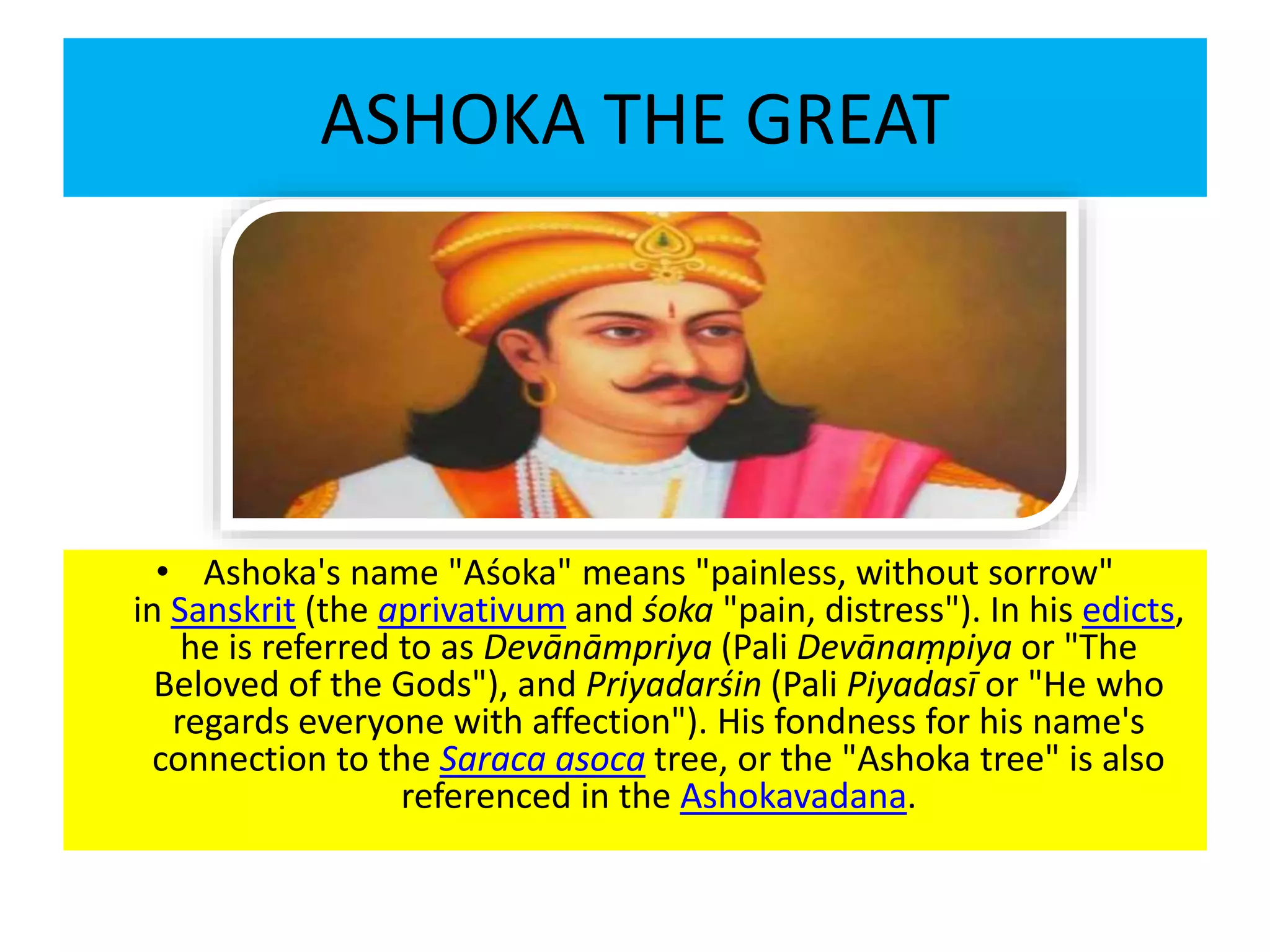
ASHOKA THE GREAT
•Ashoka's name "Aśoka" means "painless, without sorrow"
in Sanskrit (the aprivativum and śoka "pain, distress"). In his edicts,
he is referred to as Devānāmpriya (Pali Devānaṃpiya or "The
Beloved of the Gods"), and Priyadarśin (Pali Piyadasī or "He who
regards everyone with affection"). His fondness for his name's
connection to the Saraca asoca tree, or the "Ashoka tree" is also
referenced in the Ashokavadana.
4.
ASHOKA THE GREAT
Symbol
Ashoka(IAST: Aśoka; English pronunciation: /əˈʃoʊkə/; died 232 BCE) was an Indian emperor of the Maurya
Dynasty who ruled almost all of the Indian subcontinent from c. 268 to 232 BCE.One of India's greatest
emperors, Ashoka reigned over a realm that stretched from the Hindu Kush mountains in Afghanistan to
the modern state of Bangladesh in the east. It covered the entire Indian subcontinent except parts of
present-day Tamil Nadu and Kerala. The empire's capital was Pataliputra (in Magadha, present-day Bihar),
with provincial capitals at Taxila and Ujjain.
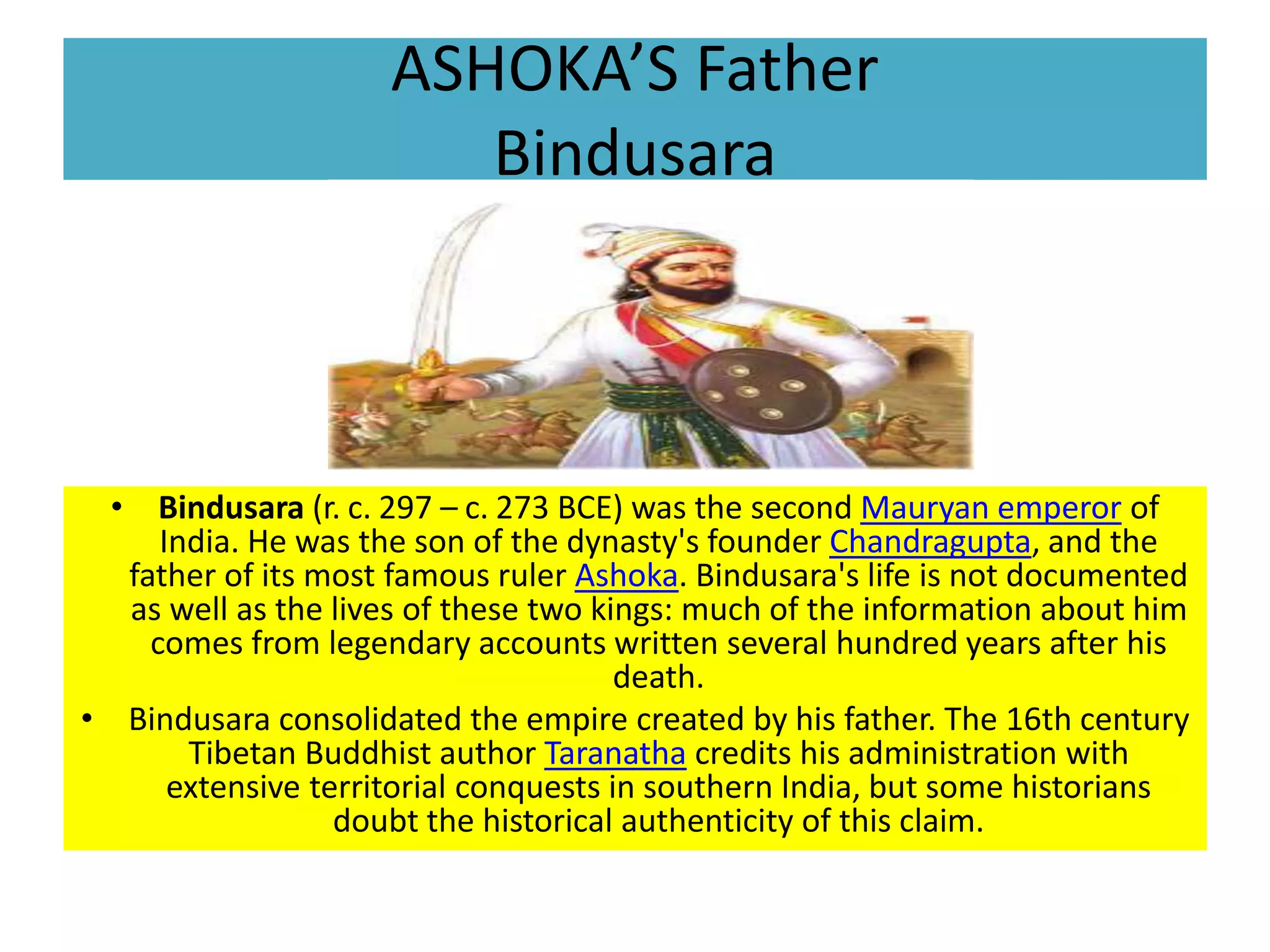
ASHOKA’S Father
Bindusara
• Bindusara(r. c. 297 – c. 273 BCE) was the second Mauryan emperor of
India. He was the son of the dynasty's founder Chandragupta, and the
father of its most famous ruler Ashoka. Bindusara's life is not documented
as well as the lives of these two kings: much of the information about him
comes from legendary accounts written several hundred years after his
death.
• Bindusara consolidated the empire created by his father. The 16th century
Tibetan Buddhist author Taranatha credits his administration with
extensive territorial conquests in southern India, but some historians
doubt the historical authenticity of this claim.
7.
ASHOKA’S Mother
Subhadrangi
• Subhadrangi(also known as Dharma or Janapadakalyani) was, according
to Buddhist sources, a wife of the Mauryan emperor, Bindusara and the mother of
his successor, Ashoka. The Ashokavadana states that Subhadrangi was the
daughter of a Brahmin from the city of Champa. The legends state that palace
politics kept her away from Bindusara and when she finally gained access to him
and bore him a son, she is said to have exclaimed, "I am now without sorrow",
which led to the child being named Ashoka. The name of her second
son, Vitashoka (meaning sorrow terminated) has a similar provenance.
8.
ASHOKA’S Wife
• Devi(full name: Vedisa-Mahadevi Sakyakumari) was,
according to the Ceylonese chronicles, the first wife of the
third Mauryan emperor Ashoka. She was also the mother
of Ashoka's first two children—his son, Mahendra, and
daughter, Sanghamitra—both of whom played important
roles in the spread of Buddhism to other countries. She is
also remembered for the Sanchi Stupa.
9.
BATTLE OF ASHOKA
KalingaWar
The Kalinga War was fought between the Maurya
Empire with Ashoka and the state of Kalinga, a
feudal republic located on the coast of the present-
day Indian state of Odisha and northern parts of Andhra
Pradesh. There is no historical evidence on the name of the
king who fought Ashoka. The Kalinga war, the only major
war Ashoka fought after his accession to throne, is one of
the major and bloodiest battles in world history. Kalinga,
then an Independent region put up a stiff resistance against
brutal strength of Ashoka and fought bravely till the end.
But despite being tough, they were outnumbered against
Ashoka's armies. The bloodshed of this war is said to have
prompted Ashoka to adopt Buddhism. However, he
retained Kalinga after its conquest and incorporated it into
the Maurya Empire.





![Ashoka the great [recovered]](https://cdn.slidesharecdn.com/ss_thumbnails/ashokathegreatrecovered-161015123240-thumbnail.jpg?width=640&height=640&fit=bounds)


