

300BCE – 232BCE
By : Praveen A Gondhali
INTRODUCTION
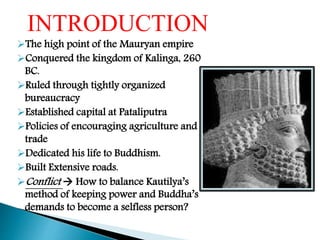
The high point of the Mauryan empire
Conquered the kingdom of Kalinga, 260
BC.
Ruled through tightly organized
bureaucracy
Established capital at Pataliputra
Policies of encouraging agriculture and
trade
Dedicated his life to Buddhism.
Built Extensive roads.
Conflict  How to balance Kautilya’s
method of keeping power and Buddha’s
demands to become a selfless person?
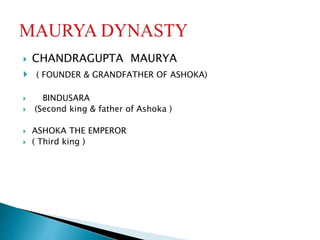
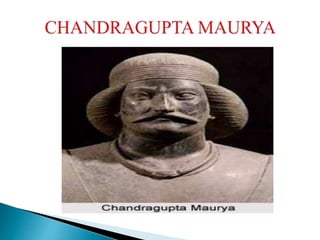
 CHANDRAGUPTA MAURYA
 ( FOUNDER & GRANDFATHER OF ASHOKA)
 BINDUSARA
 (Second king & father of Ashoka )
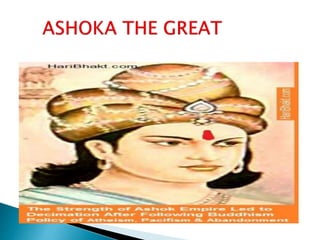
 ASHOKA THE EMPEROR
 ( Third king )
 Founder of Mauryan Dynasty in 322 BC.
 Gained power shortly after Alexander’s death.
 Was crowned king at Taxila.
 Had capital at Patliputra.
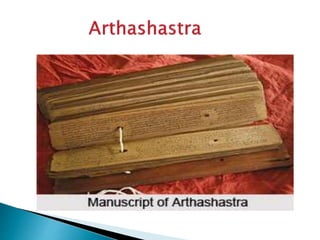
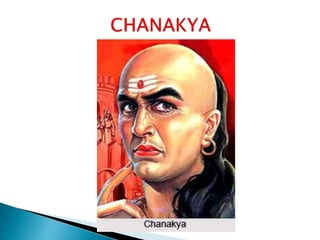
 His minister Chanakya wrote Arthashastra.
 ASHOKA BELONG TO MAURYAN DYNASTY
 HE IS THE THIRD KING OF MAURYAN
DYNASTY
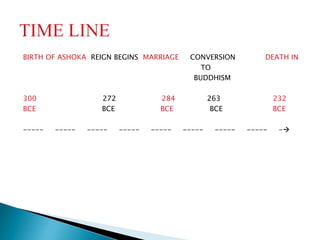
BIRTH OF ASHOKA REIGN BEGINS MARRIAGE CONVERSION DEATH IN
TO
BUDDHISM
300 272 284 263 232
BCE BCE BCE BCE BCE
----- ----- ----- ----- ----- ----- ----- ----- -
PERSONAL INFORMATION
 Quickly grew into an excellent warrior
 His command on the mauryan army started growing day by
day
 His elder brothers became suspicious of him being
favoured as the next emperor.
 The eldest son of bindusara, prince susima, convinced him
to send asoka to takshashila
 Went to kalinga, where he met a fisherwoman named
kaurwaki.
RISE TO POWER
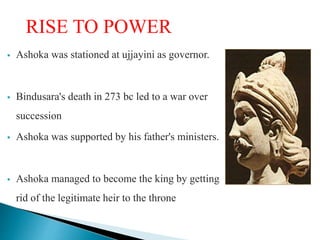
 Ashoka was stationed at ujjayini as governor.
 Bindusara's death in 273 bc led to a war over
succession
 Ashoka was supported by his father's ministers.
 Ashoka managed to become the king by getting
rid of the legitimate heir to the throne
 THE KALINGA WAR
 AFTER THE KALINGA WAR
 LEGACY OF ASHOKA
 Ashoka’s reign as emperor began with a
series of wars.
 He conquered more lands and added them to
his empire.
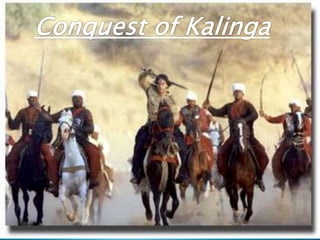
 The Kalinga War of 260BC was the worst of
all.
 The huge loss of life and suffering witnessed
on the battlefield made him turn away from
war.
 So he was deeply influenced by Buddhism,
and adopted the dharma principles.
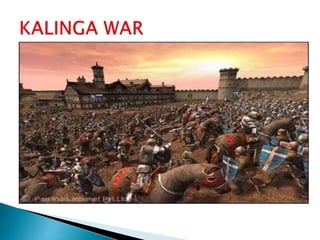
 Began in the 8th year of Ashoka's reign, probably in 261
BC
 After a bloody battle, Ashoka tried to annex kalinga
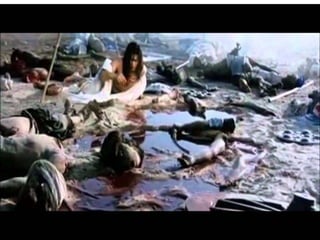
 In the aftermath of the battle of kalinga the daya river
running next to the battle field turned red with the blood of
the slain
 100,000 kalinga civilians and more than 10,000 of
ashoka's own warriors were among those slain
 After the battle in a tour of city, he could see nothing except
burnt houses and scattered corpses.
 This sight made him sick and he cried the famous monologue:
 What have I done? If this is a victory, what's a defeat then? Is
this a victory or a defeat? Is this justice or injustice? Is it
gallantry or a rout? Is it valor to kill innocent children and
women? Do I do it to widen the empire and for prosperity or to
destroy the other's kingdom and splendor? One has lost her
husband, someone else a father, someone a child, someone an
unborn infant.... What's this debris of the corpses? Are these
marks of victory or defeat? Are these vultures, crows, eagles
the messengers of death or evil?
A Sudden Change of Heart
• The mammoth loss of life and suffering witnessed on
the battlefield made him turn away from war
• He felt that he was the cause of the destruction
• His queen, Devi, who was a Buddhist, left him after
seeing the brutality at Kalinga
• Ashoka realized the consequences of wars and battles
 AFTER THE KALINGA WAR
 Dharma Principles
 Spread of Buddhism
 Ashoka the Administrator
 The main principals of dharma.
 Non violence.
 Tolerance of all sects.
 Obedience to parents.
 Respects for Brahmans, teachers & priests.
 Liberality towards friends.
 Humane treatment of servants.
 Ashoka built shrines and monasteries and
inscribed Buddhist teaching on rocks and
pillars in many places.
 He sent missionaries to countries.
 His own son Kunal became a monk & carried
Buddhism to Sri Lanka.
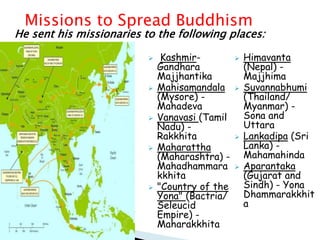
 Kashmir-
Gandhara
Majjhantika
 Mahisamandala
(Mysore) -
Mahadeva
 Vanavasi (Tamil
Nadu) -
Rakkhita
 Maharattha
(Maharashtra) -
Mahadhammara
kkhita
 "Country of the
Yona" (Bactria/
Seleucid
Empire) -
Maharakkhita
 Himavanta
(Nepal) -
Majjhima
 Suvannabhumi
(Thailand/
Myanmar) -
Sona and
Uttara
 Lankadipa (Sri
Lanka) -
Mahamahinda
 Aparantaka
(Gujarat and
Sindh) - Yona
Dhammarakkhit
a
He sent his missionaries to the following places:
Missions to Spread Buddhism
 Ashoka taught and convinced people to love
and respect all living things.
 He insisted the on the recognition of the
sancity of all human life.
 He abolished the the unnecessary slaughter
or mutilation of animals.
 Ashoka banned sport hunting and thus
protected wildlife.
 He became vegetarian & most people chose
to become vegetarians on their own.
PART – III
LEGACIES OF ASHOKA
* SYMBOLIC LEGACY
* BOLLYWOOD LEGACY
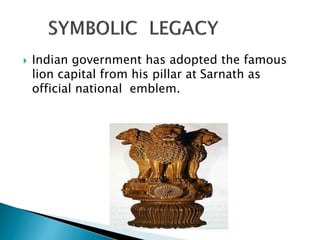
 Indian government has adopted the famous
lion capital from his pillar at Sarnath as
official national emblem.
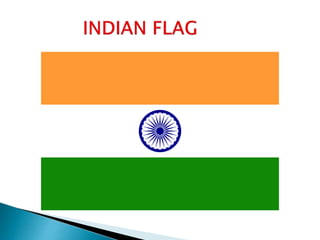
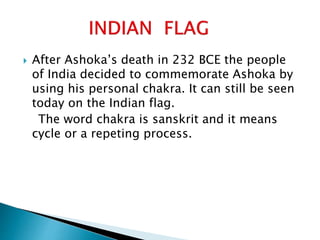
 After Ashoka’s death in 232 BCE the people
of India decided to commemorate Ashoka by
using his personal chakra. It can still be seen
today on the Indian flag.
The word chakra is sanskrit and it means
cycle or a repeting process.
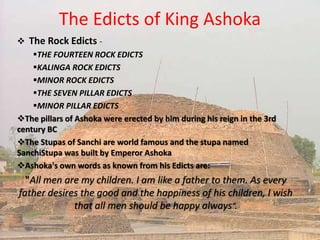
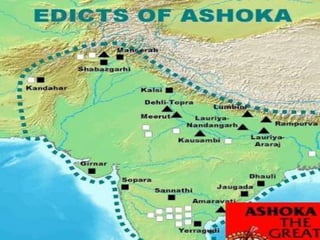
The Edicts of King Ashoka
 The Rock Edicts -
THE FOURTEEN ROCK EDICTS
KALINGA ROCK EDICTS
MINOR ROCK EDICTS
THE SEVEN PILLAR EDICTS
MINOR PILLAR EDICTS
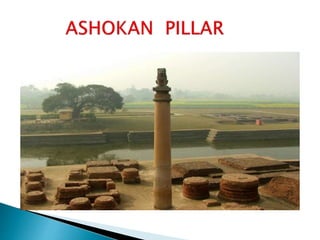
The pillars of Ashoka were erected by him during his reign in the 3rd
century BC
The Stupas of Sanchi are world famous and the stupa named
SanchiStupa was built by Emperor Ashoka
Ashoka's own words as known from his Edicts are:
"All men are my children. I am like a father to them. As every
father desires the good and the happiness of his children, I wish
that all men should be happy always”.
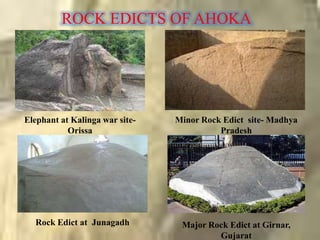
ROCK EDICTS OF AHOKA
Elephant at Kalinga war site-
Orissa
Minor Rock Edict site- Madhya
Pradesh
Rock Edict at Junagadh Major Rock Edict at Girnar,
Gujarat
 Ashoka ruled for an estimated forty years
 He had numerous wives and many heirs but most of their
name are lost
 He had entrusted to Mahindra and Sanghamitra the job of
making his state religion
 Ashoka died in 232 BC
 After his death, the Mauryan dynasty lasted just fifty more
years
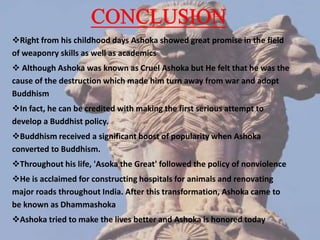
Right from his childhood days Ashoka showed great promise in the field
of weaponry skills as well as academics
 Although Ashoka was known as Cruel Ashoka but He felt that he was the
cause of the destruction which made him turn away from war and adopt
Buddhism
In fact, he can be credited with making the first serious attempt to
develop a Buddhist policy.
Buddhism received a significant boost of popularity when Ashoka
converted to Buddhism.
Throughout his life, 'Asoka the Great' followed the policy of nonviolence
He is acclaimed for constructing hospitals for animals and renovating
major roads throughout India. After this transformation, Ashoka came to
be known as Dhammashoka
Ashoka tried to make the lives better and Ashoka is honored today
Ashoka the great....

Ashoka the great....

  • 2.
    300BCE – 232BCE By: Praveen A Gondhali
  • 4.
    INTRODUCTION The high pointof the Mauryan empire Conquered the kingdom of Kalinga, 260 BC. Ruled through tightly organized bureaucracy Established capital at Pataliputra Policies of encouraging agriculture and trade Dedicated his life to Buddhism. Built Extensive roads. Conflict  How to balance Kautilya’s method of keeping power and Buddha’s demands to become a selfless person?
  • 5.
     CHANDRAGUPTA MAURYA ( FOUNDER & GRANDFATHER OF ASHOKA)  BINDUSARA  (Second king & father of Ashoka )  ASHOKA THE EMPEROR  ( Third king )
  • 7.
     Founder ofMauryan Dynasty in 322 BC.  Gained power shortly after Alexander’s death.  Was crowned king at Taxila.  Had capital at Patliputra.  His minister Chanakya wrote Arthashastra.
  • 10.
     ASHOKA BELONGTO MAURYAN DYNASTY  HE IS THE THIRD KING OF MAURYAN DYNASTY
  • 11.
    BIRTH OF ASHOKAREIGN BEGINS MARRIAGE CONVERSION DEATH IN TO BUDDHISM 300 272 284 263 232 BCE BCE BCE BCE BCE ----- ----- ----- ----- ----- ----- ----- ----- -
  • 12.
    PERSONAL INFORMATION  Quicklygrew into an excellent warrior  His command on the mauryan army started growing day by day  His elder brothers became suspicious of him being favoured as the next emperor.  The eldest son of bindusara, prince susima, convinced him to send asoka to takshashila  Went to kalinga, where he met a fisherwoman named kaurwaki.
  • 13.
    RISE TO POWER Ashoka was stationed at ujjayini as governor.  Bindusara's death in 273 bc led to a war over succession  Ashoka was supported by his father's ministers.  Ashoka managed to become the king by getting rid of the legitimate heir to the throne
  • 14.
     THE KALINGAWAR  AFTER THE KALINGA WAR  LEGACY OF ASHOKA
  • 17.
     Ashoka’s reignas emperor began with a series of wars.  He conquered more lands and added them to his empire.  The Kalinga War of 260BC was the worst of all.
  • 20.
     The hugeloss of life and suffering witnessed on the battlefield made him turn away from war.  So he was deeply influenced by Buddhism, and adopted the dharma principles.
  • 21.
     Began inthe 8th year of Ashoka's reign, probably in 261 BC  After a bloody battle, Ashoka tried to annex kalinga  In the aftermath of the battle of kalinga the daya river running next to the battle field turned red with the blood of the slain  100,000 kalinga civilians and more than 10,000 of ashoka's own warriors were among those slain
  • 22.
     After thebattle in a tour of city, he could see nothing except burnt houses and scattered corpses.  This sight made him sick and he cried the famous monologue:  What have I done? If this is a victory, what's a defeat then? Is this a victory or a defeat? Is this justice or injustice? Is it gallantry or a rout? Is it valor to kill innocent children and women? Do I do it to widen the empire and for prosperity or to destroy the other's kingdom and splendor? One has lost her husband, someone else a father, someone a child, someone an unborn infant.... What's this debris of the corpses? Are these marks of victory or defeat? Are these vultures, crows, eagles the messengers of death or evil? A Sudden Change of Heart
  • 23.
    • The mammothloss of life and suffering witnessed on the battlefield made him turn away from war • He felt that he was the cause of the destruction • His queen, Devi, who was a Buddhist, left him after seeing the brutality at Kalinga • Ashoka realized the consequences of wars and battles
  • 24.
     AFTER THEKALINGA WAR
  • 25.
     Dharma Principles Spread of Buddhism  Ashoka the Administrator
  • 26.
     The mainprincipals of dharma.  Non violence.  Tolerance of all sects.  Obedience to parents.  Respects for Brahmans, teachers & priests.  Liberality towards friends.  Humane treatment of servants.
  • 27.
     Ashoka builtshrines and monasteries and inscribed Buddhist teaching on rocks and pillars in many places.  He sent missionaries to countries.  His own son Kunal became a monk & carried Buddhism to Sri Lanka.
  • 29.
     Kashmir- Gandhara Majjhantika  Mahisamandala (Mysore)- Mahadeva  Vanavasi (Tamil Nadu) - Rakkhita  Maharattha (Maharashtra) - Mahadhammara kkhita  "Country of the Yona" (Bactria/ Seleucid Empire) - Maharakkhita  Himavanta (Nepal) - Majjhima  Suvannabhumi (Thailand/ Myanmar) - Sona and Uttara  Lankadipa (Sri Lanka) - Mahamahinda  Aparantaka (Gujarat and Sindh) - Yona Dhammarakkhit a He sent his missionaries to the following places: Missions to Spread Buddhism
  • 30.
     Ashoka taughtand convinced people to love and respect all living things.  He insisted the on the recognition of the sancity of all human life.  He abolished the the unnecessary slaughter or mutilation of animals.  Ashoka banned sport hunting and thus protected wildlife.  He became vegetarian & most people chose to become vegetarians on their own.
  • 31.
  • 32.
    * SYMBOLIC LEGACY *BOLLYWOOD LEGACY
  • 34.
     Indian governmenthas adopted the famous lion capital from his pillar at Sarnath as official national emblem.
  • 36.
     After Ashoka’sdeath in 232 BCE the people of India decided to commemorate Ashoka by using his personal chakra. It can still be seen today on the Indian flag. The word chakra is sanskrit and it means cycle or a repeting process.
  • 38.
    The Edicts ofKing Ashoka  The Rock Edicts - THE FOURTEEN ROCK EDICTS KALINGA ROCK EDICTS MINOR ROCK EDICTS THE SEVEN PILLAR EDICTS MINOR PILLAR EDICTS The pillars of Ashoka were erected by him during his reign in the 3rd century BC The Stupas of Sanchi are world famous and the stupa named SanchiStupa was built by Emperor Ashoka Ashoka's own words as known from his Edicts are: "All men are my children. I am like a father to them. As every father desires the good and the happiness of his children, I wish that all men should be happy always”.
  • 40.
    ROCK EDICTS OFAHOKA Elephant at Kalinga war site- Orissa Minor Rock Edict site- Madhya Pradesh Rock Edict at Junagadh Major Rock Edict at Girnar, Gujarat
  • 41.
     Ashoka ruledfor an estimated forty years  He had numerous wives and many heirs but most of their name are lost  He had entrusted to Mahindra and Sanghamitra the job of making his state religion  Ashoka died in 232 BC  After his death, the Mauryan dynasty lasted just fifty more years
  • 42.
    Right from hischildhood days Ashoka showed great promise in the field of weaponry skills as well as academics  Although Ashoka was known as Cruel Ashoka but He felt that he was the cause of the destruction which made him turn away from war and adopt Buddhism In fact, he can be credited with making the first serious attempt to develop a Buddhist policy. Buddhism received a significant boost of popularity when Ashoka converted to Buddhism. Throughout his life, 'Asoka the Great' followed the policy of nonviolence He is acclaimed for constructing hospitals for animals and renovating major roads throughout India. After this transformation, Ashoka came to be known as Dhammashoka Ashoka tried to make the lives better and Ashoka is honored today