1. Students willbe able to discuss and write about the significant contributions of
emperor Asoka.
2. Students will be able to enquiry and interact about the life and achievements of
emperor Asoka.
Learning Objectives
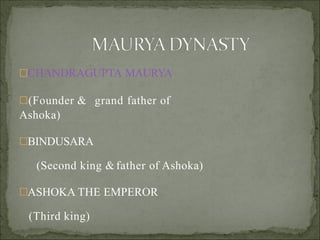
CHANDRAGUPTA MAURYA
(Founder &grand father of
Ashoka)
BINDUSARA
(Second king & father of Ashoka)
ASHOKA THE EMPEROR
(Third king)
8.
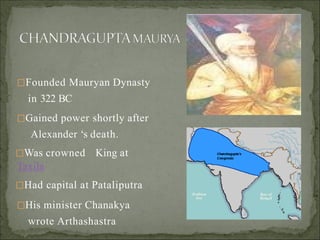
Founded Mauryan Dynasty
in322 BC
Gained power shortly after
Alexander ‘s death.
Was crowned King at
Taxila
Had capital at Pataliputra
His minister Chanakya
wrote Arthashastra
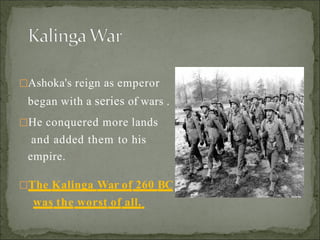
Ashoka's reign asemperor
began with a series of wars .
He conquered more lands
and added them to his
empire.
The Kalinga War of 260 BC
was the worst of all.
12.
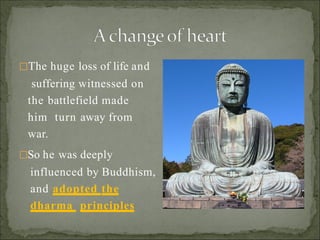
The huge lossof life and
suffering witnessed on
the battlefield made
him turn away from
war.
So he was deeply
influenced by Buddhism,
and adopted the
dharma principles
The main principlesof dharma (dhamma)
nonviolence,
tolerance of all sects,
obedience to parents,
respect for Brahmans , teachers &
priests
liberality towards friends,
humane treatment of servants,
16.
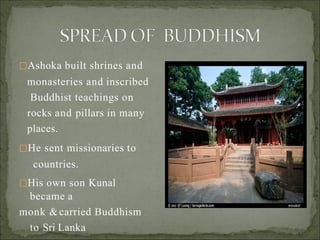
Ashoka built shrinesand
monasteries and inscribed
Buddhist teachings on
rocks and pillars in many
places.
He sent missionaries to
countries.
His own son Kunal
became a
monk & carried Buddhism
to Sri Lanka
17.
Ashoka taught andconvinced people to love and
respect all living things.
He insisted on the recognition of the
sanctity of all human life.
He abolished the unnecessary slaughter or
mutilation of animals.
Ashoka banned sport hunting & thus protected wildlife.
He became vegetarian & most people
chose to become vegetarians on their own.
He allowed one day leave to prisoners to go outside
for a day of the year.
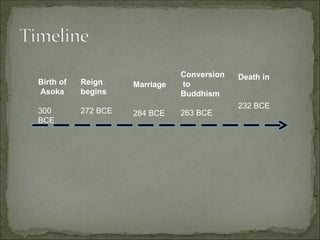
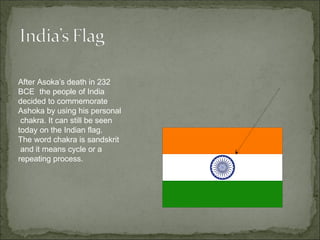
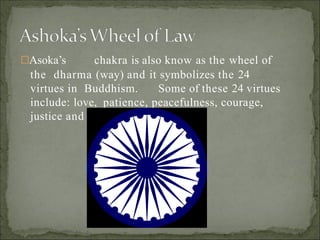
After Asoka’s deathin 232
BCE the people of India
decided to commemorate
Ashoka by using his personal
chakra. It can still be seen
today on the Indian flag.
The word chakra is sandskrit
and it means cycle or a
repeating process.
21.
Asoka’s chakra isalso know as the wheel of
the dharma (way) and it symbolizes the 24
virtues in Buddhism. Some of these 24 virtues
include: love, patience, peacefulness, courage,
justice and mercy.
22.
After the deathof Asoka's father, Binder Sar, Ashoka
and his older brother competed for the throne.
The prime minister and other important ministers
at the time though Asoka to be more discreet,
capable and efficient ruler.
The next three years Ashoka focused on reestablishing
peace.
During Asoka's rule theft declined and science,
medicine and technology all flourished.
Buddhism received a significant boost of
popularity when Ashoka converted to Buddhism.
23.
Asoka married acommoner called Karuwaki, she was a
fisher.
He met her before his reign when he was sent to
Taxshila to subdue an uprising as a general of the
Mauryan empire.
Due to Ashoka’s success in the quelling of the uprising
and his growing popularity, his step-brothers forced
him into exile to prevent him from obtaining the
throne.
Asoka however returned two years later being
summoned by the emperor to quell another
uprising.
24.
BeforeAshoka’s conquest ofKalinga he was
known as Chandashok ( Chanda-cruel, shok-
associated with Hindu goddess of eternal energy)
Asoka was considered a bloodthirsty and power
greedy individual. It was not until later, after the
conquest of Kalinga, where Asoka received his
revelation that he was considered great.




![Ashoka the great [recovered]](https://cdn.slidesharecdn.com/ss_thumbnails/ashokathegreatrecovered-161015123240-thumbnail.jpg?width=640&height=640&fit=bounds)


