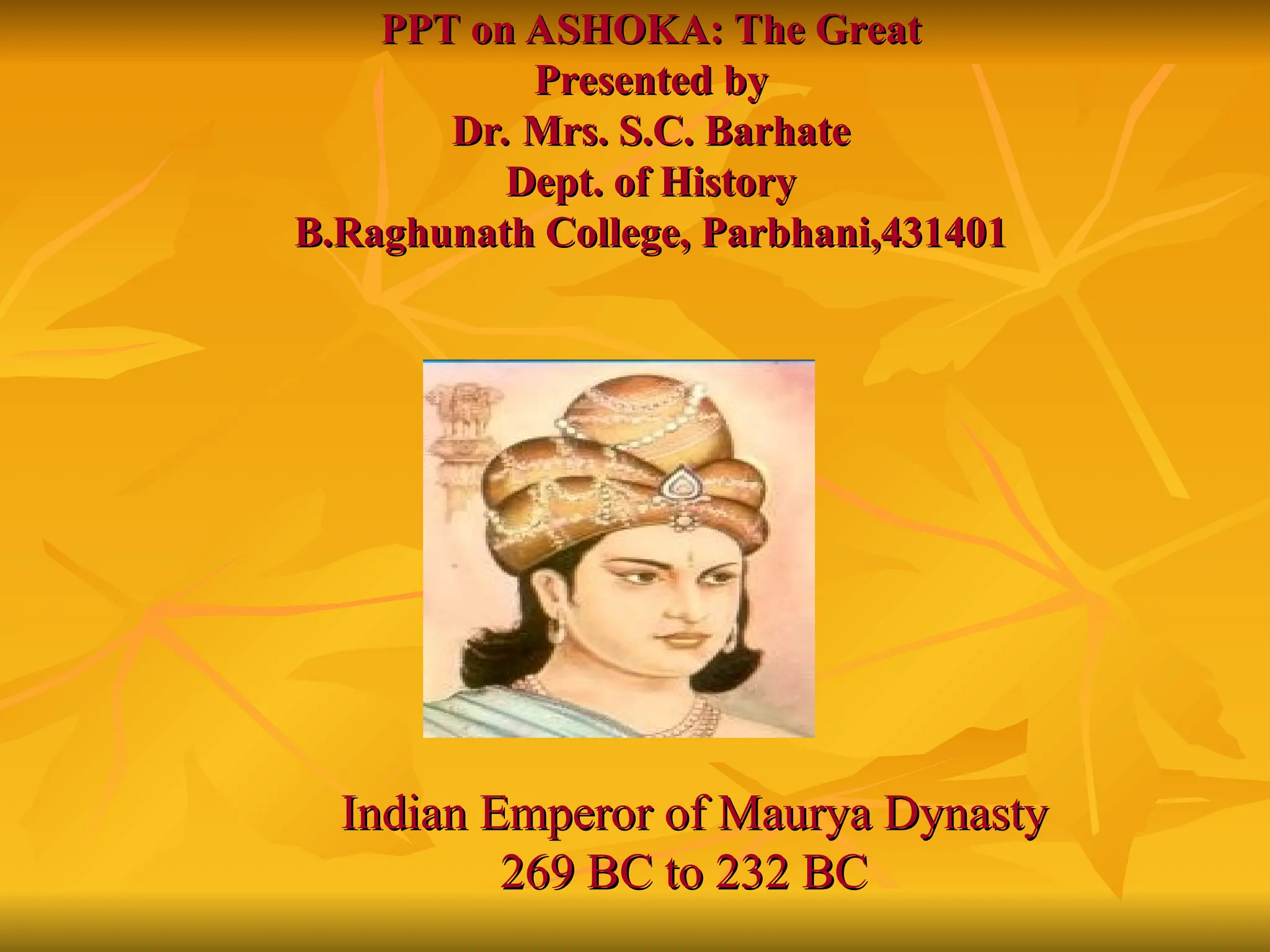
PPT on ASHOKA:The Great
PPT on ASHOKA: The Great
Presented by
Presented by
Dr. Mrs. S.C. Barhate
Dr. Mrs. S.C. Barhate
Dept. of History
Dept. of History
B.Raghunath College, Parbhani,431401
B.Raghunath College, Parbhani,431401
Indian Emperor of Maurya Dynasty
Indian Emperor of Maurya Dynasty
269 BC to 232 BC
269 BC to 232 BC
2.
Index
Index
Introduction
Introduction
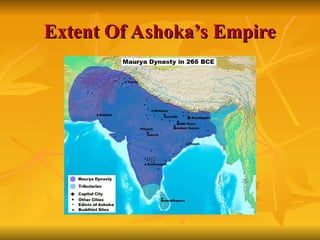
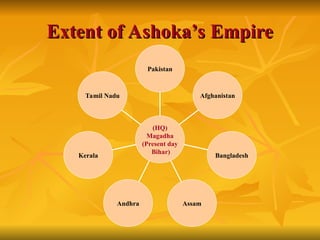
Extentof Empire
Extent of Empire
The Kalinga War
The Kalinga War
Conversion to Buddhism
Conversion to Buddhism
Propagation of Buddhism
Propagation of Buddhism
Achievements
Achievements
Conclusion
Conclusion
3.
Introduction
Introduction
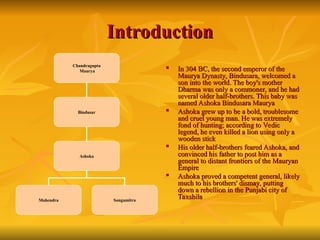
Chandragupta
Maurya
Bindusar
Ashoka
Mahendra Sangamitra
In 304BC, the second emperor of the
In 304 BC, the second emperor of the
Maurya Dynasty, Bindusara, welcomed a
Maurya Dynasty, Bindusara, welcomed a
son into the world. The boy's mother
son into the world. The boy's mother
Dharma was only a commoner, and he had
Dharma was only a commoner, and he had
several older half-brothers. This baby was
several older half-brothers. This baby was
named Ashoka Bindusara Maurya
named Ashoka Bindusara Maurya
Ashoka grew up to be a bold, troublesome
Ashoka grew up to be a bold, troublesome
and cruel young man. He was extremely
and cruel young man. He was extremely
fond of hunting; according to Vedic
fond of hunting; according to Vedic
legend, he even killed a lion using only a
legend, he even killed a lion using only a
wooden stick
wooden stick
His older half-brothers feared Ashoka, and
His older half-brothers feared Ashoka, and
convinced his father to post him as a
convinced his father to post him as a
general to distant frontiers of the Mauryan
general to distant frontiers of the Mauryan
Empire
Empire
Ashoka proved a competent general, likely
Ashoka proved a competent general, likely
much to his brothers' dismay, putting
much to his brothers' dismay, putting
down a rebellion in the Punjabi city of
down a rebellion in the Punjabi city of
Taxshila
Taxshila
Extent
Extent of Ashoka’sEmpire
of Ashoka’s Empire
Tamil Nadu
Kerala
Andhra Assam
Bangladesh
Afghanistan
Pakistan
(HQ)
Magadha
(Present day
Bihar)
6.
The Kalinga
The KalingaWar
War
The war that changed Ashoka’s life
The war that changed Ashoka’s life
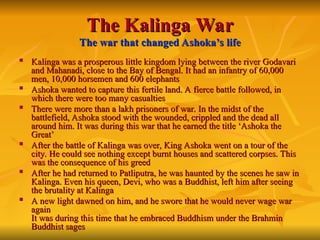
Kalinga was a prosperous little kingdom lying between the river Godavari
Kalinga was a prosperous little kingdom lying between the river Godavari
and Mahanadi, close to the Bay of Bengal. It had an infantry of 60,000
and Mahanadi, close to the Bay of Bengal. It had an infantry of 60,000
men, 10,000 horsemen and 600 elephants
men, 10,000 horsemen and 600 elephants
Ashoka wanted to capture this fertile land. A fierce battle followed, in
Ashoka wanted to capture this fertile land. A fierce battle followed, in
which there were too many casualties
which there were too many casualties
There were more than a lakh prisoners of war. In the midst of the
There were more than a lakh prisoners of war. In the midst of the
battlefield, Ashoka stood with the wounded, crippled and the dead all
battlefield, Ashoka stood with the wounded, crippled and the dead all
around him. It was during this war that he earned the title ‘Ashoka the
around him. It was during this war that he earned the title ‘Ashoka the
Great’
Great’
After the battle of Kalinga was over, King Ashoka went on a tour of the
After the battle of Kalinga was over, King Ashoka went on a tour of the
city. He could see nothing except burnt houses and scattered corpses. This
city. He could see nothing except burnt houses and scattered corpses. This
was the consequence of his greed
was the consequence of his greed
After he had returned to Patliputra, he was haunted by the scenes he saw in
After he had returned to Patliputra, he was haunted by the scenes he saw in
Kalinga. Even his queen, Devi, who was a Buddhist, left him after seeing
Kalinga. Even his queen, Devi, who was a Buddhist, left him after seeing
the brutality at Kalinga
the brutality at Kalinga
A new light dawned on him, and he swore that he would never wage war
A new light dawned on him, and he swore that he would never wage war
again
again
It was during this time that he embraced Buddhism under the Brahmin
It was during this time that he embraced Buddhism under the Brahmin
Buddhist sages
Buddhist sages
7.
Conversion to Buddhism
Conversionto Buddhism
Ashoka
Ashoka religiously
religiously followed
followed the
the
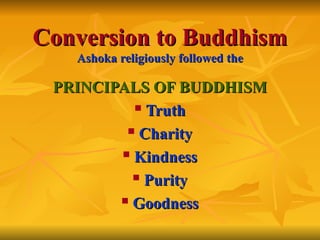
PRINCIPALS OF BUDDHISM
PRINCIPALS OF BUDDHISM
Truth
Truth
Charity
Charity
Kindness
Kindness
Purity
Purity
Goodness
Goodness
8.
Propagation of Buddhism
Propagationof Buddhism
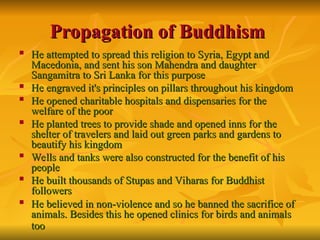
He attempted to spread this religion to Syria, Egypt and
He attempted to spread this religion to Syria, Egypt and
Macedonia, and sent his son Mahendra and daughter
Macedonia, and sent his son Mahendra and daughter
Sangamitra to Sri Lanka for this purpose
Sangamitra to Sri Lanka for this purpose
He engraved it's principles on pillars throughout his kingdom
He engraved it's principles on pillars throughout his kingdom
He opened charitable hospitals and dispensaries for the
He opened charitable hospitals and dispensaries for the
welfare of the poor
welfare of the poor
He planted trees to provide shade and opened inns for the
He planted trees to provide shade and opened inns for the
shelter of travelers and laid out green parks and gardens to
shelter of travelers and laid out green parks and gardens to
beautify his kingdom
beautify his kingdom
Wells and tanks were also constructed for the benefit of his
Wells and tanks were also constructed for the benefit of his
people
people
He built thousands of Stupas and Viharas for Buddhist
He built thousands of Stupas and Viharas for Buddhist
followers
followers
He believed in non-violence and so he banned the sacrifice of
He believed in non-violence and so he banned the sacrifice of
animals. Besides this he opened clinics for birds and animals
animals. Besides this he opened clinics for birds and animals
too
too
9.
Achievements
Achievements
The caste systemceased to exist in his eyes and he treated all his subjects
The caste system ceased to exist in his eyes and he treated all his subjects
as equals. At the same time, each and every person was given the rights to
as equals. At the same time, each and every person was given the rights to
freedom, tolerance, and equality
freedom, tolerance, and equality
His good works earned him the name of Devanamapriya Priyadarshi
His good works earned him the name of Devanamapriya Priyadarshi
(Beloved of the Gods)
(Beloved of the Gods)
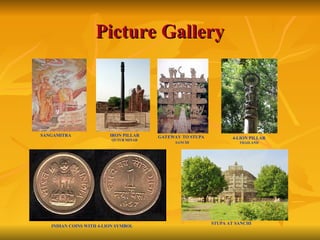
One of his stupas, the Great Sanchi Stupa, has been declared as a World
One of his stupas, the Great Sanchi Stupa, has been declared as a World
Heritage Site by UNECSO
Heritage Site by UNECSO
The Ashoka Pillar at Sarnath has a four-lion capital, which was later
The Ashoka Pillar at Sarnath has a four-lion capital, which was later
adopted as the national emblem of the modern Indian republic
adopted as the national emblem of the modern Indian republic
To commemorate his rule and its implications the Government of India has
To commemorate his rule and its implications the Government of India has
adopted the Ashoka Chakra as its national symbol, which can be seen till
adopted the Ashoka Chakra as its national symbol, which can be seen till
today on the national flag
today on the national flag
10.
Conclusion
Conclusion
After ruling overthe Indian subcontinent for a
After ruling over the Indian subcontinent for a
period of approximately 40 years, the Great
period of approximately 40 years, the Great
Emperor Asoka left for the holy abode in 232
Emperor Asoka left for the holy abode in 232
BC. After his death, his empire lasted for just
BC. After his death, his empire lasted for just
fifty more years.
fifty more years.
But his name still lives on…
But his name still lives on…
“
“Ashoka …Without Sorrow”
Ashoka …Without Sorrow”



![Ashoka the great [recovered]](https://cdn.slidesharecdn.com/ss_thumbnails/ashokathegreatrecovered-161015123240-thumbnail.jpg?width=640&height=640&fit=bounds)


