Vijayanagar Empire
Nearest to ‘War State’
Abdul Azim Akhtar
• Harihar & Bukka ( converted & reverted)
• 1336- Harihara crowned himself at Hampi;
• Belonged to sangam dynasty
• Harihar ( 1336-56)
• Bukka- 1356-77) he was engaged in aggression
and series of attacks; on Bahamani Sultans;
• Krishna Deva Raya (1509-1530)
Abdul Azim Akhtar
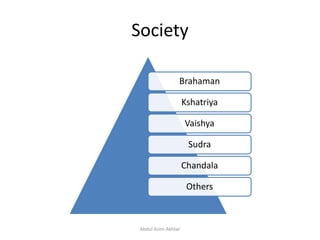
Society
Brahaman
Kshatriya
Vaishya
Sudra
Chandala
Others
Abdul Azim Akhtar
Society
• Caste system was enforced in letter & spirit
• Brahmans- honoured, granted Agrahara,
occupied key posts, ministers, army officers,
accountants
• Kshatriya- serving in the army
• Vaishya- trading
• Sudras- cultivate land; some like Blanjas rose
to prominence
Abdul Azim Akhtar
Society
• Women-women became slave as ‘devdasi’ in
temples; elite women enjoyed better position;
Gangadevi w/o Kumara Kampana wrote
‘Madura Vijayam’ ; Tirumalamba author of
‘Varadmika Parinayam’.
• Sati- common often among upper classes;
Memorial stones were raised for sati women
as Satikal & Sati Virakal
Abdul Azim Akhtar
• Food- Rice, millet, grain, veg & Non-veg food
• Dress- Cotton, silk colthes in vogue, majority
of people wore shoes
Abdul Azim Akhtar
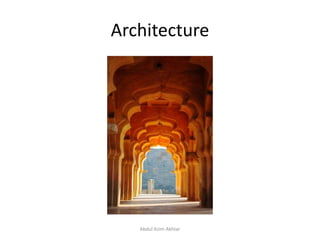
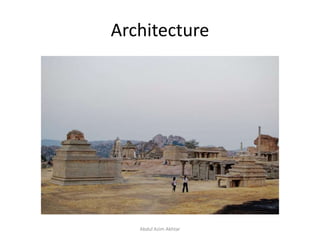
Architecture
Abdul Azim Akhtar
Architecture
Abdul Azim Akhtar
Hampi
• Palace fortified and protected by seven walls;
middle class live in flat roofed house, lower
classes lived in thached houses
• Temple- South Viman Style : 1) Adhisthana
Base 2) Pada ( enclosure of deity) 3)Prastara –
Prastara –Horizontal 4) Greebha – Neck 5)
Shikhara (Spire) 6) Crown (Stupi)
Abdul Azim Akhtar
• Temples, palaces, forts ; Gopuras (tower at
entrace) replaced Vimana (structure over
sanctum sanctorum); main deity accompanied by
subordinate deities
Mandap- pillared hall created ; temples at Madurai,
Srirangam, Chidambaram, Kanchi, Tadipatri,
Vittala temple & Hazarnama
Figures of Narsimha is found in Vaishnav temple;
Two feminine Dwarapalikas at the entrance are
figured- identified as Ganga & Yamuna; figure of
animals women used to decorate
Abdul Azim Akhtar
• Virbhadra at Lepakshi & Bhimesvara (Tanjore)
famous for painting decorations; Tepakshi
temple has scene from Ramayana & figures of
Vishnu; pigments mixed with lime water to
dry the wall
Abdul Azim Akhtar
• Amaram System
NAYAK was granted a piece of land , and in
return of which he was to maintain a number
of troops, horses and elephants for the ruler;
There were around 200 Nayaks in the
Vijayanagar Kingdom
Abdul Azim Akhtar
Commerce & Trade
• Merchants formed guild, head was called as
Setti or PattnaSwami; maintained financial
stability and granted donations to charities /
temples; decide & regulate wholesale price;
They helped in collection of taxes ; Export-
cloth, rice, iron, spice; import-horses; ports-
West-Bhatkal, Calicut; East – Motupalli,
Pullicot, Madras, Nagapattam
Abdul Azim Akhtar
• Taxes- ¼ to 1/3 collected as taxes; Land
Revenue, Marriage Tax, Grazing Tax, custom
duties, tax on prostitutes; tax collection was
given to highest bidder; tax burden heavy and
people migrated due to it
• Culture- Students were offered free eduction,
boarding, and lodging; patron of literature,
taxfree land to scholars granted,
Abdul Azim Akhtar
• Precious stones uses and sold
• Agriculture- Main occupation; canals and
tanks dugged; Porumamila Tank in Cuddapah
district built during this period ; Also tank at
Hampi with the help of Portuguese; New lands
was brough under cultivation; rice, wheat,
grains, cotton, & other products grown
Abdul Azim Akhtar
• Telgu,
• Kannada and
• Tamil language developed
• Krishnadeva Raya patronised 8 Telgu poets;
Astadiggajams’; He wrote Aruukta Malayda’.
Kannada literature relates to Jain, Vira Saiva
religion; Tamil literature relates to Saivism
Abdul Azim Akhtar
Foreign Accounts
• Niccolo Conti, Paes, Nuniz, Abdur Razzak
• Paes (Italian) ‘ He (Krishna Deva Rai) is a great
ruler and a man of much justice, but subject
to sudden fits of anger’.
• Abdur-Razzak (Iran); ‘Near the palance was
Chihal-Satun or forty pillared hall’
• The King was very wealthy, most splendid in
world’
Abdul Azim Akhtar
What they say
• Conti- ‘ The king is more powerful than all other
kings of India’
• Ferishta ‘In power, wealth, and extent the Rayas
of Bijanagar ( Vijayanagar) greatly exceeded the
Bahmanis’
• Barbosa- talks of justice, equity, and religious
tolerance prevailing within empire
• Nikitin- ‘People in the country are very miserable,
while the nobles are extremely rich’
Abdul Azim Akhtar

Vijayanagar empire

  • 1.
    Vijayanagar Empire Nearest to‘War State’ Abdul Azim Akhtar
  • 2.
    • Harihar &Bukka ( converted & reverted) • 1336- Harihara crowned himself at Hampi; • Belonged to sangam dynasty • Harihar ( 1336-56) • Bukka- 1356-77) he was engaged in aggression and series of attacks; on Bahamani Sultans; • Krishna Deva Raya (1509-1530) Abdul Azim Akhtar
  • 3.
  • 4.
    Society • Caste systemwas enforced in letter & spirit • Brahmans- honoured, granted Agrahara, occupied key posts, ministers, army officers, accountants • Kshatriya- serving in the army • Vaishya- trading • Sudras- cultivate land; some like Blanjas rose to prominence Abdul Azim Akhtar
  • 5.
    Society • Women-women becameslave as ‘devdasi’ in temples; elite women enjoyed better position; Gangadevi w/o Kumara Kampana wrote ‘Madura Vijayam’ ; Tirumalamba author of ‘Varadmika Parinayam’. • Sati- common often among upper classes; Memorial stones were raised for sati women as Satikal & Sati Virakal Abdul Azim Akhtar
  • 6.
    • Food- Rice,millet, grain, veg & Non-veg food • Dress- Cotton, silk colthes in vogue, majority of people wore shoes Abdul Azim Akhtar
  • 7.
  • 8.
  • 9.
    Hampi • Palace fortifiedand protected by seven walls; middle class live in flat roofed house, lower classes lived in thached houses • Temple- South Viman Style : 1) Adhisthana Base 2) Pada ( enclosure of deity) 3)Prastara – Prastara –Horizontal 4) Greebha – Neck 5) Shikhara (Spire) 6) Crown (Stupi) Abdul Azim Akhtar
  • 10.
    • Temples, palaces,forts ; Gopuras (tower at entrace) replaced Vimana (structure over sanctum sanctorum); main deity accompanied by subordinate deities Mandap- pillared hall created ; temples at Madurai, Srirangam, Chidambaram, Kanchi, Tadipatri, Vittala temple & Hazarnama Figures of Narsimha is found in Vaishnav temple; Two feminine Dwarapalikas at the entrance are figured- identified as Ganga & Yamuna; figure of animals women used to decorate Abdul Azim Akhtar
  • 11.
    • Virbhadra atLepakshi & Bhimesvara (Tanjore) famous for painting decorations; Tepakshi temple has scene from Ramayana & figures of Vishnu; pigments mixed with lime water to dry the wall Abdul Azim Akhtar
  • 12.
    • Amaram System NAYAKwas granted a piece of land , and in return of which he was to maintain a number of troops, horses and elephants for the ruler; There were around 200 Nayaks in the Vijayanagar Kingdom Abdul Azim Akhtar
  • 13.
    Commerce & Trade •Merchants formed guild, head was called as Setti or PattnaSwami; maintained financial stability and granted donations to charities / temples; decide & regulate wholesale price; They helped in collection of taxes ; Export- cloth, rice, iron, spice; import-horses; ports- West-Bhatkal, Calicut; East – Motupalli, Pullicot, Madras, Nagapattam Abdul Azim Akhtar
  • 14.
    • Taxes- ¼to 1/3 collected as taxes; Land Revenue, Marriage Tax, Grazing Tax, custom duties, tax on prostitutes; tax collection was given to highest bidder; tax burden heavy and people migrated due to it • Culture- Students were offered free eduction, boarding, and lodging; patron of literature, taxfree land to scholars granted, Abdul Azim Akhtar
  • 15.
    • Precious stonesuses and sold • Agriculture- Main occupation; canals and tanks dugged; Porumamila Tank in Cuddapah district built during this period ; Also tank at Hampi with the help of Portuguese; New lands was brough under cultivation; rice, wheat, grains, cotton, & other products grown Abdul Azim Akhtar
  • 16.
    • Telgu, • Kannadaand • Tamil language developed • Krishnadeva Raya patronised 8 Telgu poets; Astadiggajams’; He wrote Aruukta Malayda’. Kannada literature relates to Jain, Vira Saiva religion; Tamil literature relates to Saivism Abdul Azim Akhtar
  • 17.
    Foreign Accounts • NiccoloConti, Paes, Nuniz, Abdur Razzak • Paes (Italian) ‘ He (Krishna Deva Rai) is a great ruler and a man of much justice, but subject to sudden fits of anger’. • Abdur-Razzak (Iran); ‘Near the palance was Chihal-Satun or forty pillared hall’ • The King was very wealthy, most splendid in world’ Abdul Azim Akhtar
  • 18.
    What they say •Conti- ‘ The king is more powerful than all other kings of India’ • Ferishta ‘In power, wealth, and extent the Rayas of Bijanagar ( Vijayanagar) greatly exceeded the Bahmanis’ • Barbosa- talks of justice, equity, and religious tolerance prevailing within empire • Nikitin- ‘People in the country are very miserable, while the nobles are extremely rich’ Abdul Azim Akhtar