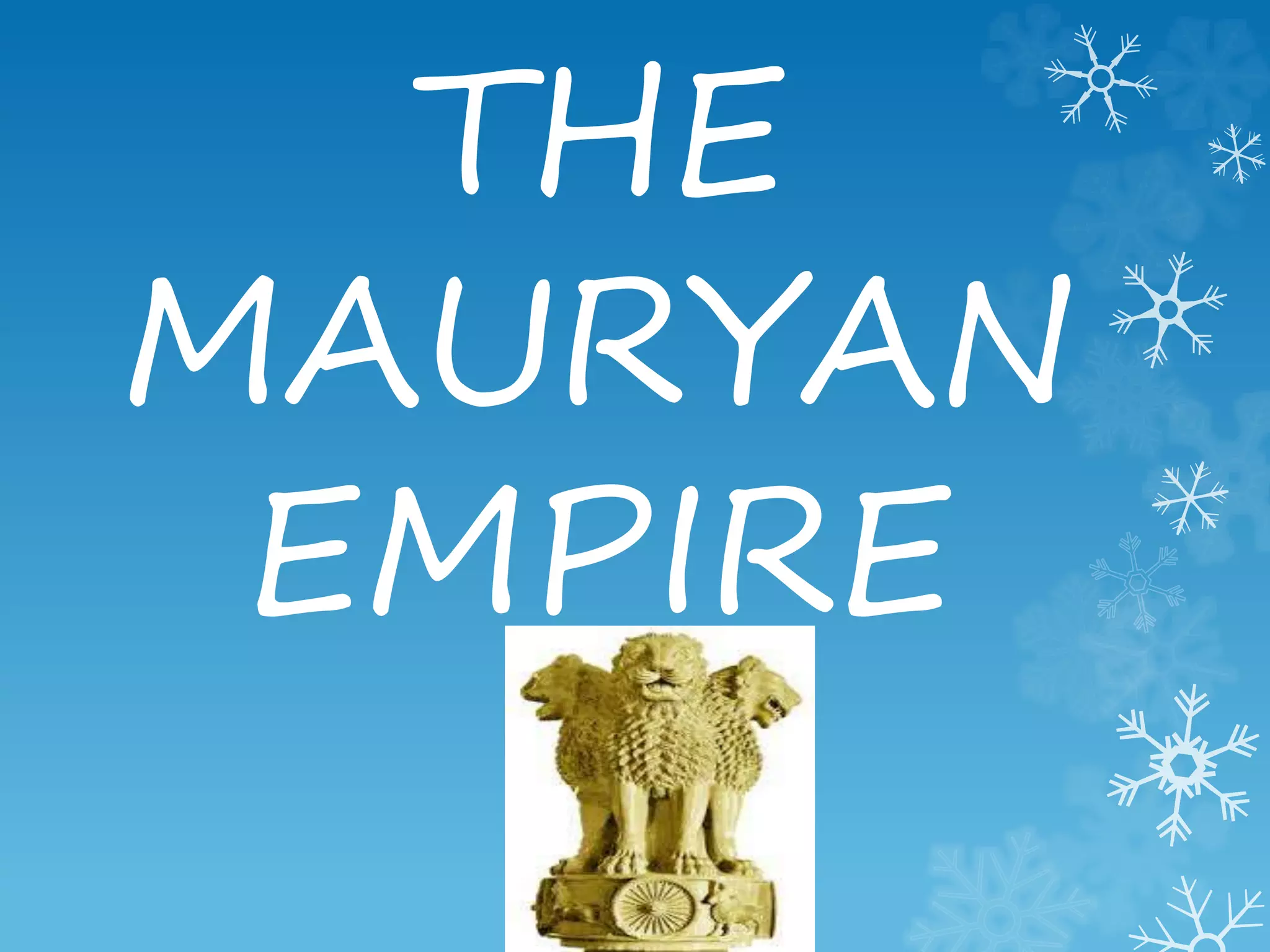
THE
MAURYAN
EMPIRE
INTRODUCTION TO THE
MAURYAN EMPIRE
 The Maurya Empire, also known as the Mauryan
Empire, was a geographically extensive Iron
Age historical power in ancient India, ruled by
the Maurya dynasty from 322–185 BCE. Originating
from the kingdom of Magadha in the Indo-Gangetic
Plain(modern Bihar, eastern Uttar Pradesh) in the
eastern side of the Indian subcontinent, the empire had
its capital city at Pataliputra
2
ALEXANDER THE GREAT
 In 327 BC Alexander of
Macedonia conquered a large
part of the northwest India.
He entered India through the
Hindukush. As a great ruler,
he developed good relations
with the local authorities
while establishing his
garrisons. While returning
back due to the pressure of
his war weary soldiers, he
left these areas to be ruled
by Greek governors.
Chandragupta Maurya fought
the Macedonians and
defeated them.
3
KAUTILYA
 Kautilya also known as
Chanakya [350 – 275 BC] was
an Indian teacher, philosopher,
economist, jurist and royal
advisor. He is traditionally
identified
as Kautilya or Vishnu Gupta,
who authored the ancient Indian
political treatise,
theArthashastra (Economics).As
such, he is considered as the
pioneer of the field of political
science and economics in India,
and his work is thought of as an
important precursor to classical
economics.His works were lost
near the end of the Gupta
Empire. Chanakya managed the
first Mauryan
emperor Chandragupta's rise to
power at a young age. He is
widely credited for having
played an important role in the
establishment of the Maurya
EmpireChanakya served as the
chief advisor to both emperors
Chandragupta and his
son Bindusara.
4
CHANDRAGUPTA MAURYA
324-300 BC
 The Maurya Empire was founded by Chandragupta
Maurya, with help from Chanakya, a Brahmin teacher
at Takshashila. According to several legends, Chanakya
traveled to Magadha, a kingdom that was large and
militarily powerful and feared by its neighbors, but was
insulted by its king Dhana Nanda, of the Nanda Dynasty.
Chanakya swore revenge and vowed to destroy the
Nanda Empire.
 Chandragupta Maurya succeeded to the Nanda throne in
321 B.C. Chandragupta belonged to the Moriya tribe, but
his caste was low. Young Maurya and his supporters
were inferior in armed strength to the Nandas.
5
INVASION OF SELEUCOS
NICATOR
6
 Seleucus was one of the leading
generals of Alexander. While
journeying back to Greece from
India, Alexander reached
Babylon, he fell seriously ill and
died there in 323 B.C. Alexander
died without any heir. So his
extensive empire was shared
out by his three generals among
themselves. three parts- the
Greek, the Egyptian and the
Asian. The first two parts came
into the possession of Ptolemy
and Antigones respectively,
while the third i.e. the Asian
part fell to the lot of
Seleucus. Seleucus wanted to
regain these territories and to
move further to the east of
Indus. . On Kautilya's advice,
Chandragupta married the
daughter of Seleucus, Helen.
KING BINDUSARA
300-273 BC
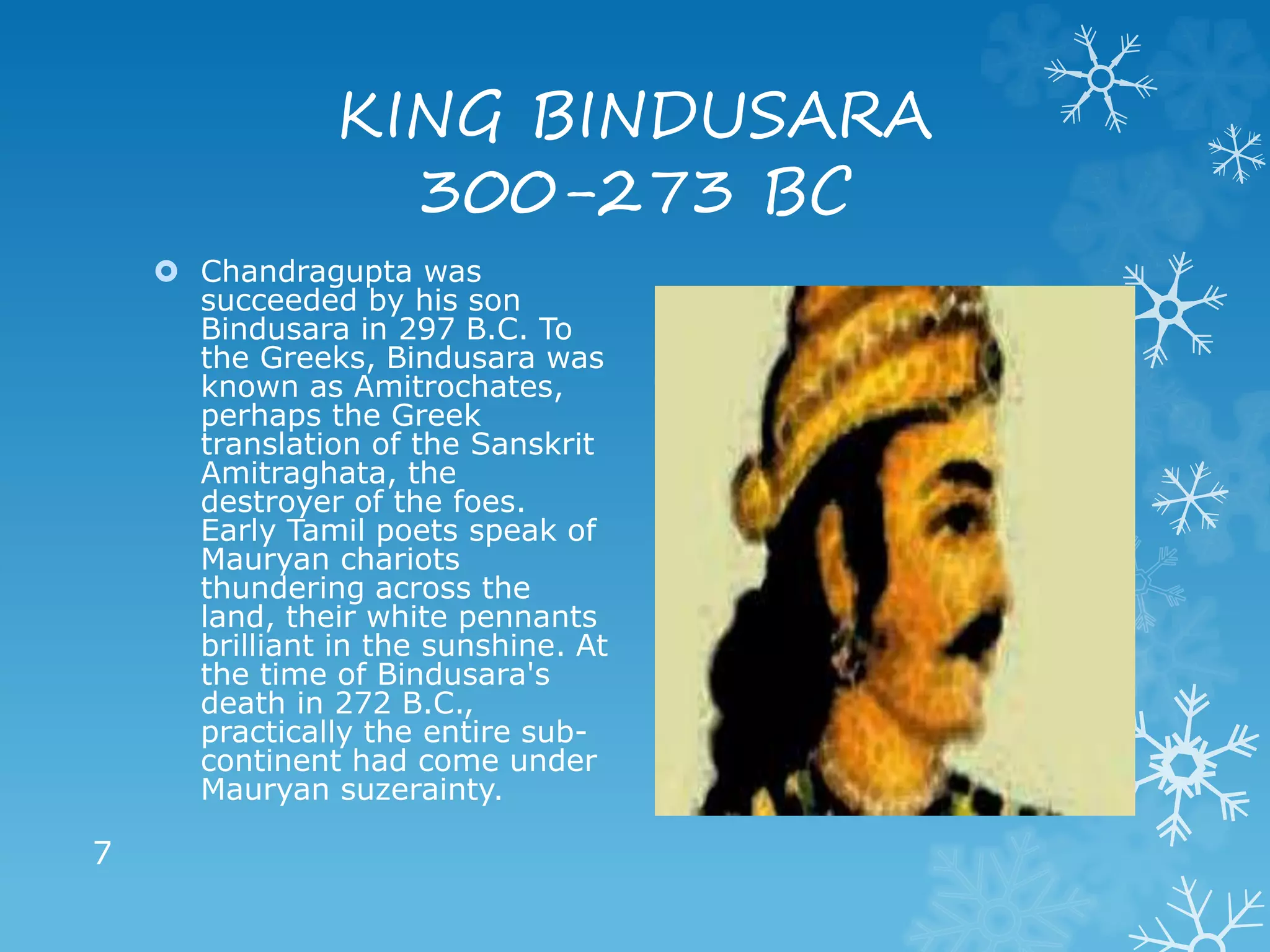
 Chandragupta was
succeeded by his son
Bindusara in 297 B.C. To
the Greeks, Bindusara was
known as Amitrochates,
perhaps the Greek
translation of the Sanskrit
Amitraghata, the
destroyer of the foes.
Early Tamil poets speak of
Mauryan chariots
thundering across the
land, their white pennants
brilliant in the sunshine. At
the time of Bindusara's
death in 272 B.C.,
practically the entire sub-
continent had come under
Mauryan suzerainty.
7
KING ASHOKA
273-232 BC
8
 Ashoka ,was the greatest
emperor of ancient India. He
ruled the Maurya Empire from
about 273 B.C. until his
death. Ashoka was the
grandson of Chandragupta,
founder of the Mauryan
dynasty. His father, Bindusara,
ruled northern India for 29
years. Ashoka was a fierce
military leader who expanded
his kingdom in the Ganges-
Jamuna valley. He continued
his victorious campaigns in
southern and eastern India for
eight years. In 261 B.C., he
conquered Kalinga (now
known as Orissa), a region on
the east coast of India.
EXTENT OF ASHOKA’S
EMPIRE
9
THE KALINGA WAR
 The Kalinga War was fought
between the Mauryan
Empire with Ashoka the
Great and the ruler of the state
of Kalinga, a
feudal republic located on the
coast of the present-
day Indian state of Odisha and
northern parts of Andhra
Pradesh. The Kalinga war, the
only major war Ashoka fought
after his accession to throne, is
one of the major and bloodiest
battles in world history. Kalinga,
then an Independent region put
up a stiff resistance against
brutal strength of Ashoka and
fought bravely till the end. But
despite being tough, they were
outnumbered against Ashoka's
armies. The bloodshed of this
war is said to have prompted
Ashoka to adopt Buddhism.
10
MAURYAN ADMINISTRATION
 The Empire was divided into four provinces, with the
imperial capital at Pataliputra. From Ashokan edicts, the
names of the four provincial capitals are Tosali (in the
east), Ujjain (in the west), Suvarnagiri (in the south),
and Taxila (in the north). The head of the provincial
administration was the Kumara (royal prince), who
governed the provinces as king's representative.
The kumara was assisted by Mahamatyas and council of
ministers. This organizational structure was reflected at
the imperial level with the Emperor and his
Mantriparishad (Council of Ministers).
11
12
13
14
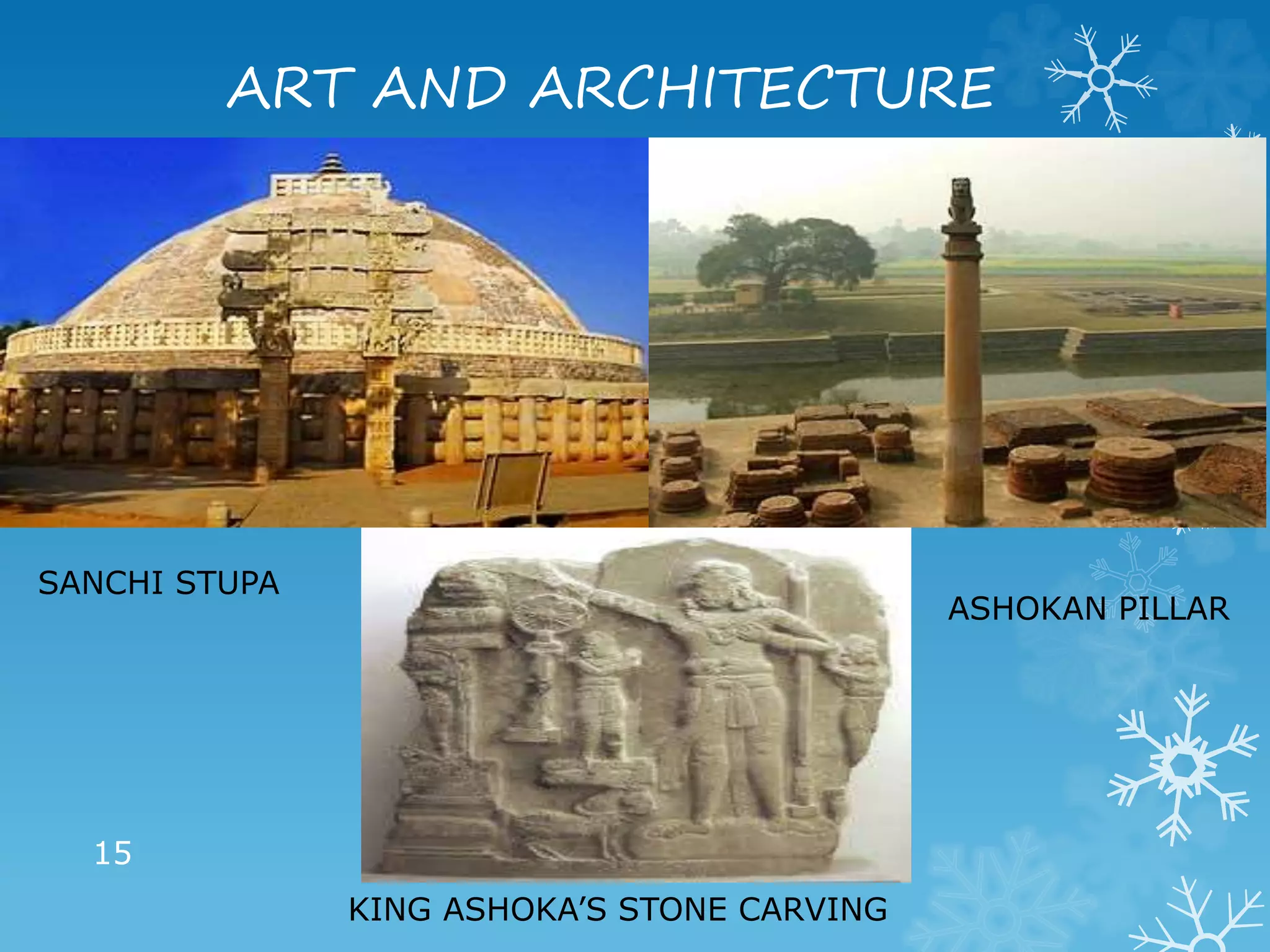
ART AND ARCHITECTURE
15
SANCHI STUPA
ASHOKAN PILLAR
KING ASHOKA’S STONE CARVING
16
17
THE DHAMMA
 The word Dhamma is the Prakrit form of
the Sanskrit word Dharma. There have been attempts
to define and find equivalent English words for it, such
as "piety", "moral life" and "righteousness" but scholars
could not translate it into English because it was coined
and used in a specific context. The word Dharma has
multiple meanings in the literature and thought of
ancient India. The best way to understand what Ashoka
means by Dhamma is to read his edicts, which were
written to explain the principles of Dhamma to the
people of that time throughout the empire.
18
19
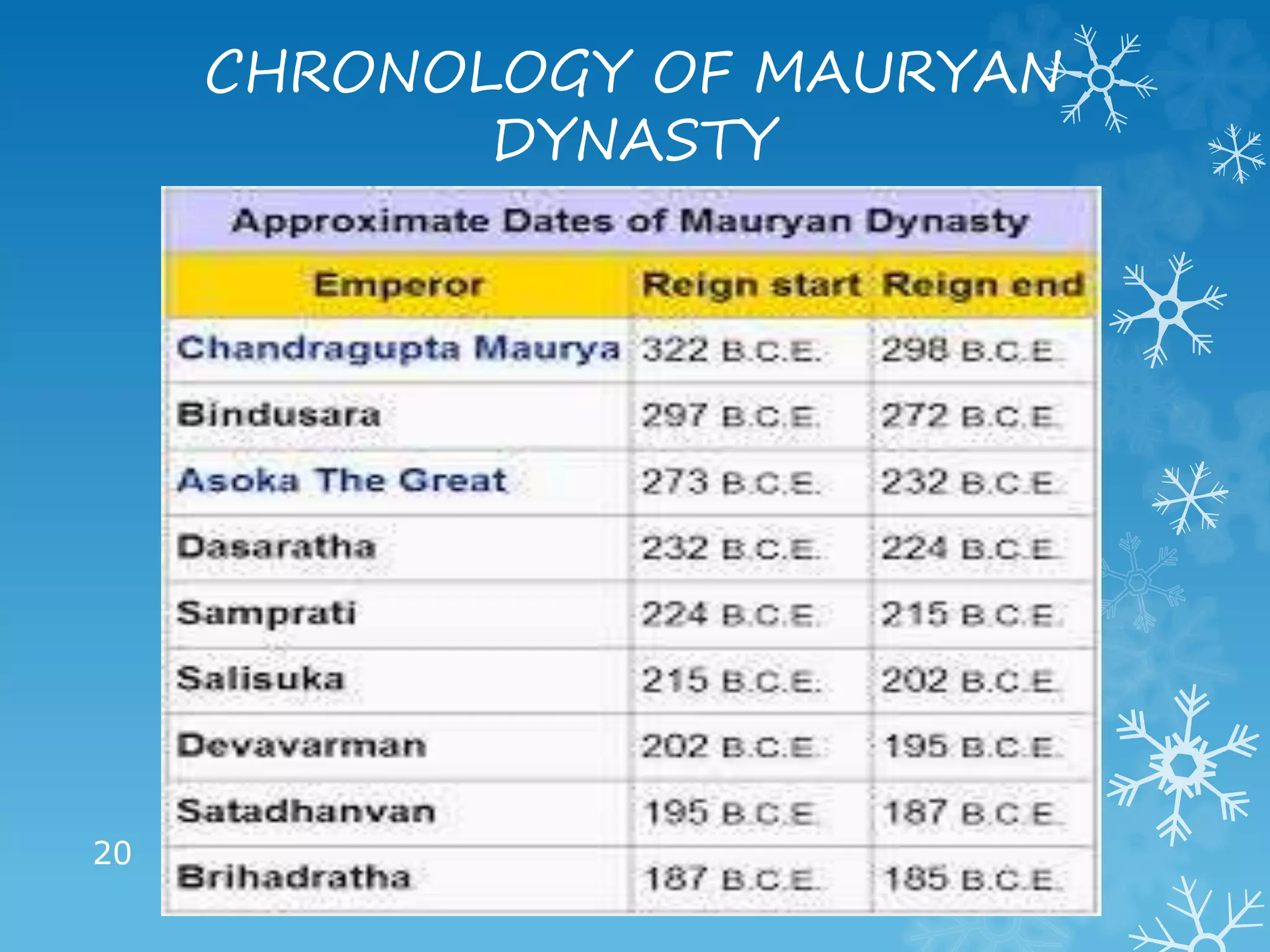
CHRONOLOGY OF MAURYAN
DYNASTY
20
21
THANK YOU FOR
WATCHING
-DONE BY
SWAROOP RAJ
22

The Mauryan Empire

  • 1.
  • 2.
    INTRODUCTION TO THE MAURYANEMPIRE  The Maurya Empire, also known as the Mauryan Empire, was a geographically extensive Iron Age historical power in ancient India, ruled by the Maurya dynasty from 322–185 BCE. Originating from the kingdom of Magadha in the Indo-Gangetic Plain(modern Bihar, eastern Uttar Pradesh) in the eastern side of the Indian subcontinent, the empire had its capital city at Pataliputra 2
  • 3.
    ALEXANDER THE GREAT In 327 BC Alexander of Macedonia conquered a large part of the northwest India. He entered India through the Hindukush. As a great ruler, he developed good relations with the local authorities while establishing his garrisons. While returning back due to the pressure of his war weary soldiers, he left these areas to be ruled by Greek governors. Chandragupta Maurya fought the Macedonians and defeated them. 3
  • 4.
    KAUTILYA  Kautilya alsoknown as Chanakya [350 – 275 BC] was an Indian teacher, philosopher, economist, jurist and royal advisor. He is traditionally identified as Kautilya or Vishnu Gupta, who authored the ancient Indian political treatise, theArthashastra (Economics).As such, he is considered as the pioneer of the field of political science and economics in India, and his work is thought of as an important precursor to classical economics.His works were lost near the end of the Gupta Empire. Chanakya managed the first Mauryan emperor Chandragupta's rise to power at a young age. He is widely credited for having played an important role in the establishment of the Maurya EmpireChanakya served as the chief advisor to both emperors Chandragupta and his son Bindusara. 4
  • 5.
    CHANDRAGUPTA MAURYA 324-300 BC The Maurya Empire was founded by Chandragupta Maurya, with help from Chanakya, a Brahmin teacher at Takshashila. According to several legends, Chanakya traveled to Magadha, a kingdom that was large and militarily powerful and feared by its neighbors, but was insulted by its king Dhana Nanda, of the Nanda Dynasty. Chanakya swore revenge and vowed to destroy the Nanda Empire.  Chandragupta Maurya succeeded to the Nanda throne in 321 B.C. Chandragupta belonged to the Moriya tribe, but his caste was low. Young Maurya and his supporters were inferior in armed strength to the Nandas. 5
  • 6.
    INVASION OF SELEUCOS NICATOR 6 Seleucus was one of the leading generals of Alexander. While journeying back to Greece from India, Alexander reached Babylon, he fell seriously ill and died there in 323 B.C. Alexander died without any heir. So his extensive empire was shared out by his three generals among themselves. three parts- the Greek, the Egyptian and the Asian. The first two parts came into the possession of Ptolemy and Antigones respectively, while the third i.e. the Asian part fell to the lot of Seleucus. Seleucus wanted to regain these territories and to move further to the east of Indus. . On Kautilya's advice, Chandragupta married the daughter of Seleucus, Helen.
  • 7.
    KING BINDUSARA 300-273 BC Chandragupta was succeeded by his son Bindusara in 297 B.C. To the Greeks, Bindusara was known as Amitrochates, perhaps the Greek translation of the Sanskrit Amitraghata, the destroyer of the foes. Early Tamil poets speak of Mauryan chariots thundering across the land, their white pennants brilliant in the sunshine. At the time of Bindusara's death in 272 B.C., practically the entire sub- continent had come under Mauryan suzerainty. 7
  • 8.
    KING ASHOKA 273-232 BC 8 Ashoka ,was the greatest emperor of ancient India. He ruled the Maurya Empire from about 273 B.C. until his death. Ashoka was the grandson of Chandragupta, founder of the Mauryan dynasty. His father, Bindusara, ruled northern India for 29 years. Ashoka was a fierce military leader who expanded his kingdom in the Ganges- Jamuna valley. He continued his victorious campaigns in southern and eastern India for eight years. In 261 B.C., he conquered Kalinga (now known as Orissa), a region on the east coast of India.
  • 9.
  • 10.
    THE KALINGA WAR The Kalinga War was fought between the Mauryan Empire with Ashoka the Great and the ruler of the state of Kalinga, a feudal republic located on the coast of the present- day Indian state of Odisha and northern parts of Andhra Pradesh. The Kalinga war, the only major war Ashoka fought after his accession to throne, is one of the major and bloodiest battles in world history. Kalinga, then an Independent region put up a stiff resistance against brutal strength of Ashoka and fought bravely till the end. But despite being tough, they were outnumbered against Ashoka's armies. The bloodshed of this war is said to have prompted Ashoka to adopt Buddhism. 10
  • 11.
    MAURYAN ADMINISTRATION  TheEmpire was divided into four provinces, with the imperial capital at Pataliputra. From Ashokan edicts, the names of the four provincial capitals are Tosali (in the east), Ujjain (in the west), Suvarnagiri (in the south), and Taxila (in the north). The head of the provincial administration was the Kumara (royal prince), who governed the provinces as king's representative. The kumara was assisted by Mahamatyas and council of ministers. This organizational structure was reflected at the imperial level with the Emperor and his Mantriparishad (Council of Ministers). 11
  • 12.
  • 13.
  • 14.
  • 15.
    ART AND ARCHITECTURE 15 SANCHISTUPA ASHOKAN PILLAR KING ASHOKA’S STONE CARVING
  • 16.
  • 17.
  • 18.
    THE DHAMMA  Theword Dhamma is the Prakrit form of the Sanskrit word Dharma. There have been attempts to define and find equivalent English words for it, such as "piety", "moral life" and "righteousness" but scholars could not translate it into English because it was coined and used in a specific context. The word Dharma has multiple meanings in the literature and thought of ancient India. The best way to understand what Ashoka means by Dhamma is to read his edicts, which were written to explain the principles of Dhamma to the people of that time throughout the empire. 18
  • 19.
  • 20.
  • 21.
  • 22.