Prepared By:-
Rohan Kaushik (161310109051)
Rohit Chavda (161310109052)
Dual Conveters
 CONTENTS
1. Introduction
2. Block Diagram
3. Principle of operation
4. Mode of operation
5. Four quadrant operation
6. Ideal Dual Converter
7. Typesof Dual converter
8. Applications of dualconverter
INTRODUCTION
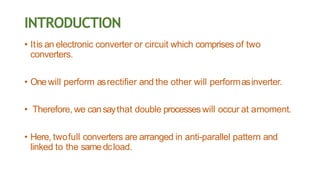
• Itis an electronic converter or circuit which comprises of two
converters.
• Onewill perform asrectifier and the other will performasinverter.
• Therefore, we cansaythat double processes will occur at amoment.
• Here, twofull converters are arranged in anti-parallel pattern and
linked to the samedcload.
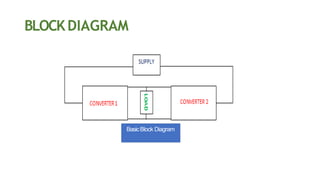
BLOCKDIAGRAM
BasicBlock Diagram
Principle OfOperation
• A.C input given to converter 1 for rectification.
• In this process positive cycle of input is given to first set of forward
biased thyristors which gives arectified D.Con positive cycle, aswell
negative cycle is given to set of reverse biased thyristors which givesa
D.Con negative cycle completing full wave rectified output canbe
given to load.
Modesof Operation of Dual Converter
• There are two functionalmodes:
1. Non-circulating current mode.
2. Circulating mode.
Non Circulating CurrentMode
• Oneconverter will perform at atime. Sothere is nocirculating
current between the converters.
• During the converter 1 operation, firing angle (α1) willbe 0<α1< 90o;
Vdcand Idc arepositive.
• During the converter 2 operation, firing angle (α2) willbe 0<α2< 90o;
Vdcand Idc arenegative.
Circulating Current Mode
• Twoconverters will be in the ONcondition at the sametime.So
circulating current ispresent.
• Thefiring angles are adjusted such that firing angle of converter 1(α1)
+firing angle of converter 2 (α2) =180o.
• Converter 1 performs asa controlled rectifier when firing angle be
0<α1< 90o and Converter 2 performs as an inverter when the firing
angle be 90o<α2< 180o. In this condition, Vdcand Idc arepositive.
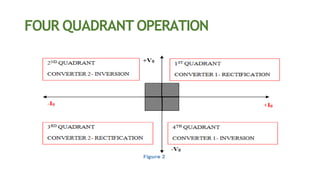
FOUR QUADRANT OPERATION
Ideal DualConverter
• The term ‘ideal’ refers to the ripple free output voltage.
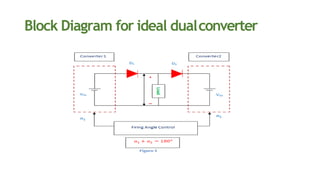
• For the purpose of unidirectional flow of DCcurrent, two diodes
(D1and D2) are incorporated between the converters.
• However, the direction of current canbe in any way.Theaverage
output voltage of the converter 1 is V01and converter 2 isV02.
• Tomake the output voltage of the two converters insamepolarity
and magnitude, the firing angles of the thyristors have to be
controlled.
Block Diagram for ideal dualconverter
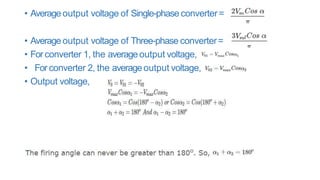
• Average output voltage of Single-phase converter=
• Average output voltage of Three-phase converter=
• For converter 1, the averageoutput voltage,
• For converter 2, the averageoutput voltage,
• Output voltage,
Typesof DualConverters
• Theyare of two types:
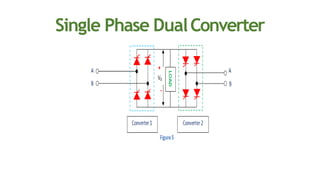
1. Single-phase dual converter.
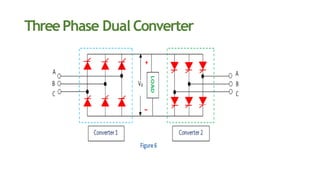
2. Three-phase dual converter.
Single Phase DualConverter
ThreePhase Dual Converter
Application of DualConverter
• Direction and Speedcontrol of DCmotors.
• Applicable wherever the reversible DCisrequired.
• Industrial variable speed DCdrives.
Pe dual converter ppt

Pe dual converter ppt

  • 1.
    Prepared By:- Rohan Kaushik(161310109051) Rohit Chavda (161310109052) Dual Conveters
  • 2.
     CONTENTS 1. Introduction 2.Block Diagram 3. Principle of operation 4. Mode of operation 5. Four quadrant operation 6. Ideal Dual Converter 7. Typesof Dual converter 8. Applications of dualconverter
  • 3.
    INTRODUCTION • Itis anelectronic converter or circuit which comprises of two converters. • Onewill perform asrectifier and the other will performasinverter. • Therefore, we cansaythat double processes will occur at amoment. • Here, twofull converters are arranged in anti-parallel pattern and linked to the samedcload.
  • 4.
  • 5.
    Principle OfOperation • A.Cinput given to converter 1 for rectification. • In this process positive cycle of input is given to first set of forward biased thyristors which gives arectified D.Con positive cycle, aswell negative cycle is given to set of reverse biased thyristors which givesa D.Con negative cycle completing full wave rectified output canbe given to load.
  • 6.
    Modesof Operation ofDual Converter • There are two functionalmodes: 1. Non-circulating current mode. 2. Circulating mode.
  • 7.
    Non Circulating CurrentMode •Oneconverter will perform at atime. Sothere is nocirculating current between the converters. • During the converter 1 operation, firing angle (α1) willbe 0<α1< 90o; Vdcand Idc arepositive. • During the converter 2 operation, firing angle (α2) willbe 0<α2< 90o; Vdcand Idc arenegative.
  • 8.
    Circulating Current Mode •Twoconverters will be in the ONcondition at the sametime.So circulating current ispresent. • Thefiring angles are adjusted such that firing angle of converter 1(α1) +firing angle of converter 2 (α2) =180o. • Converter 1 performs asa controlled rectifier when firing angle be 0<α1< 90o and Converter 2 performs as an inverter when the firing angle be 90o<α2< 180o. In this condition, Vdcand Idc arepositive.
  • 9.
  • 10.
    Ideal DualConverter • Theterm ‘ideal’ refers to the ripple free output voltage. • For the purpose of unidirectional flow of DCcurrent, two diodes (D1and D2) are incorporated between the converters. • However, the direction of current canbe in any way.Theaverage output voltage of the converter 1 is V01and converter 2 isV02. • Tomake the output voltage of the two converters insamepolarity and magnitude, the firing angles of the thyristors have to be controlled.
  • 11.
    Block Diagram forideal dualconverter
  • 12.
    • Average outputvoltage of Single-phase converter= • Average output voltage of Three-phase converter= • For converter 1, the averageoutput voltage, • For converter 2, the averageoutput voltage, • Output voltage,
  • 13.
    Typesof DualConverters • Theyareof two types: 1. Single-phase dual converter. 2. Three-phase dual converter.
  • 14.
  • 15.
  • 16.
    Application of DualConverter •Direction and Speedcontrol of DCmotors. • Applicable wherever the reversible DCisrequired. • Industrial variable speed DCdrives.