Field Research +
Parametric Analysis
How Current State Analysis
leads to Future State
Optimization
Upali Nanda
Alison Avendt
Steve Jacobsen
Camilla Moretti
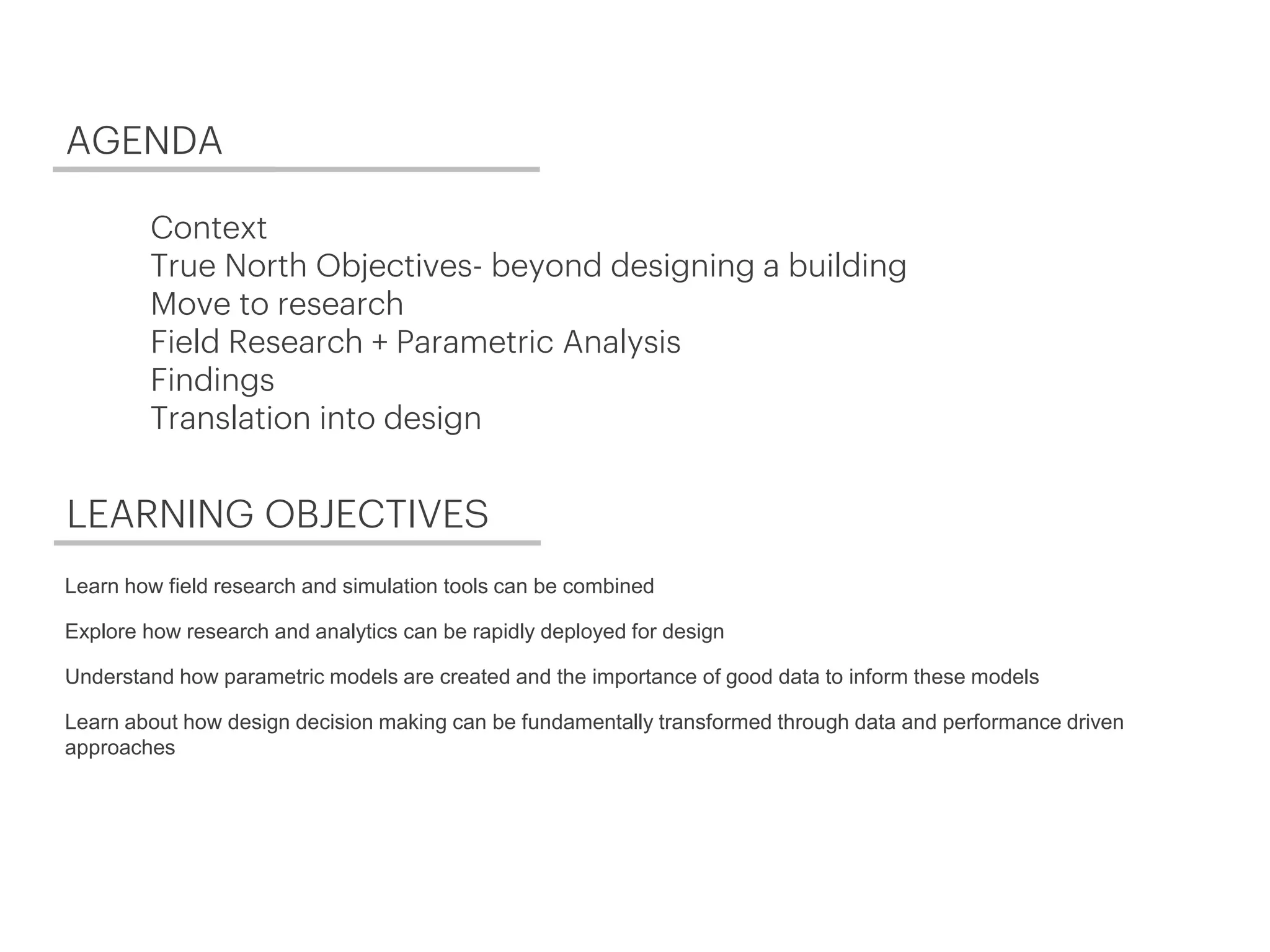
AGENDA
Context
True North Objectives- beyond designing a building
Move to research
Field Research + Parametric Analysis
Findings
Translation into design
Learn how field research and simulation tools can be combined
Explore how research and analytics can be rapidly deployed for design
Understand how parametric models are created and the importance of good data to inform these models
Learn about how design decision making can be fundamentally transformed through data and performance driven
approaches
LEARNING OBJECTIVES
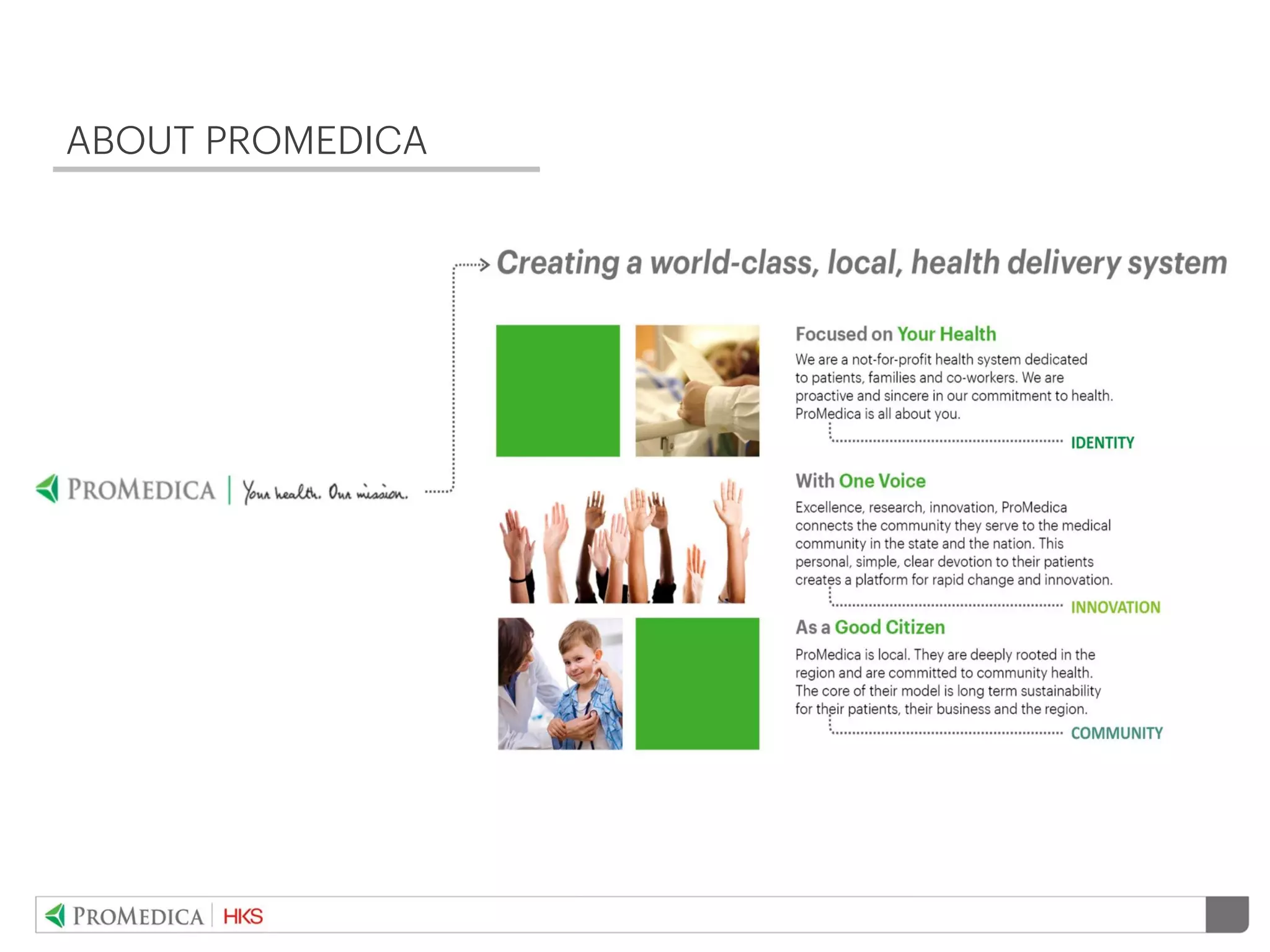
ABOUT PROMEDICA
ABOUT PROMEDICA
• 15,000 employees
• $2.7 billion in revenue
• Fully integrated system
• 12 acute care hospitals in
NW Ohio & SE Michigan,
2300 beds
• Paramount Insurance with
316,000 members
• Over 800 employed
physicians
• ProMedica Transportation
Network ground and air
ambulance
• Ambulatory surgery
centers, Home Care and
Hospice, Inpatient Rehab,
Skilled Nursing facilities,
OP lab and radiology sites
• “and growing”
PROMEDICA TOLEDO HOSPITAL AND TOLEDO
CHILDREN’S HOSPITAL
Campus Overview
Community based since 1927
Operating 600 beds
Tertiary care, Level 1 Trauma
Center, 100,000+ ED visits,
Level 3 NICU, 24/7
Cardiology, Telestroke
Network
• Modern patient tower, latest technology
• Patient and family centered
• Safe, effective, high quality treatment environment
• Efficient workflows to eliminate bottlenecks, lean design
and process
• Attract and retain an engaged workforce of high quality
physicians and caregivers
THE FUTURE NOW
GUIDING PRINCIPLES
• Create efficient, safe, quality and flexible patient care
environments within new patient tower
• Create efficiency through co-location and consolidation of
services within the facility
• Replace processes that create a sense of two levels of care,
creating a consistent customer experience
• Improve access, wayfinding, and parking for patients accessing
services throughout campus
• Identify the best services, the right capacity and appropriate
access for those within the new patient tower
• Meet budget and scheduling expectations throughout project
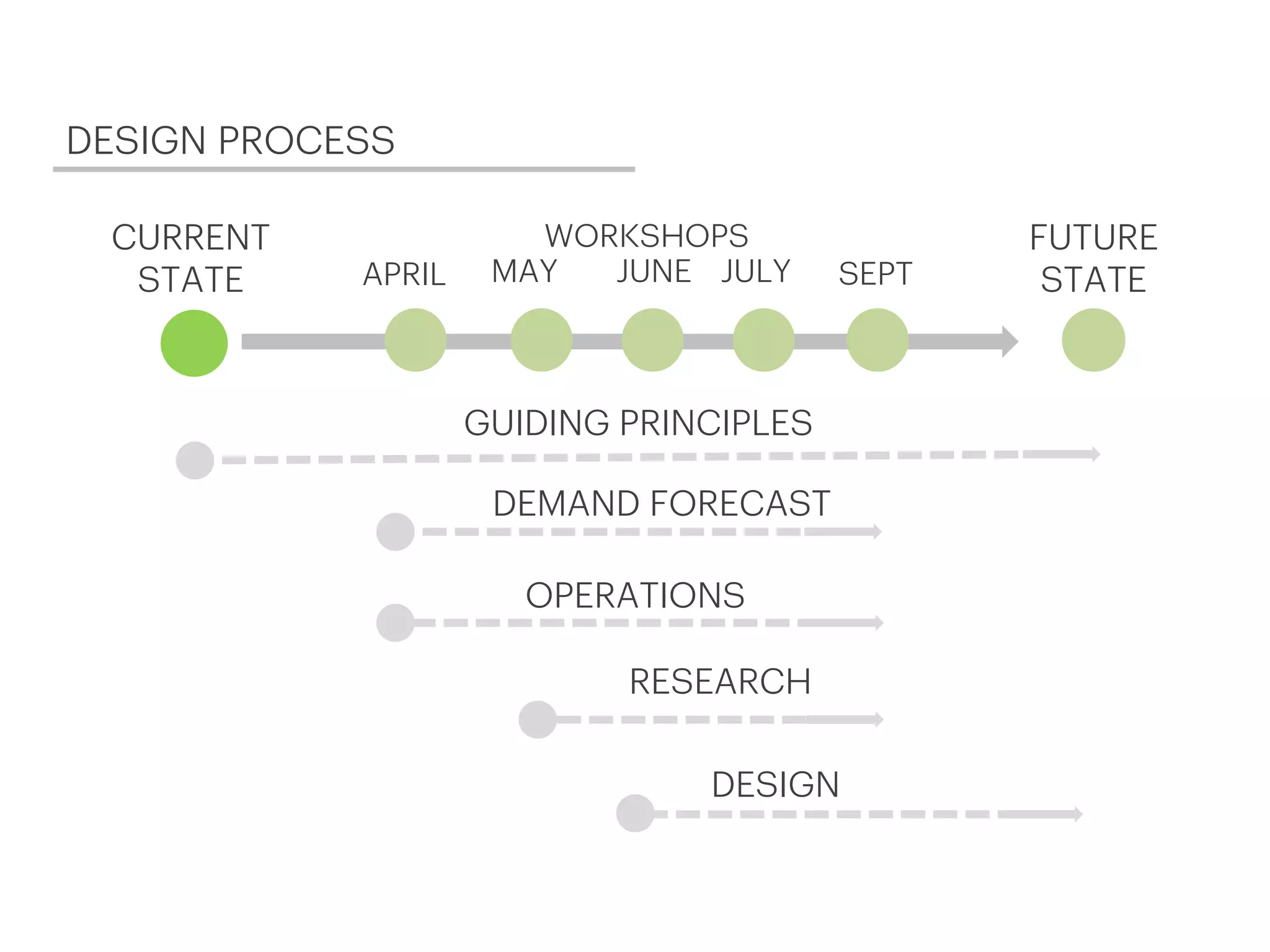
DESIGN PROCESS
JULY SEPTMAY JUNEAPRIL
CURRENT
STATE
FUTURE
STATE
DEMAND FORECAST
DESIGN
OPERATIONS
RESEARCH
GUIDING PRINCIPLES
WORKSHOPS
INTEGRATED FUNCTIONAL PLANNING AND DESIGN
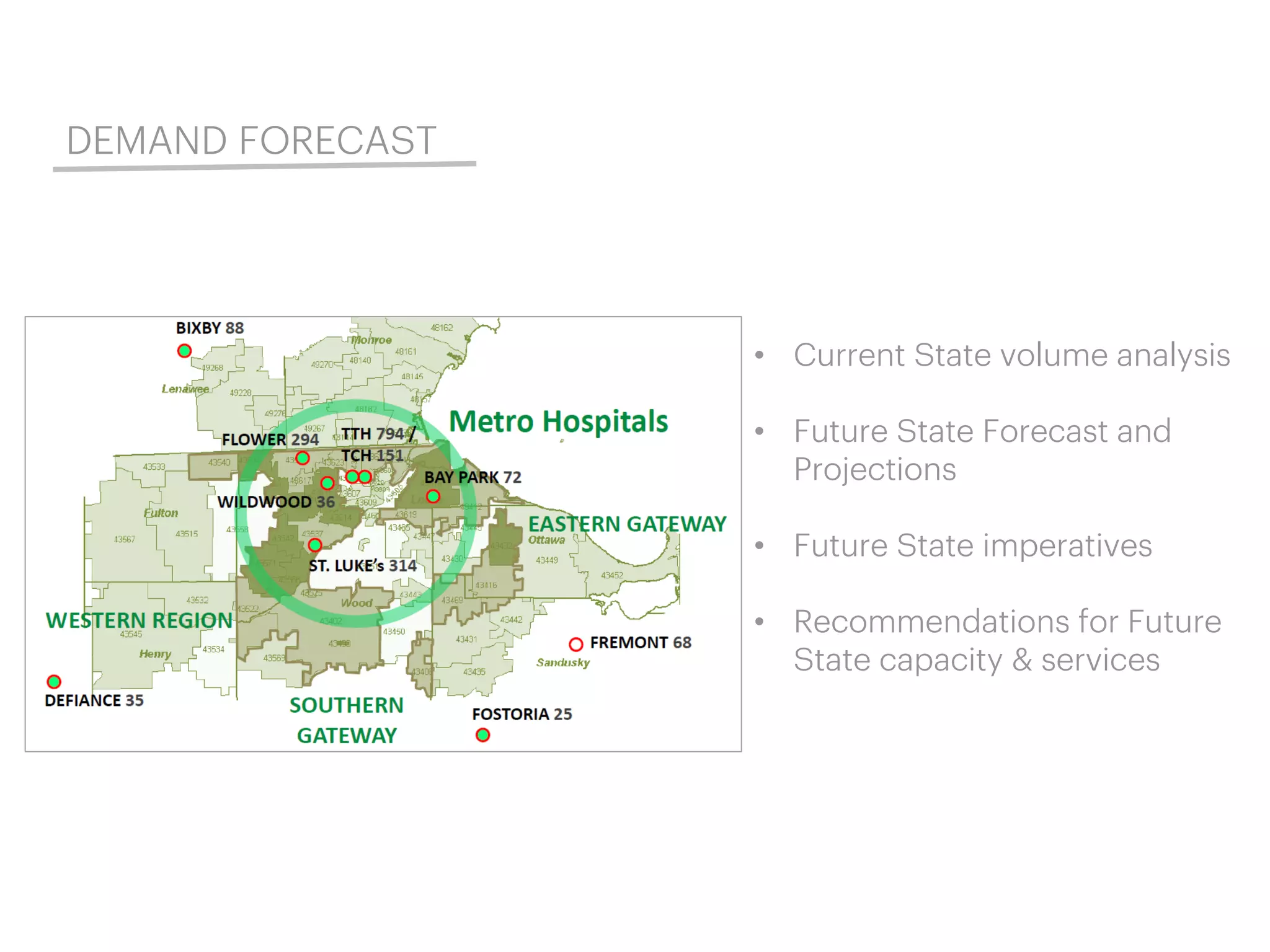
DEMAND FORECAST
• Current State volume analysis
• Future State Forecast and
Projections
• Future State imperatives
• Recommendations for Future
State capacity & services
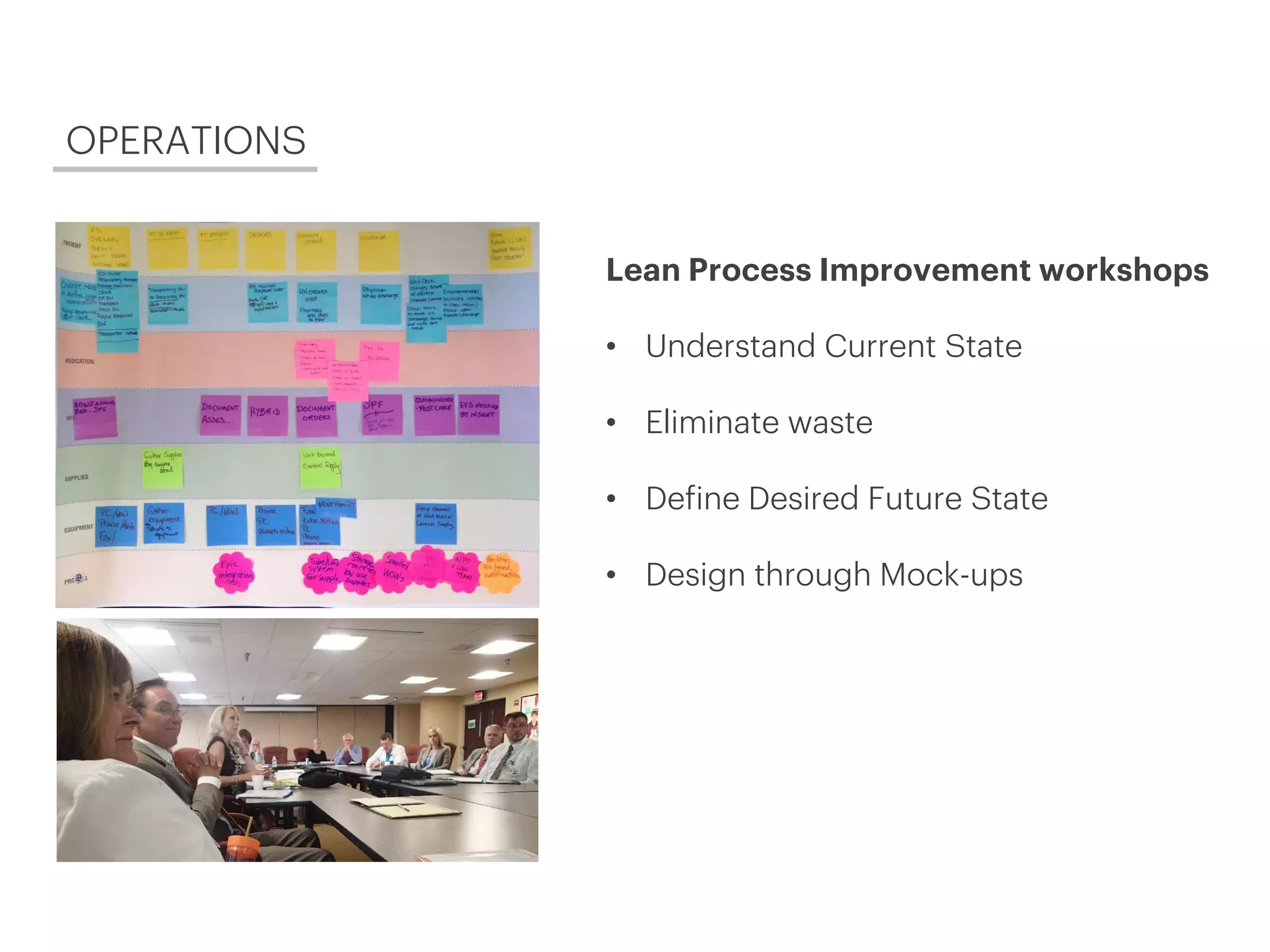
Lean Process Improvement workshops
• Understand Current State
• Eliminate waste
• Define Desired Future State
• Design through Mock-ups
OPERATIONS
RESULTS FOR FUTURE STATE
STRATEGY
DESIGN
OPERATIONS
RESEARCH
GUIDING PRINCIPLES
REINFORCING
PROMEDICA’S MISSION
RIGHT SIZED AND
OPTIMIZED FOR FUTURE
REDUCE WASTE AND
IMPROVE PROCESS
DATA DRIVEN DESIGN
DRIVING FUTURE
FORWARD
Reported Observed Spatial
RESEARCH
CURRENT STATE FUTURE STATE
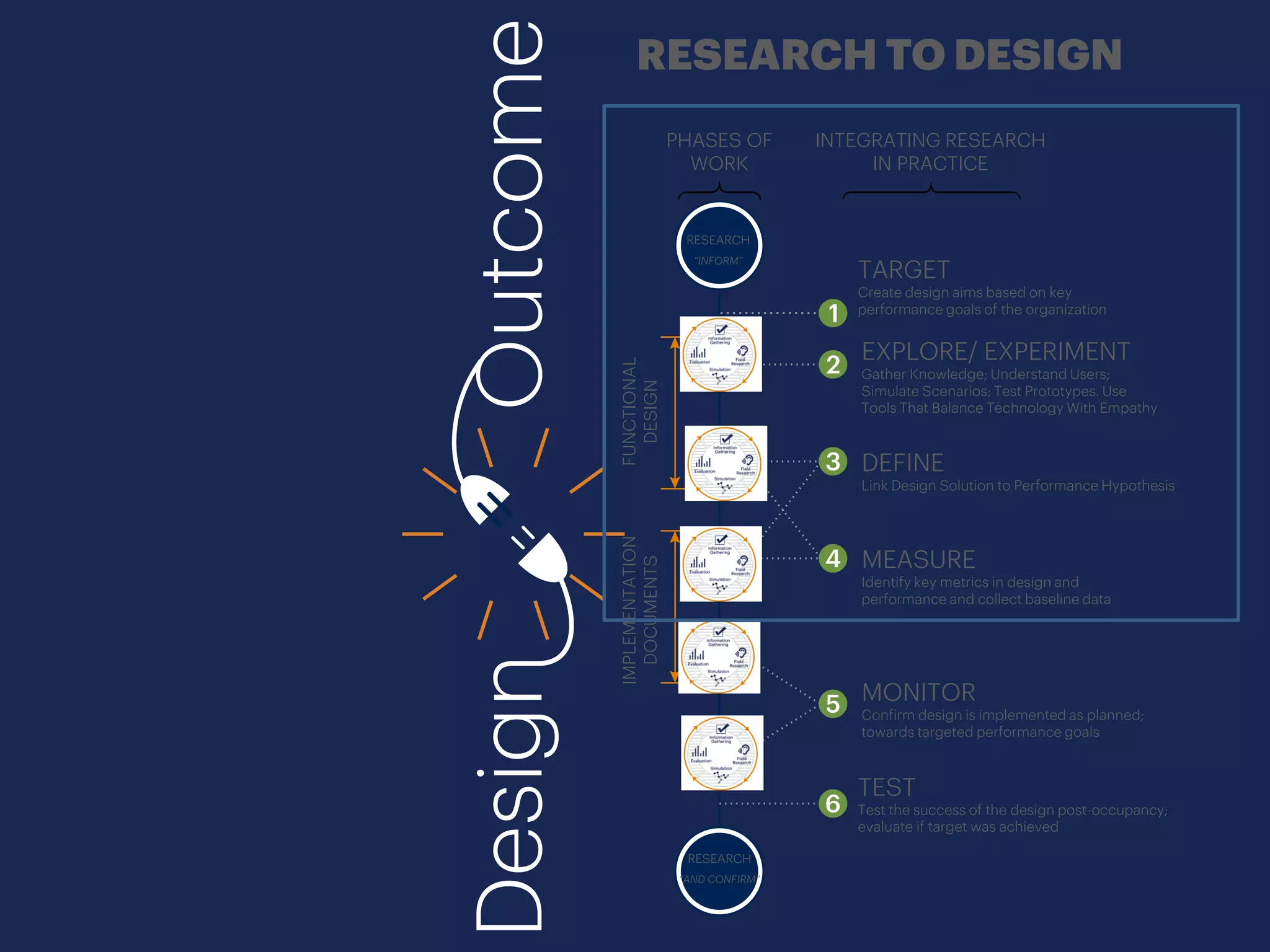
PHASES OF
WORK
INTEGRATING
RESEARCH IN PRACTICE
FUNCTIONAL
DESIGN
IMPLEMENTATION
DOCUMENTS
RESEARCH
“INFORM”
CONCEPT
SD
DD
CA
CD
RESEARCH
“AND
CONFIRM”
TARGET
Create design aims based on key
performance goals of the organization
EXPLORE/ EXPERIMENT
Gather Knowledge; Understand Users;
Simulate Scenarios; Test Prototypes. Use
Tools That Balance Technology With Empathy
DEFINE
Link Design Solution to Performance Hypothesis
MEASURE
Identify key metrics in design and
performance and collect baseline data
MONITOR
Confirm design is implemented as planned;
towards targeted performance goals
TEST
Test the success of the design post-occupancy;
evaluate if target was achieved
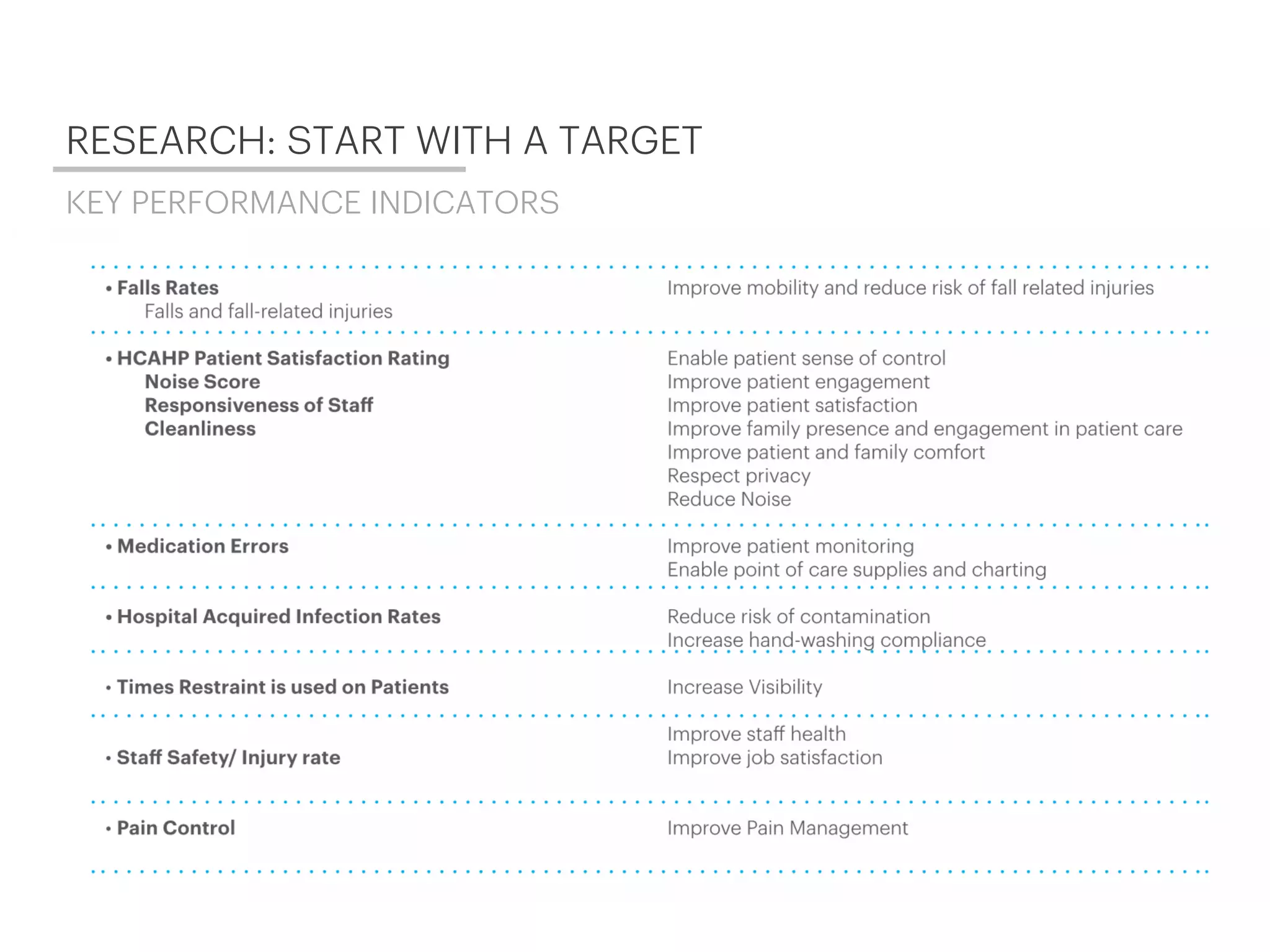
RESEARCH: START WITH A TARGET
KEY PERFORMANCE INDICATORS
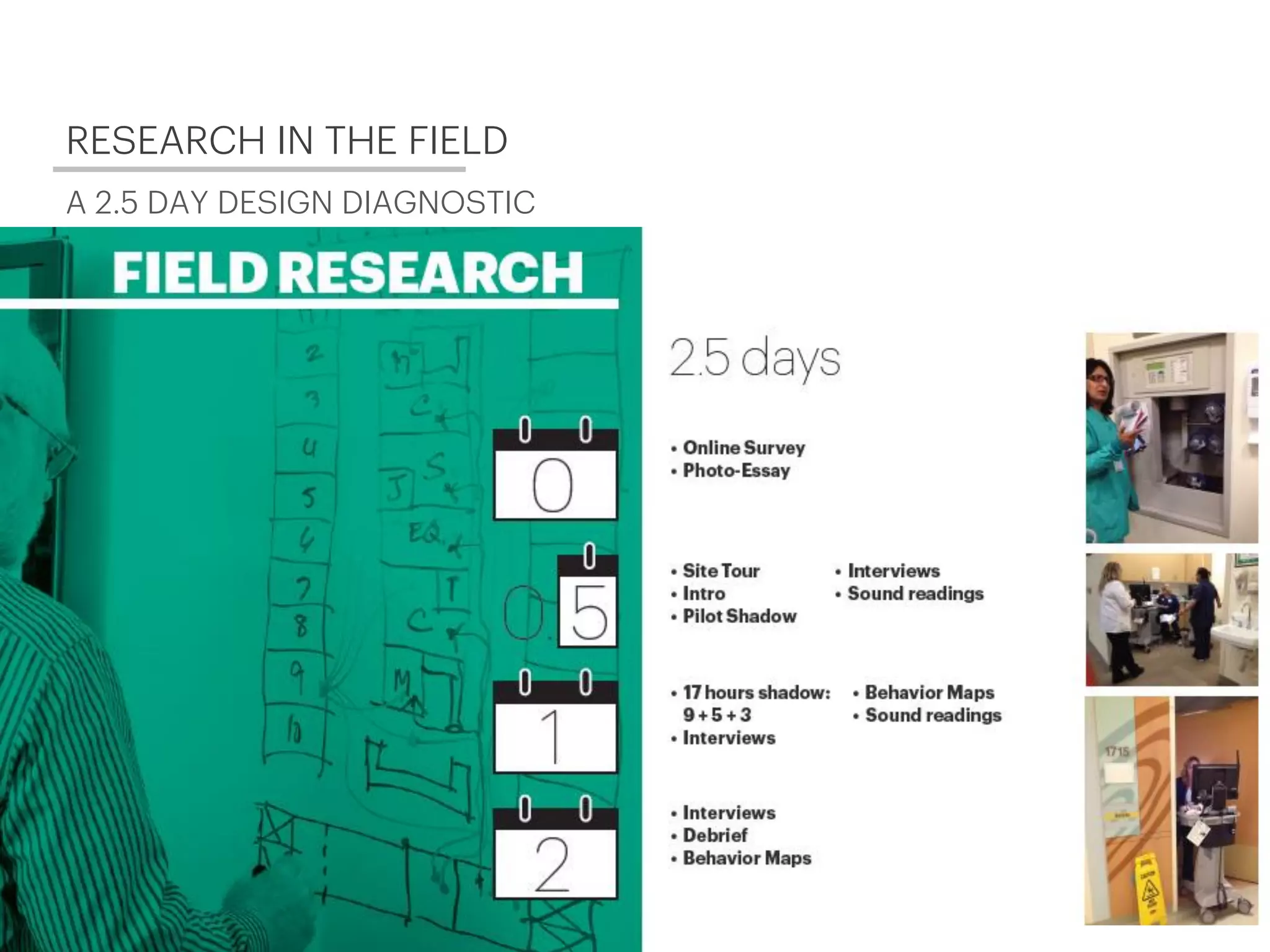
RESEARCH IN THE FIELD
A 2.5 DAY DESIGN DIAGNOSTIC
FIRST TO FILL UNIT
(mostly full
occupancy)
2 wings
4 nursing stations
20 rooms in each wing
2 meds/supply rooms
1 nourishment room
2 soiled linen
2 equipment
MED-SURG UNIT
KEY PERFORMANCE INDICATORS
Unused
Kitchen
Unused
Pyxis Rm
Opaque
Doors in
Meds/Su
pplies
Unit Clerk
Opp Side
Minimally
used
Consult
Rm
Off-stage
“hide-
aways”
SPACE UTILIZATION
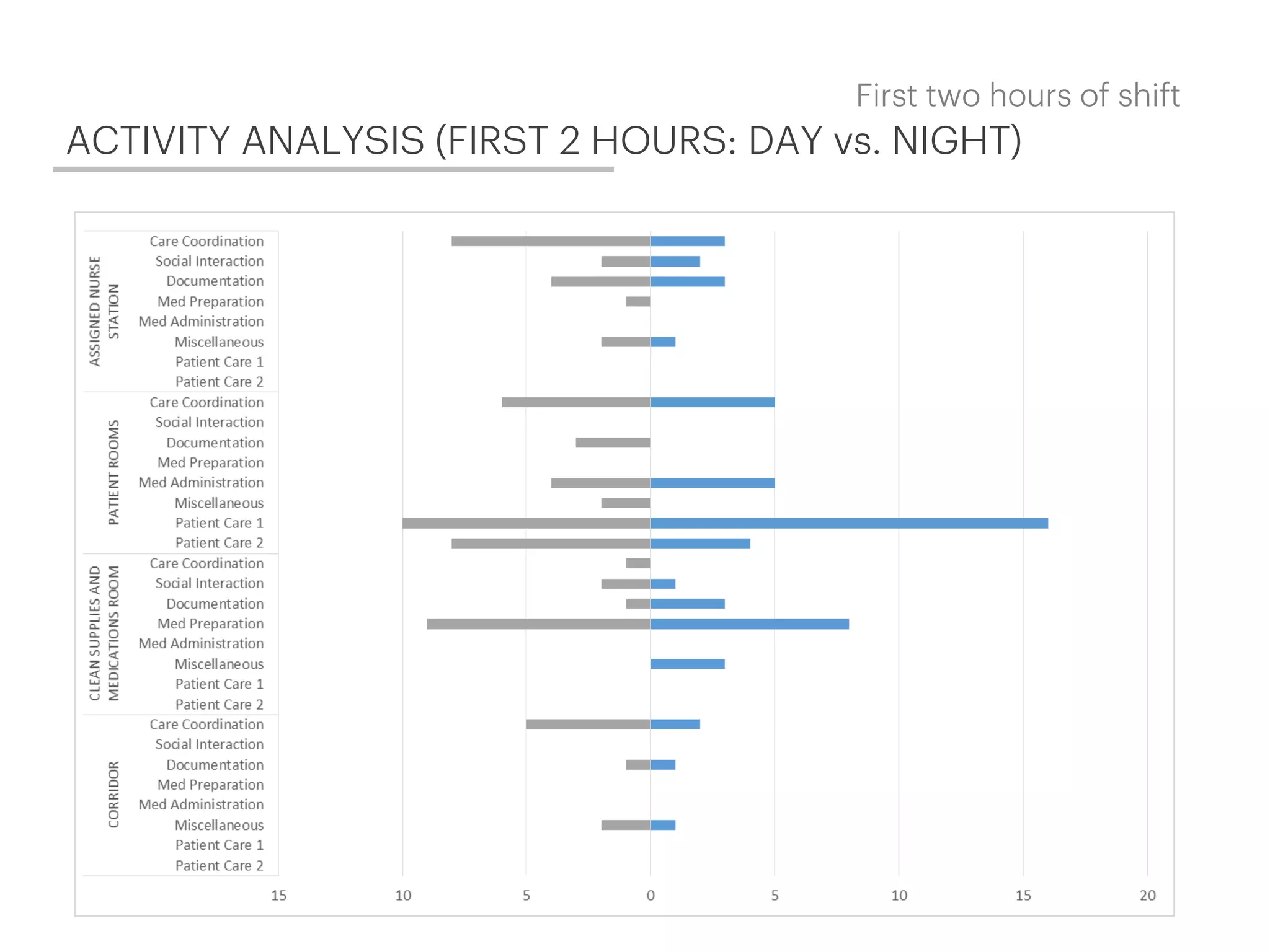
COMMUNICATION 1
(Care Coordination)
Activities involving care coordination of a patient, team meetings and huddles,
work-related conversations with co-workers, educating and mentoring
COMMUNICATION 2
(Socialization)
Communications with co-workers but not pertaining to patient care or work;
socializing
DOCUMENTATION Charting, scanning, documenting, printing
MED 1
(Med Preparation)
This activity pertained to the preparation of medications
MED 2
(Med Administration)
This pertained to the delivery and administration of medication to the patient
PATIENT CARE 1 This pertained to any clinical activity involving patient interface
PATIENT CARE 2 This pertained to any non-clinical activity involving patient interface
ACTIVITY ANALYSIS
ACTIVITY ANALYSIS
ACTIVITY ANALYSIS (FIRST 2 HOURS: DAY)
First two hours of shift
ACTIVITY ANALYSIS (FIRST 2 HOURS: DAY vs. NIGHT)
w ww w
w
ww
w
w
w
w
w ww w
w
w
w ww w
w WoW
Charging
THE “WOW” EFFECT
DESIGNING FOR MOBILITY/ FLEXIBILTY
POSITIVE NEGATIVE
Love the WOWs, but...
Not enough plug
points.
No place to store.
On-the-go charting
No log-in, log-out issues
Flexibility
Mobile storage for nurses
Corridor parking
Bedside charting
Corridors are now work spaces
Patient Mobility Deterrent
Increased Sound Levels
Potential HIPAA violations
Units in the room are unused
No way of telling where a nurse is
Infection Risk?
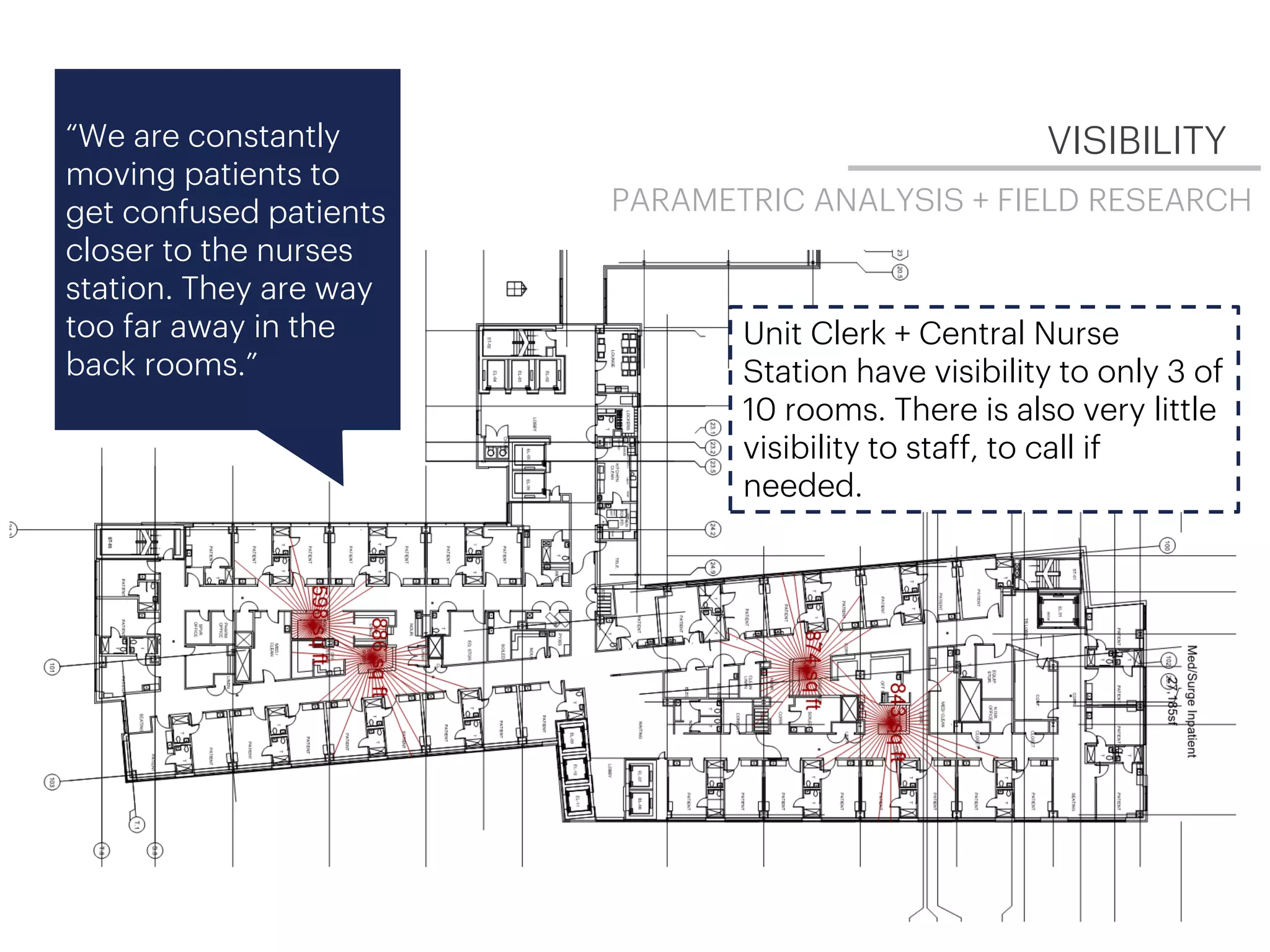
Unit Clerk + Central Nurse
Station have visibility to only 3 of
10 rooms. There is also very little
visibility to staff, to call if
needed.
“We are constantly
moving patients to
get confused patients
closer to the nurses
station. They are way
too far away in the
back rooms.”
VISIBILITY
PARAMETRIC ANALYSIS + FIELD RESEARCH
0.00 1.00 2.00 3.00 4.00 5.00
Documentation
Station to Patient
Head
Peer- Peer
Documentation
station to patient
room door
Unit clerk to entrance
VISIBILITY
STAFF PERCEPTION
4.20 4.30 4.40 4.50 4.60 4.70 4.80 4.90 5.00
Hearing the patient and the
alarms
Seeing the patient
Being able to monitor vital signs
remotely
VISIBILITY/ MONITORING
STAFF PERCEPTION: DESIGNING FOR “AUDITORY” VISIBILITY
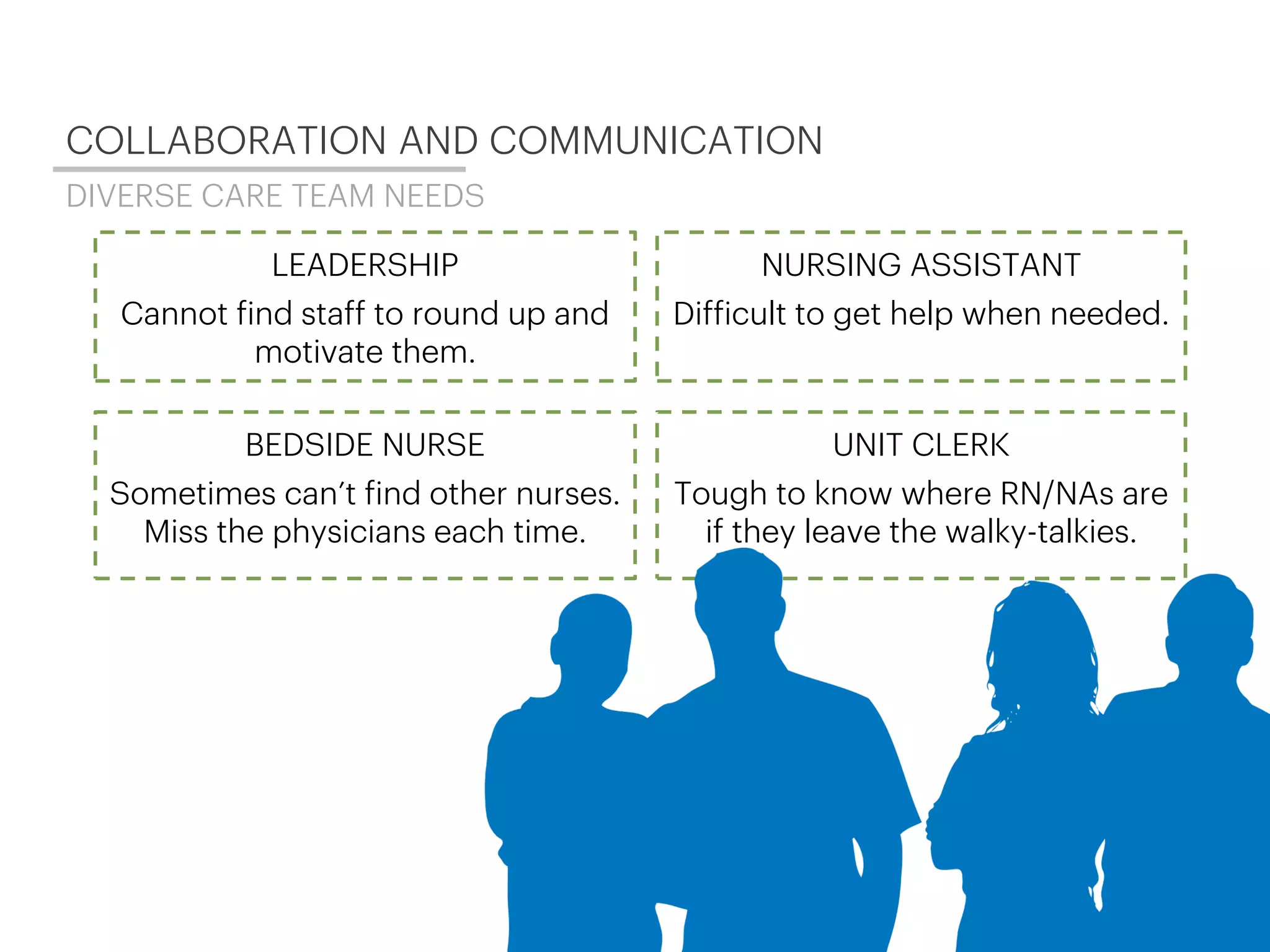
LEADERSHIP
Cannot find staff to round up and
motivate them.
BEDSIDE NURSE
Sometimes can’t find other nurses.
Miss the physicians each time.
NURSING ASSISTANT
Difficult to get help when needed.
UNIT CLERK
Tough to know where RN/NAs are
if they leave the walky-talkies.
COLLABORATION AND COMMUNICATION
DIVERSE CARE TEAM NEEDS
WALKING
Proximity Calculator | Rapidly Generated Heat Map
Excessive
Distance
Reasonable
Distance
PROXIMITY ANALYSIS
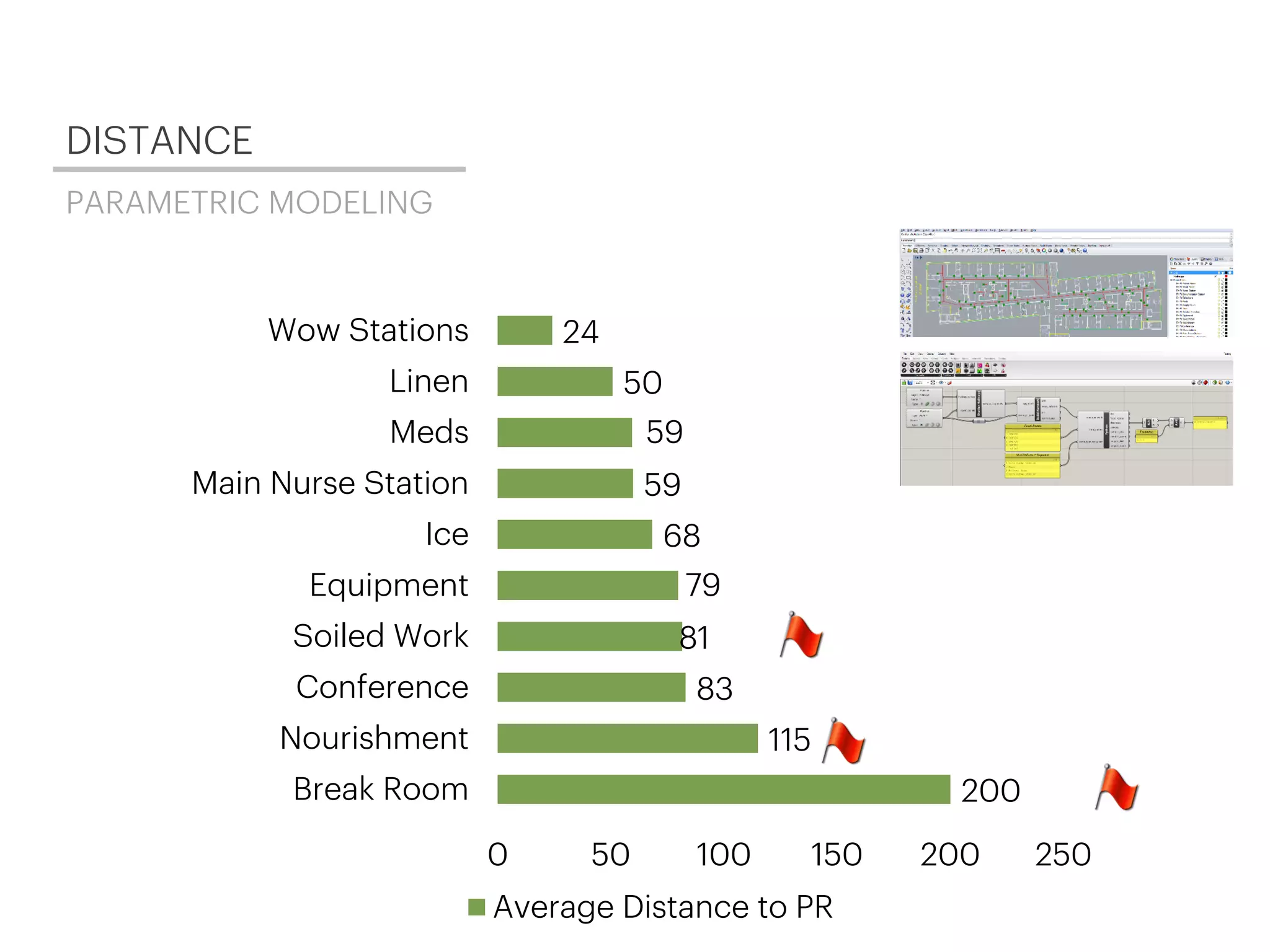
PARAMETRIC MODELING
200
115
83
81
79
68
59
59
50
24
0 50 100 150 200 250
Break Room
Nourishment
Conference
Soiled Work
Equipment
Ice
Main Nurse Station
Meds
Linen
Wow Stations
Average Distance to PR
DISTANCE
PARAMETRIC MODELING
FIELD RESEARCH +
PARAMETRIC ANALYSIS
PATIENT CARE: INDIVIDUAL ASSESSMENT NS→PR→NS
PATIENT CARE: ROUND ASSESSMENT
(at the start of and towards end of shift)
NS→PR1→PR2→...→PRn→NS
MEDICATION DELIVERY
NS→CS→PR→NS
NS→CS→NS(Docum/CareCoor)→PR→NS
CALL RESPONSE NS→PR→NS
WALKING IS MORE THAN “DISTANCE”
THE IMPORTANCE OF SEQUENCES
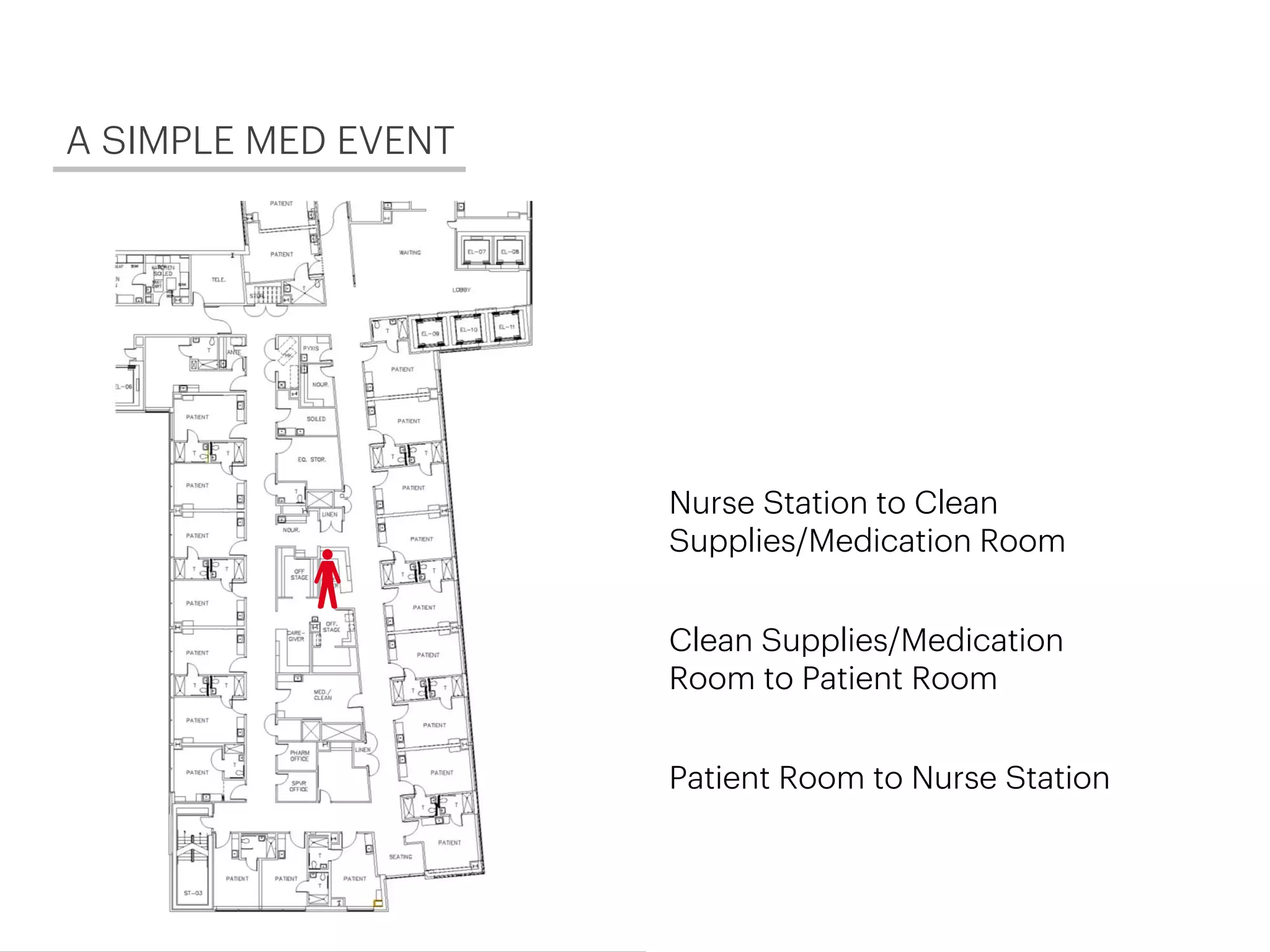
Nurse Station to Clean
Supplies/Medication Room
Clean Supplies/Medication
Room to Patient Room
Patient Room to Nurse Station
A SIMPLE MED EVENT
Nurse Station to Patient Room
Patient Room to Clean Supplies/Medication
Room
Clean Supplies/Medication Room to Patient
Room
Patient Room to Nourishment
Nourishment to Patient Room
Patient Room to Ice
Ice to Patient Room
Patient Room to Supplies
Supplies to Patient Room
Patient Room to Linen
Linen to Patient Room
Patient Room to Soiled
Soiled to Nurse Station
A SAMPLE MED EVENT
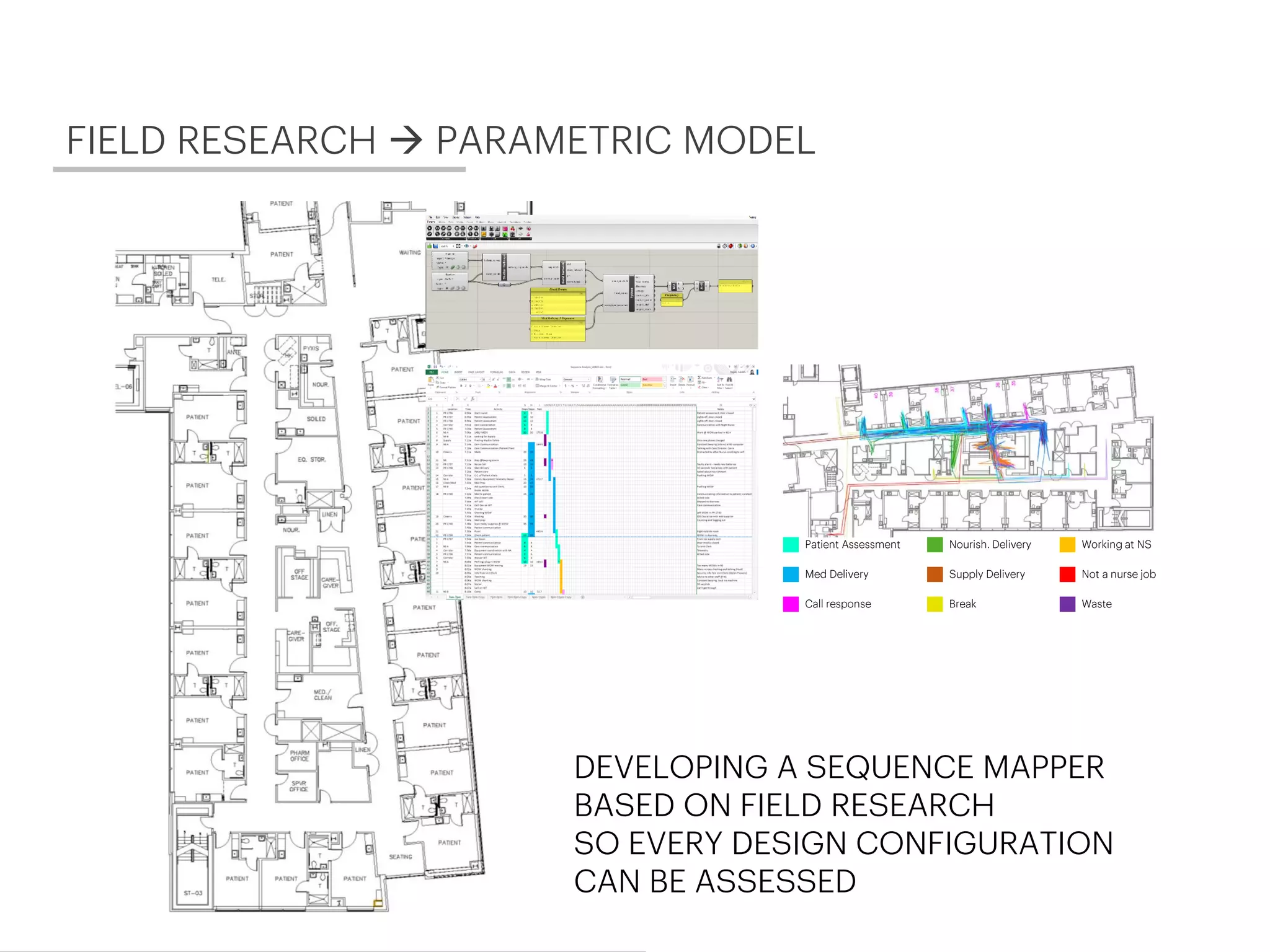
FIELD RESEARCH  PARAMETRIC MODEL
DEVELOPING A SEQUENCE MAPPER
BASED ON FIELD RESEARCH
SO EVERY DESIGN CONFIGURATION
CAN BE ASSESSED
Comparison of actual vs. optimal task pathways showed that
multitasking not only didn’t decrease nurses’ travel distance,
it also slightly increase their walking.
MYTH: MULTI-TASKING REDUCES TIME
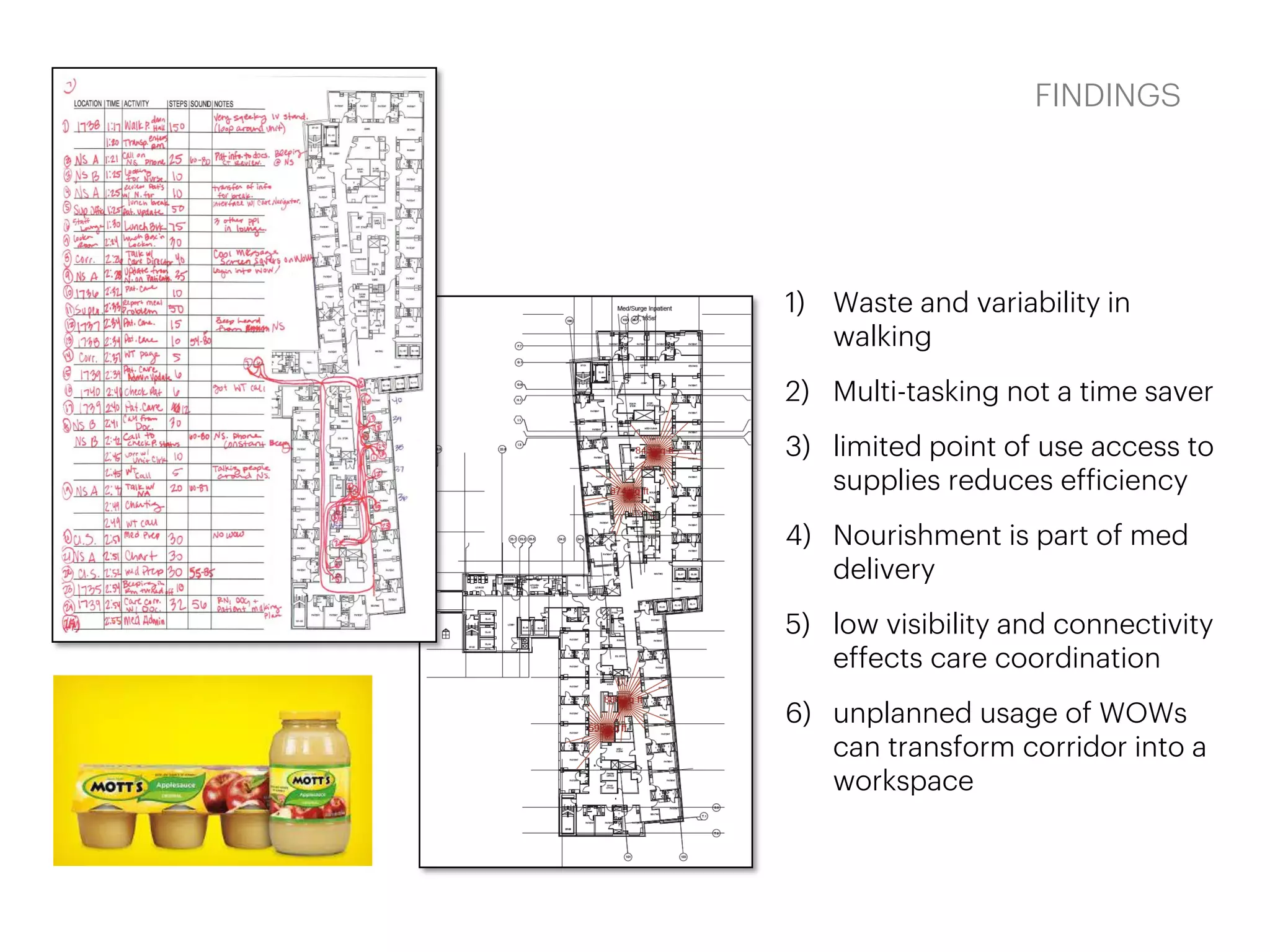
1) Waste and variability in
walking
2) Multi-tasking not a time saver
3) limited point of use access to
supplies reduces efficiency
4) Nourishment is part of med
delivery
5) low visibility and connectivity
effects care coordination
6) unplanned usage of WOWs
can transform corridor into a
workspace
FINDINGS
PHASES OF
WORK
INTEGRATING RESEARCH
IN PRACTICE
FUNCTIONAL
DESIGN
IMPLEMENTATION
DOCUMENTS
RESEARCH
“INFORM”
CONCEPT
SD
DD
CA
CD
RESEARCH
“AND CONFIRM”
TARGET
Create design aims based on key
performance goals of the organization
EXPLORE/ EXPERIMENT
Gather Knowledge; Understand Users;
Simulate Scenarios; Test Prototypes. Use
Tools That Balance Technology With Empathy
DEFINE
Link Design Solution to Performance Hypothesis
MEASURE
Identify key metrics in design and
performance and collect baseline data
MONITOR
Confirm design is implemented as planned;
towards targeted performance goals
TEST
Test the success of the design post-occupancy;
evaluate if target was achieved
RESEARCH DURING DESIGN
PARAMETRIC ANALYSIS OF PLAN CONFIGURATIONS
UNIT CONFIGURATION
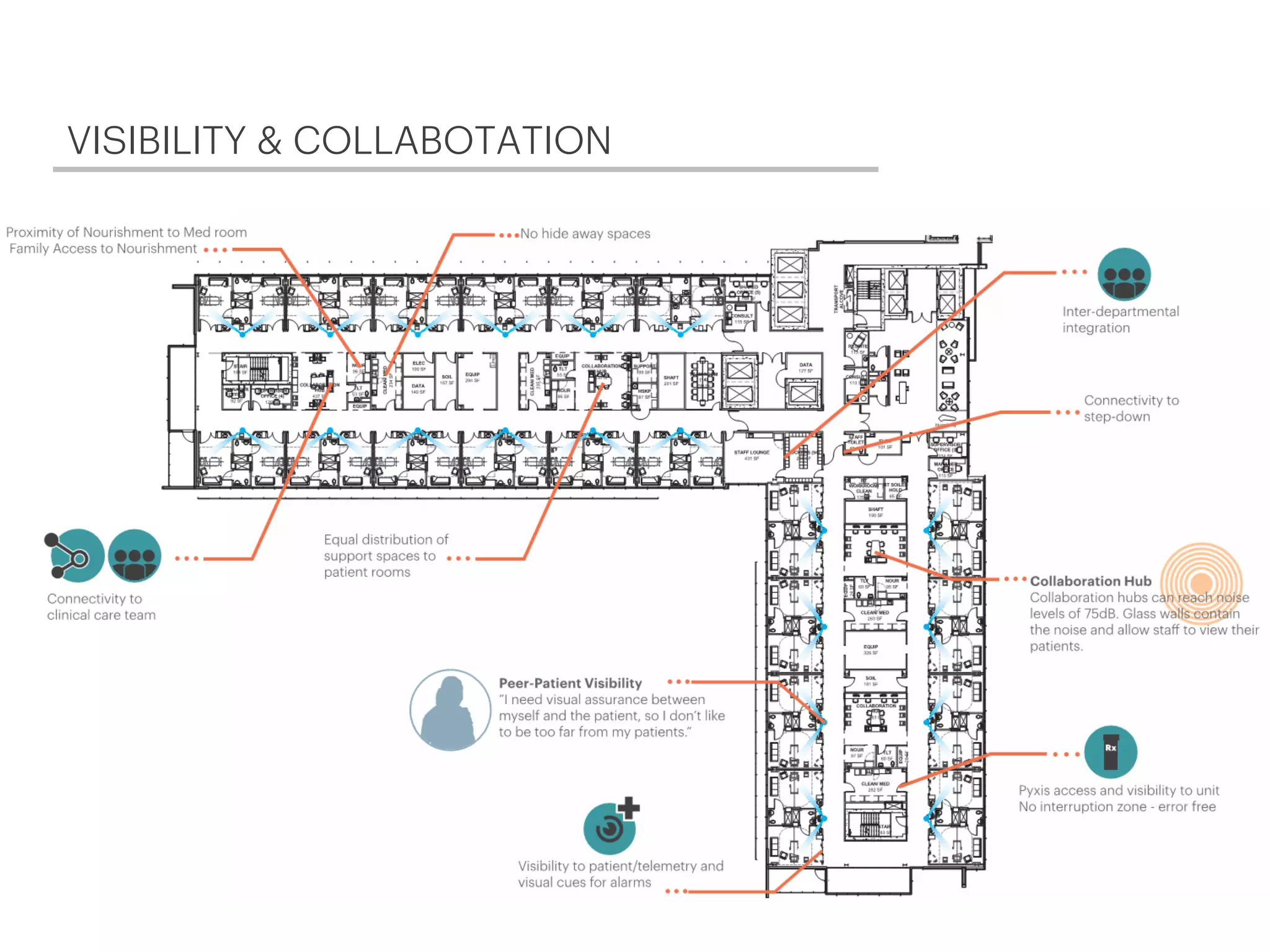
VISIBILITY & COLLABOTATION
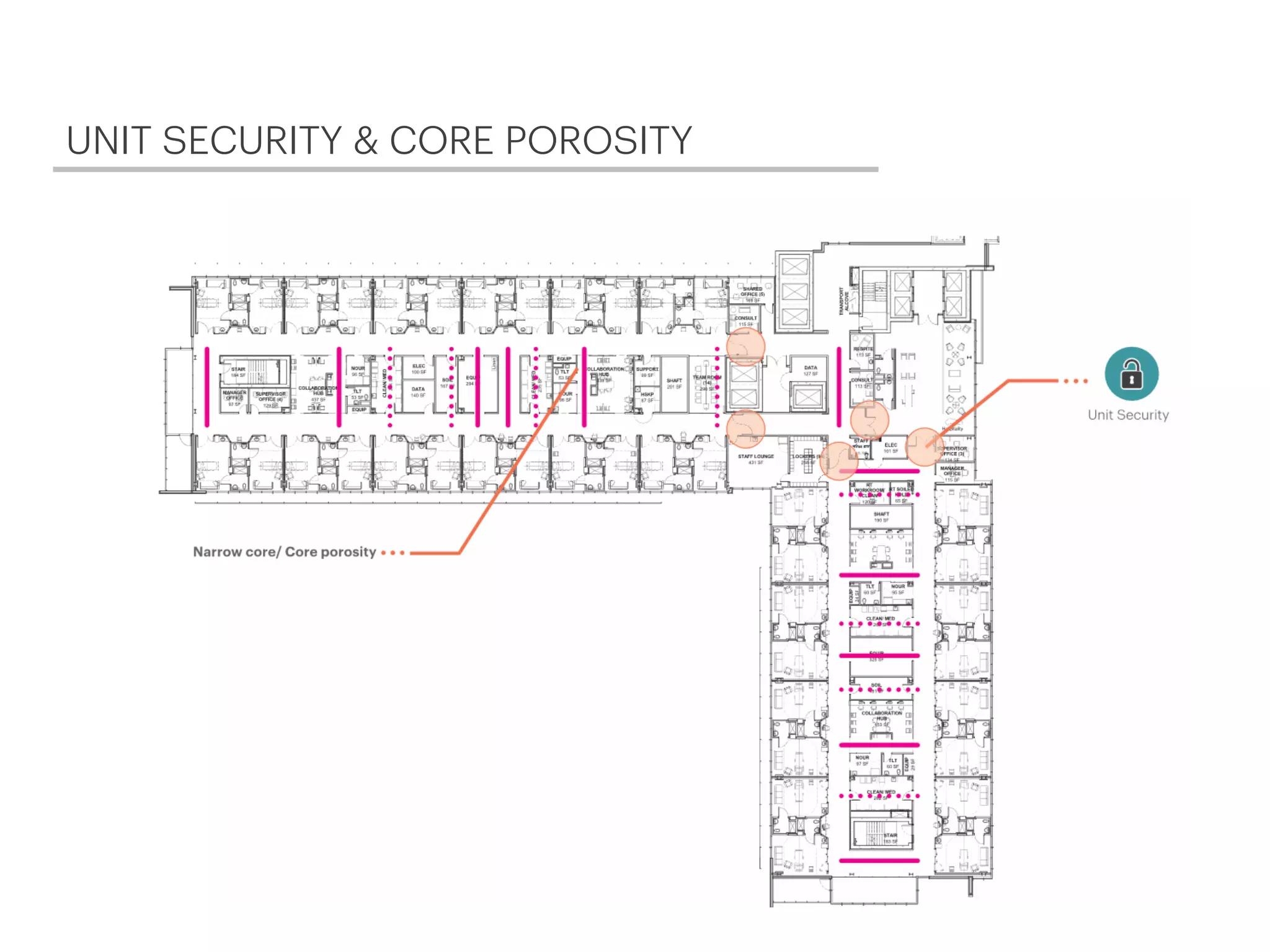
UNIT SECURITY & CORE POROSITY
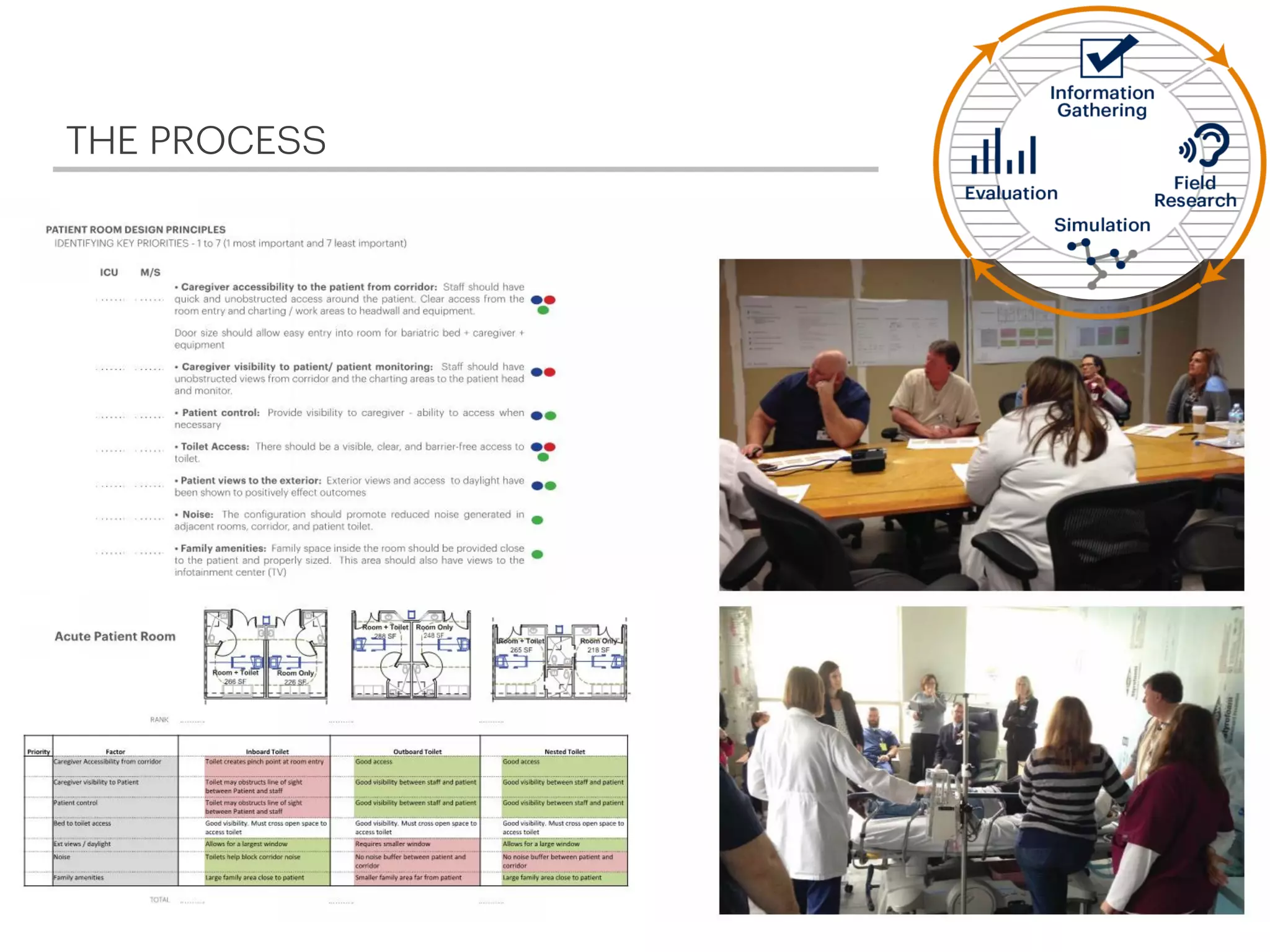
THE PROCESS
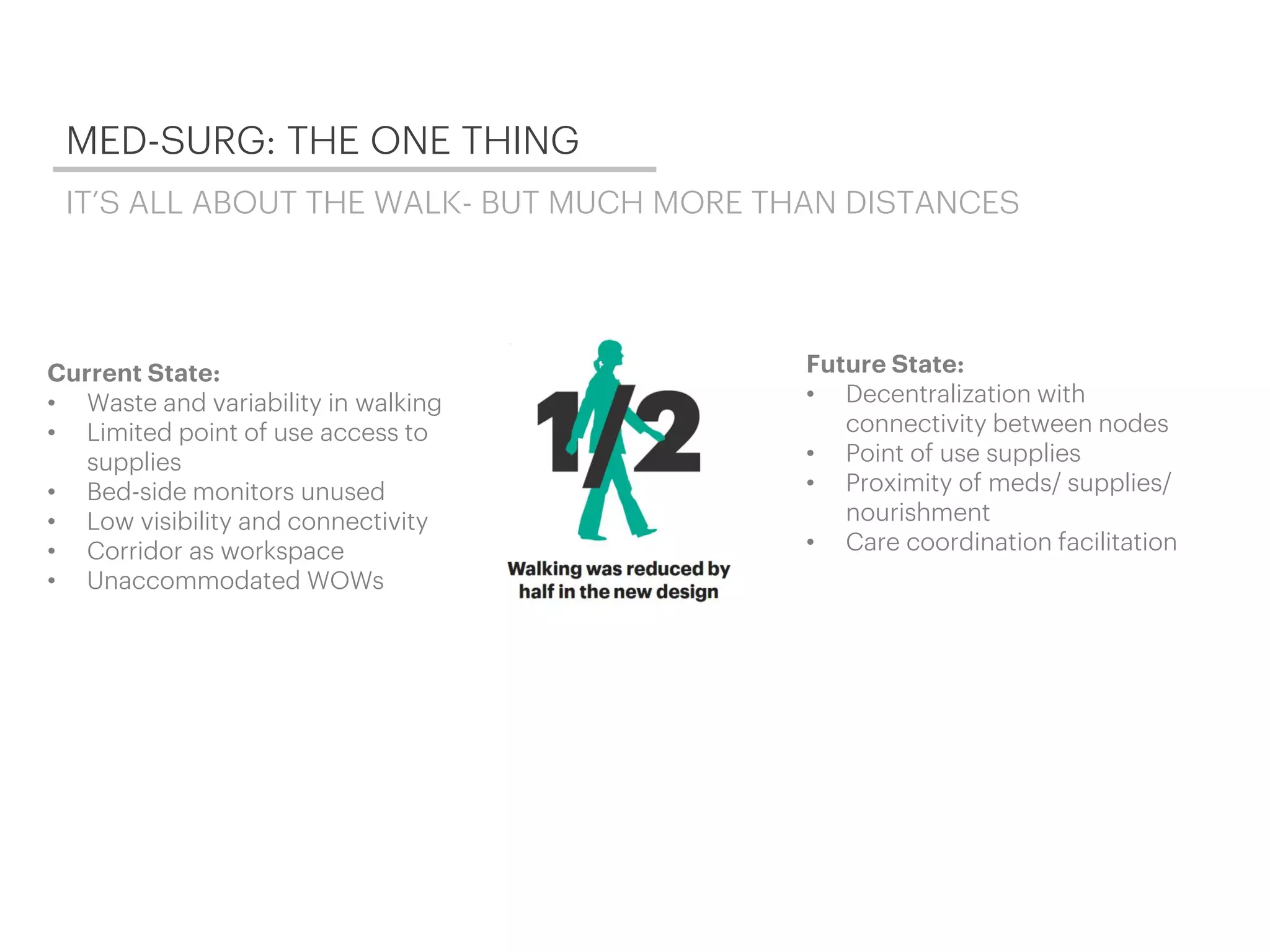
MED-SURG: THE ONE THING
Current State:
• Waste and variability in walking
• Limited point of use access to
supplies
• Bed-side monitors unused
• Low visibility and connectivity
• Corridor as workspace
• Unaccommodated WOWs
Future State:
• Decentralization with
connectivity between nodes
• Point of use supplies
• Proximity of meds/ supplies/
nourishment
• Care coordination facilitation
IT’S ALL ABOUT THE WALK- BUT MUCH MORE THAN DISTANCES
MED-SURG: THE ONE THING
Current State:
• Waste and variability in walking
• Limited point of use access to
supplies
• Bed-side monitors unused
• Low visibility and connectivity
• Corridor as workspace
• Unaccommodated WOWs
Future State:
• Decentralization with
connectivity between nodes
• Point of use supplies
• Proximity of meds/ supplies/
nourishment
• Care coordination facilitation
IT’S ALL ABOUT THE WALK- BUT MUCH MORE THAN DISTANCES
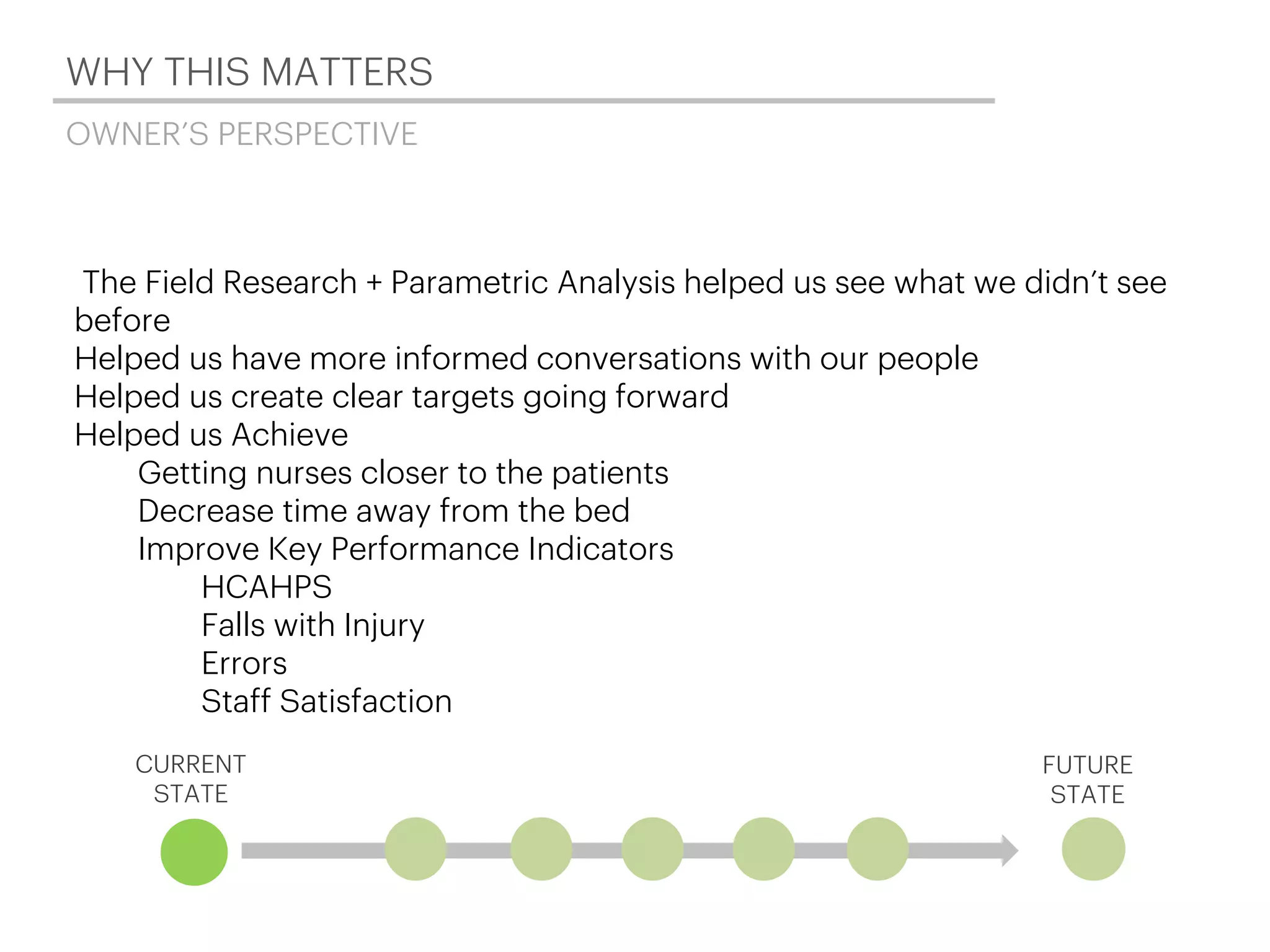
WHY THIS MATTERS
CURRENT
STATE
FUTURE
STATE
The Field Research + Parametric Analysis helped us see what we didn’t see
before
Helped us have more informed conversations with our people
Helped us create clear targets going forward
Helped us Achieve
Getting nurses closer to the patients
Decrease time away from the bed
Improve Key Performance Indicators
HCAHPS
Falls with Injury
Errors
Staff Satisfaction
OWNER’S PERSPECTIVE
GOING FORWARD
CURRENT
STATE
FUTURE
STATE
DESIGN
STRATEGY.
OPERATIONS.
RESEARCH.
questions

PDC_2015_Promedica

  • 1.
    Field Research + ParametricAnalysis How Current State Analysis leads to Future State Optimization Upali Nanda Alison Avendt Steve Jacobsen Camilla Moretti
  • 2.
    AGENDA Context True North Objectives-beyond designing a building Move to research Field Research + Parametric Analysis Findings Translation into design Learn how field research and simulation tools can be combined Explore how research and analytics can be rapidly deployed for design Understand how parametric models are created and the importance of good data to inform these models Learn about how design decision making can be fundamentally transformed through data and performance driven approaches LEARNING OBJECTIVES
  • 3.
  • 4.
    ABOUT PROMEDICA • 15,000employees • $2.7 billion in revenue • Fully integrated system • 12 acute care hospitals in NW Ohio & SE Michigan, 2300 beds • Paramount Insurance with 316,000 members • Over 800 employed physicians • ProMedica Transportation Network ground and air ambulance • Ambulatory surgery centers, Home Care and Hospice, Inpatient Rehab, Skilled Nursing facilities, OP lab and radiology sites • “and growing”
  • 5.
    PROMEDICA TOLEDO HOSPITALAND TOLEDO CHILDREN’S HOSPITAL Campus Overview Community based since 1927 Operating 600 beds Tertiary care, Level 1 Trauma Center, 100,000+ ED visits, Level 3 NICU, 24/7 Cardiology, Telestroke Network
  • 6.
    • Modern patienttower, latest technology • Patient and family centered • Safe, effective, high quality treatment environment • Efficient workflows to eliminate bottlenecks, lean design and process • Attract and retain an engaged workforce of high quality physicians and caregivers THE FUTURE NOW
  • 7.
    GUIDING PRINCIPLES • Createefficient, safe, quality and flexible patient care environments within new patient tower • Create efficiency through co-location and consolidation of services within the facility • Replace processes that create a sense of two levels of care, creating a consistent customer experience • Improve access, wayfinding, and parking for patients accessing services throughout campus • Identify the best services, the right capacity and appropriate access for those within the new patient tower • Meet budget and scheduling expectations throughout project
  • 8.
    DESIGN PROCESS JULY SEPTMAYJUNEAPRIL CURRENT STATE FUTURE STATE DEMAND FORECAST DESIGN OPERATIONS RESEARCH GUIDING PRINCIPLES WORKSHOPS
  • 9.
  • 10.
    DEMAND FORECAST • CurrentState volume analysis • Future State Forecast and Projections • Future State imperatives • Recommendations for Future State capacity & services
  • 11.
    Lean Process Improvementworkshops • Understand Current State • Eliminate waste • Define Desired Future State • Design through Mock-ups OPERATIONS
  • 12.
    RESULTS FOR FUTURESTATE STRATEGY DESIGN OPERATIONS RESEARCH GUIDING PRINCIPLES REINFORCING PROMEDICA’S MISSION RIGHT SIZED AND OPTIMIZED FOR FUTURE REDUCE WASTE AND IMPROVE PROCESS DATA DRIVEN DESIGN DRIVING FUTURE FORWARD
  • 13.
  • 14.
    PHASES OF WORK INTEGRATING RESEARCH INPRACTICE FUNCTIONAL DESIGN IMPLEMENTATION DOCUMENTS RESEARCH “INFORM” CONCEPT SD DD CA CD RESEARCH “AND CONFIRM” TARGET Create design aims based on key performance goals of the organization EXPLORE/ EXPERIMENT Gather Knowledge; Understand Users; Simulate Scenarios; Test Prototypes. Use Tools That Balance Technology With Empathy DEFINE Link Design Solution to Performance Hypothesis MEASURE Identify key metrics in design and performance and collect baseline data MONITOR Confirm design is implemented as planned; towards targeted performance goals TEST Test the success of the design post-occupancy; evaluate if target was achieved
  • 15.
    RESEARCH: START WITHA TARGET KEY PERFORMANCE INDICATORS
  • 16.
    RESEARCH IN THEFIELD A 2.5 DAY DESIGN DIAGNOSTIC
  • 17.
    FIRST TO FILLUNIT (mostly full occupancy) 2 wings 4 nursing stations 20 rooms in each wing 2 meds/supply rooms 1 nourishment room 2 soiled linen 2 equipment MED-SURG UNIT KEY PERFORMANCE INDICATORS
  • 18.
    Unused Kitchen Unused Pyxis Rm Opaque Doors in Meds/Su pplies UnitClerk Opp Side Minimally used Consult Rm Off-stage “hide- aways” SPACE UTILIZATION
  • 19.
    COMMUNICATION 1 (Care Coordination) Activitiesinvolving care coordination of a patient, team meetings and huddles, work-related conversations with co-workers, educating and mentoring COMMUNICATION 2 (Socialization) Communications with co-workers but not pertaining to patient care or work; socializing DOCUMENTATION Charting, scanning, documenting, printing MED 1 (Med Preparation) This activity pertained to the preparation of medications MED 2 (Med Administration) This pertained to the delivery and administration of medication to the patient PATIENT CARE 1 This pertained to any clinical activity involving patient interface PATIENT CARE 2 This pertained to any non-clinical activity involving patient interface ACTIVITY ANALYSIS
  • 20.
  • 21.
  • 22.
    First two hoursof shift ACTIVITY ANALYSIS (FIRST 2 HOURS: DAY vs. NIGHT)
  • 23.
    w ww w w ww w w w w www w w w w ww w w WoW Charging THE “WOW” EFFECT DESIGNING FOR MOBILITY/ FLEXIBILTY
  • 24.
    POSITIVE NEGATIVE Love theWOWs, but... Not enough plug points. No place to store. On-the-go charting No log-in, log-out issues Flexibility Mobile storage for nurses Corridor parking Bedside charting Corridors are now work spaces Patient Mobility Deterrent Increased Sound Levels Potential HIPAA violations Units in the room are unused No way of telling where a nurse is Infection Risk?
  • 25.
    Unit Clerk +Central Nurse Station have visibility to only 3 of 10 rooms. There is also very little visibility to staff, to call if needed. “We are constantly moving patients to get confused patients closer to the nurses station. They are way too far away in the back rooms.” VISIBILITY PARAMETRIC ANALYSIS + FIELD RESEARCH
  • 26.
    0.00 1.00 2.003.00 4.00 5.00 Documentation Station to Patient Head Peer- Peer Documentation station to patient room door Unit clerk to entrance VISIBILITY STAFF PERCEPTION
  • 27.
    4.20 4.30 4.404.50 4.60 4.70 4.80 4.90 5.00 Hearing the patient and the alarms Seeing the patient Being able to monitor vital signs remotely VISIBILITY/ MONITORING STAFF PERCEPTION: DESIGNING FOR “AUDITORY” VISIBILITY
  • 28.
    LEADERSHIP Cannot find staffto round up and motivate them. BEDSIDE NURSE Sometimes can’t find other nurses. Miss the physicians each time. NURSING ASSISTANT Difficult to get help when needed. UNIT CLERK Tough to know where RN/NAs are if they leave the walky-talkies. COLLABORATION AND COMMUNICATION DIVERSE CARE TEAM NEEDS
  • 29.
  • 30.
    Proximity Calculator |Rapidly Generated Heat Map Excessive Distance Reasonable Distance PROXIMITY ANALYSIS PARAMETRIC MODELING
  • 31.
    200 115 83 81 79 68 59 59 50 24 0 50 100150 200 250 Break Room Nourishment Conference Soiled Work Equipment Ice Main Nurse Station Meds Linen Wow Stations Average Distance to PR DISTANCE PARAMETRIC MODELING
  • 32.
  • 33.
    PATIENT CARE: INDIVIDUALASSESSMENT NS→PR→NS PATIENT CARE: ROUND ASSESSMENT (at the start of and towards end of shift) NS→PR1→PR2→...→PRn→NS MEDICATION DELIVERY NS→CS→PR→NS NS→CS→NS(Docum/CareCoor)→PR→NS CALL RESPONSE NS→PR→NS WALKING IS MORE THAN “DISTANCE” THE IMPORTANCE OF SEQUENCES
  • 34.
    Nurse Station toClean Supplies/Medication Room Clean Supplies/Medication Room to Patient Room Patient Room to Nurse Station A SIMPLE MED EVENT
  • 35.
    Nurse Station toPatient Room Patient Room to Clean Supplies/Medication Room Clean Supplies/Medication Room to Patient Room Patient Room to Nourishment Nourishment to Patient Room Patient Room to Ice Ice to Patient Room Patient Room to Supplies Supplies to Patient Room Patient Room to Linen Linen to Patient Room Patient Room to Soiled Soiled to Nurse Station A SAMPLE MED EVENT
  • 36.
    FIELD RESEARCH PARAMETRIC MODEL DEVELOPING A SEQUENCE MAPPER BASED ON FIELD RESEARCH SO EVERY DESIGN CONFIGURATION CAN BE ASSESSED
  • 37.
    Comparison of actualvs. optimal task pathways showed that multitasking not only didn’t decrease nurses’ travel distance, it also slightly increase their walking. MYTH: MULTI-TASKING REDUCES TIME
  • 38.
    1) Waste andvariability in walking 2) Multi-tasking not a time saver 3) limited point of use access to supplies reduces efficiency 4) Nourishment is part of med delivery 5) low visibility and connectivity effects care coordination 6) unplanned usage of WOWs can transform corridor into a workspace FINDINGS
  • 39.
    PHASES OF WORK INTEGRATING RESEARCH INPRACTICE FUNCTIONAL DESIGN IMPLEMENTATION DOCUMENTS RESEARCH “INFORM” CONCEPT SD DD CA CD RESEARCH “AND CONFIRM” TARGET Create design aims based on key performance goals of the organization EXPLORE/ EXPERIMENT Gather Knowledge; Understand Users; Simulate Scenarios; Test Prototypes. Use Tools That Balance Technology With Empathy DEFINE Link Design Solution to Performance Hypothesis MEASURE Identify key metrics in design and performance and collect baseline data MONITOR Confirm design is implemented as planned; towards targeted performance goals TEST Test the success of the design post-occupancy; evaluate if target was achieved
  • 40.
    RESEARCH DURING DESIGN PARAMETRICANALYSIS OF PLAN CONFIGURATIONS
  • 41.
  • 42.
  • 43.
    UNIT SECURITY &CORE POROSITY
  • 44.
  • 45.
    MED-SURG: THE ONETHING Current State: • Waste and variability in walking • Limited point of use access to supplies • Bed-side monitors unused • Low visibility and connectivity • Corridor as workspace • Unaccommodated WOWs Future State: • Decentralization with connectivity between nodes • Point of use supplies • Proximity of meds/ supplies/ nourishment • Care coordination facilitation IT’S ALL ABOUT THE WALK- BUT MUCH MORE THAN DISTANCES
  • 46.
    MED-SURG: THE ONETHING Current State: • Waste and variability in walking • Limited point of use access to supplies • Bed-side monitors unused • Low visibility and connectivity • Corridor as workspace • Unaccommodated WOWs Future State: • Decentralization with connectivity between nodes • Point of use supplies • Proximity of meds/ supplies/ nourishment • Care coordination facilitation IT’S ALL ABOUT THE WALK- BUT MUCH MORE THAN DISTANCES
  • 47.
    WHY THIS MATTERS CURRENT STATE FUTURE STATE TheField Research + Parametric Analysis helped us see what we didn’t see before Helped us have more informed conversations with our people Helped us create clear targets going forward Helped us Achieve Getting nurses closer to the patients Decrease time away from the bed Improve Key Performance Indicators HCAHPS Falls with Injury Errors Staff Satisfaction OWNER’S PERSPECTIVE
  • 48.
  • 49.