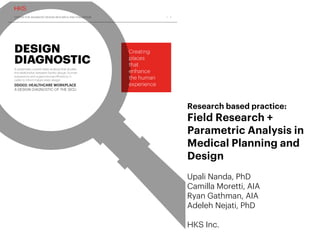



Research based practice:
Field Research +
Parametric Analysis in
Medical Planning and
Design
Upali Nanda, PhD
Camilla Moretti, AIA
Ryan Gathman, AIA
Adeleh Nejati, PhD
HKS Inc.
……it is important to
define a problem before designing a solution
continuously test the solution to make sure it
works
Learn how field research and simulation tools can be combined
Explore how research and analytics can be rapidly deployed for design
Learn about how design decision making can be fundamentally transformed through
data and performance driven approaches
LEARNING OBJECTIVES
noun
1.
the systematic investigation into and
study of materials and sources in order to
establish facts and reach new
conclusions.
verb
1.
investigate systematically.
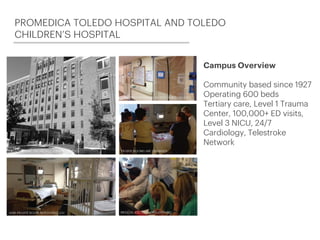
PROMEDICA TOLEDO HOSPITAL AND TOLEDO
CHILDREN’S HOSPITAL
Campus Overview
Community based since 1927
Operating 600 beds
Tertiary care, Level 1 Trauma
Center, 100,000+ ED visits,
Level 3 NICU, 24/7
Cardiology, Telestroke
Network
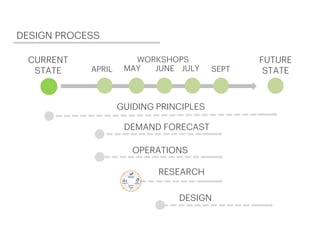
DESIGN PROCESS
JULY SEPTMAY JUNEAPRIL
CURRENT
STATE
FUTURE
STATE
DEMAND FORECAST
DESIGN
OPERATIONS
RESEARCH
GUIDING PRINCIPLES
WORKSHOPS
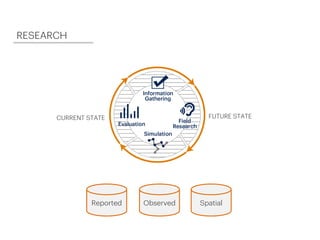
Reported Observed Spatial
RESEARCH
CURRENT STATE FUTURE STATE
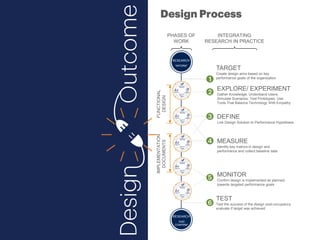
PHASES OF
WORK
INTEGRATING
RESEARCH IN PRACTICE
FUNCTIONAL
DESIGN
IMPLEMENTATION
DOCUMENTS
RESEARCH
“INFORM”
CONCEPT
SD
DD
CA
CD
RESEARCH
“AND
CONFIRM”
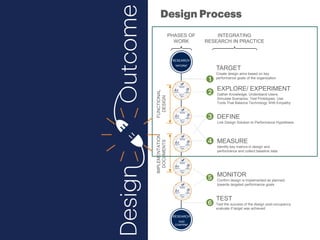
TARGET
Create design aims based on key
performance goals of the organization
EXPLORE/ EXPERIMENT
Gather Knowledge; Understand Users;
Simulate Scenarios; Test Prototypes. Use
Tools That Balance Technology With Empathy
DEFINE
Link Design Solution to Performance Hypothesis
MEASURE
Identify key metrics in design and
performance and collect baseline data
MONITOR
Confirm design is implemented as planned;
towards targeted performance goals
TEST
Test the success of the design post-occupancy;
evaluate if target was achieved
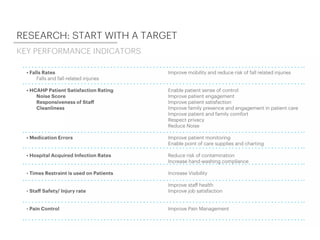
RESEARCH: START WITH A TARGET
KEY PERFORMANCE INDICATORS
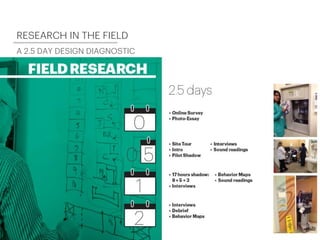
RESEARCH IN THE FIELD
A 2.5 DAY DESIGN DIAGNOSTIC
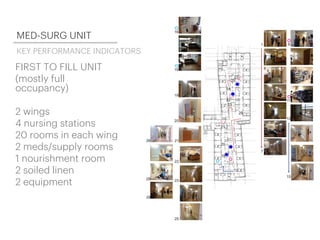
FIRST TO FILL UNIT
(mostly full
occupancy)
2 wings
4 nursing stations
20 rooms in each wing
2 meds/supply rooms
1 nourishment room
2 soiled linen
2 equipment
MED-SURG UNIT
KEY PERFORMANCE INDICATORS
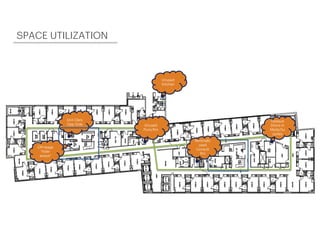
Unused
Kitchen
Unused
Pyxis Rm
Opaque
Doors in
Meds/Su
pplies
Unit Clerk
Opp Side
Minimally
used
Consult
Rm
Off-stage
“hide-
aways”
SPACE UTILIZATION
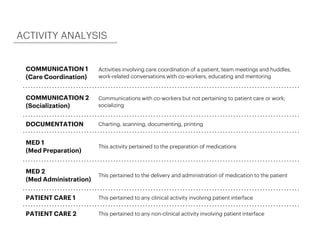
COMMUNICATION 1
(Care Coordination)
Activities involving care coordination of a patient, team meetings and huddles,
work-related conversations with co-workers, educating and mentoring
COMMUNICATION 2
(Socialization)
Communications with co-workers but not pertaining to patient care or work;
socializing
DOCUMENTATION Charting, scanning, documenting, printing
MED 1
(Med Preparation)
This activity pertained to the preparation of medications
MED 2
(Med Administration)
This pertained to the delivery and administration of medication to the patient
PATIENT CARE 1 This pertained to any clinical activity involving patient interface
PATIENT CARE 2 This pertained to any non-clinical activity involving patient interface
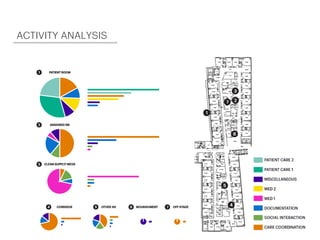
ACTIVITY ANALYSIS
ACTIVITY ANALYSIS
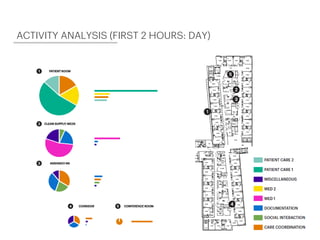
ACTIVITY ANALYSIS (FIRST 2 HOURS: DAY)
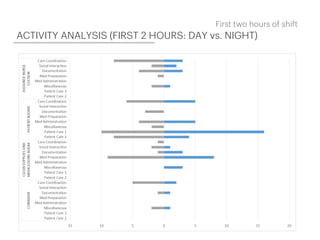
First two hours of shift
ACTIVITY ANALYSIS (FIRST 2 HOURS: DAY vs. NIGHT)
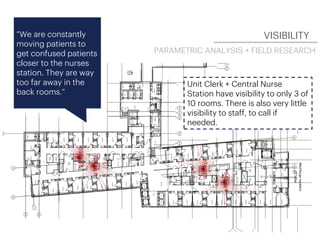
Unit Clerk + Central Nurse
Station have visibility to only 3 of
10 rooms. There is also very little
visibility to staff, to call if
needed.
“We are constantly
moving patients to
get confused patients
closer to the nurses
station. They are way
too far away in the
back rooms.”
VISIBILITY
PARAMETRIC ANALYSIS + FIELD RESEARCH
WALKING
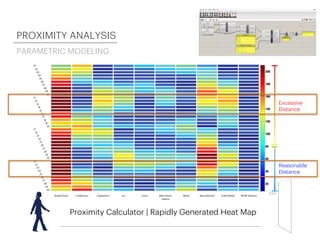
Proximity Calculator | Rapidly Generated Heat Map
Excessive
Distance
Reasonable
Distance
PROXIMITY ANALYSIS
PARAMETRIC MODELING
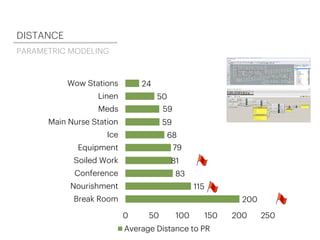
200
115
83
81
79
68
59
59
50
24
0 50 100 150 200 250
Break Room
Nourishment
Conference
Soiled Work
Equipment
Ice
Main Nurse Station
Meds
Linen
Wow Stations
Average Distance to PR
DISTANCE
PARAMETRIC MODELING
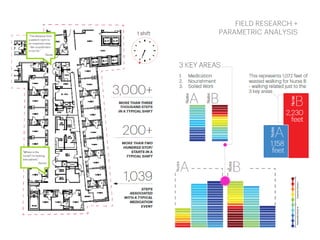
FIELD RESEARCH +
PARAMETRIC ANALYSIS
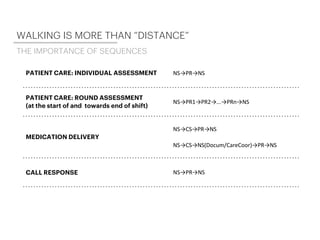
PATIENT CARE: INDIVIDUAL ASSESSMENT NS→PR→NS
PATIENT CARE: ROUND ASSESSMENT
(at the start of and towards end of shift)
NS→PR1→PR2→...→PRn→NS
MEDICATION DELIVERY
NS→CS→PR→NS
NS→CS→NS(Docum/CareCoor)→PR→NS
CALL RESPONSE NS→PR→NS
WALKING IS MORE THAN “DISTANCE”
THE IMPORTANCE OF SEQUENCES
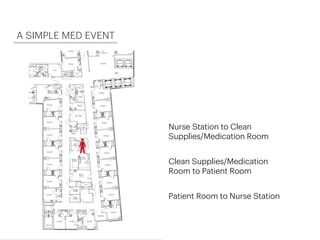
Nurse Station to Clean
Supplies/Medication Room
Clean Supplies/Medication
Room to Patient Room
Patient Room to Nurse Station
A SIMPLE MED EVENT
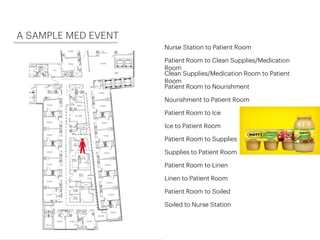
Nurse Station to Patient Room
Patient Room to Clean Supplies/Medication
Room
Clean Supplies/Medication Room to Patient
Room
Patient Room to Nourishment
Nourishment to Patient Room
Patient Room to Ice
Ice to Patient Room
Patient Room to Supplies
Supplies to Patient Room
Patient Room to Linen
Linen to Patient Room
Patient Room to Soiled
Soiled to Nurse Station
A SAMPLE MED EVENT
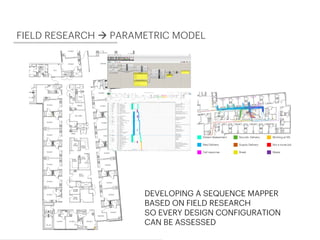
FIELD RESEARCH  PARAMETRIC MODEL
DEVELOPING A SEQUENCE MAPPER
BASED ON FIELD RESEARCH
SO EVERY DESIGN CONFIGURATION
CAN BE ASSESSED
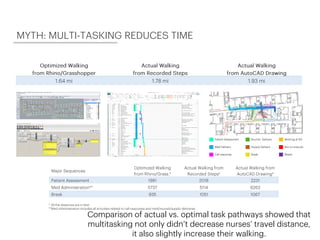
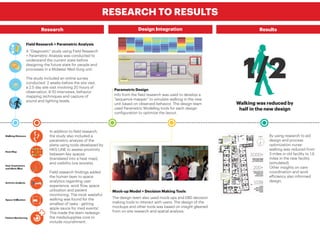
Comparison of actual vs. optimal task pathways showed that
multitasking not only didn’t decrease nurses’ travel distance,
it also slightly increase their walking.
MYTH: MULTI-TASKING REDUCES TIME
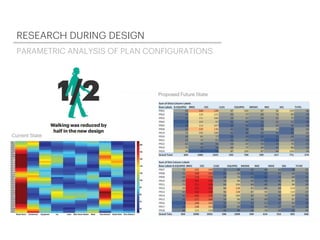
RESEARCH DURING DESIGN
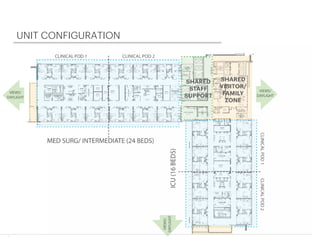
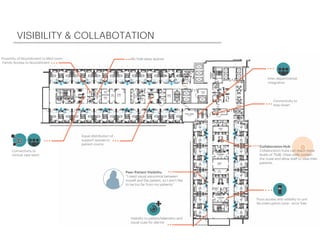
PARAMETRIC ANALYSIS OF PLAN CONFIGURATIONS
UNIT CONFIGURATION
VISIBILITY & COLLABOTATION
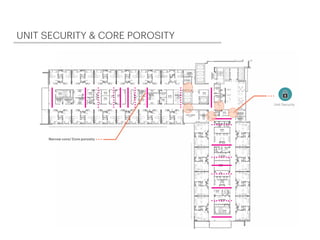
UNIT SECURITY & CORE POROSITY
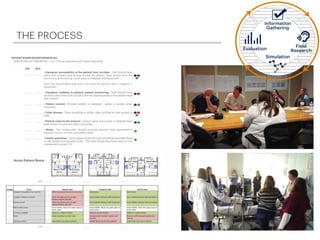
THE PROCESS
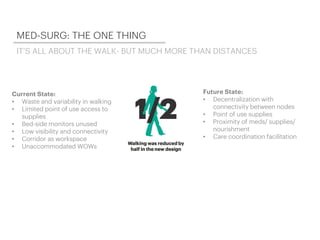
MED-SURG: THE ONE THING
Current State:
• Waste and variability in walking
• Limited point of use access to
supplies
• Bed-side monitors unused
• Low visibility and connectivity
• Corridor as workspace
• Unaccommodated WOWs
Future State:
• Decentralization with
connectivity between nodes
• Point of use supplies
• Proximity of meds/ supplies/
nourishment
• Care coordination facilitation
IT’S ALL ABOUT THE WALK- BUT MUCH MORE THAN DISTANCES
MED-SURG: THE ONE THING
Current State:
• Waste and variability in walking
• Limited point of use access to
supplies
• Bed-side monitors unused
• Low visibility and connectivity
• Corridor as workspace
• Unaccommodated WOWs
Future State:
• Decentralization with
connectivity between nodes
• Point of use supplies
• Proximity of meds/ supplies/
nourishment
• Care coordination facilitation
IT’S ALL ABOUT THE WALK- BUT MUCH MORE THAN DISTANCES
WHY THIS MATTERS
CURRENT
STATE
FUTURE
STATE
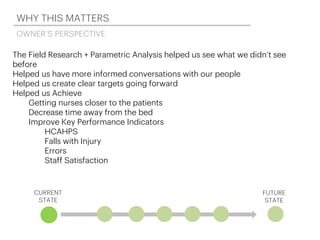
The Field Research + Parametric Analysis helped us see what we didn’t see
before
Helped us have more informed conversations with our people
Helped us create clear targets going forward
Helped us Achieve
Getting nurses closer to the patients
Decrease time away from the bed
Improve Key Performance Indicators
HCAHPS
Falls with Injury
Errors
Staff Satisfaction
OWNER’S PERSPECTIVE
PHASES OF
WORK
INTEGRATING
RESEARCH IN PRACTICE
FUNCTIONAL
DESIGN
IMPLEMENTATION
DOCUMENTS
RESEARCH
“INFORM”
CONCEPT
SD
DD
CA
CD
RESEARCH
“AND
CONFIRM”
TARGET
Create design aims based on key
performance goals of the organization
EXPLORE/ EXPERIMENT
Gather Knowledge; Understand Users;
Simulate Scenarios; Test Prototypes. Use
Tools That Balance Technology With Empathy
DEFINE
Link Design Solution to Performance Hypothesis
MEASURE
Identify key metrics in design and
performance and collect baseline data
MONITOR
Confirm design is implemented as planned;
towards targeted performance goals
TEST
Test the success of the design post-occupancy;
evaluate if target was achieved
De Ja VuVe Ja Du
Ready for Questions & Comments
unanda@hksinc.com

ARCC_2015_Promedica

  • 1.
    Research based practice: FieldResearch + Parametric Analysis in Medical Planning and Design Upali Nanda, PhD Camilla Moretti, AIA Ryan Gathman, AIA Adeleh Nejati, PhD HKS Inc.
  • 2.
    ……it is importantto define a problem before designing a solution continuously test the solution to make sure it works
  • 3.
    Learn how fieldresearch and simulation tools can be combined Explore how research and analytics can be rapidly deployed for design Learn about how design decision making can be fundamentally transformed through data and performance driven approaches LEARNING OBJECTIVES noun 1. the systematic investigation into and study of materials and sources in order to establish facts and reach new conclusions. verb 1. investigate systematically.
  • 4.
    PROMEDICA TOLEDO HOSPITALAND TOLEDO CHILDREN’S HOSPITAL Campus Overview Community based since 1927 Operating 600 beds Tertiary care, Level 1 Trauma Center, 100,000+ ED visits, Level 3 NICU, 24/7 Cardiology, Telestroke Network
  • 5.
    DESIGN PROCESS JULY SEPTMAYJUNEAPRIL CURRENT STATE FUTURE STATE DEMAND FORECAST DESIGN OPERATIONS RESEARCH GUIDING PRINCIPLES WORKSHOPS
  • 6.
  • 7.
    PHASES OF WORK INTEGRATING RESEARCH INPRACTICE FUNCTIONAL DESIGN IMPLEMENTATION DOCUMENTS RESEARCH “INFORM” CONCEPT SD DD CA CD RESEARCH “AND CONFIRM” TARGET Create design aims based on key performance goals of the organization EXPLORE/ EXPERIMENT Gather Knowledge; Understand Users; Simulate Scenarios; Test Prototypes. Use Tools That Balance Technology With Empathy DEFINE Link Design Solution to Performance Hypothesis MEASURE Identify key metrics in design and performance and collect baseline data MONITOR Confirm design is implemented as planned; towards targeted performance goals TEST Test the success of the design post-occupancy; evaluate if target was achieved
  • 8.
    RESEARCH: START WITHA TARGET KEY PERFORMANCE INDICATORS
  • 9.
    RESEARCH IN THEFIELD A 2.5 DAY DESIGN DIAGNOSTIC
  • 10.
    FIRST TO FILLUNIT (mostly full occupancy) 2 wings 4 nursing stations 20 rooms in each wing 2 meds/supply rooms 1 nourishment room 2 soiled linen 2 equipment MED-SURG UNIT KEY PERFORMANCE INDICATORS
  • 11.
    Unused Kitchen Unused Pyxis Rm Opaque Doors in Meds/Su pplies UnitClerk Opp Side Minimally used Consult Rm Off-stage “hide- aways” SPACE UTILIZATION
  • 12.
    COMMUNICATION 1 (Care Coordination) Activitiesinvolving care coordination of a patient, team meetings and huddles, work-related conversations with co-workers, educating and mentoring COMMUNICATION 2 (Socialization) Communications with co-workers but not pertaining to patient care or work; socializing DOCUMENTATION Charting, scanning, documenting, printing MED 1 (Med Preparation) This activity pertained to the preparation of medications MED 2 (Med Administration) This pertained to the delivery and administration of medication to the patient PATIENT CARE 1 This pertained to any clinical activity involving patient interface PATIENT CARE 2 This pertained to any non-clinical activity involving patient interface ACTIVITY ANALYSIS
  • 13.
  • 14.
  • 15.
    First two hoursof shift ACTIVITY ANALYSIS (FIRST 2 HOURS: DAY vs. NIGHT)
  • 16.
    Unit Clerk +Central Nurse Station have visibility to only 3 of 10 rooms. There is also very little visibility to staff, to call if needed. “We are constantly moving patients to get confused patients closer to the nurses station. They are way too far away in the back rooms.” VISIBILITY PARAMETRIC ANALYSIS + FIELD RESEARCH
  • 17.
  • 18.
    Proximity Calculator |Rapidly Generated Heat Map Excessive Distance Reasonable Distance PROXIMITY ANALYSIS PARAMETRIC MODELING
  • 19.
    200 115 83 81 79 68 59 59 50 24 0 50 100150 200 250 Break Room Nourishment Conference Soiled Work Equipment Ice Main Nurse Station Meds Linen Wow Stations Average Distance to PR DISTANCE PARAMETRIC MODELING
  • 20.
  • 21.
    PATIENT CARE: INDIVIDUALASSESSMENT NS→PR→NS PATIENT CARE: ROUND ASSESSMENT (at the start of and towards end of shift) NS→PR1→PR2→...→PRn→NS MEDICATION DELIVERY NS→CS→PR→NS NS→CS→NS(Docum/CareCoor)→PR→NS CALL RESPONSE NS→PR→NS WALKING IS MORE THAN “DISTANCE” THE IMPORTANCE OF SEQUENCES
  • 22.
    Nurse Station toClean Supplies/Medication Room Clean Supplies/Medication Room to Patient Room Patient Room to Nurse Station A SIMPLE MED EVENT
  • 23.
    Nurse Station toPatient Room Patient Room to Clean Supplies/Medication Room Clean Supplies/Medication Room to Patient Room Patient Room to Nourishment Nourishment to Patient Room Patient Room to Ice Ice to Patient Room Patient Room to Supplies Supplies to Patient Room Patient Room to Linen Linen to Patient Room Patient Room to Soiled Soiled to Nurse Station A SAMPLE MED EVENT
  • 24.
    FIELD RESEARCH PARAMETRIC MODEL DEVELOPING A SEQUENCE MAPPER BASED ON FIELD RESEARCH SO EVERY DESIGN CONFIGURATION CAN BE ASSESSED
  • 25.
    Comparison of actualvs. optimal task pathways showed that multitasking not only didn’t decrease nurses’ travel distance, it also slightly increase their walking. MYTH: MULTI-TASKING REDUCES TIME
  • 26.
    RESEARCH DURING DESIGN PARAMETRICANALYSIS OF PLAN CONFIGURATIONS
  • 27.
  • 28.
  • 29.
    UNIT SECURITY &CORE POROSITY
  • 30.
  • 31.
    MED-SURG: THE ONETHING Current State: • Waste and variability in walking • Limited point of use access to supplies • Bed-side monitors unused • Low visibility and connectivity • Corridor as workspace • Unaccommodated WOWs Future State: • Decentralization with connectivity between nodes • Point of use supplies • Proximity of meds/ supplies/ nourishment • Care coordination facilitation IT’S ALL ABOUT THE WALK- BUT MUCH MORE THAN DISTANCES
  • 32.
    MED-SURG: THE ONETHING Current State: • Waste and variability in walking • Limited point of use access to supplies • Bed-side monitors unused • Low visibility and connectivity • Corridor as workspace • Unaccommodated WOWs Future State: • Decentralization with connectivity between nodes • Point of use supplies • Proximity of meds/ supplies/ nourishment • Care coordination facilitation IT’S ALL ABOUT THE WALK- BUT MUCH MORE THAN DISTANCES
  • 33.
    WHY THIS MATTERS CURRENT STATE FUTURE STATE TheField Research + Parametric Analysis helped us see what we didn’t see before Helped us have more informed conversations with our people Helped us create clear targets going forward Helped us Achieve Getting nurses closer to the patients Decrease time away from the bed Improve Key Performance Indicators HCAHPS Falls with Injury Errors Staff Satisfaction OWNER’S PERSPECTIVE
  • 34.
    PHASES OF WORK INTEGRATING RESEARCH INPRACTICE FUNCTIONAL DESIGN IMPLEMENTATION DOCUMENTS RESEARCH “INFORM” CONCEPT SD DD CA CD RESEARCH “AND CONFIRM” TARGET Create design aims based on key performance goals of the organization EXPLORE/ EXPERIMENT Gather Knowledge; Understand Users; Simulate Scenarios; Test Prototypes. Use Tools That Balance Technology With Empathy DEFINE Link Design Solution to Performance Hypothesis MEASURE Identify key metrics in design and performance and collect baseline data MONITOR Confirm design is implemented as planned; towards targeted performance goals TEST Test the success of the design post-occupancy; evaluate if target was achieved
  • 35.
  • 36.
    Ready for Questions& Comments unanda@hksinc.com