









Creating Diplomats For Hope
Webinar
Series
Empathy & Lean
Using Lean Healthcare methodologies to
improve upon the patient experience
Creating Diplomats For Hope
Webinar
Series
HOUSEKEEPING
AUDIO is available through your computer speakers or
through dial-in. All lines are muted.
You can SUBMIT QUESTIONS/COMMENTS at any time.
We will address all questions during the Q&A session at
the end of today’s presentation.
Links to the slides and RECORDING will be made
available and sent to all attendees via e-mail.
Creating Diplomats For Hope
Webinar
Series
ABOUT US
WE WORK WITH NATIONALLY-RECOGNIZED INSTITUTIONS:
5 “Honor Roll” institutions
5 out of the top 10 cancer programs
3 out of the top 4 pediatric hospitals
3 out of the top 10 cardiovascular programs
NATIONAL BENCHMARKING STUDIES:
Patient experience management
Marketing practices
Physician relations programs
International programs
Ranked as one of top 50 Healthcare Consulting firms by Modern
Healthcare
Creating Diplomats For Hope
Webinar
Series
JILL F. SECORD
GELB SENIOR ADVISOR, HEALTHCARE
Jill RN, BSN, MBA has 40 years of experience as a nurse with expert
skills in leadership, operations, managed care, nursing education
and creating roles for nurses in non traditional nursing settings. She
has clinical experience in critical care, orthopedics, home care,
home infusion, surgery, recovery and administrative experience in
managed care, contracting, provider relations, data analysis,
program operations and strategic planning.
She is certified in Lean Quality Healthcare and has developed systems to integrate
Lean techniques with Patient Experience Mapping and Family Focused Care
initiatives. Jill has worked with a variety of healthcare organizations
to create new departments, streamline current processes, and
develop new profitable programs.
Creating Diplomats For Hope
Webinar
Series
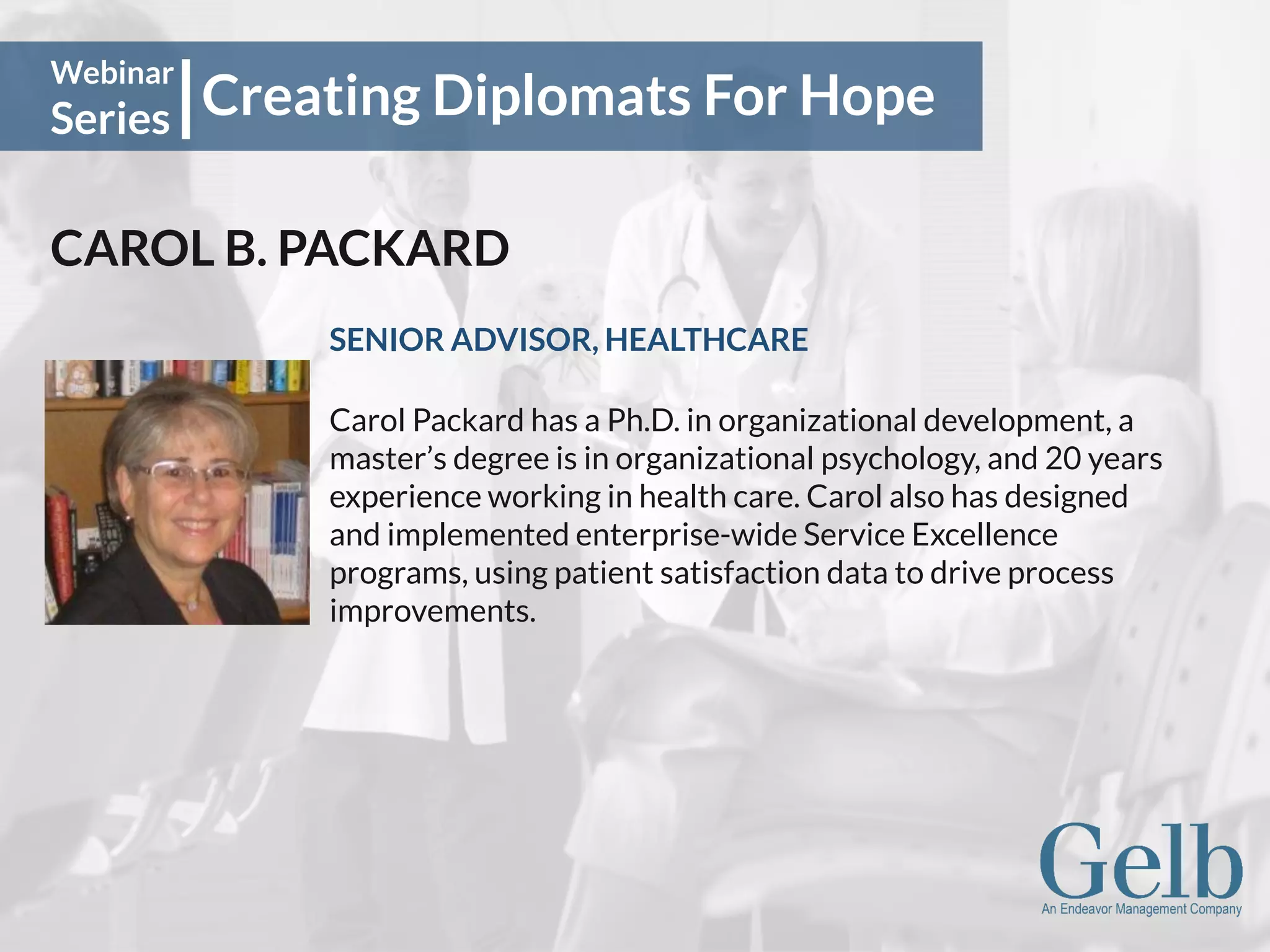
CAROL B. PACKARD
SENIOR ADVISOR, HEALTHCARE
Carol Packard has a Ph.D. in organizational development, a
master’s degree is in organizational psychology, and 20 years
experience working in health care. Carol also has designed
and implemented enterprise-wide Service Excellence
programs, using patient satisfaction data to drive process
improvements.
Objectives
To understand the difference between
EMOTIONAL needs and FUNCTIONAL needs
To understand a few LEAN TECHNIQUES
that you can use in your clinic setting
To have some “TOOLS” for your own personal
tool kit for future efficiency projects
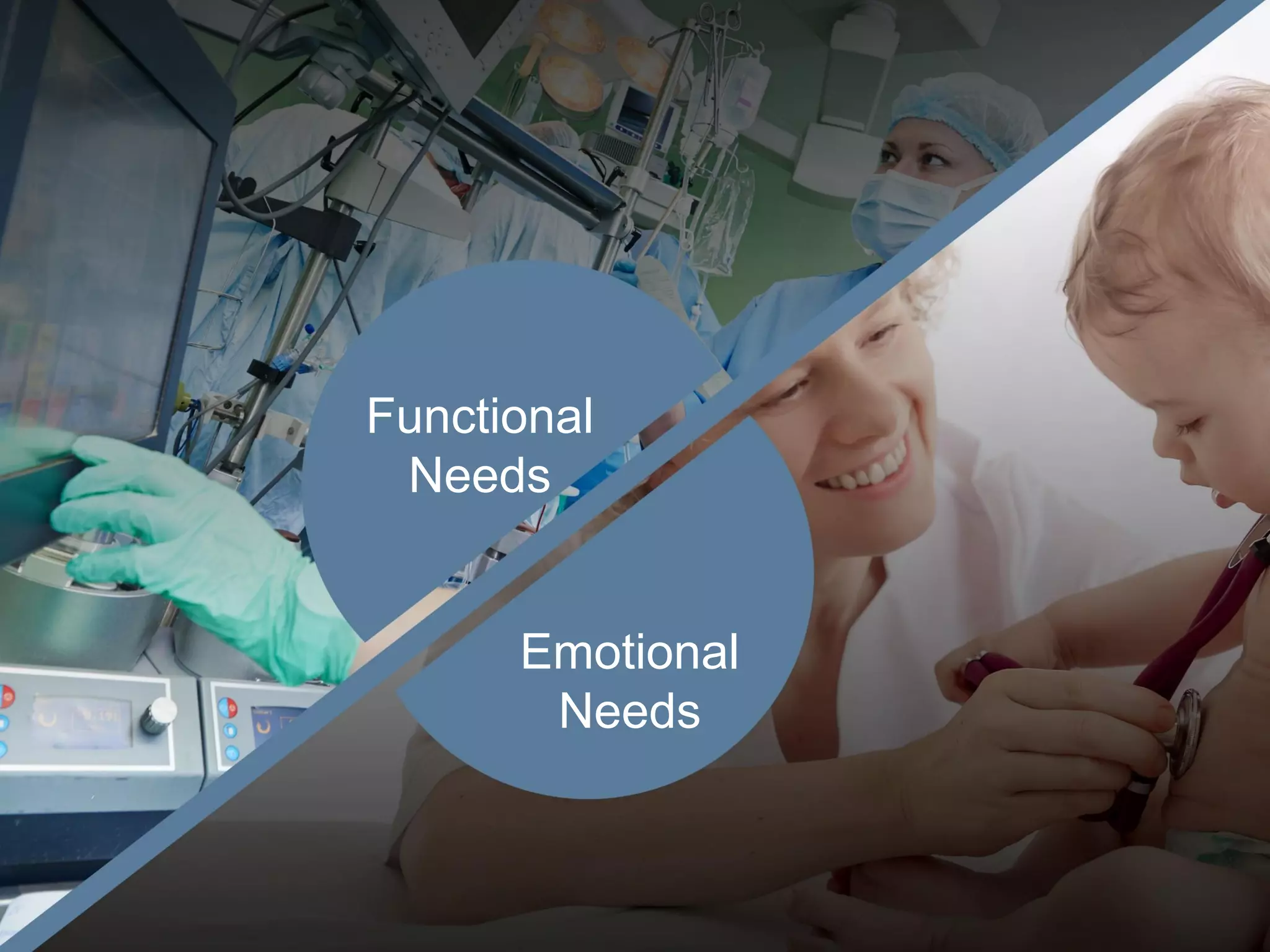
Functional
Needs
Emotional
Needs
Patient–Centered Settings
RESEARCH: WHY LEAN? WHY NOW?
As Health Systems move toward the
Accountable Care Model, systems will be
reimbursed based on:
• Improved patient CLINICAL OUTCOMES
• Higher patient SATISFACTION rates
• Fewer ACCIDENTS and INFECTIONS
• Lower COSTS
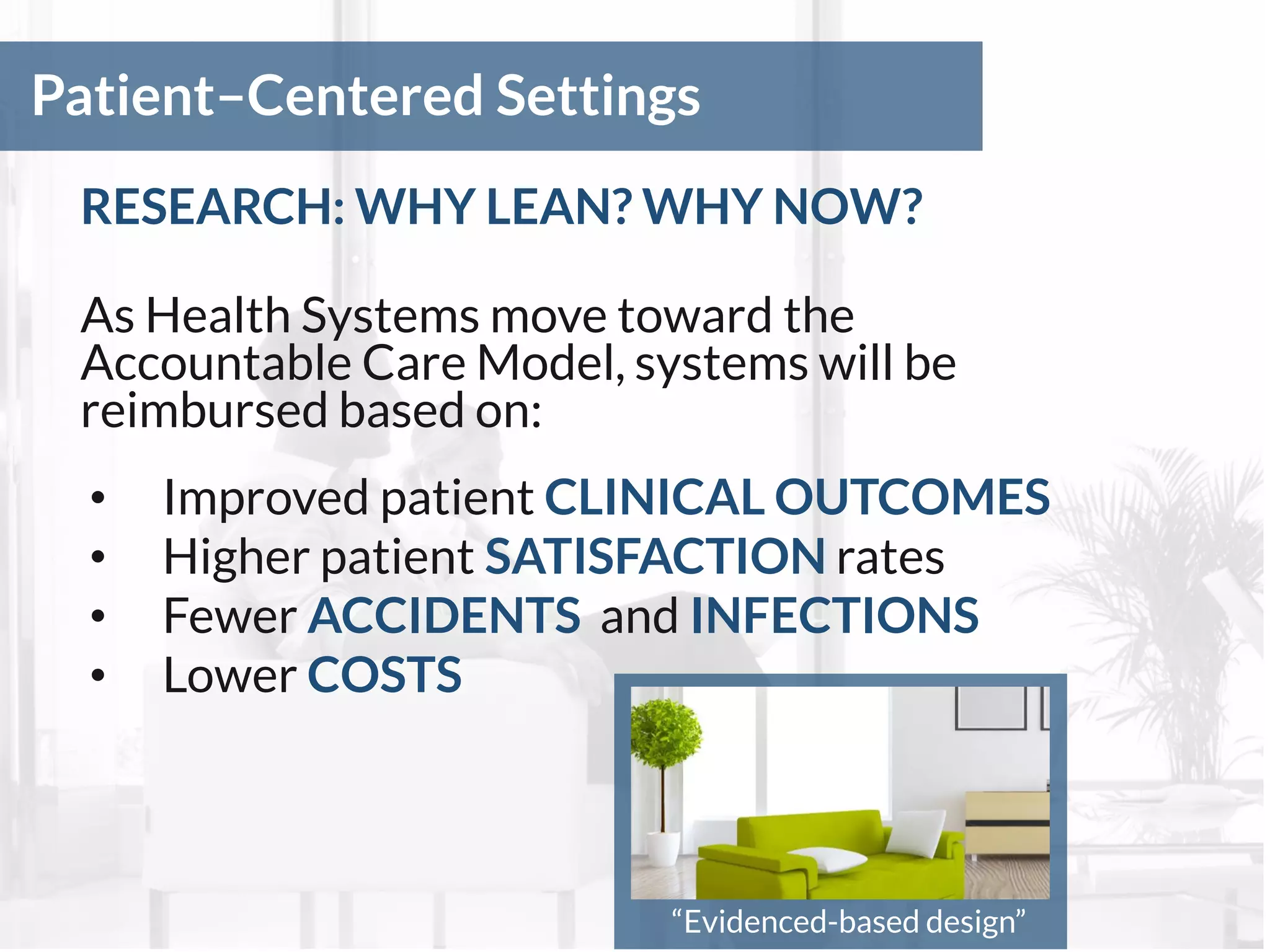
“Evidenced-based design”
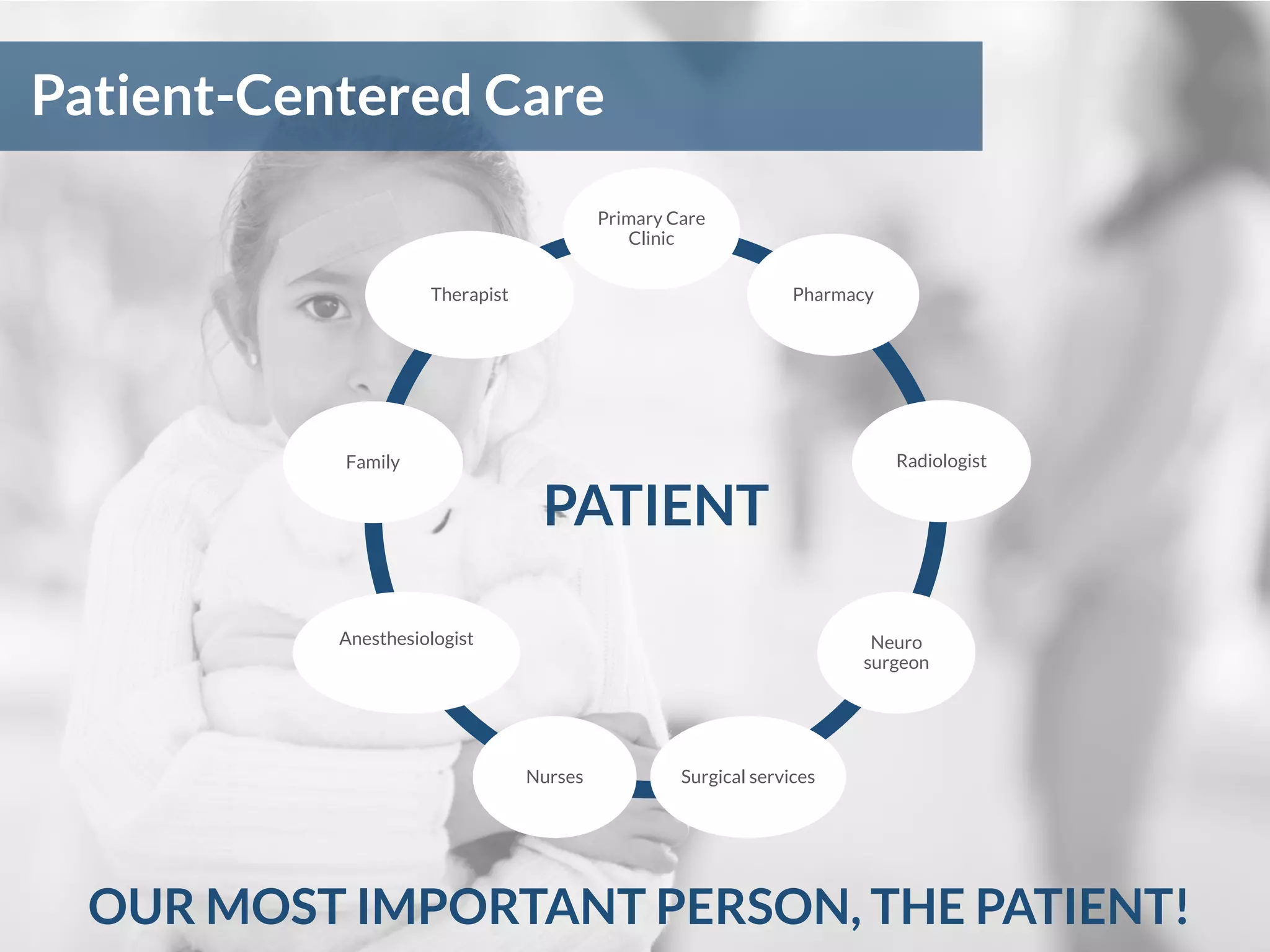
Patient-Centered Care
OUR MOST IMPORTANT PERSON, THE PATIENT!
PATIENT
Primary Care
Clinic
Pharmacy
Radiologist
Neuro
surgeon
Surgical servicesNurses
Anesthesiologist
Family
Therapist
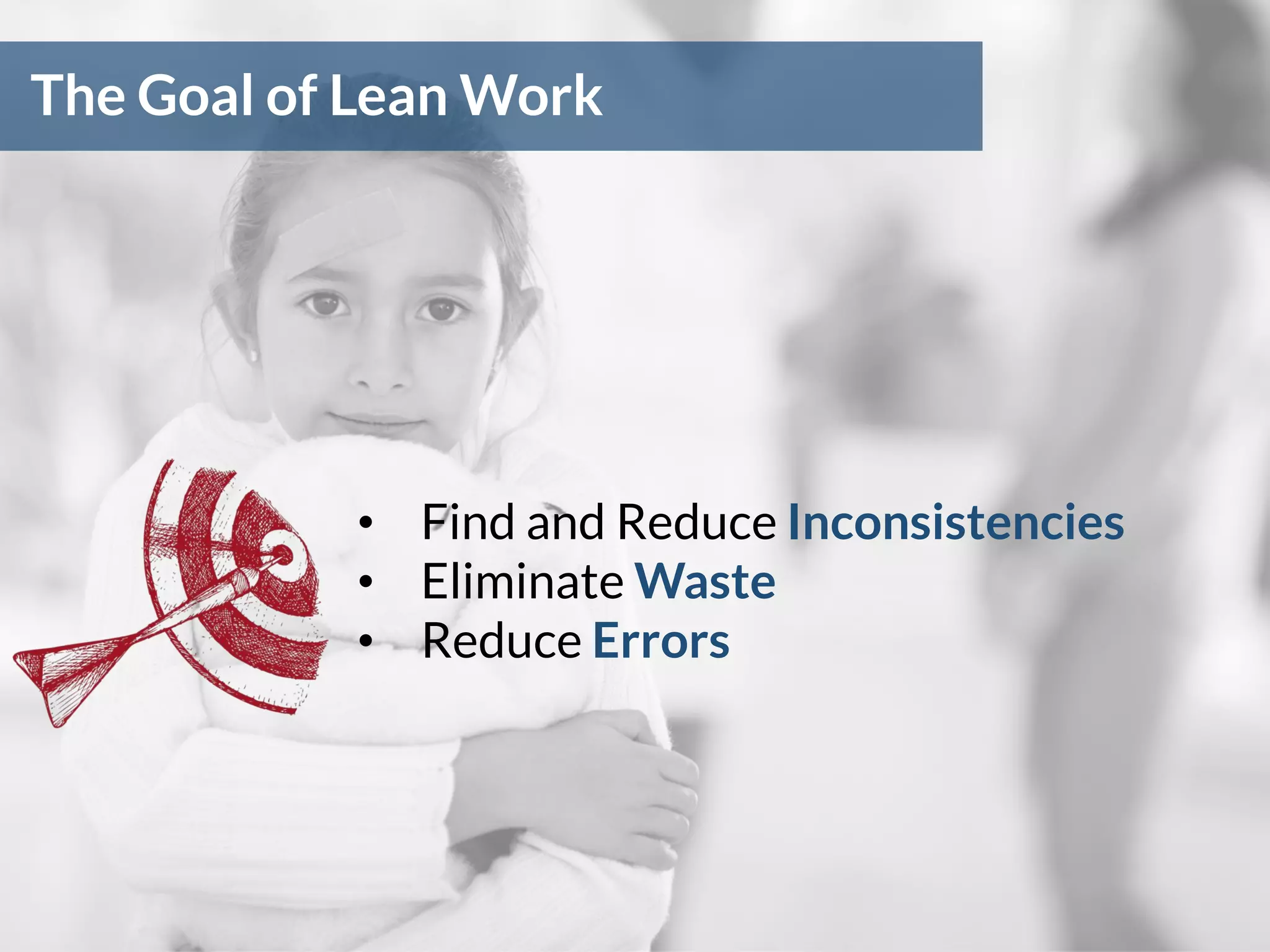
The Goal of Lean Work
• Find and Reduce Inconsistencies
• Eliminate Waste
• Reduce Errors
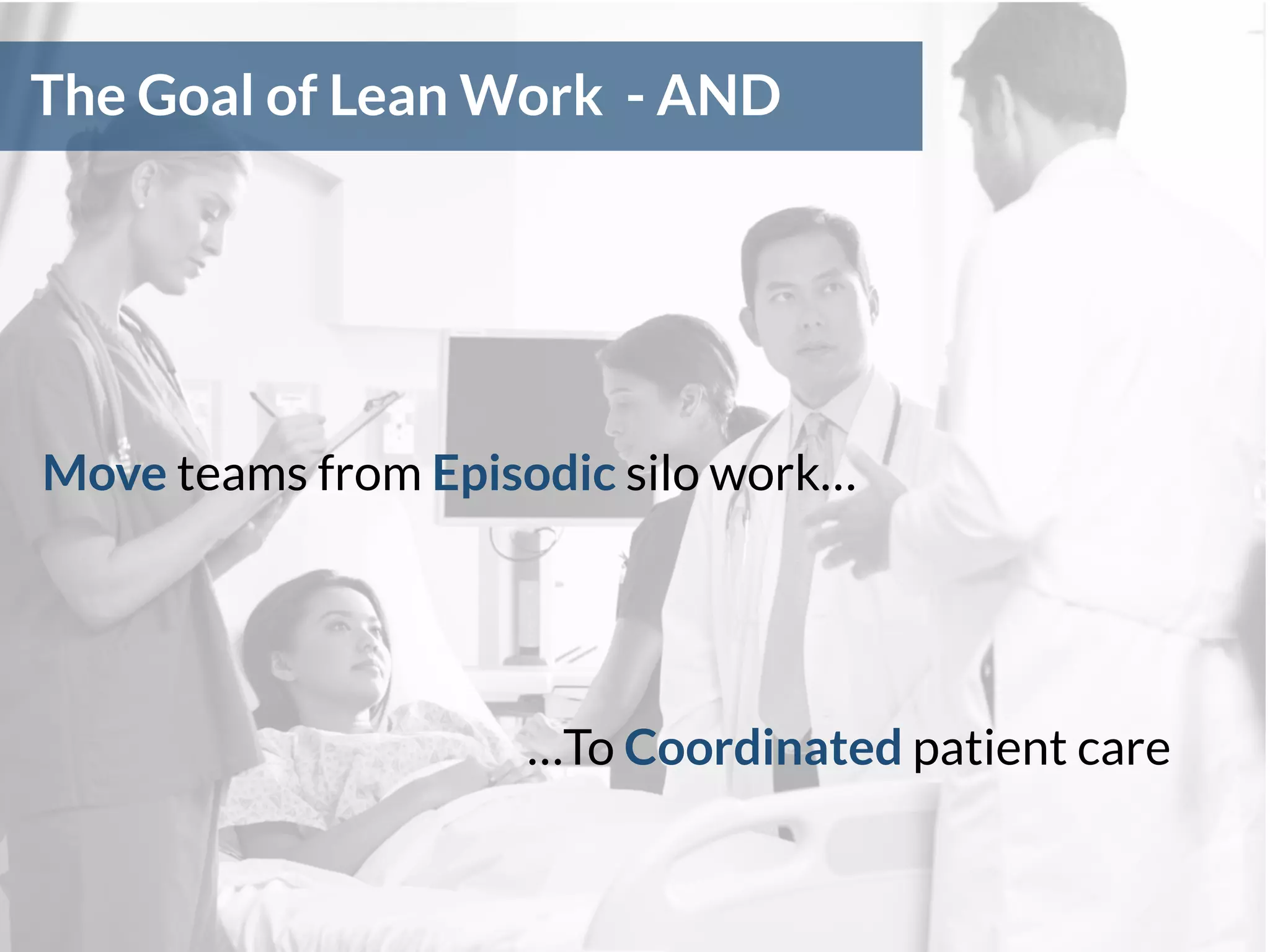
The Goal of Lean Work - AND
…To Coordinated patient care
Move teams from Episodic silo work…
Principles of Lean
The five-step thought process for guiding the implementation of lean
techniques is easy to remember, but not always easy to achieve:
1. Specify value from the standpoint of the patient and family.
2. Identify all the steps in the value stream for each service line, eliminating
whenever possible those steps that do not create value.
3. Make the value-creating steps occur in tight sequence so the service line will
flow smoothly toward the patient.
4. As flow is introduced, let patients pull value from the next upstream activity.
(Self scheduling for example)
5. As value is specified, value streams are identified, wasted steps are removed,
and flow and pull are introduced, begin the process again and continue it until a
state of perfection is reached in which perfect value is created with no waste.
(Continuous improvement).
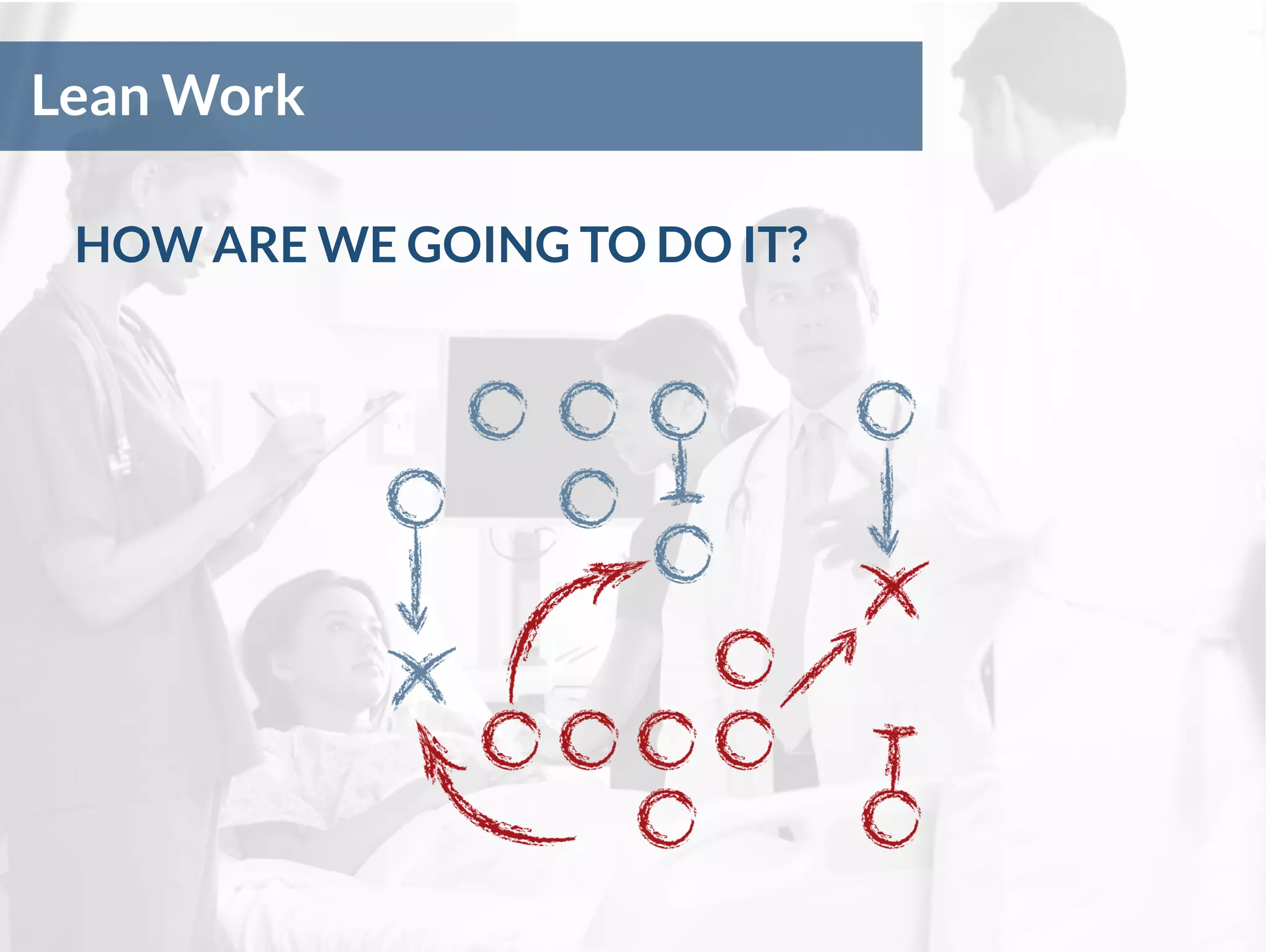
Lean Work
HOW ARE WE GOING TO DO IT?
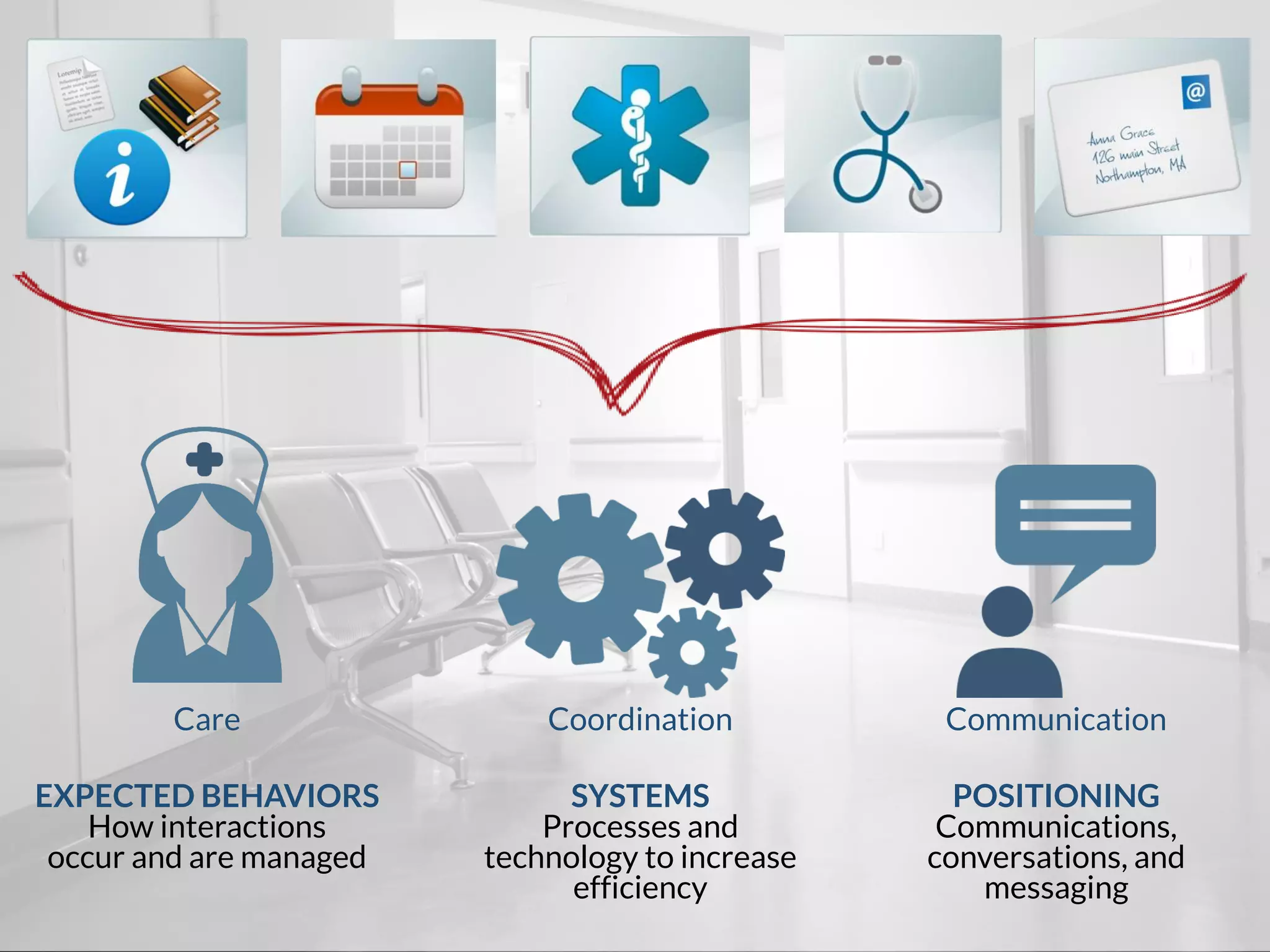
Care Coordination Communication
EXPECTED BEHAVIORS
How interactions
occur and are managed
SYSTEMS
Processes and
technology to increase
efficiency
POSITIONING
Communications,
conversations, and
messaging
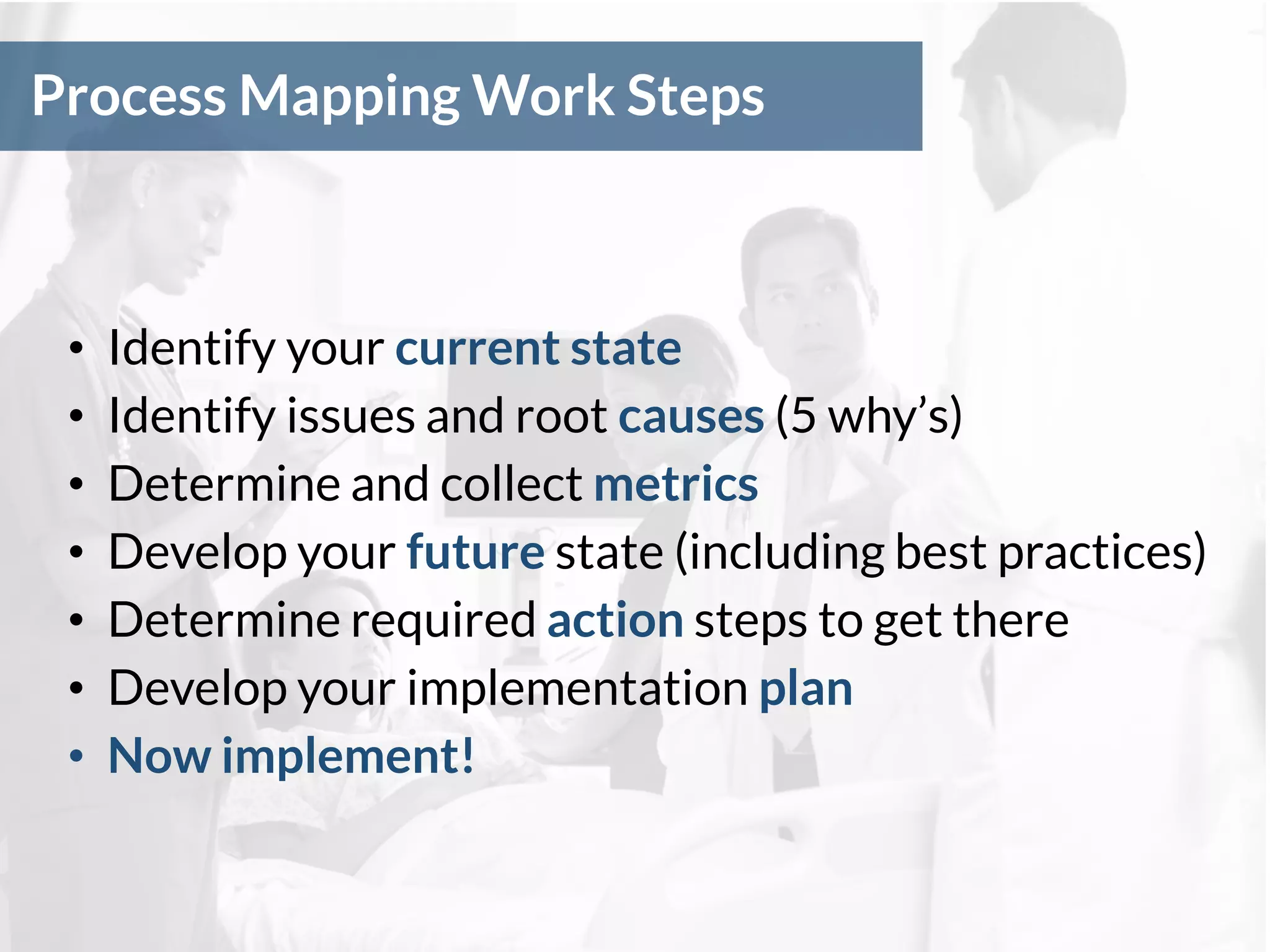
Process Mapping Work Steps
• Identify your current state
• Identify issues and root causes (5 why’s)
• Determine and collect metrics
• Develop your future state (including best practices)
• Determine required action steps to get there
• Develop your implementation plan
• Now implement!
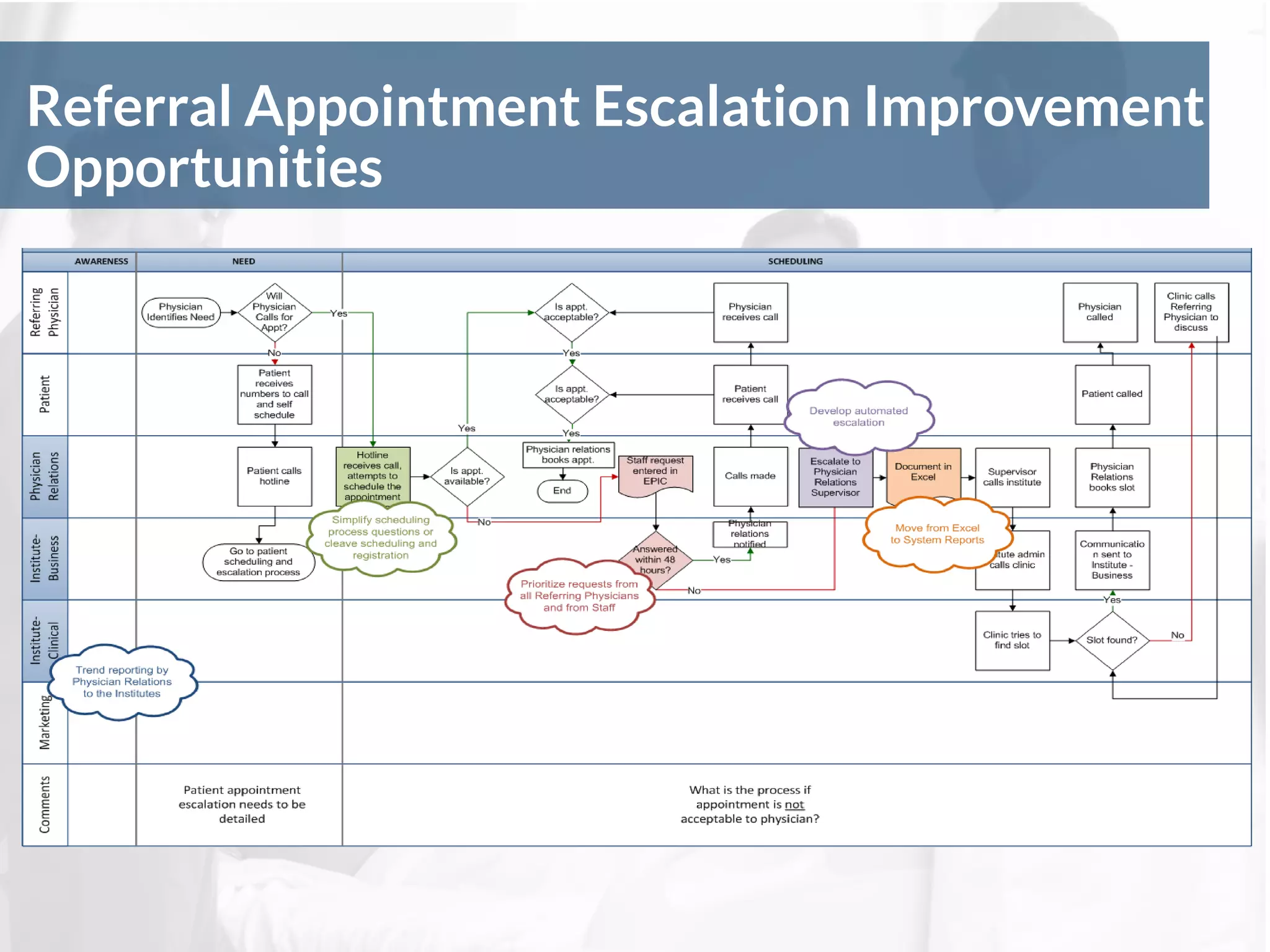
Referral Appointment Escalation Improvement
Opportunities
Gap Analysis Steps
Complete your Patient experience map from the site review, metrics and
observations:
• Plot the patient flow through your specific clinic
• Look closely at each step, is this necessary?
• Is it valuable to your patient and families?
• Identify gaps in the flow to create an “outlined best practice” for your future
state
• Identify areas where patients find value and where they don’t
• identify opportunities for improvement determined from satisfaction
surveys and other feedback
Gather specific metrics on wait times. Use current “check in” technology to gather
wait time data and identify gaps in data collection.
Move opportunities to an effort/impact matrix.
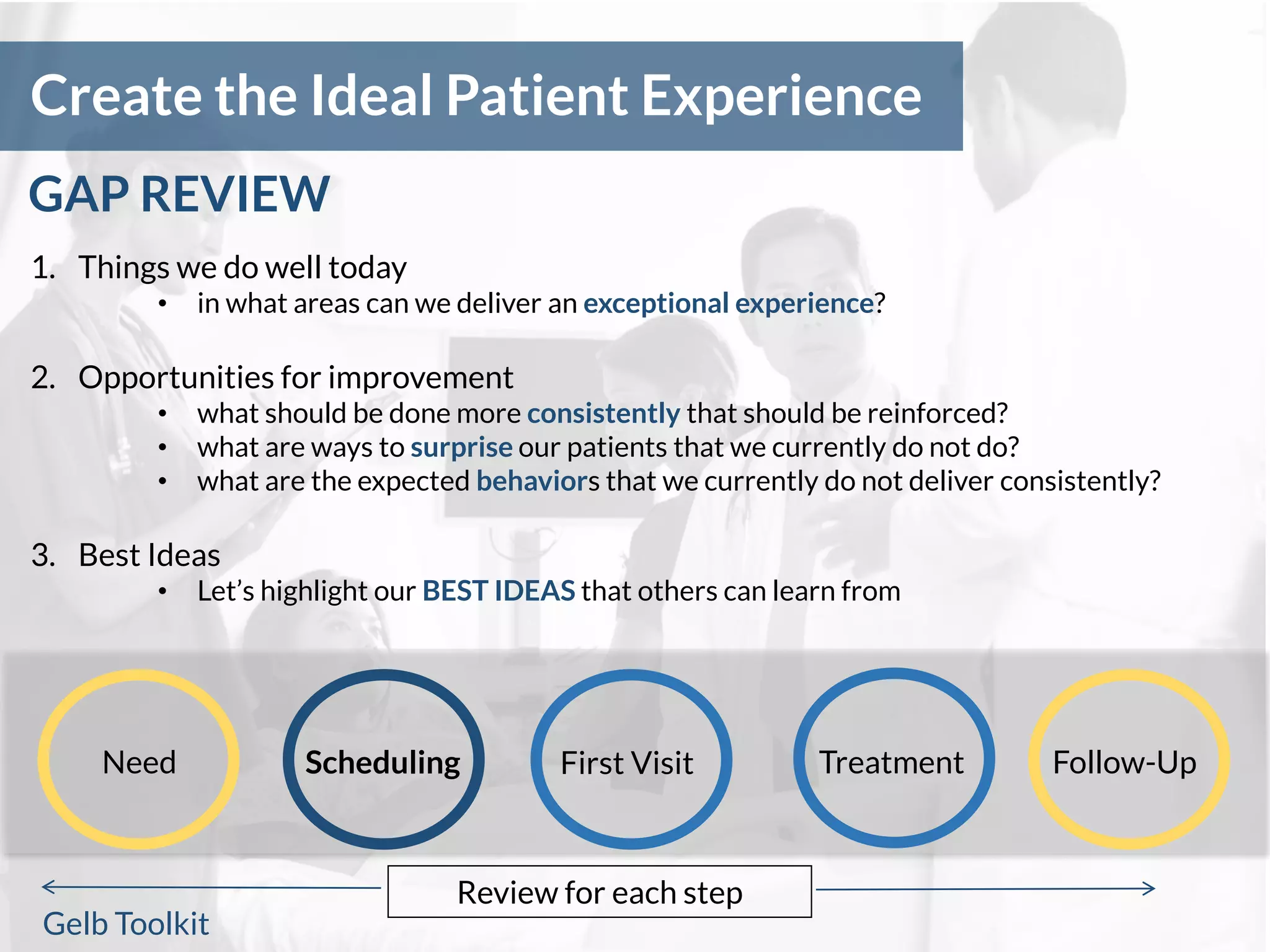
Create the Ideal Patient Experience
1. Things we do well today
• in what areas can we deliver an exceptional experience?
2. Opportunities for improvement
• what should be done more consistently that should be reinforced?
• what are ways to surprise our patients that we currently do not do?
• what are the expected behaviors that we currently do not deliver consistently?
3. Best Ideas
• Let’s highlight our BEST IDEAS that others can learn from
GAP REVIEW
Review for each step
Need Scheduling First Visit Treatment Follow-Up
Gelb Toolkit
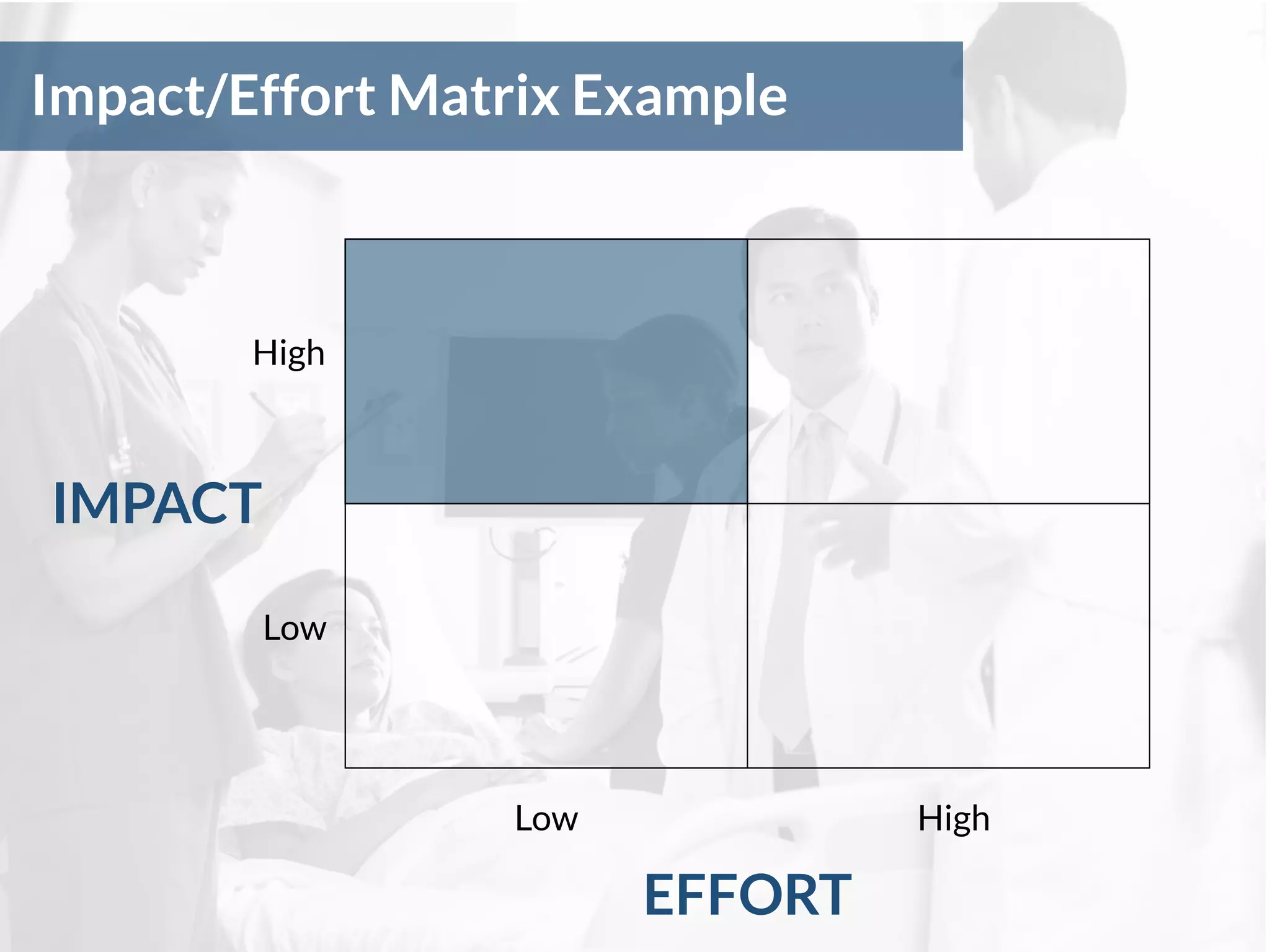
Impact/Effort Matrix Example
EFFORT
IMPACT
Low
Low
High
High
Quick Hits
• Those HIGH IMPACT LOW EFFORT tasks
that can be done today with little cost or
effort on the part of the staff.
• QUICK RESULTS
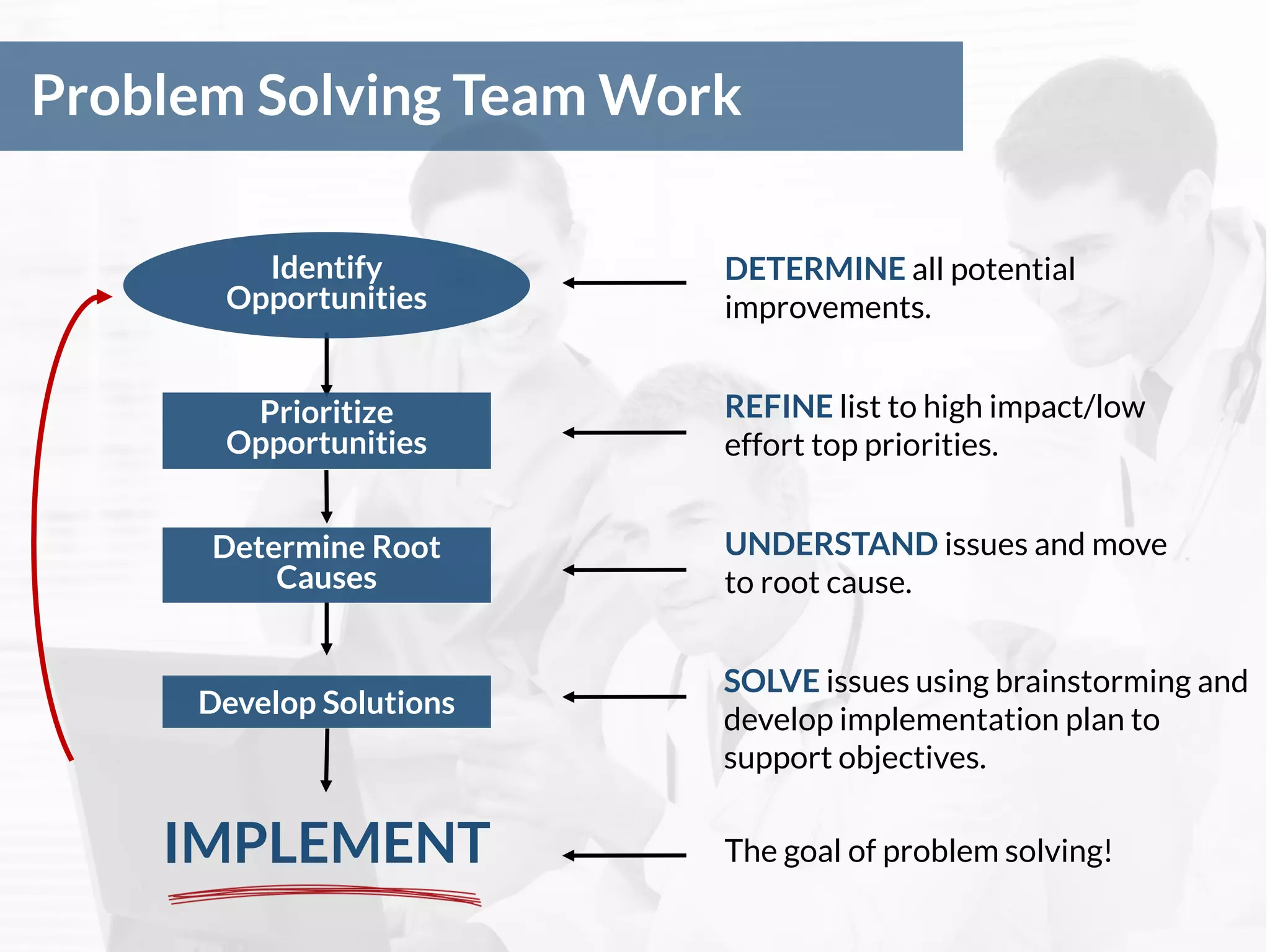
Problem Solving Team Work
REFINE list to high impact/low
effort top priorities.
Identify
Opportunities
UNDERSTAND issues and move
to root cause.
Prioritize
Opportunities
Develop Solutions
DETERMINE all potential
improvements.
The goal of problem solving!
Determine Root
Causes
SOLVE issues using brainstorming and
develop implementation plan to
support objectives.
IMPLEMENT
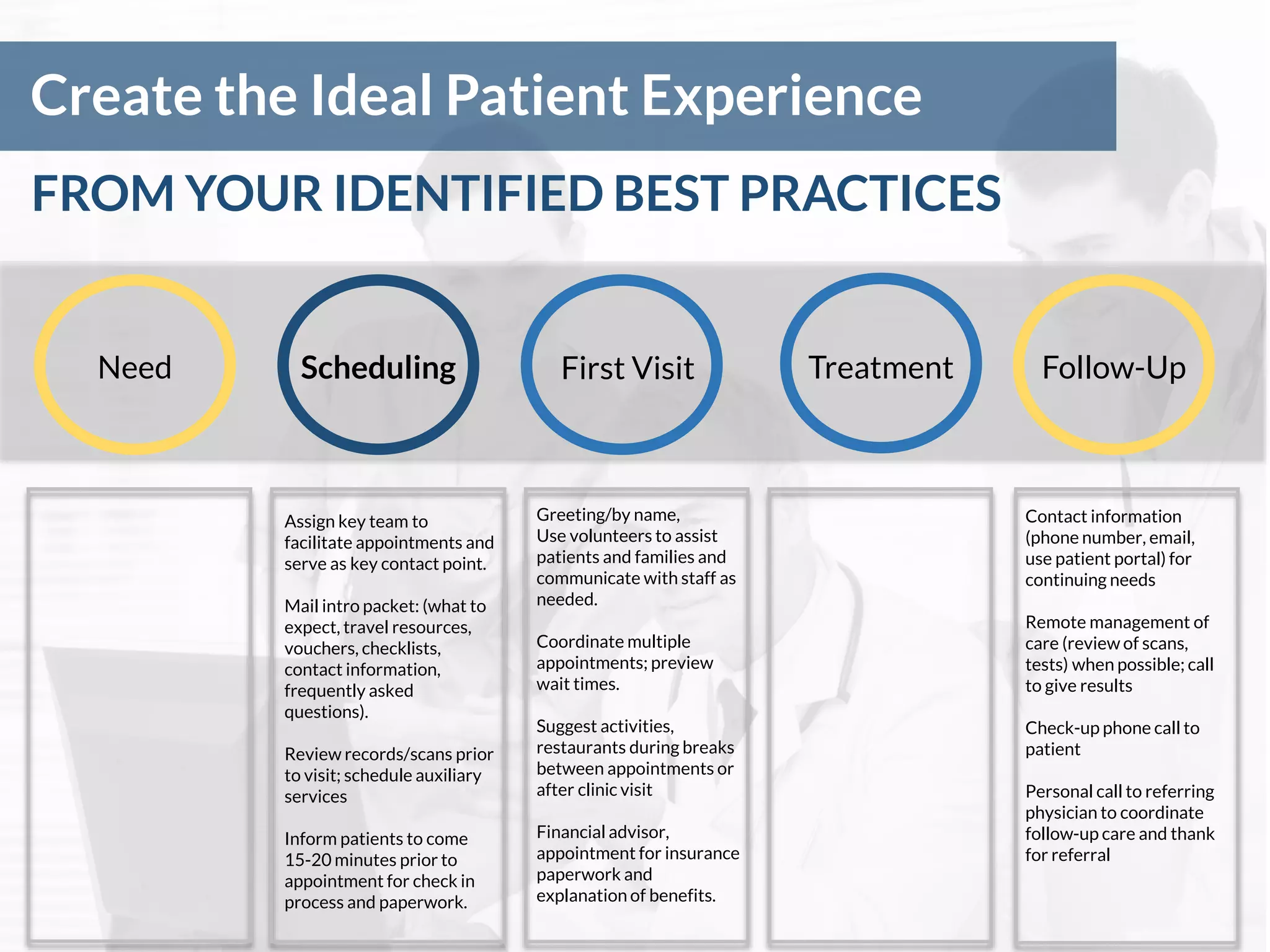
Create the Ideal Patient Experience
FROM YOUR IDENTIFIED BEST PRACTICES
Need Scheduling First Visit Treatment Follow-Up
Assign key team to
facilitate appointments and
serve as key contact point.
Mail intro packet: (what to
expect, travel resources,
vouchers, checklists,
contact information,
frequently asked
questions).
Review records/scans prior
to visit; schedule auxiliary
services
Inform patients to come
15-20 minutes prior to
appointment for check in
process and paperwork.
Greeting/by name,
Use volunteers to assist
patients and families and
communicate with staff as
needed.
Coordinate multiple
appointments; preview
wait times.
Suggest activities,
restaurants during breaks
between appointments or
after clinic visit
Financial advisor,
appointment for insurance
paperwork and
explanation of benefits.
Contact information
(phone number, email,
use patient portal) for
continuing needs
Remote management of
care (review of scans,
tests) when possible; call
to give results
Check-up phone call to
patient
Personal call to referring
physician to coordinate
follow-up care and thank
for referral
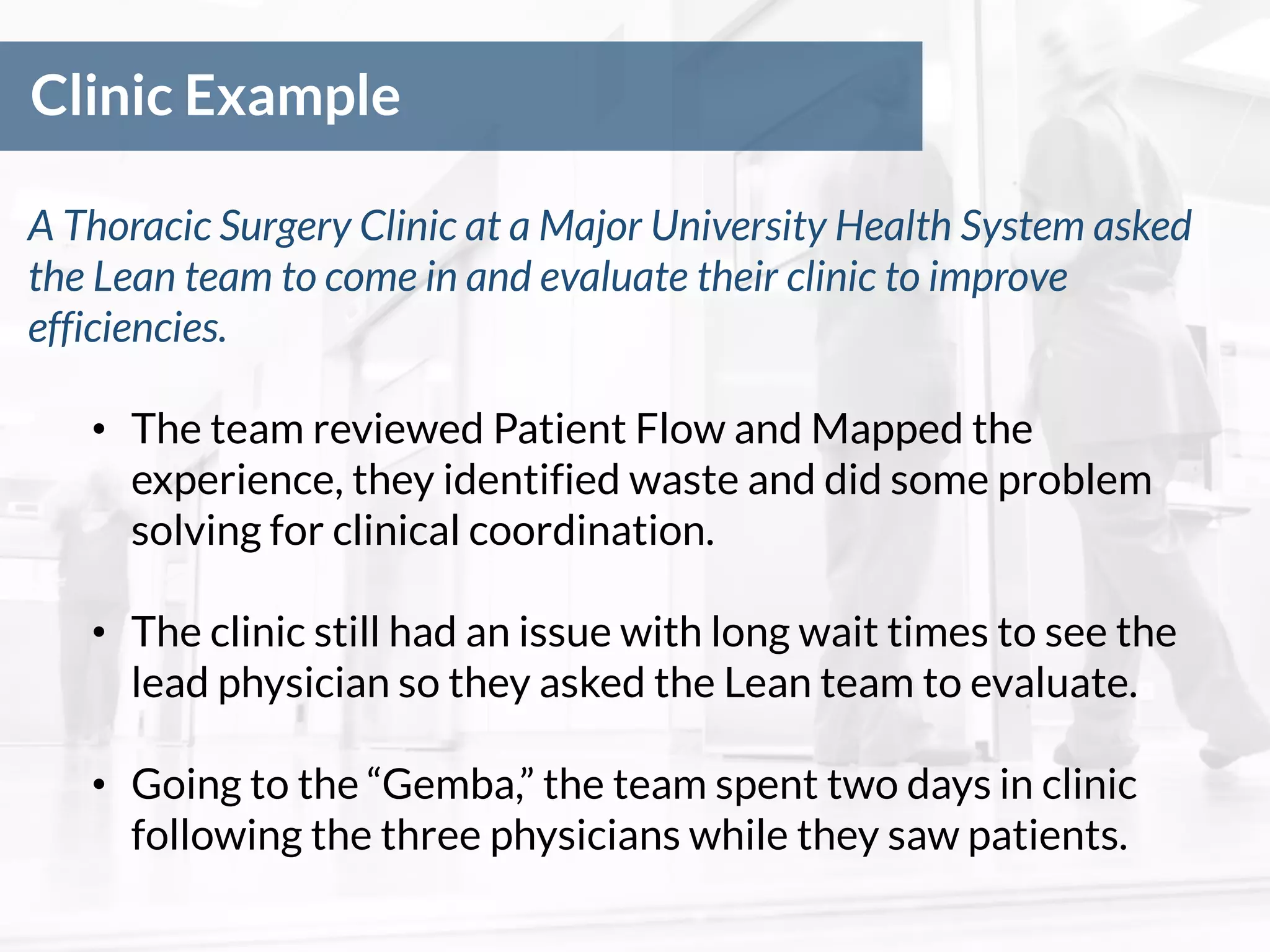
Clinic Example
A Thoracic Surgery Clinic at a Major University Health System asked
the Lean team to come in and evaluate their clinic to improve
efficiencies.
• The team reviewed Patient Flow and Mapped the
experience, they identified waste and did some problem
solving for clinical coordination.
• The clinic still had an issue with long wait times to see the
lead physician so they asked the Lean team to evaluate.
• Going to the “Gemba,” the team spent two days in clinic
following the three physicians while they saw patients.
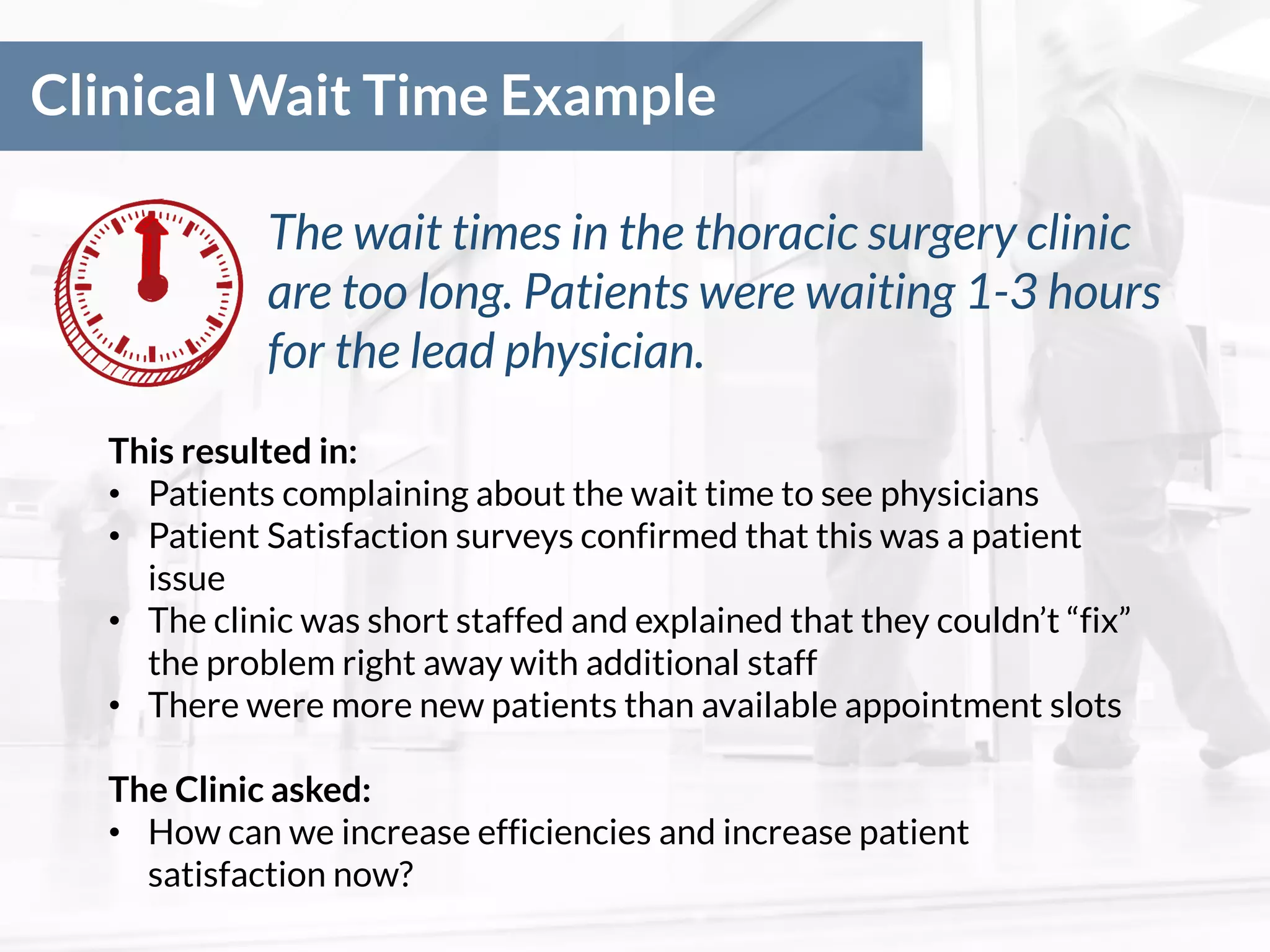
Clinical Wait Time Example
The wait times in the thoracic surgery clinic
are too long. Patients were waiting 1-3 hours
for the lead physician.
This resulted in:
• Patients complaining about the wait time to see physicians
• Patient Satisfaction surveys confirmed that this was a patient
issue
• The clinic was short staffed and explained that they couldn’t “fix”
the problem right away with additional staff
• There were more new patients than available appointment slots
The Clinic asked:
• How can we increase efficiencies and increase patient
satisfaction now?
What we found
Each of the three physicians followed in the clinic practiced differently:
• LEAD PHYSICIAN #1 saw his patients in clinic and then dictated the note right
after the visit. This resulted in running behind by lunchtime and also late in the
day. Often physicians missed lunch to “catch up” or had lunch on the run as
patients were getting set up. And clinics may run until 7pm at night increasing
staff overtime. Physician #1’s biggest issues was the dictation on new patients as
they took longer to dictate notes due to the full exam needed.
• PHYSICIAN #2 did his note at the end of the day and patients were on time most
days. He was late due to leaving clinic.
• PHYSICIAN #3 did his note sometime during the week following, for example, on
Saturday. He was also late due to leaving clinic.
Each physician had one “incident” that happened in clinic every week causing delays.
So even though it appeared that incidents were once a week in the individual
physician mind, they were actually happening 3-4 times per week.
Review of issues
• LEAD PHYSICIAN #1 didn’t want to change his practice pattern as he thought that his
practice allowed him to capture all pertinent information and dictation right after the visit
allowed him to capture more pertinent information and was better for his patient care. But:
• LEAD PHYSICIAN #1 didn’t think he had the power to change his clinic schedule.
• HIS SCHEDULER didn’t think that she had the power to change his schedule.
With all parties in the room, the Clinic Manager approved the change in the clinic schedule
for new patients, as the change affected only one appointment time during clinic the day.
This appointment could be covered by a Nurse Practitioner in the clinic.
• “INCIDENTS” needed to be handled urgently.
• Incidents included esophageal bleeds, scopes off site, see urgent patients in house, etc.
The Clinic Manager was in the process of hiring a new physician and came up with the
ideal of having the new physician “float” rather than be scheduled in the clinic.
Solutions
THE LEAD PHYSICIAN’S appointment schedule was
expanded to one hour and a half for first visit
appointments. This allowed for a full pre- surgery exam
and a full dictation in preparation for surgery.
A NEW STAFF PHYSICIAN was scheduled each week as a
“float” to cover incidents, inpatients and procedures. If a
clinic physician had to leave due to continuity of care, the
“float” physician would take over in clinic.
Result One Month Post
• The Thoracic Clinic is now on time for all physicians, most clinic days.
Patients are taken back for their appointment within ten minutes of
arrival.
• The lead physician is happy as he is on time, has time to see patients
without rushing, can have a lunch period, and catch up if running behind.
• The “float” physician handles the “incidents,” add ons and fills in if a
physician has to be pulled away for an emergency. This keeps the clinic
flowing throughout the day and keeps the clinic on time.
• Patient satisfaction scores increased in the next quarter for this clinic as
patients are more satisfied.
IMPLEMENTATION OF SOLUTIONS
The rest of the story
• The Thoracic Clinic continues to RUN SMOOTHLY.
• The Lean team member would worked on this project was HIRED by
the clinic to continue the process improvement activities.
• The Lead physician was retiring and a WORK PLAN was put in place
to transition staff and workload.
• Lean methods have transitioned to LEAN AND DAILY WORK,
meaning that as improvements occur the process becomes easier to
implement. New improvements can be done on a daily basis
because the larger process efforts are in place.
AND SIX MONTH FOLLOW UP
Quick Hits: How do I get started today?
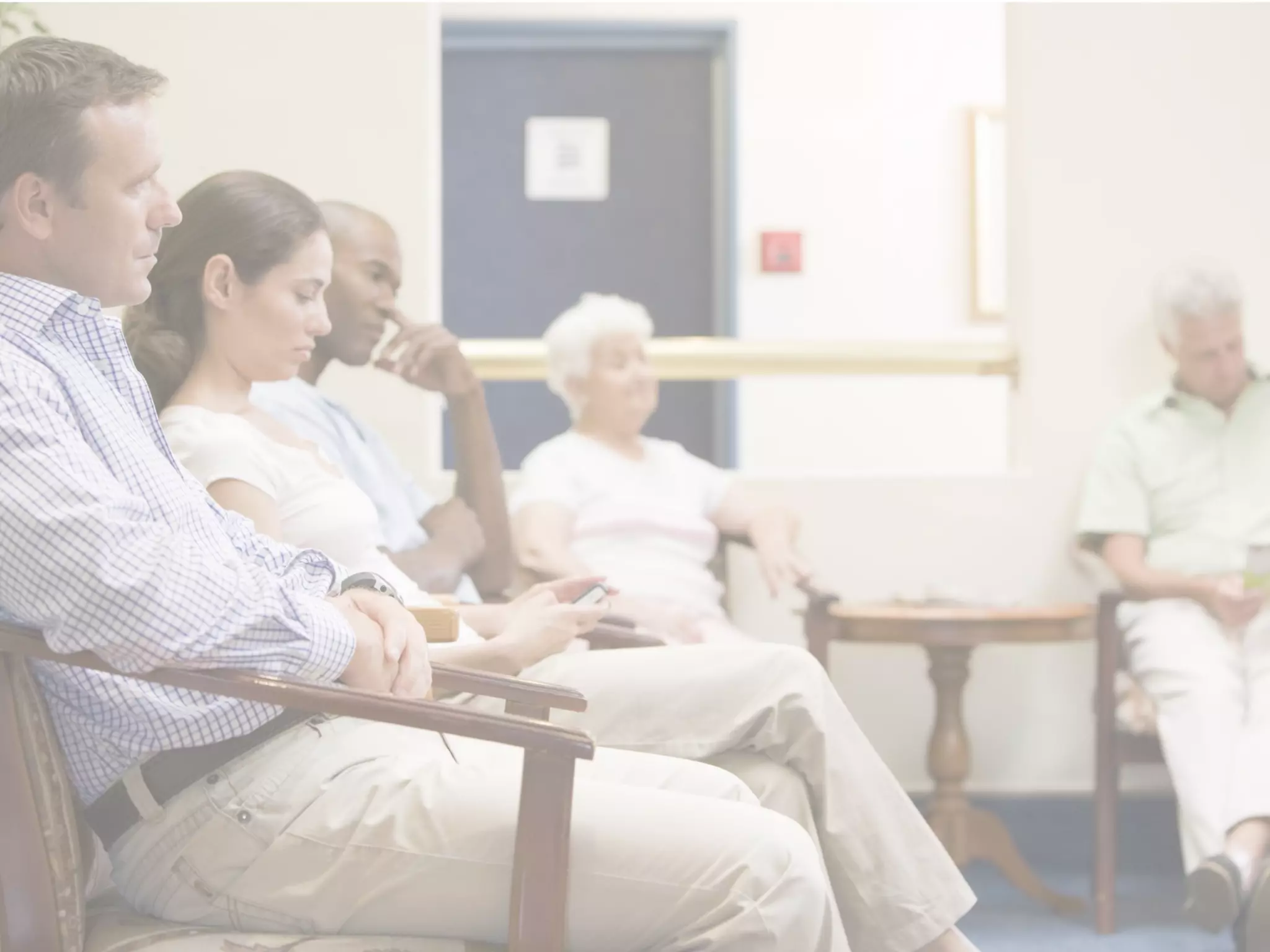
Sit in your waiting room for 10-15 minutes.
OBSERVE what you see…
• What are your patients doing?
• What are they reading?
• Who are they with?
• What do their facial expressions show?
Is there one thing that you could IMPLEMENT that
would make your patients and families more
comfortable with the wait?
This could be as simple as changing the placement of the
furniture…
The Psychology of Wait (January 20)
The Hope Effect (January 27)
Empathy & Lean (February 3)
Creating Diplomats For Hope
Webinar
Series
Questions ?
Comments ?
• Have a representative contact you?
• Have a representative come to
speak at your organization?
• Want more information?
Would You Like To
2700 Post Oak Blvd., Suite 1400
Houston, TX 77056
+1 713.877.8130
www.endeavormgmt.com/healthcare
Contact Us
Carol Packard
cpackard@endeavormgmt.com
Jill Secord
jsecord@endeavormgmt.com
THANK YOU FOR PARTICIPATING!

Empathy and Lean - Quality and Metrics

  • 1.
    Creating Diplomats ForHope Webinar Series Empathy & Lean Using Lean Healthcare methodologies to improve upon the patient experience
  • 2.
    Creating Diplomats ForHope Webinar Series HOUSEKEEPING AUDIO is available through your computer speakers or through dial-in. All lines are muted. You can SUBMIT QUESTIONS/COMMENTS at any time. We will address all questions during the Q&A session at the end of today’s presentation. Links to the slides and RECORDING will be made available and sent to all attendees via e-mail.
  • 3.
    Creating Diplomats ForHope Webinar Series ABOUT US WE WORK WITH NATIONALLY-RECOGNIZED INSTITUTIONS: 5 “Honor Roll” institutions 5 out of the top 10 cancer programs 3 out of the top 4 pediatric hospitals 3 out of the top 10 cardiovascular programs NATIONAL BENCHMARKING STUDIES: Patient experience management Marketing practices Physician relations programs International programs Ranked as one of top 50 Healthcare Consulting firms by Modern Healthcare
  • 5.
    Creating Diplomats ForHope Webinar Series JILL F. SECORD GELB SENIOR ADVISOR, HEALTHCARE Jill RN, BSN, MBA has 40 years of experience as a nurse with expert skills in leadership, operations, managed care, nursing education and creating roles for nurses in non traditional nursing settings. She has clinical experience in critical care, orthopedics, home care, home infusion, surgery, recovery and administrative experience in managed care, contracting, provider relations, data analysis, program operations and strategic planning. She is certified in Lean Quality Healthcare and has developed systems to integrate Lean techniques with Patient Experience Mapping and Family Focused Care initiatives. Jill has worked with a variety of healthcare organizations to create new departments, streamline current processes, and develop new profitable programs.
  • 6.
    Creating Diplomats ForHope Webinar Series CAROL B. PACKARD SENIOR ADVISOR, HEALTHCARE Carol Packard has a Ph.D. in organizational development, a master’s degree is in organizational psychology, and 20 years experience working in health care. Carol also has designed and implemented enterprise-wide Service Excellence programs, using patient satisfaction data to drive process improvements.
  • 7.
    Objectives To understand thedifference between EMOTIONAL needs and FUNCTIONAL needs To understand a few LEAN TECHNIQUES that you can use in your clinic setting To have some “TOOLS” for your own personal tool kit for future efficiency projects
  • 8.
  • 9.
    Patient–Centered Settings RESEARCH: WHYLEAN? WHY NOW? As Health Systems move toward the Accountable Care Model, systems will be reimbursed based on: • Improved patient CLINICAL OUTCOMES • Higher patient SATISFACTION rates • Fewer ACCIDENTS and INFECTIONS • Lower COSTS “Evidenced-based design”
  • 10.
    Patient-Centered Care OUR MOSTIMPORTANT PERSON, THE PATIENT! PATIENT Primary Care Clinic Pharmacy Radiologist Neuro surgeon Surgical servicesNurses Anesthesiologist Family Therapist
  • 11.
    The Goal ofLean Work • Find and Reduce Inconsistencies • Eliminate Waste • Reduce Errors
  • 12.
    The Goal ofLean Work - AND …To Coordinated patient care Move teams from Episodic silo work…
  • 13.
    Principles of Lean Thefive-step thought process for guiding the implementation of lean techniques is easy to remember, but not always easy to achieve: 1. Specify value from the standpoint of the patient and family. 2. Identify all the steps in the value stream for each service line, eliminating whenever possible those steps that do not create value. 3. Make the value-creating steps occur in tight sequence so the service line will flow smoothly toward the patient. 4. As flow is introduced, let patients pull value from the next upstream activity. (Self scheduling for example) 5. As value is specified, value streams are identified, wasted steps are removed, and flow and pull are introduced, begin the process again and continue it until a state of perfection is reached in which perfect value is created with no waste. (Continuous improvement).
  • 14.
    Lean Work HOW AREWE GOING TO DO IT?
  • 15.
    Care Coordination Communication EXPECTEDBEHAVIORS How interactions occur and are managed SYSTEMS Processes and technology to increase efficiency POSITIONING Communications, conversations, and messaging
  • 16.
    Process Mapping WorkSteps • Identify your current state • Identify issues and root causes (5 why’s) • Determine and collect metrics • Develop your future state (including best practices) • Determine required action steps to get there • Develop your implementation plan • Now implement!
  • 17.
    Referral Appointment EscalationImprovement Opportunities
  • 18.
    Gap Analysis Steps Completeyour Patient experience map from the site review, metrics and observations: • Plot the patient flow through your specific clinic • Look closely at each step, is this necessary? • Is it valuable to your patient and families? • Identify gaps in the flow to create an “outlined best practice” for your future state • Identify areas where patients find value and where they don’t • identify opportunities for improvement determined from satisfaction surveys and other feedback Gather specific metrics on wait times. Use current “check in” technology to gather wait time data and identify gaps in data collection. Move opportunities to an effort/impact matrix.
  • 19.
    Create the IdealPatient Experience 1. Things we do well today • in what areas can we deliver an exceptional experience? 2. Opportunities for improvement • what should be done more consistently that should be reinforced? • what are ways to surprise our patients that we currently do not do? • what are the expected behaviors that we currently do not deliver consistently? 3. Best Ideas • Let’s highlight our BEST IDEAS that others can learn from GAP REVIEW Review for each step Need Scheduling First Visit Treatment Follow-Up Gelb Toolkit
  • 20.
  • 21.
    Quick Hits • ThoseHIGH IMPACT LOW EFFORT tasks that can be done today with little cost or effort on the part of the staff. • QUICK RESULTS
  • 22.
    Problem Solving TeamWork REFINE list to high impact/low effort top priorities. Identify Opportunities UNDERSTAND issues and move to root cause. Prioritize Opportunities Develop Solutions DETERMINE all potential improvements. The goal of problem solving! Determine Root Causes SOLVE issues using brainstorming and develop implementation plan to support objectives. IMPLEMENT
  • 23.
    Create the IdealPatient Experience FROM YOUR IDENTIFIED BEST PRACTICES Need Scheduling First Visit Treatment Follow-Up Assign key team to facilitate appointments and serve as key contact point. Mail intro packet: (what to expect, travel resources, vouchers, checklists, contact information, frequently asked questions). Review records/scans prior to visit; schedule auxiliary services Inform patients to come 15-20 minutes prior to appointment for check in process and paperwork. Greeting/by name, Use volunteers to assist patients and families and communicate with staff as needed. Coordinate multiple appointments; preview wait times. Suggest activities, restaurants during breaks between appointments or after clinic visit Financial advisor, appointment for insurance paperwork and explanation of benefits. Contact information (phone number, email, use patient portal) for continuing needs Remote management of care (review of scans, tests) when possible; call to give results Check-up phone call to patient Personal call to referring physician to coordinate follow-up care and thank for referral
  • 24.
    Clinic Example A ThoracicSurgery Clinic at a Major University Health System asked the Lean team to come in and evaluate their clinic to improve efficiencies. • The team reviewed Patient Flow and Mapped the experience, they identified waste and did some problem solving for clinical coordination. • The clinic still had an issue with long wait times to see the lead physician so they asked the Lean team to evaluate. • Going to the “Gemba,” the team spent two days in clinic following the three physicians while they saw patients.
  • 25.
    Clinical Wait TimeExample The wait times in the thoracic surgery clinic are too long. Patients were waiting 1-3 hours for the lead physician. This resulted in: • Patients complaining about the wait time to see physicians • Patient Satisfaction surveys confirmed that this was a patient issue • The clinic was short staffed and explained that they couldn’t “fix” the problem right away with additional staff • There were more new patients than available appointment slots The Clinic asked: • How can we increase efficiencies and increase patient satisfaction now?
  • 26.
    What we found Eachof the three physicians followed in the clinic practiced differently: • LEAD PHYSICIAN #1 saw his patients in clinic and then dictated the note right after the visit. This resulted in running behind by lunchtime and also late in the day. Often physicians missed lunch to “catch up” or had lunch on the run as patients were getting set up. And clinics may run until 7pm at night increasing staff overtime. Physician #1’s biggest issues was the dictation on new patients as they took longer to dictate notes due to the full exam needed. • PHYSICIAN #2 did his note at the end of the day and patients were on time most days. He was late due to leaving clinic. • PHYSICIAN #3 did his note sometime during the week following, for example, on Saturday. He was also late due to leaving clinic. Each physician had one “incident” that happened in clinic every week causing delays. So even though it appeared that incidents were once a week in the individual physician mind, they were actually happening 3-4 times per week.
  • 27.
    Review of issues •LEAD PHYSICIAN #1 didn’t want to change his practice pattern as he thought that his practice allowed him to capture all pertinent information and dictation right after the visit allowed him to capture more pertinent information and was better for his patient care. But: • LEAD PHYSICIAN #1 didn’t think he had the power to change his clinic schedule. • HIS SCHEDULER didn’t think that she had the power to change his schedule. With all parties in the room, the Clinic Manager approved the change in the clinic schedule for new patients, as the change affected only one appointment time during clinic the day. This appointment could be covered by a Nurse Practitioner in the clinic. • “INCIDENTS” needed to be handled urgently. • Incidents included esophageal bleeds, scopes off site, see urgent patients in house, etc. The Clinic Manager was in the process of hiring a new physician and came up with the ideal of having the new physician “float” rather than be scheduled in the clinic.
  • 28.
    Solutions THE LEAD PHYSICIAN’Sappointment schedule was expanded to one hour and a half for first visit appointments. This allowed for a full pre- surgery exam and a full dictation in preparation for surgery. A NEW STAFF PHYSICIAN was scheduled each week as a “float” to cover incidents, inpatients and procedures. If a clinic physician had to leave due to continuity of care, the “float” physician would take over in clinic.
  • 29.
    Result One MonthPost • The Thoracic Clinic is now on time for all physicians, most clinic days. Patients are taken back for their appointment within ten minutes of arrival. • The lead physician is happy as he is on time, has time to see patients without rushing, can have a lunch period, and catch up if running behind. • The “float” physician handles the “incidents,” add ons and fills in if a physician has to be pulled away for an emergency. This keeps the clinic flowing throughout the day and keeps the clinic on time. • Patient satisfaction scores increased in the next quarter for this clinic as patients are more satisfied. IMPLEMENTATION OF SOLUTIONS
  • 30.
    The rest ofthe story • The Thoracic Clinic continues to RUN SMOOTHLY. • The Lean team member would worked on this project was HIRED by the clinic to continue the process improvement activities. • The Lead physician was retiring and a WORK PLAN was put in place to transition staff and workload. • Lean methods have transitioned to LEAN AND DAILY WORK, meaning that as improvements occur the process becomes easier to implement. New improvements can be done on a daily basis because the larger process efforts are in place. AND SIX MONTH FOLLOW UP
  • 31.
    Quick Hits: Howdo I get started today? Sit in your waiting room for 10-15 minutes. OBSERVE what you see… • What are your patients doing? • What are they reading? • Who are they with? • What do their facial expressions show? Is there one thing that you could IMPLEMENT that would make your patients and families more comfortable with the wait? This could be as simple as changing the placement of the furniture…
  • 34.
    The Psychology ofWait (January 20) The Hope Effect (January 27) Empathy & Lean (February 3) Creating Diplomats For Hope Webinar Series
  • 35.
  • 36.
    • Have arepresentative contact you? • Have a representative come to speak at your organization? • Want more information? Would You Like To
  • 37.
    2700 Post OakBlvd., Suite 1400 Houston, TX 77056 +1 713.877.8130 www.endeavormgmt.com/healthcare Contact Us Carol Packard cpackard@endeavormgmt.com Jill Secord jsecord@endeavormgmt.com
  • 38.
    THANK YOU FORPARTICIPATING!