Lessons Learned in the
Development of a Framework
Funded By:
AIA Academy of Architecture for Health Foundation
HKS
Boldt
Supported by:
Akron Children’s Hospital
Value Analysis of Lean IPD and TVD
Di Ai, MS (Estimation)
John Bienko, AIA (Project Management and Design)
Upali Nanda, PhD (Design Research)
Zofia Rybkowski, PhD (Construction Management)
Funded By:
AIA Academy of Architecture for Health Foundation
HKS
Boldt
• TVD (Target Value Design) and Lean
approaches to IPD (Integrated Project Delivery)
• Advantages and challenges of using Lean
thinking in the IPD process.
• Definition of “value” and quality metrics.
• Framework for cost/benefit assessment based
on metrics currently tracked.
• Exploration of implicit costs and benefits
• Extensive documentation
• Transparency
• Input from multiple stakeholders
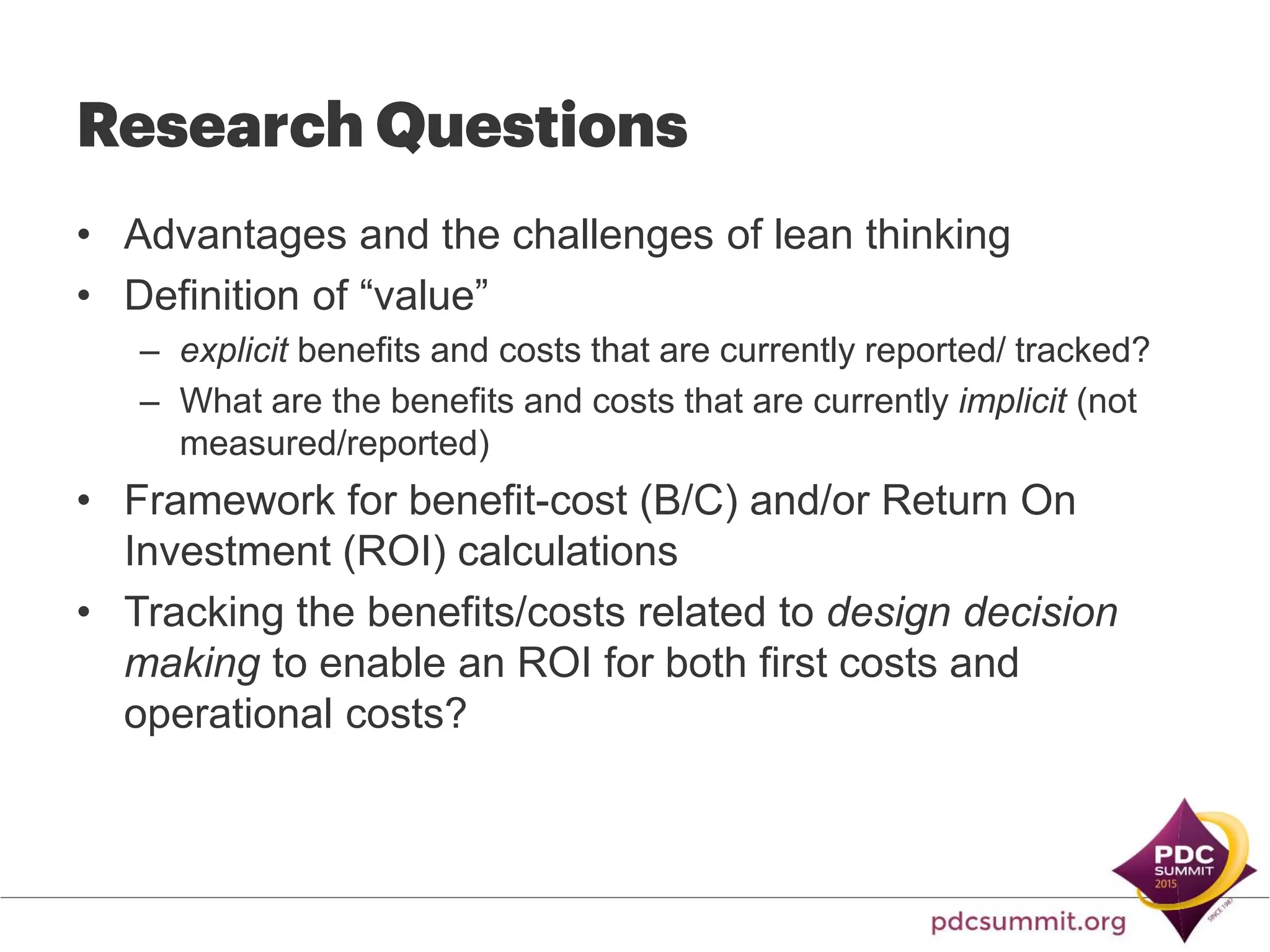
• Advantages and the challenges of lean thinking
• Definition of “value”
– explicit benefits and costs that are currently reported/ tracked?
– What are the benefits and costs that are currently implicit (not
measured/reported)
• Framework for benefit-cost (B/C) and/or Return On
Investment (ROI) calculations
• Tracking the benefits/costs related to design decision
making to enable an ROI for both first costs and
operational costs?
• Archival Data via E-Builder
• Site Visit
• Interviews (7)
• Focus groups (16 + 4)
• Survey (49 of 79)
OAEC*
Current state 2P
D
C
A
Current state 1
Future state 2
Current state 3
P
D
C
A
Future state 3
Current state 4
P
D
C
A
Future state 4
P
D
C
A
Future state n+1
Future state n
Current state n
OAEC
OAEC
OAEC
Time à
C U L T U R E o f R E S P E C T
waste value
*OAEC: Owner Architect Engineer Constructor (collaborative)
%ofCAPITAL
COST
Time
Cost
Quality
Safety
Morale
Minimum
Maximum
MinimumMaximum
Minimum
Maximum
Minimum
Maximum
Minimum
Maximum
Lean Construction reduces waste and adds value using continuous improvement in
a culture of respect
Adapted from Rybkowski, Z. K., Abdelhamid, T., and Forbes, L. (2013). “On the back of a cocktail napkin: An exploration of
graphic definitions of lean construction," Proceedings of the 21th annual conference for the International Group for Lean
Construction; July 31-August 2, 2013: Fortaleza, Brazil, 83-92.
VALUE =
What you get (benefit)
What you give (cost)
Saxon (2005)
Value is greater than 1 when Benefits exceed Cost and less than 1 when
Costs exceed Benefits. We need to consider time value of money.
Target costing as “a system of profit planning and cost
management that ensures that new products and services
meet market determined price and financial return.” (Ansari,
1997)
Allowable Cost
Target Cost
EstimatedCost
Time
Progressive reduction of estimated first cost during Target Value Design
after Rybkowski (2009)
Movement of funds across system boundaries during Target Value Design
after Rybkowski (2009)
Example of movement of funds across system boundaries during Target
Value Design, Cathedral Hill Hospital, Sutter Health, after Rybkowski (2009)
TVD is a management practice that
motivates designers to deliver customer
value and develops design within project
constraints (Ballard, 2009)
All
Projects
Non TVD
Projects
TVD Projects
Profit
Contingency
Cost of
work
Uncertainity
Miscommunication
Missing Detail
Miscoordination
Change Orders
Lack of Trust
Litigation
Uncertainity
Miscommunication
Miscoordination
Trust
Collaboration
Aligned Incentives
Early involvement
Coordination with BIM
Cross disciplinary problem solving
Project Governance
Steering design to target value
Co-location
Prior working relationships
Learning as ateam
Transparency
Total
Project
Budget
Cost Control Mechanism
Adapted from Do, 2014
But how is “value” assessed?
Predesign Schematic Design Construction Agency Permit/ Construction
Design Development Documents Bidding
Conceptualization Criteria Detailed Implementation Agency Coord/ Construction
Design Design Documents Final Buyout
1
2
4
3
1
2
4
3
Ability to impact cost and function
Cost of design changes
Traditional Design-Bid-Build process
Integrated Project Delivery Process
TRADITIONAL
DESIGN-BID BUILD
INTEGRATED DESIGN
DELIVERY
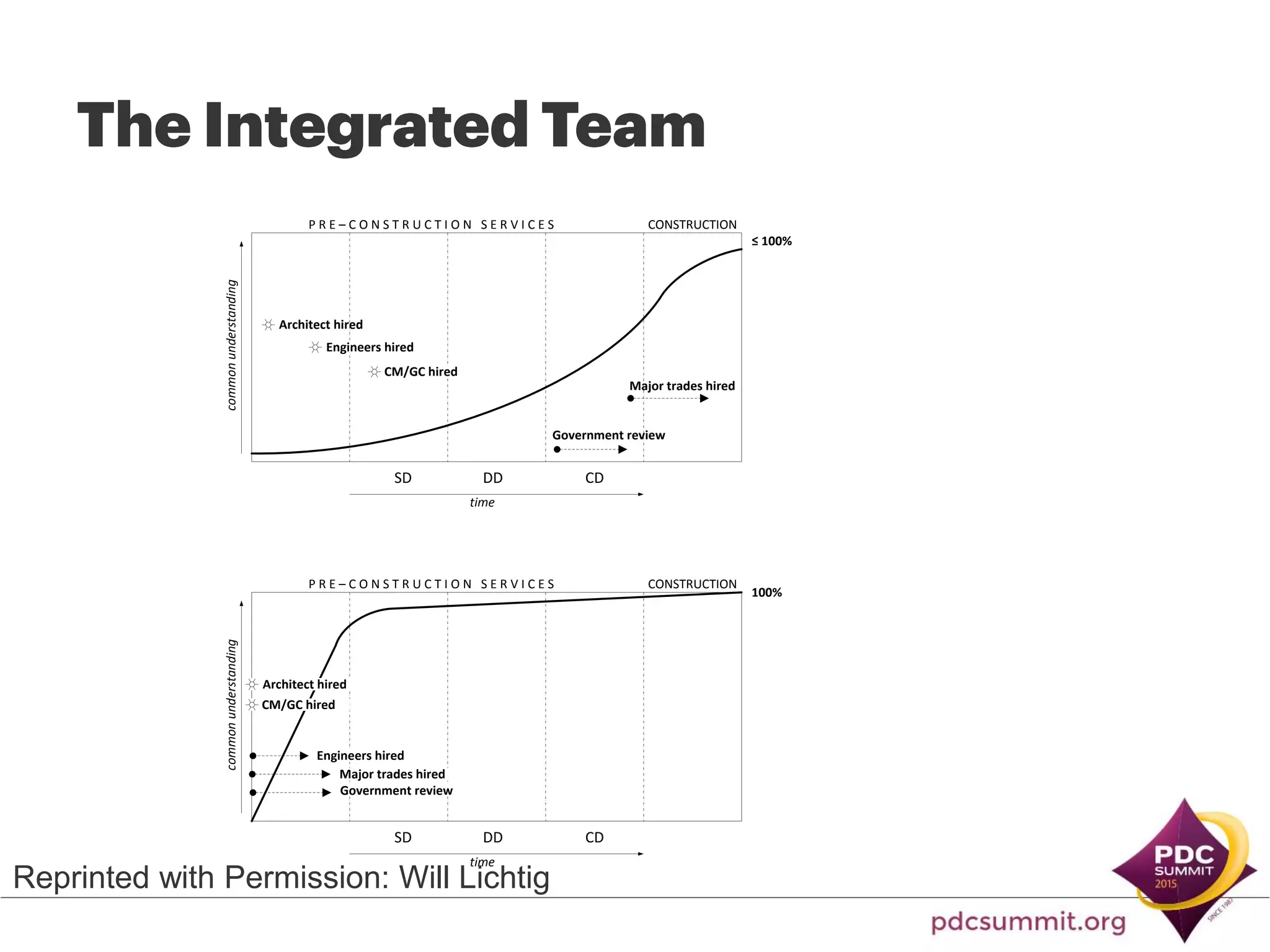
P R E – C O N S T R U C T I O N S E R V I C E Scommonunderstanding
SD DD CD
Architect hired
Engineers hired
CM/GC hired
time
CONSTRUCTION
Major trades hired
Government review
≤ 100%
P R E – C O N S T R U C T I O N S E R V I C E S
commonunderstanding
SD DD CD
Architect hired
time
CONSTRUCTION
Government review
100%
Engineers hired
CM/GC hired
Major trades hired
Reprinted with Permission: Will Lichtig
• Akron, OH
• 4,619 employees
• 780 Medical Staff
• Gold Seal of Approval from the Joint
Commission
• Magnet Recognition Status from
American Nurses Credentialing Center
• 2,854 transports/509 air in 2012
• 20 Primary Care office network
Innovation
production
workshops
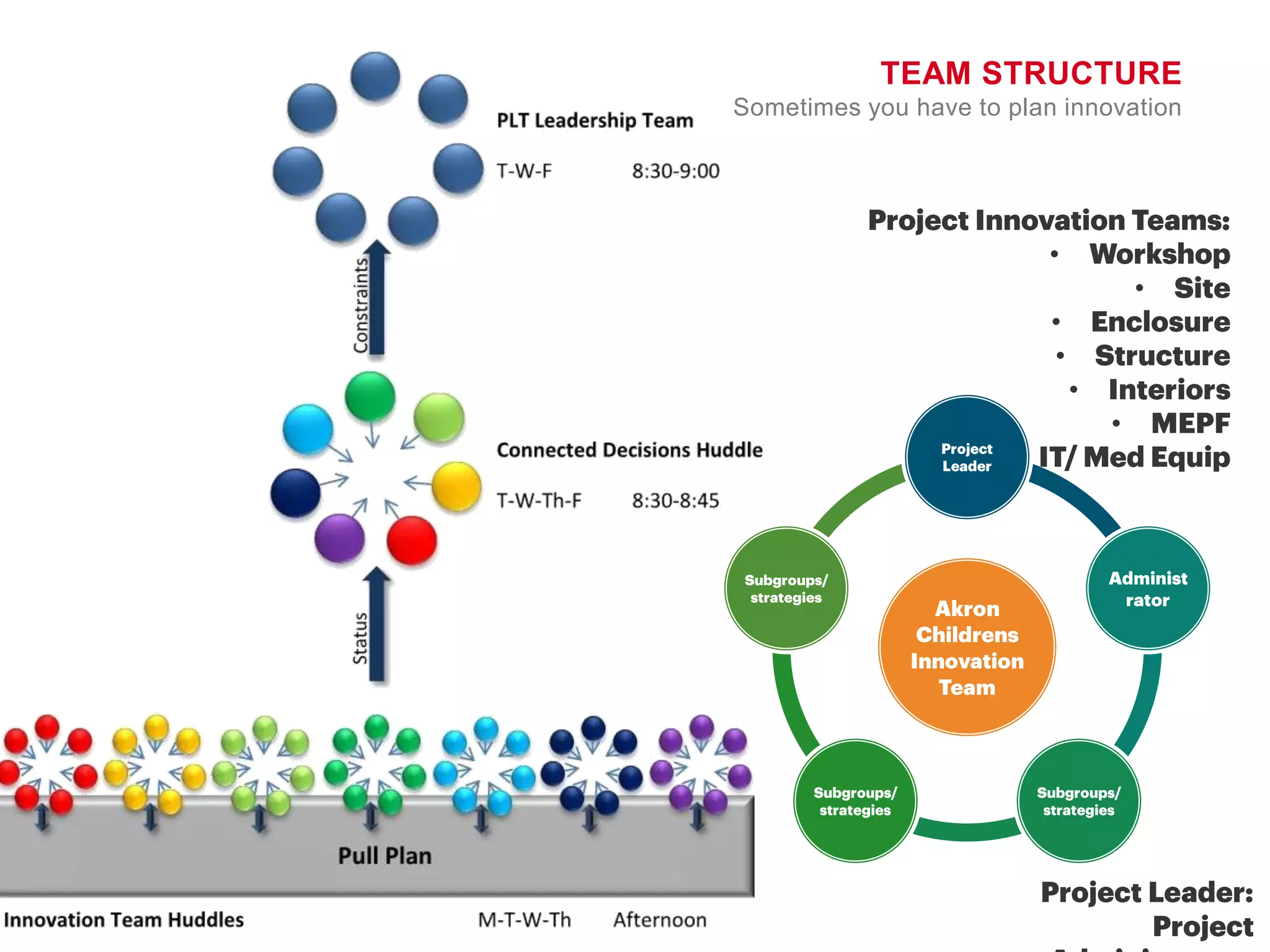
TEAM STRUCTURE
Owner
Owners
Representative
Architect
Construction
Manager Partnership
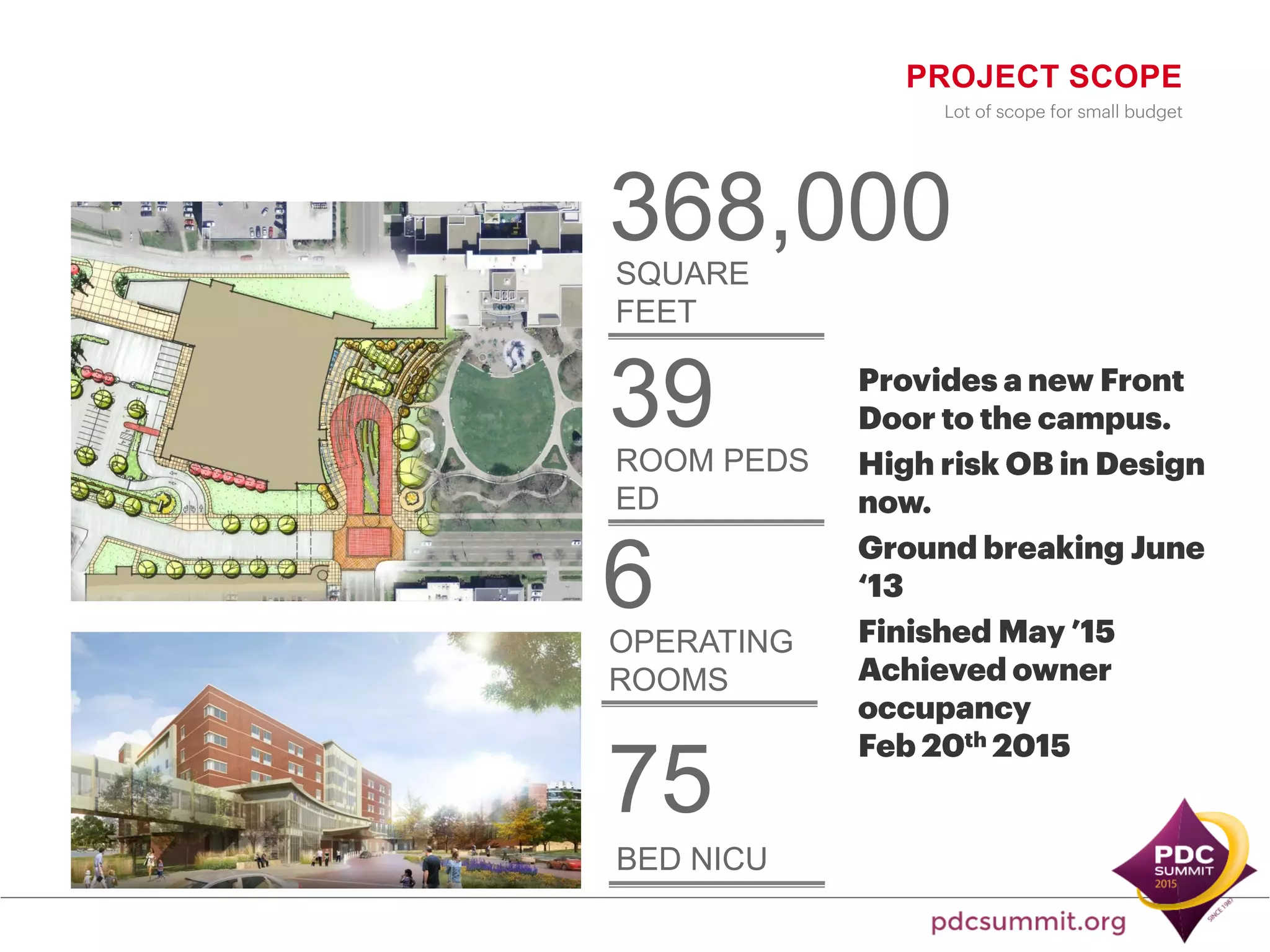
368,000SQUARE
FEET
39ROOM PEDS
ED
6OPERATING
ROOMS
75
BED NICU
Lot of scope for small budget
PROJECT SCOPE
the old way versus the new way
DESIGN PROCESS
Predesign Schematic Design Construction Agency Permit/ Construction
Design Development Documents Bidding
Conceptualization Criteria Detailed Implementation Agency Coord/ Construction
Design Design Documents Final Buyout
1
2
4
3
1
2
4
3
Ability to impact cost and function
Cost of design changes
Traditional Design-Bid-Build process
Integrated Project Delivery Process
TRADITIONAL
DESIGN-BID BUILD
INTEGRATED DESIGN
DELIVERY
TEAM STRUCTURE
Sometimes you have to plan innovation
•
•
•
•
•
•
•
DECISION MAKING
STRUCTURE
Ambulatory Care Center and Critical Care Tower
BACKGROUND
CURRENT STATE
ANALYSIS
GOAL
FUTURE STATE
IMPLEMENTATION
PLAN
UNRESOLVED ISSUES
IMPACTS
PL
AN
AC/
DECIDE
Ambulatory Care Center and Critical Care Tower
BACKGROUND
CURRENT STATE
ANALYSIS
GOAL
FUTURE STATE
IMPLEMENTATION
PLAN
UNRESOLVED ISSUES
IMPACTS
PL
AN
AC/
DECIDE
Ambulatory Care Center and Critical Care Tower
BACKGROUND
CURRENT STATE
ANALYSIS
GOAL
FUTURE STATE
IMPLEMENTATION
PLAN
UNRESOLVED ISSUES
IMPACTS
PL
AN
Ambulatory Care Center and Critical Care Tower
BACKGROUND
CURRENT STATE
ANALYSIS
GOAL
FUTURE STATE
IMPLEMENTATION
PLAN
UNRESOLVED ISSUES
IMPACTS
PL
AN
PLAN
DO/
RESEARCH
CHECK/
CBA
AC/
DECIDEAC/
DECIDE
ACT/
DECIDE
ADVANTAGES
ADVANTAGES
ADVANTAGES
ADVANTAGES
ADVANTAGES ADVANTAGES ADVANTAGES ADVANTAGES
•
•
•
•
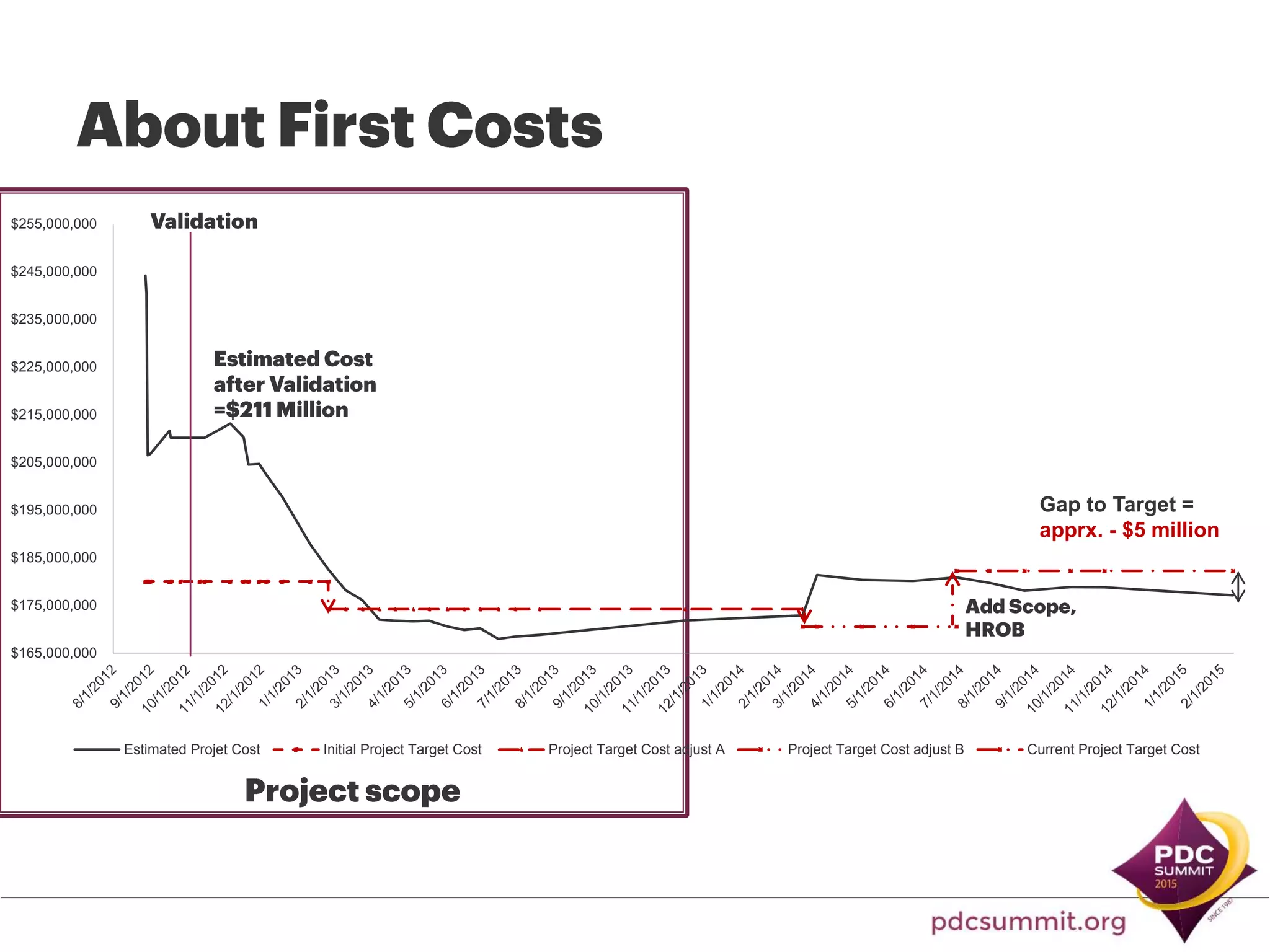
• Original Estimate at validation 211 million
• Target Cost 180 million
• Revised Target Cost (after scope change)
182.5 Million
• Current Target Cost 177 Million
• TOTAL PROJECTED SAVINGS: 5.5 Million
Allowable Cost
Target Cost
EstimatedCost
Time
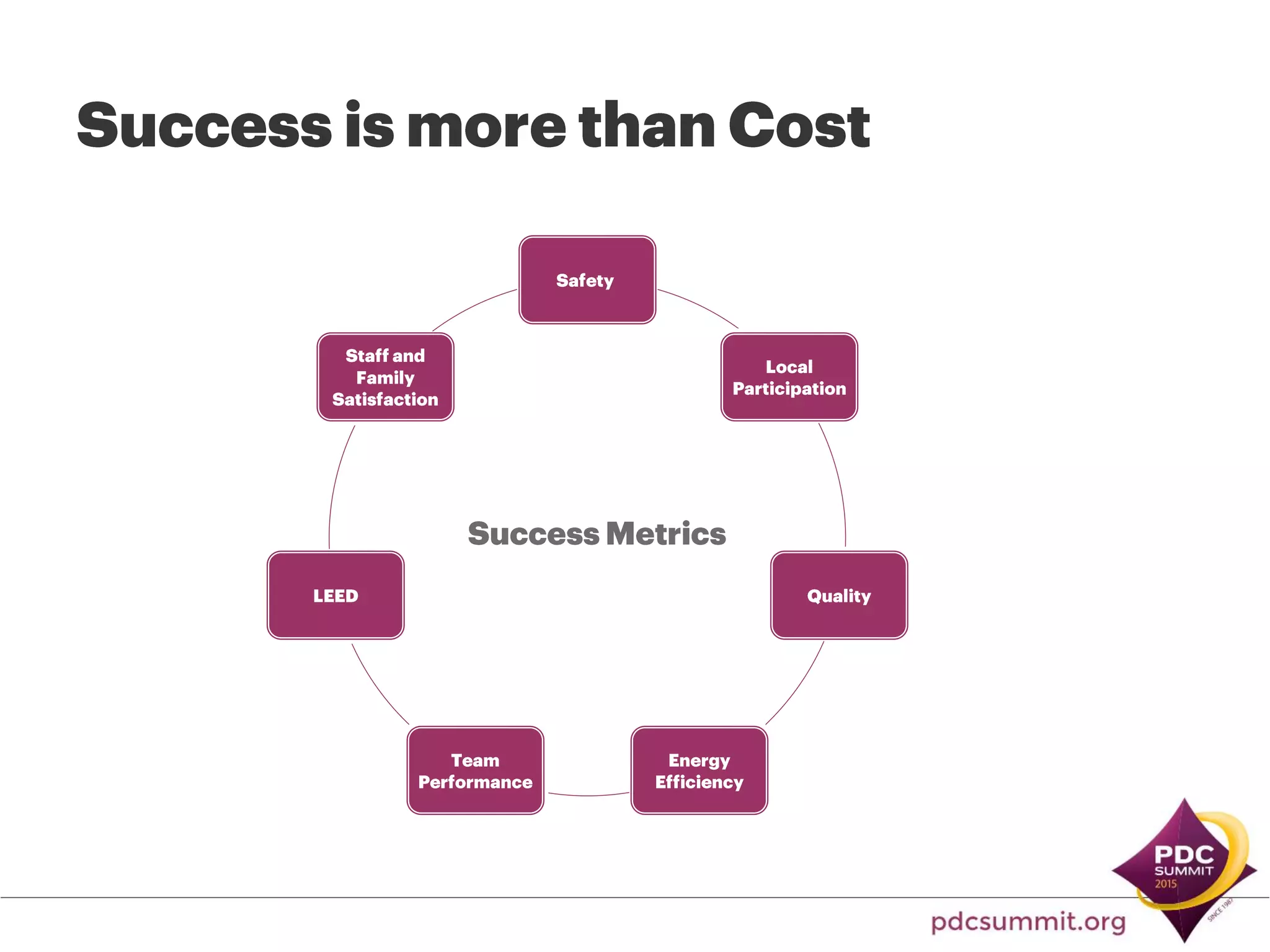
SAFETY
Goal: Deliver the project safely with 0 Lost
Time, 0 Days Restricted/ Transferred
(Based on the DART rate from the Bureau
of Labor Statistics). DART Rate 2.2 is the
National Average for the working trades
involved in healthcare projects.
LOCAL
PARTICIPATION
Goal: 85% of (ICL) project
team labor hours spent by
people living, as defined
by their W-2, in certain
counties. Participation is
considered for all workers,
not just ICL participants.
ENERGY EFFICIENCY
Goal: Achieve top 10% hospital nationally.
LEED®
Goal: Achieve LEED Silver certification
TEAM PERFORMANCE
Goal: Highly Effective Team –
Team Pulse Check
SCHEDULE
Goal: Turn-Over Building
50 Calendar Days Sooner
than 24 Month Schedule to
Owner for Move-In
QUALITY
Goal 1: Want Team Approach to Resolving
Project Issues Quickly & Efficiently Through
Collaboration
Goal 2: Want Project Team To Take Pride In
Producing Quality Work
Goal 3: Want Collaborative Team Approach
In Designing & Constructing the Project.
STAFF AND FAMILY
SATISFACTION
Goal 1: Staff and Family that have been integral
to the process and a driving force throughout the
project and a team that listens to their input.
Goal 2: Keep the Staff and family engaged and
informed throughout construction.
Goal 3: Post Construction Survey refer to the 9
Guiding Principles
SAFETY 18
LOCAL
PARTICIPATION 11
ENERGY
EFFICIENCY
12
TEAM
Performance 9SCHEDULE
10
QUALITY
11
LEED 6
STAFF AND
FAMILY
SATISFACTION 15
Unavailable
Points 8
$160,826,326
$159,198,883
$5,926,335
$2,500,000
$8,683,557
$8,683,557
$5,789,038 $5,789,038
$1,000,000 $1,000,000
$- $505,378
ICL Tracking (Target vs. CWE)
Direct Costs Total Project Contingency
Base Profit (60% of Potential Profit (PP)) ICL Profit (40% of Potential Profit (PP))
Owner Profit Payment ($1M) ICL Profit (3rd Tier - 10% of Savings)
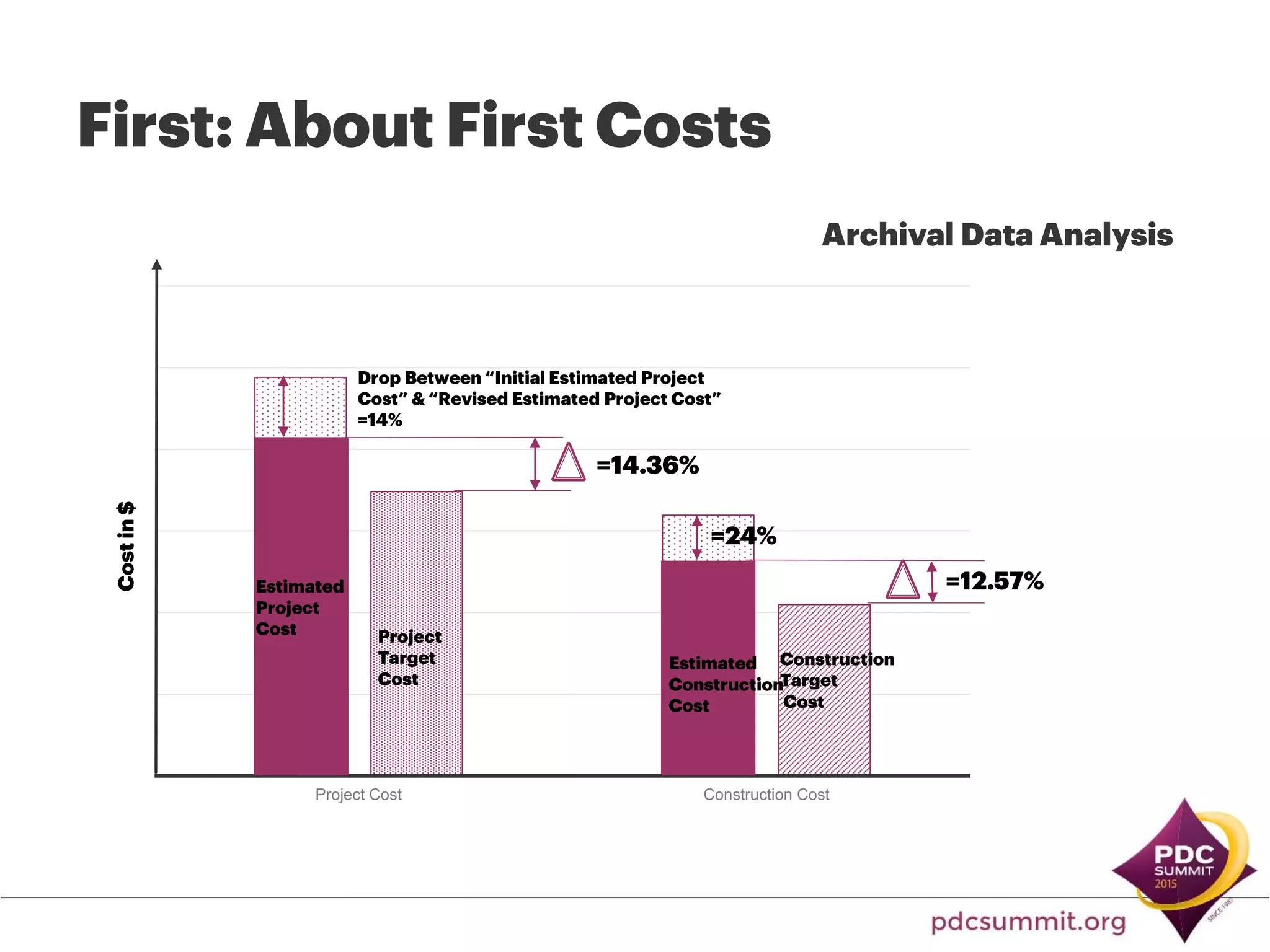
$182,225,256
Current Target
$177,676,855
Current
Working
Estimate
Project Cost Construction Cost
$165,000,000
$175,000,000
$185,000,000
$195,000,000
$205,000,000
$215,000,000
$225,000,000
$235,000,000
$245,000,000
$255,000,000
Estimated Projet Cost Initial Project Target Cost Project Target Cost adjust A Project Target Cost adjust B Current Project Target Cost
Gap to Target =
apprx. - $5 million
AS OF DEC 2013
Team Week Meeting and
Co-location
Mock-up
Labor X X
Material X X
Equipment X X
Location
Cost
X X
Cost items
I
Team Week
Meetings and
Co-location1
A. Material
White board
Supplies (large Post-It® notes,
markers, flipcharts, push pins,
masking tape)
Floor plans of existing hospital
Rolls of paper
B. Labor
Owner and owner
representative
Architects
General contractors
Structural engineer
MEP engineer
Sub-contractors
Vendors
C. Equipment
Speakers
Projector
Conference call equipment
D. Location Cost
Co-location space rent or build
cost
II
Full Scale
Mock-up2
A. Material
Cardboard
Tape and nail to fix cardboard
Furniture for mock-up scenario
Food and Warehouse Amenities
B. Labor
Lean facilitator
Architects
Healthcare administrators
Physicians
Nurses
Clinical Staff Costs
Former patients and their
parents
C. Equipment
Equipment for mock-up
scenario
Warehouse Rent
Warehouse Construction labor
D. Location Cost Utility
[.
Total Decision-Making Cost associated
with TVD, Lean IPD that happened until
Dec. 2013 was $7 Million
However, this does NOT take into
account the costs a typical DBB process
would have which also have extensive
meeting time.
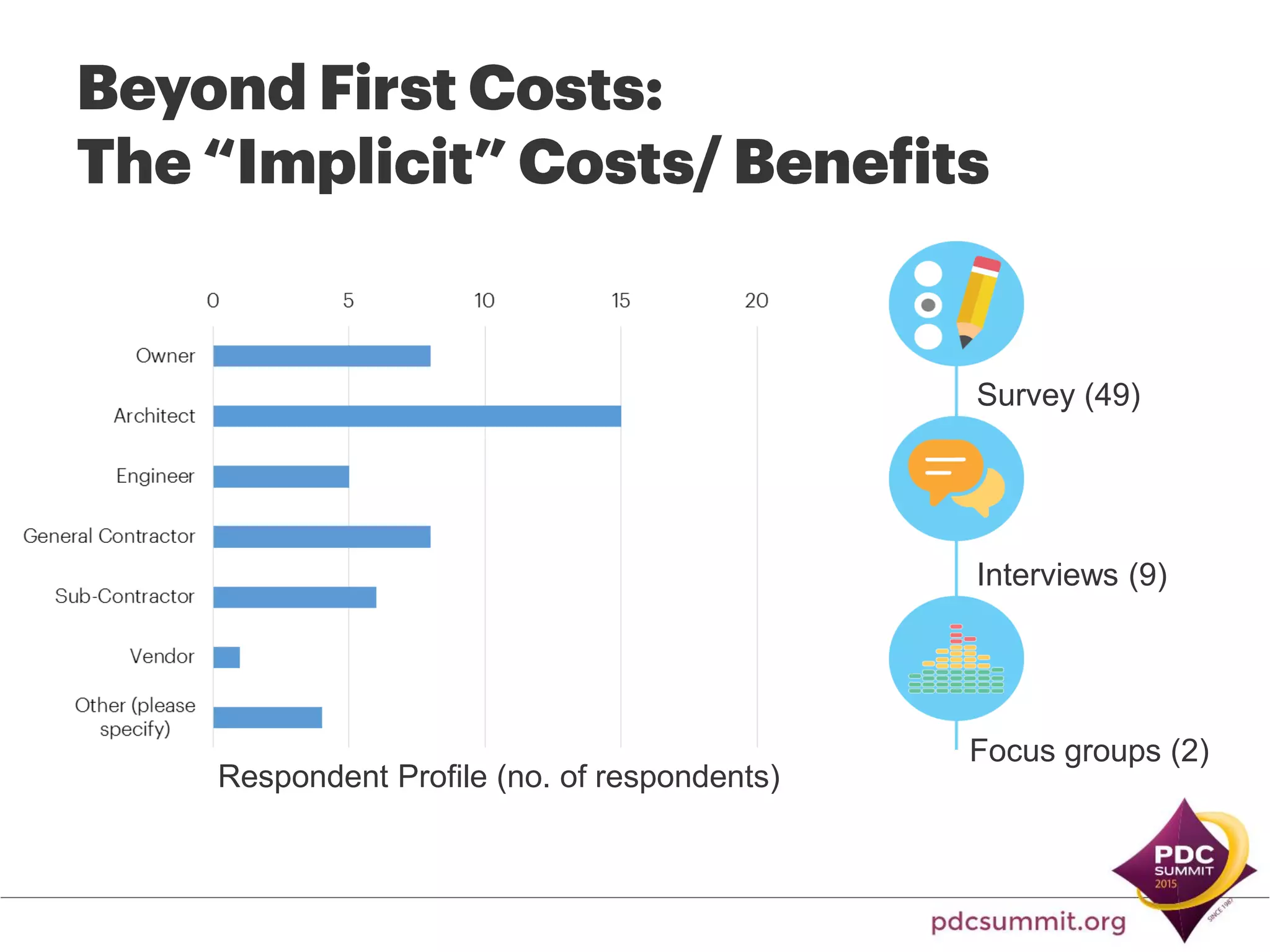
Survey (49)
Interviews (9)
Focus groups (2)
Respondent Profile (no. of respondents)
Plus-Delta
When asked to
construct a +/ Δ chart,
stakeholders listed
more Δ than +
for Design-Bid-Build
and more + than Δ
for Lean-IPD
Design-Bid Build
Lean-IPD
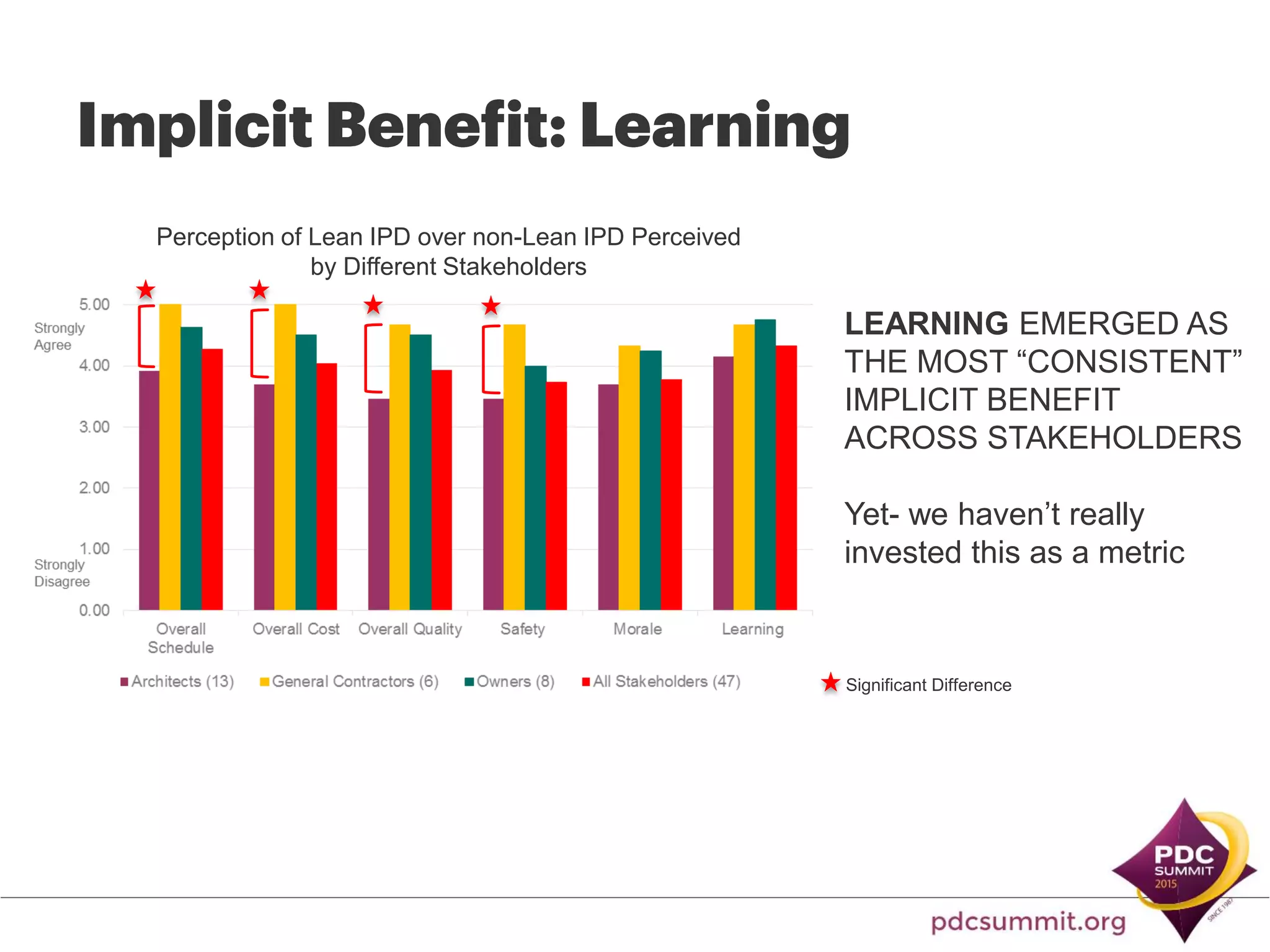
Perception of Lean IPD over non-Lean IPD Perceived
by Different Stakeholders
LEARNING EMERGED AS
THE MOST “CONSISTENT”
IMPLICIT BENEFIT
ACROSS STAKEHOLDERS
Yet- we haven’t really
invested this as a metric
Significant Difference
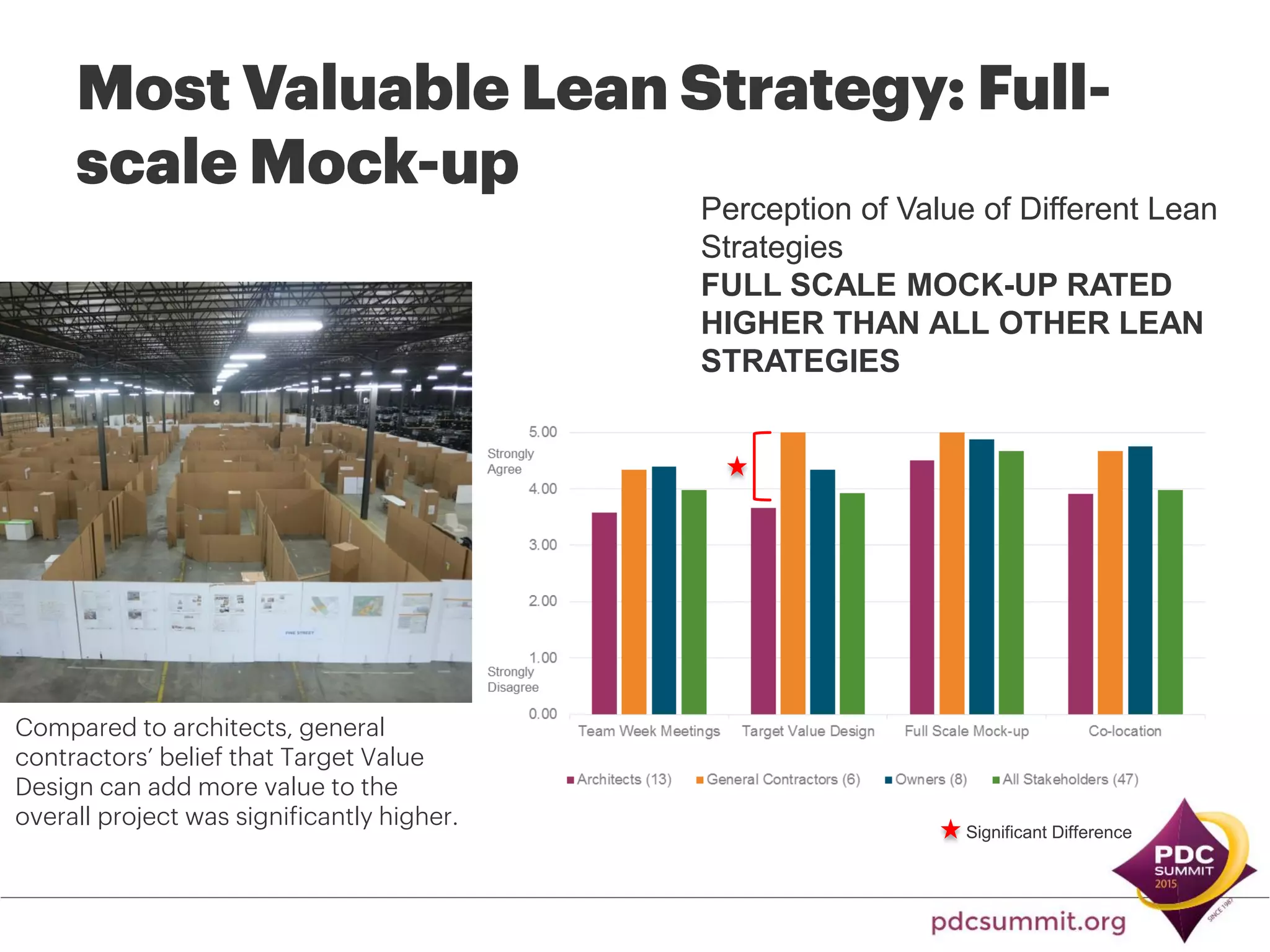
Perception of Value of Different Lean
Strategies
FULL SCALE MOCK-UP RATED
HIGHER THAN ALL OTHER LEAN
STRATEGIES
Significant Difference
Compared to architects, general
contractors’ belief that Target Value
Design can add more value to the
overall project was significantly higher.
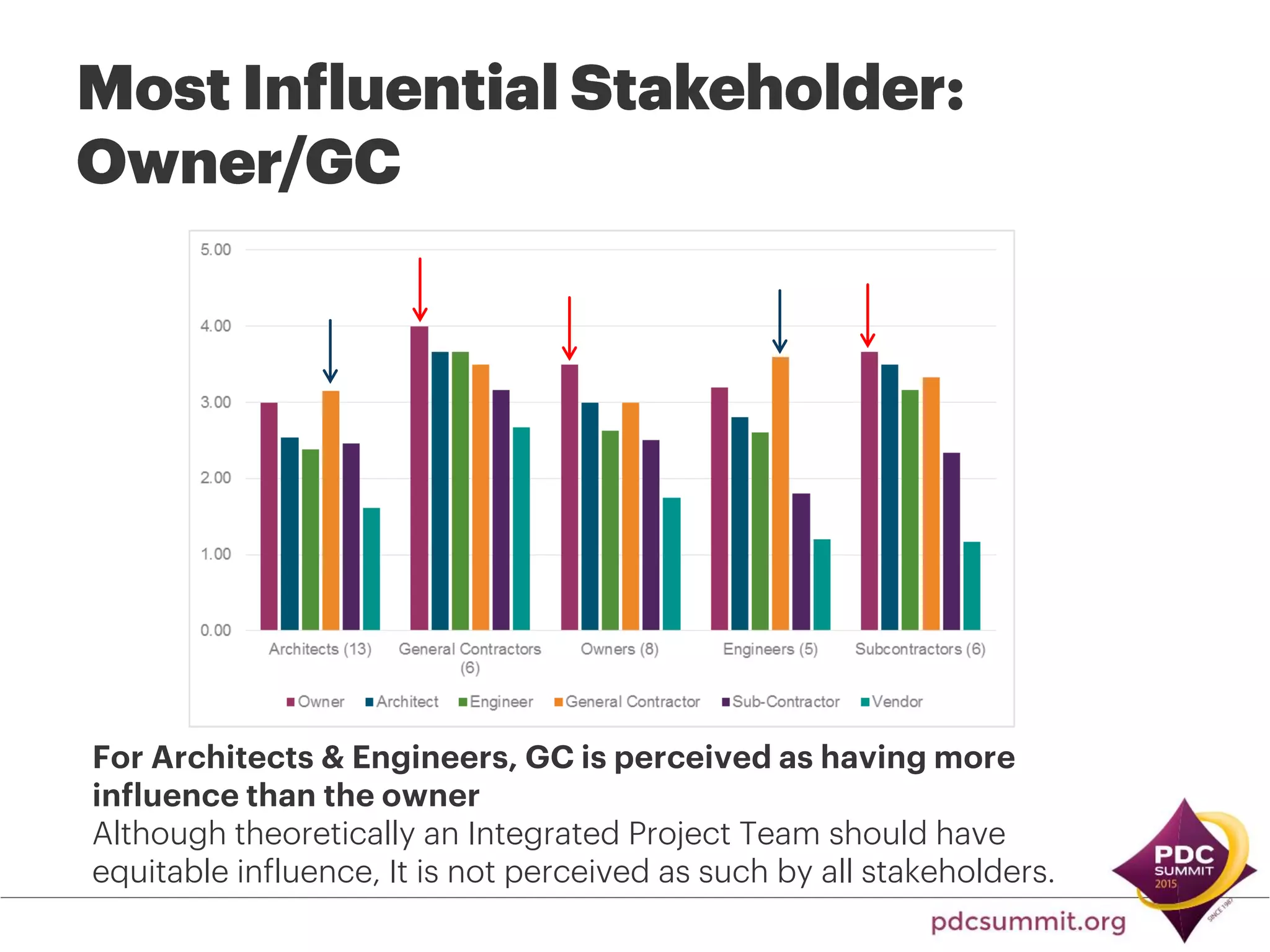
For Architects & Engineers, GC is perceived as having more
influence than the owner
Although theoretically an Integrated Project Team should have
equitable influence, It is not perceived as such by all stakeholders.
Architects perceived themselves with lower levels of
influence compared with owner and general contractors
who perceived their own influences higher than average
Self-perception
Architects perceived themselves with lower levels of
influence compared with owner and general contractors
who perceived their own influences slightly higher than
what others perceived.
2.54
3.50 3.50
2.60
2.33
3.24 3.27
3.47
2.96
2.48
0.00
0.50
1.00
1.50
2.00
2.50
3.00
3.50
4.00
Architects (13) General Contractors
(6)
Owners (8) Engineers (5) Subcontractors (6)
Self perception Others' Perception
“what the client feels will improve their ability to deliver quality
care”;
“to provide the most appropriate building to meet the user’s
need without excess”; “exceeding the conditions of satisfaction
from the owner”
“Most benefit for the least cost”; “
higher quality, lower costs, and increased efficiency
Architect
Owner
“Value is in the eyes of the customer. We were building this
building for our patients, families but also our staff to provide
the best care environment that allowed to staff to concentrate
on care and not have the facility create barriers to that care”.
“Adds quality to project and reduces cost to project”.
GC
“value for the client/ owner becomes value for the
team and the project”
“A benefit or enhancement that comes as part of
a product or service or at a low cost”
Owner User
Who is the “customer” shifts- and thus value shifts as well
arrow
Plus (What Worked) Delta (What Can Be Improved)
Enhanced collaboration
Positive professional relationships
User engagement and buy-in
Learning and education (for team,
and larger community)
Successful Strategies
Mock-ups; Pull planning;
Co-location/Team Weeks to allow
more face time; Last Planner times,
Incremental decision-making;
Transparent pricing allowing for
more participative discussion on
reducing price without compromising
value
Estimation Accuracy
Wasted Time (time wasted in co-
location without clear tasks)
Perceived imbalance of
control/influence:
Equal Voice
Optimal use of lean strategies
Cultural adaptation
More early engagement
More quality metrics
Contract complexity
Technology
Tying success metrics to post-
occupancy benefits
Cost savings opportunities are present in
three phases :
• Validation
• Innovation (design)
• Production
ROI Implication:
In order to calculate Return on Investment, incremental costs must be itemized and considered as well.
cost contributors include material (Lean facilitation in workshops and documentation, and mock-up
construction), labor (considerable additional time for all participants), equipment (mock-up support), and real
estate required for team week meetings and co-location, as well as a full scale cardboard mockup. There
are also indirect and overhead costs associated with these items.
Focus for this study
• Learning: A tremendous implicit benefit which is not tracked
– Team, User and Community
– An implicit benefit that is not currently captured
• The cardboard mock-up workshop – the most successful lean strategy
• More accuracy needed in estimation
• Owner perceived as having the largest influence in the process, followed closely by the
General Contractor.
• Quality is a key component of value but robust measures to access quality are lacking.
Greater value can be a result of greater/ same benefit with lower costs.
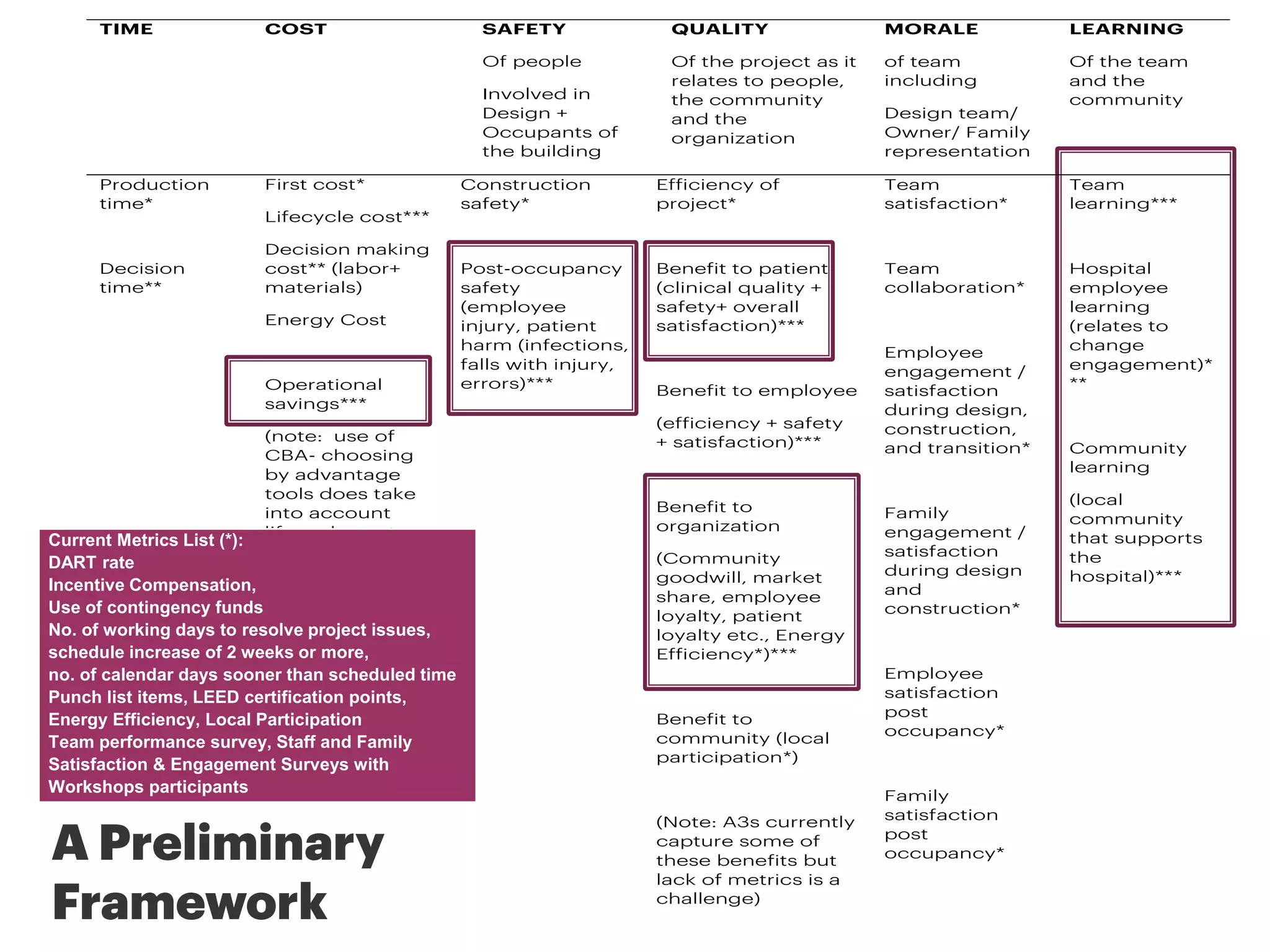
COST BENEFIT
TIME COST SAFETY
Of people
Involved in
Design +
Occupants of
the building
QUALITY
Of the project as it
relates to people,
the community
and the
organization
MORALE
of team
including
Design team/
Owner/ Family
representation
LEARNING
Of the team
and the
community
Production
time*
Decision
time**
First cost*
Lifecycle cost***
Decision making
cost** (labor+
materials)
Energy Cost
Operational
savings***
(note: use of
CBA- choosing
by advantage
tools does take
into account
lifecycle cost
and was used
for some key
design decisions
as documented
in A3s)
Construction
safety*
Post-occupancy
safety
(employee
injury, patient
harm (infections,
falls with injury,
errors)***
Efficiency of
project*
Benefit to patient
(clinical quality +
safety+ overall
satisfaction)***
Benefit to employee
(efficiency + safety
+ satisfaction)***
Benefit to
organization
(Community
goodwill, market
share, employee
loyalty, patient
loyalty etc., Energy
Efficiency*)***
Benefit to
community (local
participation*)
(Note: A3s currently
capture some of
these benefits but
lack of metrics is a
challenge)
Team
satisfaction*
Team
collaboration*
Employee
engagement /
satisfaction
during design,
construction,
and transition*
Family
engagement /
satisfaction
during design
and
construction*
Employee
satisfaction
post
occupancy*
Family
satisfaction
post
occupancy*
Team
learning***
Hospital
employee
learning
(relates to
change
engagement)*
**
Community
learning
(local
community
that supports
the
hospital)***
*Metrics Exist
Current Metrics List (*):
DART rate
Incentive Compensation,
Use of contingency funds
No. of working days to resolve project issues,
schedule increase of 2 weeks or more,
no. of calendar days sooner than scheduled time
Punch list items, LEED certification points,
Energy Efficiency, Local Participation
Team performance survey, Staff and Family
Satisfaction & Engagement Surveys with
Workshops participants
+ Benefits During Design + Post
Occupancy (over the project
lifecycle)
Defender (Traditional project delivery)
Challenger (Lean-IPD-TVD)
PERMITTING
PROJECT
DEFINITION
PRE-PROJECT
PLANNING
DESIGN
CONSTRUCTION
COMMISSIO
NING/
TURNOVER
SCHEMATIC
DESIGN
PRE-DESIGN
DESIGN
DEVELOPMENT
CONSTRUCTION
DOCUMENTS
AGENCY
PERMIT/
BUILDING
CONSTRUCTION
Time
Additional cost for meetings + full-
scale mock-up + co-location
Reduced cost of construction
due to reduced errors and
omissions, RFIs, shortened
construction period
Δ = Challenger - Defender
Time
Time
To translate these success metrics into an ROI, three
additional components are needed, namely:
• A baseline of benefits and costs in comparable traditional Design
Bid Build projects to allow a benchmark for comparison
• A more thorough documentation of incremental (additional) costs
associated with the decision- making process involved in a Lean-
IPD project
• An assessment of the long-term/ occupancy implications of design
decisions. This links to the field of Evidence-based Design and must
be investigated further.
Questions?
Contact us,
• Upali Nanda, unanda@hksinc.com
• John Bienko, jbienko@hksinc.com
• Zofia Rybkowski, zrybkowski@tamu.edu
• Di Ai, diai80520@gmail.com

PDC_2015_Lean_IPD

  • 1.
    Lessons Learned inthe Development of a Framework Funded By: AIA Academy of Architecture for Health Foundation HKS Boldt Supported by: Akron Children’s Hospital
  • 2.
    Value Analysis ofLean IPD and TVD Di Ai, MS (Estimation) John Bienko, AIA (Project Management and Design) Upali Nanda, PhD (Design Research) Zofia Rybkowski, PhD (Construction Management) Funded By: AIA Academy of Architecture for Health Foundation HKS Boldt
  • 3.
    • TVD (TargetValue Design) and Lean approaches to IPD (Integrated Project Delivery) • Advantages and challenges of using Lean thinking in the IPD process. • Definition of “value” and quality metrics. • Framework for cost/benefit assessment based on metrics currently tracked. • Exploration of implicit costs and benefits
  • 4.
    • Extensive documentation •Transparency • Input from multiple stakeholders
  • 5.
    • Advantages andthe challenges of lean thinking • Definition of “value” – explicit benefits and costs that are currently reported/ tracked? – What are the benefits and costs that are currently implicit (not measured/reported) • Framework for benefit-cost (B/C) and/or Return On Investment (ROI) calculations • Tracking the benefits/costs related to design decision making to enable an ROI for both first costs and operational costs?
  • 6.
    • Archival Datavia E-Builder • Site Visit • Interviews (7) • Focus groups (16 + 4) • Survey (49 of 79)
  • 7.
    OAEC* Current state 2P D C A Currentstate 1 Future state 2 Current state 3 P D C A Future state 3 Current state 4 P D C A Future state 4 P D C A Future state n+1 Future state n Current state n OAEC OAEC OAEC Time à C U L T U R E o f R E S P E C T waste value *OAEC: Owner Architect Engineer Constructor (collaborative) %ofCAPITAL COST Time Cost Quality Safety Morale Minimum Maximum MinimumMaximum Minimum Maximum Minimum Maximum Minimum Maximum Lean Construction reduces waste and adds value using continuous improvement in a culture of respect Adapted from Rybkowski, Z. K., Abdelhamid, T., and Forbes, L. (2013). “On the back of a cocktail napkin: An exploration of graphic definitions of lean construction," Proceedings of the 21th annual conference for the International Group for Lean Construction; July 31-August 2, 2013: Fortaleza, Brazil, 83-92.
  • 8.
    VALUE = What youget (benefit) What you give (cost) Saxon (2005) Value is greater than 1 when Benefits exceed Cost and less than 1 when Costs exceed Benefits. We need to consider time value of money.
  • 9.
    Target costing as“a system of profit planning and cost management that ensures that new products and services meet market determined price and financial return.” (Ansari, 1997) Allowable Cost Target Cost EstimatedCost Time Progressive reduction of estimated first cost during Target Value Design after Rybkowski (2009)
  • 10.
    Movement of fundsacross system boundaries during Target Value Design after Rybkowski (2009)
  • 11.
    Example of movementof funds across system boundaries during Target Value Design, Cathedral Hill Hospital, Sutter Health, after Rybkowski (2009)
  • 12.
    TVD is amanagement practice that motivates designers to deliver customer value and develops design within project constraints (Ballard, 2009) All Projects Non TVD Projects TVD Projects Profit Contingency Cost of work Uncertainity Miscommunication Missing Detail Miscoordination Change Orders Lack of Trust Litigation Uncertainity Miscommunication Miscoordination Trust Collaboration Aligned Incentives Early involvement Coordination with BIM Cross disciplinary problem solving Project Governance Steering design to target value Co-location Prior working relationships Learning as ateam Transparency Total Project Budget Cost Control Mechanism Adapted from Do, 2014 But how is “value” assessed?
  • 13.
    Predesign Schematic DesignConstruction Agency Permit/ Construction Design Development Documents Bidding Conceptualization Criteria Detailed Implementation Agency Coord/ Construction Design Design Documents Final Buyout 1 2 4 3 1 2 4 3 Ability to impact cost and function Cost of design changes Traditional Design-Bid-Build process Integrated Project Delivery Process TRADITIONAL DESIGN-BID BUILD INTEGRATED DESIGN DELIVERY
  • 14.
    P R E– C O N S T R U C T I O N S E R V I C E Scommonunderstanding SD DD CD Architect hired Engineers hired CM/GC hired time CONSTRUCTION Major trades hired Government review ≤ 100% P R E – C O N S T R U C T I O N S E R V I C E S commonunderstanding SD DD CD Architect hired time CONSTRUCTION Government review 100% Engineers hired CM/GC hired Major trades hired Reprinted with Permission: Will Lichtig
  • 15.
    • Akron, OH •4,619 employees • 780 Medical Staff • Gold Seal of Approval from the Joint Commission • Magnet Recognition Status from American Nurses Credentialing Center • 2,854 transports/509 air in 2012 • 20 Primary Care office network
  • 16.
  • 17.
  • 18.
    the old wayversus the new way DESIGN PROCESS Predesign Schematic Design Construction Agency Permit/ Construction Design Development Documents Bidding Conceptualization Criteria Detailed Implementation Agency Coord/ Construction Design Design Documents Final Buyout 1 2 4 3 1 2 4 3 Ability to impact cost and function Cost of design changes Traditional Design-Bid-Build process Integrated Project Delivery Process TRADITIONAL DESIGN-BID BUILD INTEGRATED DESIGN DELIVERY
  • 19.
    TEAM STRUCTURE Sometimes youhave to plan innovation • • • • • • •
  • 20.
    DECISION MAKING STRUCTURE Ambulatory CareCenter and Critical Care Tower BACKGROUND CURRENT STATE ANALYSIS GOAL FUTURE STATE IMPLEMENTATION PLAN UNRESOLVED ISSUES IMPACTS PL AN AC/ DECIDE Ambulatory Care Center and Critical Care Tower BACKGROUND CURRENT STATE ANALYSIS GOAL FUTURE STATE IMPLEMENTATION PLAN UNRESOLVED ISSUES IMPACTS PL AN AC/ DECIDE Ambulatory Care Center and Critical Care Tower BACKGROUND CURRENT STATE ANALYSIS GOAL FUTURE STATE IMPLEMENTATION PLAN UNRESOLVED ISSUES IMPACTS PL AN Ambulatory Care Center and Critical Care Tower BACKGROUND CURRENT STATE ANALYSIS GOAL FUTURE STATE IMPLEMENTATION PLAN UNRESOLVED ISSUES IMPACTS PL AN PLAN DO/ RESEARCH CHECK/ CBA AC/ DECIDEAC/ DECIDE ACT/ DECIDE ADVANTAGES ADVANTAGES ADVANTAGES ADVANTAGES ADVANTAGES ADVANTAGES ADVANTAGES ADVANTAGES • • • •
  • 22.
    • Original Estimateat validation 211 million • Target Cost 180 million • Revised Target Cost (after scope change) 182.5 Million • Current Target Cost 177 Million • TOTAL PROJECTED SAVINGS: 5.5 Million Allowable Cost Target Cost EstimatedCost Time
  • 24.
    SAFETY Goal: Deliver theproject safely with 0 Lost Time, 0 Days Restricted/ Transferred (Based on the DART rate from the Bureau of Labor Statistics). DART Rate 2.2 is the National Average for the working trades involved in healthcare projects. LOCAL PARTICIPATION Goal: 85% of (ICL) project team labor hours spent by people living, as defined by their W-2, in certain counties. Participation is considered for all workers, not just ICL participants. ENERGY EFFICIENCY Goal: Achieve top 10% hospital nationally. LEED® Goal: Achieve LEED Silver certification TEAM PERFORMANCE Goal: Highly Effective Team – Team Pulse Check SCHEDULE Goal: Turn-Over Building 50 Calendar Days Sooner than 24 Month Schedule to Owner for Move-In QUALITY Goal 1: Want Team Approach to Resolving Project Issues Quickly & Efficiently Through Collaboration Goal 2: Want Project Team To Take Pride In Producing Quality Work Goal 3: Want Collaborative Team Approach In Designing & Constructing the Project. STAFF AND FAMILY SATISFACTION Goal 1: Staff and Family that have been integral to the process and a driving force throughout the project and a team that listens to their input. Goal 2: Keep the Staff and family engaged and informed throughout construction. Goal 3: Post Construction Survey refer to the 9 Guiding Principles
  • 25.
    SAFETY 18 LOCAL PARTICIPATION 11 ENERGY EFFICIENCY 12 TEAM Performance9SCHEDULE 10 QUALITY 11 LEED 6 STAFF AND FAMILY SATISFACTION 15 Unavailable Points 8 $160,826,326 $159,198,883 $5,926,335 $2,500,000 $8,683,557 $8,683,557 $5,789,038 $5,789,038 $1,000,000 $1,000,000 $- $505,378 ICL Tracking (Target vs. CWE) Direct Costs Total Project Contingency Base Profit (60% of Potential Profit (PP)) ICL Profit (40% of Potential Profit (PP)) Owner Profit Payment ($1M) ICL Profit (3rd Tier - 10% of Savings) $182,225,256 Current Target $177,676,855 Current Working Estimate
  • 26.
  • 27.
    $165,000,000 $175,000,000 $185,000,000 $195,000,000 $205,000,000 $215,000,000 $225,000,000 $235,000,000 $245,000,000 $255,000,000 Estimated Projet CostInitial Project Target Cost Project Target Cost adjust A Project Target Cost adjust B Current Project Target Cost Gap to Target = apprx. - $5 million
  • 28.
  • 29.
    Team Week Meetingand Co-location Mock-up Labor X X Material X X Equipment X X Location Cost X X Cost items I Team Week Meetings and Co-location1 A. Material White board Supplies (large Post-It® notes, markers, flipcharts, push pins, masking tape) Floor plans of existing hospital Rolls of paper B. Labor Owner and owner representative Architects General contractors Structural engineer MEP engineer Sub-contractors Vendors C. Equipment Speakers Projector Conference call equipment D. Location Cost Co-location space rent or build cost II Full Scale Mock-up2 A. Material Cardboard Tape and nail to fix cardboard Furniture for mock-up scenario Food and Warehouse Amenities B. Labor Lean facilitator Architects Healthcare administrators Physicians Nurses Clinical Staff Costs Former patients and their parents C. Equipment Equipment for mock-up scenario Warehouse Rent Warehouse Construction labor D. Location Cost Utility [. Total Decision-Making Cost associated with TVD, Lean IPD that happened until Dec. 2013 was $7 Million However, this does NOT take into account the costs a typical DBB process would have which also have extensive meeting time.
  • 31.
    Survey (49) Interviews (9) Focusgroups (2) Respondent Profile (no. of respondents)
  • 32.
    Plus-Delta When asked to constructa +/ Δ chart, stakeholders listed more Δ than + for Design-Bid-Build and more + than Δ for Lean-IPD Design-Bid Build Lean-IPD
  • 33.
    Perception of LeanIPD over non-Lean IPD Perceived by Different Stakeholders LEARNING EMERGED AS THE MOST “CONSISTENT” IMPLICIT BENEFIT ACROSS STAKEHOLDERS Yet- we haven’t really invested this as a metric Significant Difference
  • 34.
    Perception of Valueof Different Lean Strategies FULL SCALE MOCK-UP RATED HIGHER THAN ALL OTHER LEAN STRATEGIES Significant Difference Compared to architects, general contractors’ belief that Target Value Design can add more value to the overall project was significantly higher.
  • 35.
    For Architects &Engineers, GC is perceived as having more influence than the owner Although theoretically an Integrated Project Team should have equitable influence, It is not perceived as such by all stakeholders.
  • 36.
    Architects perceived themselveswith lower levels of influence compared with owner and general contractors who perceived their own influences higher than average Self-perception
  • 37.
    Architects perceived themselveswith lower levels of influence compared with owner and general contractors who perceived their own influences slightly higher than what others perceived. 2.54 3.50 3.50 2.60 2.33 3.24 3.27 3.47 2.96 2.48 0.00 0.50 1.00 1.50 2.00 2.50 3.00 3.50 4.00 Architects (13) General Contractors (6) Owners (8) Engineers (5) Subcontractors (6) Self perception Others' Perception
  • 38.
    “what the clientfeels will improve their ability to deliver quality care”; “to provide the most appropriate building to meet the user’s need without excess”; “exceeding the conditions of satisfaction from the owner” “Most benefit for the least cost”; “ higher quality, lower costs, and increased efficiency Architect Owner “Value is in the eyes of the customer. We were building this building for our patients, families but also our staff to provide the best care environment that allowed to staff to concentrate on care and not have the facility create barriers to that care”. “Adds quality to project and reduces cost to project”. GC “value for the client/ owner becomes value for the team and the project” “A benefit or enhancement that comes as part of a product or service or at a low cost”
  • 39.
    Owner User Who isthe “customer” shifts- and thus value shifts as well arrow
  • 40.
    Plus (What Worked)Delta (What Can Be Improved) Enhanced collaboration Positive professional relationships User engagement and buy-in Learning and education (for team, and larger community) Successful Strategies Mock-ups; Pull planning; Co-location/Team Weeks to allow more face time; Last Planner times, Incremental decision-making; Transparent pricing allowing for more participative discussion on reducing price without compromising value Estimation Accuracy Wasted Time (time wasted in co- location without clear tasks) Perceived imbalance of control/influence: Equal Voice Optimal use of lean strategies Cultural adaptation More early engagement More quality metrics Contract complexity Technology Tying success metrics to post- occupancy benefits
  • 41.
    Cost savings opportunitiesare present in three phases : • Validation • Innovation (design) • Production ROI Implication: In order to calculate Return on Investment, incremental costs must be itemized and considered as well. cost contributors include material (Lean facilitation in workshops and documentation, and mock-up construction), labor (considerable additional time for all participants), equipment (mock-up support), and real estate required for team week meetings and co-location, as well as a full scale cardboard mockup. There are also indirect and overhead costs associated with these items. Focus for this study
  • 42.
    • Learning: Atremendous implicit benefit which is not tracked – Team, User and Community – An implicit benefit that is not currently captured • The cardboard mock-up workshop – the most successful lean strategy • More accuracy needed in estimation • Owner perceived as having the largest influence in the process, followed closely by the General Contractor. • Quality is a key component of value but robust measures to access quality are lacking. Greater value can be a result of greater/ same benefit with lower costs.
  • 43.
    COST BENEFIT TIME COSTSAFETY Of people Involved in Design + Occupants of the building QUALITY Of the project as it relates to people, the community and the organization MORALE of team including Design team/ Owner/ Family representation LEARNING Of the team and the community Production time* Decision time** First cost* Lifecycle cost*** Decision making cost** (labor+ materials) Energy Cost Operational savings*** (note: use of CBA- choosing by advantage tools does take into account lifecycle cost and was used for some key design decisions as documented in A3s) Construction safety* Post-occupancy safety (employee injury, patient harm (infections, falls with injury, errors)*** Efficiency of project* Benefit to patient (clinical quality + safety+ overall satisfaction)*** Benefit to employee (efficiency + safety + satisfaction)*** Benefit to organization (Community goodwill, market share, employee loyalty, patient loyalty etc., Energy Efficiency*)*** Benefit to community (local participation*) (Note: A3s currently capture some of these benefits but lack of metrics is a challenge) Team satisfaction* Team collaboration* Employee engagement / satisfaction during design, construction, and transition* Family engagement / satisfaction during design and construction* Employee satisfaction post occupancy* Family satisfaction post occupancy* Team learning*** Hospital employee learning (relates to change engagement)* ** Community learning (local community that supports the hospital)*** *Metrics Exist Current Metrics List (*): DART rate Incentive Compensation, Use of contingency funds No. of working days to resolve project issues, schedule increase of 2 weeks or more, no. of calendar days sooner than scheduled time Punch list items, LEED certification points, Energy Efficiency, Local Participation Team performance survey, Staff and Family Satisfaction & Engagement Surveys with Workshops participants
  • 44.
    + Benefits DuringDesign + Post Occupancy (over the project lifecycle) Defender (Traditional project delivery) Challenger (Lean-IPD-TVD) PERMITTING PROJECT DEFINITION PRE-PROJECT PLANNING DESIGN CONSTRUCTION COMMISSIO NING/ TURNOVER SCHEMATIC DESIGN PRE-DESIGN DESIGN DEVELOPMENT CONSTRUCTION DOCUMENTS AGENCY PERMIT/ BUILDING CONSTRUCTION Time Additional cost for meetings + full- scale mock-up + co-location Reduced cost of construction due to reduced errors and omissions, RFIs, shortened construction period Δ = Challenger - Defender Time Time
  • 45.
    To translate thesesuccess metrics into an ROI, three additional components are needed, namely: • A baseline of benefits and costs in comparable traditional Design Bid Build projects to allow a benchmark for comparison • A more thorough documentation of incremental (additional) costs associated with the decision- making process involved in a Lean- IPD project • An assessment of the long-term/ occupancy implications of design decisions. This links to the field of Evidence-based Design and must be investigated further.
  • 46.
    Questions? Contact us, • UpaliNanda, unanda@hksinc.com • John Bienko, jbienko@hksinc.com • Zofia Rybkowski, zrybkowski@tamu.edu • Di Ai, diai80520@gmail.com